
Life, 1903-06-18 · page 14 of 24
Life — June 18, 1903 — page 14: what you’re looking at
What you’re looking at
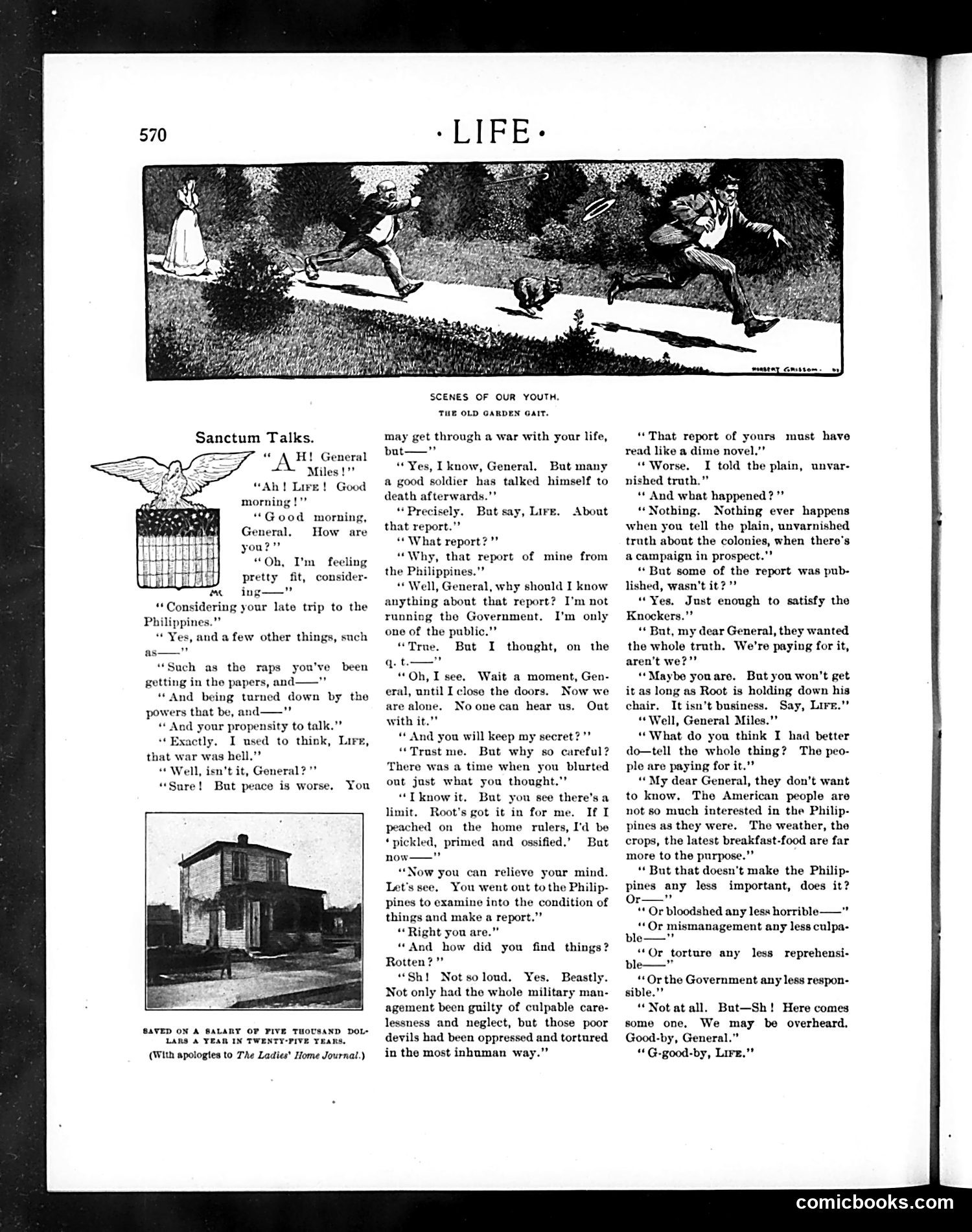
This satirical dialogue between General Nelson Miles (a prominent U.S. military figure) and "Life" (personified as a journalist) critiques American suppression of information about the Philippines during the early 1900s colonial conflict. **The Setup:** Miles returned from investigating conditions in the Philippines and filed a damning report documenting military mismanagement and torture of Filipino civilians. **The Satire's Point:** The conversation reveals how: - Secretary of War Elihu Root ("Root's got it in for me") suppressed the report's full publication - The American public lacks interest in colonial atrocities - Censorship occurs not through prohibition but through selective, limited release ("just enough to satisfy the Knockers") - Editors and officials prioritize trivial news (weather, food) over accountability The final nervous "Sh! Here comes someone" emphasizes that discussing imperial wrongdoing requires secrecy—suggesting Life magazine itself practices self-censorship. **Historical Context:** This critiques real suppression of Philippine War reports documenting American abuses, a major controversy of the McKinley administration (1898-1901).
📄 Transcribed text from this page (OCR, searchable)
Machine-transcribed from the original scan — historical spelling and the odd misread are preserved.
ts H! General 4 Miles!" “Ah! Lire! Good morning !"” “Good morning, General. How are you?” “Oh, I'm feeling pretty fit, consider- ing—" “Considering your late trip to the Philippines.” “ Yes, and a few other things, such as “Such as the raps you've getting in the papers, and——" ‘“*And being turned down by the powers that be, and—" “ And your propensity to talk.” “Exactly, I used to think, Lire, that war was hell,” “Well, isn't it, General?” “Sure! But peace is worse. been You SAVED ON A SALARY OP FIVE THOUSAND DOL+ LARS 4 YEAR IN TWENTY-PIVE YEARS, (With apologies to The Ladies’ Home Journal.) SCENES OF OUR YOUTH. THE OLD GARDEN Gait. may get through a war with your life, but id “Yes, I know, General, But many a good soldier has talked himself to death afterwards.’’ But say, Lire. * Precisely. About that report.” “What report?” “Why, that report of mine from the Philippines.’” “Well, General, why should I know anything about that report? I’m not running the Gor ment. I’m only one of the public. “True. But I thought, on the q. t.——"" “Oh, I see. Wait a moment, Gen- eral, until I close the doors. Now we are alone. Noonecan hear us, Out with it.” “And you will keep my secret? ’’ “Trust me. But why so careful? There was a time when you blurted out just what you thought.” “*T know it. But you see there’sa limit. Root's got it in for me. If I peached on the home rulers, I'd be ‘pickled, primed and ossified.’ But now——" ow you can relieve your mind. Let's see. You went out tothe Philip- pines to examine into the condition of things and make a report.” “Right you are.” “And how did you find things? Rotten?” “Sh! Notsoloud. Yes. Beastly. Not only had the whole military man- agement been guilty of culpable care- lessness and neglect, but those poor devils had been oppressed and tortured in the most inhuman way.” “That report of yours must have read like a dime novel.”’ “Worse. I told the plain, unvar- nished trath.”” “And what happened?” “Nothing. Nothing ever happens when you tell the plain, unvarnished truth about the colonies, when there's a campaign in prospect."* “But some of the report was pub- lished, wasn't it? ’” “Yes. Just enough to satisfy the Knockers.”” “ But, my dear General, they wanted the whole trath. We're paying for it, aren't we?”’ “Maybe yonare. But you won't get it as long as Root is holding down his chair. Itisn’t business, Say, Lire.’’ “Well, General Miles.” “What do you think I had better do—tell the whole thing? The peo- ple are paying for it.”” “My dear General, they don’t want to know. The American people are not so much interested in the Philip- pines as they were. The weather, the crops, the latest breakfast-food are far more to the purpose.’” ‘ But that doesn't make the Philip- pines any less important, does it? Or—” ‘* Or bloodshed any less horrible—" a Or mismanagement any less culpa- ble—”" “Or torture any ble—” ‘Or the Government any less respon- sible.” “Notatall. But—Sh! Here comes some one, We may be overheard, Good-by, General.” “G-good-by, Lire.” less reprehensi- comicbooks.com