
A complete issue · 36 pages · 1903
Life — April 2, 1903
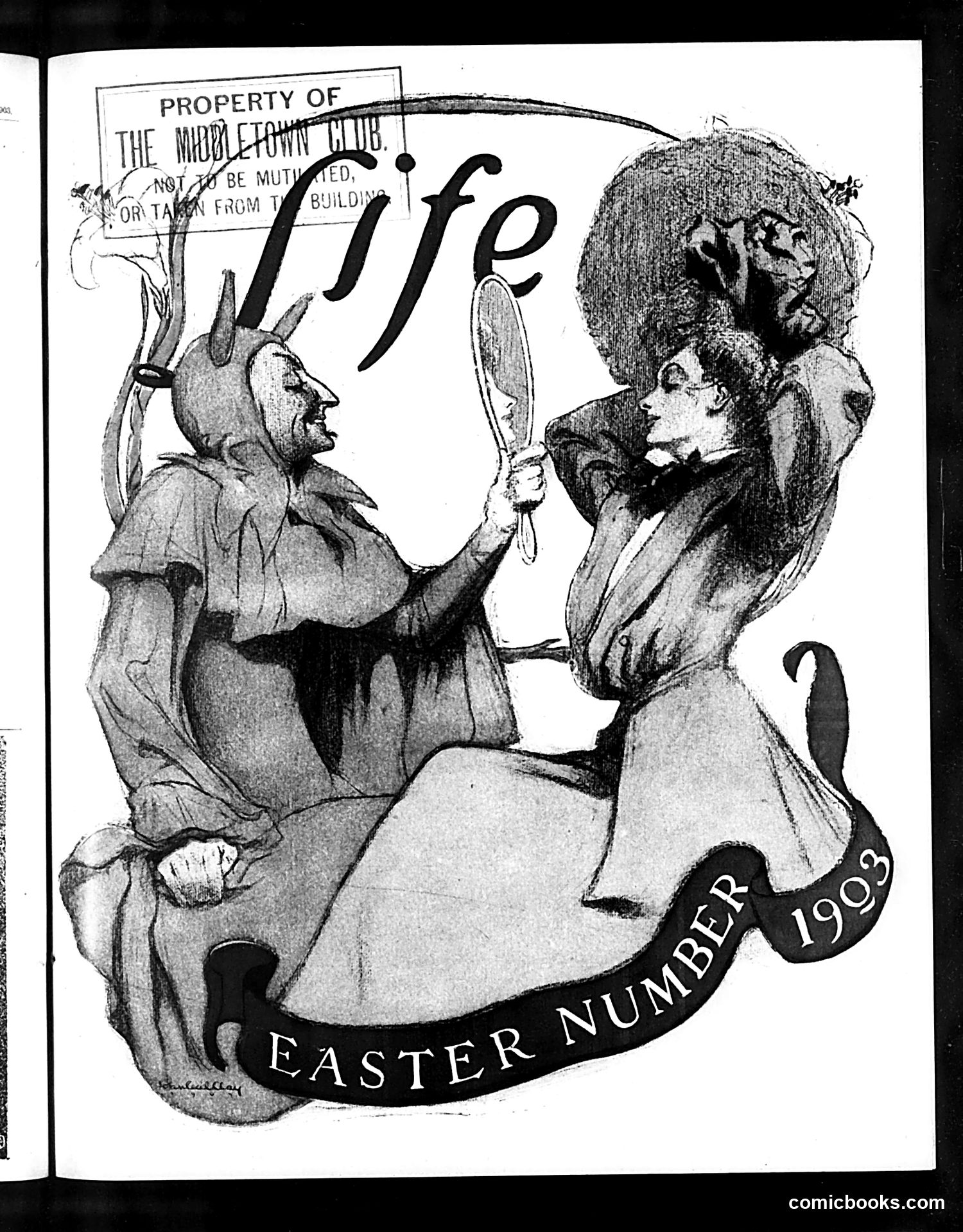
This is the cover for Life magazine's Easter issue from 1903. The cartoon depicts two figures: on the left, a devil or demon figure holding a mirror, and on the right, a woman examining her reflection. The title "Life" appears prominently above them. The satire appears to be commenting on vanity and self-regard, particularly among women—a common theme in early 1900s satirical magazines. The devil-figure presenting the mirror suggests temptation toward narcissism or superficiality. The Easter timing adds ironic contrast, as Easter traditionally emphasizes spiritual renewal rather than worldly vanity. The "Property of The Middletown Club" stamp indicates this copy belonged to a specific institution, suggesting the magazine circulated among educated, affluent audiences who would appreciate the satirical commentary.
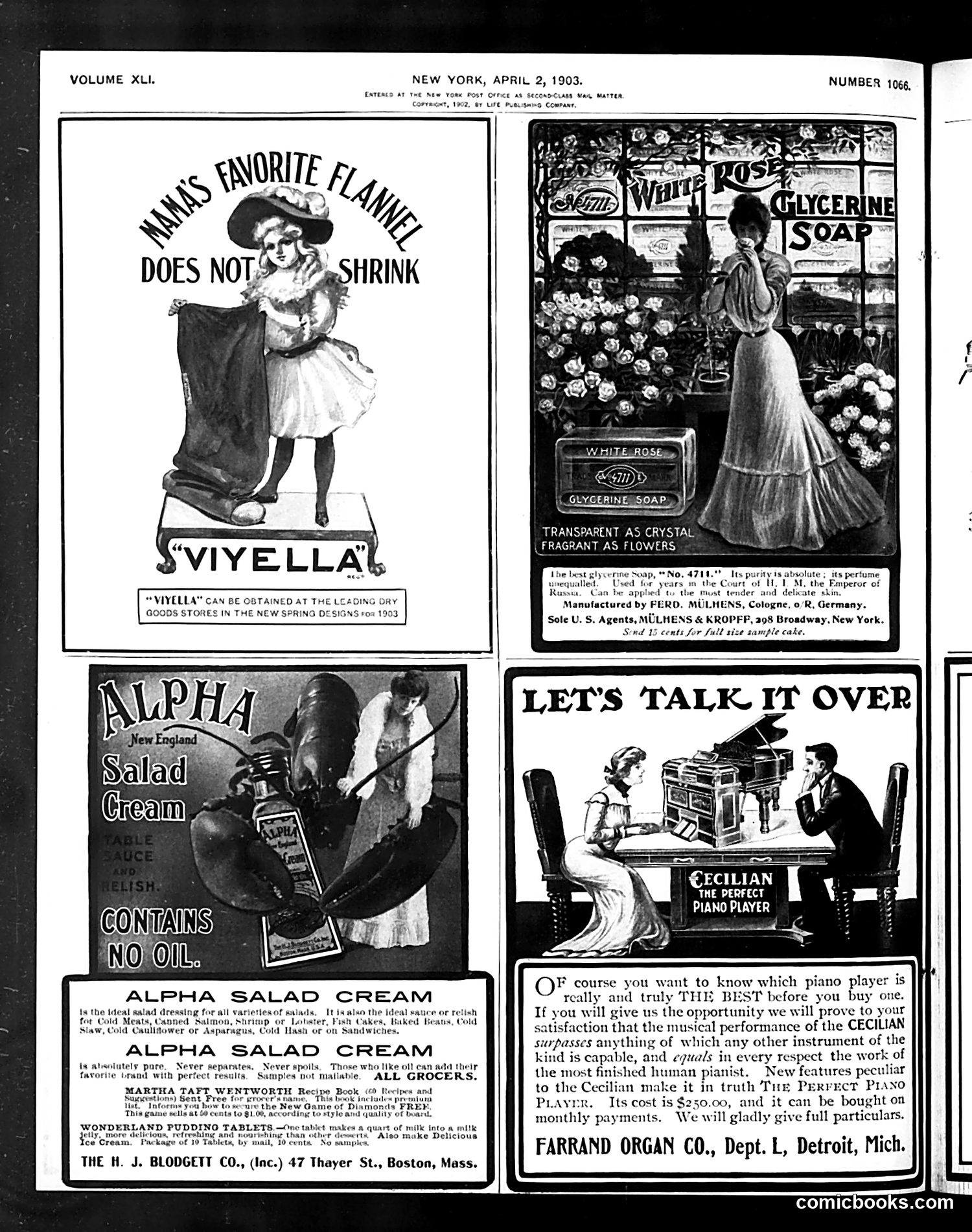
This page consists entirely of **product advertisements** from the early 1900s, not political cartoons or satire. The ads feature: 1. **Viyella flannel** - showing a woman displaying fabric that "does not shrink" 2. **White Rose Glycerine Soap** - advertising "transparent as crystal, fragrant as flowers" 3. **Alpha Salad Cream** - emphasizing it "contains no oil" 4. **Cecilian Player Piano** - promoting an automated piano that plays itself, positioned as superior to live pianists These represent typical period advertising appeals: product durability, luxury goods, and emerging technology. The Cecilian Piano ad is noteworthy as early mechanical entertainment technology marketing. The ads reflect early 20th-century consumer culture and product claims common to the era, with no satirical content evident.
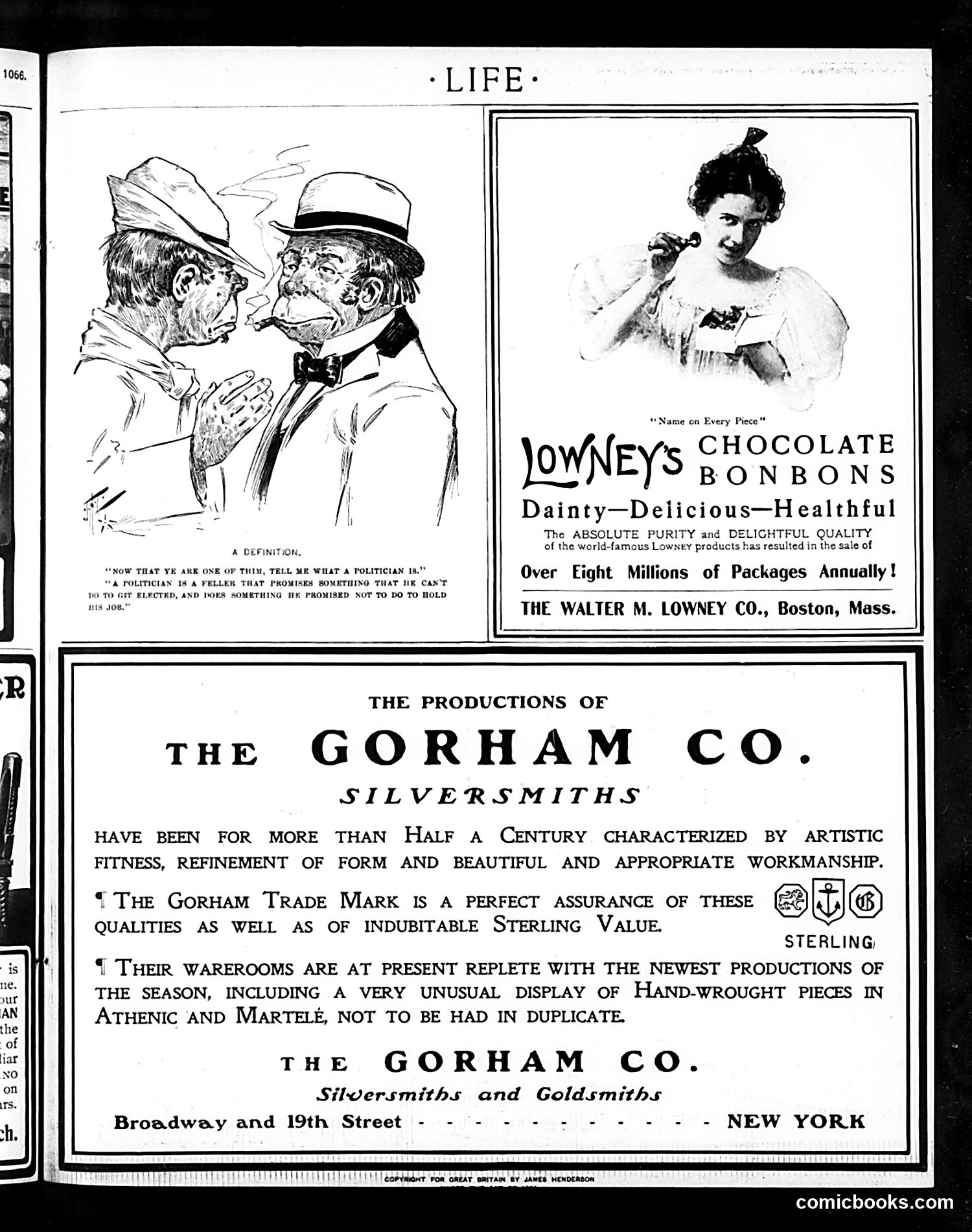
The left cartoon titled "A Definition" depicts two men in conversation. The text below reads: "Now that we are one of them, tell me what a politician is." The second figure responds: "A politician is a fellow that promises something he can't do to get elected, and does something he promised not to do to hold his job." This is a cynical joke about political hypocrisy—a common satirical theme. The cartoon suggests that politicians routinely break campaign promises once elected. The specific figures are not identified, but they represent generic politicians rather than particular individuals. The page also contains period advertisements for Lowney's Chocolate Bonbons and The Gorham Company silversmiths, which are unrelated to the satire.
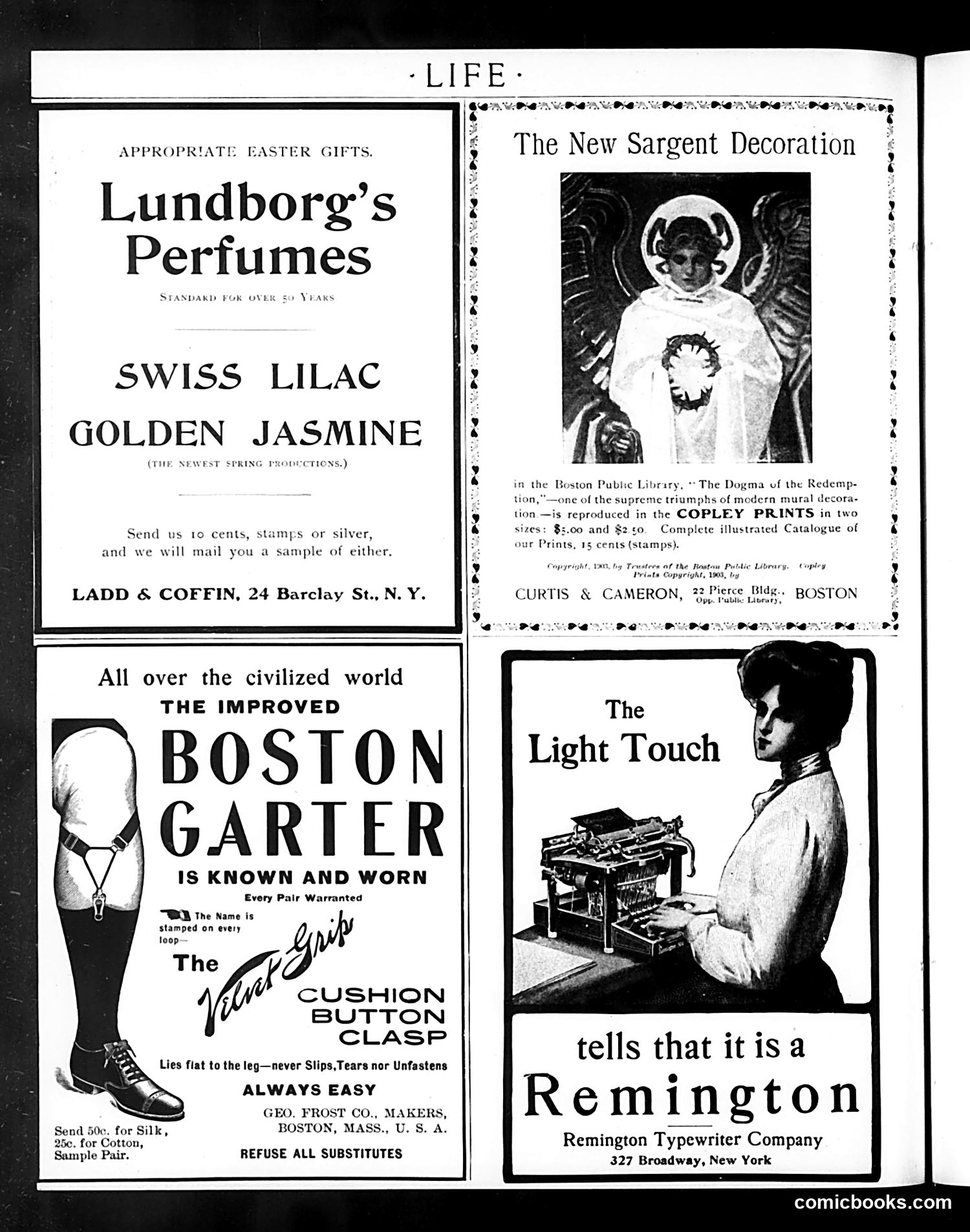
This page is **primarily advertising**, not satirical content. It contains four commercial advertisements from the early 20th century: 1. **Lundborg's Perfumes** — Easter gift promotion for Swiss Lilac and Golden Jasmine fragrances 2. **Boston Garter** — Men's hosiery with "Velvet Grip" cushion button clasp, emphasizing durability 3. **Sargent Decoration** — Art reproduction (Copley Prints) of "The Dogma of the Redemption," a religious mural 4. **Remington Typewriter** — Marketed with imagery of a woman using the machine, emphasizing ease of operation ("Light Touch") The only potentially satirical element is the typewriter ad's gendered marketing, presenting typing as effortless "women's work." Otherwise, this is a standard Life magazine advertising page with no political cartoons or social satire present.
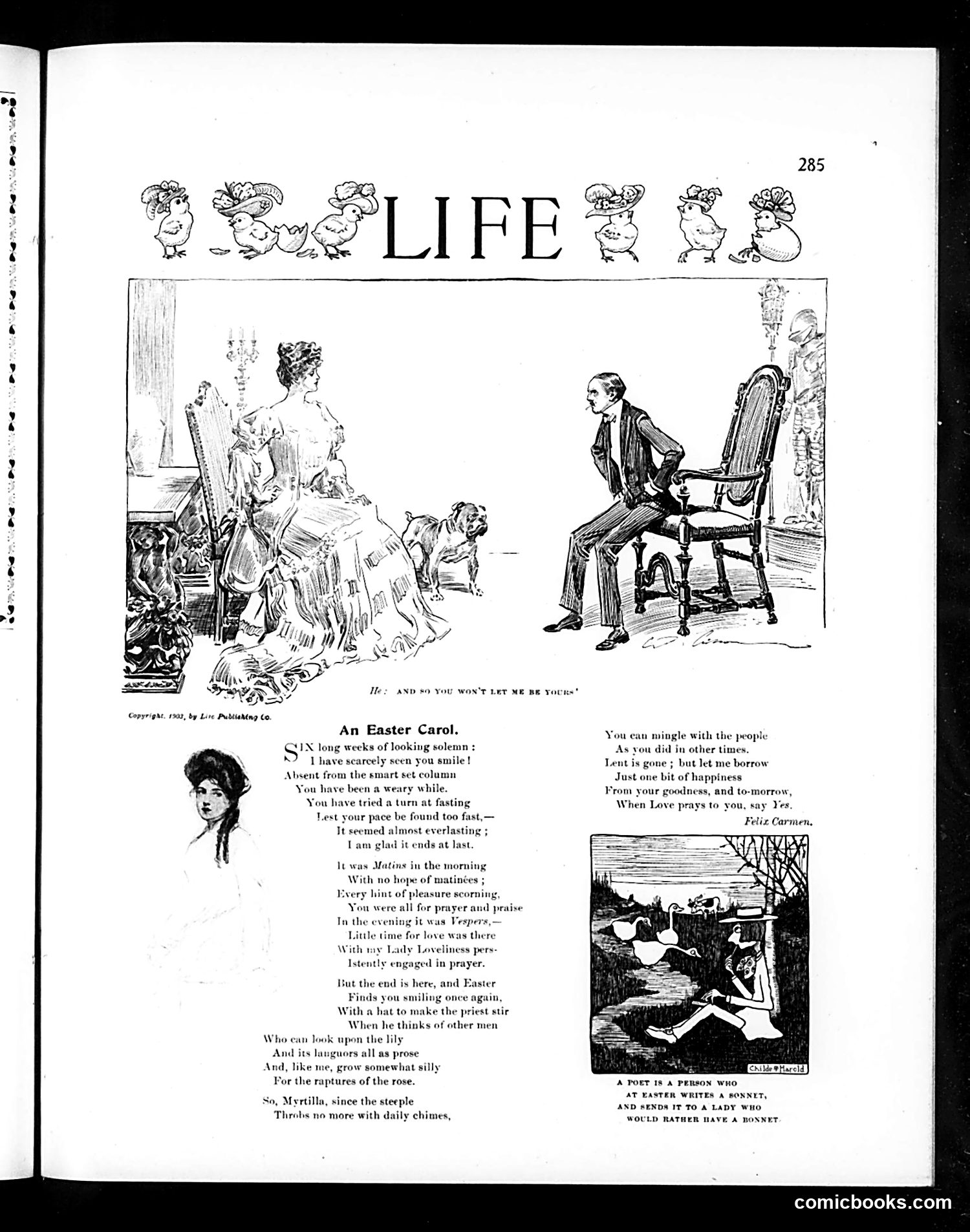
This page features "An Easter Carol," a poem by Fräz Carmen about Lenten fasting and Easter renewal. The top cartoon shows a domestic scene where a man sits across from a woman, with his caption: "And so you won't let me be yours?" This appears to be a romantic or marriage proposal scenario, likely satirizing courtship conventions of the era. The accompanying illustrations include a portrait sketch of a woman and a pastoral Easter scene showing figures in a landscape. The decorative header features small illustrated chicks and Easter imagery. The page is primarily **literary content rather than political satire**—it celebrates Easter's spiritual and social themes rather than commenting on contemporary politics or events. The humor is genteel and domestic, typical of Life's early 20th-century satirical style.
This page discusses the Waterbury, Connecticut labor strike, where union workers demanded better conditions from the Connecticut Railway and Lighting Company. The left cartoon depicts a ragged, distressed figure—likely representing the striking workers or the town itself—trapped in a noose labeled "Waterbury," suggesting the strike has become economically catastrophic. The text criticizes both sides: the unions for using "blacklist and boycott" tactics and violence against non-union workers, and the company for refusing reasonable demands. The commentary suggests the strike has spiraled into terrorism, harming innocent citizens and property while failing to achieve union goals. The page represents Life magazine's skeptical, centrist position on labor disputes—criticizing union militancy while acknowledging legitimate worker grievances.
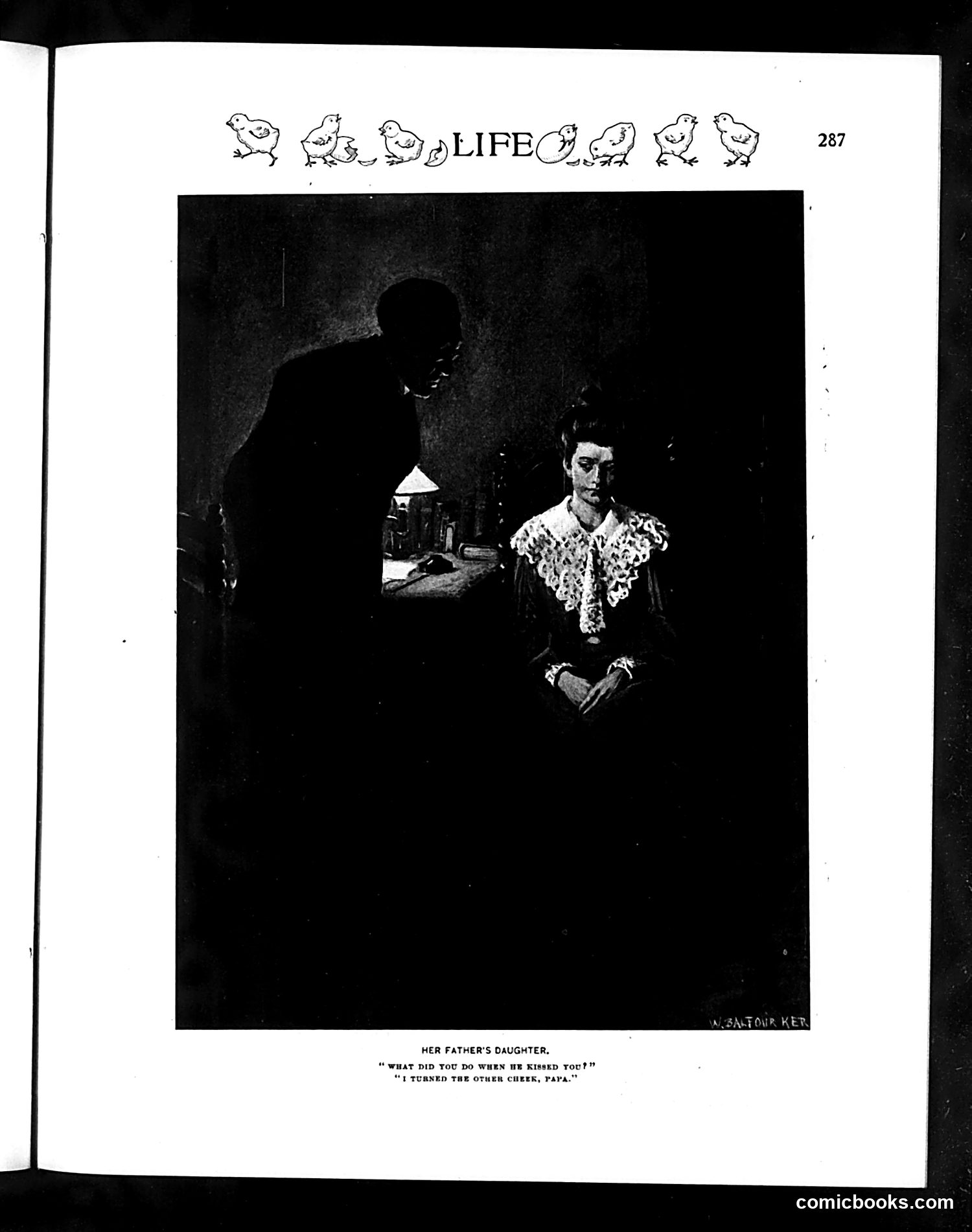
This is a dramatic illustration titled "Her Father's Daughter" from *Life* magazine (page 287). The caption presents dialogue: "What did you do when he kissed you?" / "I turned the other cheek, Papa." The image shows a woman in an ornate lace collar seated while a man leans toward her from behind. The satire appears to comment on the clash between traditional paternal authority and modern female independence. The woman's response—literally turning her cheek rather than reciprocating—suggests she's defying her father's expectations about romantic behavior or moral conduct through literal obedience to a Biblical principle ("turn the other cheek"). The joke likely satirizes generational conflict about courtship propriety during the early 20th century, mocking both the father's old-fashioned concern and the daughter's cleverly evasive compliance.
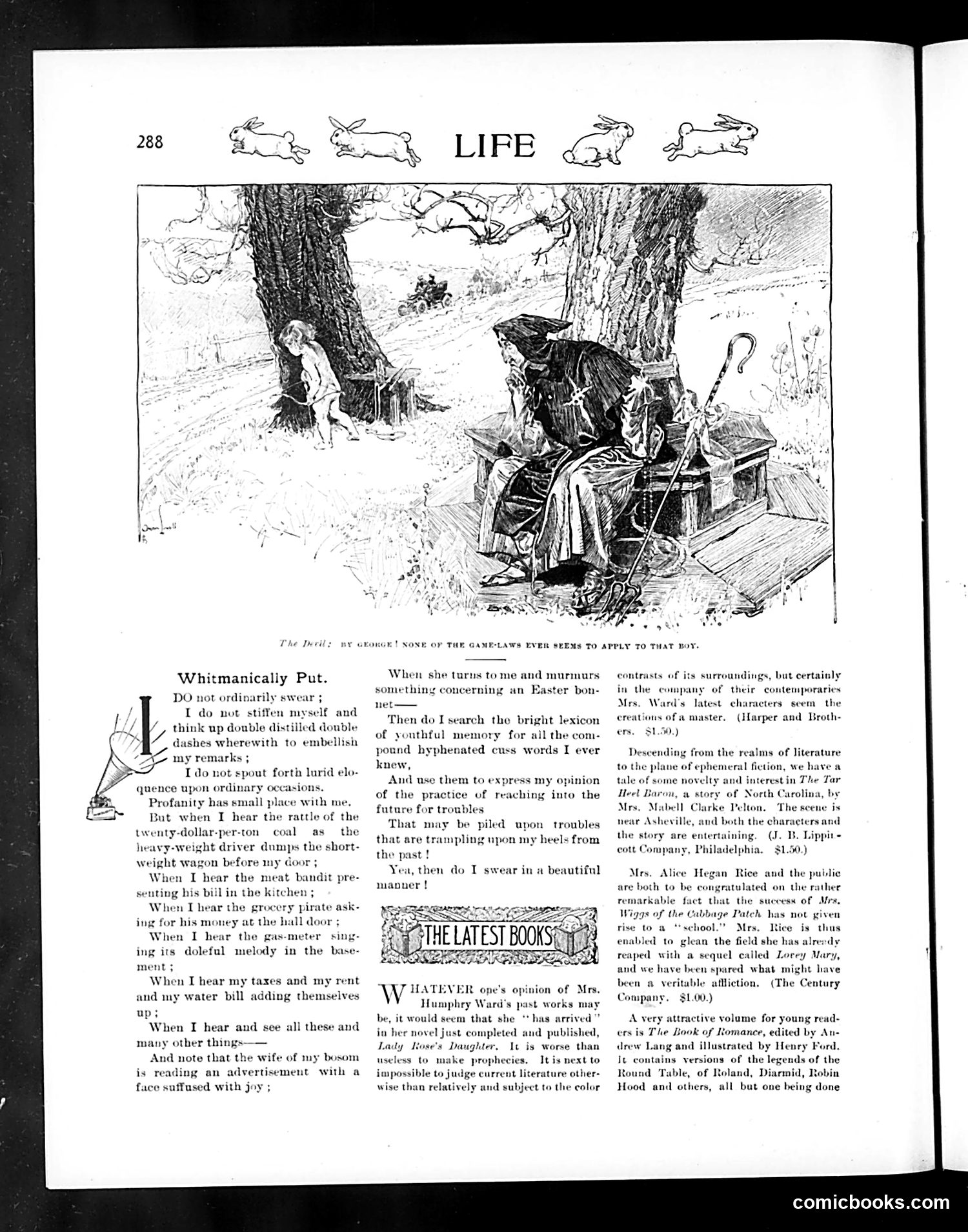
This page contains a humorous essay titled "Whimanically Put" alongside a sketch showing two figures seated outdoors beneath large trees. The essay discusses when the author chooses to use profanity—specifically, swearing "in a beautiful manner" rather than ordinarily. The humor stems from the contrast between polite Victorian society (which discouraged swearing) and the author's admission of using creative curse words in frustrating situations: dealing with lazy workers, demanding creditors, grocery pirates, tax collectors, and water bills going unpaid. The accompanying illustration depicts what appears to be idle country folk, potentially illustrating the "troubles" mentioned in the text. The overall satire targets the hypocrisy of genteel society regarding language and everyday frustrations among the middle class.
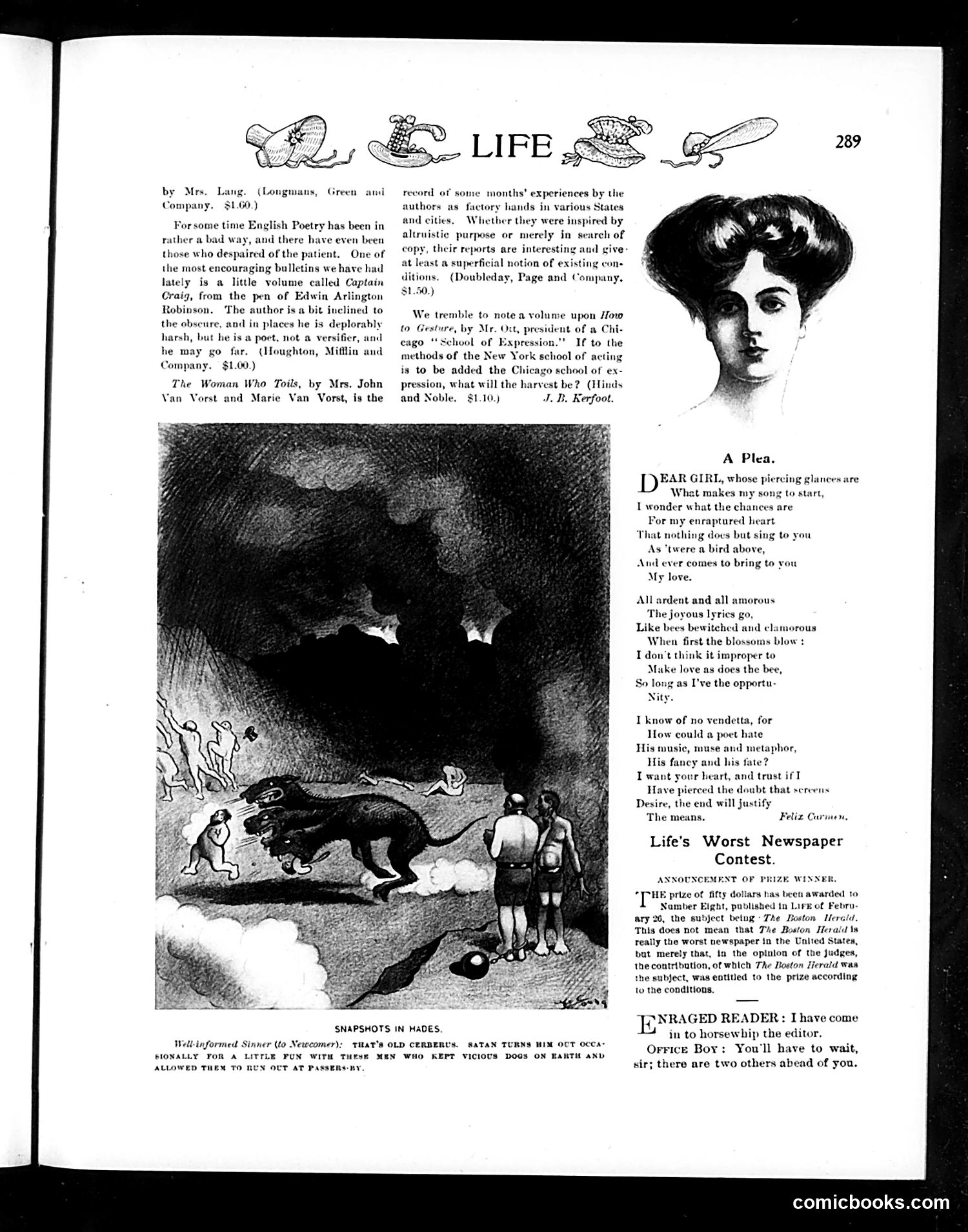
The main illustration, titled "Snapshots in Hades," depicts a satirical underworld scene. It shows what appears to be the devil or a demonic figure entertaining damned souls with dogs, while small human figures observe. The caption suggests this is a joke about Cerberus (the mythological three-headed dog guarding the underworld) being used for amusement rather than its traditional purpose of guarding Hell's gates. The page also contains book reviews, poetry ("A Plea" by Feliz Guzman), and an announcement about Life's "Worst Newspaper Contest" featuring The Boston Herald as winner. The cartoon's humor relies on classical mythology, presenting Hell as a place of recreational vice rather than pure torment—a commentary on human moral failings or frivolity.
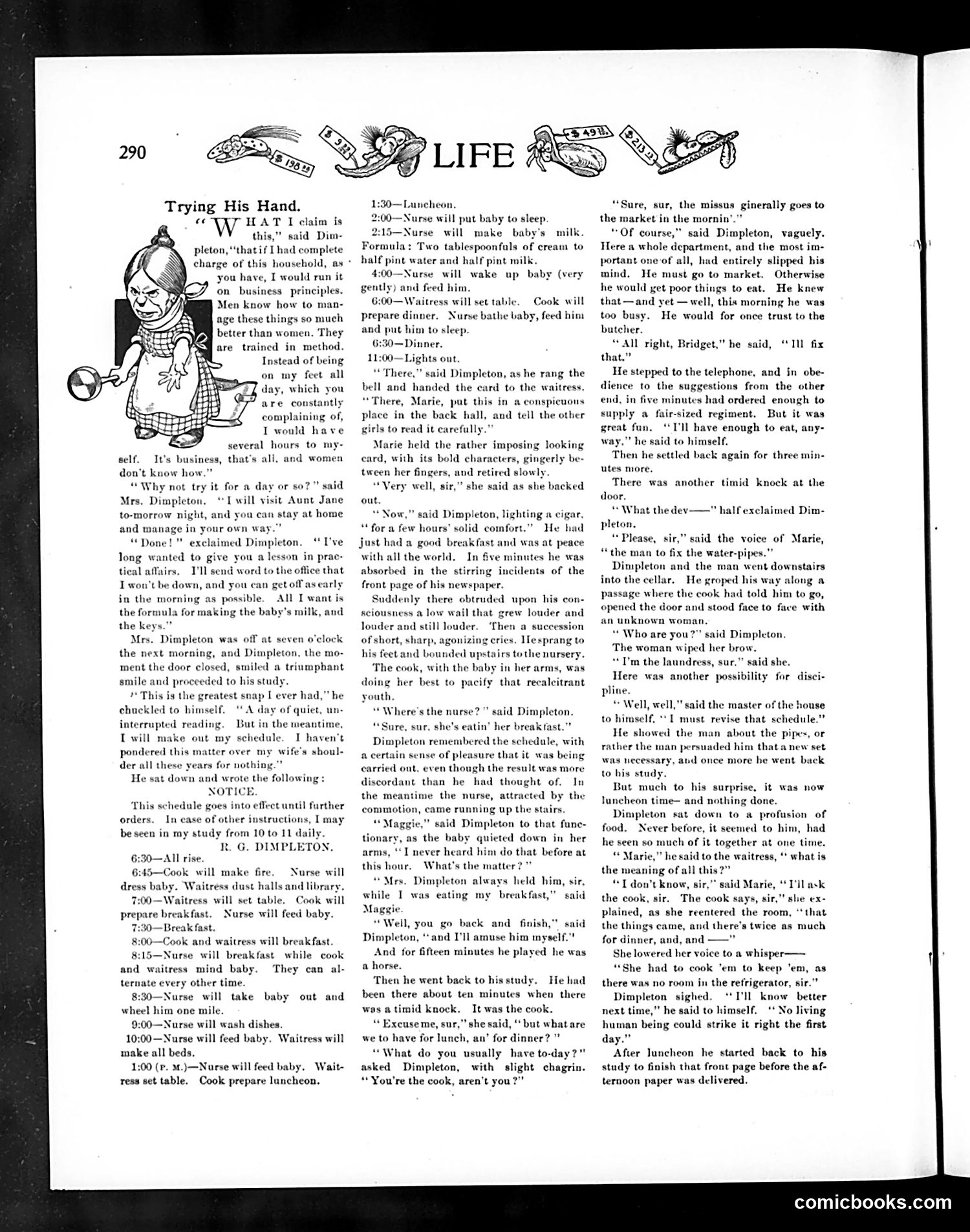
This page contains a satirical short story illustrated with a caricature of a man named Dimpleton attempting to manage a household. The narrative follows Dimpleton as he tries to oversee domestic operations—managing a nurse, cook, and waitress while caring for a baby—after apparently dismissing his wife or housekeeper. The satire targets incompetent household management by a man unaccustomed to domestic affairs. Dimpleton constantly meddles in servants' work, second-guesses decisions, and creates chaos through his interference. The story mocks the notion that a businessman accustomed to commercial affairs can easily manage a home, suggesting that domestic work requires specialized knowledge and that men are ill-equipped for such tasks—a common early-20th-century satirical theme about gender roles.
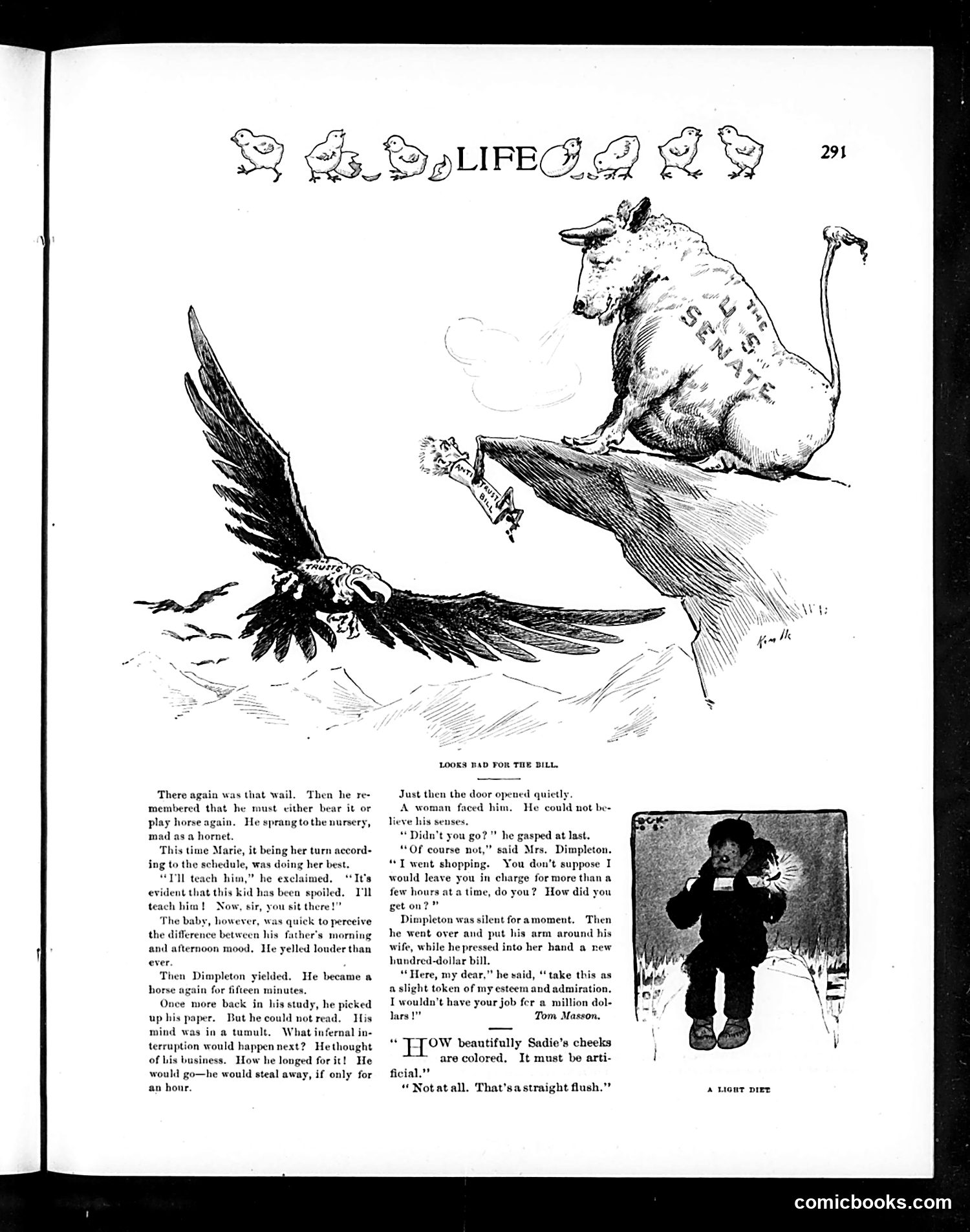
This page contains a satirical cartoon titled "LOOKS BAD FOR THE BILL." The main illustration depicts an eagle (representing America or American interests) being attacked or restrained by a large bull labeled "SENATE," while a smaller figure appears to struggle beneath them. The accompanying story text concerns a character named Dimpleton and his horse, dealing with themes of debt ("hundred-dollar bill") and domestic tensions with his wife Marie. The cartoon appears to satirize Senate obstruction of legislation—the "bill" referenced in the title. The eagle-versus-bull imagery suggests conflict between executive/national interests and Senate resistance or power. Without knowing the specific historical moment, the exact legislative battle remains unclear, but the satire targets Senate obstruction as harmful to national progress.
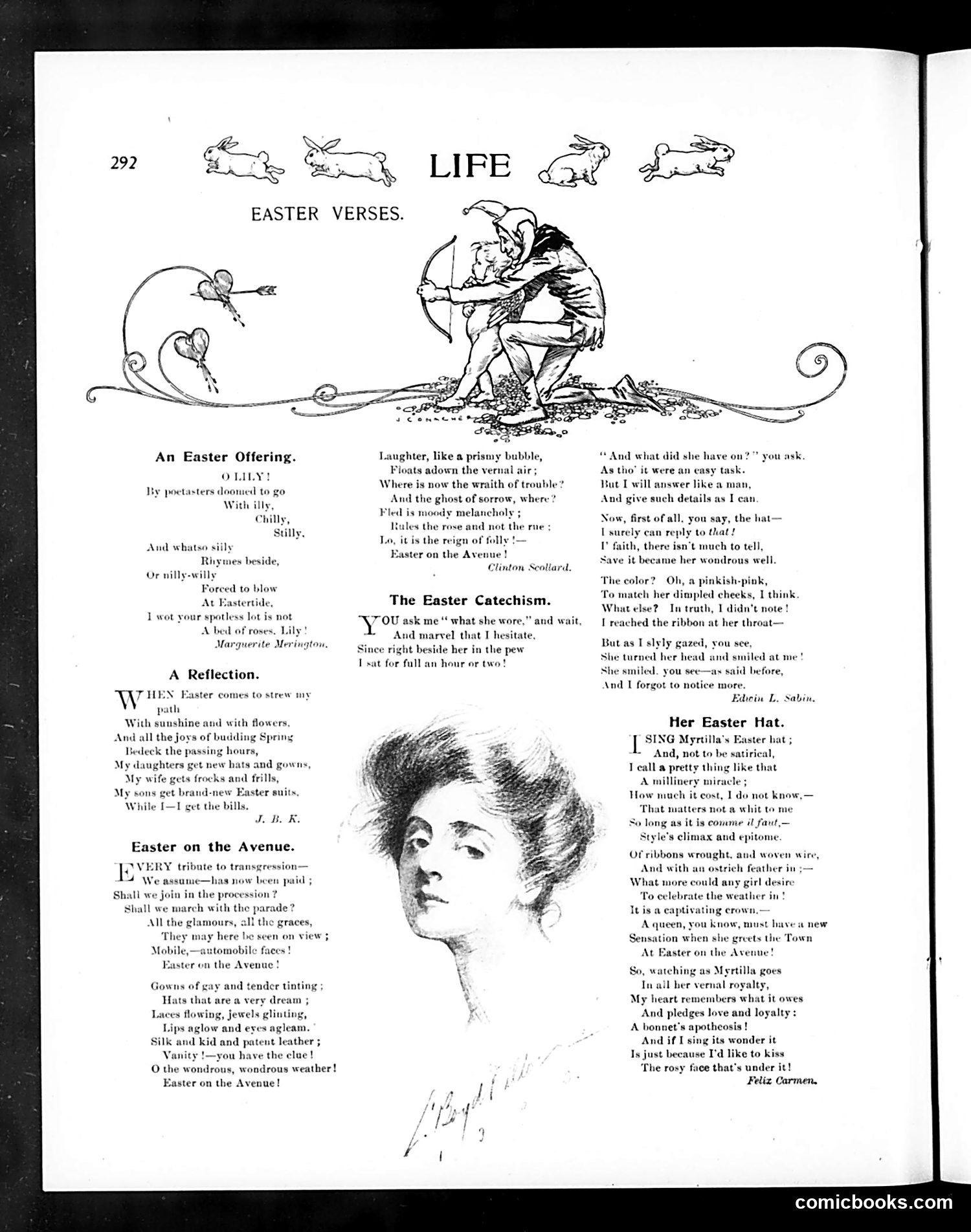
This is a **poetry and illustration page** from Life magazine's Easter issue, not a political cartoon. The content consists of several light, seasonal verses about Easter celebrations, typical of the magazine's satirical-humorous approach to holiday traditions. The central illustration shows a **Cupid-like figure** with a bow, surrounded by decorative scrollwork—a whimsical Easter motif rather than political commentary. The poems address Easter fashion ("Easter on the Avenue"), Easter hats ("Her Easter Hat"), and romantic Easter encounters ("The Easter Catechism"). A portrait sketch of a young woman's face accompanies the fashion-focused verses. The overall tone is **genteel Victorian satire** mocking upper-class Easter parade fashions and courtship rituals—not addressing political issues. This represents Life's lighter editorial content aimed at entertaining affluent readers about seasonal social customs.
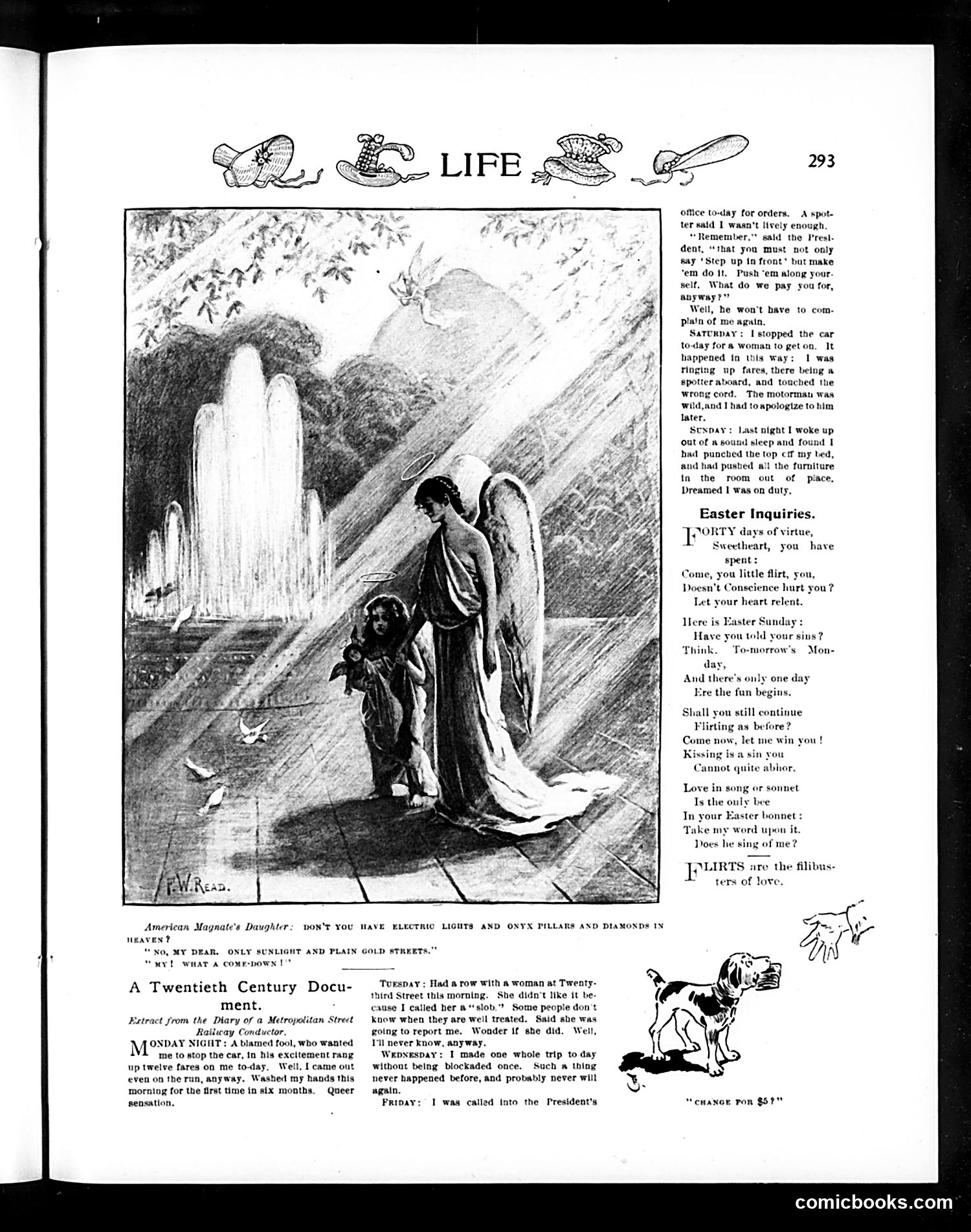
## Main Cartoon: "American Magnate's Daughter" This satirizes extreme wealth inequality. A wealthy businessman's daughter boasts that their mansion lacks electric lights and conventional luxuries—instead featuring only "sunlight and plain gold streets." The joke mocks the absurd conspicuous consumption of the ultra-rich: they're so wealthy they can afford to reject modern conveniences in favor of literal gold, presenting deprivation as ultimate luxury. The woman's response ("What a come-down!") sarcastically highlights the perversity. ## "A Twentieth Century Document" This is a diary parody mocking streetcar conductors' brutal working conditions and low moral standards. Entries reveal: employees stealing fares, verbal abuse of passengers, management pressure to be aggressive, and such exhaustion that the conductor dreams of work during sleep. The satire critiques both exploitative labor practices and worker misconduct—depicting a degraded profession where abuse flows both directions. ## "Easter Inquiries" A poem playfully chiding a flirtatious woman for "virtue" during Lent, encouraging her to resume flirtation and kissing post-Easter. It's lighthearted social satire on courtship and religious observance.
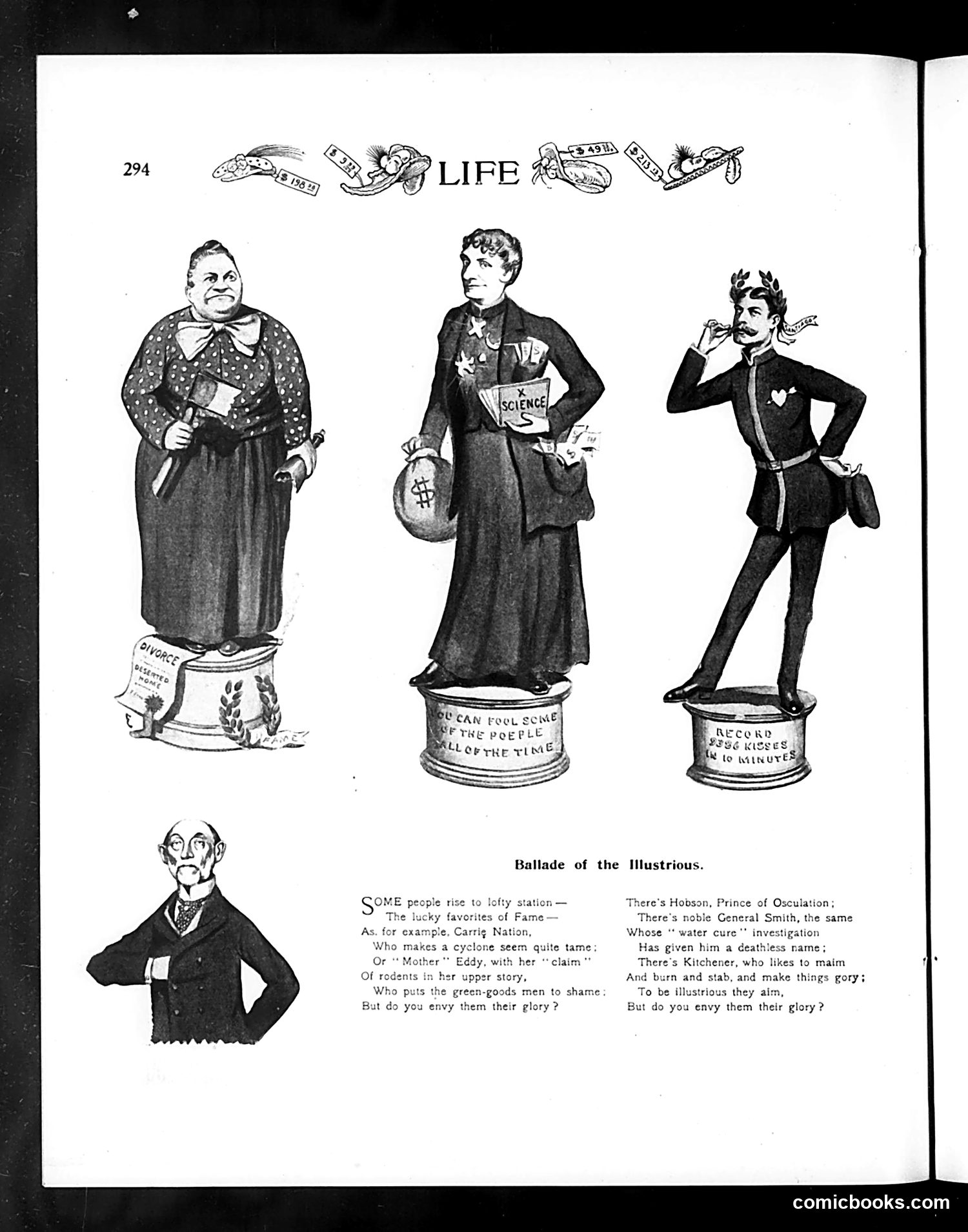
This page mocks famous figures of the early 1900s who gained notoriety through sensational or questionable acts. The three caricatured figures standing on pedestals represent: 1. **Carrie Nation** (left) — the temperance activist known for violent saloon-smashing campaigns 2. **"Mother" Eddy** (center, holding "Science" book) — likely Mary Baker Eddy, founder of Christian Science, mocked for her claims 3. An unidentified figure (right, labeled "Record Egg Rides") The accompanying poem sarcastically lists "illustrious" people: Hobson (known for public kissing), General Smith (associated with the "water cure" torture in the Philippines), and Kitchener (the brutal military commander). The satire's point: these figures became famous through sensationalism, violence, or dubious claims rather than genuine achievement. The repeated refrain "But do you envy them their glory?" suggests their fame is hollow and undesirable—a critique of celebrity built on notoriety rather than merit.
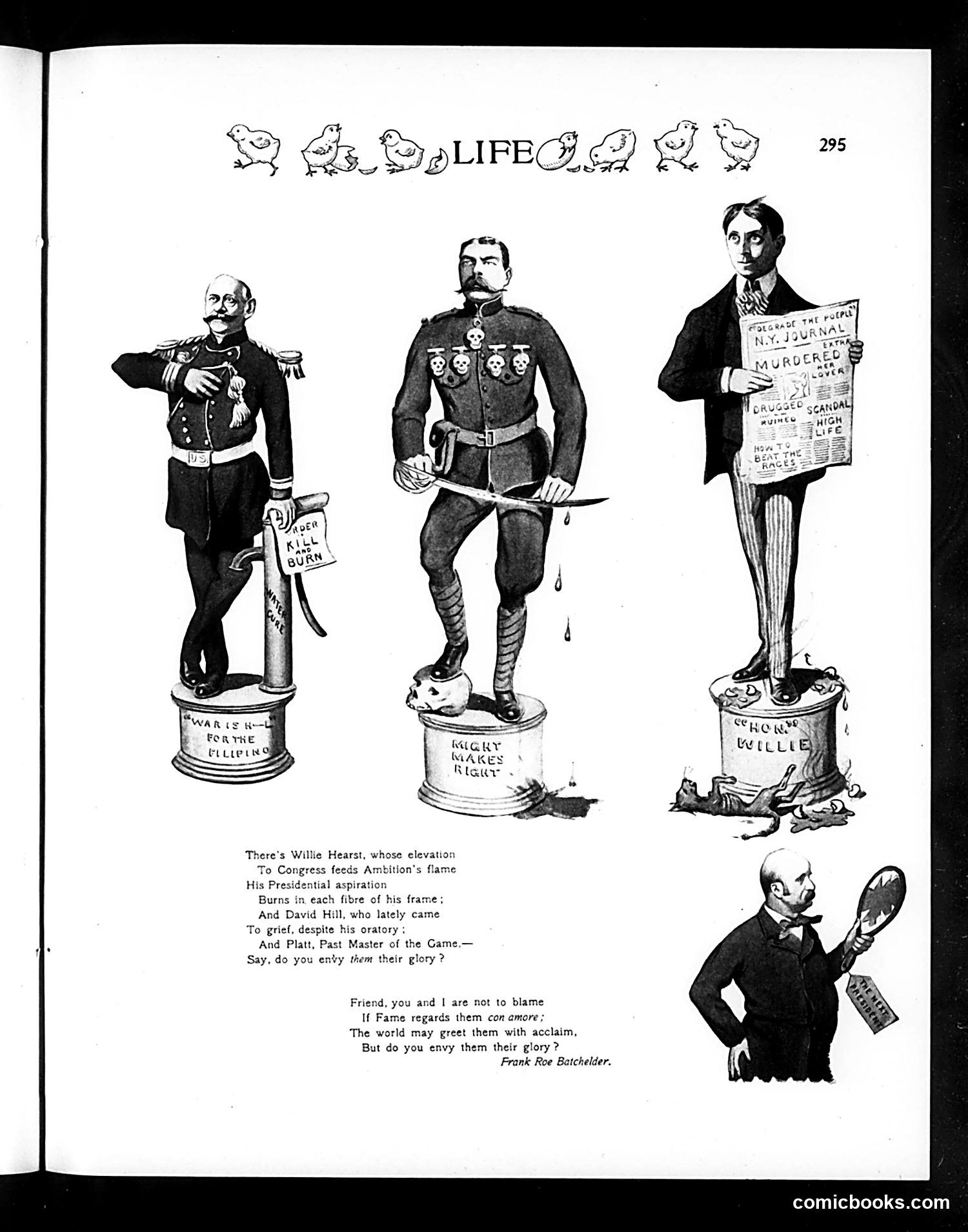
This 1890s Life magazine page satirizes three prominent American political figures standing on pedestals, each labeled with their ambitions or scandals: - **Willie Hearst** (left, military uniform) represents Congressional ambition feeding Presidential aspirations - **David Hill** (center, soldier figure) recently suffered political disgrace despite eloquence - **Platt** (right, holding sensational newspaper) represents cynical political manipulation The poem by Frank Roe Batchelder questions whether readers should envy these men's fame and glory. The satire suggests their accomplishments rest on morally questionable foundations—ambition, oratory masking failure, and manipulative "games." The pedestals themselves appear unstable, implying their positions lack solid merit. The small figure holding a mirror at bottom-right likely represents the artist's self-reflection on ambition itself. The overall message: don't envy political success built on such hollow or corrupt grounds.
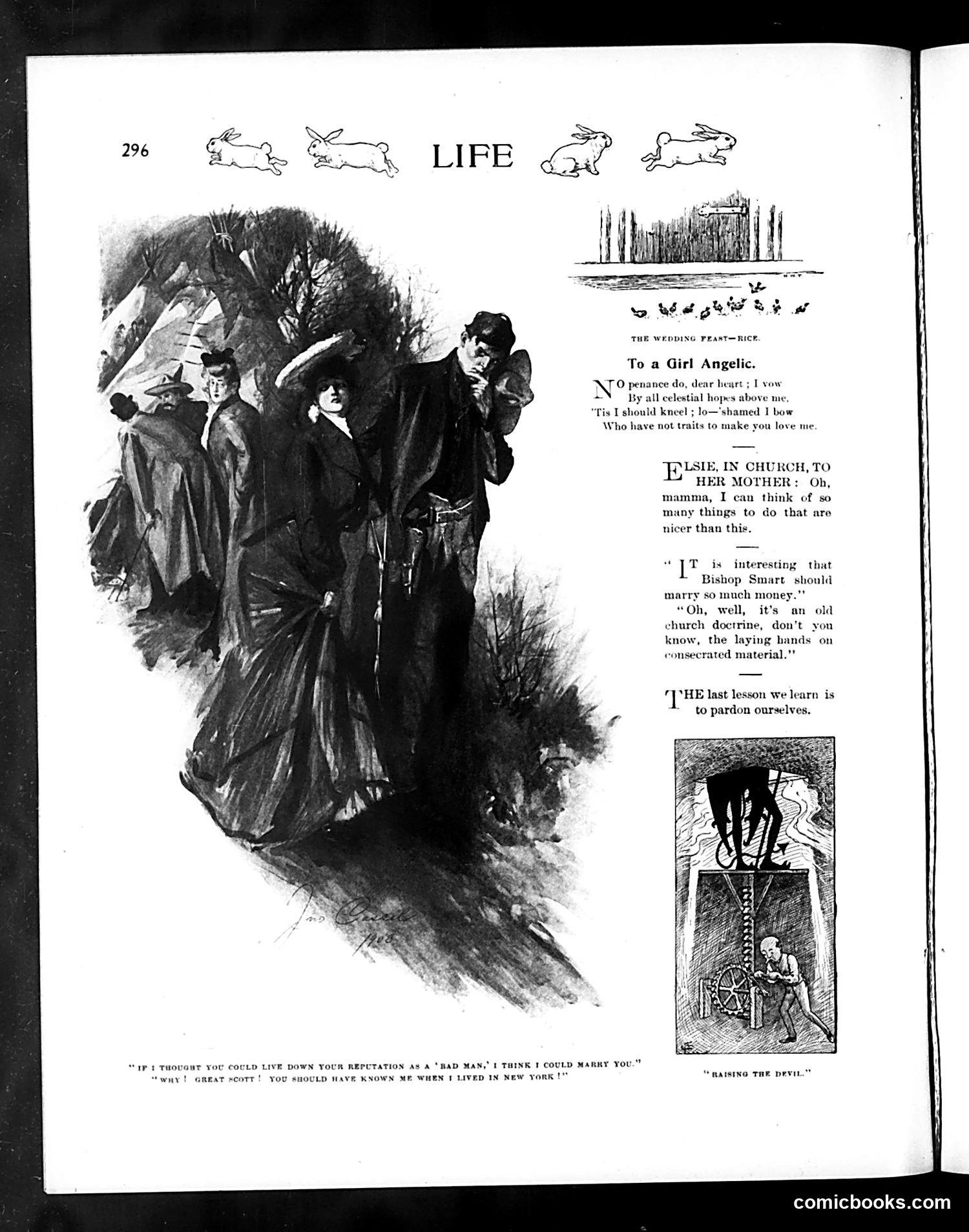
This page satirizes contemporary attitudes toward marriage and respectability in early 20th-century America. The main illustration shows a wedding procession, with accompanying jokes mocking shallow marriage motivations. "Elsie in Church" ridicules a young woman finding the ceremony tedious—satire on obligatory female participation in religious ritual. The "Bishop Smart" dialogue mocks clergy who marry wealthy parishioners, suggesting financial rather than spiritual motives. The phrase about "laying hands on consecrated material" sarcastically references religious justification for worldly gain. The bottom caption presents a cynical exchange: a woman claims she'd marry a reformed "bad man," but he regrets not knowing her when he was disreputable in New York—suggesting reputations are easier to escape geographically than morally, and that women's morality standards are conveniently flexible. Overall, the page satirizes Victorian hypocrisy around marriage, religion, money, and respectability—common targets for Life's satirical commentary.
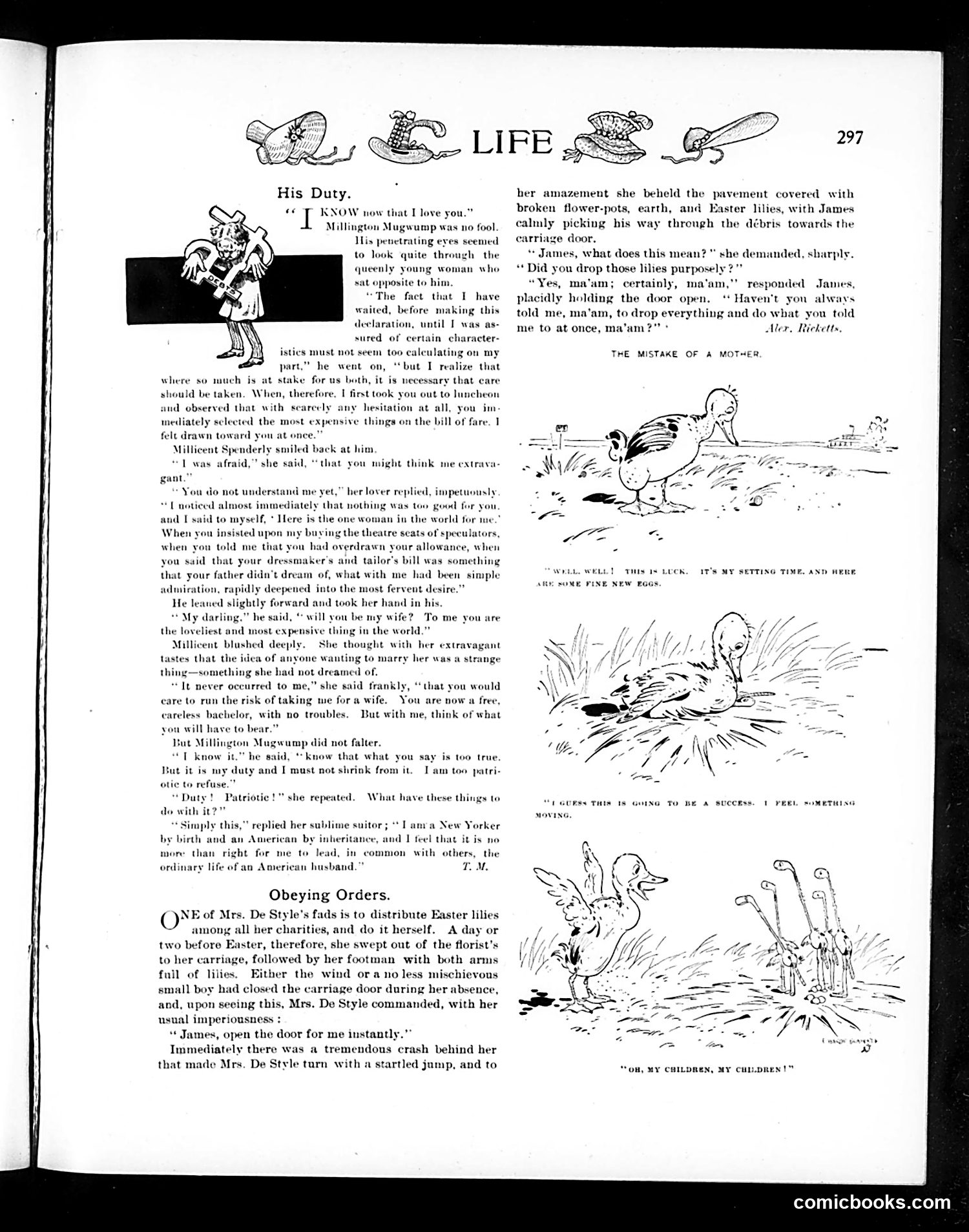
**"His Duty"** mocks a wealthy suitor, Millington Mugwump, who pursues the extravagant Millicent Spenderly specifically *because* she's a spendthrift. He interprets her expensive tastes and financial recklessness as proof she's "the one woman" for him—viewing her wasteful nature as an asset rather than a flaw. The satire targets both her shallow materialism and his delusional reasoning that marrying her represents patriotic duty as an "ordinary" American husband. **"The Mistake of a Mother"** shows a domestic servant (James) literally obeying his employer's standing order to "drop everything" when commanded. When Mrs. De Style orders him to open a carriage door "instantly," he drops the Easter lilies he's carrying, destroying them. The joke satirizes rigid class hierarchy and blind obedience—the servant prioritizes literal obedience to his social superior over common sense, resulting in absurd consequences. Both pieces critique American social pretension and class dynamics of the era.
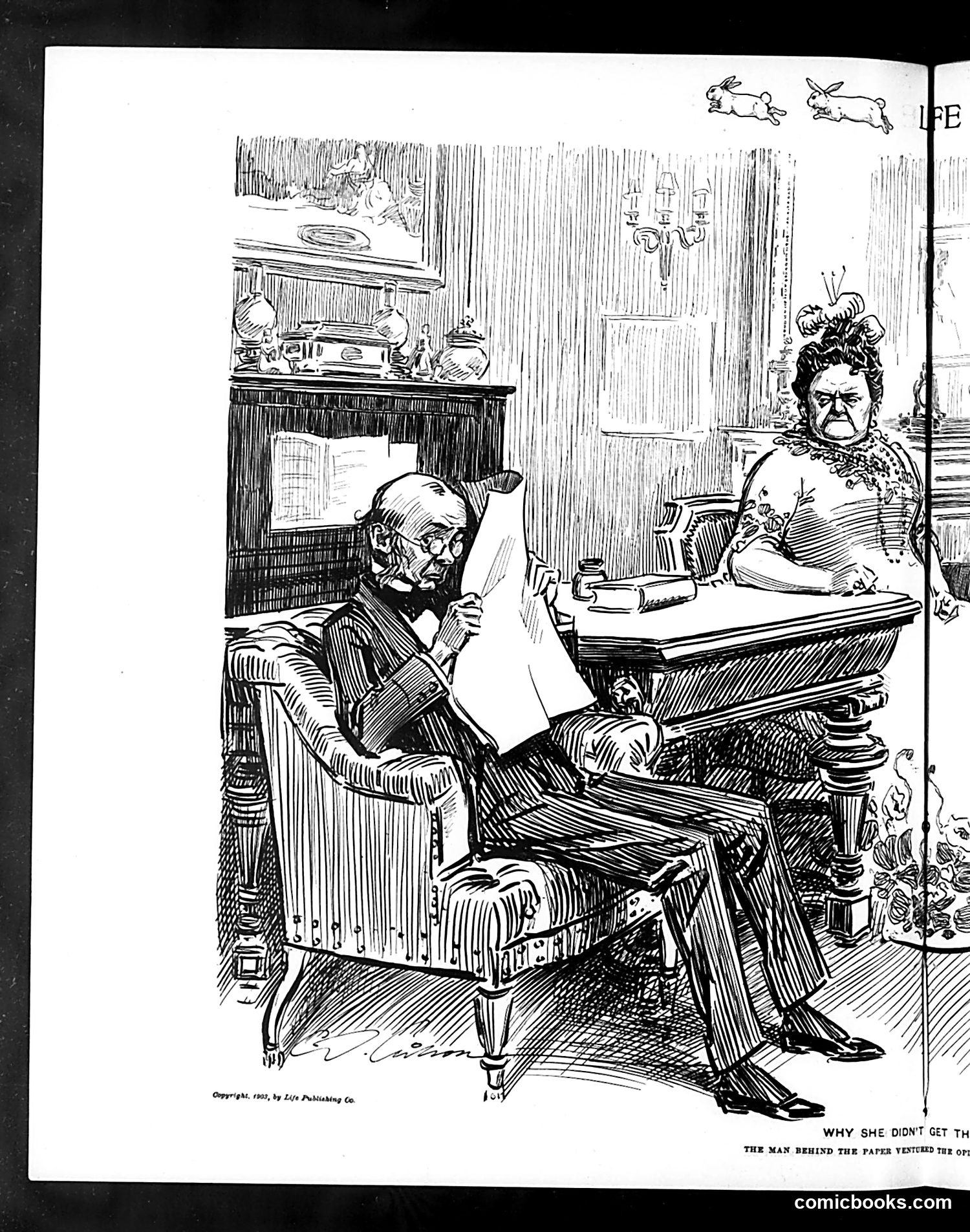
This 1902 *Life* magazine cartoon depicts a domestic scene satirizing marital communication. A thin, nervous man sits reading a large newspaper while an angry, portly woman glares at him from across the room. The title fragment "WHY SHE DIDN'T GET TH[E]" and caption "THE MAN BEHIND THE PAPER VENTURED [TO] OP[EN]..." suggest the joke concerns a husband literally hiding behind his newspaper to avoid his wife's complaints or conversation. The satire mocks the common domestic dynamic where men used newspapers as a shield against spousal interaction—both figuratively and physically. The woman's stern expression and the man's timid posture emphasize the power imbalance, while the exaggerated caricatures make light of marital tension. This reflects early-20th-century gender dynamics and domestic comedy conventions.
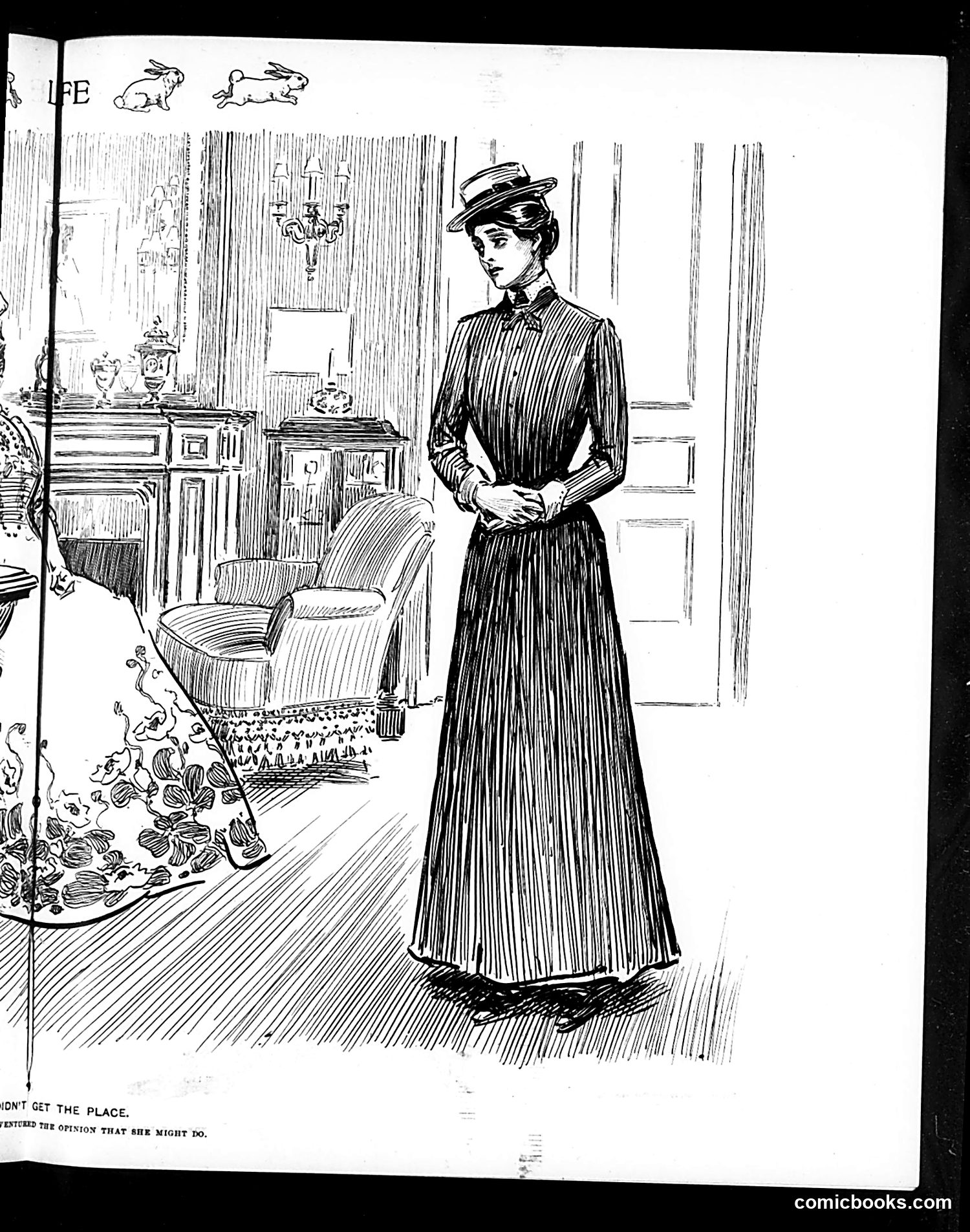
This appears to be a satirical illustration from Life magazine showing a well-dressed woman in an elegant interior, wearing a long dark dress and hat typical of early 20th-century fashion. The partial text visible at bottom reads "...DIDN'T GET THE PLACE" and "...VENTURED THE OPINION THAT SHE MIGHT DO," suggesting the cartoon comments on a woman's suitability for some position or role. The satire likely mocks either her pretensions to a position she didn't obtain, or critiques social attitudes about women's capabilities. The formal domestic setting and her composed stance contrast with the apparent judgment about her qualifications, suggesting commentary on gender and class assumptions of the era. However, without complete caption text, the specific target of satire remains unclear.
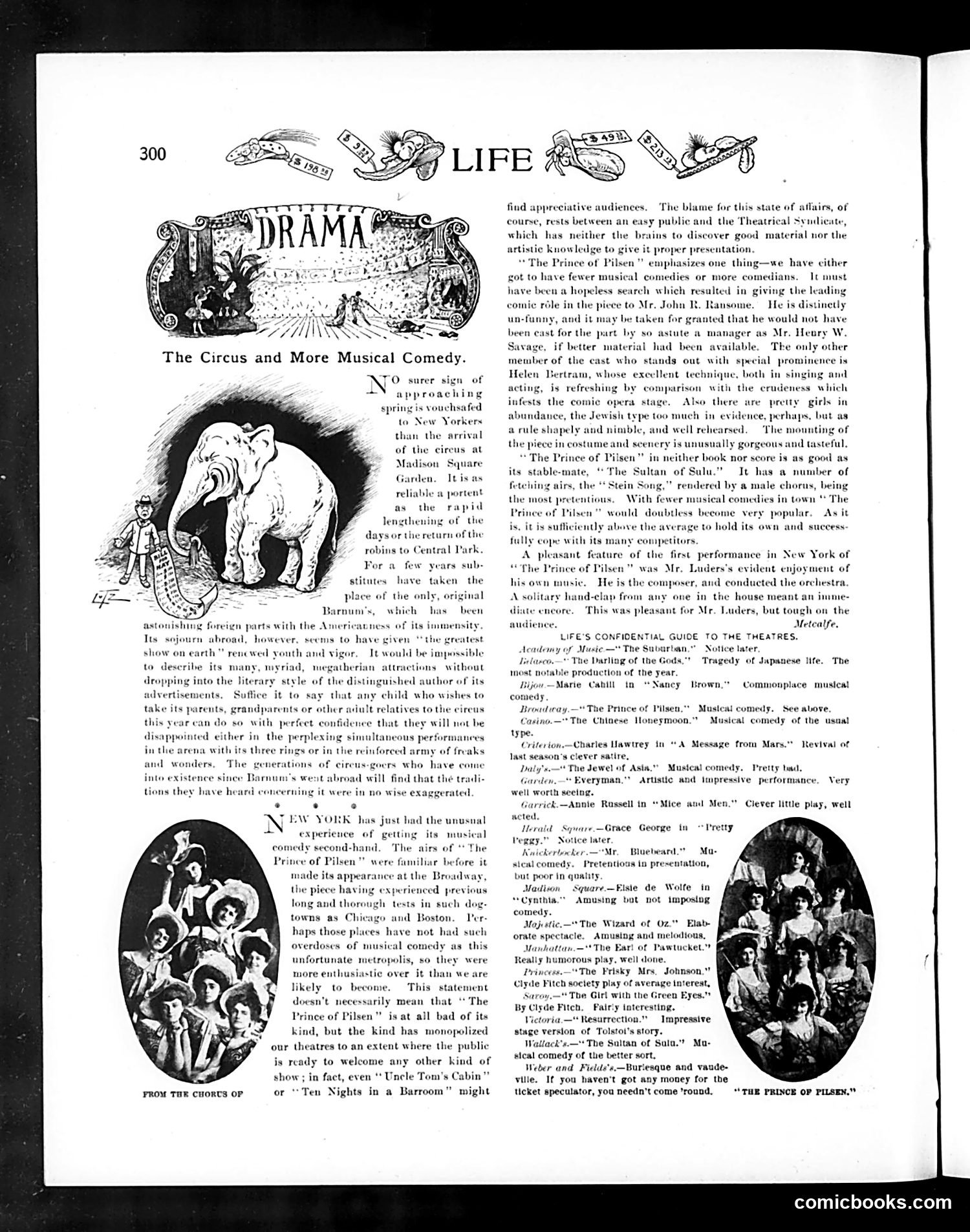
This is a theater review page from Life magazine discussing "The Prince of Pilsen," a musical comedy that opened on Broadway. The critic argues that New York has been oversaturated with mediocre musical comedies, making audiences desperate for *any* alternative entertainment—even outdated melodramas like "Uncle Tom's Cabin" or "Ten Nights in a Barroom." The satire targets the "Theatrical Syndicate" (a real trust that controlled American theaters) for lacking taste and failing to develop quality material. The reviewer criticizes the lead actor as unfunny, praises supporting actress Helen Bertram, and notes that the show's only appeal is its "pretty girls" and elaborate costumes. The implicit point: Broadway's monopolistic control over theatrical production has created artistic stagnation, forcing audiences to settle for formulaic mediocrity. The page includes illustrations from the circus and the opera's chorus line, reflecting the magazine's visual commentary on popular entertainment.
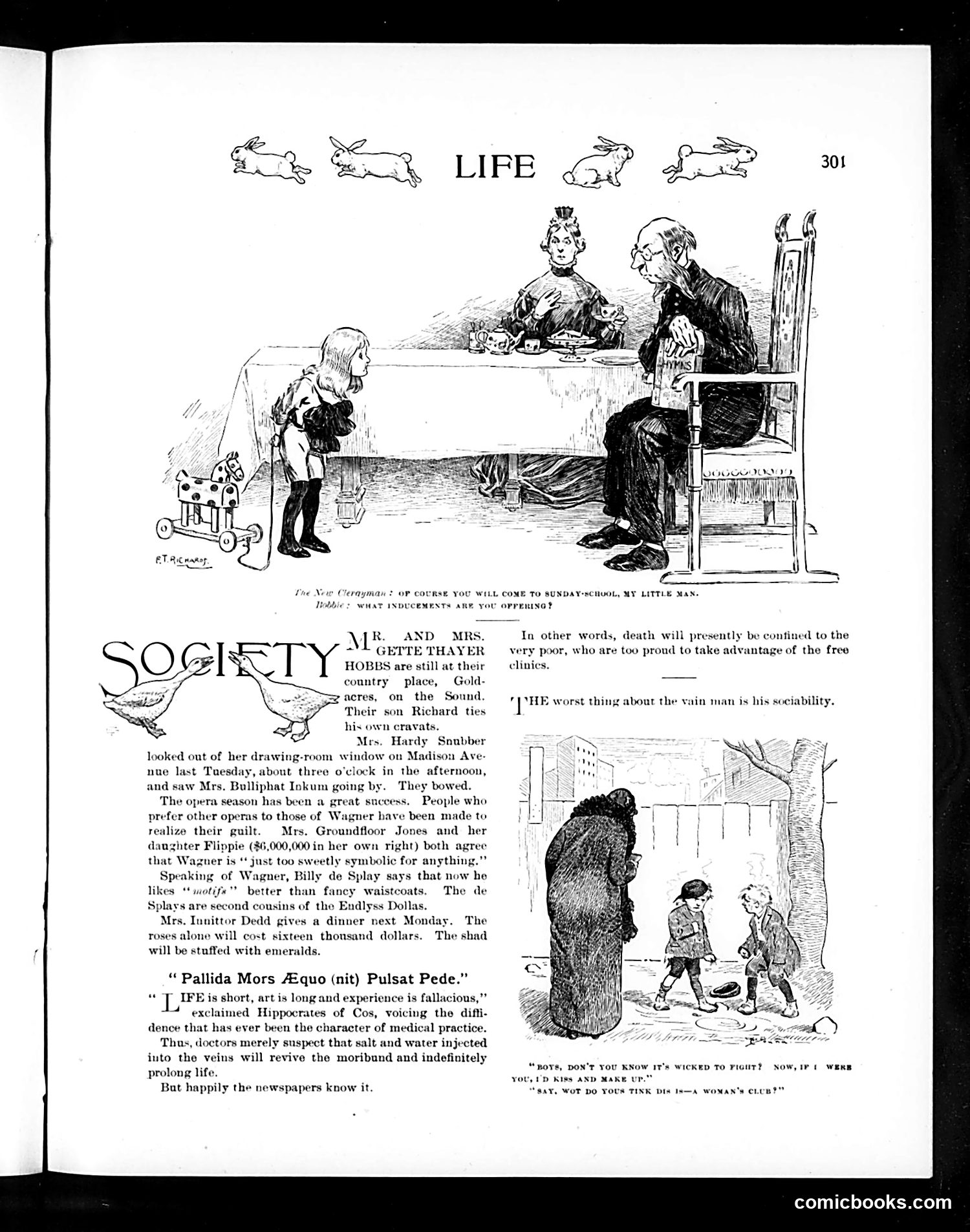
This page contains multiple satirical pieces mocking wealthy society and medical pretension: **Top cartoon:** A child asks an elderly man what "inducements" he offers for Sunday school attendance. The humor lies in the cynical implication that religion requires material incentives rather than spiritual appeal—satirizing both commercialism and the hollow religiosity of the wealthy. **Society column:** Mockingly chronicles trivial upper-class activities (Wagnerians, emerald-stuffed shad, servants tying their own cravats). The satire attacks the absurd pretension and waste of the wealthy elite. **Medical quote section:** Cites an ancient Greek physician skeptically observing that doctors merely "suspect" treatments work. The satire suggests modern medicine relies on newspaper hype rather than genuine science—doctors don't truly understand their own practices, yet newspapers uncritically promote miraculous cures. **Bottom cartoon:** Shows children fighting, with dialogue implying street children lack genteel manners. The satire mocks middle-class assumptions about "proper" behavior and class distinctions. Overall, the page satirizes wealth inequality, empty social conventions, false medical claims, and class pretension in Gilded Age America.
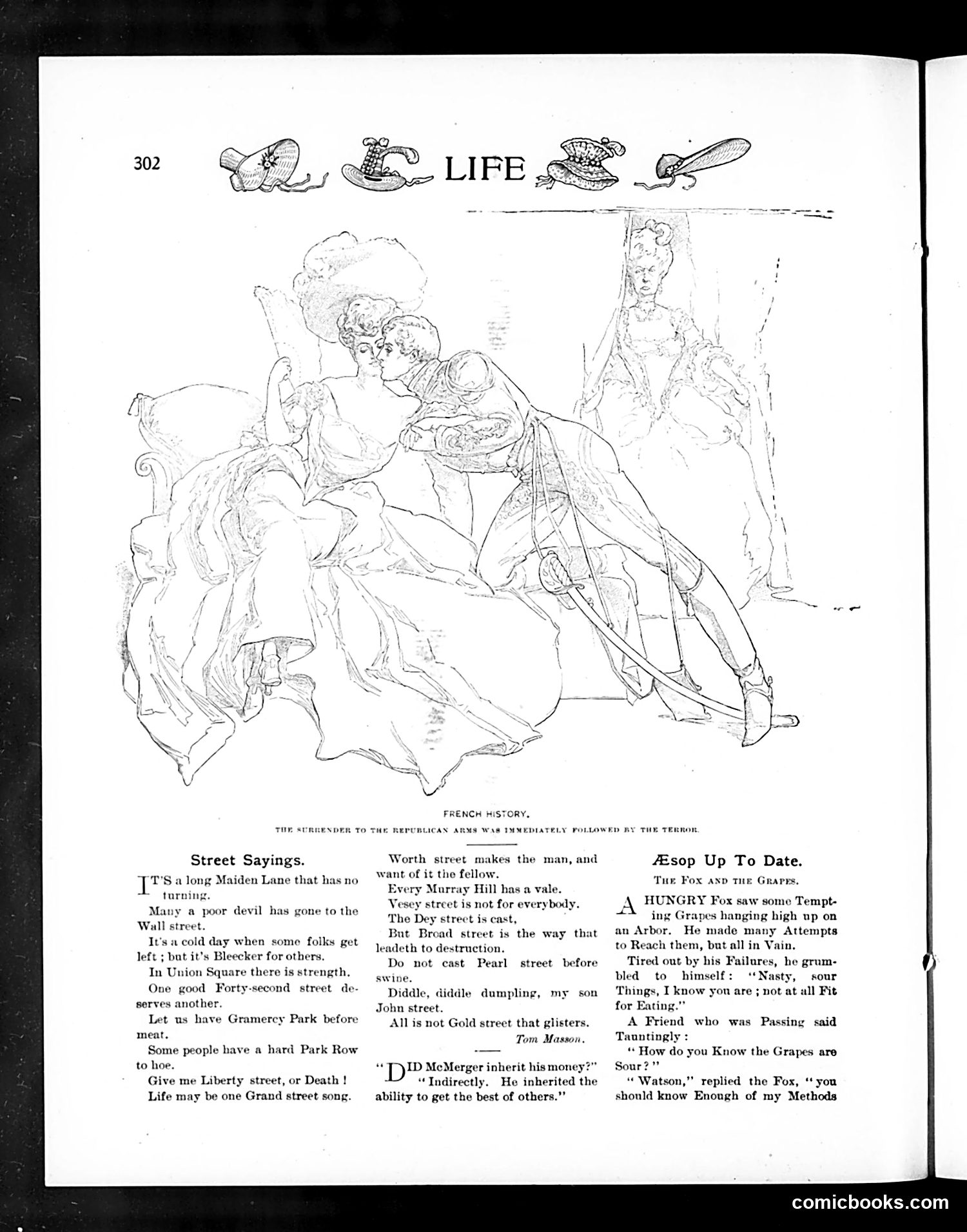
This page contains three distinct satirical elements: **French History Cartoon (top):** The illustration depicts the Reign of Terror following the French Revolution, showing violence and chaos—likely representing aristocratic figures being attacked by revolutionaries. The caption references how republican military victories were "immediately followed by the Terror," critiquing the violent excesses of revolutionary fervor. **Street Sayings (left column):** A clever pun-based humor section using New York City street names (Wall Street, Pearl Street, Broad Street, etc.) to create moralistic proverbs. These play on the double meanings of street names and common sayings—for example, "Worth street makes the man" (playing on "money makes the man"), and "Give me Liberty street, or Death" (referencing Patrick Henry's famous quote). This satirizes both New York's commercial culture and pretentious moralizing. **Aesop Updated (right):** A modernized Fable of the Fox and Grapes where the fox justifies failure through pseudoscientific rationalization ("Watson" and "Methods"), likely mocking Sherlock Holmes-style deductive reasoning or contemporary pseudo-intellectual excuses for failure.
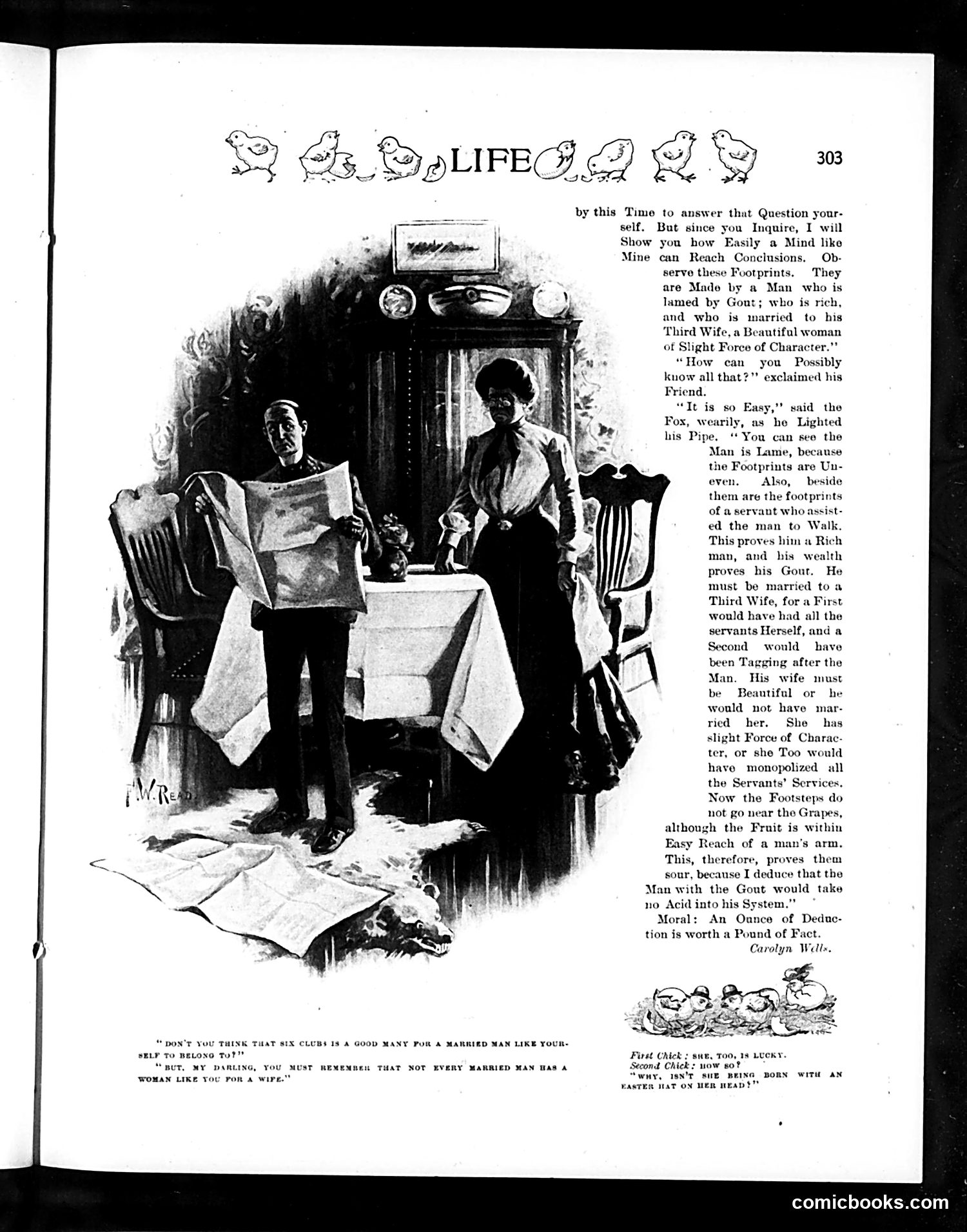
This page contains two separate satirical pieces: **Main Illustration:** A Sherlock Holmes-style deduction scene. A fox demonstrates elaborate logical reasoning to deduce a man's characteristics (wealth, gout, multiple marriages, servant assistance) from footprints alone. The satire mocks overly confident deductive reasoning—the fox reaches absurdly specific conclusions from minimal evidence. The moral ("An Ounce of Deduction is worth a Pound of Fact") ironically suggests logical deduction beats actual facts, though the reasoning shown is clearly flawed. **Bottom Captions:** Two separate jokes about marriage. The first jokes that six club memberships is excessive for a married man. The second depicts chickens discussing gender—one female chick noting she's "lucky" and another born with "an easier way on her head," making a crude anatomical joke about gender differences. The page satirizes pretentious logic, marital constraints, and contains period-typical crude humor. The artist is credited as "Carolyn Walls" for the main piece.
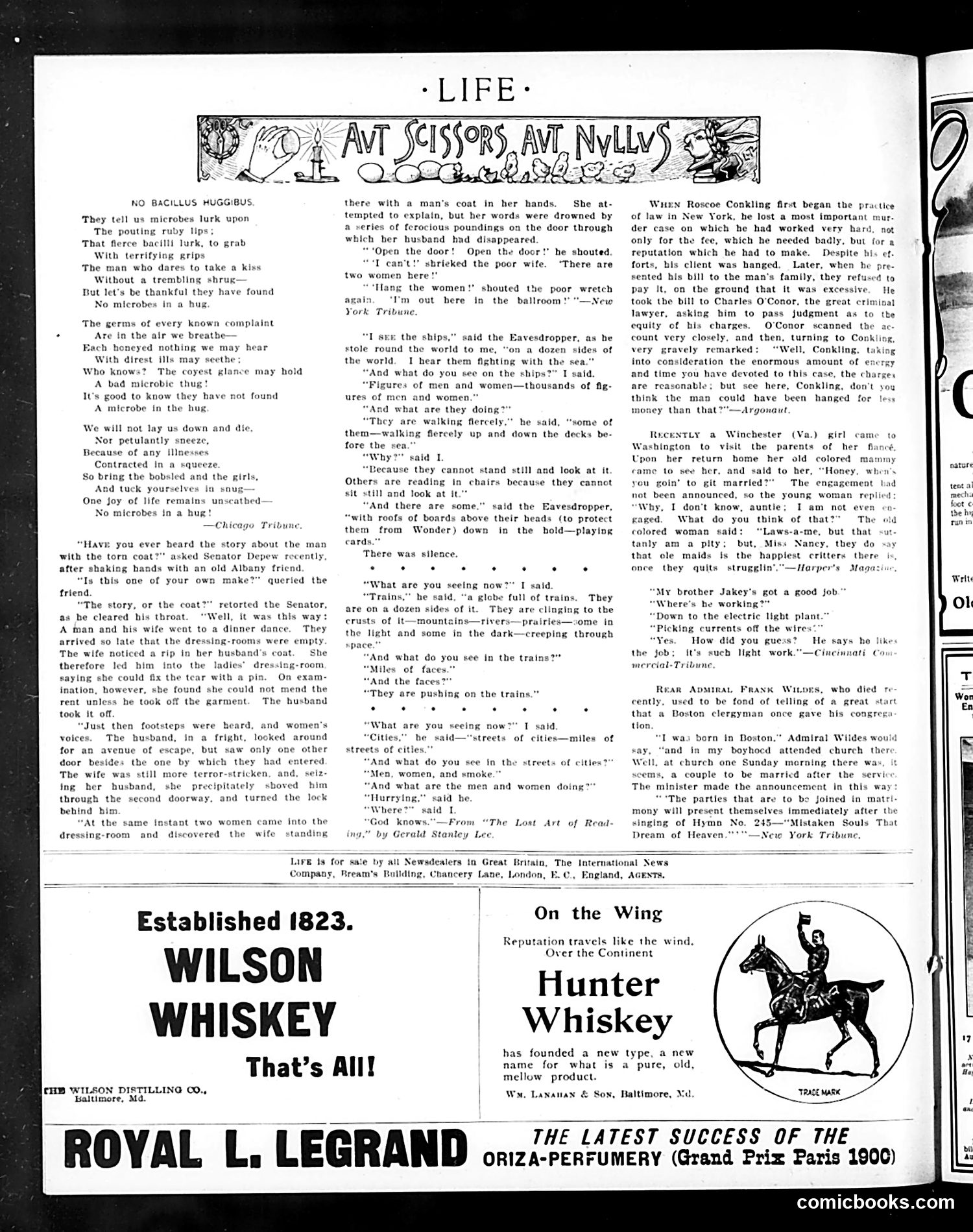
This page contains **no political cartoons**, but rather **literary and humorous content** typical of Life magazine's satirical approach. The main pieces include: 1. **"No Bacillus Huggibus"** — A poem joking about the contemporary "germ theory" craze. During the early 1900s, newly discovered microbes sparked public anxiety about disease transmission. The joke: while people feared germs everywhere (in kisses, sneezes, air), hugs remained supposedly microbe-free. 2. **Senator Depew's anecdote** — A comedic story about a man forced to remove his coat at a dinner dance when his wife tries to mend it with a pin in the ladies' dressing room. The humor derives from the awkward misunderstanding when other women enter and find him coatless. 3. **"The Eavesdropper"** — A philosophical piece describing observations of ships, trains, and cities where people are perpetually "hurrying" and "walking fiercely," suggesting commentary on modern restless society. The advertisements below promote whiskey and perfume brands.
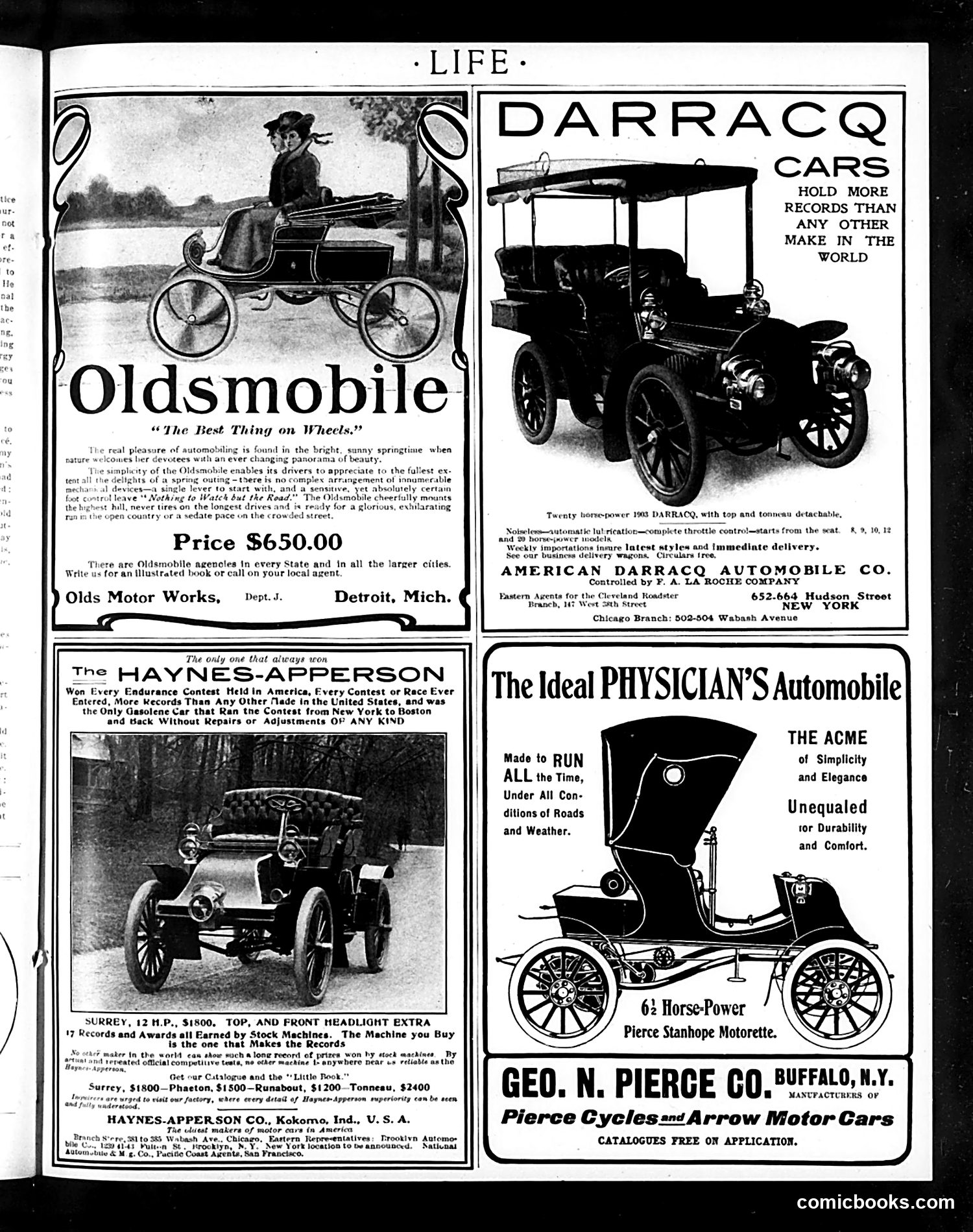
This page contains **no cartoons or satire**—it is purely **automobile advertising** from an early automotive era (approximately 1900s-1910s based on vehicle designs and prices). Four car manufacturers advertise their products: 1. **Oldsmobile** ($650) - positioned as "The Best Thing on Wheels" 2. **Darracq** - emphasizing record-holding performance 3. **Haynes-Apperson** - stressing endurance contest victories and reliability ("stock machines") 4. **Pierce** (George N. Pierce Co.) - marketing a 62-horsepower motorette for physicians The **satire is subtle but present**: each manufacturer claims superiority through competitive records and contests. The humor for modern readers lies in seeing how seriously early automakers took these competitions—much like today's tech companies. The "Ideal Physician's Automobile" pitch is particularly quaint, marketing a specific vehicle type to a professional demographic. These ads reflect the nascent automotive industry's competitive obsession with proving reliability through endurance racing, a major selling point when automobiles were still novel, unreliable machines.
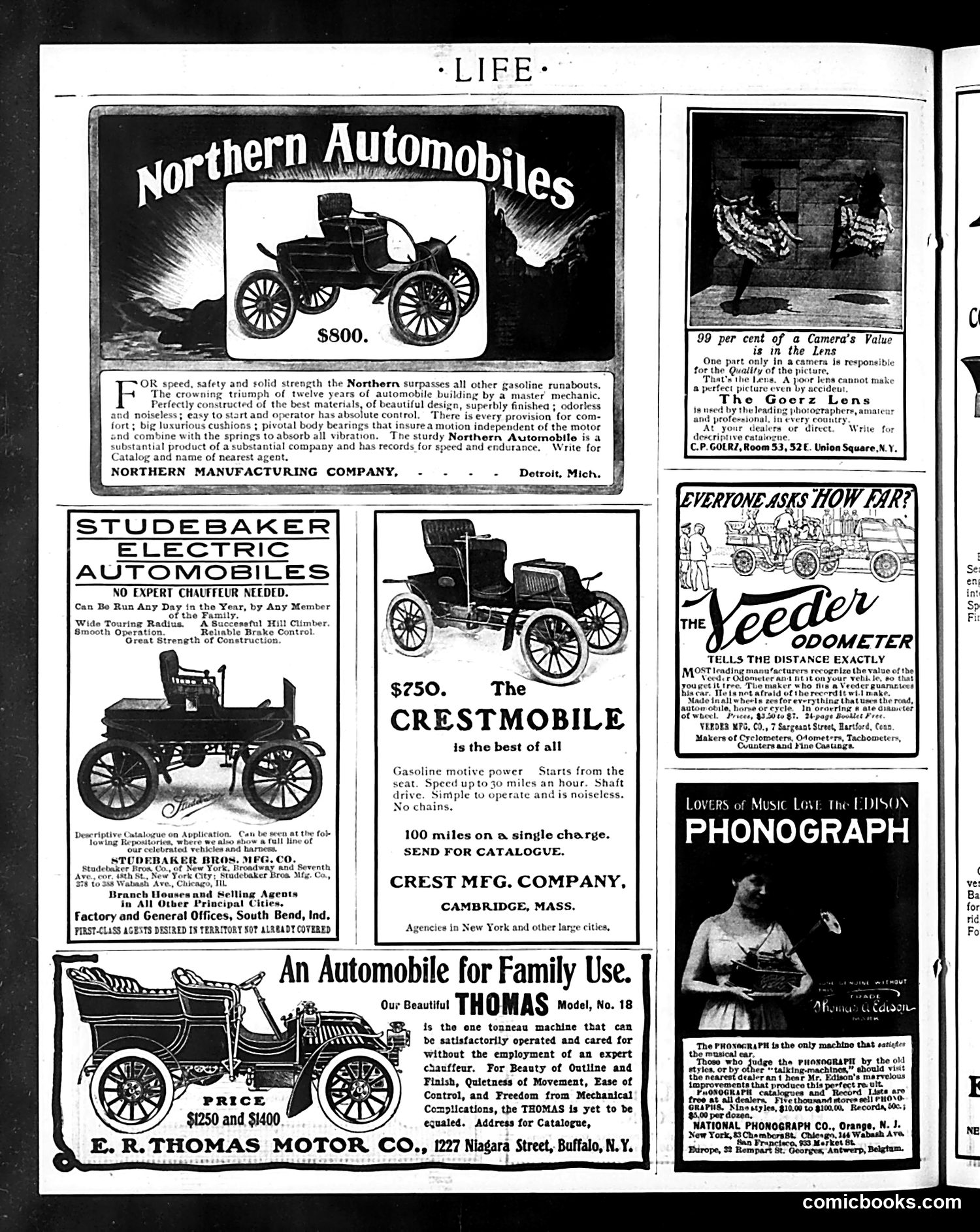
This page is entirely **advertising**, not satire or editorial content. It showcases early 1900s automobiles and one phonograph, reflecting a transformative moment in American consumer technology. The ads present newly available motorized vehicles—Northern, Studebaker Electric, Crestmobile, and Thomas automobiles—positioned as luxury goods for families. Notably, the **Studebaker Electric** and **Thomas** emphasize that no "expert chauffeur" is needed, marketing cars as operator-friendly for ordinary people. Prices range from $250 to $1,400, positioning these as premium purchases. The **Goerz Lens** ad emphasizes optical quality, while the **Veeder Odometer** ad highlights mechanical precision measurement—both reflecting contemporary technological pride. The **Edison Phonograph** ad claims superiority over competitor "talking machines," using testimonials to market recorded music as a luxury consumer good. For modern readers: this page documents the moment automobiles transitioned from novelties to aspirational family purchases, marketed with emphasis on ease-of-use and reliability rather than speed or status alone.
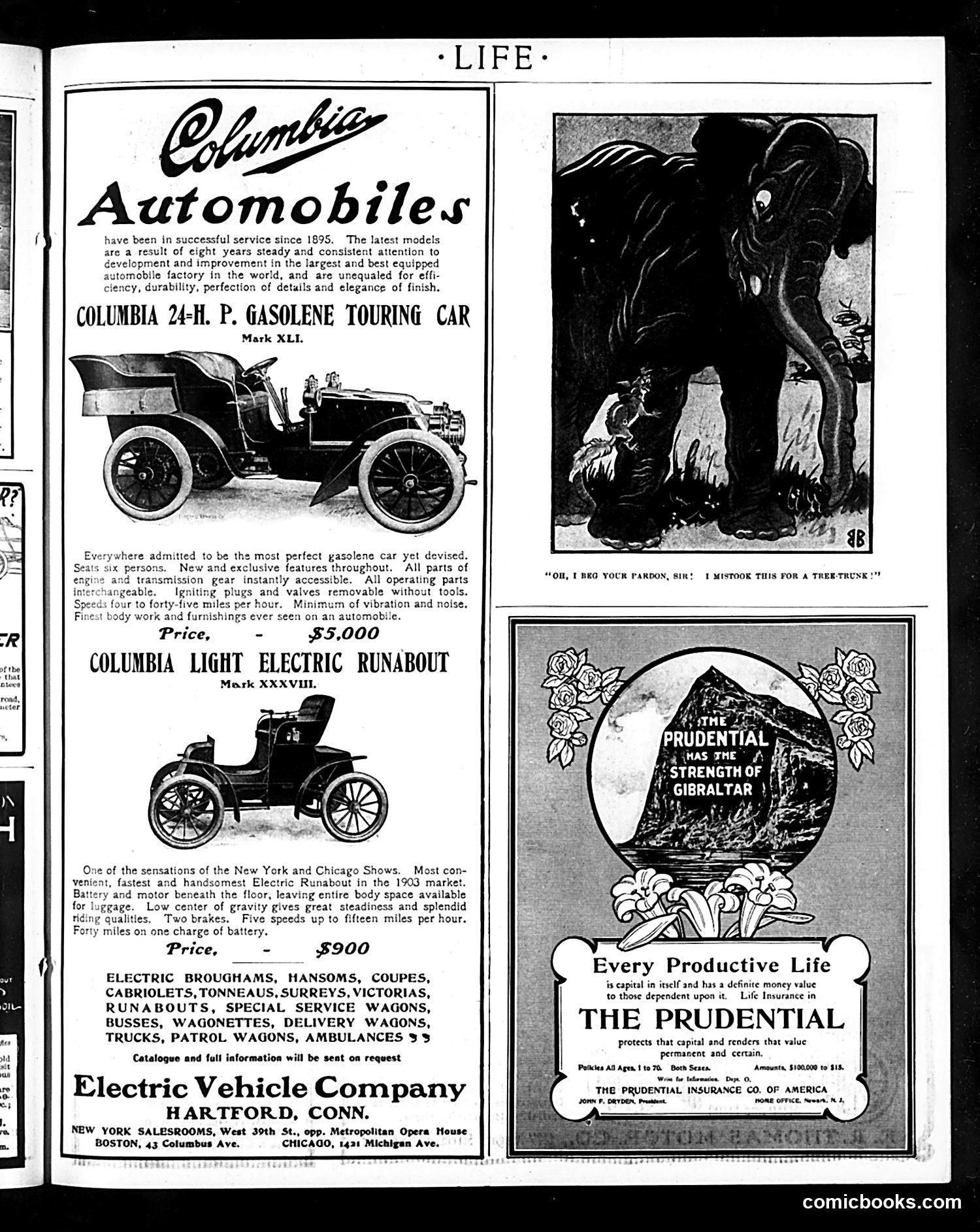
This page consists primarily of **advertisements**, not editorial cartoons. The top half showcases early automobiles from Columbia and the Electric Vehicle Company (circa 1903), highlighting competing technologies: gasoline-powered touring cars versus electric runabouts. The single **cartoon** (right side, top) depicts a confused elephant apologizing to a large tree, saying "Oh, I beg your pardon, sir! I mistook this for a tree-trunk!" This is a visual pun playing on the elephant's trunk—a simple joke with no political content. Below is a **Prudential Insurance advertisement** using an image of the Rock of Gibraltar to symbolize strength and permanence, a common metaphor in early insurance marketing. The page reflects the era's automotive competition and emerging consumer insurance products rather than political satire.
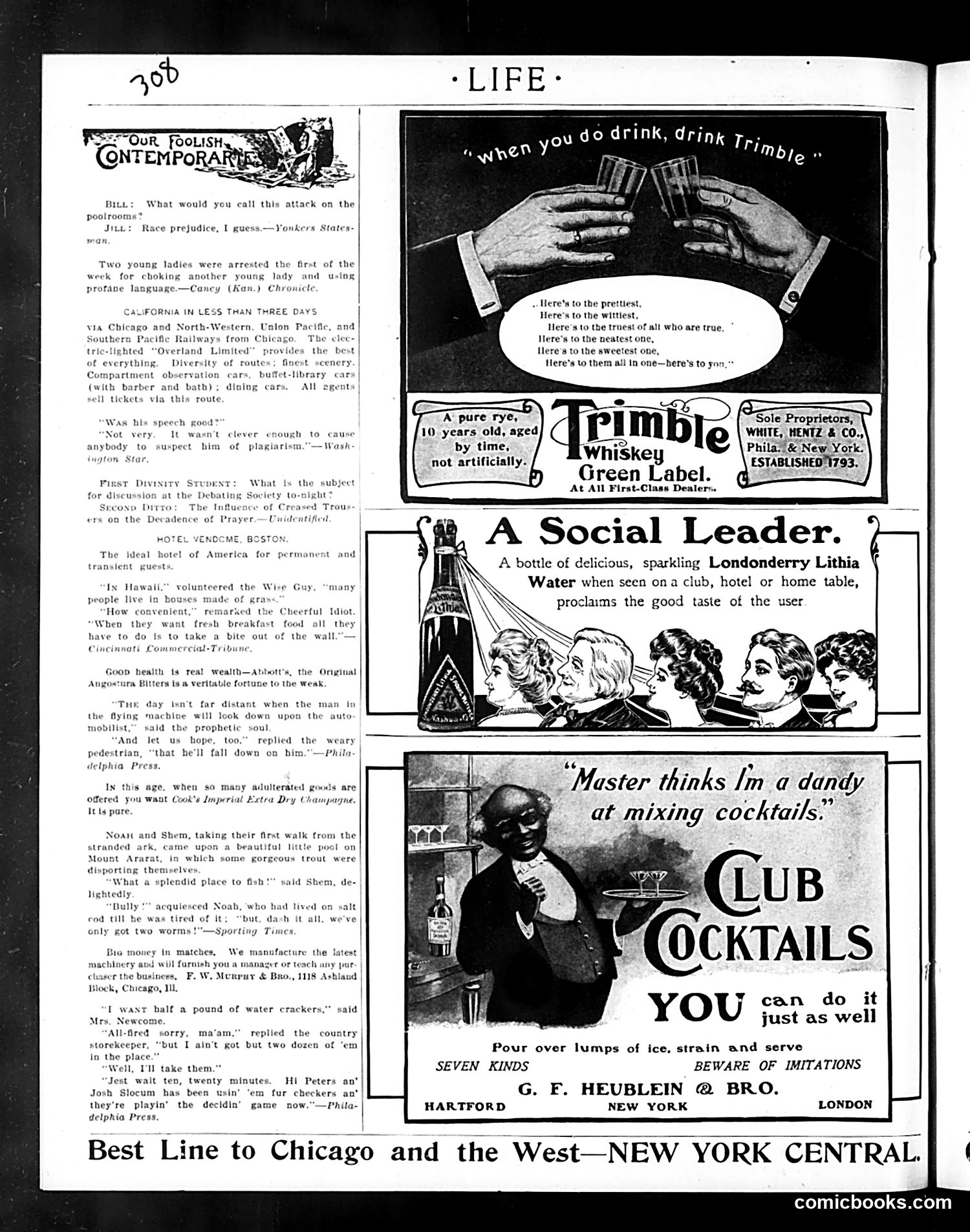
This page primarily contains **advertising** for alcoholic beverages (Trimble Whiskey, Londonderry Lithia Water, and Club Cocktails) alongside brief humorous snippets typical of Life's satirical format. The small jokes reference contemporary concerns: one criticizes "race prejudice" affecting poolrooms; another mocks verbose public speakers prone to plagiarism. A brief anecdote about Noah and salt cod serves as absurdist humor. The advertisements reflect **Prohibition-era marketing** (pre-1920) where alcohol was still legal and openly advertised. The "Club Cocktails" ad humorously suggests home bartending—"you can do it just as well"—anticipating the DIY drinking culture that would flourish during actual Prohibition. The page's dominant content is commercial rather than satirical—typical of Life's business model combining editorial humor with paid advertising. The social commentary is mild and topical rather than pointed political satire.
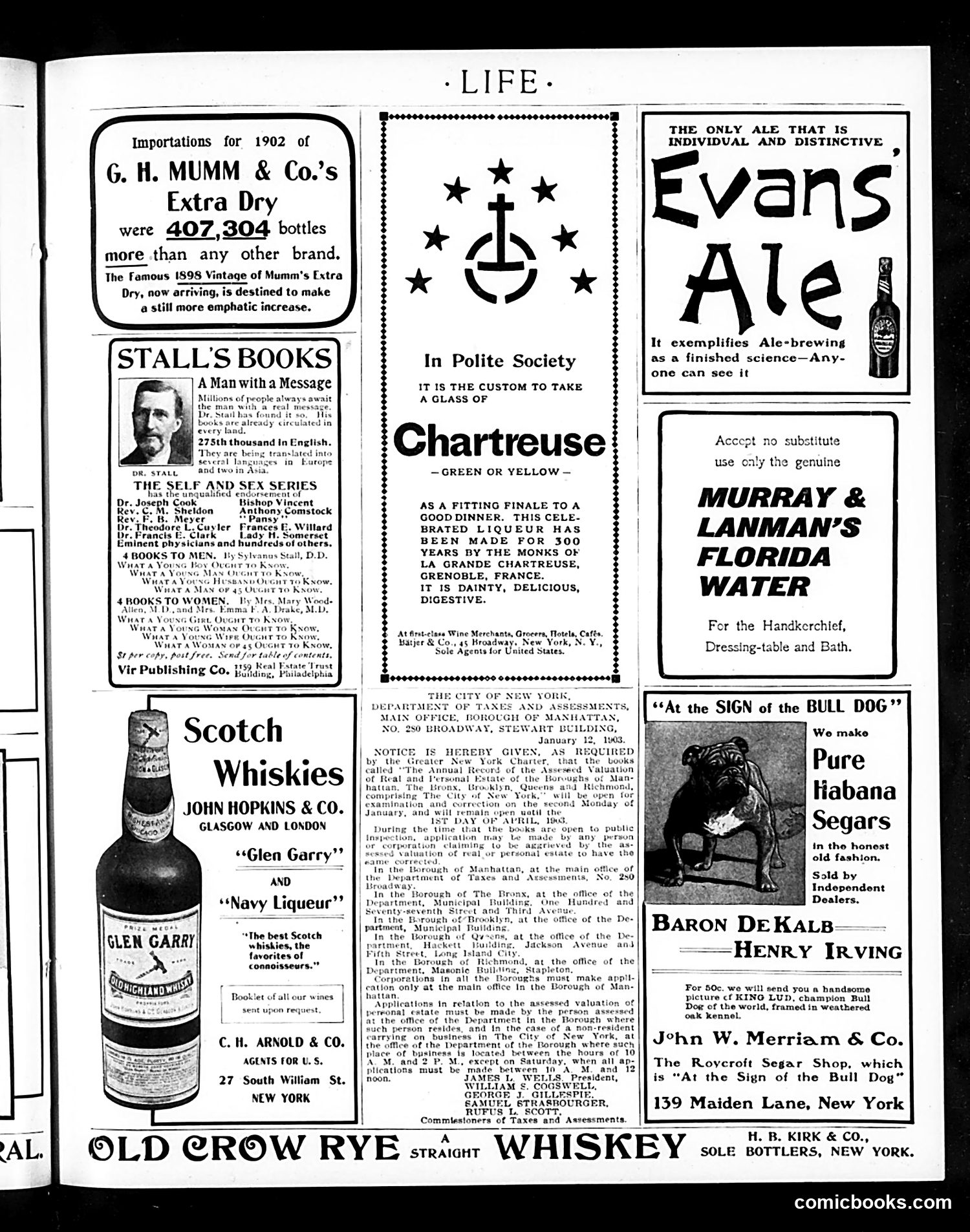
This page is primarily **advertising**, not political satire. It showcases luxury goods from early 1902: imported champagne (Mumm's), Scotch whisky, liqueurs (Chartreuse), ales, Florida water cologne, Cuban cigars, and whiskey. The only non-advertising content is **Stall's Books** advertisement, promoting the "Self and Sex Series"—educational volumes on sexual health and morality by Sylvanus Stall, endorsed by Bishop Vincent and Anthony Comstock (a famous anti-obscenity crusader). This reflects the era's discomfort discussing sexuality, requiring "scientific" books presented as moral instruction rather than frankly educational material. The single cartoon shows a **cross with stars**, labeling Chartreuse as a drink for "Polite Society" following dinner. This gently mocks upper-class pretension—the religious imagery humorously elevates a digestif liqueur to quasi-sacred status among the wealthy. The page reflects Gilded Age consumer culture and period attitudes toward propriety and class distinction.
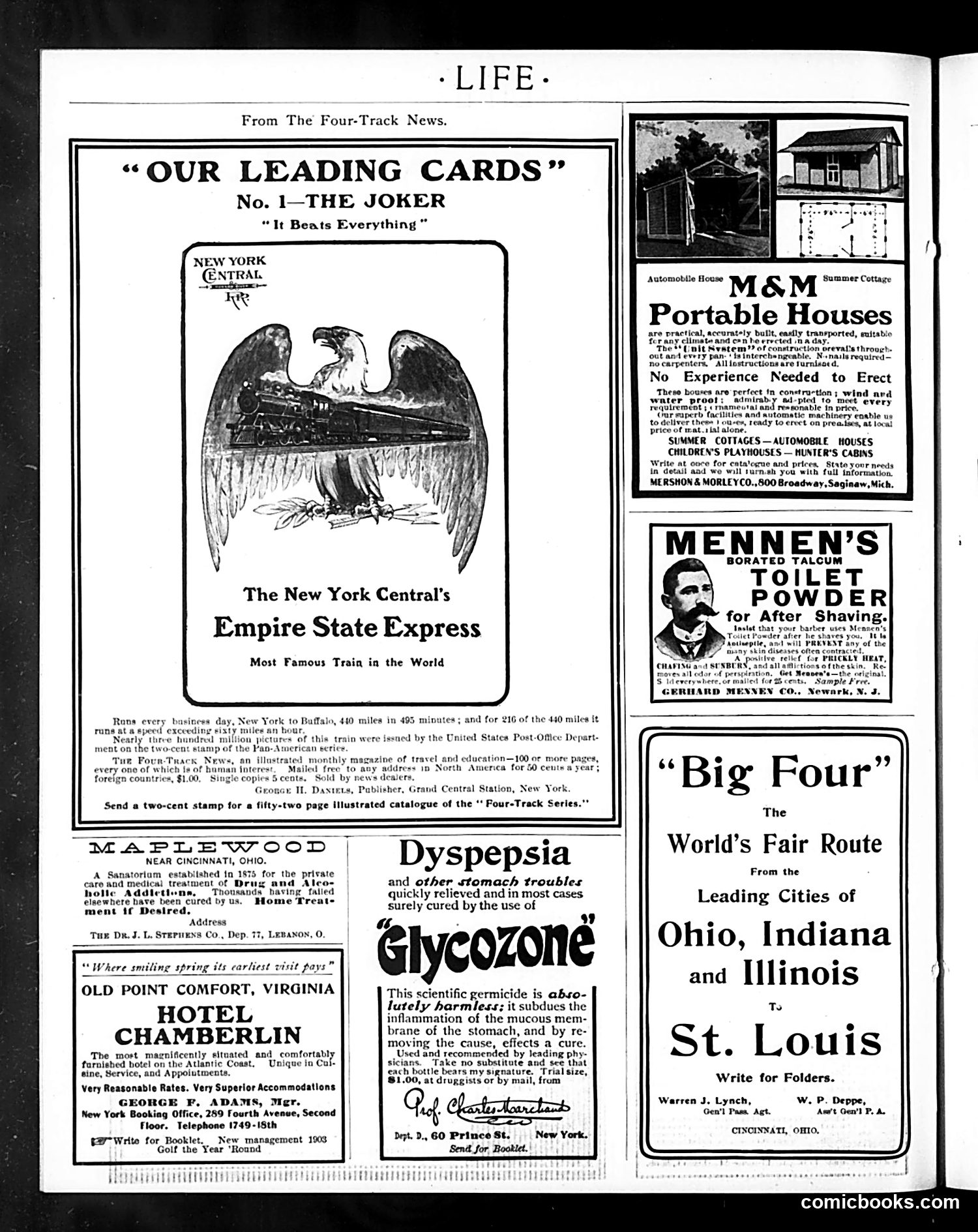
This page is primarily **advertising**, not satire or political commentary. The main content is "Our Leading Cards" No. 1, featuring the New York Central's Empire State Express train—depicted as a joker card with an eagle holding a locomotive. The joke is straightforward: the train "beats everything," playing on the joker's role in card games. The advertisement emphasizes the train's fame and speed (440 miles in 495 minutes). Accompanying text notes commemorative stamps were issued by the U.S. Post Office. The remainder of the page contains period advertisements for now-obsolete products and services: portable houses, talcum powder, sanatoriums for drug addiction treatment, a Virginia hotel, stomach medicine (Glycozone), and railroad routes to St. Louis. **What's notable to modern readers**: the casual advertising of treatments for drug and alcohol addiction, and the promotion of portable houses as practical solutions—reflecting early 1900s American commerce and social concerns.
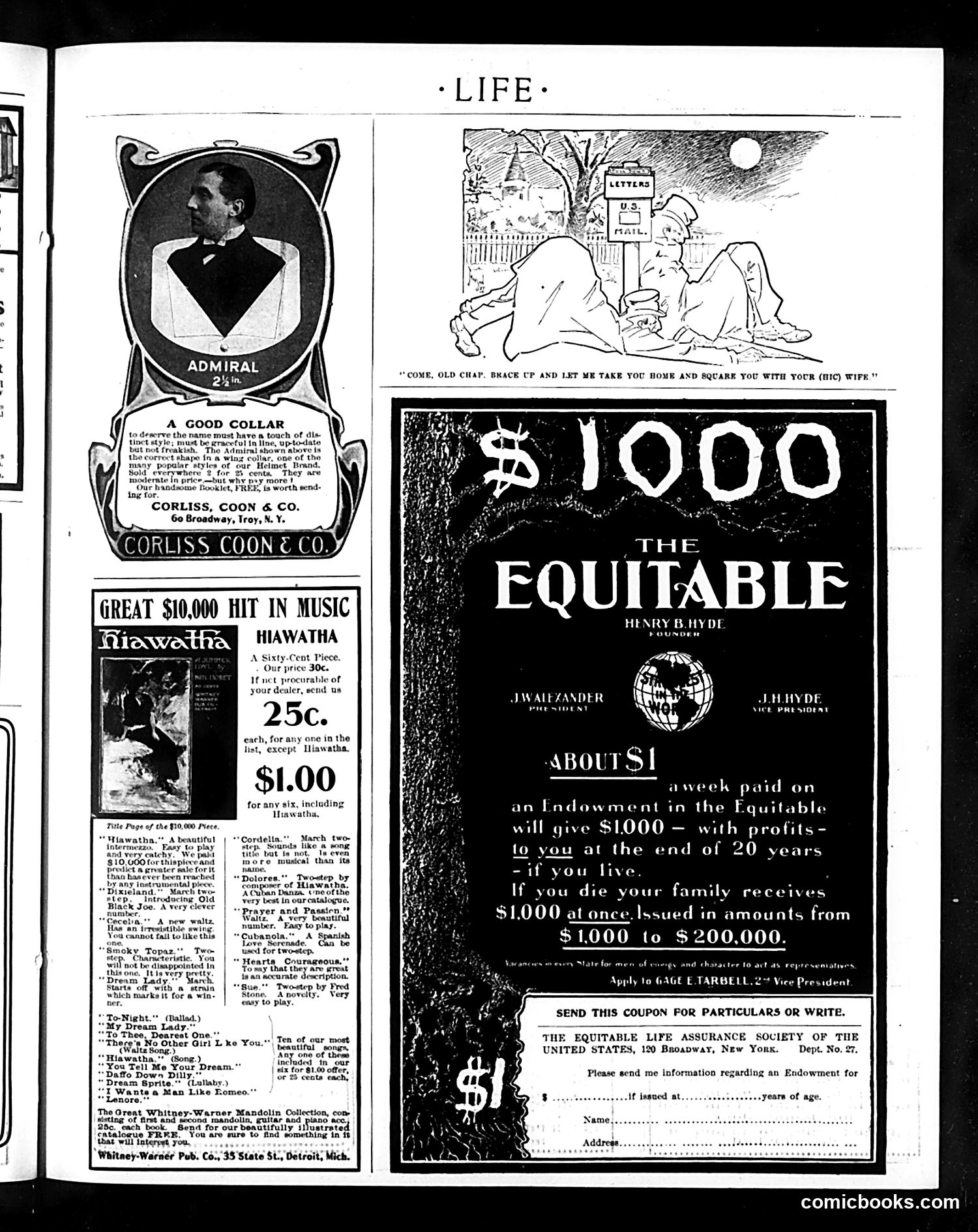
This page consists primarily of **advertisements rather than satirical content**. The main elements are: **Left side:** An "Admiral" collar advertisement from Corliss, Coon & Co., featuring a portrait of a man in formal wear. Below it is a music sheet listing ("Hiawatha" and other compositions) offered for sale at 25-30 cents each. **Right side:** A large advertisement for The Equitable Life Assurance Society promoting an endowment insurance plan. The pitch promises that $1 weekly payments will yield $1,000 plus profits after 20 years (if the policyholder survives), or immediate $1,000 payment to family upon death. **Above the insurance ad:** A small cartoon showing figures at a mailbox with the caption about taking someone home to "square you with your [rich] wife"—a mild joke about marital reconciliation. This appears to be an early 20th-century Life magazine page mixing consumer product advertising with insurance promotion, typical of the era's commercial magazine content.
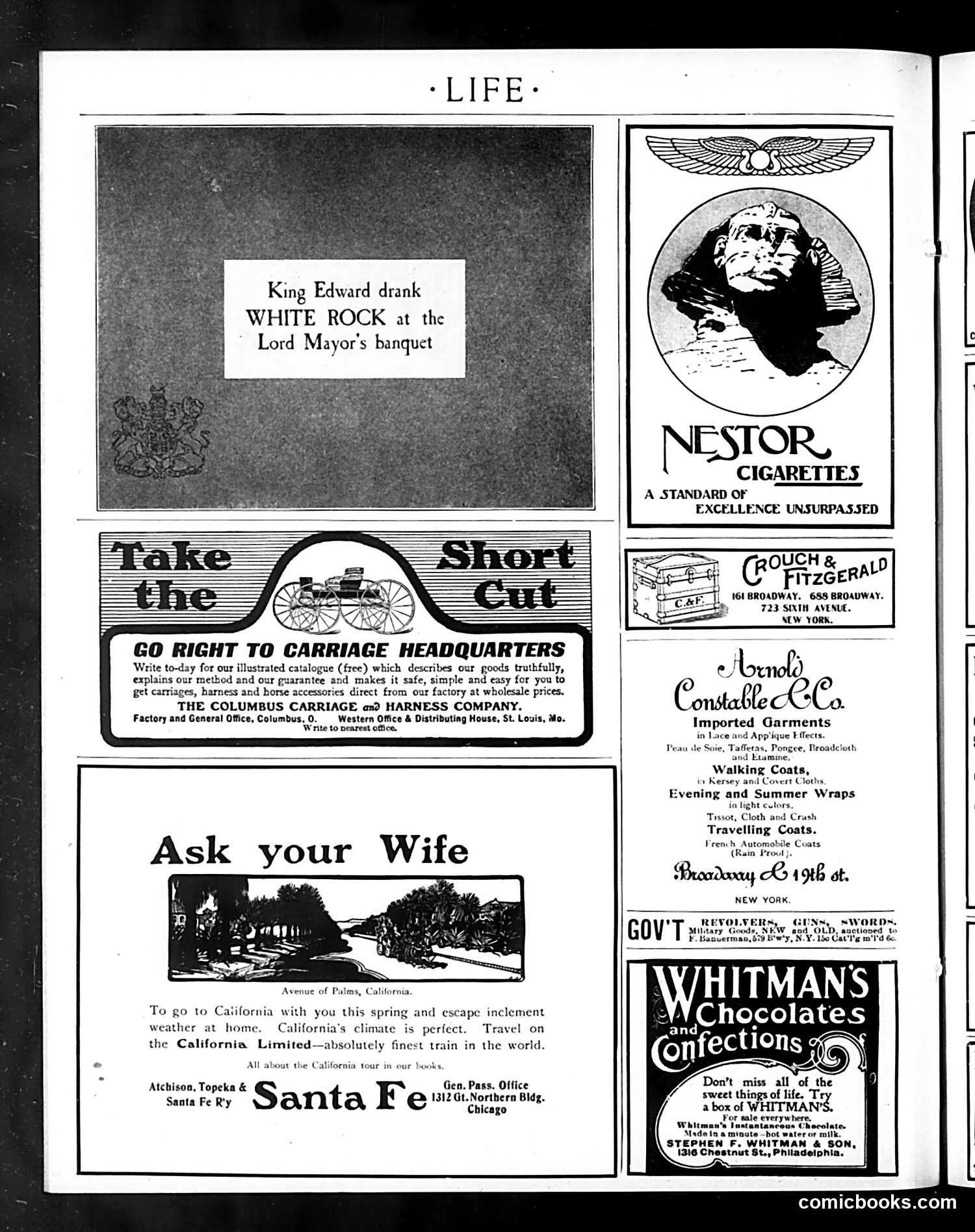
This is primarily an **advertisement page**, not a political cartoon. The main satirical content appears to be the top advertisement: "King Edward drank WHITE ROCK at the Lord Mayor's banquet." This references **King Edward VII** of Britain, likely during an actual diplomatic visit or state occasion. The humor lies in a commercial product (White Rock beverages) claiming royal endorsement—a common advertising tactic of the era. By associating the drink with a prestigious royal event, the advertiser implies that even monarchs choose their product. The page contains no political satire in the modern sense. Instead, it's a collection of period advertisements for luxury goods (carriages, cigarettes, clothing, chocolates, train travel) aimed at wealthy readers. The humor is gentle and commercial rather than biting social commentary—typical of Life magazine's advertising content during this era.
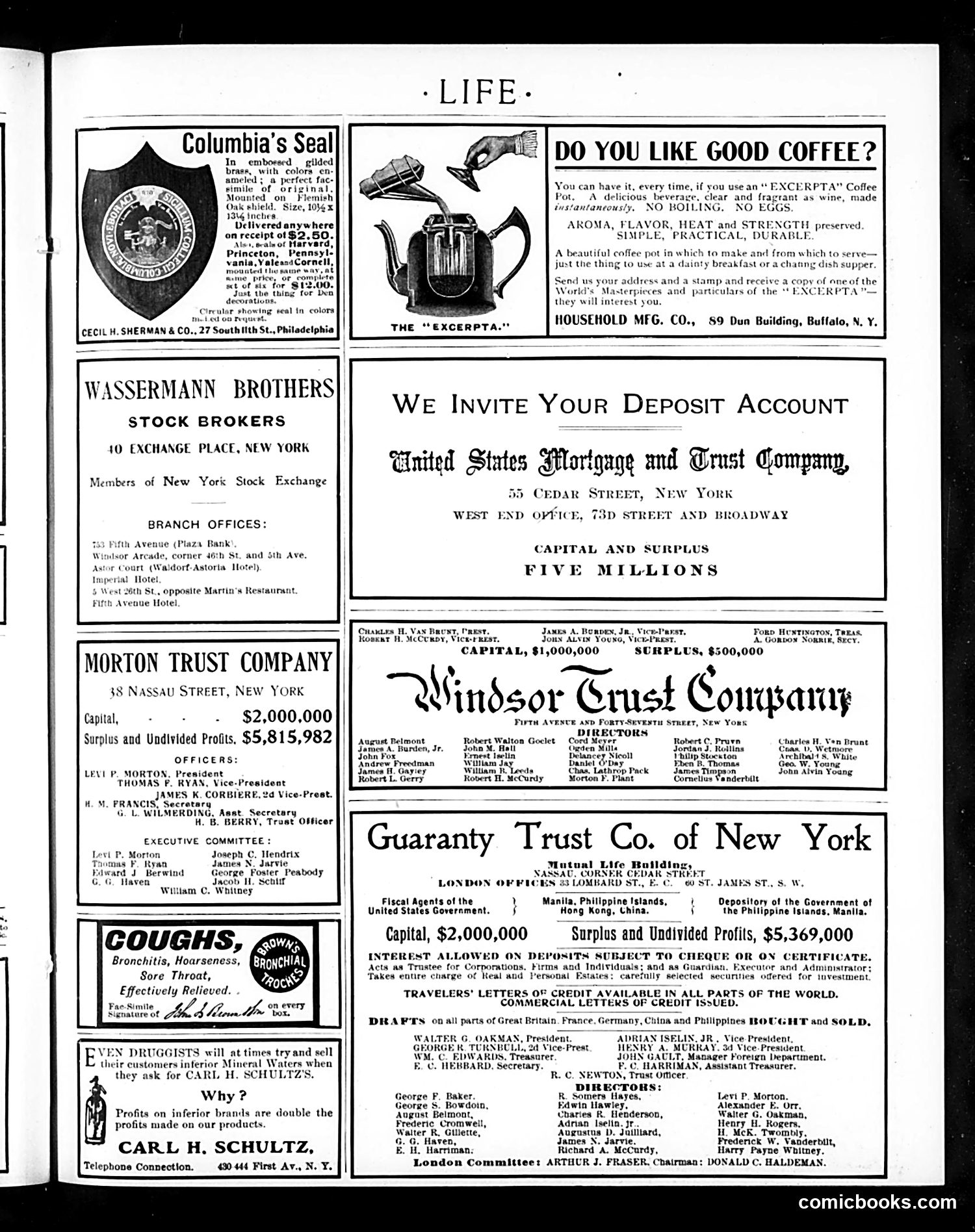
This page is primarily **advertising content** rather than editorial cartoons or satire. It features financial institutions and consumer products marketed to wealthy readers of *Life* magazine in the early 20th century. The ads showcase established New York financial firms—Morton Trust Company, Wassermann Brothers (stock brokers), Windsor Crust Company, Guaranty Trust Co.—emphasizing capital, surplus, and stability. There's also an ad for the "Excerpta" coffee pot, promoted as convenient and practical for domestic use. The only satirical element appears in the Carl H. Schultz mineral water ad, which employs humor: it uses a rhetorical "Why?" to explain that inferior brands are more profitable, suggesting unscrupulous merchants might deceive customers. The cough remedy ad below uses mild humor about "even druggists." Overall, the page reflects *Life's* era as a magazine for affluent Americans, mixing entertainment with targeted advertising for financial services and consumer goods aimed at that demographic.
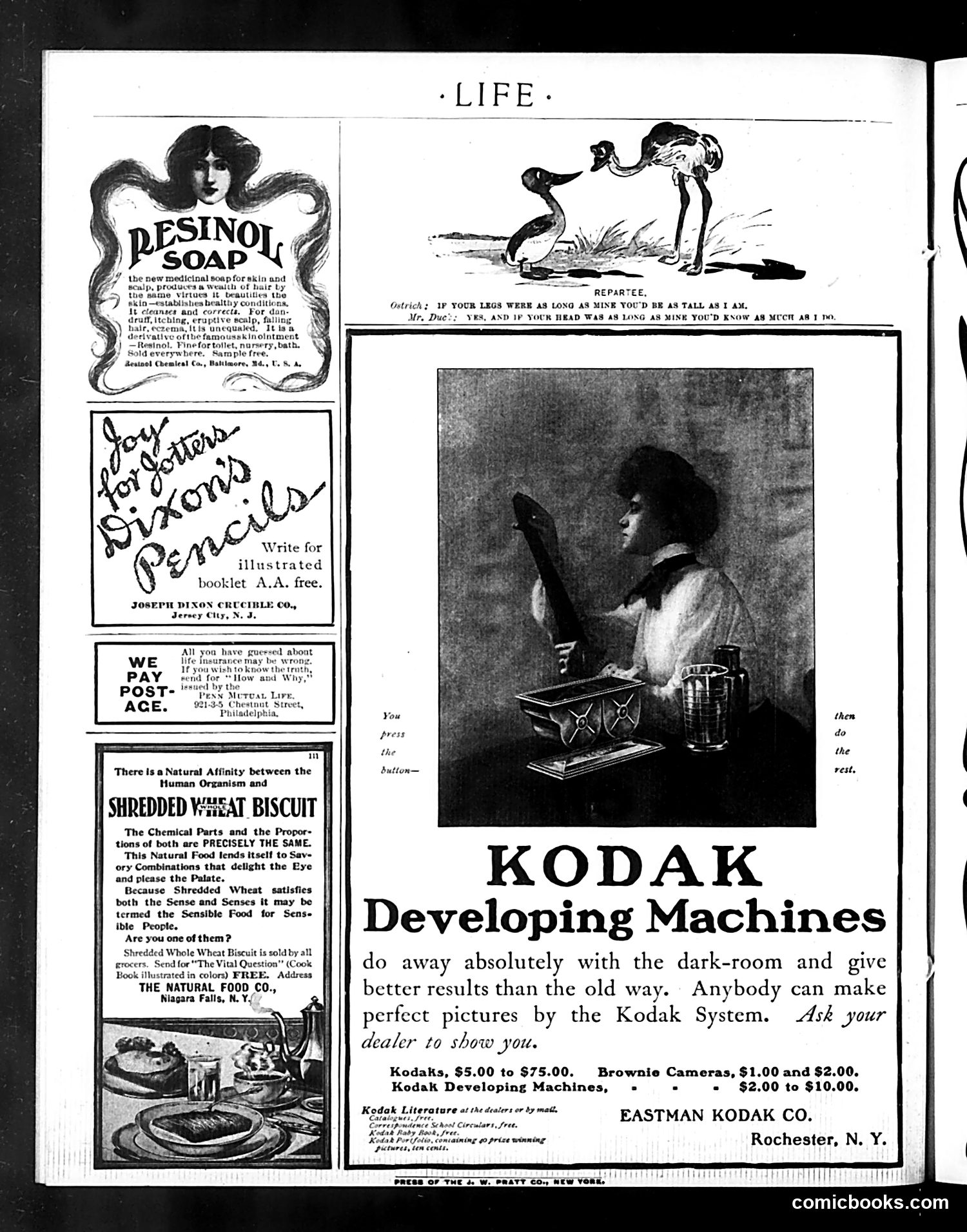
This page is primarily **advertisements** interspersed with one small cartoon. The cartoon titled "REPARTEE" depicts an ostrich and a man in a brief insulting exchange about physical proportions—the ostrich mocks the man's short legs, and the man retorts by insulting the ostrich's small brain. It's a simple joke playing on the ostrich's reputation (then common) as a stupid bird, with the humor deriving from the man's witty comeback rather than political or social commentary. The page otherwise contains product advertisements typical of early 20th-century Life magazine: Desinol Soap, Dixon Pencils, Life Insurance, Shredded Wheat Biscuit (with pseudo-scientific claims about chemical similarity to human bodies), and notably, **Kodak Developing Machines**—promoting their new technology that eliminated the need for darkrooms, marketed as democratizing photography to ordinary consumers.
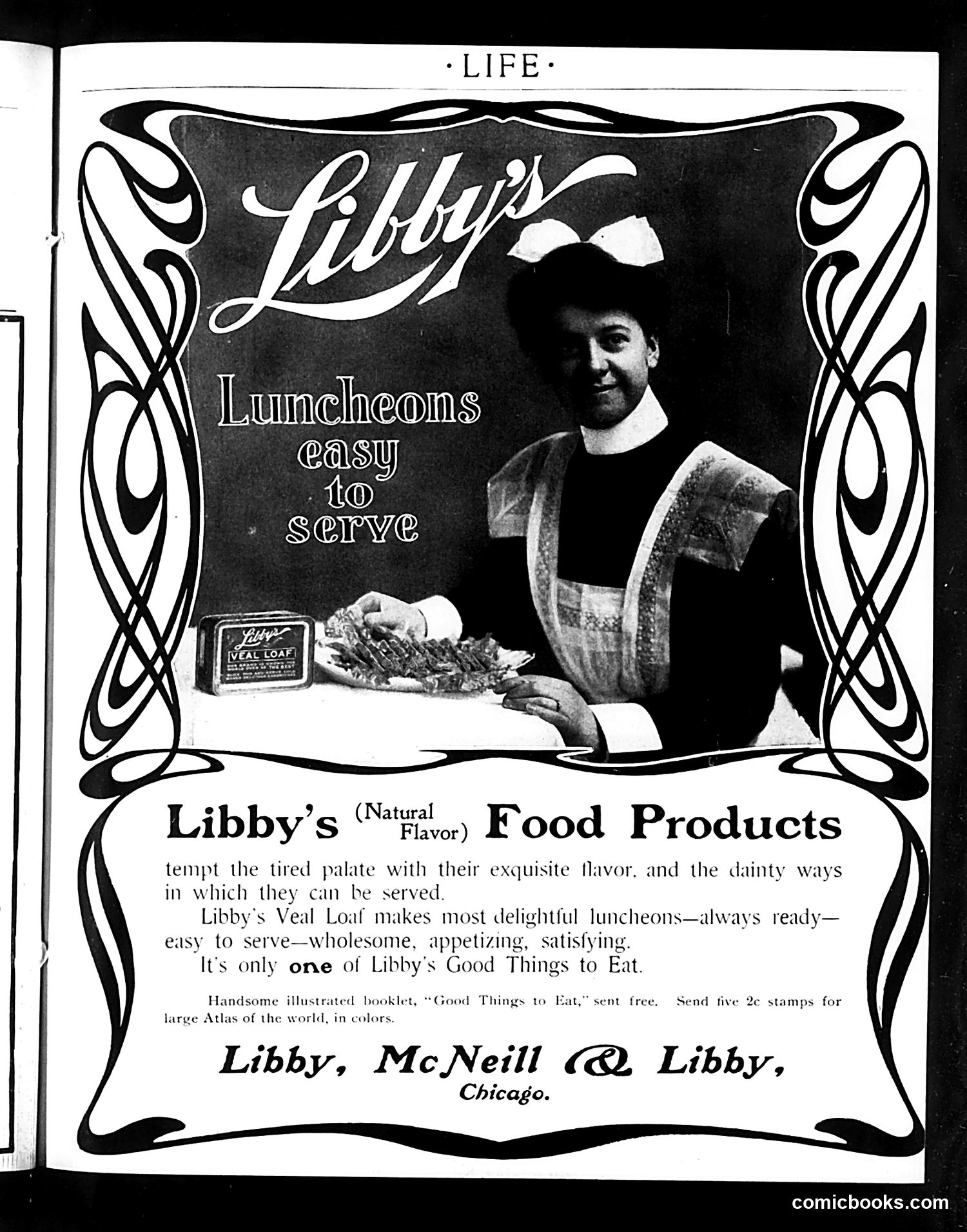
This is a **product advertisement**, not political satire. It's a Libby's (Natural Flavor) Food Products ad featuring a woman in early 20th-century attire serving what appears to be veal loaf to a guest. The ad's appeal is straightforward: it promises convenient, elegant dining. The headline "Lunches easy to serve" and accompanying text emphasize that Libby's pre-made veal loaf requires minimal preparation while appearing impressive to guests—"wholesome, appetizing, satisfying." The ornate Art Nouveau border and formal presentation suggest this targets middle-class homemakers wanting to appear refined without extensive cooking labor. The offer of a free illustrated booklet ("Good Things to Eat") was typical period marketing. This reflects early 20th-century food industry innovation: canned/processed meats presented as modern convenience that maintained social respectability.
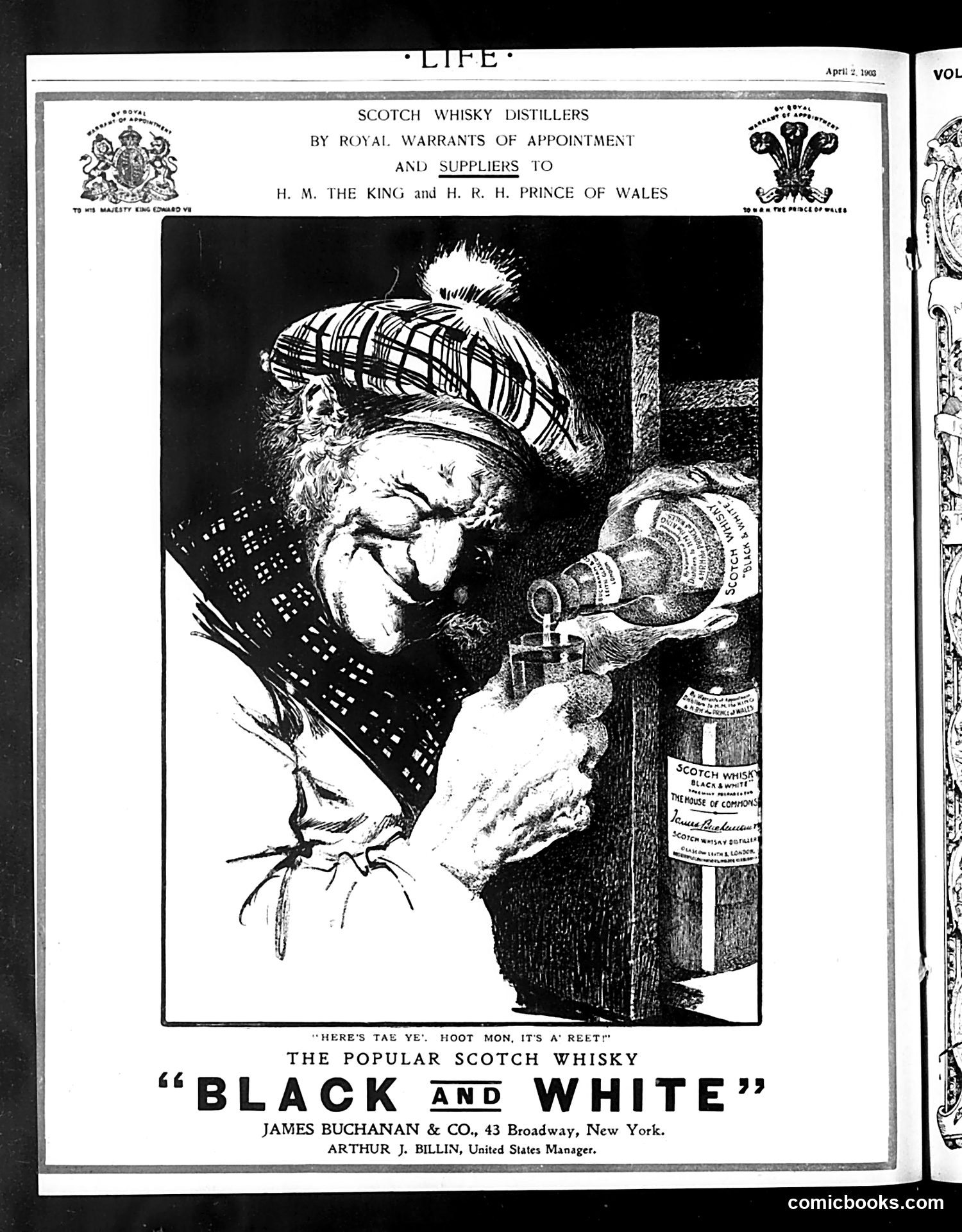
This is a **whisky advertisement**, not political satire. It promotes "Black and White" Scotch whisky by James Buchanan & Co. The image depicts a **stereotypical Scottish Highlander** in exaggerated caricature—wearing a tartan cap with pom-pom, sporting a large beard, and dressed in traditional Highland garb. He's pouring whisky from a bottle into a glass while uttering mock-Scottish dialect: "Here's tae ye'. Hoot mon, it's a' reet!" (approximately: "Here's to you. Listen here, it's alright!") The advertisement emphasizes royal credentials—claiming appointment as supplier to the King and Prince of Wales, displayed via royal warrant emblems at the top. **For modern readers**: This relies on heavy ethnic stereotyping common in early-20th-century advertising, using exaggerated Scottish caricature to market whisky. The "authenticity" appeal derived from playing up Scottishness. The royal warrants lent legitimacy and prestige to the product.