
Life, 1903-04-02 · page 6 of 36
Life — April 2, 1903 — page 6: what you’re looking at
What you’re looking at
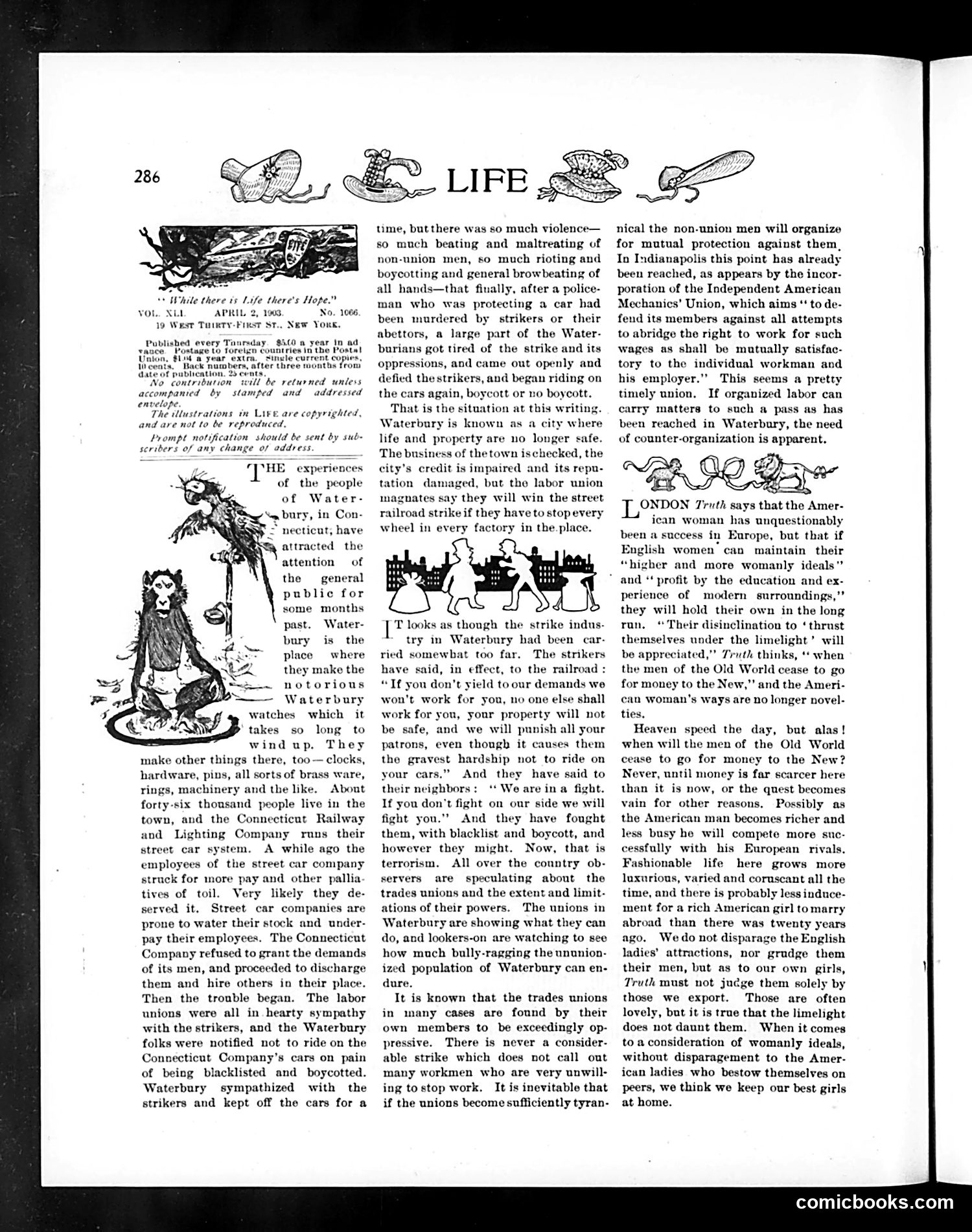
This page discusses the Waterbury, Connecticut labor strike, where union workers demanded better conditions from the Connecticut Railway and Lighting Company. The left cartoon depicts a ragged, distressed figure—likely representing the striking workers or the town itself—trapped in a noose labeled "Waterbury," suggesting the strike has become economically catastrophic. The text criticizes both sides: the unions for using "blacklist and boycott" tactics and violence against non-union workers, and the company for refusing reasonable demands. The commentary suggests the strike has spiraled into terrorism, harming innocent citizens and property while failing to achieve union goals. The page represents Life magazine's skeptical, centrist position on labor disputes—criticizing union militancy while acknowledging legitimate worker grievances.
📄 Transcribed text from this page (OCR, searchable)
Machine-transcribed from the original scan — historical spelling and the odd misread are preserved.
While there ts Life there's Hope.” ua 1908. No. 1066, 19 West Taimty-Fiest St.. New Yous, Ul be returned untes stamped and addressed contribution accompanied by envelope. The illustrations in Live are copyrighted, and are not to be reproduced. Prompt notification should be sent by sub- seribers of any change of address YHE experiences of the people of Water- “» bury, in Con- > necticut, have attracted the attention of the general public for some months past. Water- bury is the place where they make the notorious Waterbury watches which it takes so long to windup. They make other things there, too— clocks, hardware, pins, all sorts of brass ware, rings, machinery and the like. About forty-six thousand people live in the town, and the Connecticut Railway and Lighting Company runs their street car system. A while ago the employees of the street car company struck for more pay and other pallia tives of toil. Very likely they de- served it. Street car companies are prone to water their stock and under- pay their employees. The Connecticut Company refused to grant the demands of its men, and proceeded to discharge them and hire others in their place. Then the trouble began. The labor unions were all in hearty sympathy with the strikers, and the Waterbury folks were notified not to ride on the Connecticut Company's cars on pain of being blacklisted and boycotted. Waterbury sympathized with the strikers and kept off the cars for a ume, butthere was so much violence— so much beating and maltreating of non-union men, so much rioting and boycotting and general browbeating of all hands—that finally, after a police- man who was protecting a car had been murdered by strikers or their abettors, a large part of the Water- burians got tired of the strike and its oppressions, and came out openly and defied the strikers, and began riding on the cars again, boycott or no boycott. That is the situation at this writing. Waterbury is known as a city where life and property are no longer safe. The business of the town ischecked, the city’s credit is impaired and its repu- tation damaged, but the labor union magnates they will win the street railroad strike if they have to stopevery wheel in every factory in the.place. I T looks as thongh the strike indus- try in Waterbury had been car- ried somewhat too far, The strikers have said, in effect, to the railroad : “If you don't yield to our demands we won't work for you, no one else shall work for you, your property will not be safe, and we will punish all your patrons, even though it causes them the gravest hardship not to ride on your cars,” And they have said to their neighbors “We areina fight. If you don't fight on our side we will fight you.” And they have fought them, with blacklist and boycott, and however they might. Now, that is terrorism. All over the country ob- servers are speculating about the trades unions and the extent and limit- ations of their powers. The unions in Waterbury are showing what they can do, and lookers-on are watching to see how much bully-ragging the ununion- ized population of Waterbury can en- dure. It is known that the trades unions in many cases are found by their own members to be exceedingly op- pressive. There is never a consider- able strike which does not call out many workmen who are very unwill- ing to stop work. It is inevitable that if the unions become sufficiently tyran- nical the non-union men will organize for mutual protection against them, In Indianapolis this point has already been reached, as appears by the incor- poration of the Independent American Mechanics’ Union, which aims ‘* to de- fend its members against all attempts to abridge the right to work for such wages as shall be mutually satisfac- tory to the individual workman and his employer.” This seems a pretty timely union, If organized labor can carry matters to such a pass as has been reached in Waterbury, the need of counter-organization is apparent. Toxpos Truth says that the Amer- ican woman unquestionably been a success in Europe, but that if English women’ can maintain their “higher and more womanly ideals” "and “profit by the education and ex- perience of modern surroundings,” they will hold their own in the long ran, ‘ Their disinclination to ‘thrust themselves under the limelight’ will be appreciated,” Truth thinks, ‘ when the men of the Old World cease to go for money to the New,” and the Ameri- can woman's ways are no longer novel- ties. Heaven speed the day, but alas ! when will the men of the Old World cease to go for money to the New? Never, until money is far scarcer here than it is now, or the quest becomes vain for other reasons. Possibly as the American man becomes richer and. less busy he will compete more sue- cessfully with his European rivals. Fashionable life here grows more luxurious, varied and coruscant all the time, and there is probably less induce- ment for a rich American girl tomarry abroad than there was twenty years ago. Wedo not disparage the English ladies’ attractions, nor gradge them their men, but as to our own girls, Truth must not juége them solely by those we export. Those are often lovely, but it is true that the limelight does not daunt them. When it comes to a consideration of womanly ideals, without disparagement to the Amer- ican ladies who bestow themselves on peers, we think we keep our best girls at home. comicbooks.com