
A complete issue · 26 pages · 1903
Life — March 12, 1903
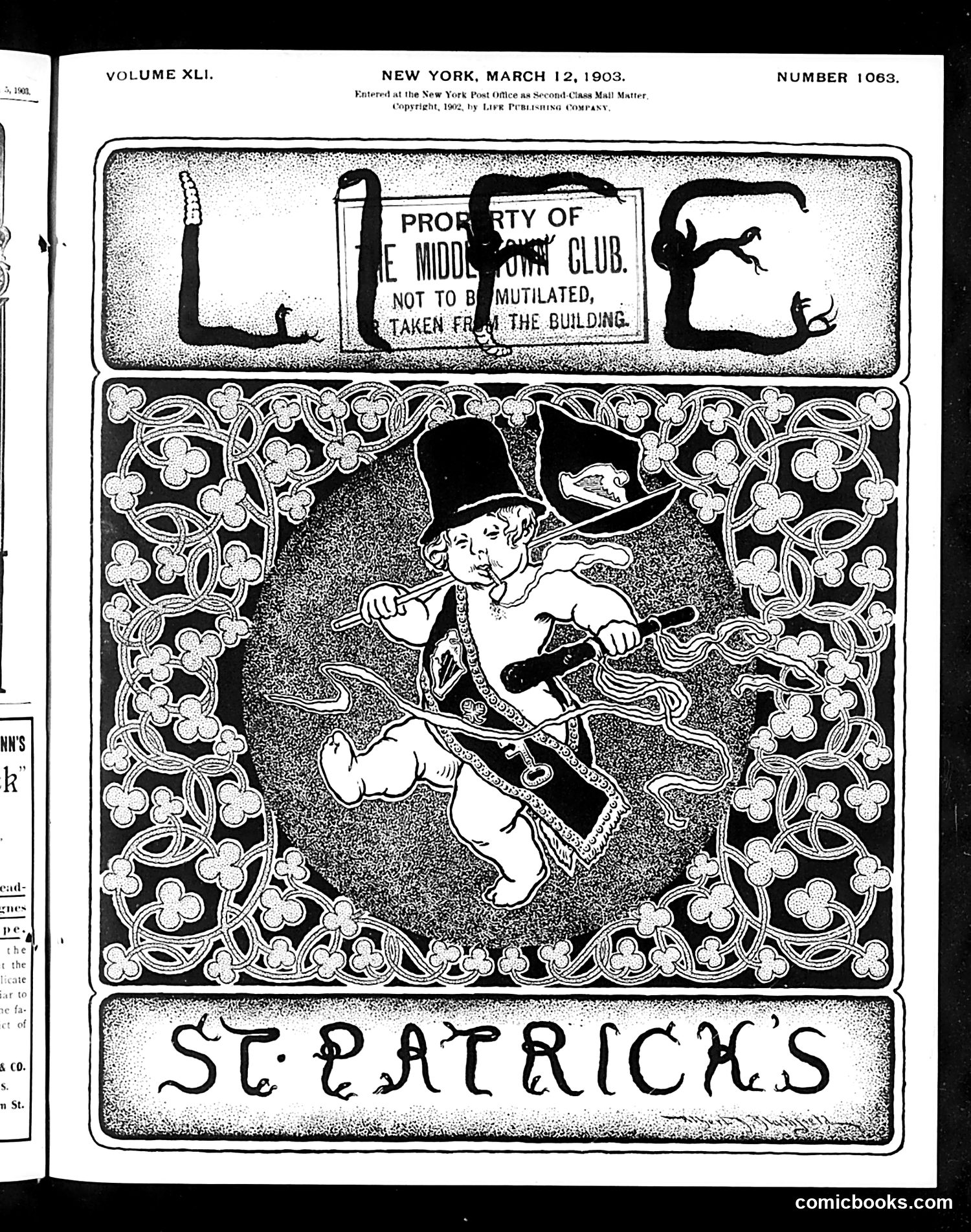
This is a St. Patrick's Day-themed cover featuring a cherubic figure dressed in formal attire (top hat, tailcoat) holding what appears to be a shillelagh (traditional Irish walking stick). The decorative border contains four-leaf clovers, reinforcing the Irish holiday theme. The upper panels show silhouettes labeled "Property of the Middletown Club—Not to be mutilated, taken from the building," suggesting this image may have been displayed as a club poster or decoration. The central illustration presents an idealized, cartoonish representation of St. Patrick's Day celebration. Without additional context, the specific political or social commentary remains unclear, though the elaborate framing suggests this was likely commentary on Irish-American cultural celebration or club life in early 1900s New York.
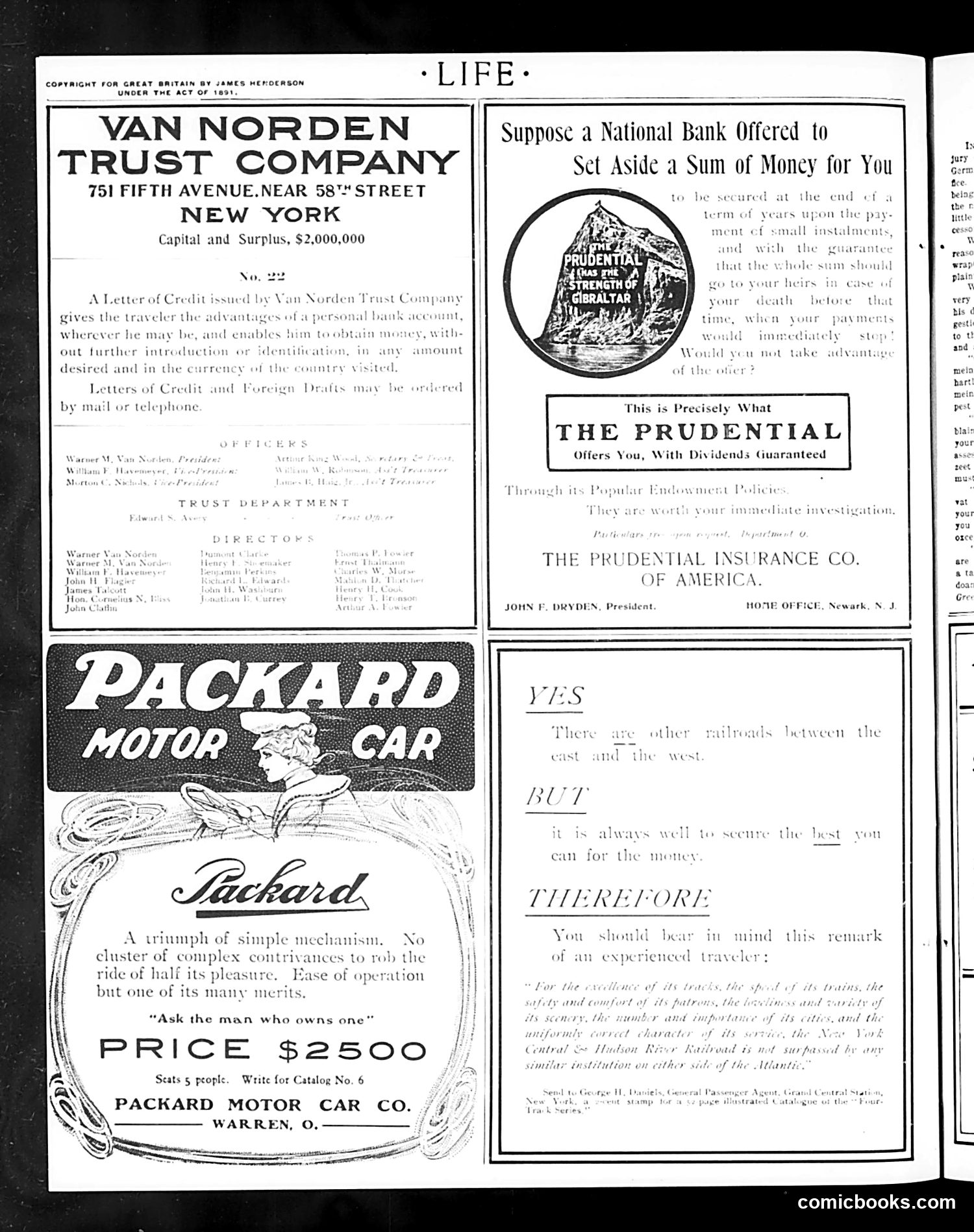
This page is **primarily advertising**, not satire or political commentary. It contains four advertisements from circa 1910s America: 1. **Van Norden Trust Company** — a financial services firm offering letters of credit for travelers 2. **Prudential Insurance Company** — promoting life insurance with guaranteed dividends, emphasizing security for heirs 3. **Packard Motor Car** — luxury automobile priced at $2,500, marketed as mechanically simple and reliable 4. **New York Central Railroad** — arguing rail travel superiority over competitors (the "YES/BUT/THEREFORE" section comparing railroads) There are no political cartoons or satirical figures visible. The page represents standard commercial messaging aimed at affluent readers—financial services, insurance, luxury goods, and transportation options typical of early 20th-century Life magazine advertising.
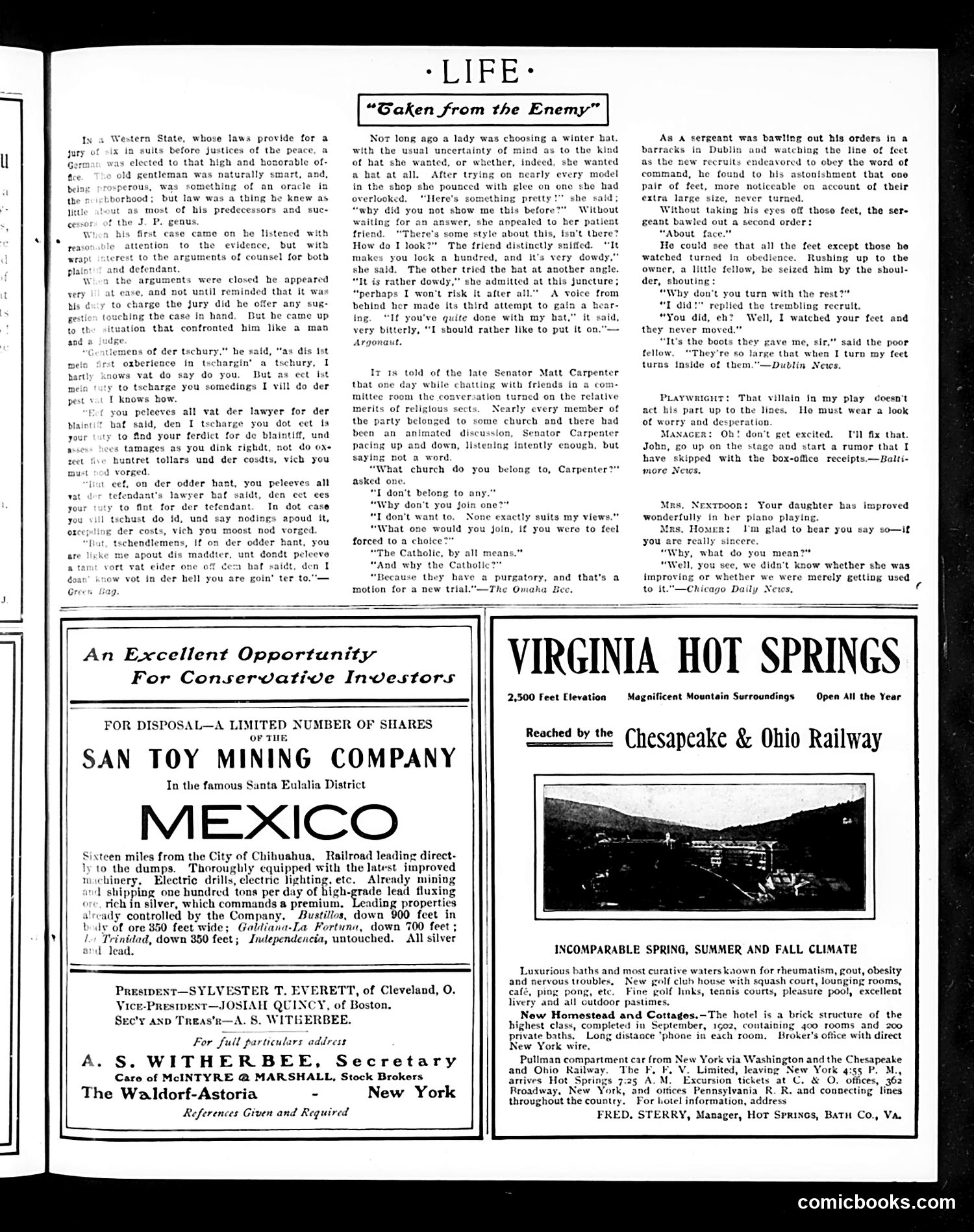
This page is primarily **advertising and humor columns**, not political cartooning. The top section contains two anecdotal humor pieces titled "Baken from the Enemy"—light satirical stories about legal arguments and social situations, typical of Life's early satirical content. The advertisements below promote: - San Toy Mining Company shares (investment opportunity in Mexico) - Virginia Hot Springs resort (accessible via Chesapeake & Ohio Railway) The humor relies on wordplay and social observation rather than political commentary. Without dated context, the specific references in the anecdotes are difficult to pin down precisely, though they appear to mock courtroom pomposity and social pretension—consistent with Life magazine's general satirical mission of mocking American institutions and behavior.
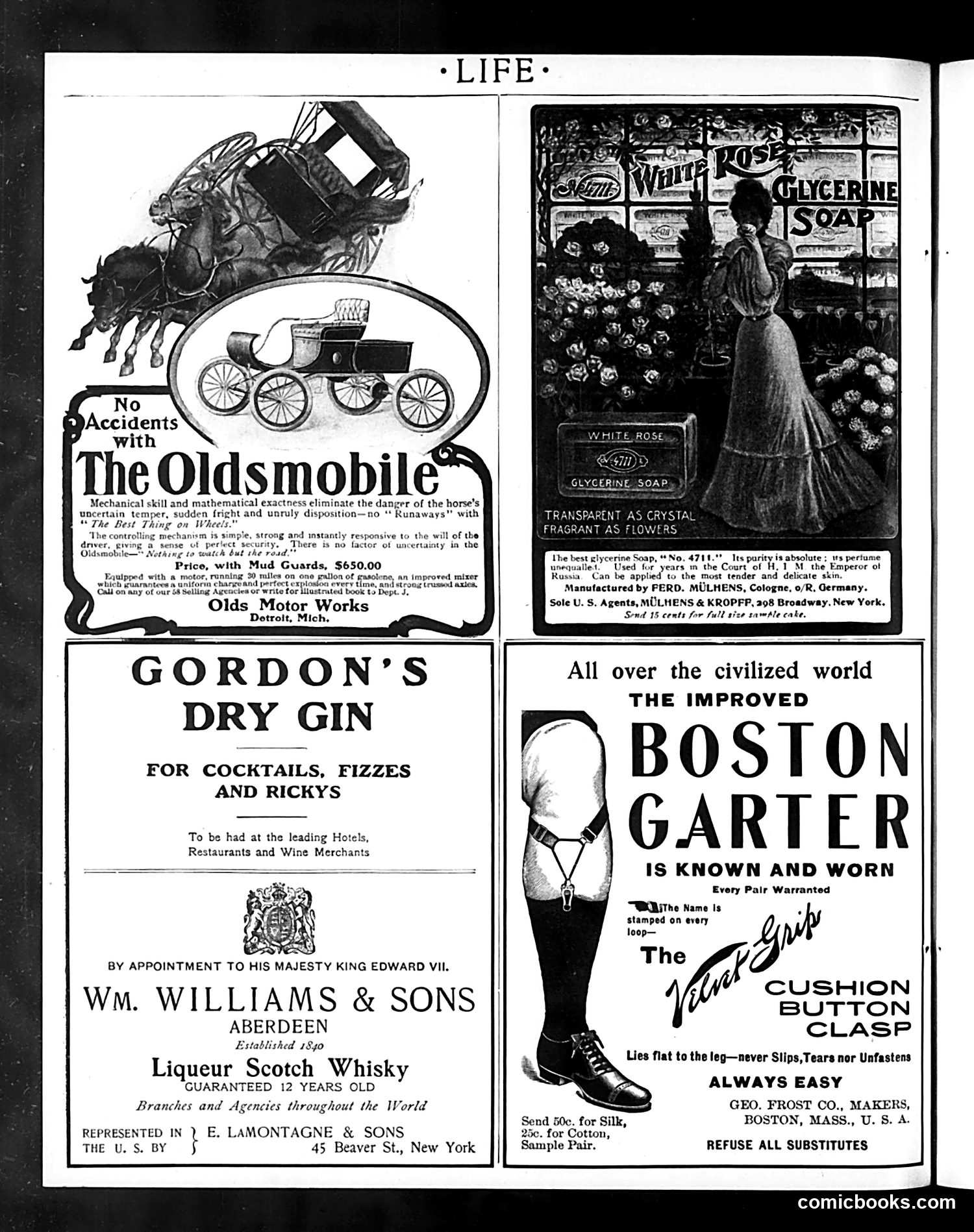
This page is **primarily advertising** with no political cartoons or satirical content. The top-left features an **Oldsmobile automobile ad** emphasizing safety—highlighting how the vehicle's design "eliminates the dangers of the horse's uncertain temper, sudden fright and unruly disposition." This reflects early automotive marketing that positioned cars as superior to horse-drawn carriages. Other advertisements include: - **White Rose Glycerine Soap** (top-right) - **Gordon's Dry Gin** (lower-left) - **Boston Garter** hosiery with a "Viaduct Cushion Button" (lower-right) - **Wm. Williams & Sons** Scotch whisky (lower-left) The page represents typical early 20th-century Life magazine content: consumer goods marketed to affluent readers through appeals to modernity, quality, and social status.
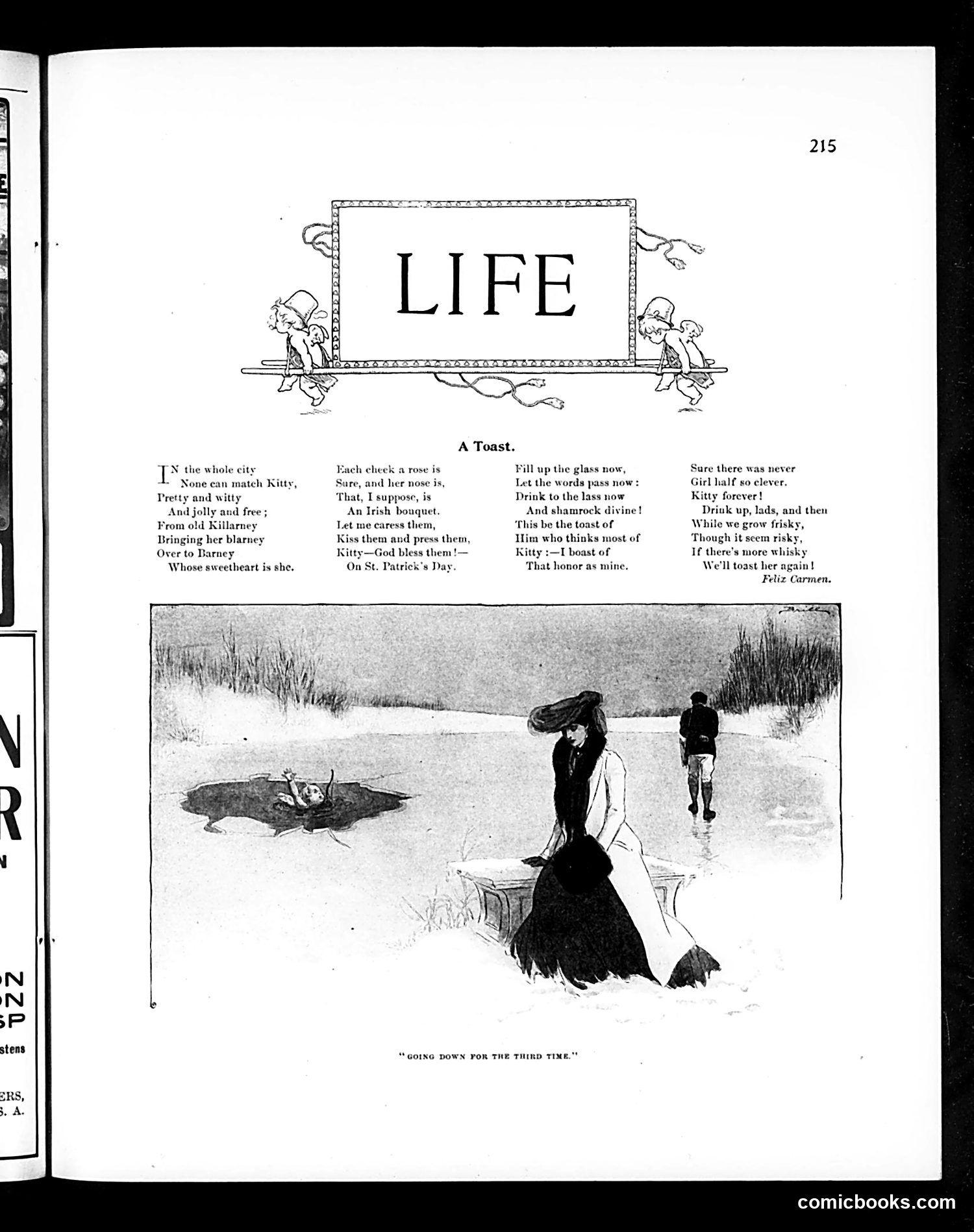
This page contains two distinct pieces: **"A Toast"** is a poem celebrating an Irish woman named Kitty, praising her beauty and spirit. It mentions St. Patrick's Day, suggesting this is Irish-themed content, likely published around that holiday. The poem's final attribution to "Feliz Carmen" indicates authorship. **The illustration below**, captioned "Going Down for the Third Time," depicts a winter scene showing a woman in dark clothing sitting by what appears to be a hole in frozen water, with two men visible in the background on the ice. This is a darkly humorous visual gag—the phrase "going down for the third time" refers to drowning, implying the woman is metaphorically drowning (likely in romantic distress or disappointment) rather than literally, as evidenced by the pastoral setting and her composed posture.
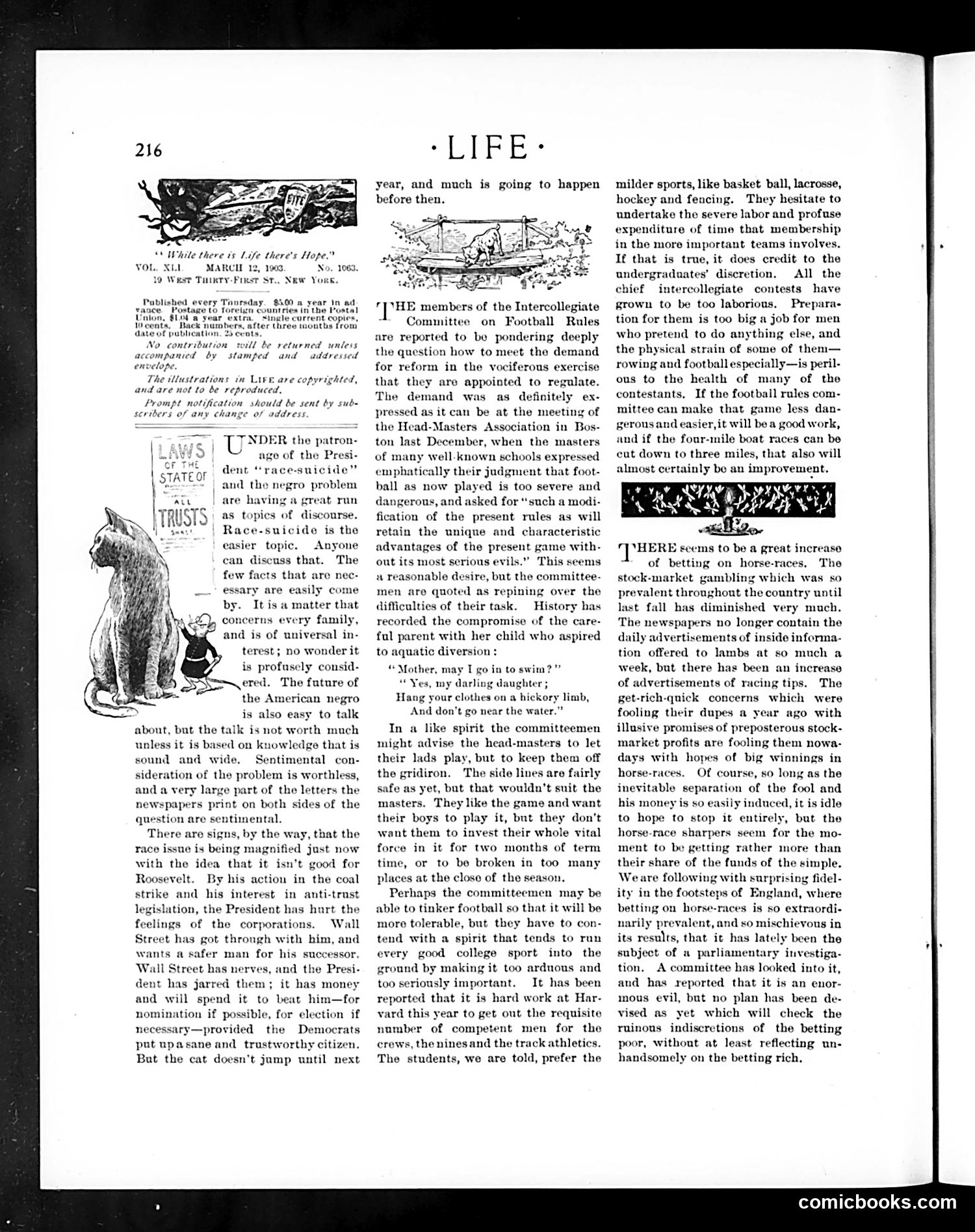
The page contains two distinct editorial items: **Left sidebar**: A small political cartoon labeled "Laws of the State of Trusts" depicts a large bear (representing monopolistic trusts/corporations) menacing a small figure. This references President Theodore Roosevelt's trust-busting agenda—a major political issue of 1903. The cartoon satirizes corporate power and Roosevelt's efforts to regulate them. **Main article**: Discusses the Intercollegiate Committee on Football Rules debating whether to reform the sport, calling it "too severe and dangerous." The text mentions concerns about excessive betting on horse-races, criticizing newspapers for running racing advertisements. Together, these items reflect early-1900s Progressive Era concerns: corporate monopolies, dangerous athletic practices, and gambling's social harms.
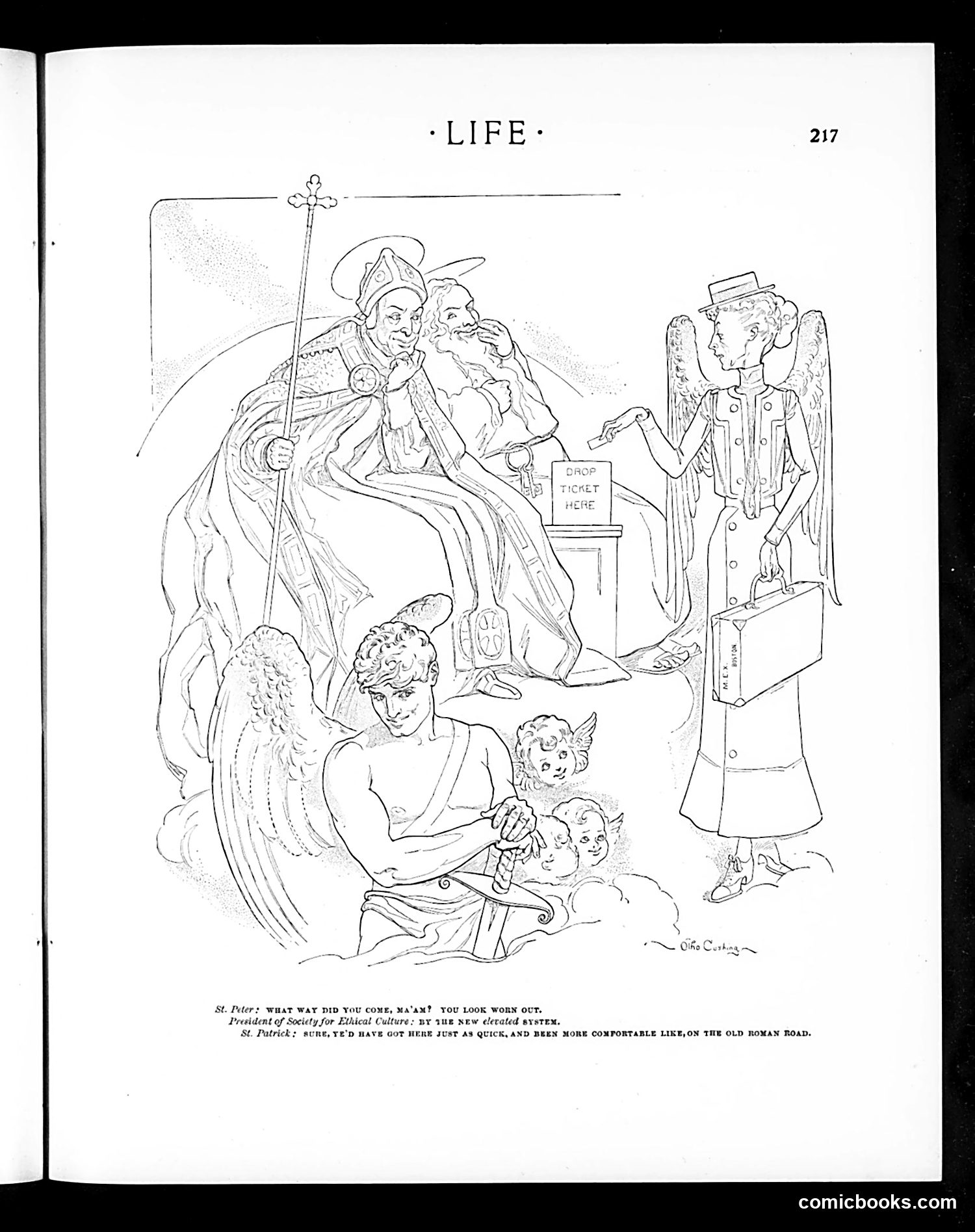
This is a satirical cartoon critiquing the "Society for Ethical Culture" and its president's vision of modernizing society. The cartoon depicts **St. Peter** (recognizable by his cross-topped staff and traditional religious garb) confronting an **angelic figure** at heaven's gate. The angel holds a sign reading "DROP TICKET HERE," suggesting a new bureaucratic system. St. Peter complains that the applicant "looks worn out," while the angel explains this is the "new elevated system." St. Patrick responds sardonically that the old Roman Road was "more comfortable." The satire mocks how progressive reformers' bureaucratic "improvements" often prove less practical than traditional methods—here comparing modern efficiency systems to outdated but reliable approaches. The religious setting emphasizes the irony of imposing such systems even in the afterlife.
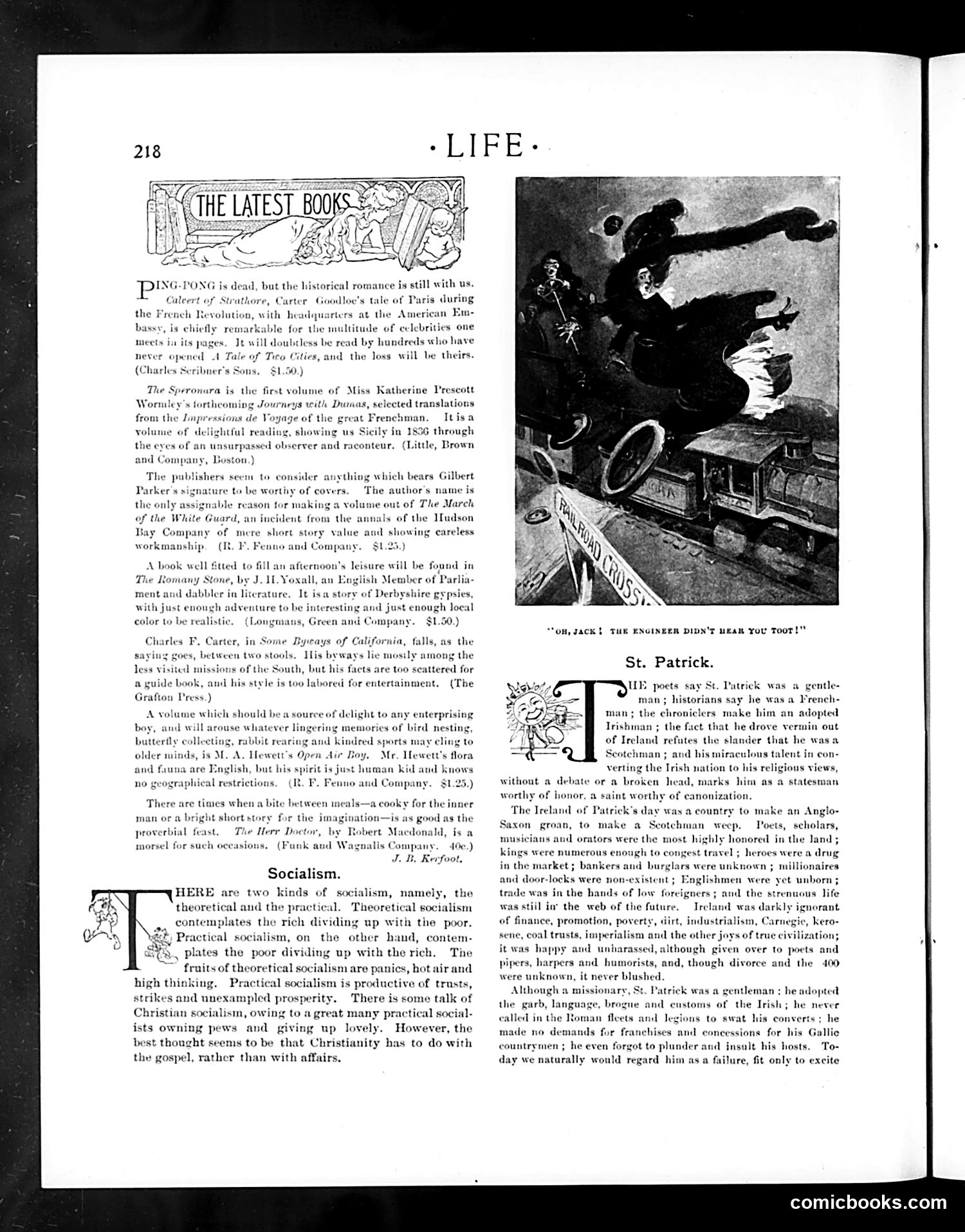
This page from *Life* magazine contains book reviews and commentary rather than political cartoons. The main image shows what appears to be a theatrical or comedic scene with the caption "Oh, Jack! The Engineer Didn't Hear You Too!" — likely illustrating a scene from reviewed literature. The page discusses several books, including works by Carter Goodloe and Katherine Prescott Wormeley. A substantial section critiques "Socialism," presenting theoretical versus practical socialism. The text argues that theoretical socialism envisions wealth redistribution, while practical socialism produces trusts and monopolies—suggesting the author viewed actual socialist implementation as corrupt and hypocritical. The "St. Patrick" section that follows appears to be a separate article about the historical saint rather than satire.
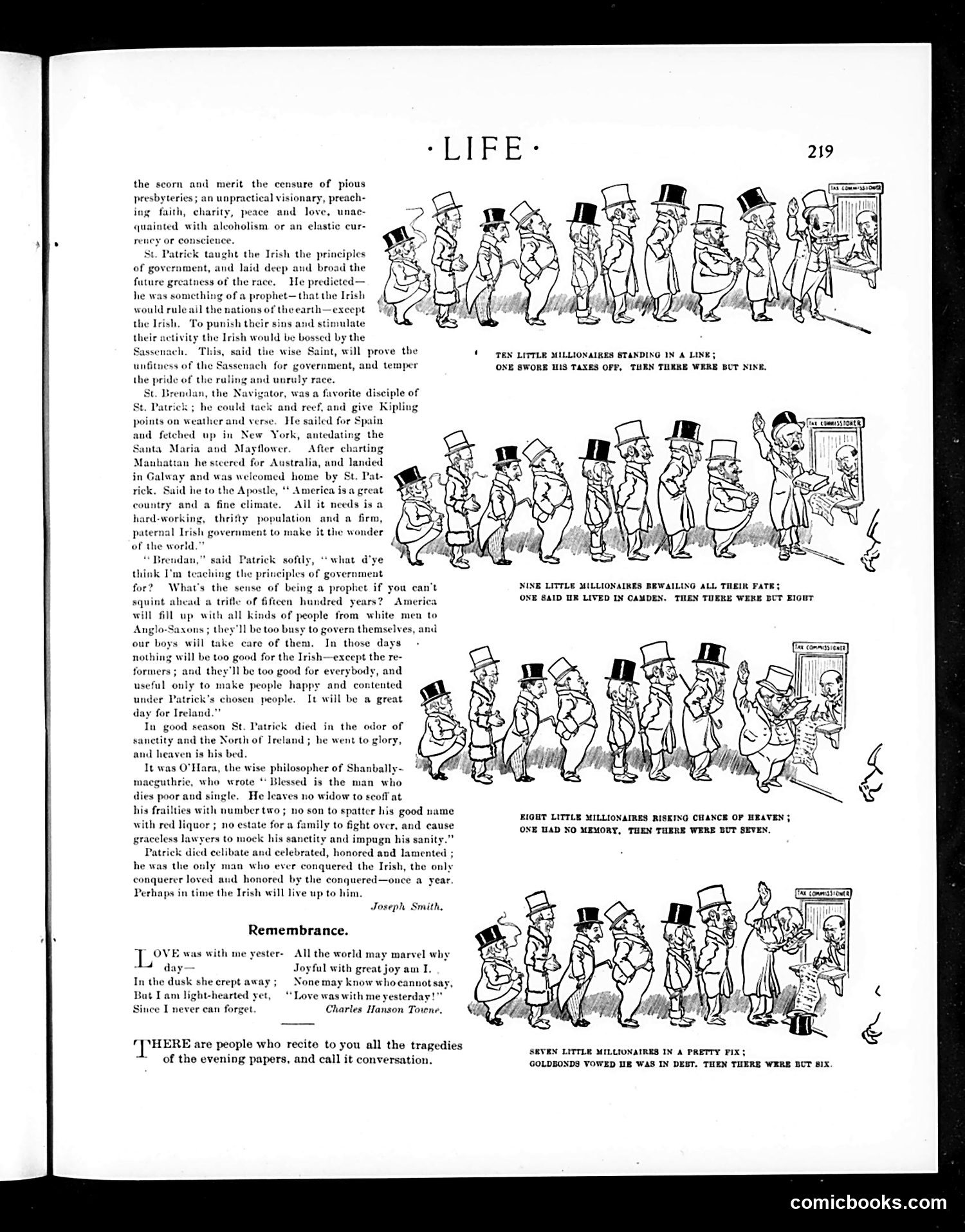
This page presents a humorous serial cartoon about Irish taxation and wealth. The repeated sequence shows ten millionaires standing in a line; one removes his hat (presumably paying taxes), leaving nine. This pattern continues through multiple panels, with each successive scene showing fewer millionaires remaining. The satire targets Irish economic policy and tax burden—specifically, how taxation progressively reduces the wealthy population. The joke's dark humor suggests that taxing the rich so heavily drives them away or into poverty, eliminating the very class that generates wealth. The accompanying text discusses St. Patrick and Irish governance, establishing the cartoon as commentary on contemporary Irish economic challenges and government fiscal policy.
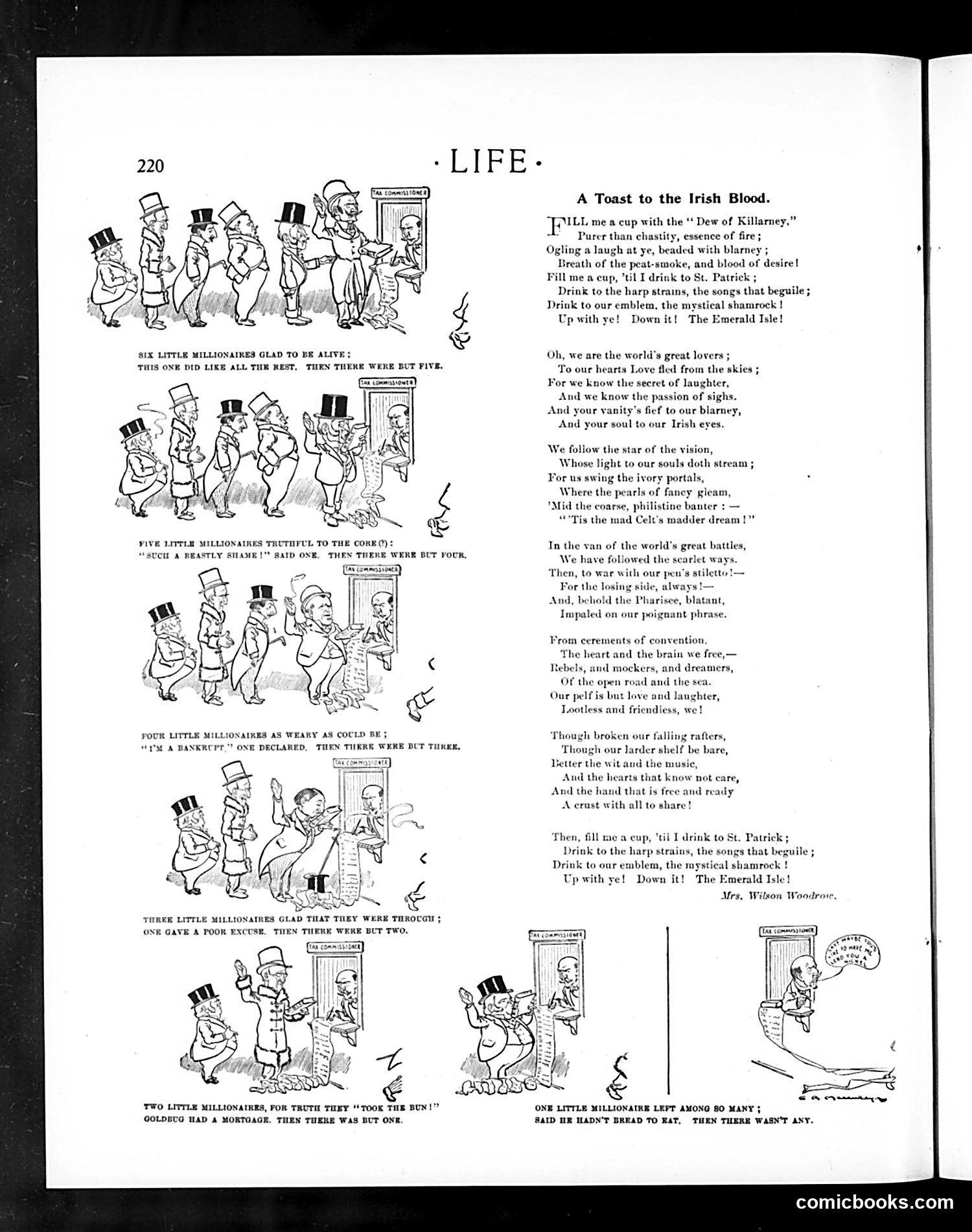
The left side presents a serialized joke about Irish immigrants ("little millionaires"). The cartoon depicts six figures progressively losing wealth through bad decisions—starting with six alive, then five, four, three, two, and finally one left with no bread. Each panel shows them at a door (marked with what appears to be a pawnbroker sign), suggesting they're pawning possessions. The right side is "A Toast to the Irish Blood," a poem by Mrs. Wilson Woodrow celebrating Irish identity, passion, love, and rebellion against convention. It romanticizes Irish characteristics: "rebels and mockers and dreamers, / Of the open road and the sea." The contrast is stark: the cartoons mock Irish immigrants as poor and financially reckless, while the poem simultaneously celebrates Irish culture as noble and romantic. This reflects period ambivalence toward Irish-American communities—simultaneously caricatured as foolish yet idealized as spirited.
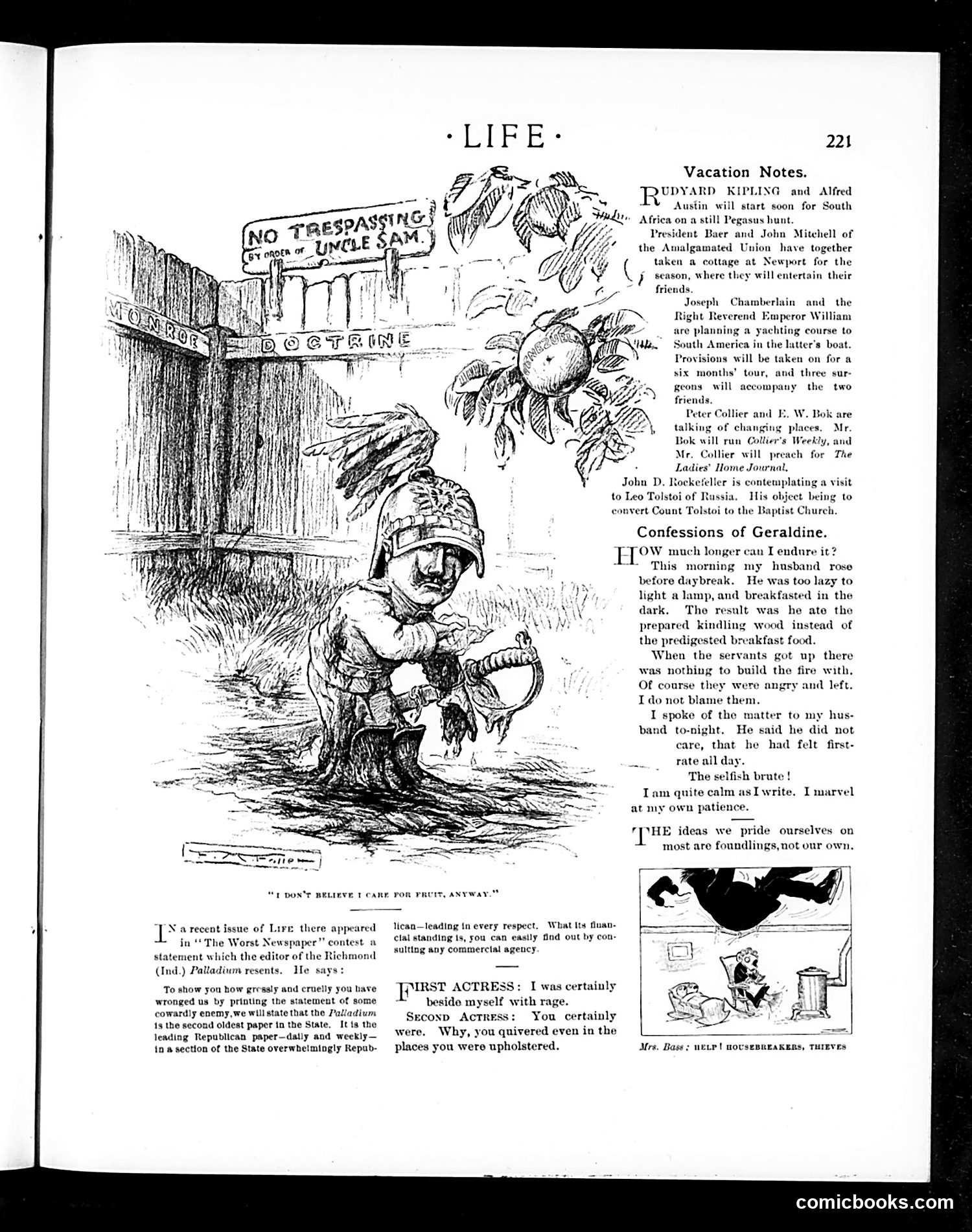
The main cartoon depicts a soldier in a military helmet standing in mud, saying "I don't believe I care for fruit, anyway." This appears to be satirizing military hardship and food deprivation during wartime—the soldier is resigned to doing without provisions rather than complaining. The page also contains "Vacation Notes" mentioning various society figures (Kipling, Rockefeller, etc.) taking leisure trips, and "Confessions of Geraldine," describing domestic frustrations with an inconsiderate husband who rose before dawn and left the household unprepared. The bottom section shows a dispute between two actresses about who was more ill-mannered in public spaces, captioned "Mrs. Bass: Help! Housebreakers, Thieves." The satire contrasts soldiers' sacrifice with the leisured complaints of the comfortable classes.
This is a satirical illustration from Life magazine (copyright 1901, per visible text). The cartoon depicts a classical allegorical scene: winged figures (appearing to represent abstract concepts or goddesses) are lifting a formally-dressed man upward toward clouds and cherubs. The style suggests this is **political or social satire** about elevation, success, or promotion—likely commenting on a contemporary public figure being "lifted up" by various forces or influences. The man's formal attire and the classical artistic treatment suggest he represents someone of social importance. Without additional caption text visible on this page, I cannot definitively identify the specific figure or precise political reference. The satire appears to mock either undeserved elevation or the various social/political forces conspiring to promote someone.
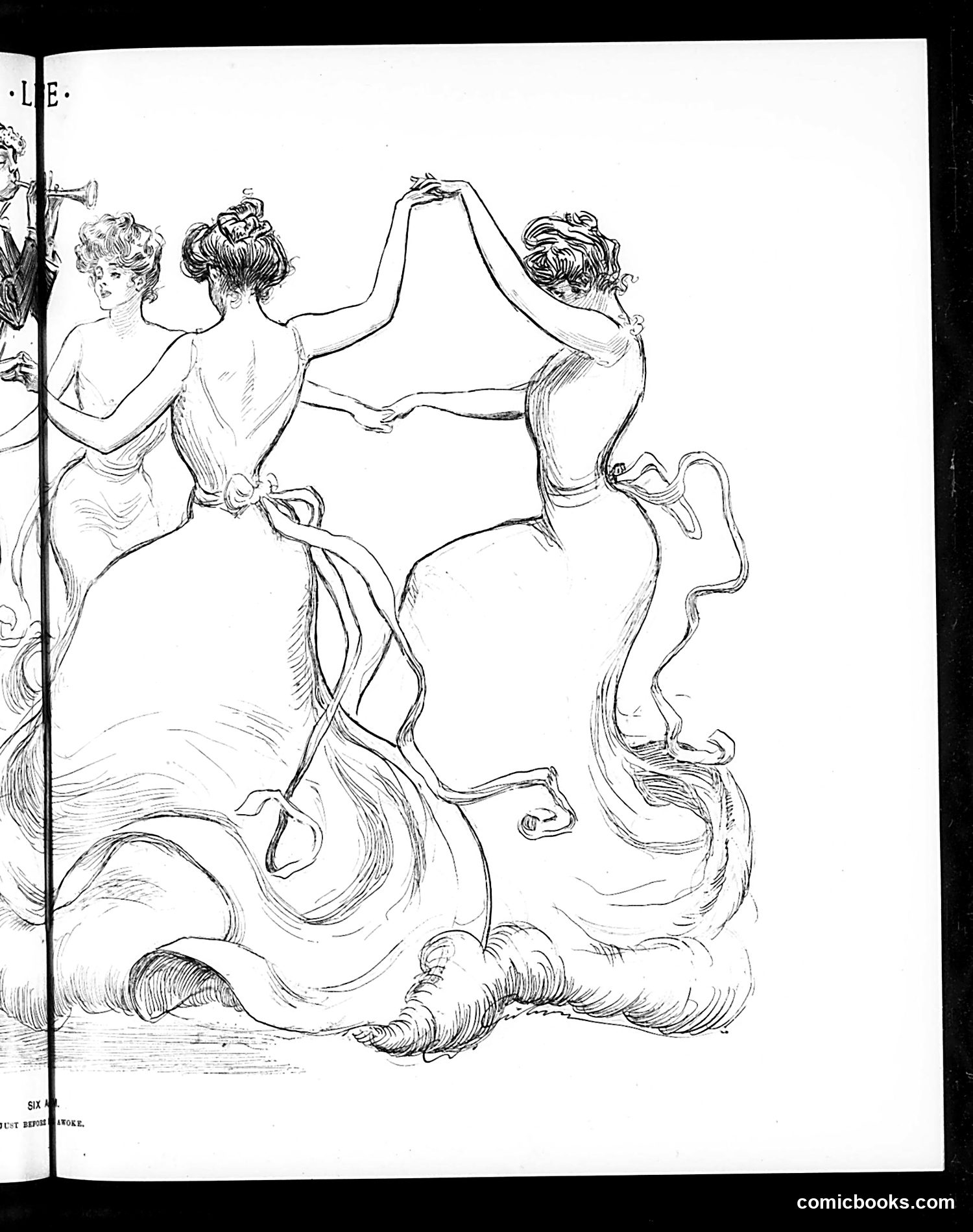
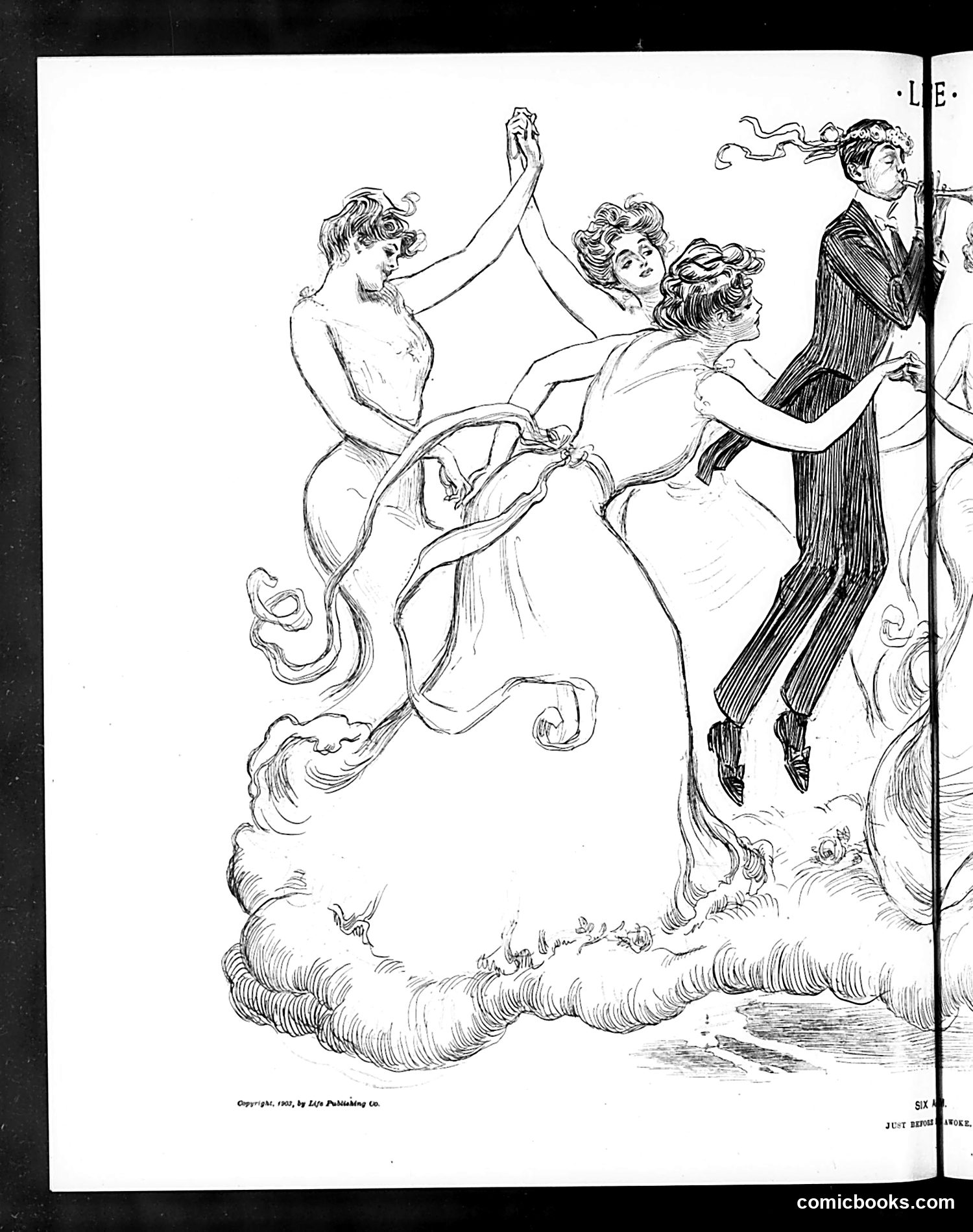
I can see this is a pen-and-ink satirical illustration from Life magazine showing three women in elaborate Edwardian-era dress engaged in what appears to be a playful or dramatic interaction. The women have styled hair typical of the early 1900s, and their garments feature flowing fabrics and ribbons. However, the OCR text is too corrupted to read clearly ("yest Brmit Brox" appears to be garbled), making it impossible to identify the specific political or social reference, the particular figures being caricatured, or the intended satirical point. Without legible caption text or title, I cannot determine what contemporary issue or personalities this cartoon addresses. The artistic style and fashion indicate early-to-mid 1900s publication, but the specific satire remains unclear from the image alone.
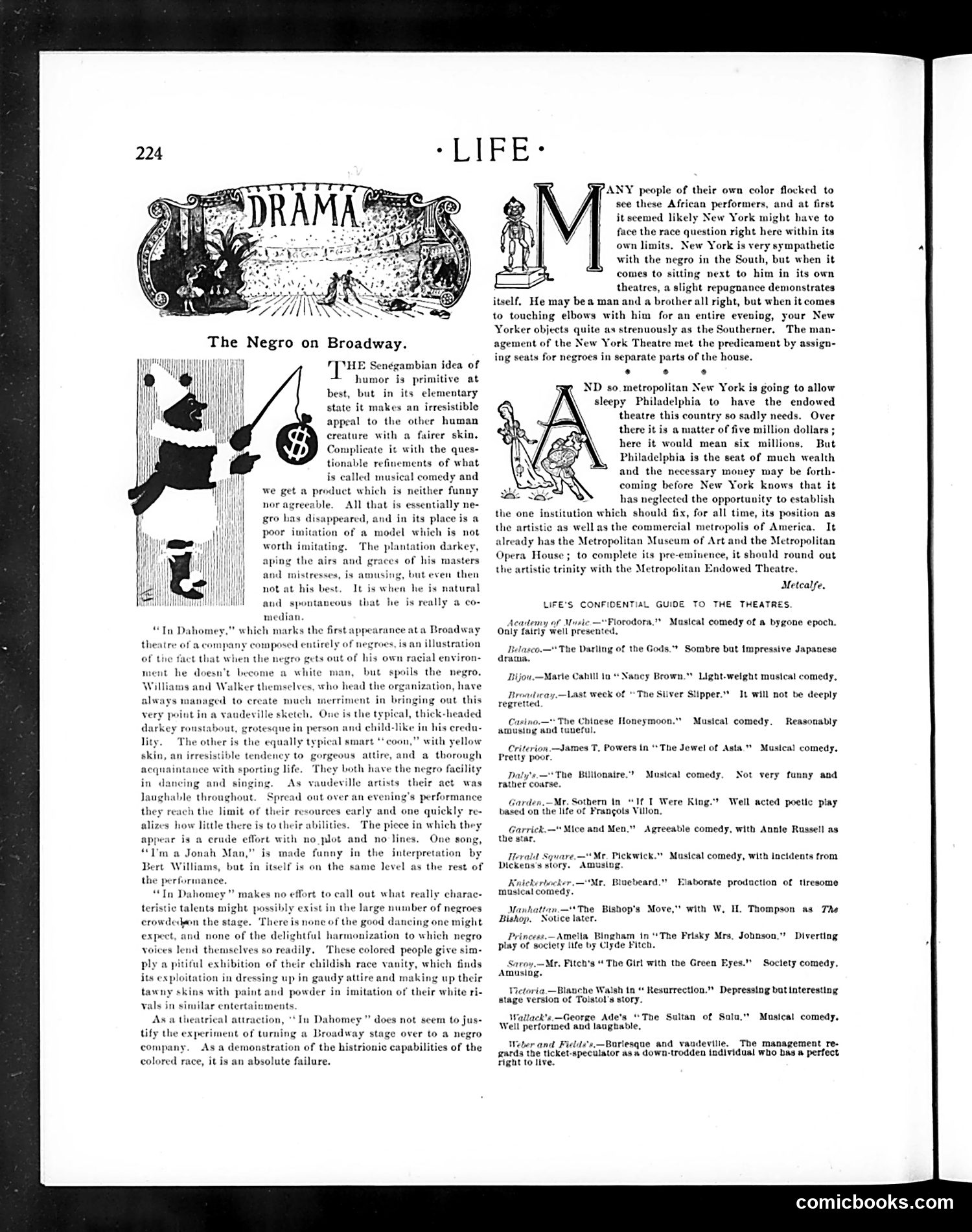
This article reviews "In Dahomey," an all-Black Broadway musical featuring performers Williams and Walker. The author expresses racist condescension typical of early 1900s white criticism: he argues that Black humor works only in "primitive" plantation contexts, and that when Black performers attempt sophisticated musical comedy, they fail because they're imitating white models rather than remaining "authentically" crude. The cartoon (left) caricatures a Black performer in exaggerated minstrel style, reinforcing these stereotypes visually. The piece also notes that New York's theater management segregated seating by race—acknowledging simultaneous Northern hypocrisy: New Yorkers claimed sympathy for Southern Blacks while refusing to sit beside them in theaters. The article dismisses the production as an "absolute failure" as evidence of Black artistic incapacity, while simultaneously revealing deep racial prejudice in both North and South.
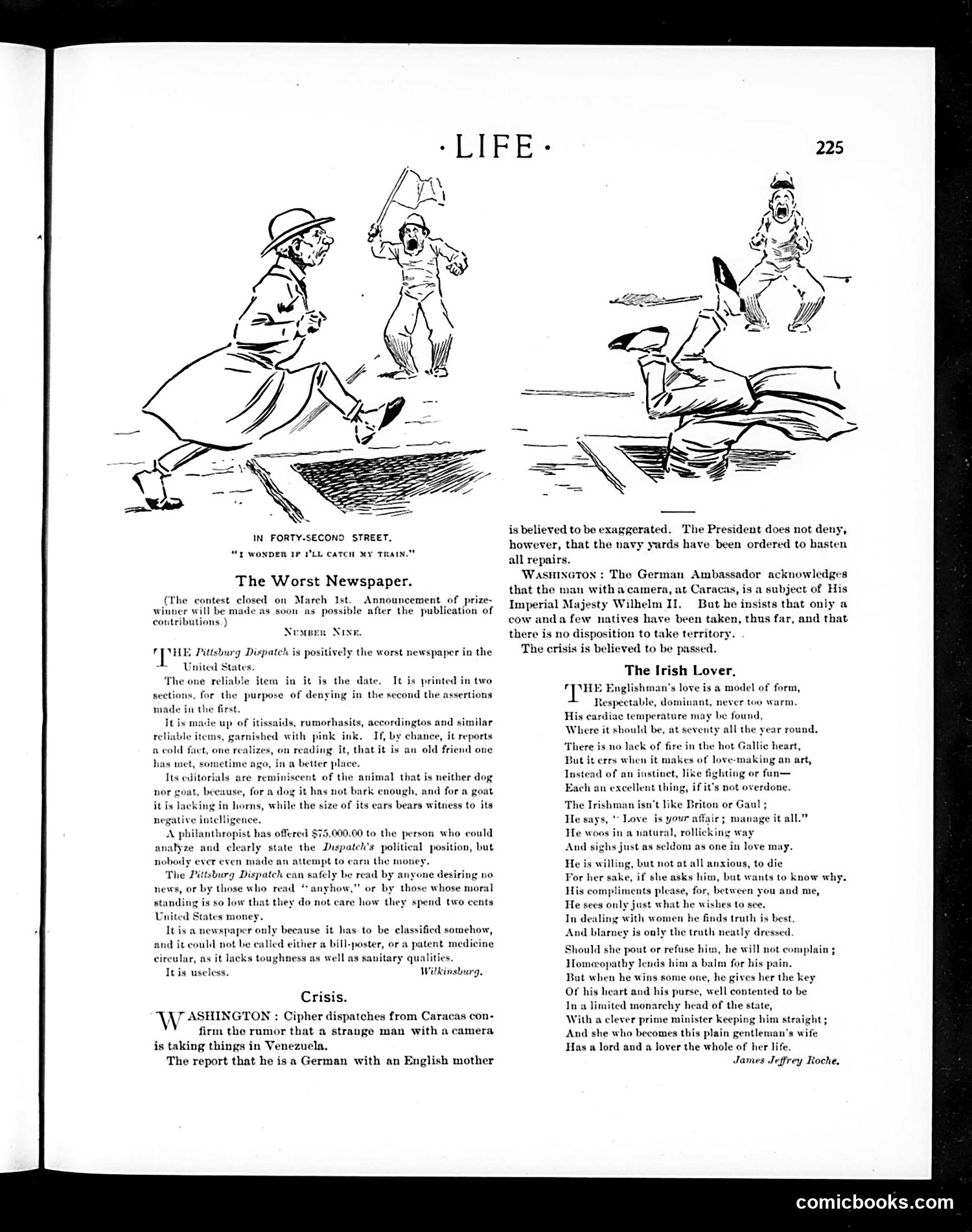
This page contains three satirical pieces typical of Life magazine's humor: **"The Worst Newspaper"** attacks the *Pittsburgh Dispatch* as utterly worthless—unreliable, poorly written, and morally bankrupt. The satire claims it's only classified as a newspaper because it must be categorized *something*, comparing it unfavorably to bill-posters and patent medicine circulars. The only reliable element is the date. **"Crisis"** is a brief political joke about a German cameraman in Venezuela (under President Castro's rule, apparently). It satirizes diplomatic tension: the German ambassador admits to photographing livestock and natives but denies territorial ambitions. The implied humor is in minimizing the incident as already resolved. **"The Irish Lover"** (poem by James Jeffrey Roche) contrasts national romantic temperaments: English lovers are formal and controlled; French lovers overcomplicate passion; Irish lovers are natural, unpretentious, and ultimately devoted. The satire gently celebrates Irish straightforwardness in matters of love. The page cartoon shows a mishap on 42nd Street, likely depicting everyday urban comedy rather than political commentary.
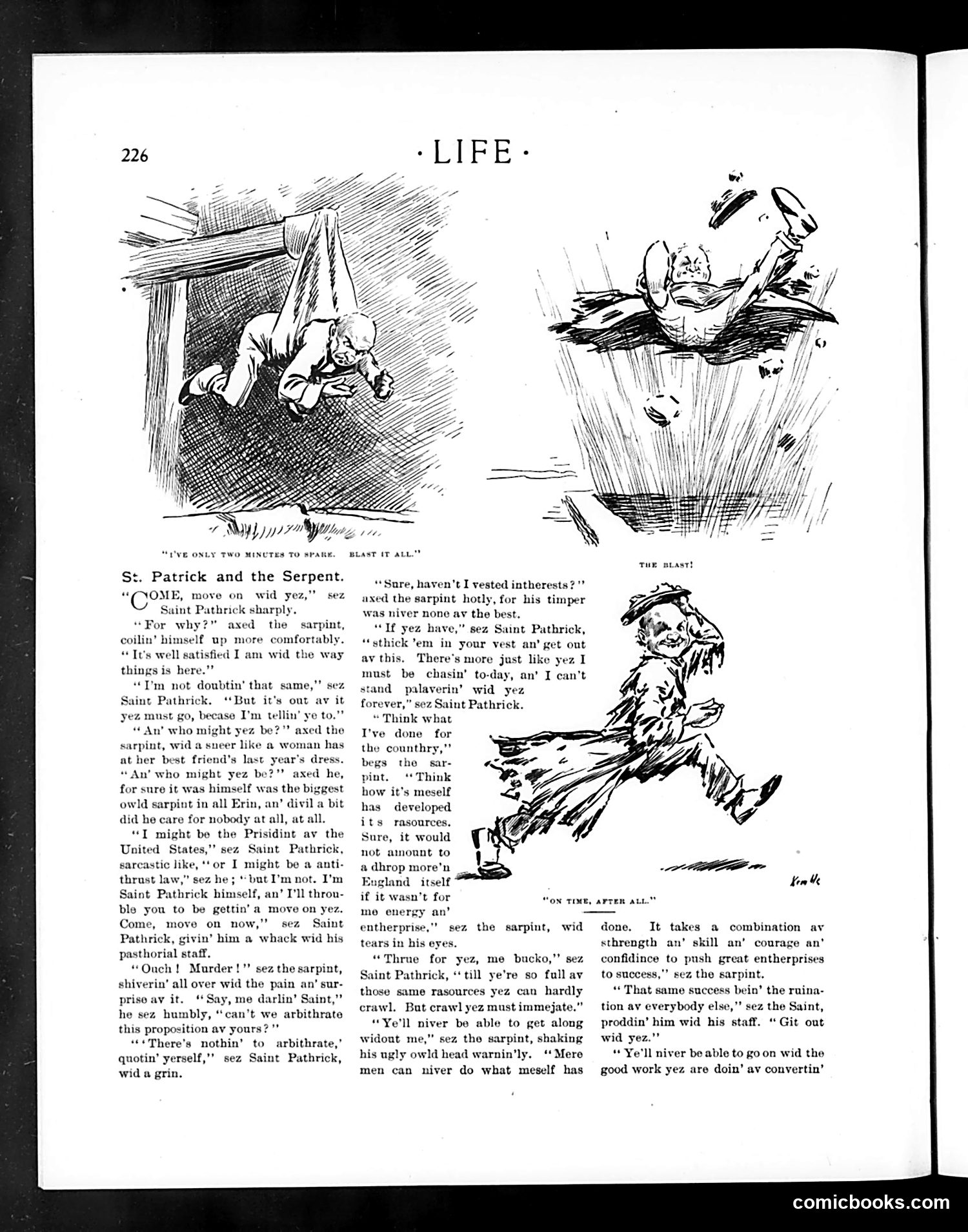
This allegorical cartoon uses Irish dialect humor to critique monopolistic business interests. Saint Patrick represents reform or populist forces, while the serpent embodies entrenched corporate power ("vested interests"). The satire targets business monopolies' claims that they've "developed resources" and that the nation cannot function without them. The serpent argues it provides "sthrength an' skill an' courage"—essentially claiming indispensability while causing "ruination av everybody else." Saint Patrick's threat to expel the serpent (using his "pasthorial staff") reflects contemporary anti-monopoly sentiment, possibly referencing trust-busting efforts. The serpent's desperate pleas—"can't we arbithrate?"—mock how corporations resisted reform through legal maneuvering. The cartoon ridicules monopolies' self-justifying rhetoric while supporting their removal as necessary for the nation's moral and economic health. The Irish-inflected dialogue targets both Irish-American readers and the stereotype of Irish saints as righteous enforcers.
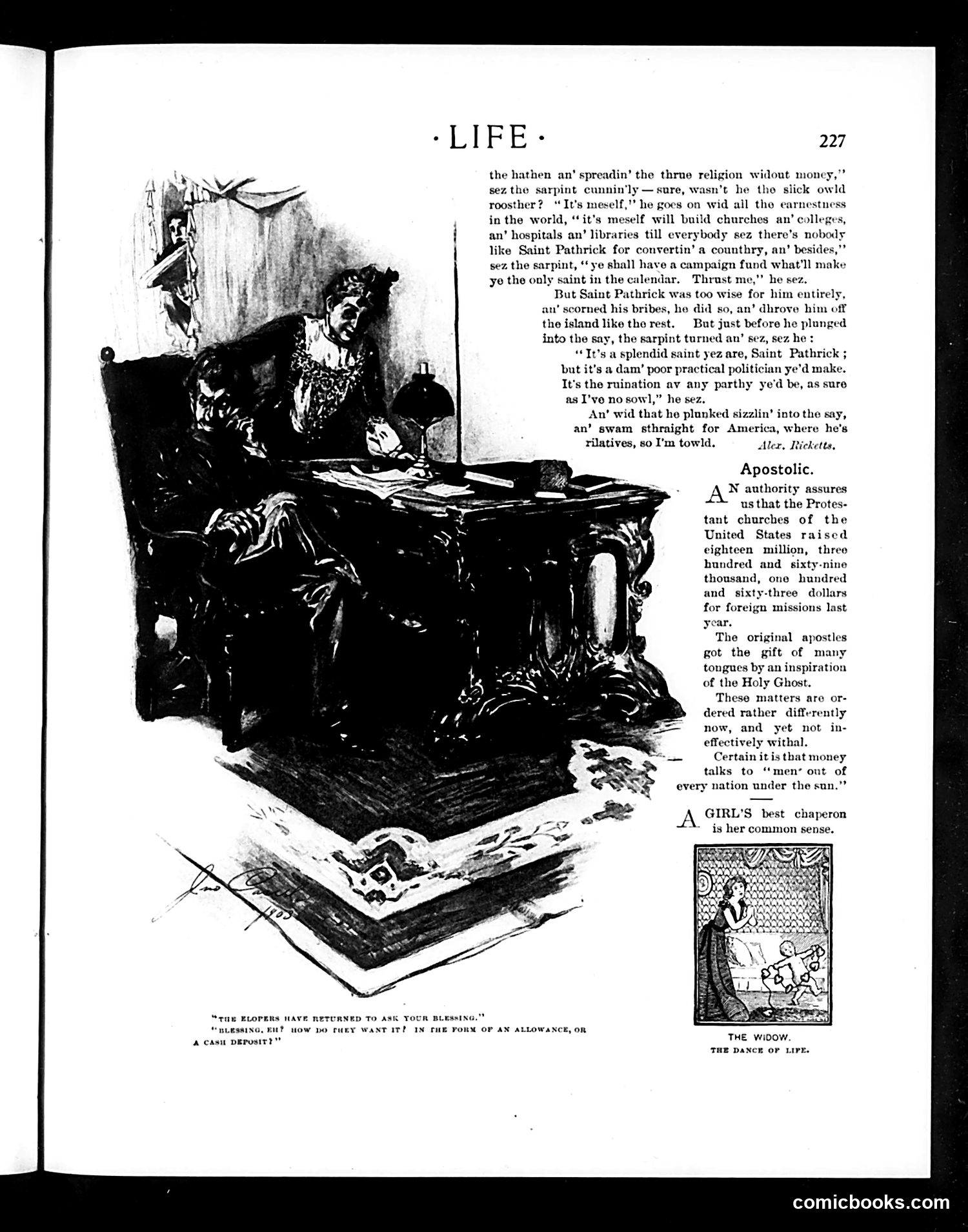
**Main Cartoon (Left):** A large illustration depicting a dialogue between Saint Patrick and a serpent (Satan), rendered in Irish dialect. The serpent tempts Patrick with bribes—churches, colleges, hospitals, and a "campaign fund"—to convert Ireland without genuine faith. Patrick refuses, calling the devil a poor "practical politician," and drives him into the sea. The serpent retreats to America where it has "relatives." **Satire Target:** American religious fundraising and commercialism. The piece mocks Protestant churches raising over $18 million for foreign missions, contrasting the apostles' authentic spiritual gifts with modern Christianity's reliance on money. The joke: spreading religion through monetary incentives rather than genuine conviction—making the practice morally equivalent to the devil's corruption. **Secondary Cartoon (Bottom Right):** "The Widow: The Dance of Life" shows eloping lovers returning to ask blessing, with a parent asking whether the blessing should come as "an allowance, or a cash deposit?"—satirizing materialism in modern family relations. **Overall Theme:** Critique of American materialism infiltrating both religious and domestic institutions.
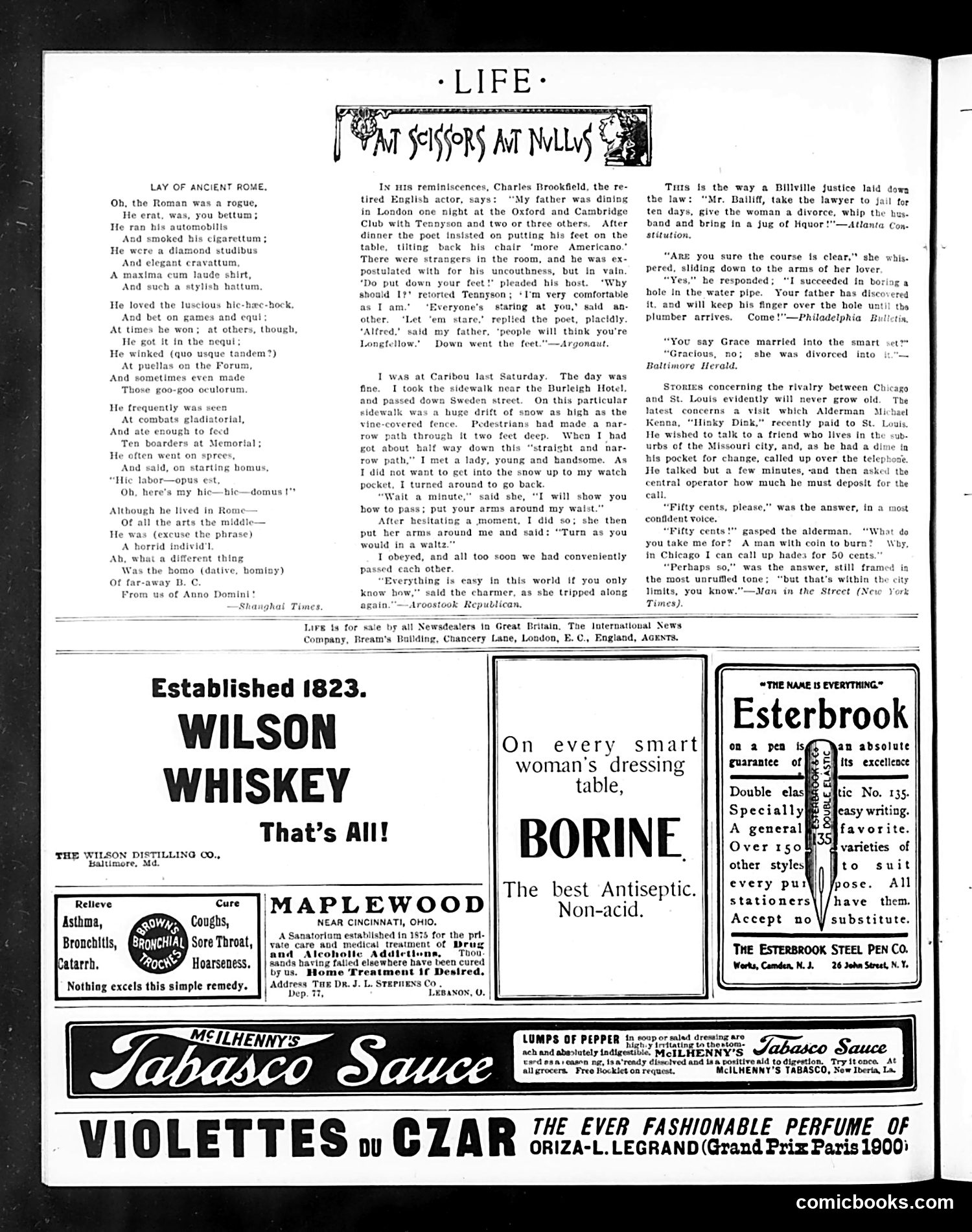
This page from *Life* magazine combines literary satire with period humor and advertisements. **Main Content:** The lead feature is "Lay of Ancient Rome," a mock-heroic poem satirizing Romans by describing them in faux-Latin macaronic English ("automobilis," "cigarettum," "cravattum"). The joke mocks Romans as modern, materialistic figures—driving cars, smoking, gambling—rather than dignified ancients. This inverts classical pretension by suggesting ancient Romans were as vulgar and undisciplined as contemporary society. **Supporting Humor:** Several anecdotes follow, including one about poet Tennyson rudely putting his feet on a table, defended by claiming comfort. Other short jokes concern romantic encounters and urban rivalries (Chicago vs. St. Louis telephone operators). **Advertisements:** The lower half features period product ads: Wilson Whiskey (established 1823), Maplewood remedy, Borine antiseptic, Esterbrook pens, Tabasco sauce, and Violettes du Czar perfume—typical early-20th-century luxury goods marketed to affluent readers. The satire's point: mock dignity and pretension through crude humor.
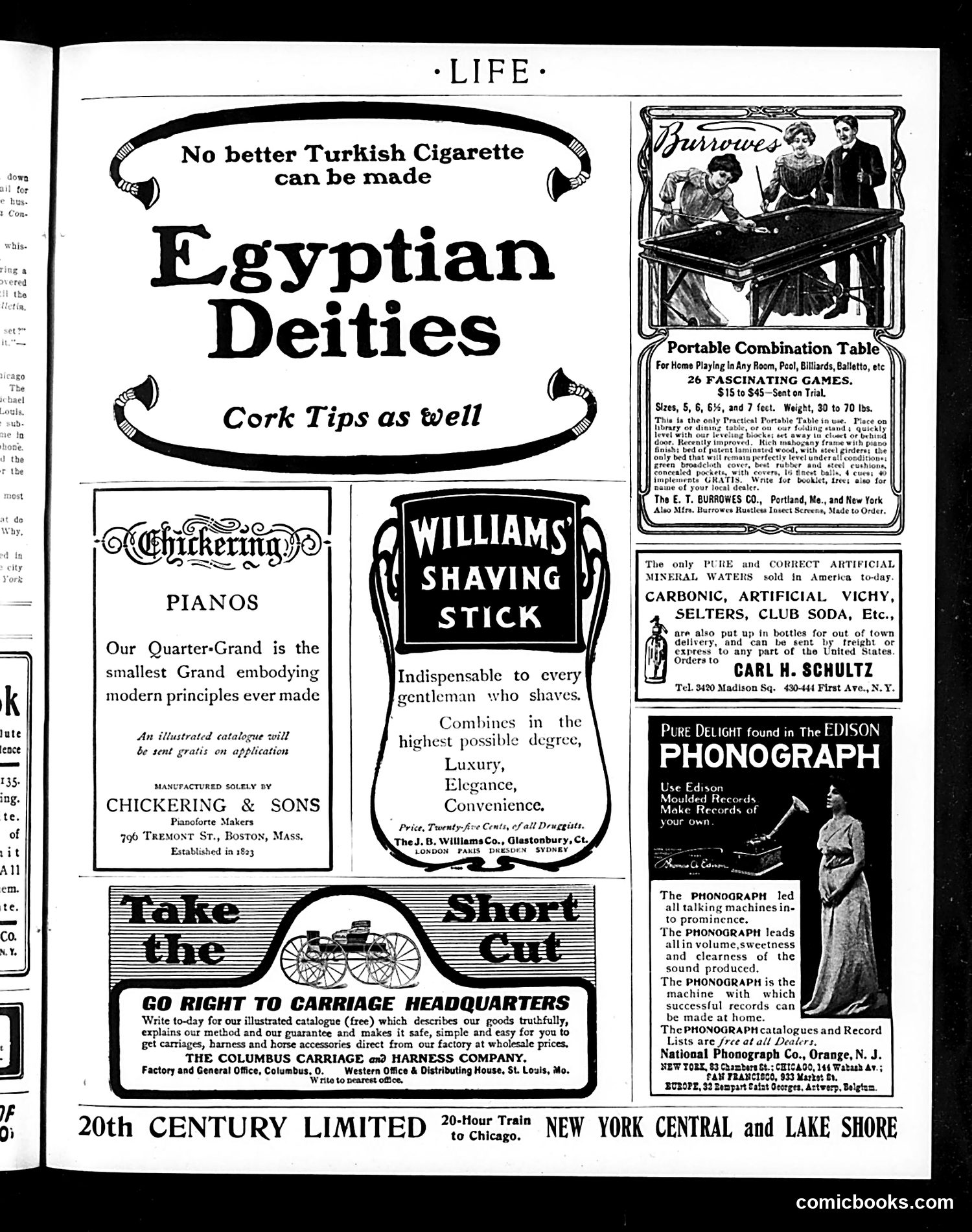
This is primarily an **advertising page** with no political cartoons or satire. The page contains period product advertisements typical of early 20th-century magazines. **Key advertisements include:** - **Egyptian Deities cigarettes** — promoting Turkish tobacco with cork tips - **Chickering & Sons pianos** — marketing their "Quarter-Grand" model - **Williams' Shaving Stick** — emphasizing luxury and convenience for gentlemen - **Burrowes Portable Combination Table** — a multi-purpose game table for billiards, etc. - **Carl H. Schultz mineral waters** — artificial carbonated waters (Vichy, seltzer, club soda) - **Edison Phonograph** — highlighting superior sound quality and home recording capability - **Columbus Carriage & Harness Company** — direct factory sales of carriages and accessories - **20th Century Limited train** — New York Central railroad service These ads reflect consumer goods and leisure activities marketed to middle/upper-class American consumers. There is no discernible satirical content; this appears to be a standard Life magazine advertising section.
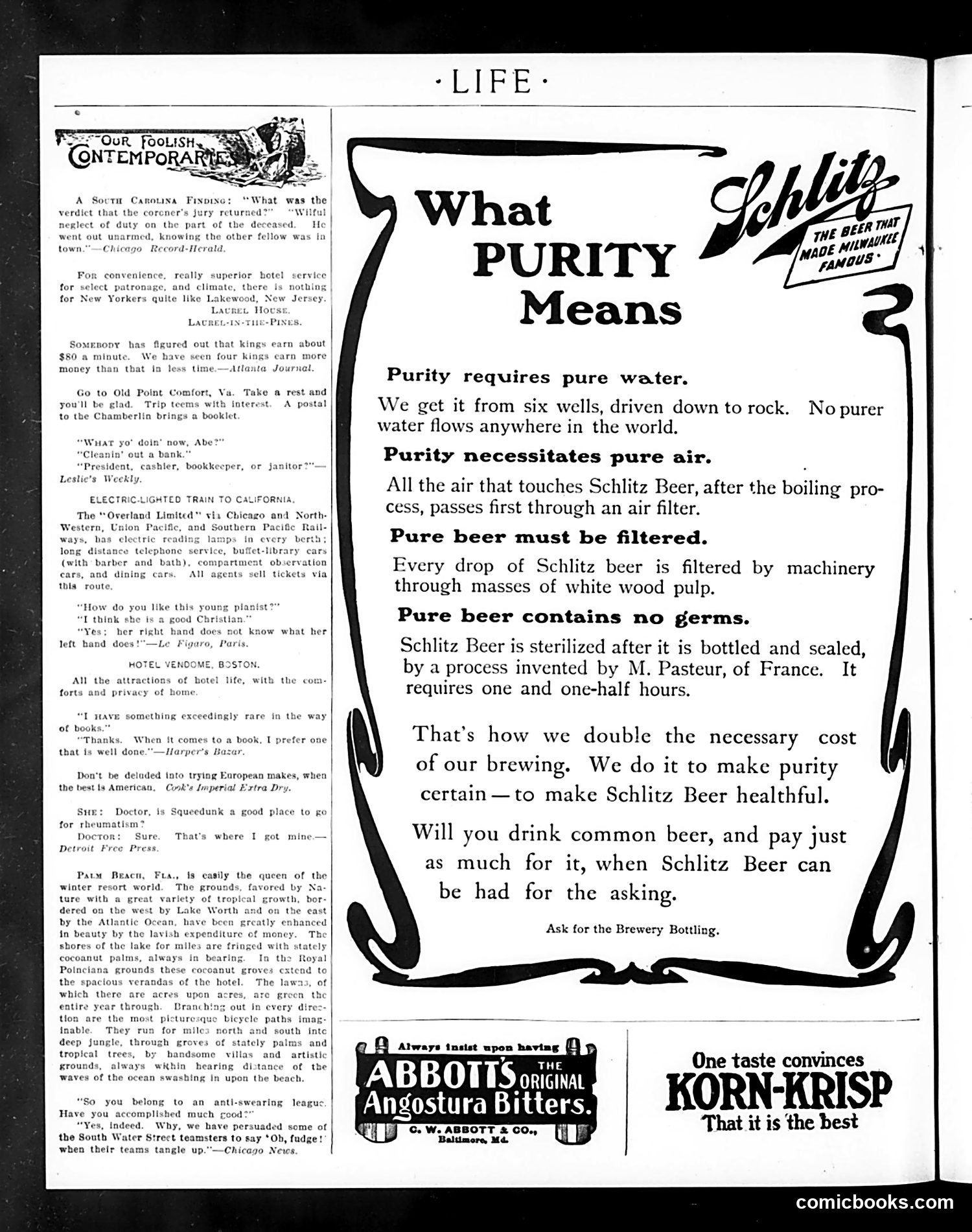
This page is primarily a **Schlitz Beer advertisement**, not political satire. The left column contains miscellaneous humor snippets from Life magazine; the right side is a full-page ad for Schlitz beer. The advertisement uses **turn-of-the-century health marketing**, emphasizing "purity" as a selling point. Schlitz claims superiority through: - Pure water from deep wells - Air filtration systems - Wood pulp filtering - Pasteurization (citing Louis Pasteur's process) The pitch appeals to contemporary **germ theory anxieties**—a major concern in the Progressive Era. By positioning beer as "healthful" and scientifically sterilized, Schlitz positioned itself as a modern, safe product versus "common beer." The surrounding ads for Korn-Krisp cereal and Angostura Bitters suggest this targets middle-class consumers concerned with cleanliness and health. This reflects early 20th-century advertising's embrace of scientific authority to sell consumer goods—before Prohibition (1920).
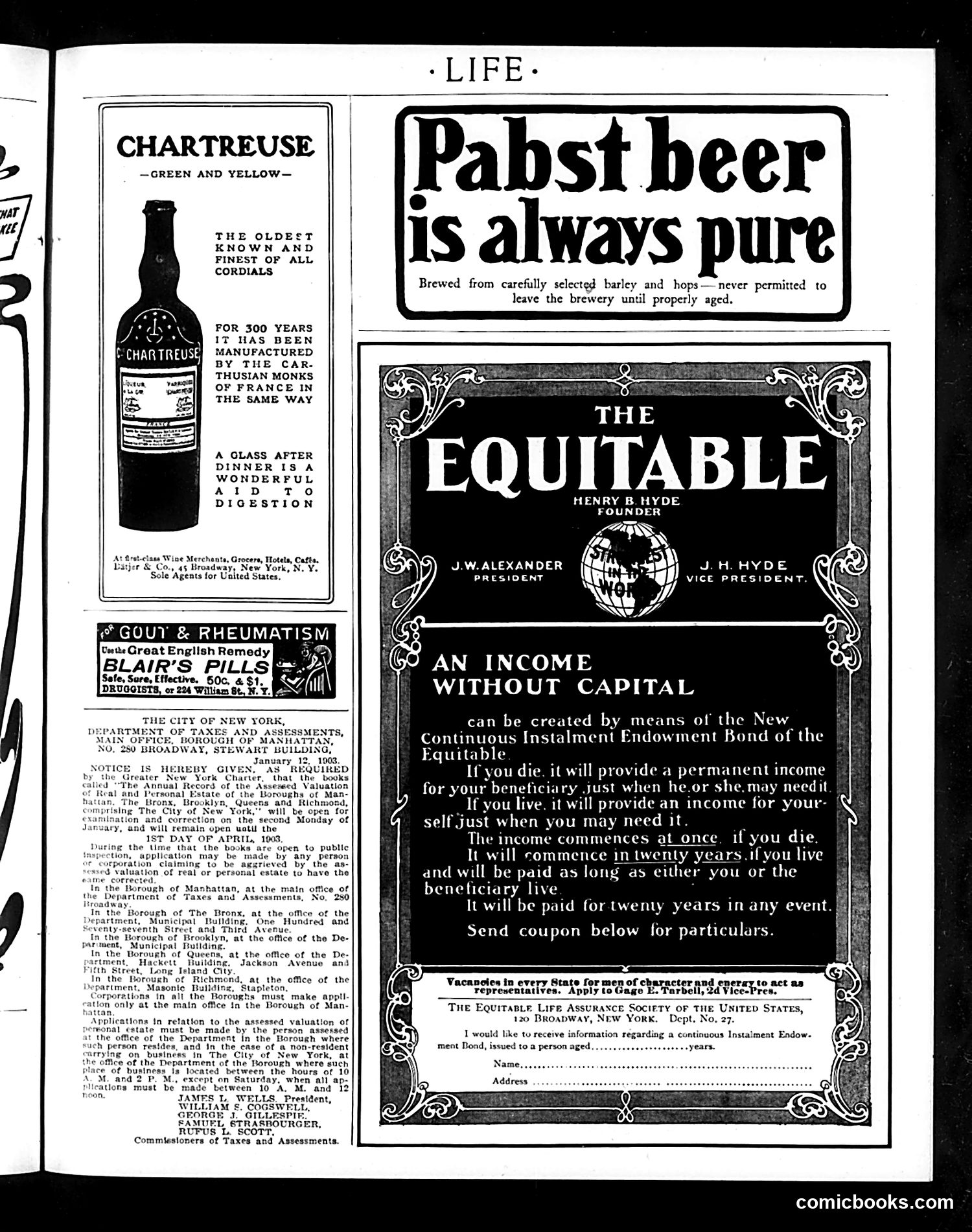
This page is primarily **advertising**, not political satire. It contains four product advertisements from early 1903: 1. **Chartreuse liqueur** — promoting a French cordial claimed to aid digestion 2. **Blair's Pills** — a patent medicine for gout and rheumatism 3. **Pabst Beer** — emphasizing purity and proper aging 4. **Equitable Life Insurance** — the dominant advertisement, promoting a "Continuous Instalment Endowment Bond" that promises income for beneficiaries upon death or for the policyholder in retirement The Equitable ad is noteworthy for its pitch: creating "an income without capital" through life insurance — a financial product concept that appears relatively novel for 1903. The page reflects the era's heavy reliance on patent medicines and emerging insurance products, alongside traditional luxury imports. There is no political cartoon or satire visible on this page.
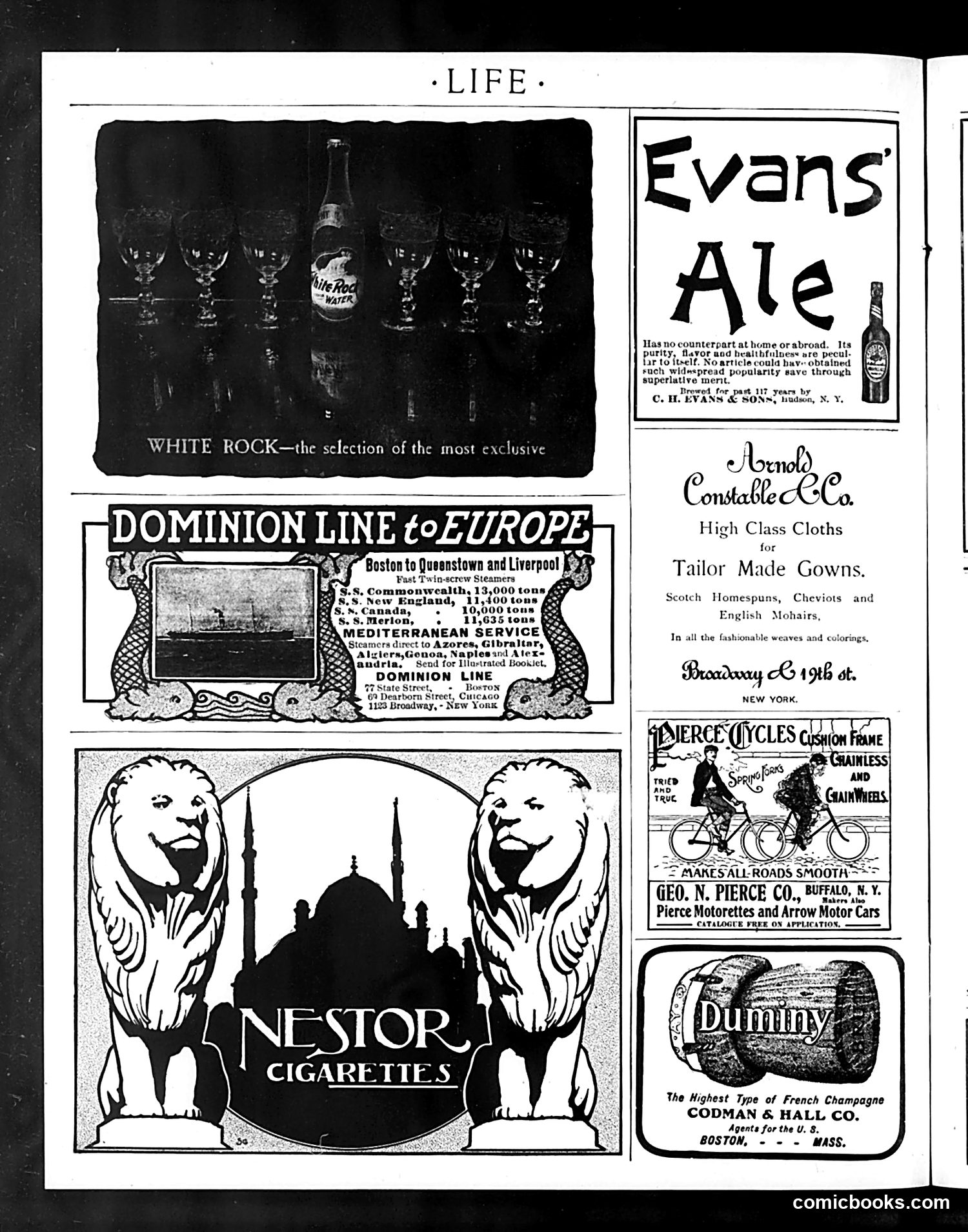
This page is primarily **advertising**, not political satire. It contains luxury product advertisements from the early 1900s: **White Rock** (beverages) — shown with glasses and a bottle, marketed as "the selection of the most exclusive" **Dominion Line** — transatlantic steamship service from Boston to Europe **Evans' Ale** — brewed for 117 years, claiming superiority through "purity, flavor and healthfulness" **Nestor Cigarettes** — featuring two stylized lion heads flanking a mosque silhouette, suggesting exotic/international appeal **Arnold Constable & Co.** — high-end tailoring fabrics **Pierce Cycles and Motorcycles** — marketed as smooth-riding **Duminy Champagne** — "highest type of French Champagne" The ads reflect Gilded Age consumer culture targeting wealthy, cosmopolitan readers. The exoticism (mosque imagery for cigarettes, French champagne, European travel) appeals to affluent audiences seeking refined, imported goods as status markers.
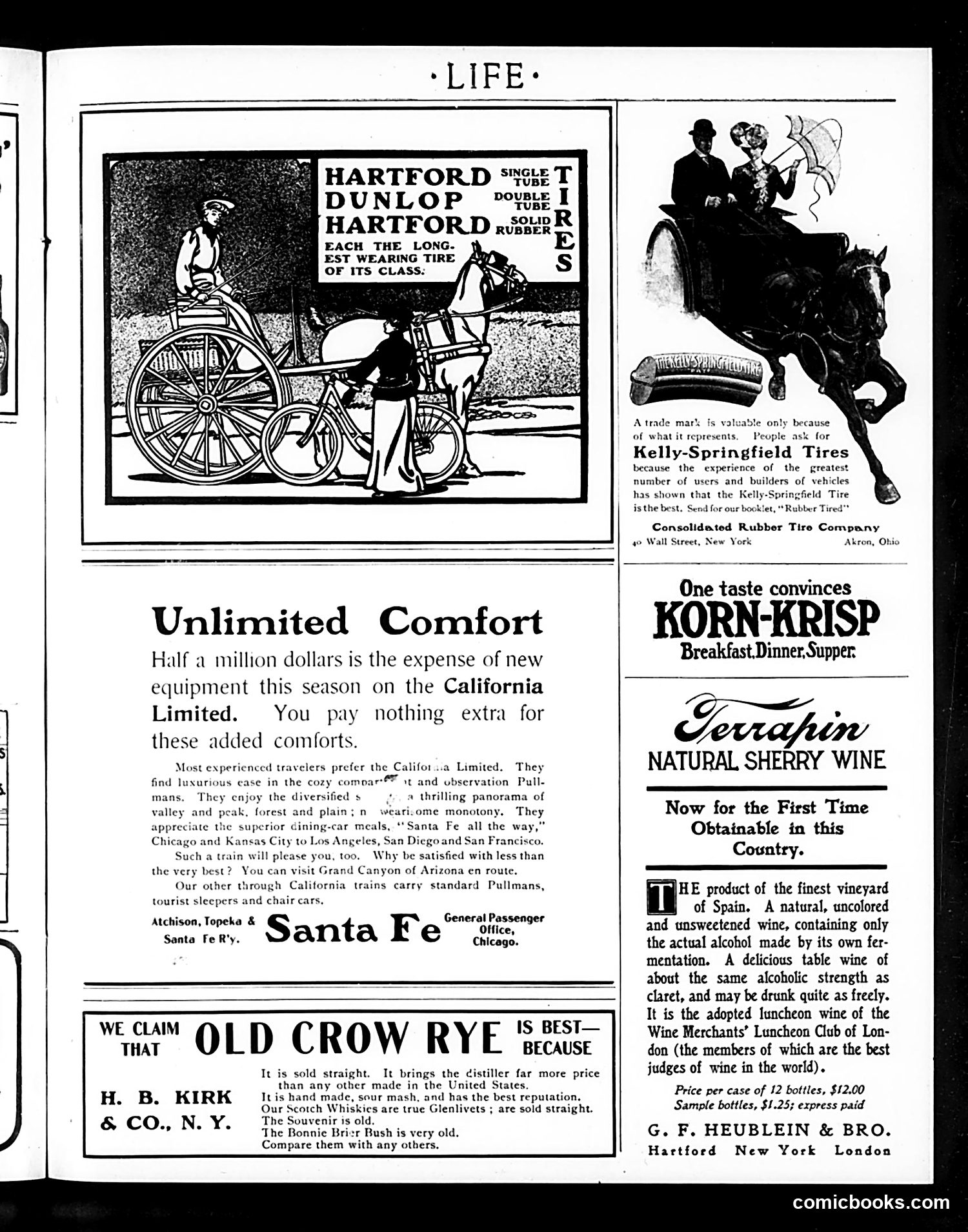
This page is primarily **advertising**, not political satire. It contains five product advertisements from the early 20th century: 1. **Hartford/Dunlop tires** - competing tire brands claiming longest wear 2. **Santa Fe Railway** - promoting the "California Limited" train with luxury amenities (Pullmans, dining cars, observation decks) for the cross-country journey to Arizona and California 3. **Kelly-Springfield Tires** - emphasizing brand reputation and user experience 4. **Korn-Krisp cereal** and **Terrapin Natural Sherry Wine** - food/beverage products 5. **Old Crow Rye whiskey** and **Heublein & Bro. products** - spirits The small illustration (top right) appears to be a humorous vignette of a couple on horseback, possibly promoting the leisure travel theme. **Context for modern readers:** These ads reflect early 1900s consumer culture emphasizing luxury rail travel, emerging automobile tire technology, and branded products claiming superiority through reputation and quality materials. There is no political cartoon or satire present.
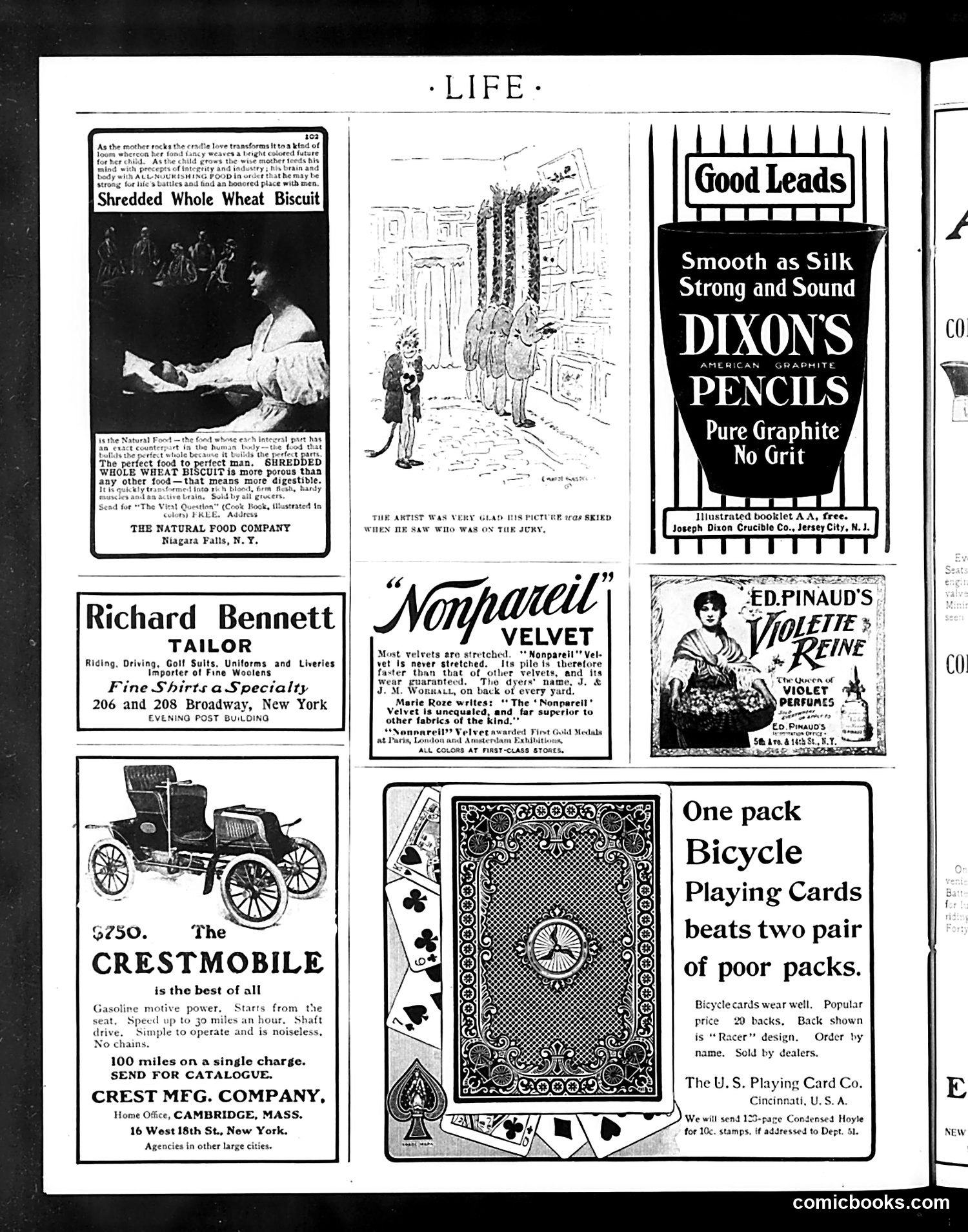
This is primarily an **advertising page** with one small cartoon. The cartoon (center-top) shows a courtroom scene with the caption: "The artist was very glad his picture was skied when he saw who was on the jury." "Skied" was period slang meaning a painting was rejected or hung too high to be seen properly—essentially hidden. The joke is that the artist is *relieved* his work was rejected because he recognizes someone on the jury (likely someone whose opinion he distrusts or fears). It's a light satirical jab at the art world and jury selection. The rest of the page contains early 1900s advertisements for products including: Shredded Wheat Biscuit (health food), Dixon's pencils, a tailor shop, the Crestmobile (early automobile claiming 30 mph speed), Nonpareil velvet fabric, Ed. Pinaud's Violette perfume, and Bicycle playing cards. These ads reflect consumer goods and aspirational products of the era.
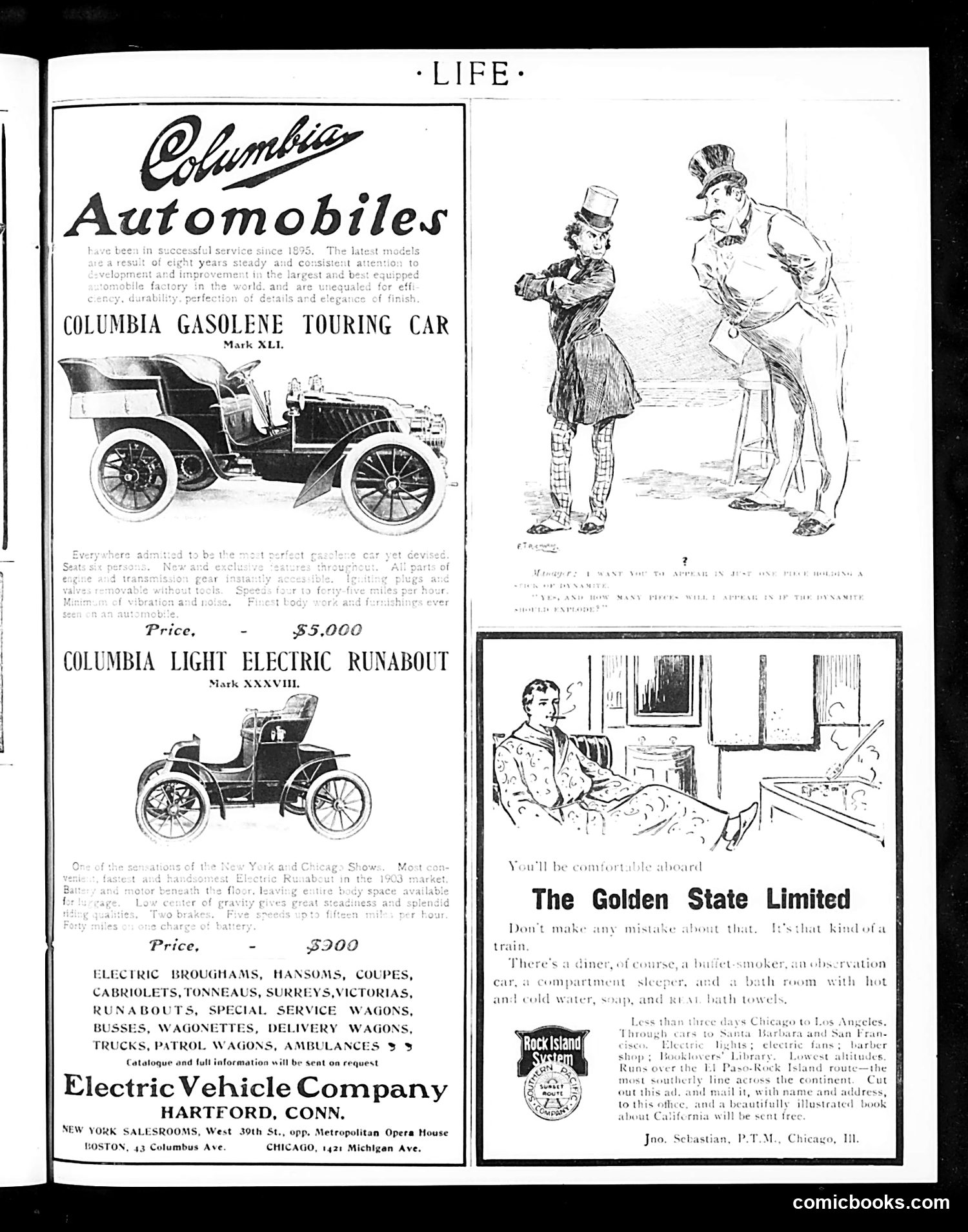
This page is **primarily advertising**, not political satire. The left side features advertisements for Columbia automobiles (both gasoline and electric models) from the Electric Vehicle Company of Hartford, Connecticut, with prices listed ($5,000 and $200). The right side contains two unrelated items: a sketch-cartoon showing two figures in conversation (the caption appears humorous but is partially illegible in the OCR), and an advertisement for "The Golden State Limited" train service, emphasizing passenger comfort with amenities like diners, sleepers, and observation cars. The cartoon's specific satire is unclear from the available text, though it appears to be social commentary typical of *Life* magazine's humor. Without clearer text, the joke's target cannot be reliably identified.
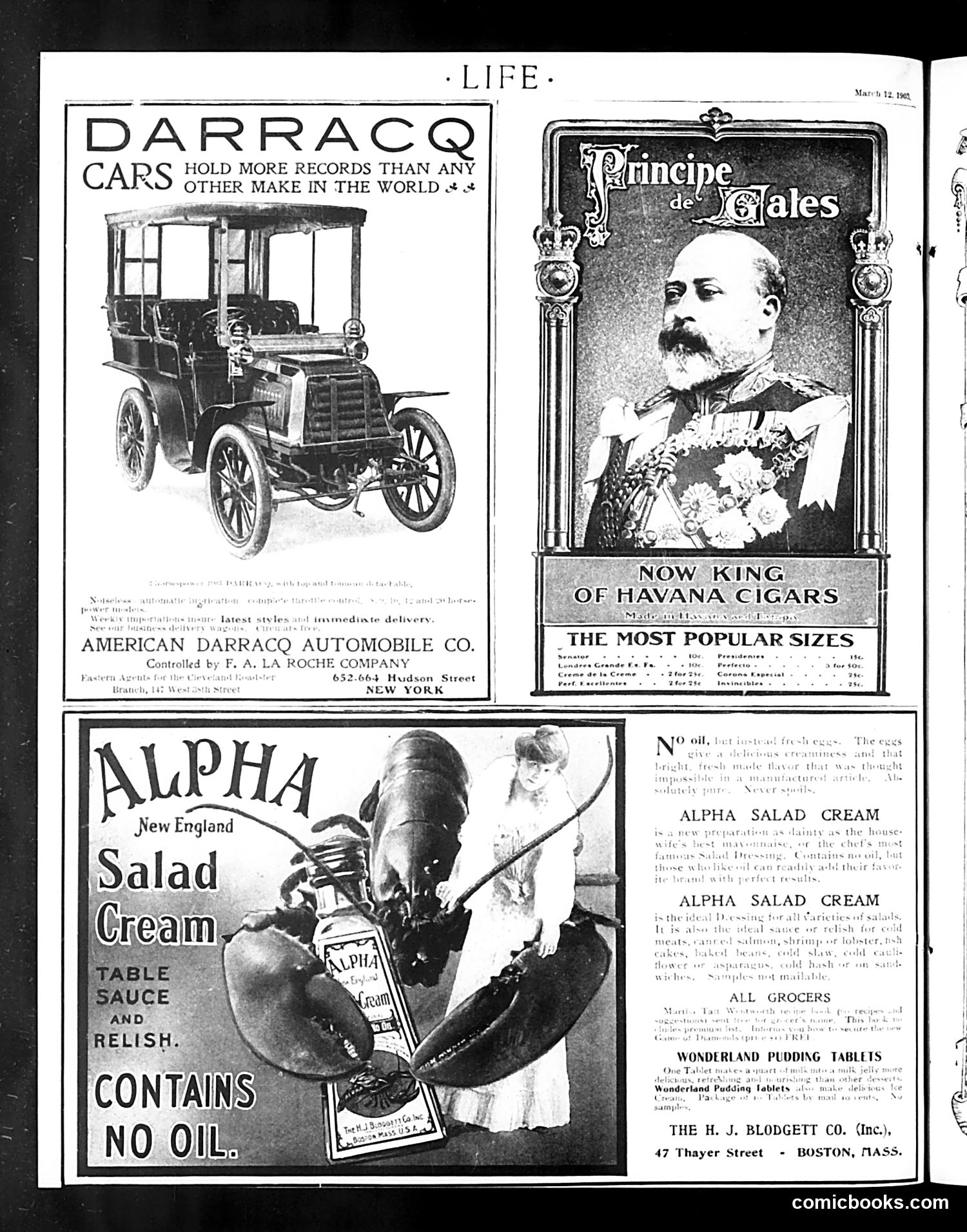
This page is primarily **advertising**, not political satire. It contains four commercial advertisements: 1. **Darracq automobiles** — promotes the American Darracq brand's racing records 2. **Príncipe de Gales cigars** — features a mustachioed military figure (likely a Spanish or Cuban dignitary) with the caption "Now King of Havana Cigars," playing on monarchy imagery to market the product 3. **Alpha Salad Cream** — shows a chef with lobsters, emphasizing the product "contains no oil" 4. **Wonderland Pudding Tablets** — a Boston-based food product The only potentially satirical element is the cigar ad's use of royal imagery and the phrase "now king," which may gently mock pretentious branding, but this appears to be straightforward period advertising rather than political commentary. The page reflects early 1900s consumer goods marketing and Life's role as a venue for such advertisements.