
Life, 1903-03-12 · page 8 of 26
Life — March 12, 1903 — page 8: what you’re looking at
What you’re looking at
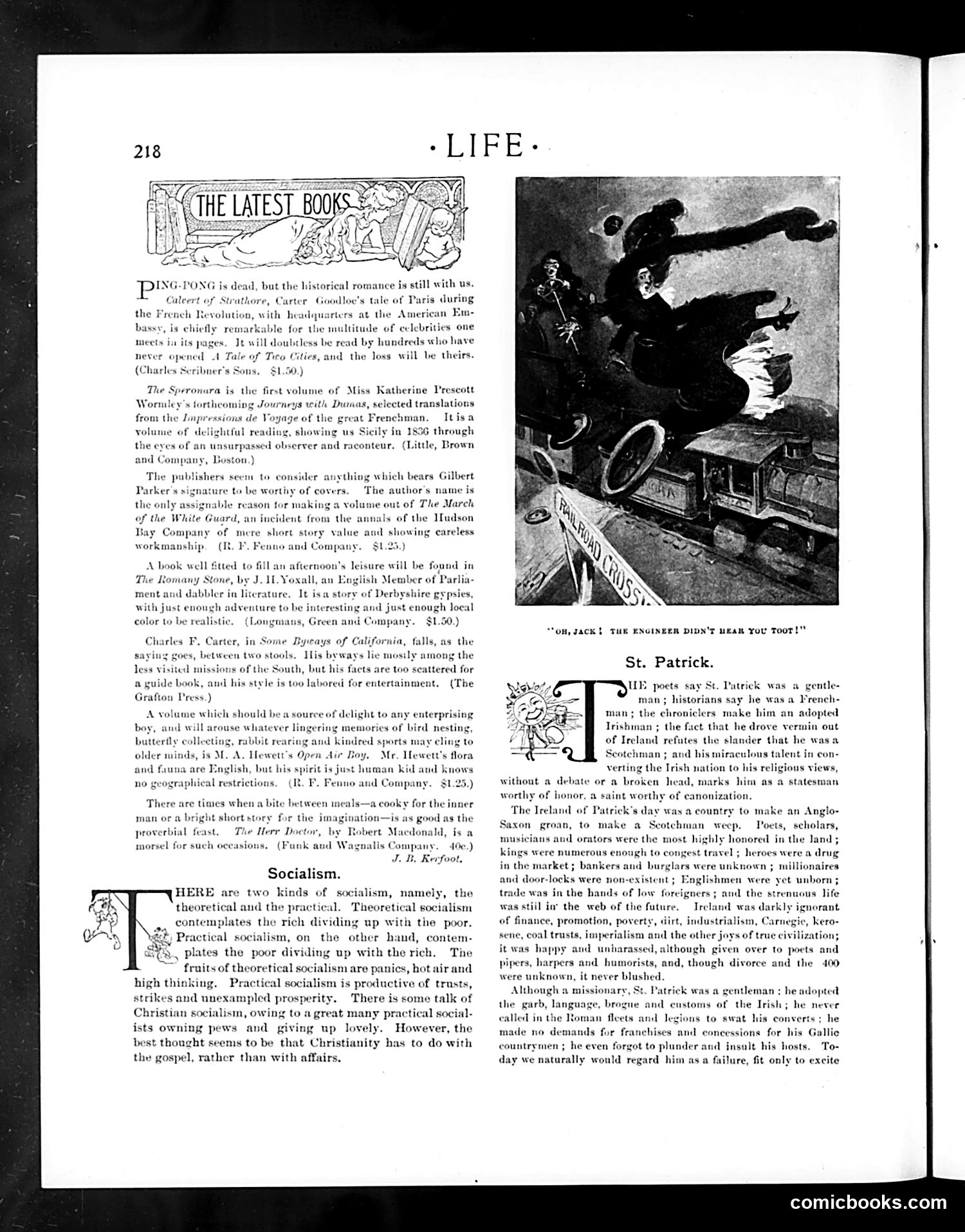
This page from *Life* magazine contains book reviews and commentary rather than political cartoons. The main image shows what appears to be a theatrical or comedic scene with the caption "Oh, Jack! The Engineer Didn't Hear You Too!" — likely illustrating a scene from reviewed literature. The page discusses several books, including works by Carter Goodloe and Katherine Prescott Wormeley. A substantial section critiques "Socialism," presenting theoretical versus practical socialism. The text argues that theoretical socialism envisions wealth redistribution, while practical socialism produces trusts and monopolies—suggesting the author viewed actual socialist implementation as corrupt and hypocritical. The "St. Patrick" section that follows appears to be a separate article about the historical saint rather than satire.
📄 Transcribed text from this page (OCR, searchable)
Machine-transcribed from the original scan — historical spelling and the odd misread are preserved.
pistorical romance is still with us. ore, Carter Goodloc’s tale of Paris during neh Revolution, with headquarters the American Em- , is chiefly remarkable for the multitude of celebrities one ia its pages. It will doubtless be read by hundreds who have never opencd A Tale of Tico Cities, and the loss will be theirs. (Charles Scribner's Sons, $1.50.) rronara is the first volume of Miss Katherine Drescott -neys with Dumas, selected translations from the Impressions de Voyage of the great of delightful reading, showing us s , nv unsurpassed observer and raconteur, (Little, Brown and Company, 1 The publishe 1 to consider anything which bears Gilb ‘arker's nature to be worthy of covers, The author's name the onl ble reason for making a volume out of The March of the White Guard, an incident from the annals of the Hudson y Company of mere short story value and showing careless anship. (It. F. Fenno and Company. $L A book well fitted to fill an afternoon's leisure will be found in Romany Stone, by J. M.Yoxall, an English Member of Parlia- ment and dabbler in literature. It isa story of Derbyshire gypsies, with just enough adventure to be interesting and just enough local color to be realistic, s, Green and Company. $1.50.) “om, sack} TUE ENOINEER DIDN'T WEAR You Toot!" Charles F. Carter, in Some Byrrays of Califi , falls, the saying goes, between two stools. His byways lie 1 r less visited missions of the South, but his facts are too scattered for St. Patrick. a guide book, his style is too labored for entertainment. (The . , ILE poets sa Grafton Tress.) YW ONE man; historians say he was a French- Avo! e source of delight to enterpri ee, man; the chroniclers make him an adopted boy, and will arouse whatever lingering memories of bird nestin 7 as Irishman ; the fact that he drove vermin out butterfly collecting, rabbit rearing and kindred sports may clit of Ireland refutes the s older w is, is M. A. Iewett's Open Air B Mr. Ifewett's flora Scotchman ; and his miraculous talent in co and fauna are hh, but his spirit is just human kid and verting the Trish na ne r ical restrictions R. F. Fenno and Company. $1.25 without a debate or a broken head, marks him as a statesman worthy of honor, a saint worthy of eanoniz: ¢ times when a bite betwe neals—a cooky for the inner “ , ae, - : The Ireland of Patrick's day was a country to make an Anglo- Saxon groan, to make a Scotchman weep. Poets, scholars, musicians and orators were the most highly honored in the la kings were numerous enough to congest travel ; heroes were — in the market ; bankers and burglars were unknown ; milli Socialism. and door-locks were non-existent; Englishmen were yet unborn ; HERE are two kinds of socialism, namel trade was in the hands of low foreigners; and the strenuous life theoretical and the practical. Theoretical socialism s still in’ the web of the future. Ireland was darkly ignorant contemplates the rich dividing up with the poor. finance, promotion, poverty, dirt, indust ‘2. Practical socialism, on the other hand, contem- — sene, coal trusts, imperialism and the other joys o plates the poor dividing up with the rich, Tae it 848 happy and unharassed, although given over to poets and fruits of theoretical socialism are panics, hot airand Miers: harpers aud humorists, and, though divorce and the 400 high thinking. Practical socialism is productive of trnsts, “eT Utknown, it never blush strikes and unexampled prosperity. There is some talk of man or a bright short story for the imagination—is as good as the proverbial feast. The Herr Dos by T morsel for such occasions, (Funk and Wagnalis Comy JB. Although Si rick was a gentleman ; he adopted pe : : : the garb, language, brogue and customs of the Irish; he never hristian socialism, owing to a great many practical soci: called in the Roman fleets and 1 ys to swat his converts; he ists owning pews and giving up lovely. However, the made no demands for franchises and concessions for his Gallic best thought seems to be that Christianity has to do with countrymen ; he even forgot to plunde insult his hosts. To- the gospel, rather than with affai day we naturally would regard him as a failure, fit only to excite comicbooks.com