
Life, 1903-03-12 · page 6 of 26
Life — March 12, 1903 — page 6: what you’re looking at
What you’re looking at
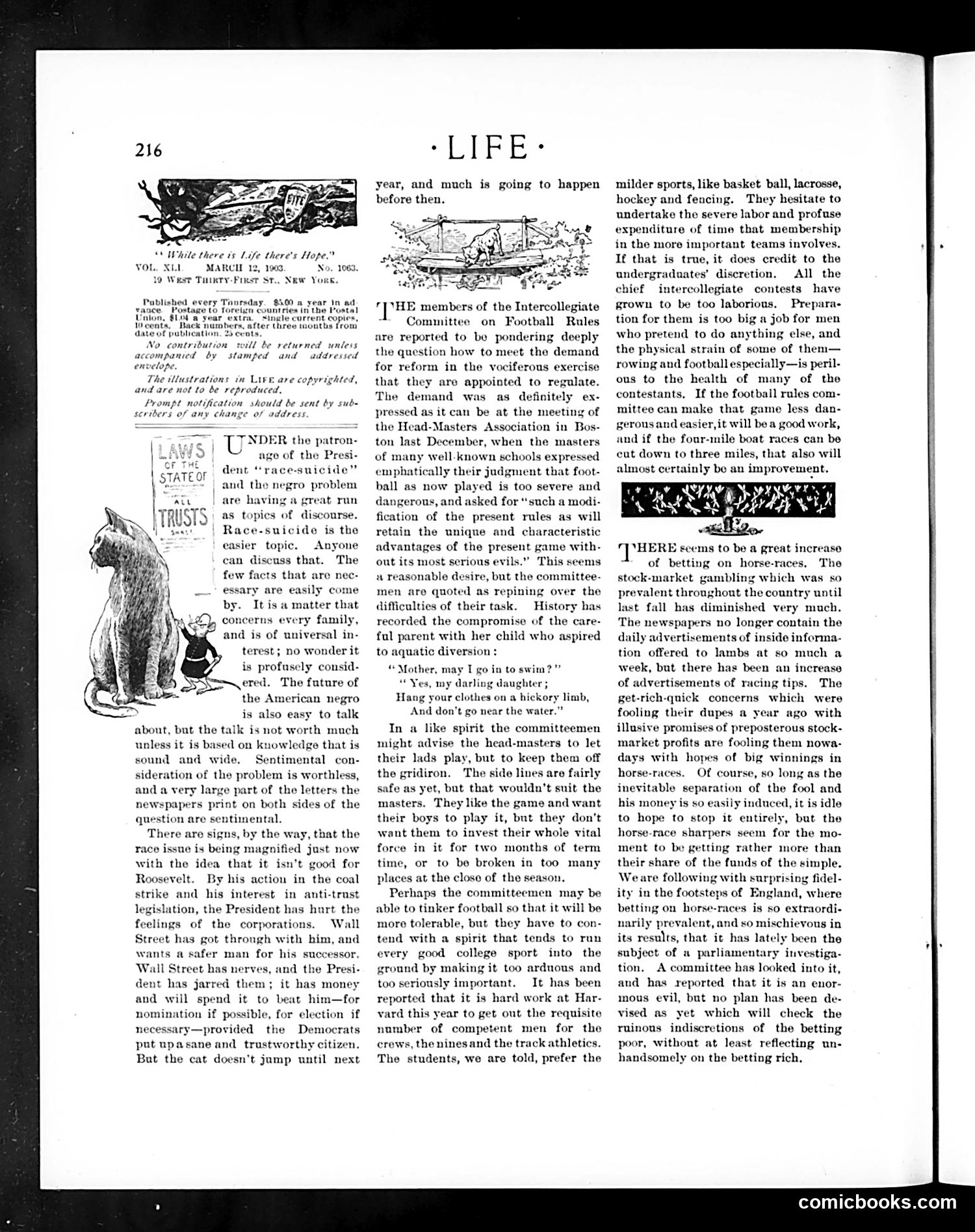
The page contains two distinct editorial items: **Left sidebar**: A small political cartoon labeled "Laws of the State of Trusts" depicts a large bear (representing monopolistic trusts/corporations) menacing a small figure. This references President Theodore Roosevelt's trust-busting agenda—a major political issue of 1903. The cartoon satirizes corporate power and Roosevelt's efforts to regulate them. **Main article**: Discusses the Intercollegiate Committee on Football Rules debating whether to reform the sport, calling it "too severe and dangerous." The text mentions concerns about excessive betting on horse-races, criticizing newspapers for running racing advertisements. Together, these items reflect early-1900s Progressive Era concerns: corporate monopolies, dangerous athletic practices, and gambling's social harms.
📄 Transcribed text from this page (OCR, searchable)
Machine-transcribed from the original scan — historical spelling and the odd misread are preserved.
‘* While there ts Life there's Hope. VOL. XU MARCH 12, l every Tooreda . $line a year extra nts. Tack nurobers, after th f publication. 25 cats ‘0 contribution will be returned unless mpanied by stamped and addressed envelope. date The illustrations in Live are copyrighted, and are not to be reproduced, Prompt notification should be sent by sub= thers of any change of address TD NDER the patron- age of the Presi- dent “race-suicide” and the negro problem are having a great run as topics of discourse. Race-suicide is the easier topic. Anyone can discuss that. The few facts that are nec- essary are easily come by. It is a matter that concerns every family, and is of universal in- terest; no wonder it is profusely consid- Sm cred. ‘The future of the American negro is also easy to talk about, but the talk is not worth much unless it is based on knowledge that is sound and wide, Sentimental con- sideration of the problem is worthless, nd a very large part of the letters the newspapers print on both sides of the question are sentimental. There aro signs, by the way, that the race issue is being magnified just now with the idea that it isn’t good for Roosevelt. By his action in the coal strike and his interest in anti-trust legislation, the President has hurt the feelings of the corporations. Wall Street has got through with him, and wants a safer man for his suc or, Wall Street has nerves, and the Presi- dent has jarred them; it has money and will spend it to beat him—for nomination if possible, for election if necessary—provided the Democrats put upasane and trustworthy citizen. But the cat doesn't jump until next “LEP E® year, and much is going to happen before then. aI ‘HE members of the Intercollegiate - Committee on Football Rules are reported to be pondering deeply the question how to meet the demand for reform in the vociferous exercise that they are appointed to regulate. The demand was as definitely ex- pressed as it can be at the meeting of the Head-Masters Association in Bos- ton last December, when the masters of many well-known schools expressed emphatically their judgment that foot- ball as now played is too severe and dangerous, and asked for “such a modi- fication of the present rules as will retain the unique and characteristic advantages of the present game with- out its most serious evils.” This seems a reasonable desire, but the committee- men are quoted as repining over the difficulties of their task. History recorded the compromise of the care- ful parent with her child who aspired to aquatic diversion : “ Mother, may [go in to swim?” “Yes, my darling daughter ; Hang your clothes on a hickory And don’t go near the water. limb, In a like spirit the committeemen might advise the head-masters to let their lads play, but to keep them off the gridiron. The side lines are fairly safe as yet, but that wouldn't suit the masters, They like the game and want their boys to play it, but they don't want them to invest their whole vital force in it for two months of term time, or to be broken in too many places at the close of the son. Perhaps the committeemen may be able to tinker football so that it will be more tolerable, but they have to con- tend with a spirit that tends to run every good college sport into the ground by making it too arduous and too seriously important. It has been reported that it is hard work at Har- vard this year to get out the requisite number of competent men for the crews, the nines and the track athletics. The students, we are told, prefer the milder sports, like basket ball, lacrosse, hockey and fencing. They hesitate to undertake the severe labor and profuse expenditure of time that membership in the more important teams involves. If that is true, it does credit to the undergraduates’ discretion, All the chief intercollegiate contests have grown to be too laborious. Prepara- tion for them is too big a job for men who pretend to do anything else, and the physical strain of some of them— rowing and football especially—is peril- ous to the health of many of the contestants, If the football rules com- mittee can make that game less dan- gerous and easier, it will be a good work, and if the four-mile boat races can be cut down to three miles, that also will almost certainly be an improvement. UATE yi 1 ‘HERE seems to be a great increase of betting on horse-1 s. The stock-market gambling which was so prevalent throughout the country until st fall has diminished very much. The newspapers no longer contain the daily advertisements of inside informa- tion offered to lambs at so much a week, but there has been an increase of advertisements of racing tips. The get-rich-quick concerns which were fooling their dupes a year ago with illusive promises of preposterous stock- market profits are fooling them nowa- days with hopes of big winnings in horse-races. Of course, so long as the inevitable separation of the fool and his money is so easily induced, it is idle to hope to stop it entirely, but the horse-race sharpers seem for the mo- ment to be getting rather more than their share of the funds of the simple. Weare following with surprising fidel- ity in the footsteps of England, where betting on horse-races is so extraordi- narily prevalent, and so mischievous in its results, that it has lately been the subject of a parliamentary investiga- tion. A committee has looked into it, and has reported that it is an enor- mous evil, but no plan has been de- vised as yet which will check the ruinous indiscretions of the betting poor, without at least reflecting un- handsomely on the betting rich, comicbooks.com