
A complete issue · 20 pages · 1903
Life — January 29, 1903
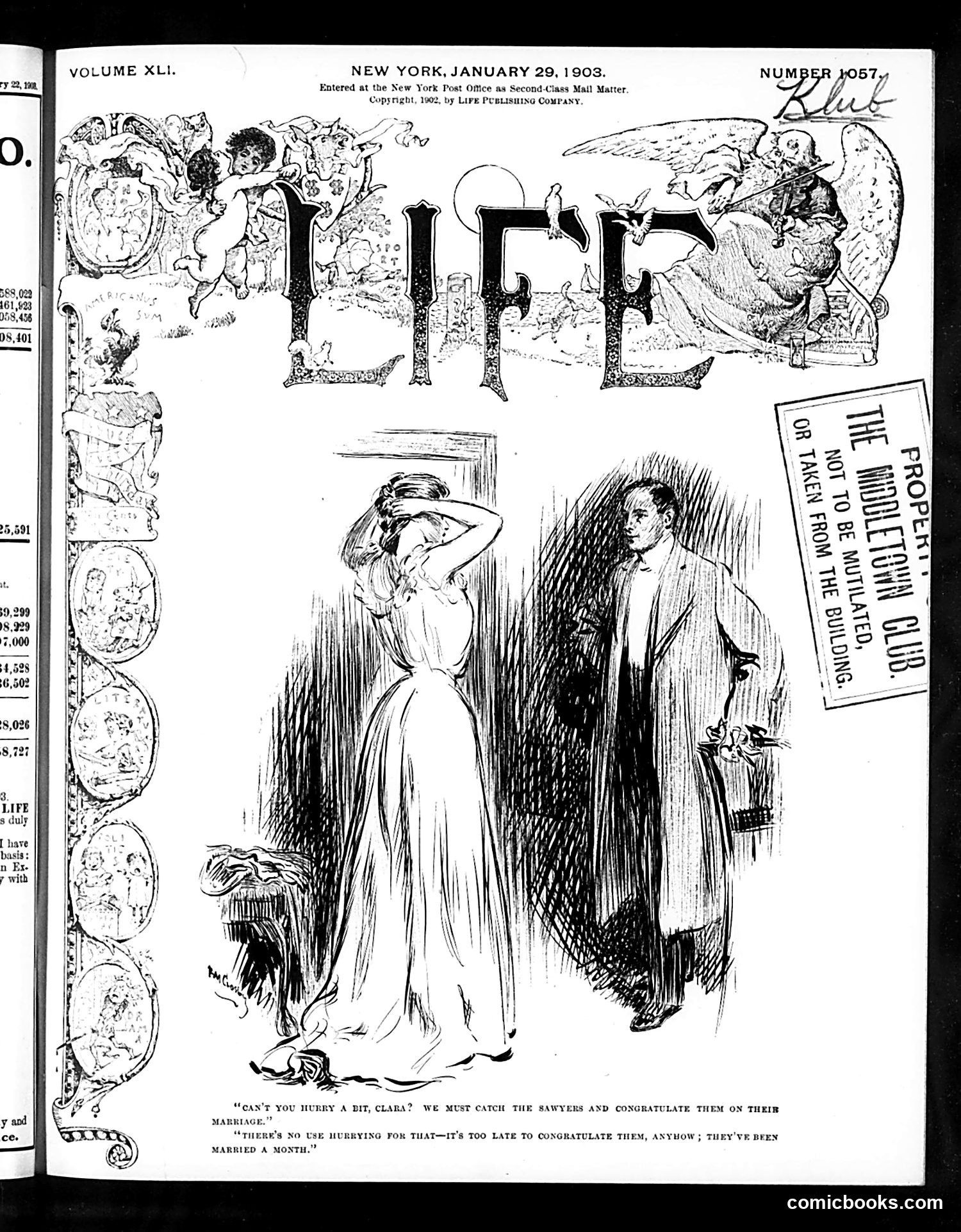
This page features a single cartoon depicting a domestic scene. A woman in a light dress stands between two men in darker clothing, with one appearing agitated or troubled. The caption reads: "Can't you hurry a bit, Clara? We must catch the sawyers and congratulate them on their marriage." The second man responds: "There's no use hurrying for that—it's too late to congratulate them, anyhow; they've been married a month." The joke appears to be social satire about the awkwardness of belated wedding congratulations. The humor relies on the contrast between the woman's urgency and the man's resigned acceptance that they've missed the appropriate window for offering congratulations—a commentary on social etiquette and the embarrassment of being tardy with such obligations.
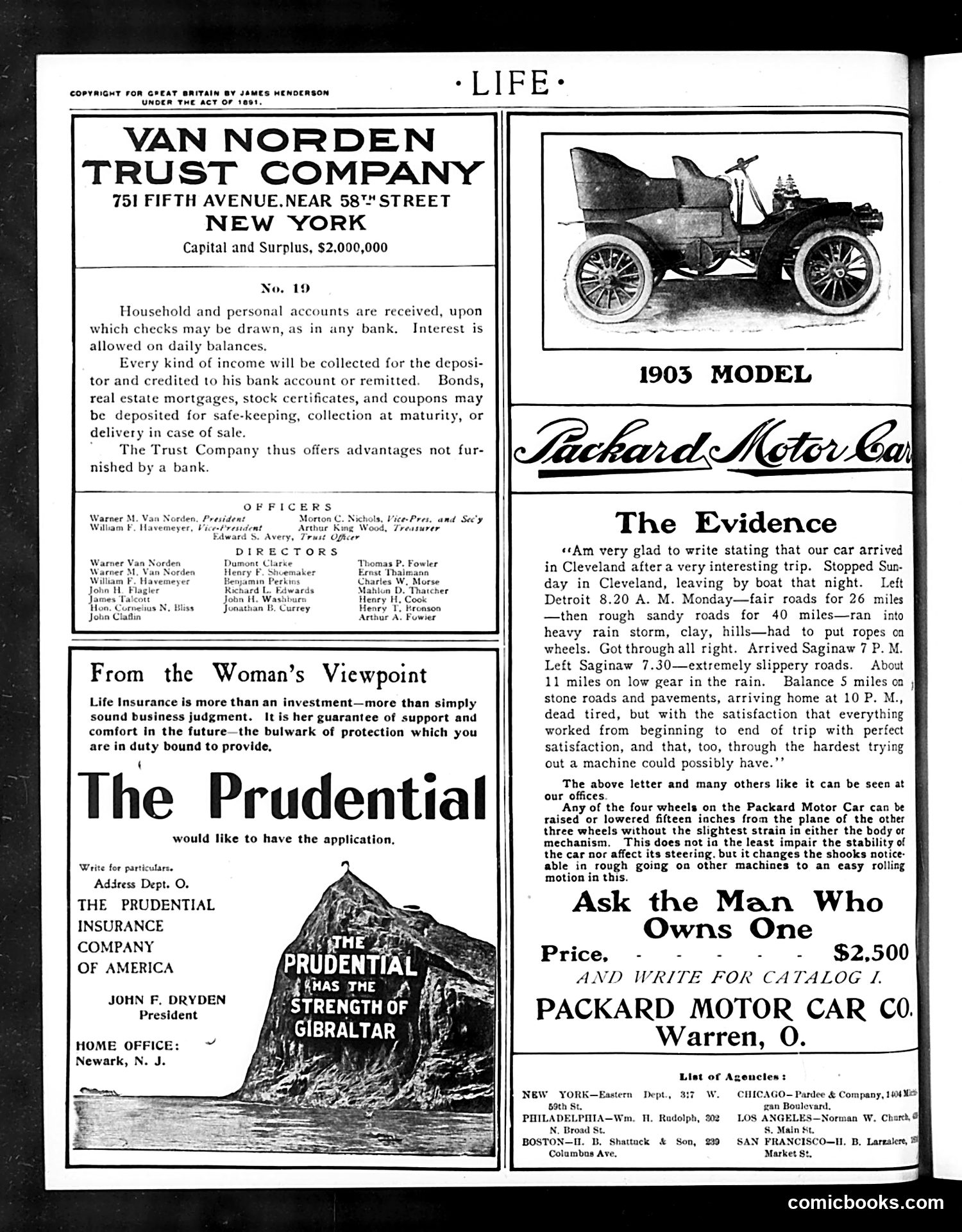
This page contains **no political cartoons or satire**. It's primarily **early 1900s advertising** for financial and automotive services. The left side features ads for Van Norden Trust Company (banking services) and The Prudential Insurance Company. The right side showcases a 1903 Packard Motor Car advertisement, including a customer testimonial ("The Evidence") describing a successful cross-country trip from Cleveland to Detroit. The Packard ad emphasizes the vehicle's reliability—it handled rough roads, rain, and sandy terrain without issue. The selling points were durability and adjustable wheel suspension. This represents **genuine product marketing** from the pre-WWI era, not satirical commentary. Life magazine at this period mixed serious advertising with humorous content across different pages.
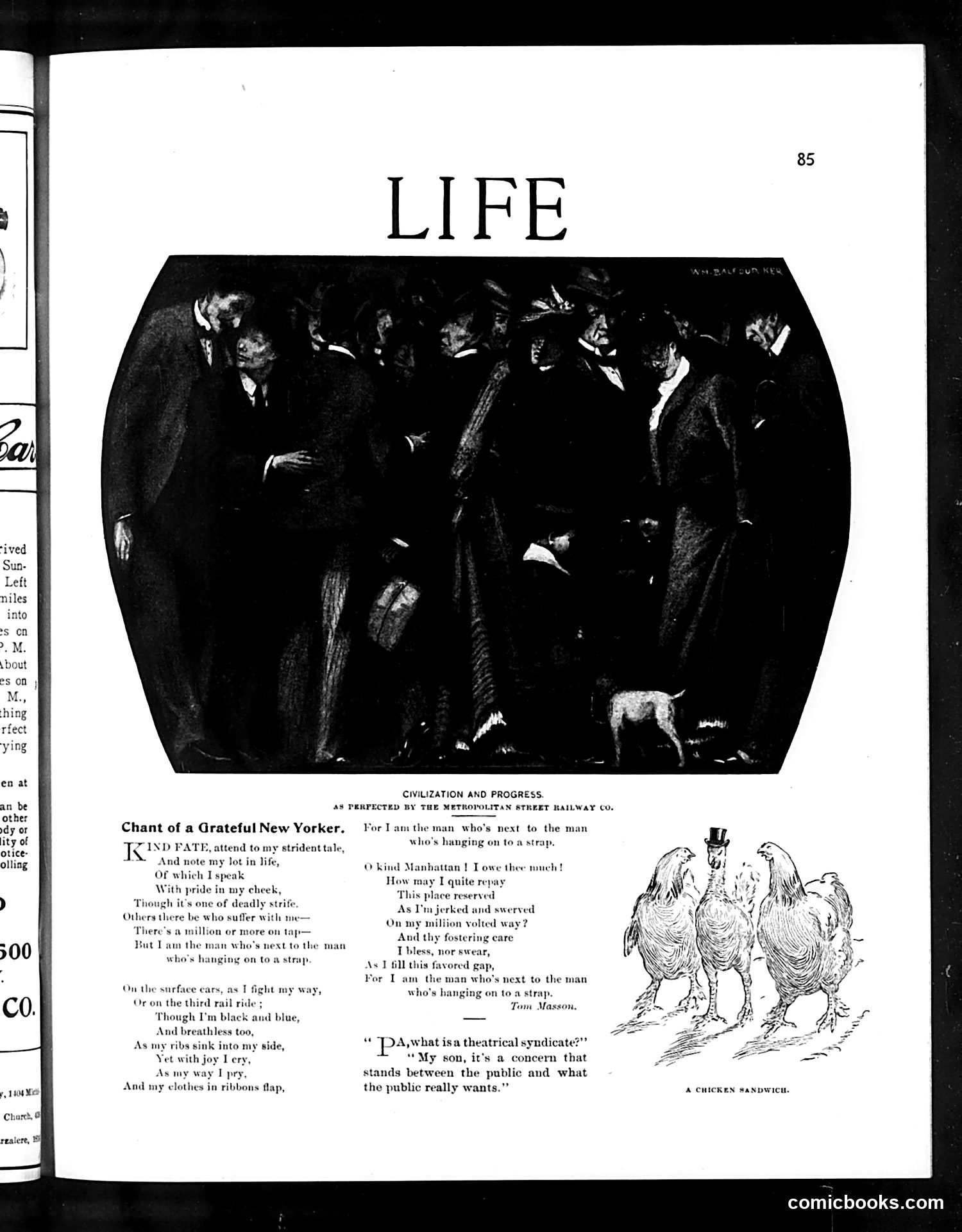
This Life magazine page satirizes New York City subway conditions and urban life circa early 1900s. **Top Image:** "Civilization and Progress as Perfected by the Metropolitan Railway Co." depicts crowded, formally-dressed commuters packed tightly on a subway car—a stark visual irony contrasting the headline's claim of "progress" with the undignified reality of mass transit. **Poems & Text:** "Chant of a Grateful New Yorker" sarcastically celebrates subway suffering—the speaker endures "deadly strife," bruising, and cramped conditions while ironically praising his commute. The theatrical syndicate quote mocks entertainment industry gatekeeping. **Illustration:** "A Chicken Sandwich" depicts chickens, apparently mocking food quality or the absurdity of finding real substance in urban life. Overall, the page critiques modern urban infrastructure as failing to deliver promised civilization while crowding citizens like livestock.
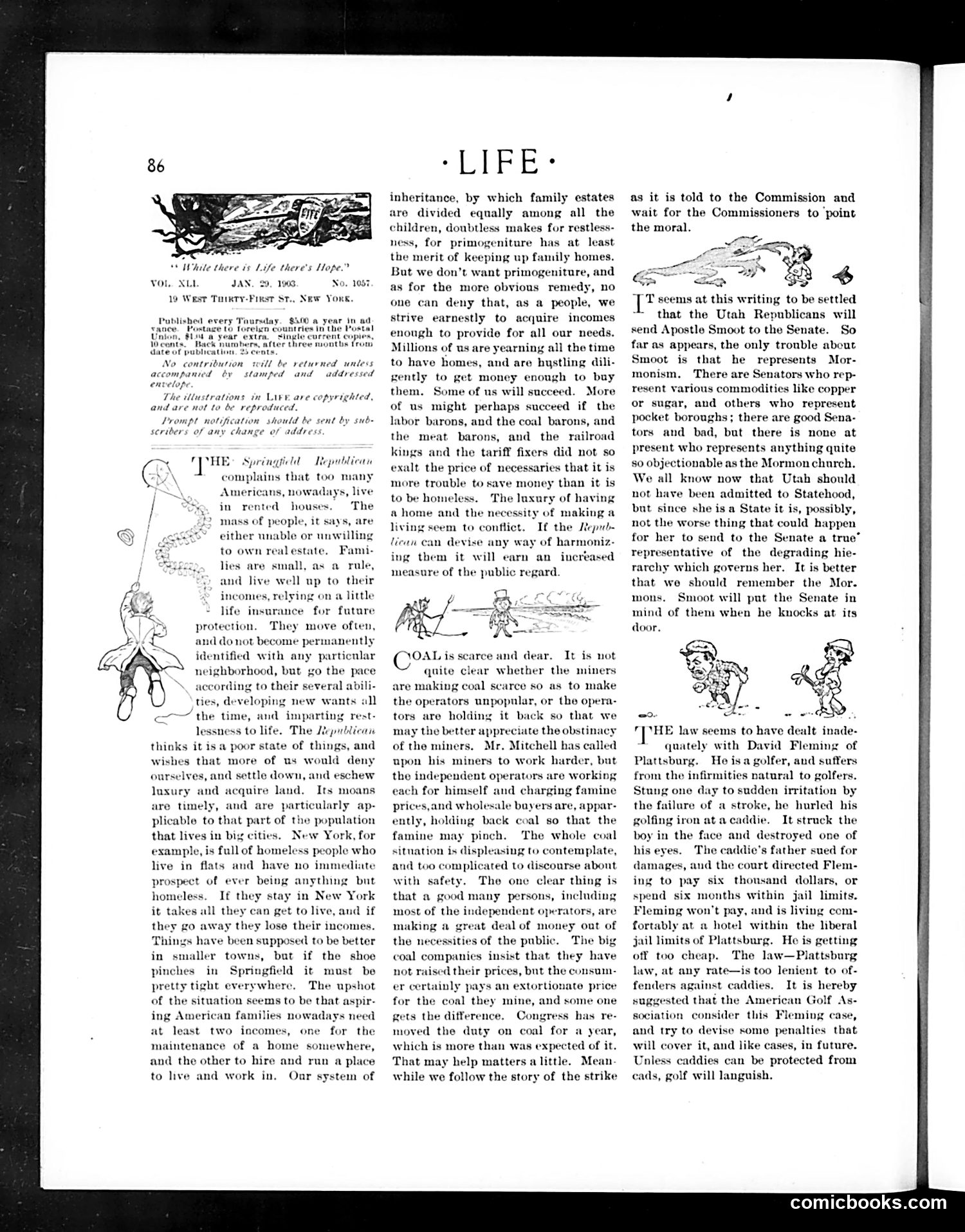
The page contains three distinct cartoon illustrations satirizing contemporary social issues: 1. **Top left**: A figure appears to represent wealth or privilege, depicted with exaggerated features—likely critiquing the concentration of inherited wealth among the wealthy elite. 2. **Middle left**: A caricatured man in formal dress (possibly representing a businessman or politician) is shown in a compromising position, suggesting hypocrisy or moral failing among the upper classes. 3. **Bottom right**: Multiple figures are sketched in what appears to be a domestic or social scene, though the specific reference is unclear from the image alone. The accompanying text discusses inheritance laws, housing scarcity for the poor, labor disputes (particularly coal mining strikes), and legal cases involving class conflict. The overall theme critiques wealth inequality and labor exploitation in early-20th-century America.
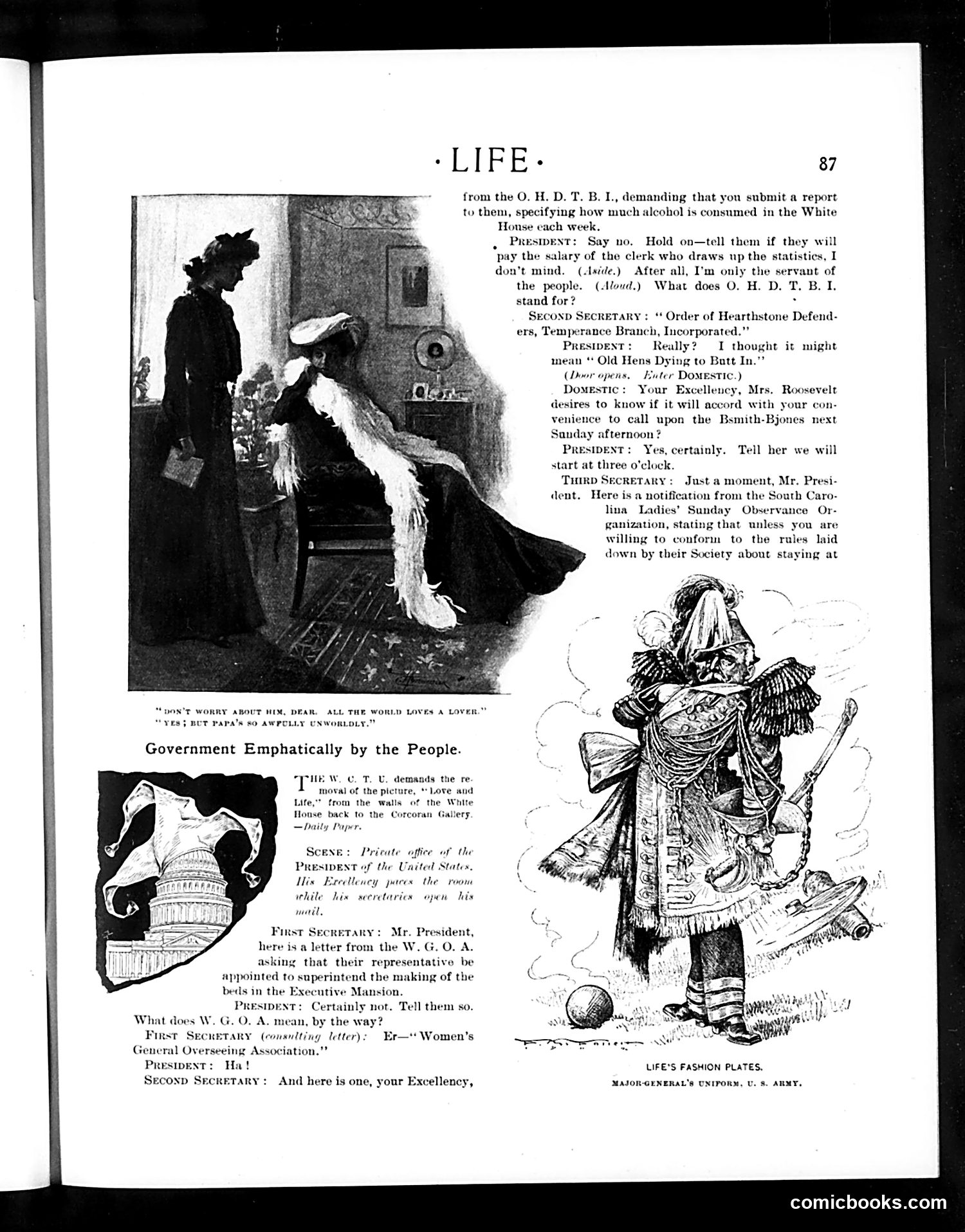
This page satirizes President Theodore Roosevelt's administration through two sketches: **Top sketch**: Shows Roosevelt's secretaries overwhelmed by competing demands from women's organizations (O.H.D.T.B.I., Temperance groups, and the South Carolina Ladies' Sunday Observance Organization). The joke centers on government being "emphatically by the people"—meaning the President is bombarded by constituent requests. **Bottom section**: The W.U.T.U. (appears to be a women's advocacy group) requests removal of a painting titled "Love and Life" from the White House, calling it indecent. Roosevelt humorously dismisses this, while secretaries struggle with conflicting organizational demands. The satire critiques how special-interest groups pressured the executive branch, suggesting Roosevelt's administration was consumed managing competing public demands rather than governing effectively.
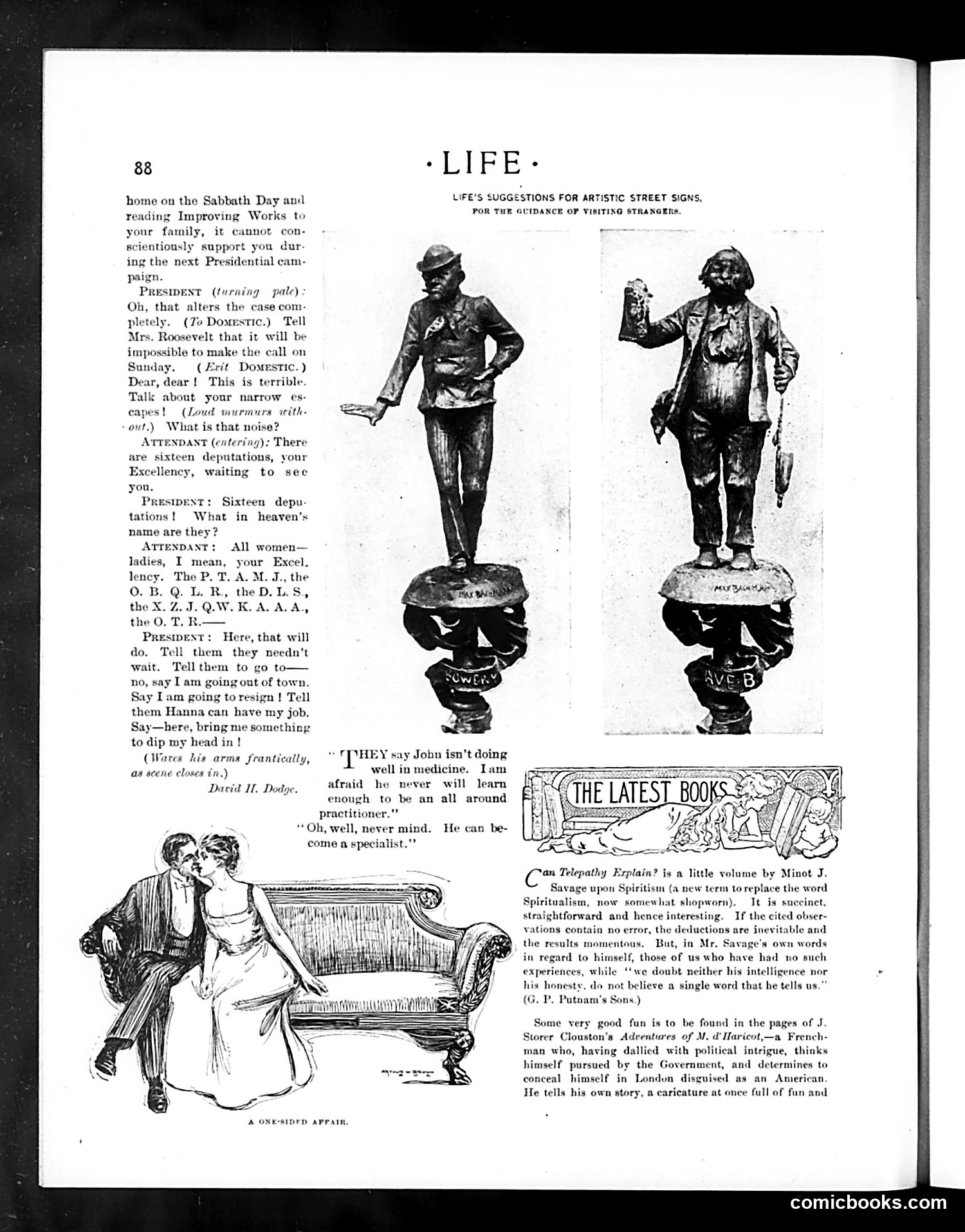
The main content is a political dialogue (likely from a play or sketch) between a President and his Attendant discussing competing demands—sixteen deputations waiting to see him, and a call from Mrs. Roosevelt about the Sabbath Day and supporting Works projects. The President dismisses the visitors, sarcastically telling them to say he's resigned or left town. The two statue illustrations labeled "HOWDY" and "AVE B" appear to be Life's suggestions for artistic street signs to guide visitors—depicting figures in working-class or frontier dress, likely satirizing public art or urban planning debates of the era. Below is a sketch titled "A One-Sided Affair" showing a couple on a couch, and text reviewing books including one on spiritualism and a French novel about political intrigue.
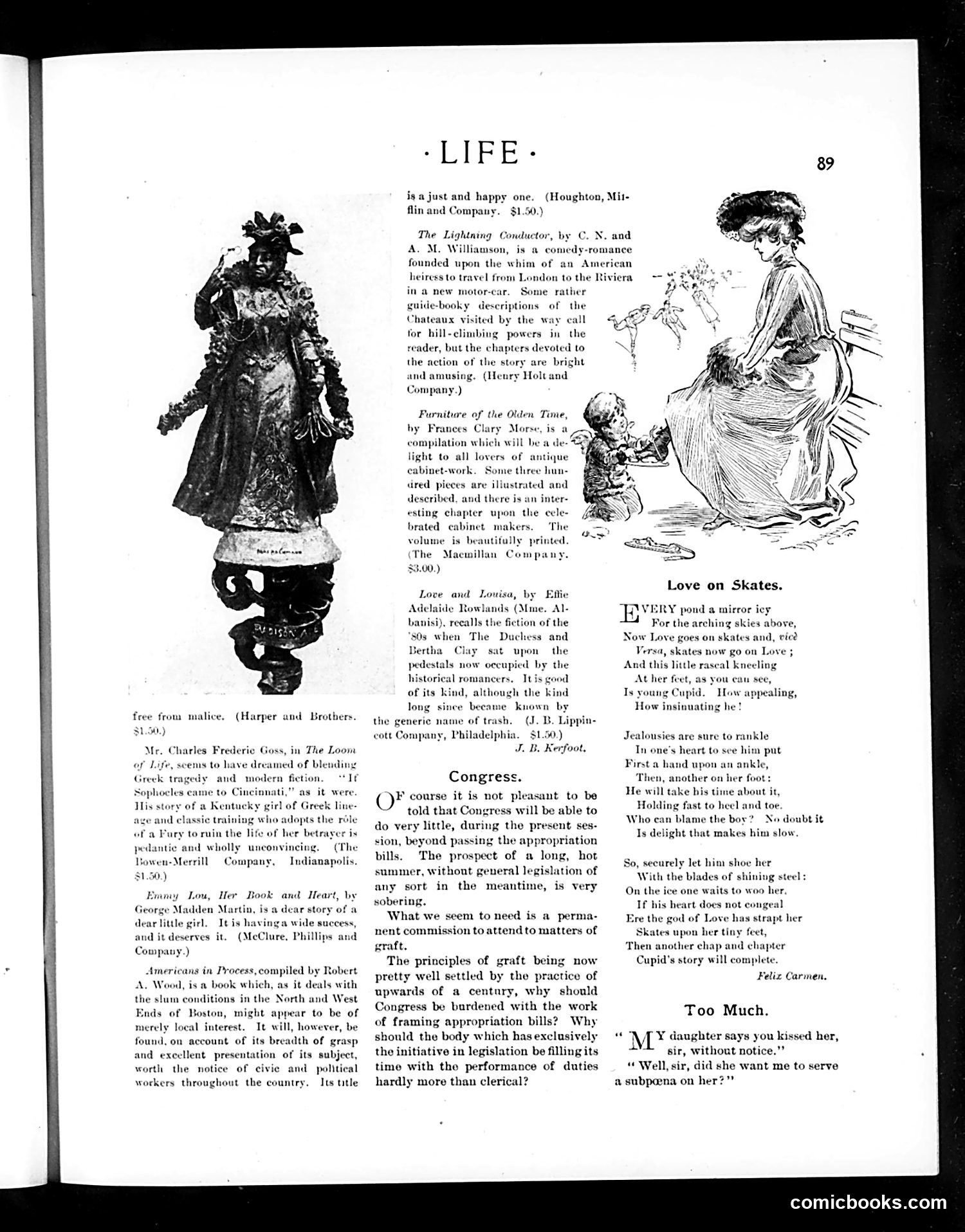
This page contains book reviews and three separate poems/cartoons rather than a unified political cartoon. The main visual elements include illustrations accompanying three literary pieces: "Love on Skates" (a poem about romantic jealousy while ice skating), "Congress" (a satirical editorial criticizing Congress's inefficiency regarding appropriation bills and graft), and "Too Much" (a humorous domestic dialogue). The "Congress" section critiques the legislative body for failing to address corruption ("graft") and wasting time on clerical work rather than substantive legislation. The author argues Congress should establish a permanent commission for graft oversight. The other items are light social satire—romantic mishaps and domestic comedy—rather than political commentary. The page primarily serves as a miscellaneous collection of short literary and humorous content typical of Life's satirical format.
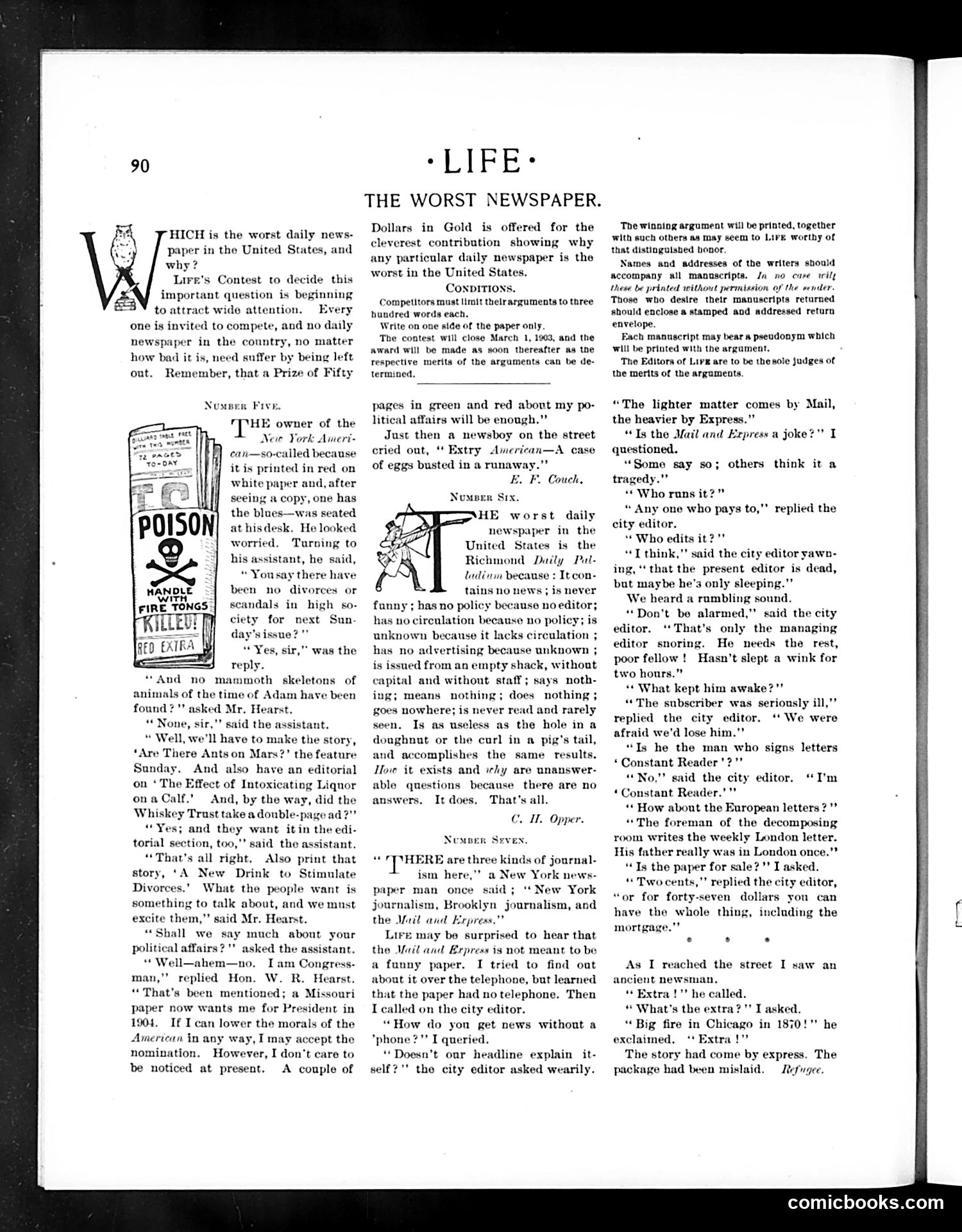
This page presents Life's contest asking readers to identify the worst daily newspaper in America. The satirical descriptions mock incompetent journalism through exaggerated examples. **Number Five** features a poison-labeled newspaper (the New York *Advertiser*), suggesting it's toxic reading material. **Number Six** targets the Richmond *Daily Patriotism*, ridiculing it as utterly worthless—containing no news, lacking circulation, advertising, or staff, existing in an "empty shack" and accomplishing nothing. The satire suggests this newspaper is so pointless it might as well not exist. **Number Seven** discusses three types of "journalism": Mail and Express journalism, Brooklyn journalism, and "West and Express" journalism, implying fragmented, inconsistent reporting standards. The overall joke mocks incompetent newspaper management and editorial failure through absurdist descriptions of fictional publications.
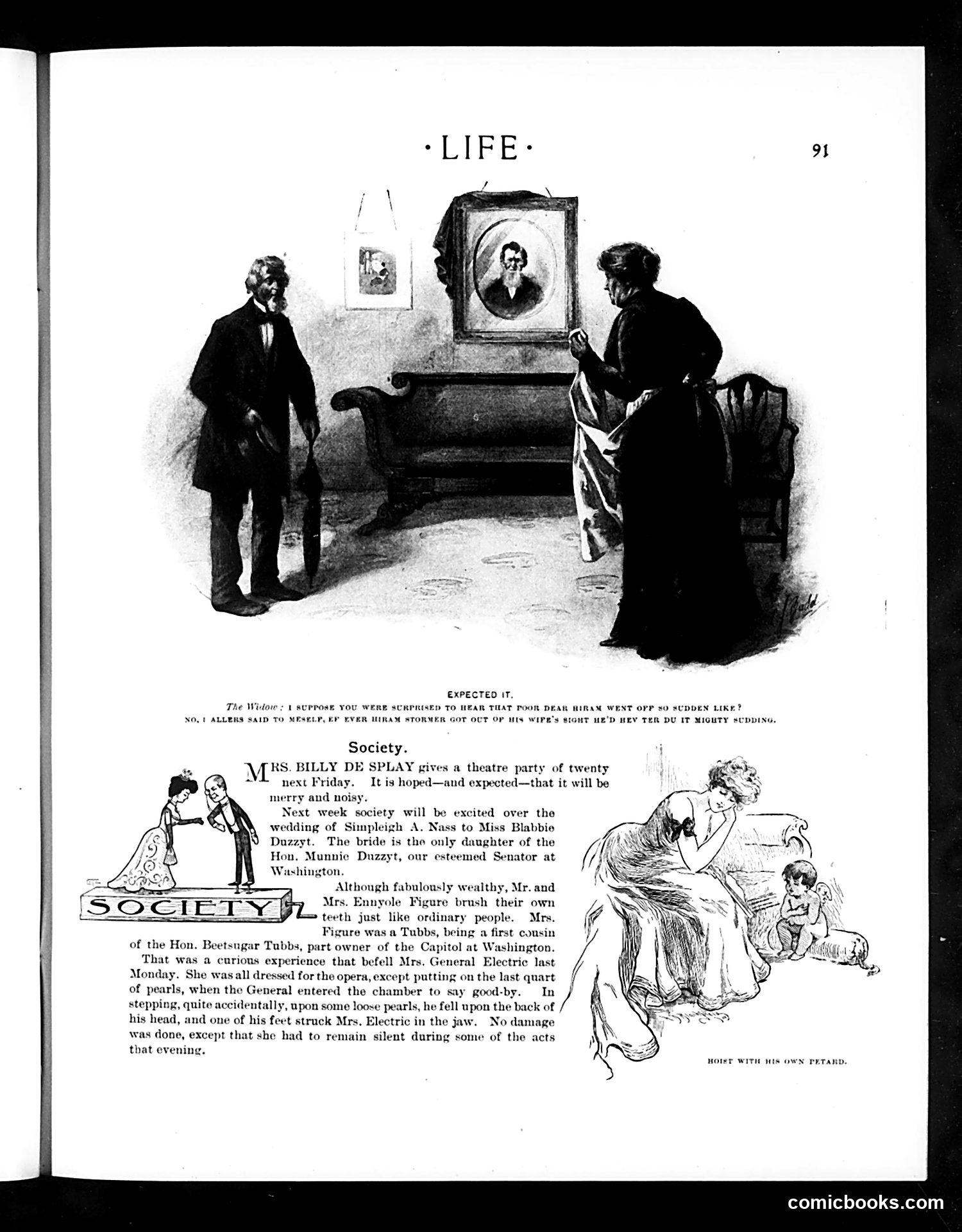
**Top Cartoon ("Expected It"):** A woman confronts a man about his friend Hiram's sudden departure from his wife. The caption suggests Hiram "went off so sudden" and the woman expected such behavior. This satirizes marital infidelity and abandonment among society men—a common scandal in Victorian-era gossip. **Society Section:** Reports on Mrs. Billy de Splay's upcoming theater party and a wedding between Stimpleton A. Nass and Miss Blabbie Duzzy. The text mocks wealthy families through ridiculous names (Nass, Duzzy, Tubbs, Figure brush), satirizing the pretensions and absurdities of high society. An anecdote about General Electric and loose pearls humbles an embarrassing socialite. The page combines scandal commentary with social mockery of the wealthy.
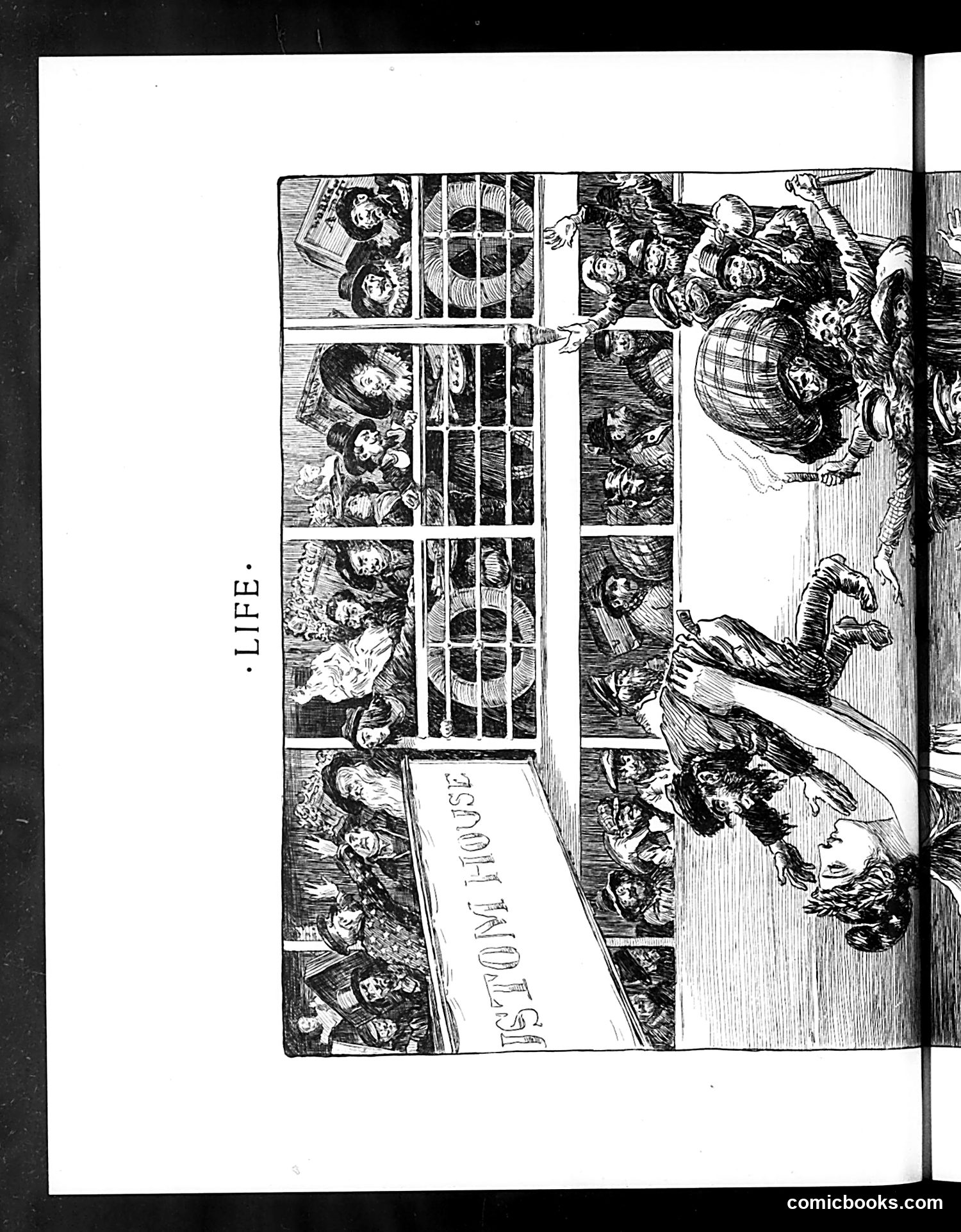
This page shows a satirical illustration titled "Life" depicting a multi-panel scene of domestic life, appearing to be rotated 90 degrees for viewing. The central image shows what looks like a house cross-section with multiple rooms and windows. The text "Is this LIFE?" appears on a banner or sign within the composition, suggesting the cartoon questions whether the depicted domestic scene represents a desirable life. Multiple figures are shown engaged in various household activities across different levels/rooms. The satire appears to critique middle-class domesticity—possibly commenting on the mundane, repetitive nature of household routines or domestic responsibilities. Without clearer visibility of specific details or knowing the magazine's publication date, the exact social commentary remains somewhat unclear, but it seems to mock conventional domestic life as presented during the era.
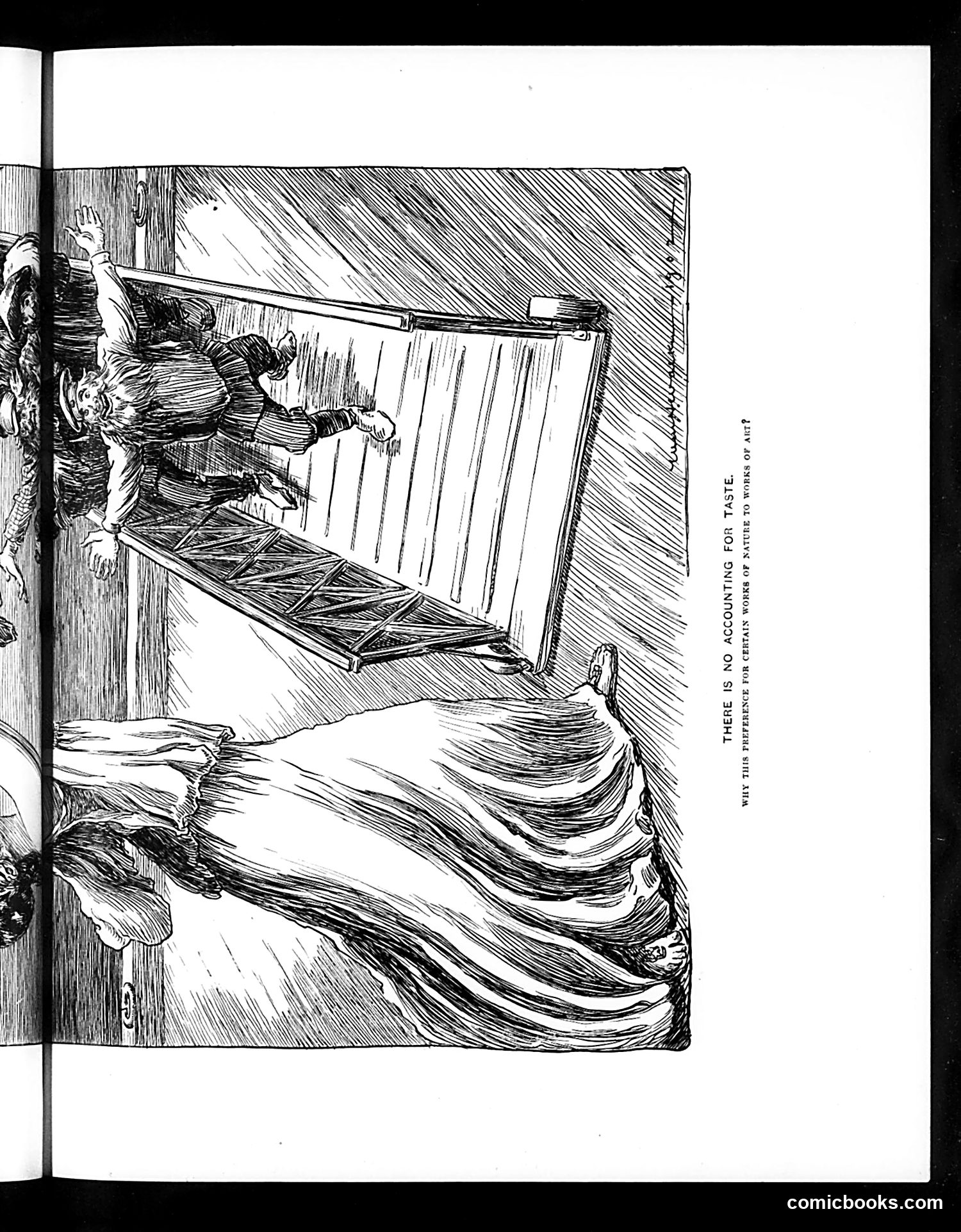
This is a political cartoon rotated 90 degrees. The caption reads: "THERE IS NO ACCOUNTING FOR TASTE. WHY THE PYTHERS [?] WOMEN OF YEMEN OR THAT?" The image shows a figure in elaborate dress holding what appears to be a long rifle or similar implement, standing in an interior space. The style and composition suggest social satire about exotic or foreign customs, likely mocking either: 1. Western fascination with "Oriental" or Middle Eastern peoples 2. Women's clothing or behavior in Yemen/that region 3. The juxtaposition of refined domestic settings with weapons The reference to "taste" suggests the cartoon critiques either Western orientalism or critiques actual Yemeni practices as barbaric. However, without clearer identification of specific figures or more legible text, the precise satirical target remains somewhat unclear.
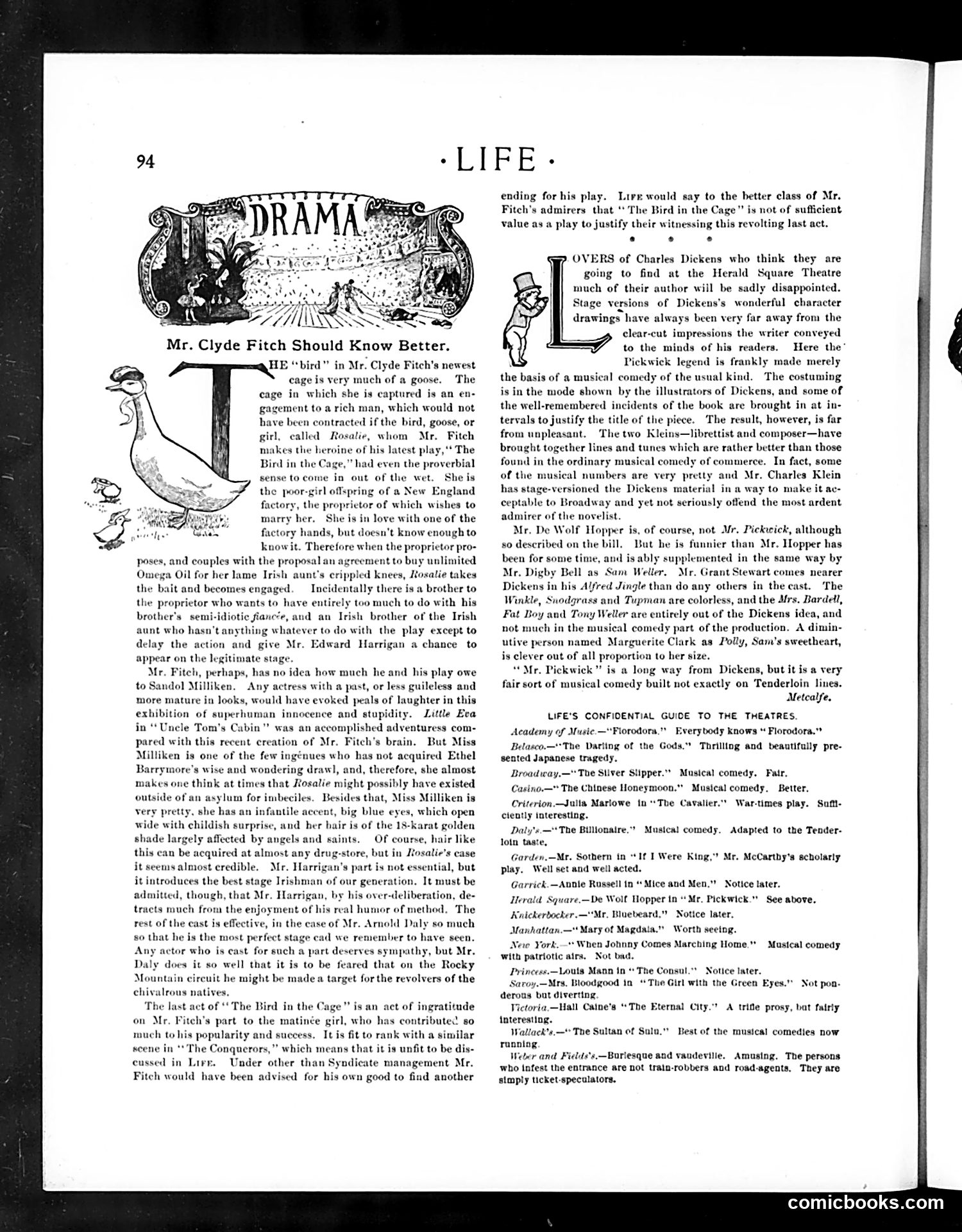
This drama critique discusses Clyde Fitch's play *"The Bird in the Cage,"* which the reviewer considers poorly executed. The cartoon depicts a caged bird, satirizing the play's central conceit. The reviewer criticizes Fitch for creating an implausible plot involving a "New England factory" proprietor who marries for love but becomes entangled in complicated romantic situations. The text suggests the play lacks the sophisticated character development and emotional authenticity of Dickens's theatrical adaptations. The piece is part of *Life* magazine's theater column, which also reviews other contemporary productions like *"Pickwick"* and various musical comedies. The satire mocks both Fitch's dramatic construction and the play's romantic melodrama conventions.
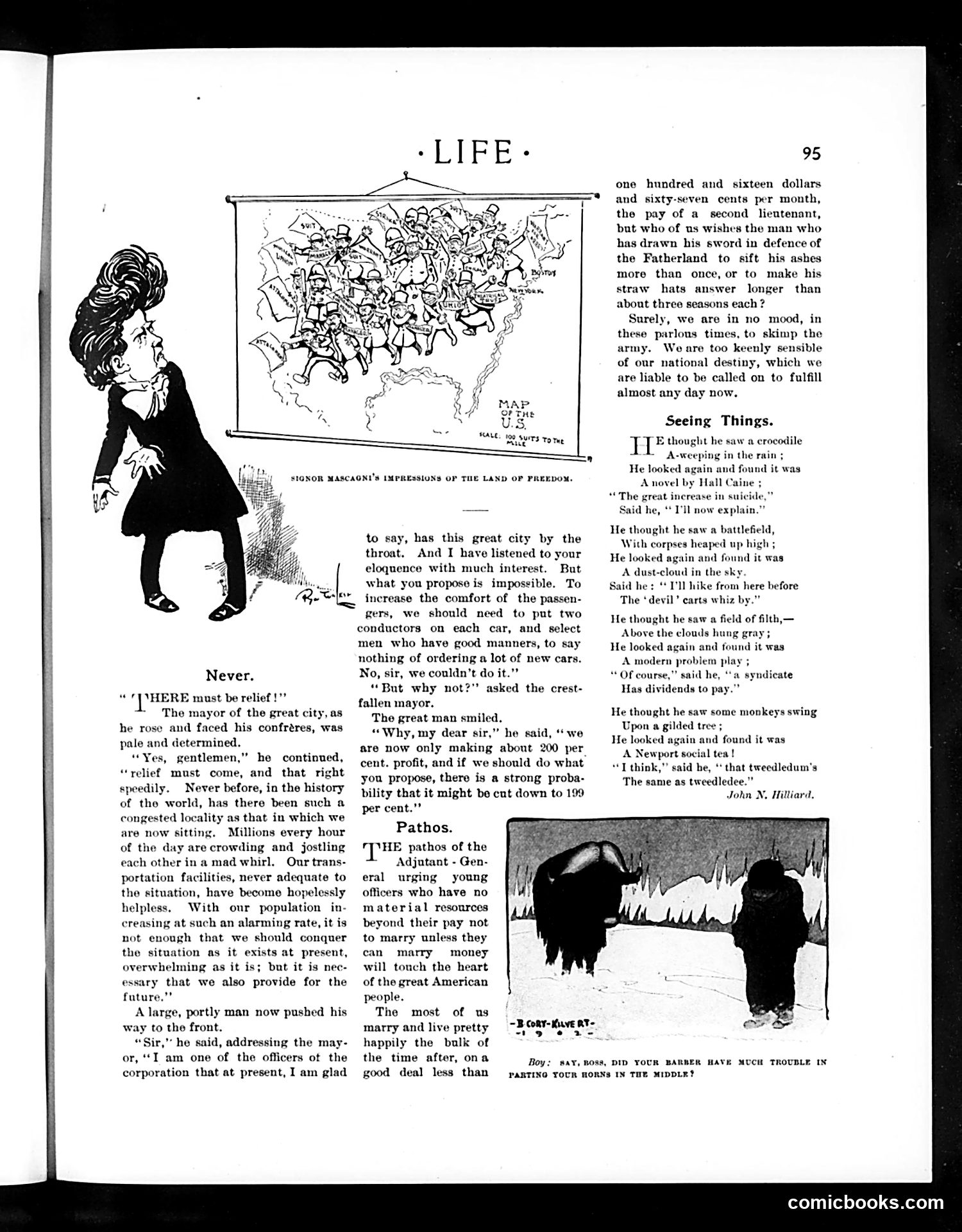
This page contains three satirical pieces critiquing American society circa early 1900s: **"Never"** depicts a mayor pleading for transit relief during a congestion crisis, confronted by a corrupt transit corporation officer. The satire targets monopolistic capitalism: the officer refuses improvements because reducing profits from 200% to 199% is unthinkable. The "great city by the throat" metaphor makes explicit that corporations hold public welfare hostage for maximum profit margins. **"Pathos"** ironically mocks military leadership for discouraging low-ranking officers (earning $116.67/month as second lieutenants) from marrying unless wealthy. The author sarcastically notes common soldiers manage on less, questioning why we'd scrimp on defending the nation—likely referencing pre-WWI military preparedness debates. **"Seeing Things"** is a whimsical poem (attributed to John N. Hilliard) about perceptual illusions, mocking contemporary absurdities: Hall Caine novels, suicide epidemics, corporate dividend-seeking ("syndicates"), and wealthy Newport society as interchangeable illusions. The bottom cartoon jokes about an elaborate hairstyle parted down the middle, comparing a boy's hair to animal horns.
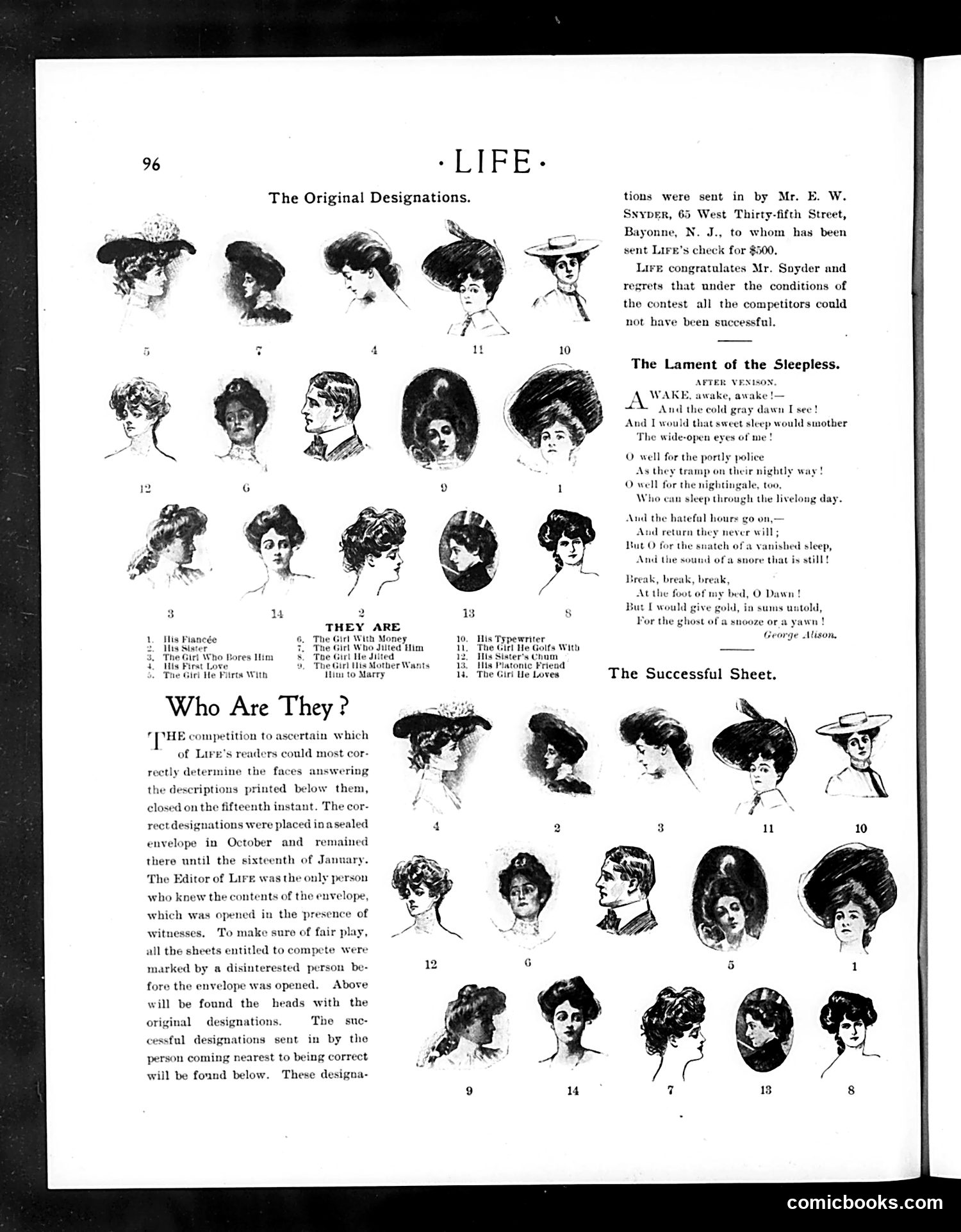
This page documents results of a reader contest where *Life* magazine challenged subscribers to identify illustrated faces based on printed descriptions. The contest ran from October through mid-January, with the editor as sole keeper of correct answers until public verification. The page shows two sets of female portrait sketches numbered 1-14: "The Original Designations" (top) and "The Successful Sheet" (bottom)—presumably the correct identifications versus a winning reader's submission. A $500 prize was awarded to E.W. Snyder of Bayonne, N.J., though the editor notes not all competitors succeeded. The page also includes a poem, "The Lament of the Sleepless," typical of *Life's* satirical content, and references a related feature titled "They Are" with captions describing relationship types ("His Fiancée," "The Girl Who Bored Him," etc.). This reflects early-20th-century magazine culture: interactive contests engaging readers while showcasing the publication's illustrative quality.
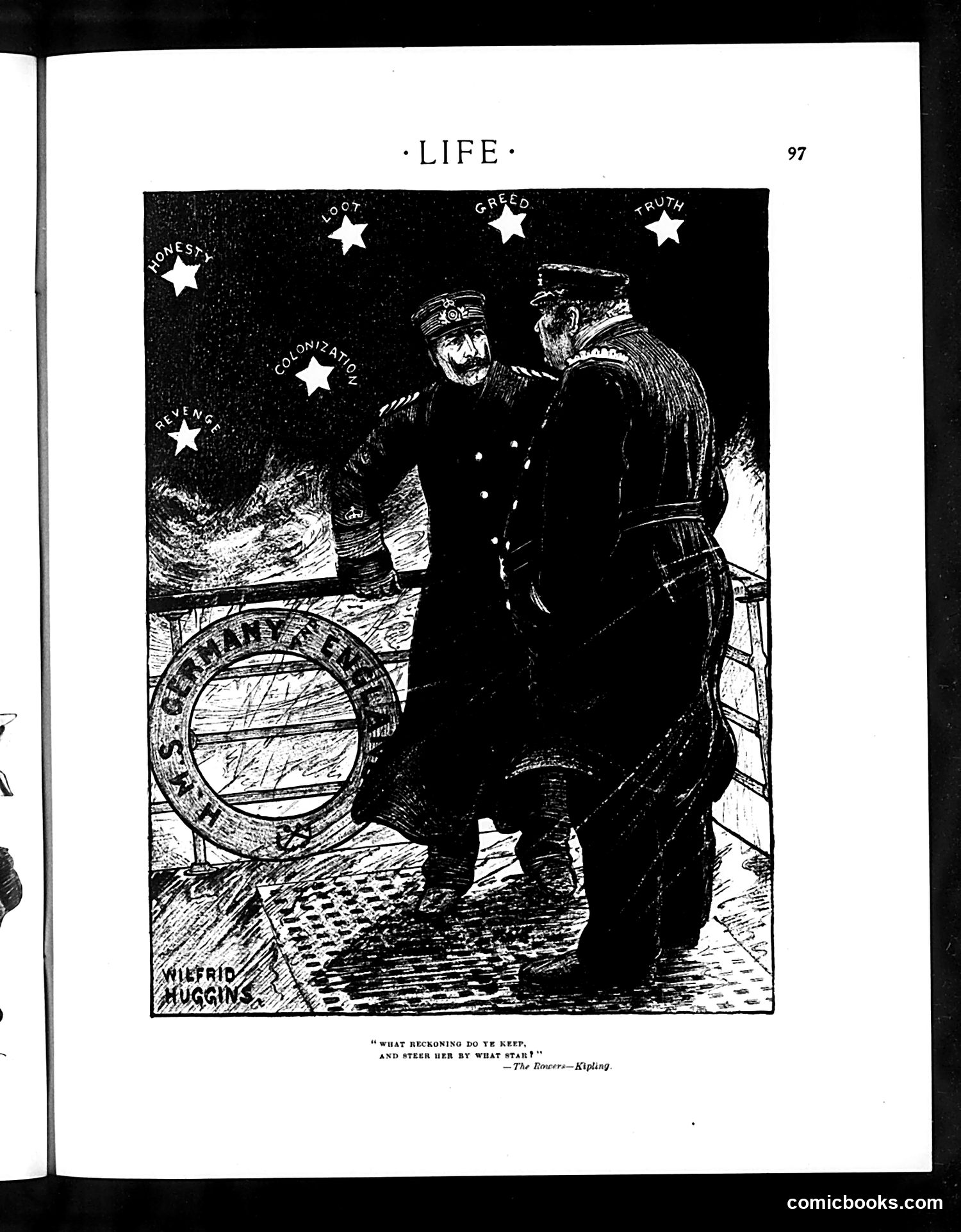
This political illustration by Wilfrid Huggins depicts two military officers in conversation beside a ship's wheel, under five stars labeled "Honesty," "Loot," "Greed," "Colonization," and "Truth." The cartoon satirizes imperial military leadership and colonial ambitions. The quote from Kipling's "The Rowers" sarcastically asks what moral "reckoning" guides their navigation—implying the answer is the five vices displayed above rather than virtuous principles. The ship's wheel and nautical setting suggest steering a nation's course. This appears to be commentary on early-20th-century military imperialism, criticizing how colonial powers justified expansion through rhetoric of "truth" and "honesty" while actually being motivated by greed, looting, and territorial conquest.
This page is **primarily advertising with some satirical content**. The main feature is "Lazy Germs at Nully's"—a humorous piece examining how germs supposedly cause various human behaviors (laziness, falling in love, working hard). It's pseudo-scientific satire mocking the era's obsession with germ theory as explanation for everything. The **Mr. Dooley** column (recognizable Irish-dialect humor) satirizes wealthy industrialists' sudden "generosity" during crises—mocking how rich men like Clancy donate money when trapped in fires, then resume stinginess once safe. **The Dr. Parker anecdote** jokes darkly about an "annibilationist" (someone believing consciousness ends at death) and the doctor's relief at this prospect. The remainder is **vintage advertising**: Wilson Whiskey (established 1823), Vigor al tonic, Esterbrook pens, Naylor's cocoa, and patent medicines. The ads reflect common early-1900s products and health claims.
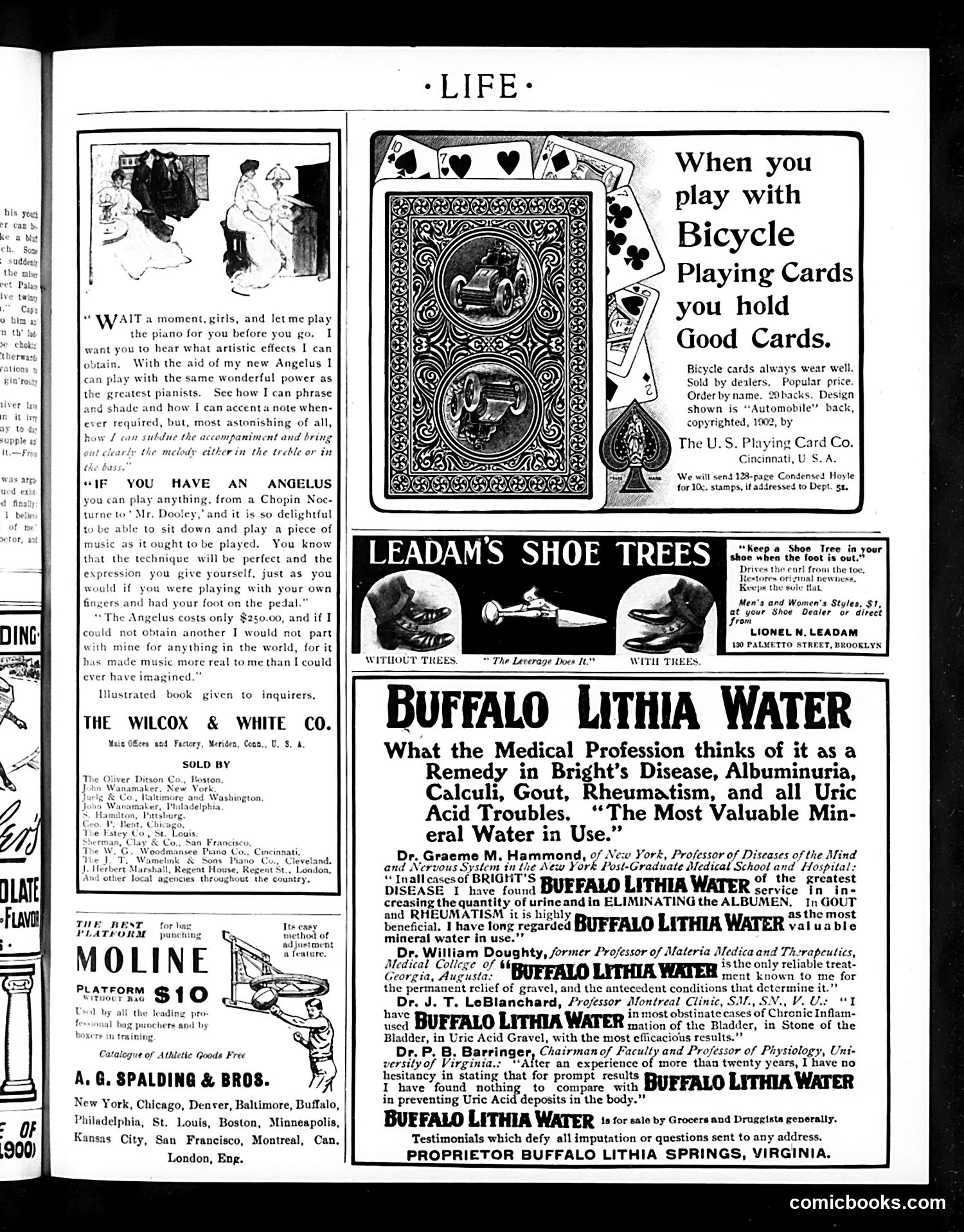
This page features **period advertisements** from circa 1902, primarily promoting mechanical and medical products. The main cartoon (upper left) shows a man at a piano demonstrating an **Angelus**, an early automated player piano. The satire mocks wealthy social pretension: the man boasts of playing "like the greatest pianists" through a machine, while actually possessing no musical skill—a commentary on how technology could fraudulently promise expertise and genuine artistry to the gullible wealthy. The page is otherwise advertising-heavy, including: - **Bicycle Playing Cards** (touting durability) - **Leadam's Shoe Trees** (with dubious anatomical claims) - **Buffalo Lithia Water**, a patent medicine claiming to cure serious ailments (Bright's disease, gout, rheumatism)—a common early-20th-century medical fraud supported by physician testimonials The **Buffalo Lithia advertisement** exemplifies the unregulated medical marketing of the era, making grand therapeutic claims without scientific evidence—typical of the patent medicine industry Life's satire often targeted.
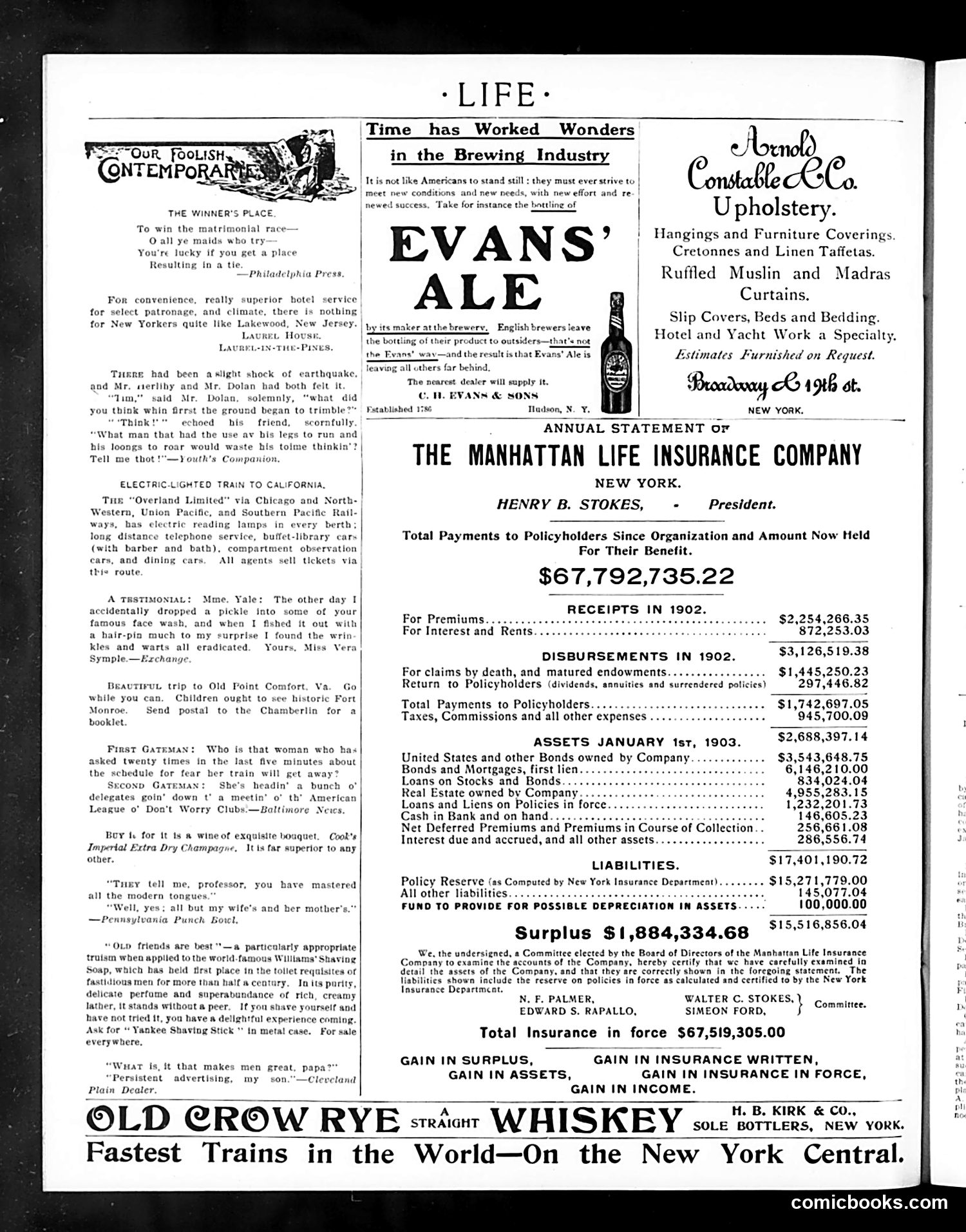
This page is primarily **advertising and financial notices** rather than political satire or editorial cartooning. The small cartoon at top left, "Our Foolish Contemporary," appears to be a brief satirical jab at a rival publication, though details are unclear from the image. The rest consists of: - **Humorous anecdotes** (Irish laborers discussing an earthquake; a woman at a train station obsessed with schedules; a professor who speaks many languages but not his wife's)—typical early-1900s American humor relying on ethnic stereotypes and domestic comedy - **Product advertisements** for whiskey, shaving soap, champagne, and upholstery services - **A detailed financial statement** from Manhattan Life Insurance Company showing $67+ million in policyholder payments and surplus assets of $1.8+ million The page reflects turn-of-the-century American consumer culture and insurance industry confidence, with no apparent political content or sophisticated satire beyond mild workplace jokes.
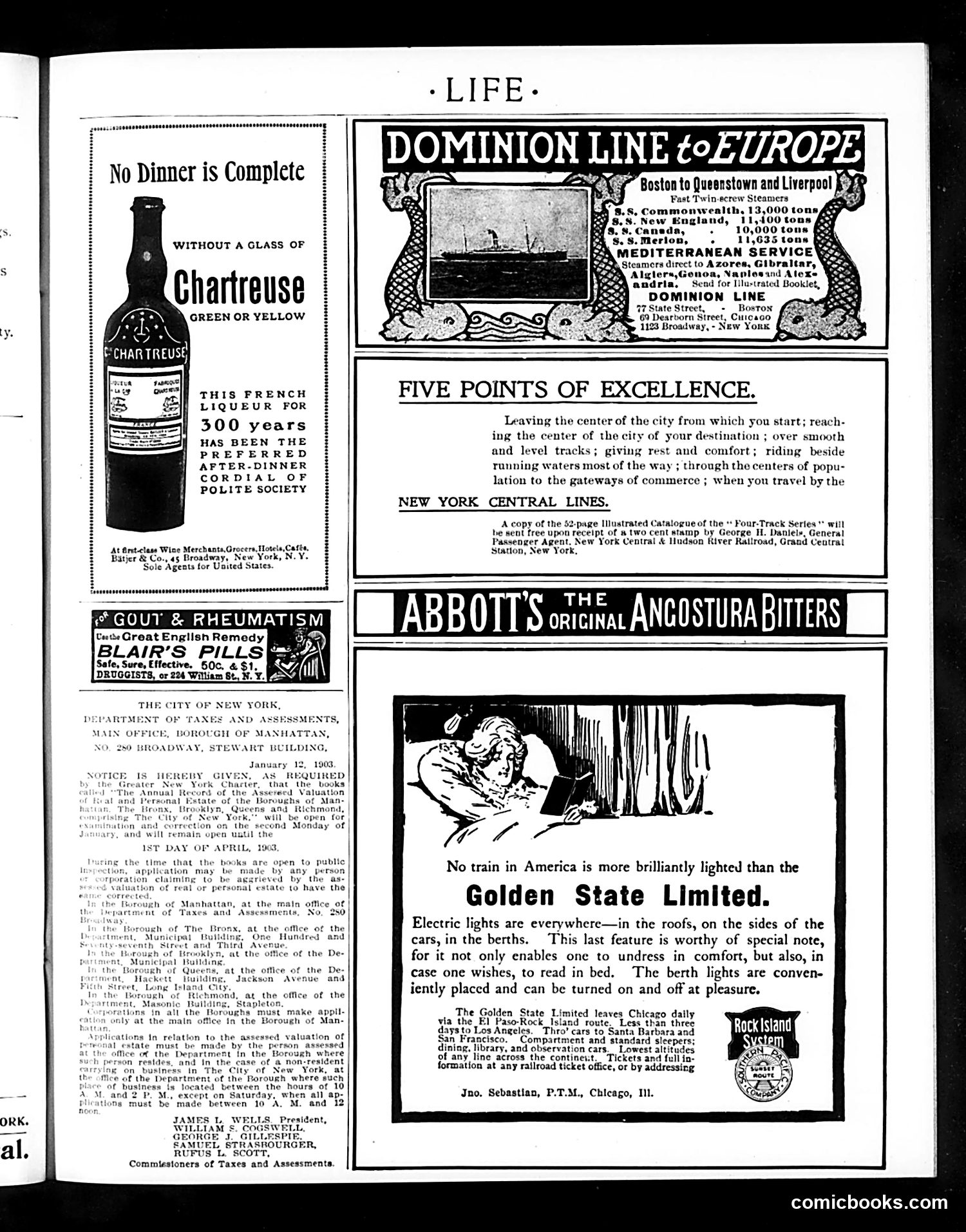
This is primarily an **advertising page** with no political cartoons or satire. The content consists entirely of commercial advertisements typical of early 1900s Life magazine: **Key advertisements:** - Dominion Line steamships to Europe - Chartreuse liqueur (a French digestif marketed to "polite society") - Blair's Pills (gout and rheumatism remedy) - New York Central railroad lines - Abbott's Angostura Bitters - Golden State Limited train service (Rock Island Line) **Notable context for modern readers:** The ads reflect Edwardian-era consumer culture: transatlantic steamship travel was luxury, French liqueurs were status symbols, patent medicines were heavily marketed, and railroads competed fiercely for passengers with amenities like electric lighting—then a novel luxury feature. The page also includes a formal City of New York tax notice, suggesting Life mixed editorial administrative content with advertising.
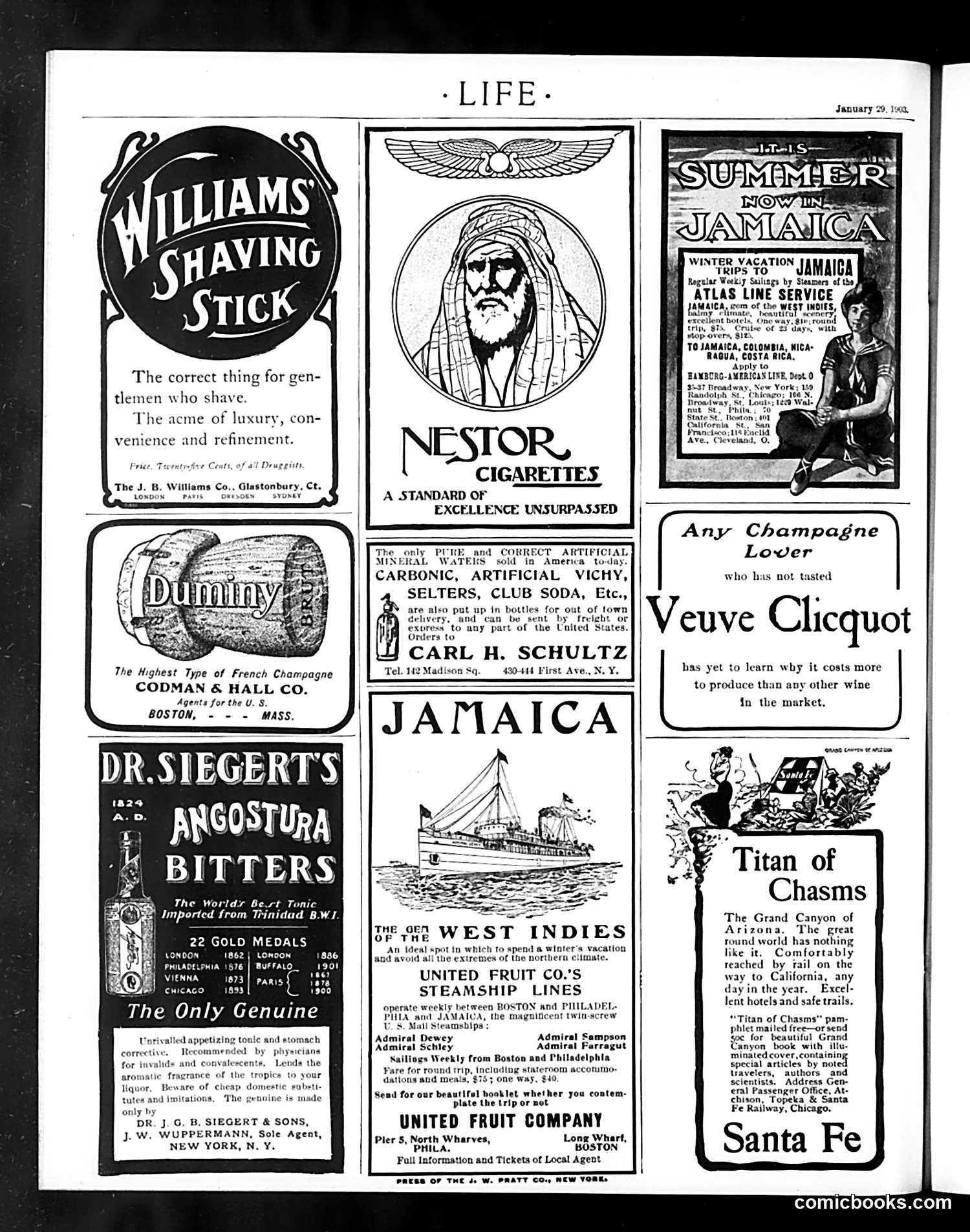
This is primarily an **advertising page** from Life magazine (January 29, 1903), not a satirical cartoon. It contains commercial advertisements typical of the era. Notable ads include: - **Williams Shaving Stick** and **Nestor Cigarettes** — luxury grooming and tobacco products - **Dr. Siegert's Angostura Bitters** — marketed as a medicinal tonic (note the 22 gold medals claimed) - **Jamaica tourism ads** — promoting winter vacations via United Fruit Company steamships named after American naval heroes (Dewey, Sampson, Schley, Farragut) - **Veuve Clicquot champagne** — luxury goods positioning - **"Titan of Chasms"** — Santa Fe Railway promoting Grand Canyon tourism The page reflects **Gilded Age consumer culture**: luxury items, imperial expansion (Caribbean travel), and the emerging tourism industry. The military-named steamships subtly link commercial expansion with American naval power during the post-Spanish American War period.