
Life, 1903-01-29 · page 12 of 20
Life — January 29, 1903 — page 12: what you’re looking at
What you’re looking at
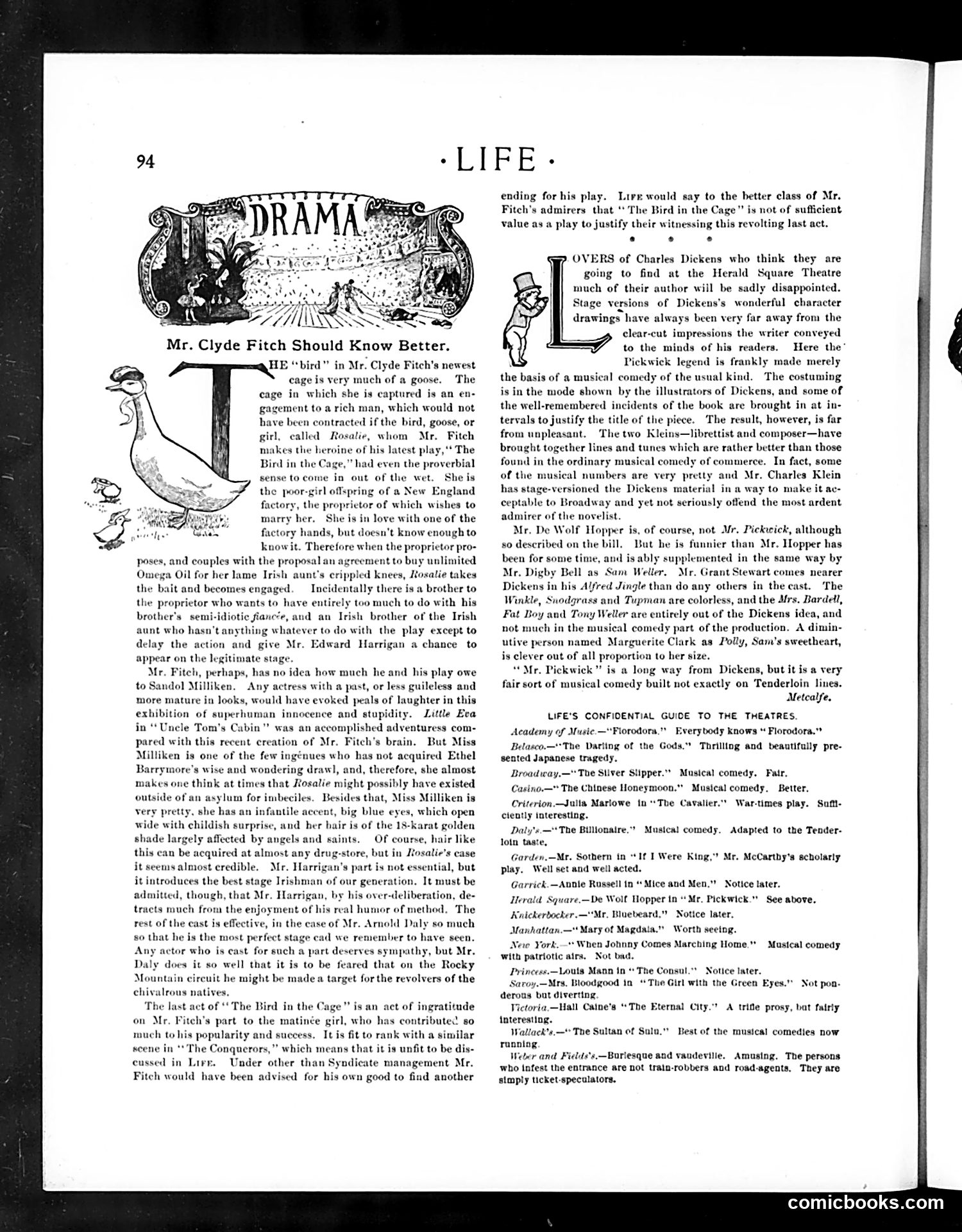
This drama critique discusses Clyde Fitch's play *"The Bird in the Cage,"* which the reviewer considers poorly executed. The cartoon depicts a caged bird, satirizing the play's central conceit. The reviewer criticizes Fitch for creating an implausible plot involving a "New England factory" proprietor who marries for love but becomes entangled in complicated romantic situations. The text suggests the play lacks the sophisticated character development and emotional authenticity of Dickens's theatrical adaptations. The piece is part of *Life* magazine's theater column, which also reviews other contemporary productions like *"Pickwick"* and various musical comedies. The satire mocks both Fitch's dramatic construction and the play's romantic melodrama conventions.
📄 Transcribed text from this page (OCR, searchable)
Machine-transcribed from the original scan — historical spelling and the odd misread are preserved.
-LIFE- HE “bird” in Mr. Clyde Fitch's newest cage is very much of a goose. The cage in which she is captured is an en- ement toa rich man, which would not ave been contracted if the bird, goose, or girl, called Rosalie, whom Mr. Fitch makes the heroine of his latest play,"* The Bird in the Cage,” had even the proverbial sense to come in out of the w She is the poor-girl ofspring of a New England factory, the proprietor of which wishes to marry her. She is in love with one of the factory hands, but doesn't know enough to know it. Therefore when the proprietor pro- ses, and couples with the proposal an agreement to buy unlimited Omega Oil for her lame Irish aunt's crippled knees, Kosalie takes the bait and becomes engaged. Incidentally there is a brother to the proprietor who wants to have entirely too much to do with his brother's semi-idiotic sian and an Irish brother of the Irish aunt who hasn't anything whatever to do with the play except to delay the action and give Mr. Edward Harrigan a chance to appear on the legitimate stage Mr. Fitch, perhaps, has no idea how much he and his play owe to Sandol Milliken, Any actress with a past, or less guileless and more mature in looks, would have evoked peals of laughter in this exhibition of superhuman innocence and stupidity. Little Eva in ‘Uncle Tom's Cabin was an accomplished adventuress com- pared with this recent creation of Mr. Fitch's brain. But Miss Milliken is one of the few ingénues who has not acquired Ethel Barrymore's wise and wondering drawl, and, therefore, she almost makes one think at times that Rosalie might possibly have existed outside of an asylum for imbeciles. Bes' that, Miss Milliken is very pretty, she has an infantile accent, big blue eyes, which open le with childish surprise, and her bair is of the 18-karat golden shade largely affected by angels and saints, Of course, hair like this can be acquired at almost any drug-store, but in Rosalie’s case it seems almost credible. Mr. Harrigan’s part is not essential, but it introduces the best stage Jrishman of our generation. It must be admitted, though, that Mr. Harrigan, by his over-deliberation, de- tracts much from the enjoyment of his real humor of method. The rest of the cast is effective, in the case of Mr. Arnold Daly so much so that he is the most perfect stag: to have seen. ot who is cast for such a p , but Mr. does it so well that it is to be feared that on the Rocky antain circuit he might be made a target for the revolvers of the chivalrous natives. The last act of ‘‘ The Bird in the Cage” is an act of ingratitude on Mr. Fitch's part to the matinée girl, who has contributed so much to his popularity and success, It is fit to rank with a similar The Conquerors,” which means that it is unfit to be dis- cussed in Lire. Under other than Syndicate management Mr. Fitch would have been advised for his own good to find another dd we remembe t deserves symp seene in * ending for his play. Lire would say to the better class of Mr. Fitch's admirers that ‘* The Bird in the Cage" is not of sufficient value as a play to justify their witnessing this revolting last act. ° ° ° OVERS of Charles Dickens who think they are going to find at the Herald Square Theatre much of their author will be sadly disappointed. Stage versions of Dickens's wonderful character drawings have al been very far away from the clear-cut impressions the writer conveyed to the minds of his readers. Here the’ Pickwick legend is frankly made merely the usual kind. The costuming is in the mode shown by the illustrators of Dickens, and some of the well-remembered incidents of the book are brought in at in- tervals to justify the title of the piece. ‘The result, however, is far from unpleasant. The two Kleins—librettist and composer—have brought together lines and tunes which are rather better than those found in the ordinary musical comedy of commerce. In fact, some of the musical numbers are very pretty and Mr. Charles Klein has stage-versioned the Dickens material in a way to make it ac- ceptable to Broadway and yet not seriously offend the most ardent admirer of the novelist. Mr. De Wolf Hopper is, of course, not Mr. Pickwick, although so described on the bill. But he is funnier than Mr. Hopper has been for some time, and is ably supplemented in the same way by Mr. Digby Bell as Sam Weller, Mr. Grant Stewart comes nearer Dickens in his Alfred Jingle than do any others in the cast. The Winkle, Snodgrass and Tupman are colorless, and the Mfrs. Bardetl, Fat Boy and Tony Weller are entirely out of the Dickens idea, and not much in the musical comedy part of the production. A dimin- utive person named Marguerite Clark as Polly, Sam's sweetheart, is clever out of all proportion to her size. “Mr. Pickwick” is a long way from Dickens, but it is a very fair sort of musical comedy built not exactly on Tenderloin lines. Metcalfe, LIFE’S CONFIDENTIAL GUICE TO THE THEATRES. Academy of Music —“Florodora,"” Everybody knows “ Florodora."* Belasco.—"The Darling of the Gods.” Thrilling and beautifully pre- sented Japanese tragedy. Broadway.—"The Stiver Supper.” Musical comedy. Futr, Casino.—* The Chinese Honeymoon.” Musical comedy, Better. Criterion —Julla Mariowe in ‘Tbe Cavalier." War-times play. Safl- ciently interesting. Daly's —“The Billionaire.” Musical comedy, Adapted to the Tender- Join tast Garden.—Mr. Sothern in “If I Were King," Mr. McCarthy's scholarly play, Well set and weil acted. Garrick.—Aunie Russell tn “Mice and Men,” Notice tater. Herald Square,—De Wolt Hopper in “Mr. Pickwick." See above. Knickerbocker. —"Mr. Bluebeard." Notice later, Manhattan.—* Mary of Magdata."” Worth seeing. Neo York. When Johnny Comes Marching Home."* with patriotic airs, Not bad. Princess.—Louts Mann in “The Consul." Notice tater. Saroy.—Mrs, Bloodgood tn “ The Girl with the Green Eyes.” derous but diverting, Tictoria.—Hall Caine’s “The Eternal City.’ A trifle prosy, bat fairly interesting. Wallack’s.—* The Sultan of Sulu,” Best of the musical comedies now running Weler and Fietds's—Buriesque and vaudeville. Amusing. The persons who infest the entrance are not train-robbers and road-agents, They are stmply ticket-specalatora, Mustcal comedy Not pon. comicbooks.com