
Life, 1903-01-29 · page 4 of 20
Life — January 29, 1903 — page 4: what you’re looking at
What you’re looking at
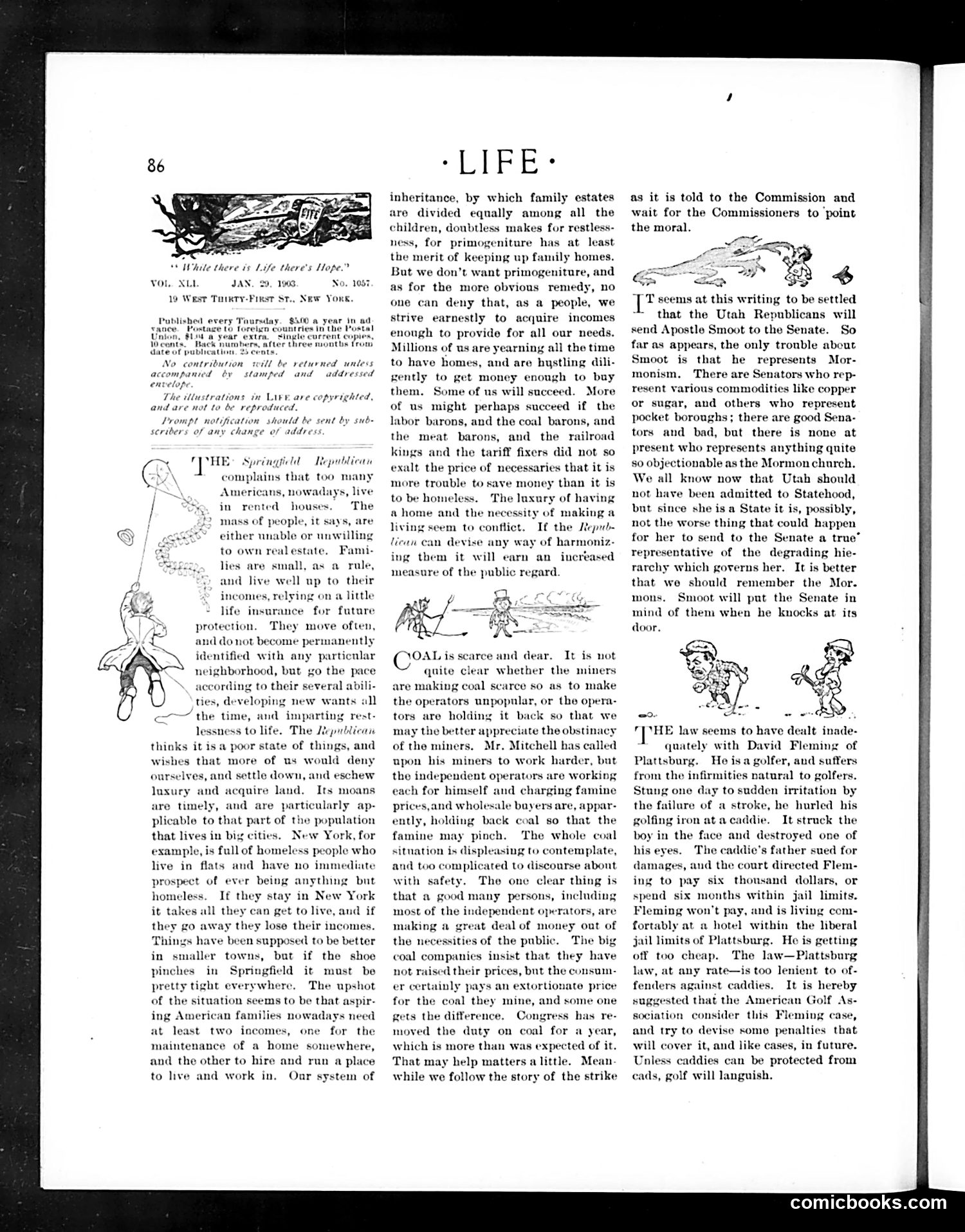
The page contains three distinct cartoon illustrations satirizing contemporary social issues: 1. **Top left**: A figure appears to represent wealth or privilege, depicted with exaggerated features—likely critiquing the concentration of inherited wealth among the wealthy elite. 2. **Middle left**: A caricatured man in formal dress (possibly representing a businessman or politician) is shown in a compromising position, suggesting hypocrisy or moral failing among the upper classes. 3. **Bottom right**: Multiple figures are sketched in what appears to be a domestic or social scene, though the specific reference is unclear from the image alone. The accompanying text discusses inheritance laws, housing scarcity for the poor, labor disputes (particularly coal mining strikes), and legal cases involving class conflict. The overall theme critiques wealth inequality and labor exploitation in early-20th-century America.
📄 Transcribed text from this page (OCR, searchable)
Machine-transcribed from the original scan — historical spelling and the odd misread are preserved.
‘\ White there is Life there's Hope.” XLL JAN. 2, 19 West Tutrty-Finst St. vou. 1963. No. sew YORE. Published every Tauraday i foreign Hea Weants. Back date of publicate ats Wl be returned untess stamped and addressed Oa year in ad Withe Postal No contribution accompanied by envelope The itlustratio) Lire are copyrighted, and are not to be reprodu should be sent by sub- of address Prompt notification seribers of any change ‘HE complains that too many Americans, nov in rented mass of people, it either unable or unwilli to own realestate. Fami- lies are small, as a rule, Springfield houses. and live well up to their incomes, relying on a little life r future protection. They move often, and do not become permanently identified with any particular neighborhood, but go the pace according to their several abili- ties, developing new wants all “the time, and imparting rest- lessness to life. The Republican thinks it isa poor state of things, and wishes that more of us would deny ourselves, and settle down, and eschew luxury and acquire land. are timely, and are particularly ap- plicable to that part of the population that lives in big cities. New York, for example, is full of homeless people who live in flats and have no immediate prospect of ever being anything but If they y in New York it t n get to live, and if they go away ir incomes, ngs have been supposed to be better in smaller towns, bat if the shoe pinches in Springfield it must be pretty tight everywhere. The upshot of the situation seems to be that aspir- ing American families nowadays need at least for the maintenance of a home somewhere, and the other to hire and run a place to hve and work in. Oar system of insurance Its moans homeless. two incomes, one -LIFE* inheritance, by which family estates are divided equally among all the children, doubtless makes for restless- ness, for primogeniture has at least the merit of keeping up family homes. But we don’t want primogeniture, and as for the more obvious remedy, no one can deny that, as a people, we strive earnestly to acquire incomes enough to provide for all our needs. Millions of us are yearning all the time to have homes, and are hystling dili- gently to get money enough to buy them. Some of us will succeed. More of us might perhaps succeed if the labor barons, and the coal barons, and the meat barons, and the railroad kings and the tariff fixers did not so exalt the price of necessaries that it is more trouble to save money than it is to be homeless. The luxury of having a home and the necessity of making a living seem to conflict. If the Reput- licun can devise any of harmoniz- ing them it will earn an increased measure of the public regard. Coats scarce and dear. It is not quite clear whether the miners are making coal scarce so as to make the operators unpopular, or the opera- tors are holding it back so that we he better appreciate the obstinacy of the miners. Mr. Mitchell has called upon his miners to work harder, but the independent operators are working each for himself and charging famine prices,and wholesale bayers are, appar- ently, holding back coal so that the famine may pinch. The whole coal sitnation is displeasing to contemplate, and too complicated to discourse about with safe! The one clear thing is that a good many persons, including most of the independent operators, are making a great deal of money out of the necessities of the public. The big coal companies insist that they have not raised their prices, but the consum- er certainly pays an extortionate price for the coal they mine, and some one gets the difference. Congress has re- moved the duty on coal for a year, which is more than was expected of it. That may help matters alittle. Mean while we follow the story of the strike as it is told to the Commission and wait for the Commissioners to ‘point the moral. seems at this writing to be settled that the Utah Republicans will send Apostle Smoot to the Senate. So far as appears, the only trouble about Smoot is that he represents Mor- monism. There are Senators who rep- resent various commodities like copper or sugar, and others who represent pocket boroughs; there are good Sena- tors and bad, but there is none at present who represents anything quite so objectionable as the Mormon church, We all know now that Utah should not have been admitted to Statehood, but since she is a State it is, possibly, not the worse thing that could happen for her to send to the Senate a true” representative of the degrading hie- rarchy which governs her. It is better that we should remember the Mor. mons, Smoot will put the Senate in mind of them when he knocks at its door. S |]. HE law seems to have dealt inade- quately with David Fleming of Plattsburg. He isa golfer, and suffers from the infirmities natural to golfers. Stung one day to sudden irritation by the failure of a stroke, he hurled his golfing iron atacaddie. It struck the boy in the face and destroyed one of his € The caddie’s father sued for damages, and the court directed Flem- ing to pay six thousand dollars, or spend six months within jail limits. Fleming won't pay, and is living com- fortably at a hotel within the liberal 1 limits of Plattsburg. He is getting off too cheap. The law—Plattsburg law, at any rate—is too lenient to of- fenders against caddies. It is hereby suggested that the American Golf A sociation consider this Fleming case, and try to devise some penalties that will cover it, and like cases, in future. Unless caddies can be protected from As, golf will languish, comicbooks.com