
A complete issue · 20 pages · 1903
Life — January 22, 1903
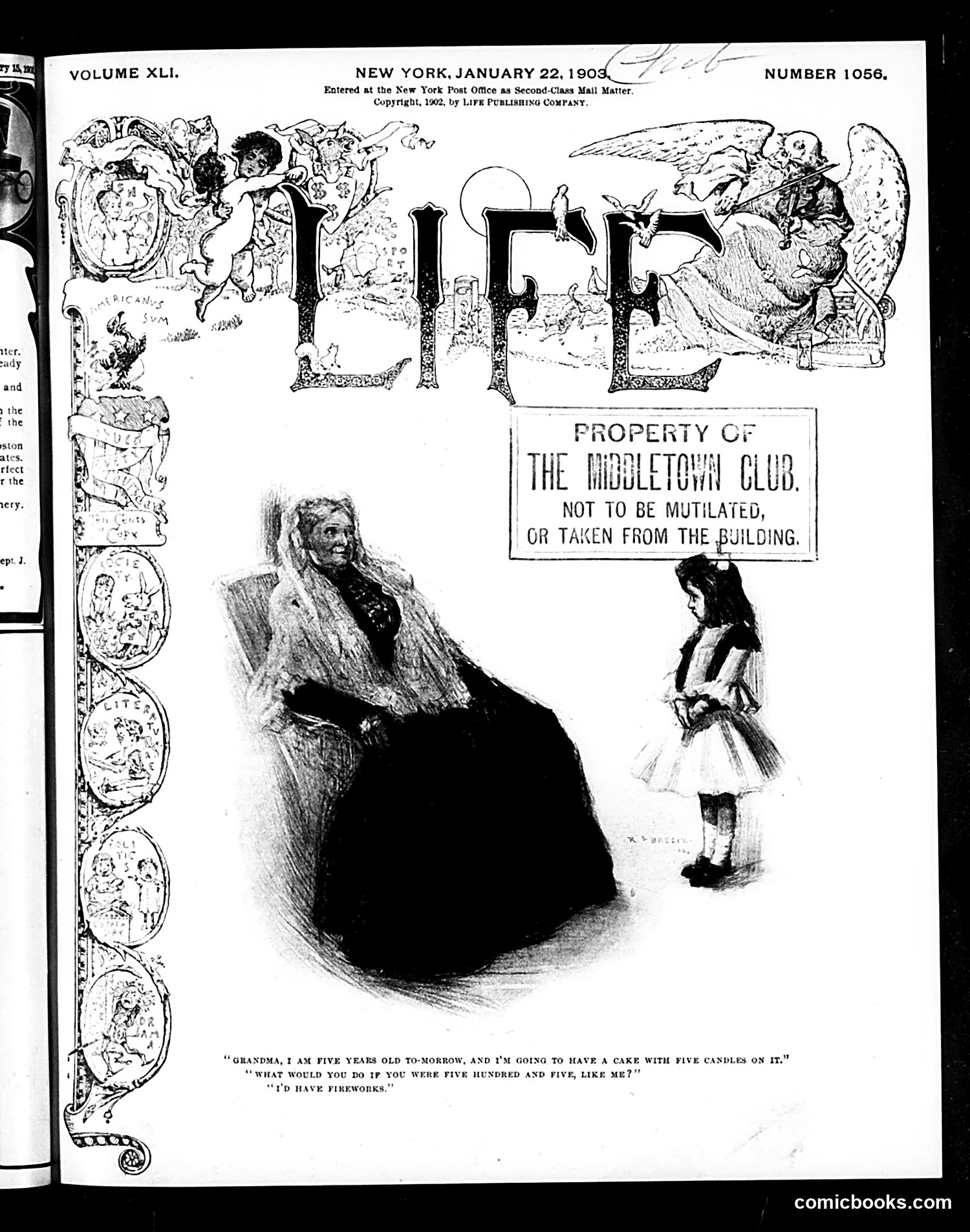
This is a **Life magazine cover from January 22, 1903** featuring a humorous domestic scene rather than political satire. **The Main Image:** An elderly woman (labeled "Grandma") converses with a young girl. The grandmother states she'll be five years old tomorrow with a birthday cake of five candles, then poses the absurd question: "What would you do if you were five hundred and five, like me?"—suggesting extreme old age. The girl's reply, "To have fireworks," is the punchline: a humorous escalation of birthday celebrations to match such an implausibly advanced age. **The Joke:** It's gentle, family-oriented humor playing on generational differences and the exaggeration of aging—typical of Life's lighter content. The ornamental border with zodiac signs reinforces the age/time theme. This page reflects early-1900s American magazine humor: innocent, domestic, and reliant on wordplay rather than political commentary.
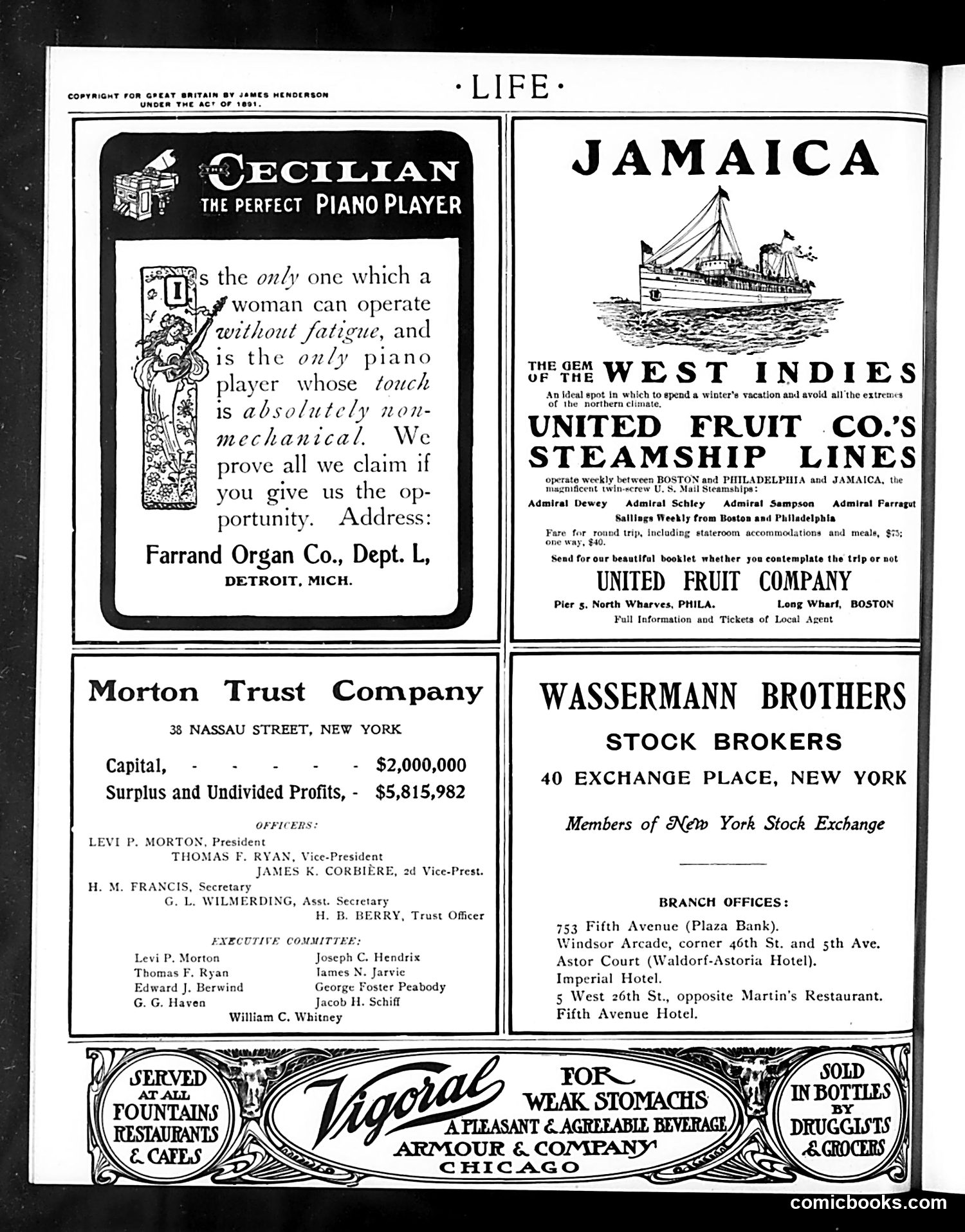
This page is primarily **advertising**, not satire or political commentary. It contains four distinct ads: 1. **Cecilian Piano Player** (top left): A music device advertisement claiming women can operate it "without fatigue" and that its touch is "absolutely non-mechanical"—highlighting period assumptions about women's capabilities and preferences. 2. **Jamaica/United Fruit Company** (top right): A steamship vacation advertisement promoting Caribbean travel to escape harsh northern winters. 3. **Morton Trust Company** (bottom left): A financial services advertisement listing capital and leadership. 4. **Wassermann Brothers** (bottom right): A stock brokerage advertisement. 5. **Vigoral** (footer): A beverage marketed for "weak stomachs." The page reflects early 20th-century commercial culture and period attitudes toward gender, leisure travel, and health remedies.
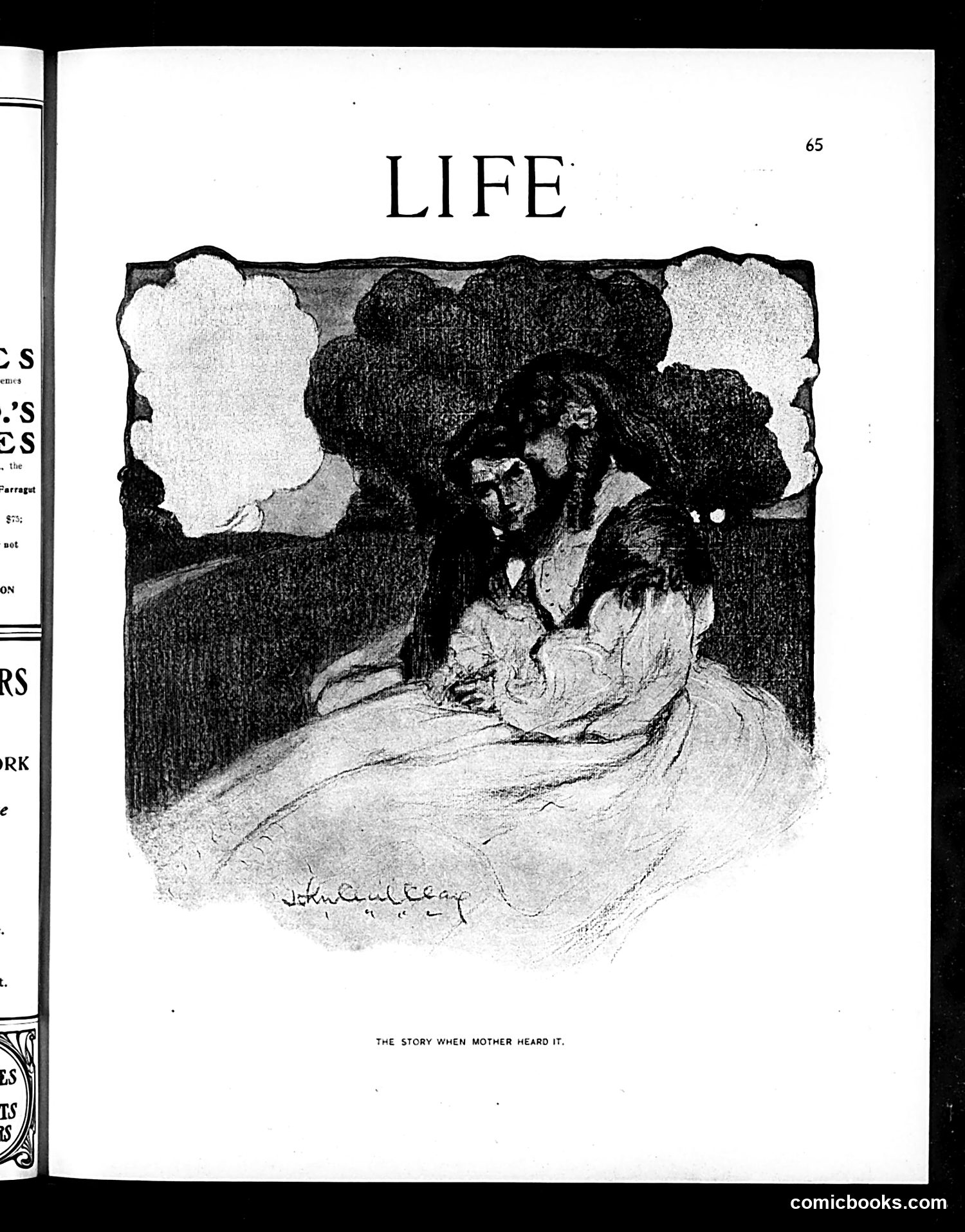
This illustration by John Cecil Legé depicts an intimate domestic scene titled "The Story When Mother Heard It." The image shows a young woman in bed, appearing to confide in or embrace another figure, likely her mother, in a darkened bedroom setting. Without additional context from surrounding pages, the specific satirical point remains unclear. However, given *Life* magazine's focus on social commentary, this likely comments on Victorian-era attitudes toward female sexuality, courtship secrets, or domestic propriety—possibly mocking either prudish maternal responses or youthful romantic indiscretions. The intimate framing and the emphasis on "when mother heard it" suggests satire about generational gaps or scandal within respectable households, though the precise social reference cannot be determined from this page alone.
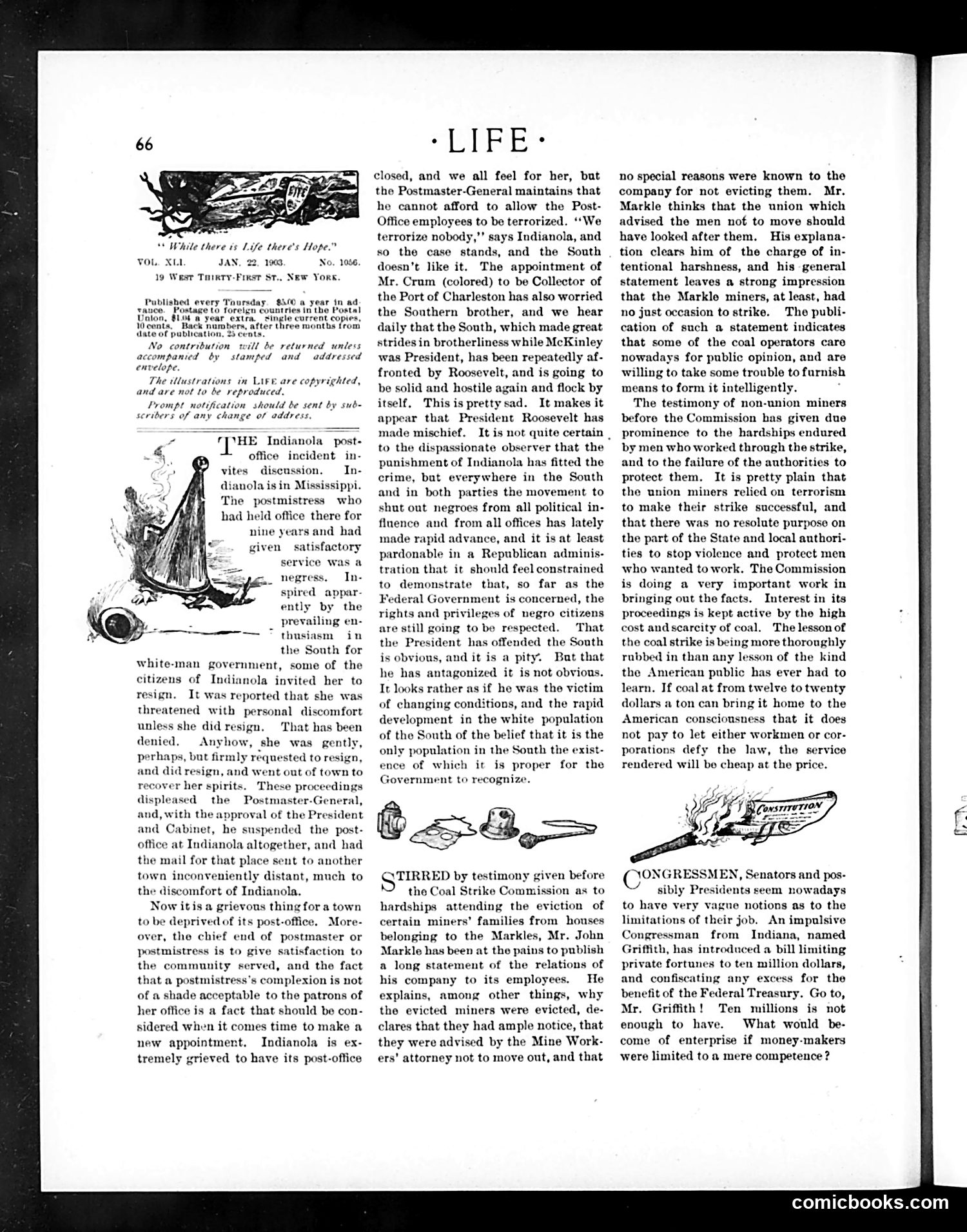
This page contains two satirical pieces about early 1900s labor and political conflicts. The **left cartoon** depicts the Indianola, Mississippi post office controversy, where a white postmaster position was given to a Black appointee under President Roosevelt. Southern white citizens demanded her resignation; when she refused, she faced threats and was ultimately removed. Life satirizes this as demonstrating Roosevelt's inconsistency—claiming to support Black civil rights while yielding to Southern pressure. The **right section** discusses Congressman Griffith's bill to limit railroad fortunes and prevent excessive profit accumulation. Life sardonically questions whether limiting millionaires' wealth contradicts American free enterprise principles. Both pieces critique government overreach and inconsistent progressive policies of the Roosevelt era.
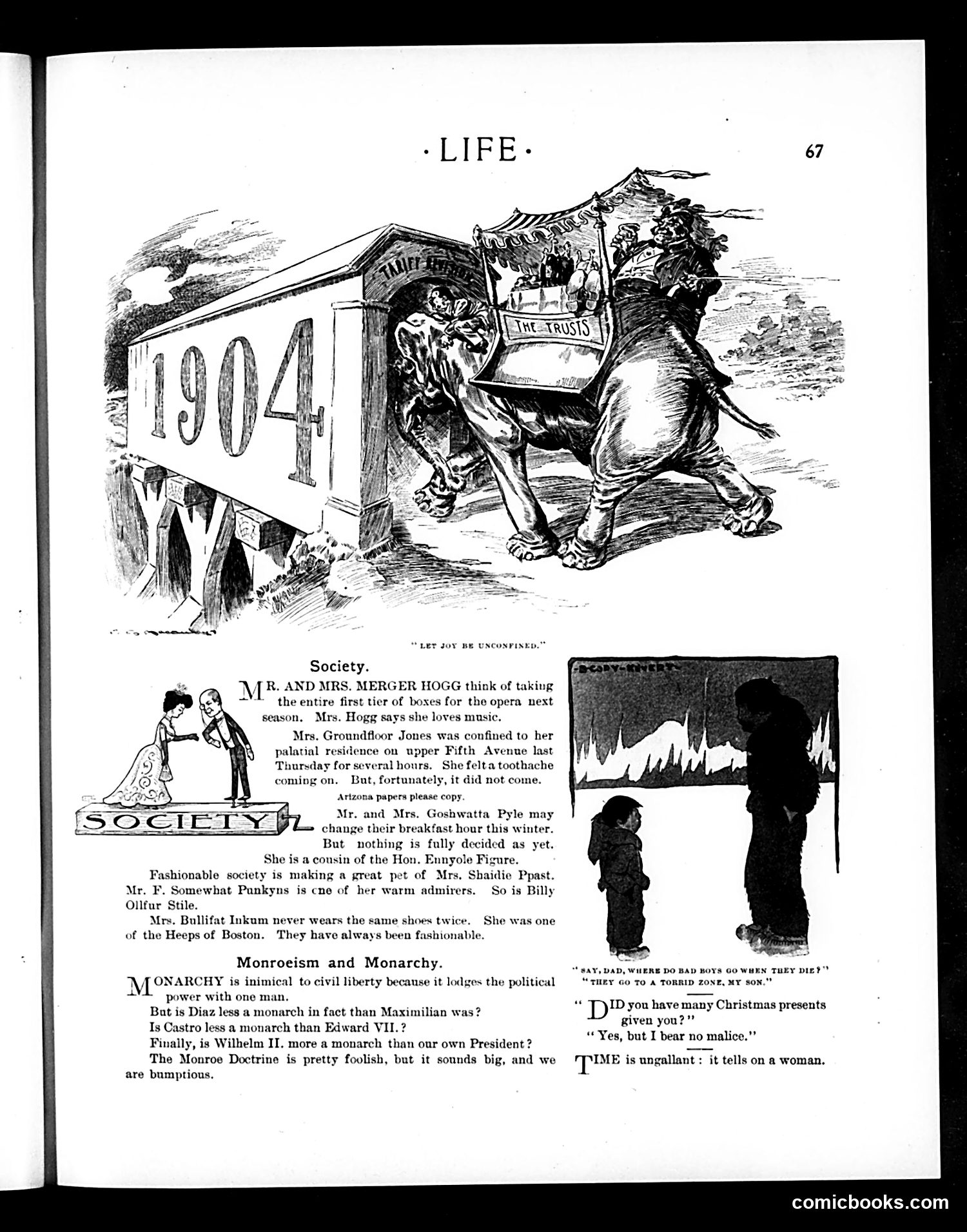
The main cartoon depicts **1904** as a constrained figure trapped in a box labeled "THE TRUSTS," with "TURIFF" visible on the structure. An elephant (the Republican Party symbol) stands nearby, suggesting Republican responsibility for monopolistic business practices that year. The **"Society"** section contains gossipy society notes about wealthy New Yorkers' social activities and plans. Below this, a section titled **"Monroeism and Monarchy"** critiques political systems, questioning whether various historical figures (Diaz, Castro, Wilhelm II, etc.) were truly monarchs compared to the U.S. President, concluding that "The Monroe Doctrine is pretty foolish, but it sounds big, and we are bumptious." The small comic dialogue at bottom is unclear without additional context.
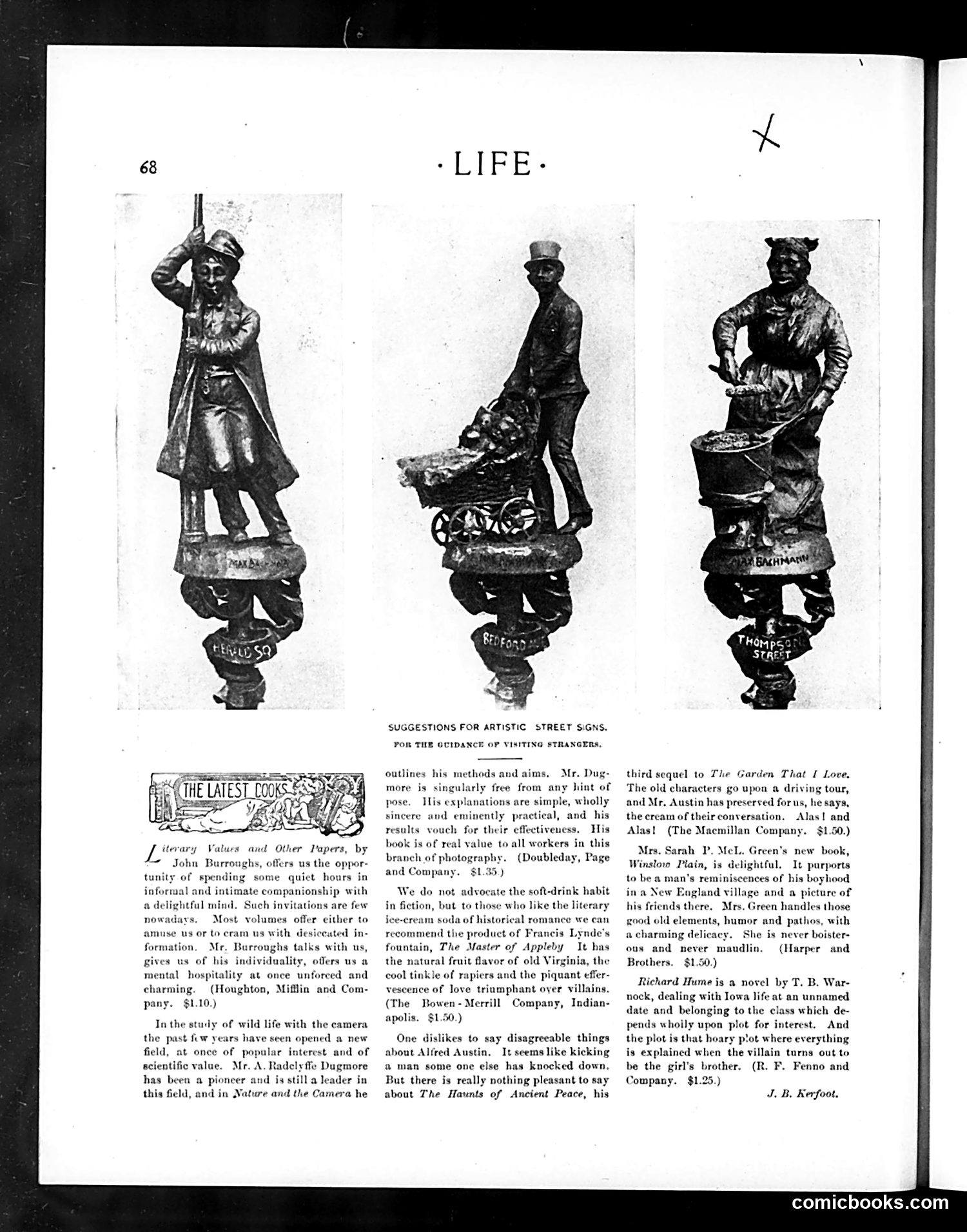
**The Image:** Three ornamental street signs showing figures engaged in activities—woodcutting, pushing a baby carriage, and stirring a large pot. The caption reads "SUGGESTIONS FOR ARTISTIC STREET SIGNS FOR THE GUIDANCE OF VISITING STRANGERS." **The Satire:** This appears to be mockery of decorative street signage, likely Victorian-era ornamental signs meant to beautify public spaces. The humor lies in suggesting absurd, mundane domestic activities as subjects for artistic public monuments—reducing grand civic art to the ridiculous. Rather than depicting heroic or noble figures, the proposal shows ordinary people doing humble tasks, mocking both the pretentiousness of decorative street furniture and perhaps contemporary attitudes about labor and class. The joke satirizes the gap between artistic pretension and everyday reality.
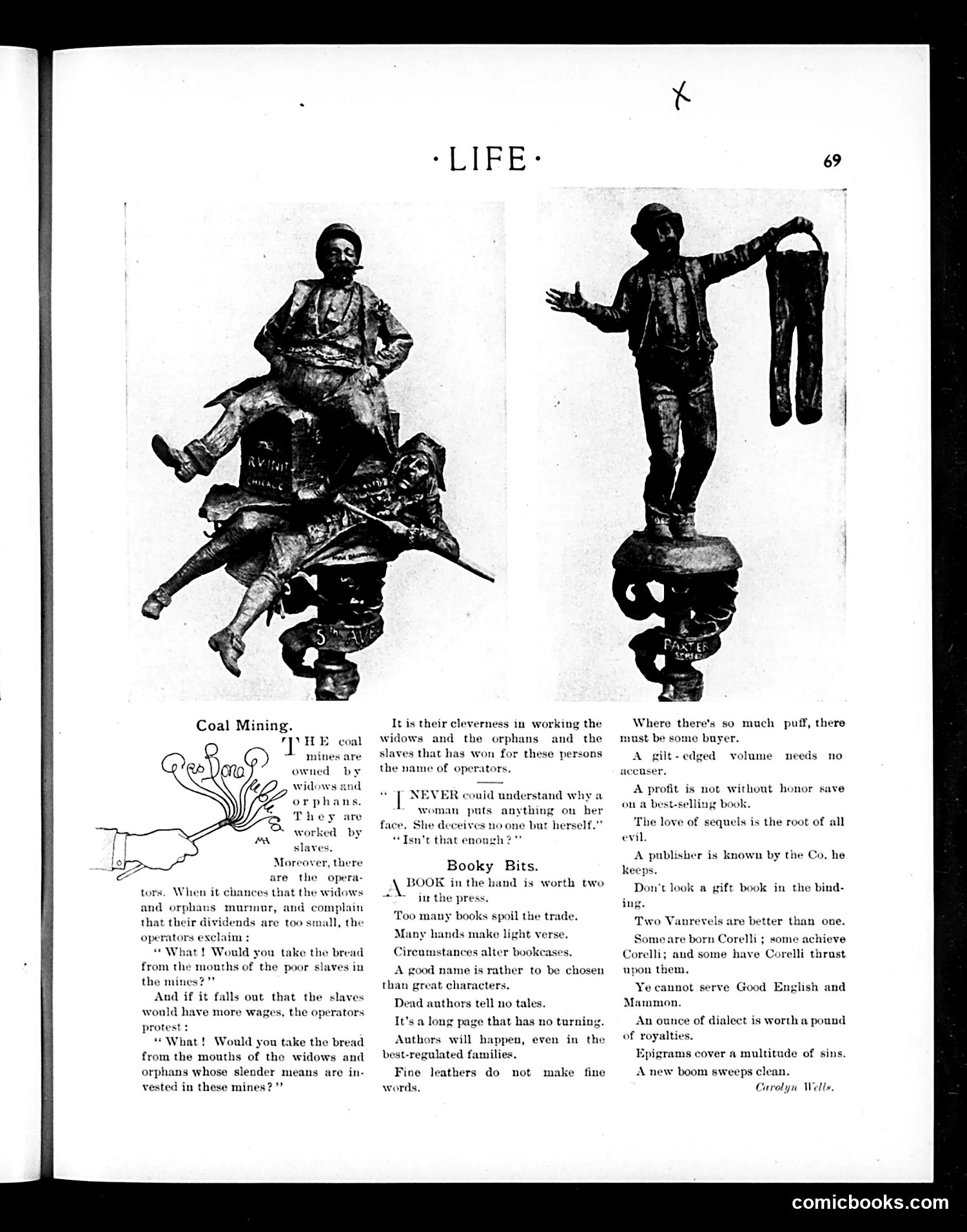
This page satirizes the exploitation of workers in coal mining. The left image shows figures sitting atop a skull—a visual metaphor for how mining profits are built literally on workers' deaths and suffering. The dialogue beneath presents the operators' callous logic: when asked what they'd take from poor miners' families, they respond they'd take bread from widows and orphans if it meant higher dividends. This exposes the moral bankruptcy of prioritizing profits over human welfare. The "Booky Bits" section offers publishing aphorisms, seemingly unrelated but likely reinforcing themes of exploitation—how the publishing industry similarly exploits writers while claiming respectability. The overall message: industrial operators justify systematic human suffering through profit-seeking rationalization.
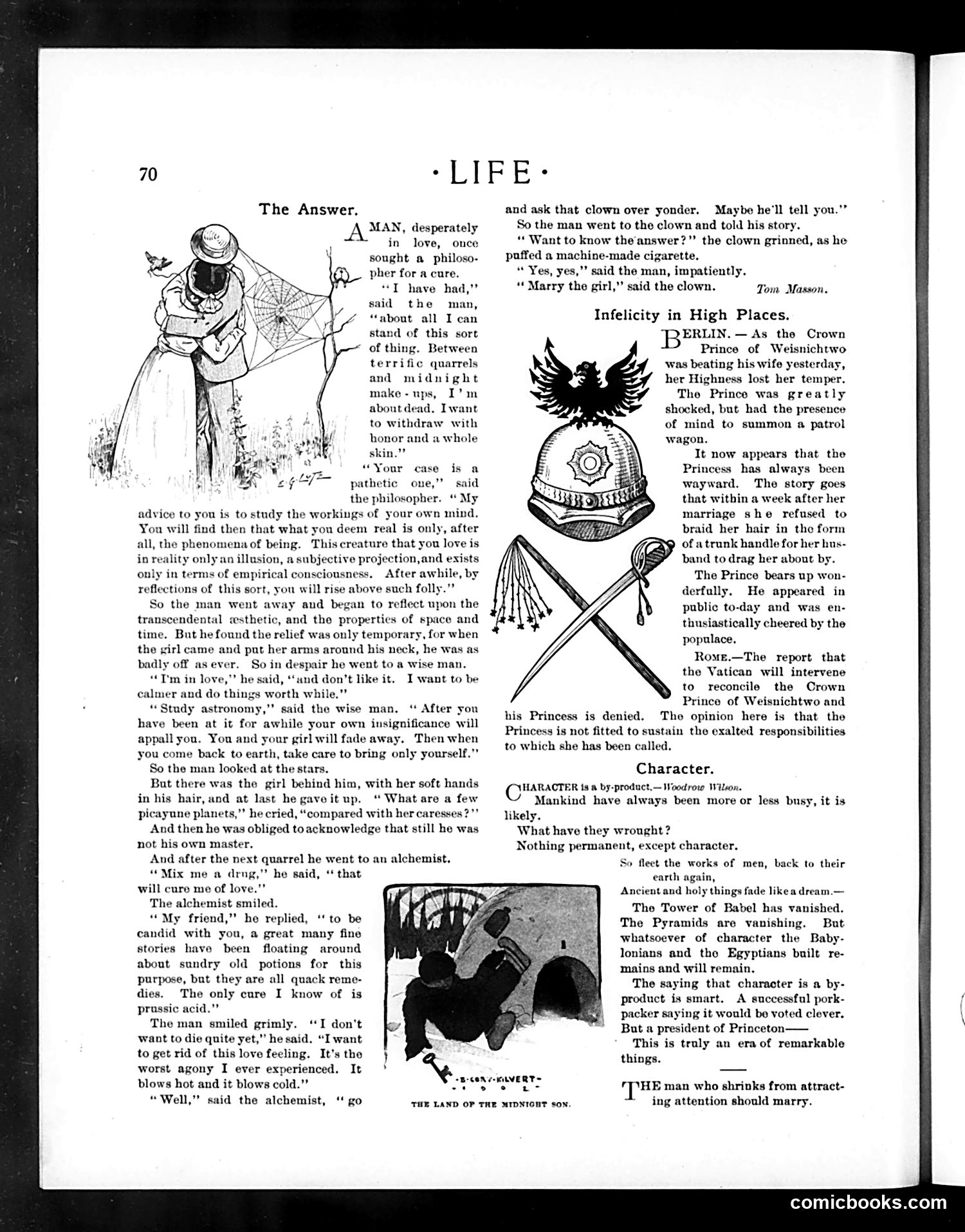
This page contains two main stories with accompanying illustrations: **"The Answer"** depicts a man in love seeking philosophical counsel. The illustration shows him with a woman, and the text describes his consultation with an alchemist about a "drug" to cure love. The story's humor lies in the absurdity of seeking scientific/magical solutions to emotional problems—a satire on rationalism applied to romance. **"Infelicity in High Places"** reports on the Crown Prince of Weisnichtwo (a fictional place name) beating his wife while she refused to hold his hair in a particular style. This appears to be satirical commentary on aristocratic domestic dysfunction and the absurdity of marital disputes among nobility. Both pieces mock human folly through exaggerated scenarios typical of Life magazine's satirical approach.
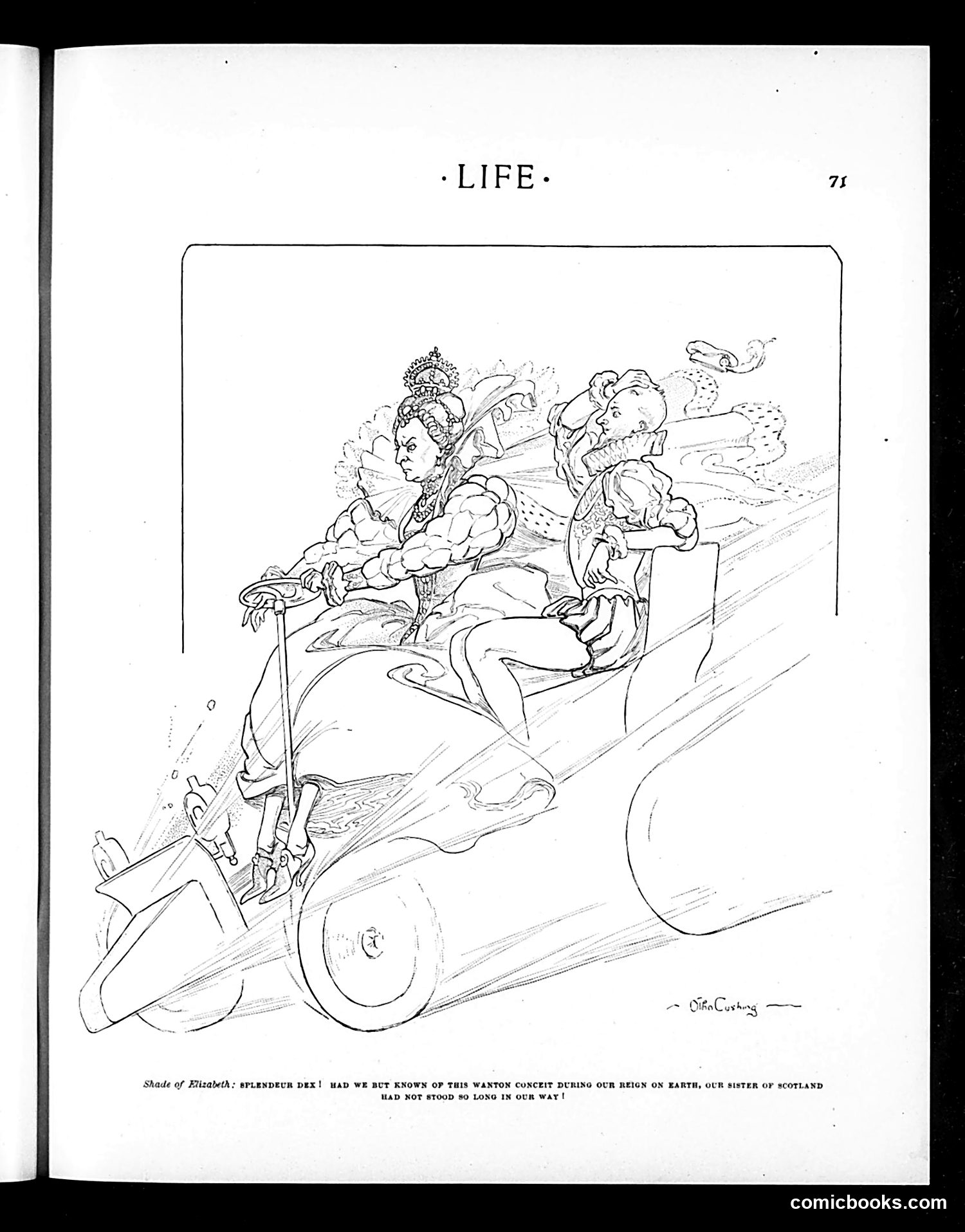
This is a satirical cartoon from *Life* magazine's section titled "Shade of Elizabeth!" The caption references Queen Elizabeth I and Scotland, suggesting a historical parallel. The cartoon depicts two elaborately dressed figures in what appears to be a fantastical vehicle or vessel moving at speed. The text warns that had a "wanton conceit" (reckless idea) been known during Elizabeth's reign on Earth, "our sister of Scotland had not stood so long in our way." The satire appears to mock a contemporary political figure or proposal by comparing it unfavorably to historical Scottish-English relations. The ornate, exaggerated dress and impossible conveyance suggest absurdity or delusion. Without clearer identification of the figures or specific historical context from this *Life* issue, the precise political target remains unclear, though it likely references early 20th-century British politics or international relations.
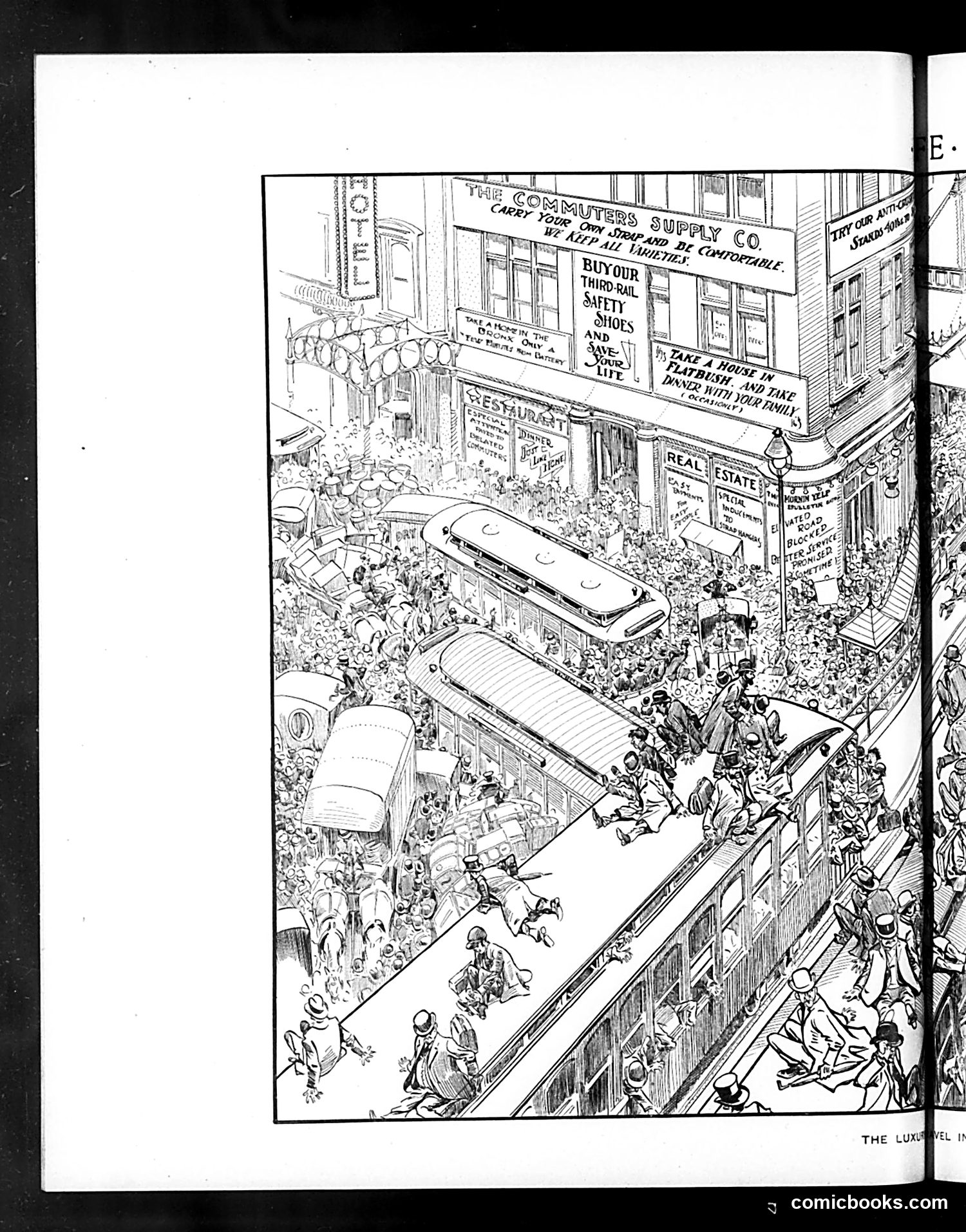
This is a detailed satirical illustration of a crowded urban street scene, likely from the early 20th century. The bird's-eye perspective shows multiple streetcars/trolleys packed with passengers amid dense crowds on the sidewalk. The visible signage advertises various businesses including "The Commuters Supply Co," real estate, and restaurants. The satire appears to target **urban congestion and the chaos of modern city life**—specifically the overwhelming crowds and transportation challenges of densely populated American cities during the streetcar era. The massive throngs of people, cramped vehicles, and competing commercial advertisements suggest commentary on **overpopulation and the frenetic pace of metropolitan life**. This likely reflects contemporary anxieties about rapid urbanization and whether cities could accommodate their growing populations. The exaggerated detail emphasizes the perceived chaos rather than progress of modern urban development.
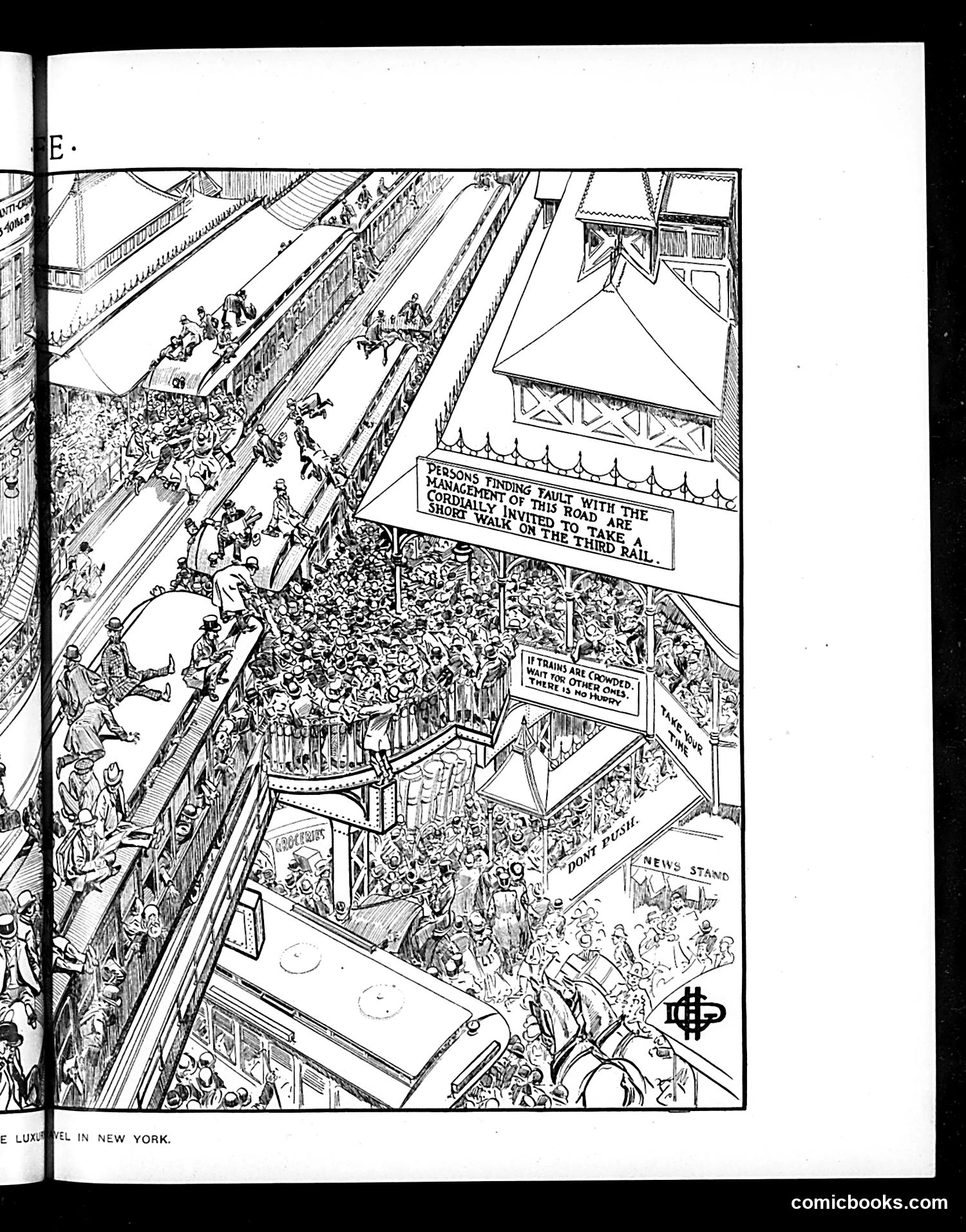
This is a satirical illustration of a crowded New York City elevated train platform and station. The cartoon depicts an impossibly packed scene with hundreds of people crammed into multiple levels and areas. Three text boxes contain the satire: 1. One warns about "fault management" and invites people to "walk on the third rail" 2. Another notes trains are "so crowded" people should "try other lines" 3. A third warns "Don't push" The humor targets the notorious overcrowding of NYC's elevated transit system—the cartoon exaggerates the chaos to absurd levels. The sarcastic "solutions" (electrocution via third rail, switching lines) mock the transit authority's inability to manage congestion. This appears to be early-to-mid 20th-century social commentary on urban infrastructure failures and commuter misery.
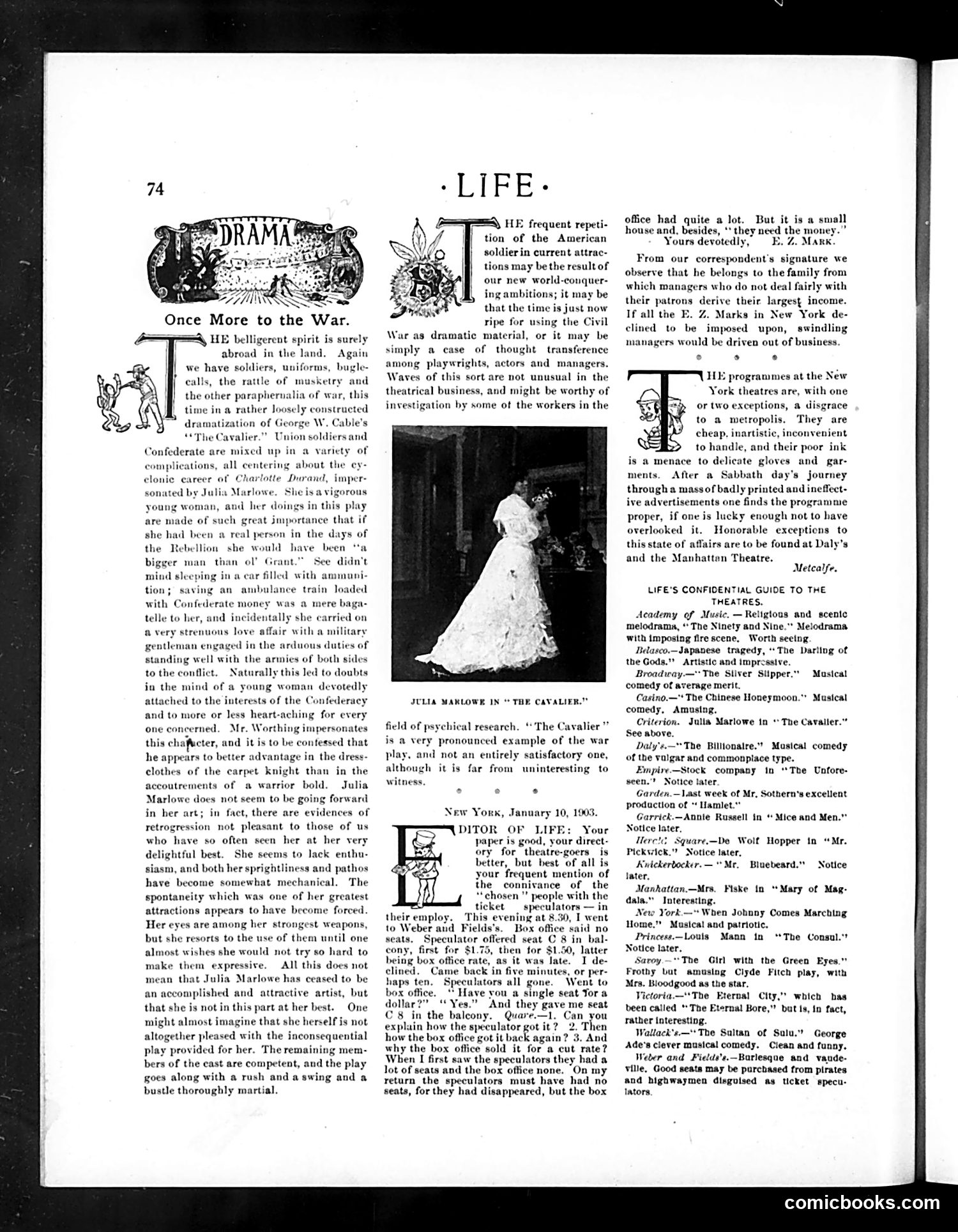
This page features theater criticism and reviews from January 10, 1903. The main drama section discusses a play called "The Cavalier," which uses the American Civil War as its subject matter. The article notes this reflects a trend of Civil War dramatizations becoming popular theatrical material. The accompanying photograph shows Julia Marlowe in "The Cavalier," a prominent actress of the era. The text critiques the play's dramatic effectiveness and historical accuracy regarding the Confederacy. The page also includes a "Life's Confidential Guide to the Theatres" listing current New York productions, including musicals and comedies. The focus is theatrical entertainment and contemporary Broadway offerings, not political satire.
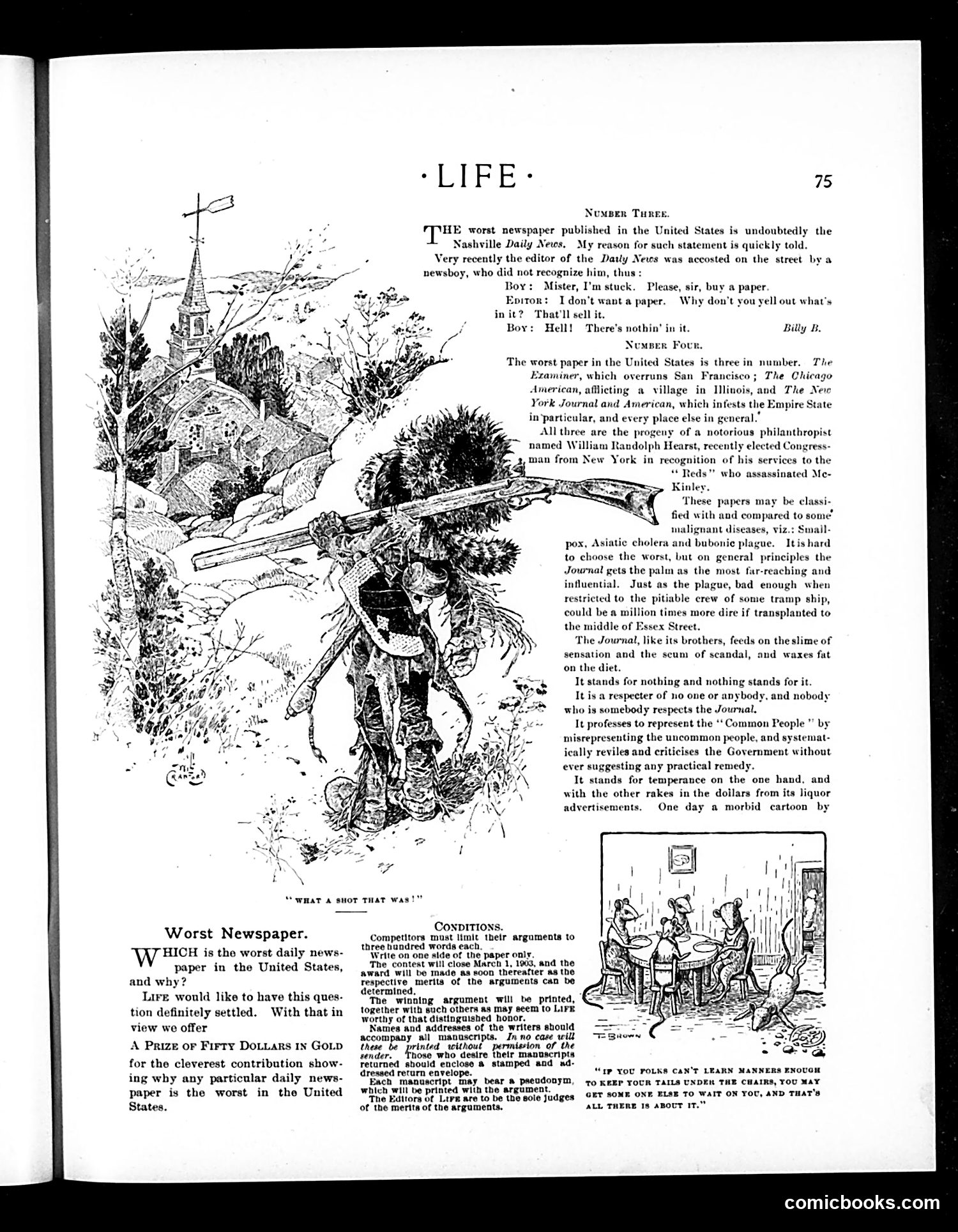
This page attacks sensationalist American newspapers, particularly those owned by **William Randolph Hearst**—specifically the *Nashville Daily News*, the San Francisco *Examiner*, Chicago *American*, and New York *Journal and American*. The opening anecdote mocks the *Daily News* as so devoid of content that even a newsboy admits "there's nothin' in it." The longer critique accuses Hearst's papers of being like "malignant diseases" (smallpox, cholera, plague), spreading sensation and scandal while claiming to represent "the Common People" while actually misrepresenting them. The satire highlights their hypocrisy: advocating temperance while profiting from liquor advertisements. The cartoon labeled "What a Shot That Was!" appears to reference political violence, likely alluding to McKinley's assassination (1901), suggesting these papers' inflammatory rhetoric bears responsibility. Life magazine then contests readers to identify the worst newspaper in America—offering fifty dollars gold for the best argument, seeking to systematize and publicly shame American journalism's most egregious offender.
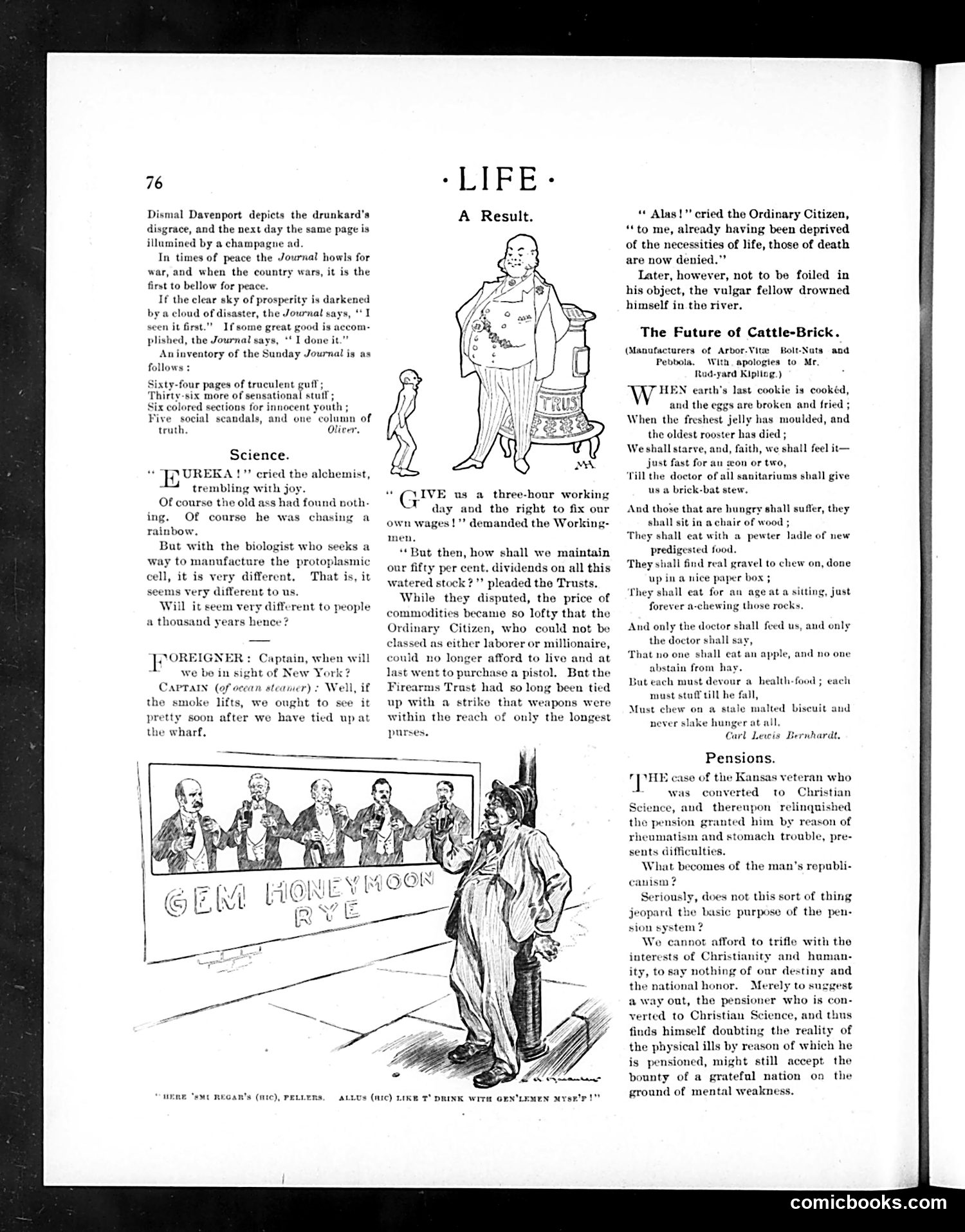
This satirical page contains multiple critiques of American institutions circa early 1900s: **"A Result"** cartoon depicts the conflict between workers demanding three-hour workdays and fixed wages versus capitalists protecting "watered stock" dividends. The satirized outcome: the ordinary citizen, squeezed by both labor disputes and resulting inflation, cannot afford even a pistol to end his suffering—the Firearms Trust's strikes have made weapons unaffordable. He drowns himself instead, highlighting how ordinary people suffer while powerful interests fight. **"Gem Honeymoon Rye"** cartoon (bottom) satirizes business monopolies and their deceptive marketing—here, businessmen promoting adulterated whiskey. **"The Future of Cattle-Brick"** parodies Kipling's imperialist poetry, sardonically imagining a dystopian future where "health foods" and "brick-bat stew" replace real nutrition—mocking sanitarium doctors and processed-food manufacturers. **"Pensions"** section criticizes a Kansas veteran who abandoned his military pension after converting to Christian Science, questioning whether principle should override pragmatism. The page's theme: satirizing how capitalists, trusts, monopolies, and pseudoscience exploit or harm ordinary citizens.
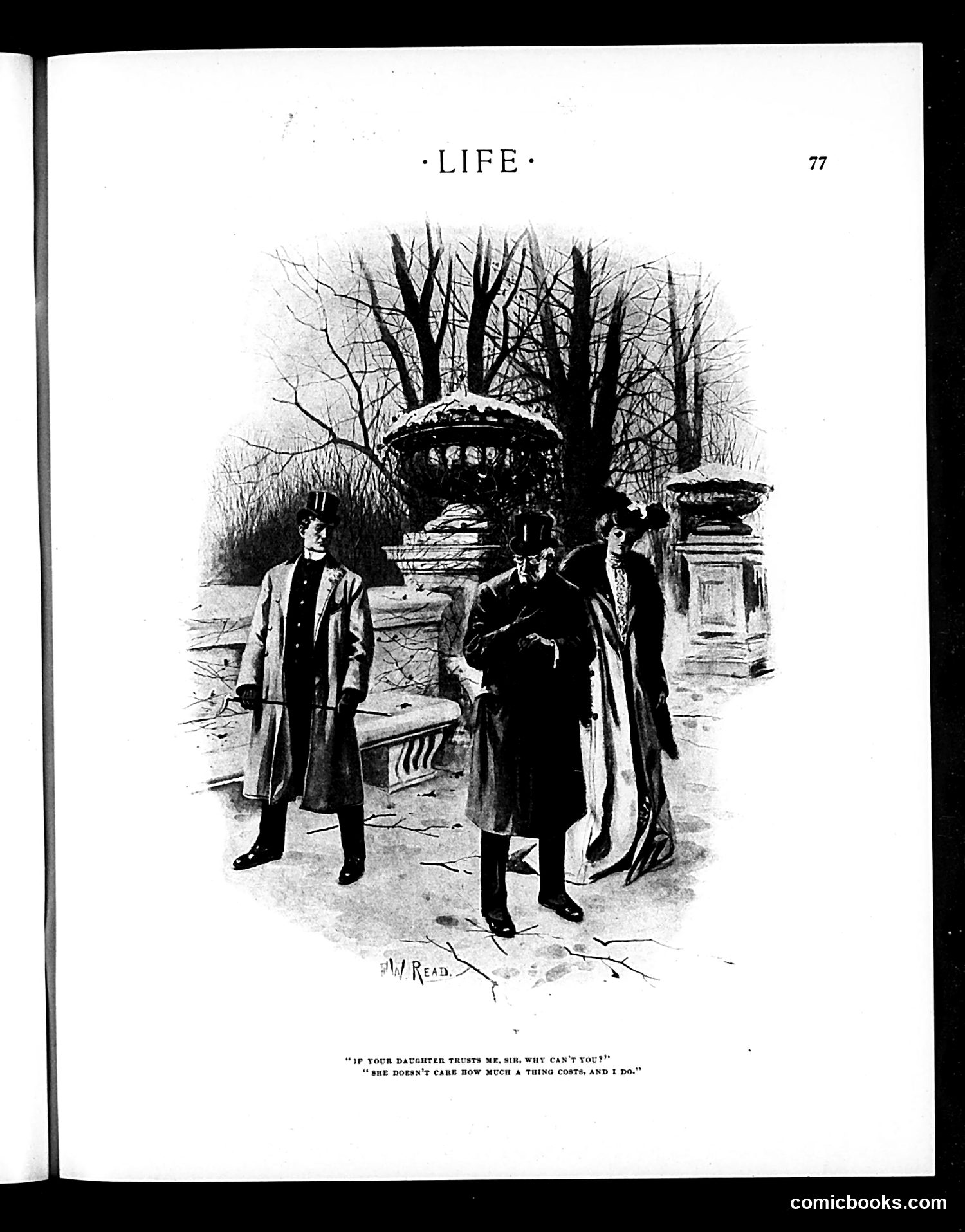
This cartoon satirizes a common tension between generations regarding money and values. A young man appeals to a father figure, arguing that if the daughter trusts him, the father should too. The father's response reveals the joke's point: he's worried not about character but about cost—the young man's spending habits or financial irresponsibility. The humor lies in the father's blunt admission that trust in romance differs from trust in fiscal responsibility. The daughter apparently doesn't care about expenses, but the father (who likely pays them) very much does. This reflects early 20th-century anxieties about courtship, class, and young men's financial reliability—concerns that transcended mere romantic worthiness.
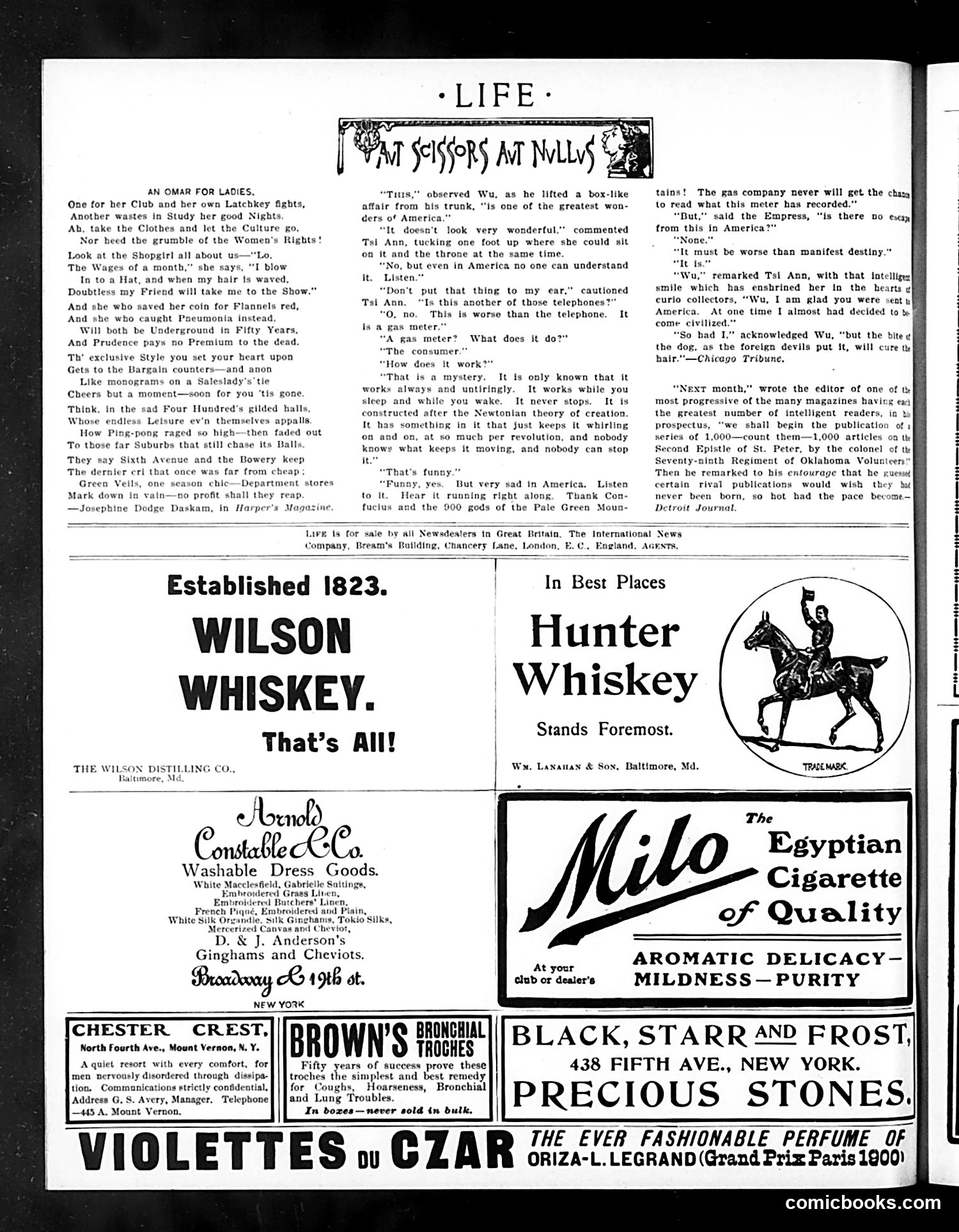
This page is primarily **advertisements with two satirical pieces** inserted for editorial content. The main cartoon is a dialogue between Wu (a Chinese visitor) and Tsi Ann (the Empress), satirizing American progress and industry. Wu presents a gas meter—representing American technological advancement—as a marvel. The satire critiques American capitalism: the meter runs perpetually, measuring consumption the customer can never verify, and nobody can stop it. It's worse than the telephone, he claims. The joke mocks American industrial culture and consumer exploitation: Americans have created an unstoppable system to extract money from consumers who have no recourse. When Tsi Ann jokes that this proves America is uncivilized, Wu agrees—this is precisely what kept *him* from becoming "civilized." The accompanying poem satirizes American consumer culture and fashion's disposability: expensive trends quickly become bargain-basement goods; leisure classes seek novelty constantly; fads vanish. Both pieces critique American materialism and the machinery of consumerism.
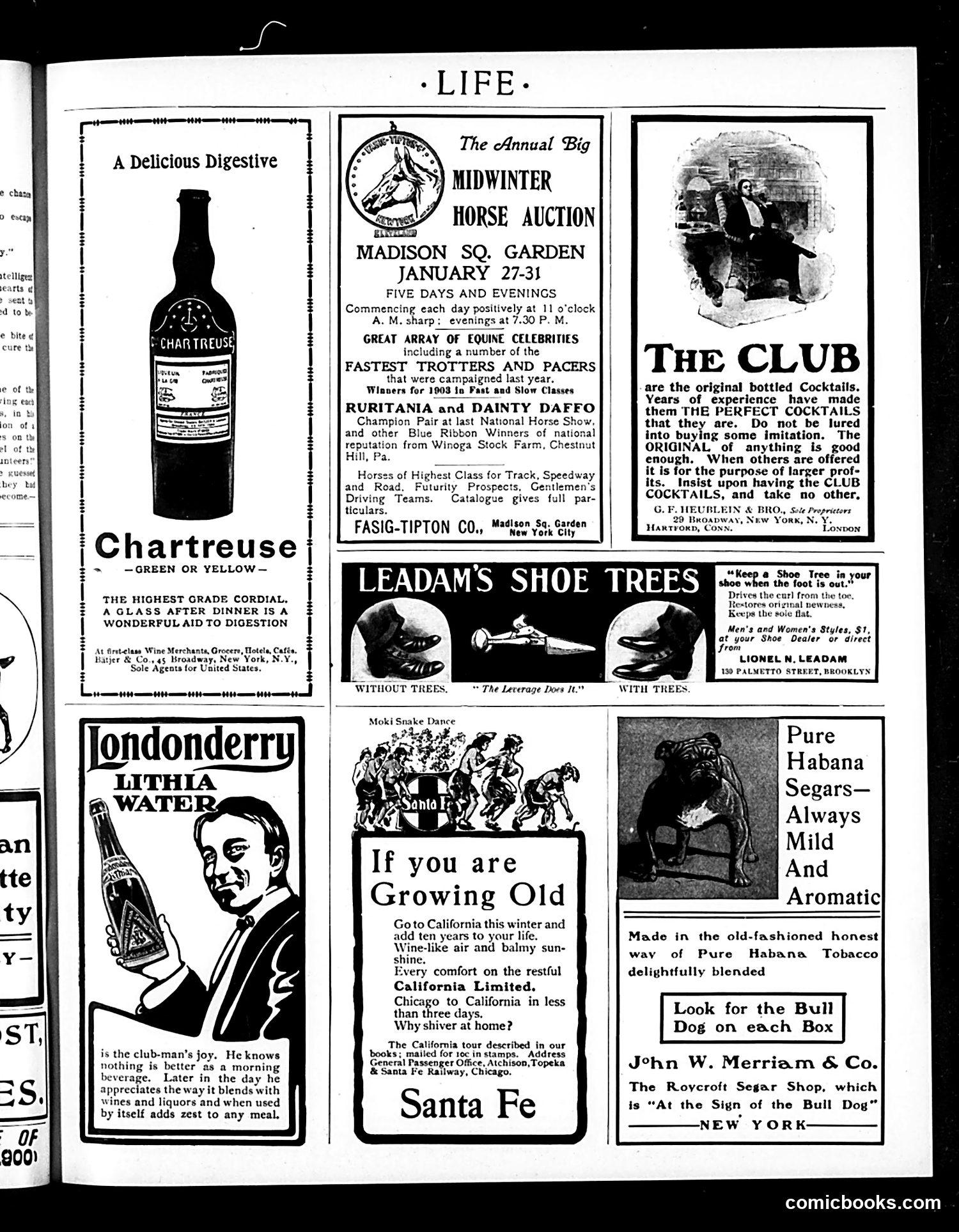
This is primarily an **advertising page** from Life magazine, not a satirical cartoon page. It contains nine distinct advertisements for luxury goods and services aimed at upper-class readers circa 1903-1904. The ads promote: - **Chartreuse liqueur** (digestive aid) - **The Club cocktails** (pre-bottled, "original" drinks) - **Londonderry Lithia Water** (morning beverage for gentlemen) - **Leadam's Shoe Trees** (footwear maintenance) - **Midwinter Horse Auction** at Madison Square Garden (elite sporting event) - **Santa Fe Railway** (California tourism for the aging wealthy) - **Pure Habana Cigars** (luxury tobacco) The only visual element approaching satire is the "Moki Snake Dance" illustration, which appears to reference Native American cultural practices—likely presented as exotic curiosity rather than serious commentary. The page reflects **Gilded Age consumerism**: advertisements emphasize quality, exclusivity, and leisure activities for affluent urban men—cordials, cocktails, fine horses, and travel.
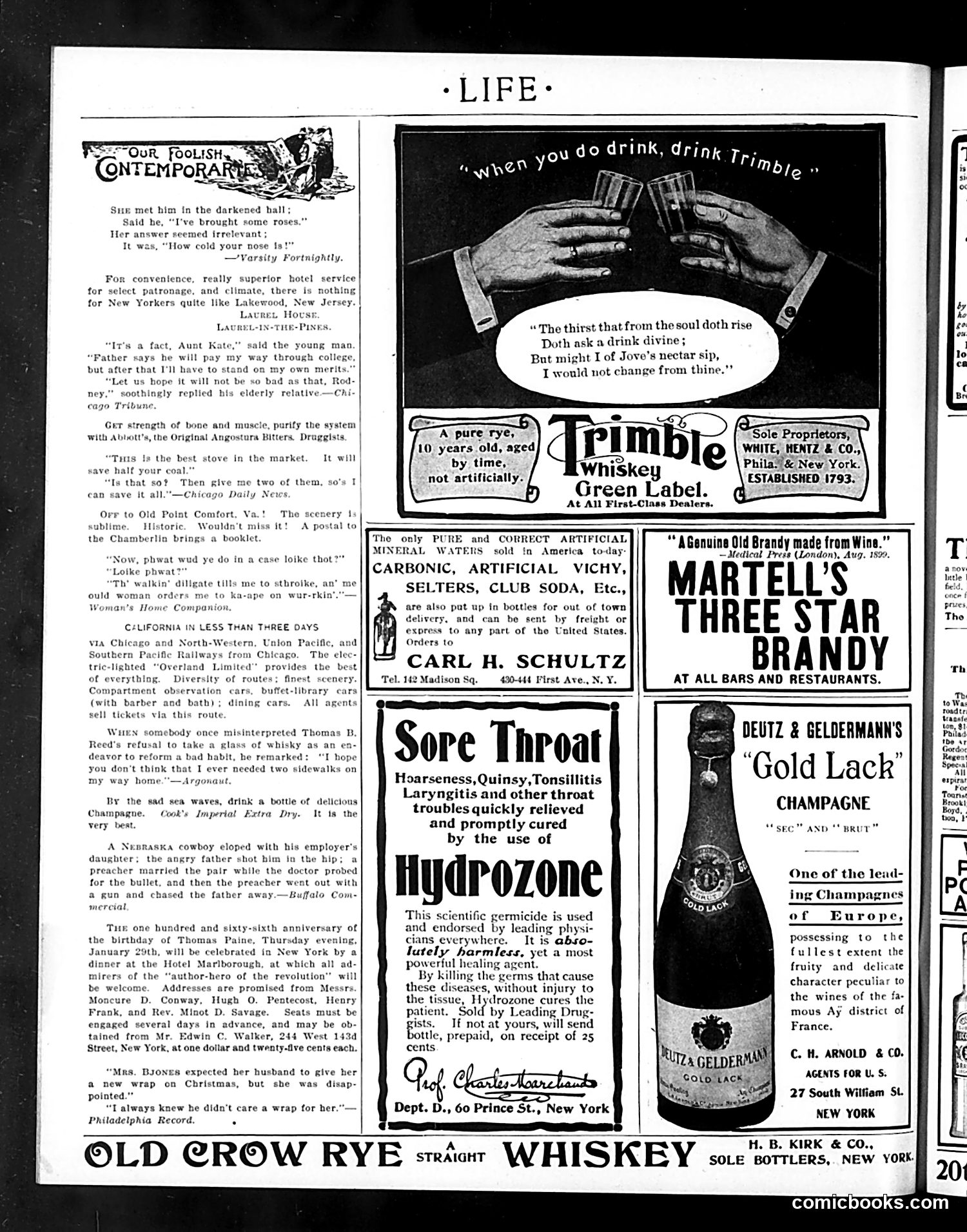
This page is primarily **advertising**, with brief humorous anecdotes in the margins. The main content includes: **Satirical Anecdotes:** - A young man's father promises to pay for college but expects him to "stand on his own merits"—the joke being the contradiction between financial support and self-reliance - A woman misinterpreting a man's cold nose as romantic interest - Thomas B. Reed's quip about whisky reform (Reed was a prominent 19th-century politician/speaker) - A Nebraska frontier story combining elopement, shooting, and hasty marriage **Dominant Content:** The page is filled with period advertisements for alcohol (whiskey, brandy, champagne), patent medicines (Hydrozone for sore throats), and luxury travel services—typical of Life magazine's era. **Historical Context:** This appears to be from the 1890s-1900s, when Life functioned as a satirical weekly for educated urban readers. The humor relies on social observations about courtship, class mobility, and frontier adventures that would resonate with that audience. The abundance of alcohol advertising reflects pre-Prohibition America.
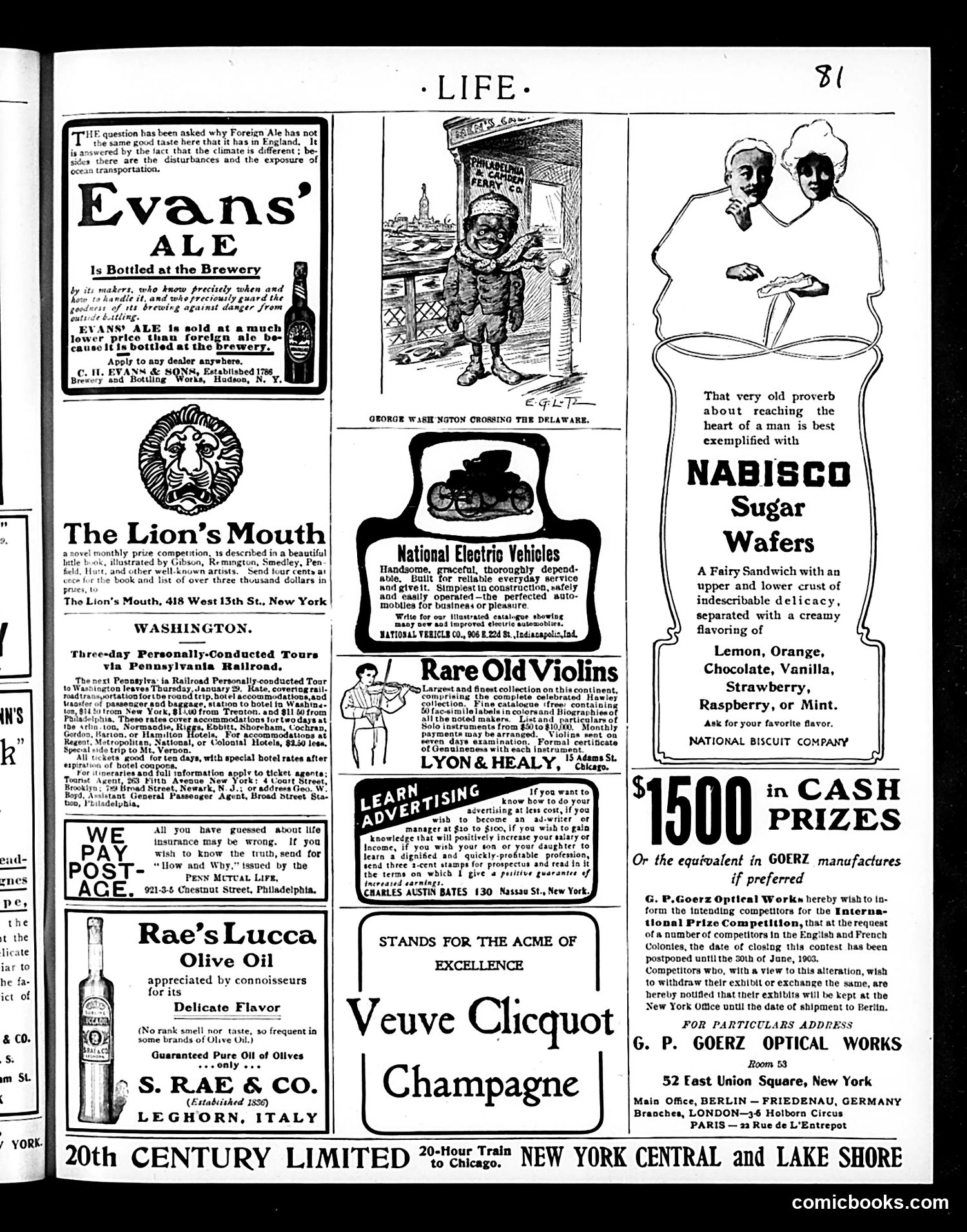
This is primarily an **advertising page** from an early 20th-century American satirical magazine, with one notable cartoon. The main visual content is **"George Wade Wiston Crossing the Delaware,"** a historical parody sketch showing a figure in period dress at a dock. This appears to reference the famous Washington crossing, but the specific satire's target is unclear from the image alone. The page is dominated by **product advertisements** typical of the era: Evans' Ale (bottled at the brewery to preserve quality during ocean transport), National Electric Vehicles, Nabisco Sugar Wafers, Veuve Clicquot Champagne, and other luxury goods. Notable is the **"Learn Advertising"** section promoting copywriting as a profitable profession, reflecting early 20th-century marketing industry growth. The **proverb about "reaching the heart of a man"** used to sell Nabisco wafers exemplifies period advertising's sentimental appeals to consumer sentiment. Without additional context about the cartoon's specific reference, its satirical point remains unclear to modern readers.
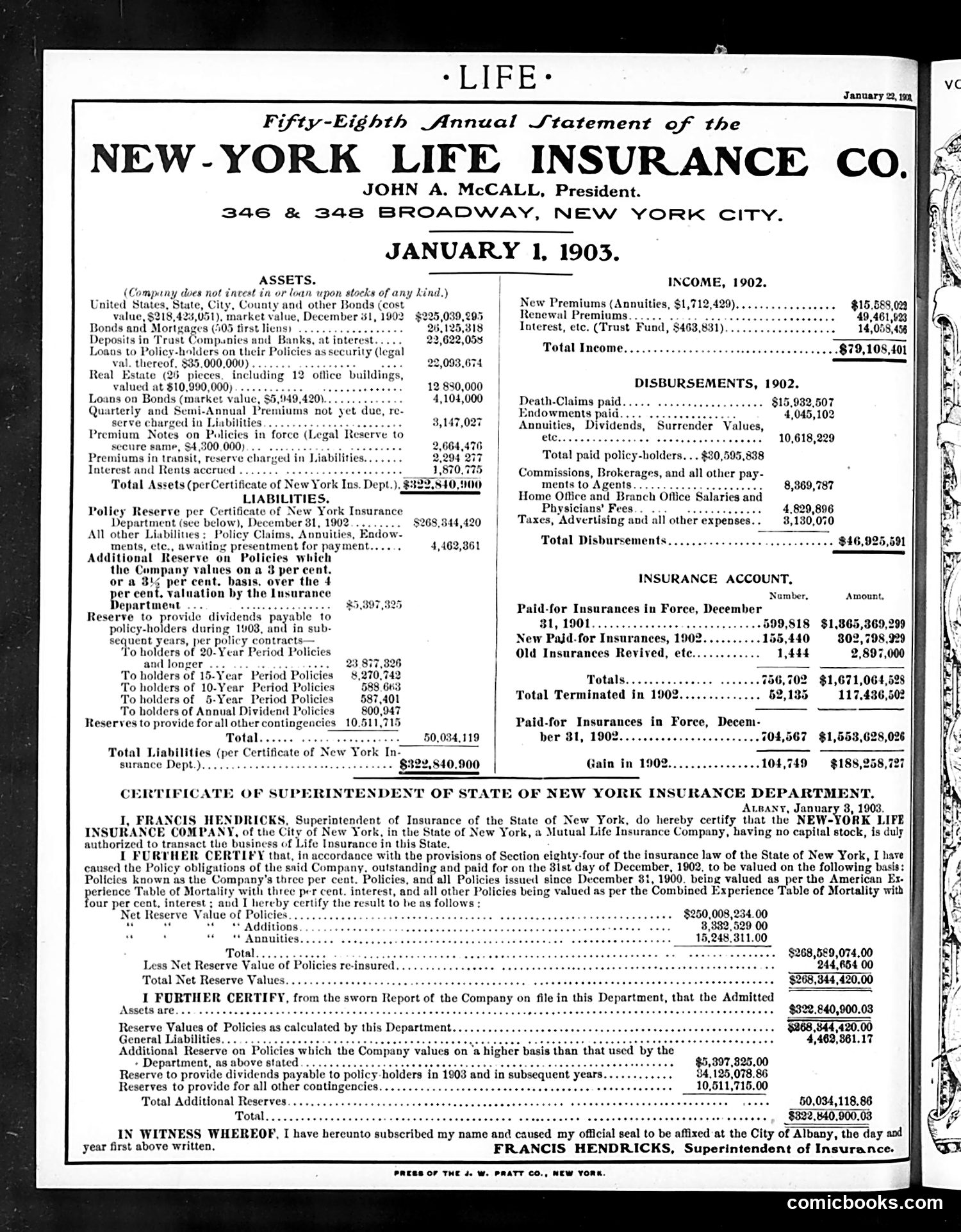
This is **not a cartoon page**—it's a financial statement advertisement. Life magazine published this as a full-page insert featuring New York Life Insurance Company's official "Fifty-Eighth Annual Statement" dated January 1, 1903. The page displays corporate financial data: assets ($322.8 million), income ($79.1 million), disbursements ($46.9 million), and insurance policies in force. It includes a certificate of authenticity from Francis Hendricks, New York State's Insurance Superintendent, validating the company's reserves and solvency. **Historical context**: This reflects the era when major corporations advertised their financial health directly to the public through magazines, demonstrating stability and trustworthiness. The detailed figures reassured potential policyholders of the company's legitimacy—important given periodic insurance industry scandals of that period. There is no satire or political commentary on this page; it's straightforward corporate advertising dressed in official documentation.