
Life, 1903-01-22 · page 4 of 20
Life — January 22, 1903 — page 4: what you’re looking at
What you’re looking at
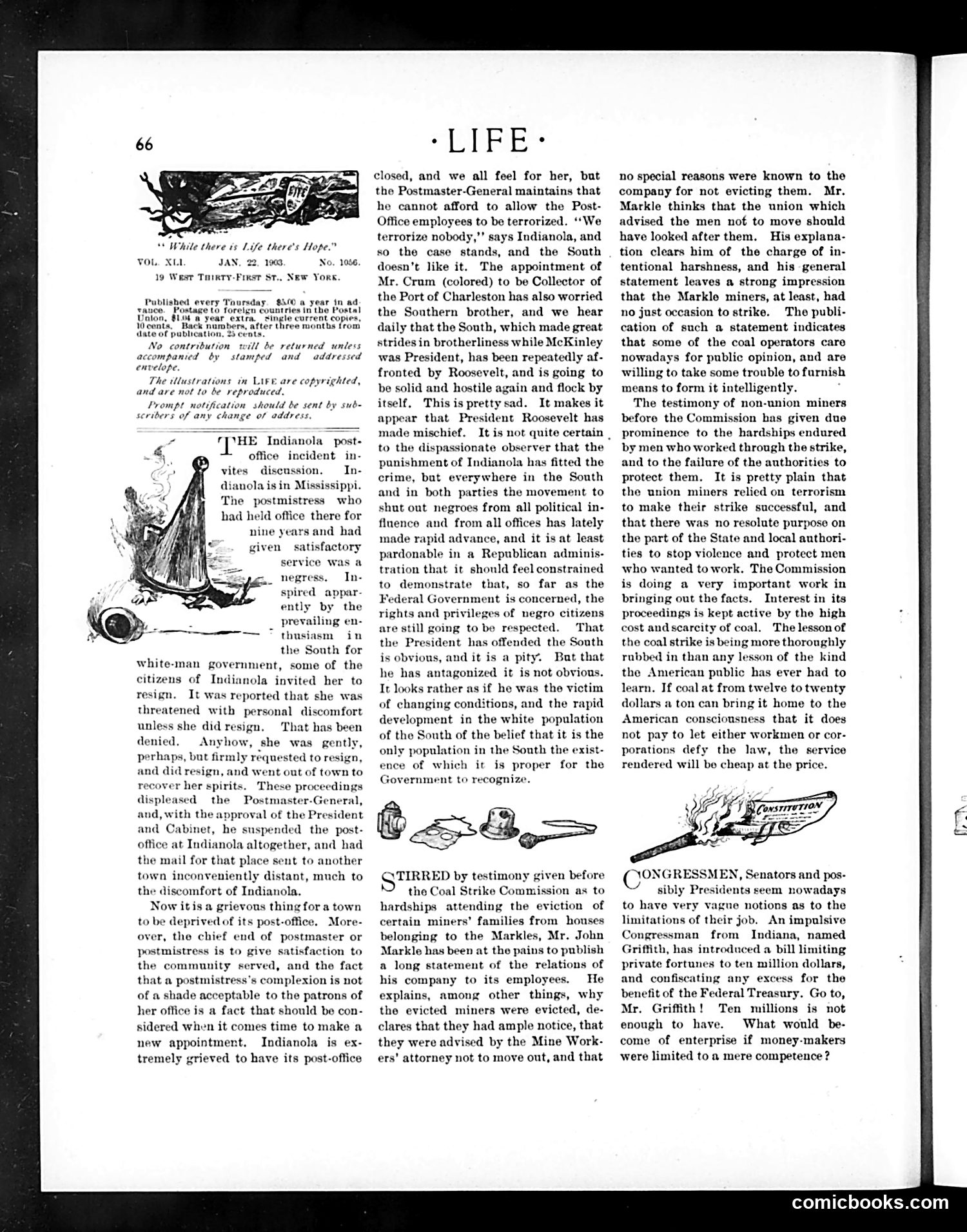
This page contains two satirical pieces about early 1900s labor and political conflicts. The **left cartoon** depicts the Indianola, Mississippi post office controversy, where a white postmaster position was given to a Black appointee under President Roosevelt. Southern white citizens demanded her resignation; when she refused, she faced threats and was ultimately removed. Life satirizes this as demonstrating Roosevelt's inconsistency—claiming to support Black civil rights while yielding to Southern pressure. The **right section** discusses Congressman Griffith's bill to limit railroad fortunes and prevent excessive profit accumulation. Life sardonically questions whether limiting millionaires' wealth contradicts American free enterprise principles. Both pieces critique government overreach and inconsistent progressive policies of the Roosevelt era.
📄 Transcribed text from this page (OCR, searchable)
Machine-transcribed from the original scan — historical spelling and the odd misread are preserved.
“While there is Life there's Hope.” VOU. XLL 19 West Torry. Published every a year in ad sauce. Postage to for tho Postal Ualon, $14 a year extra. single current copies, Weents, Back numbers, after three months from date of publication, 25 cents. No contribution will be returned untess accompanied by stamped and addressed envelope. The illustrations in LAE are copyrighted, and are not to be reproduced. Prompt notification should be sent by sub- scribers of any change of address, [HE Indianola _post- office incident in- vites discussion. — In- dianola is in Mississippi. The postmistress who had held office there for nine years and had given satisfactory service was a negress, In- spired appar ently by the prevailing en- thusiasm in the South for white-man government, some of the citizens of Indianola invited her to resign. It was reported that she was threatened with personal discomfort unless she did resign, That has been denied. Anyhow, she was gently, perhaps, but firmly requested to resign, and did resign, and went out of town to recover her spirits. These proceedings displeased the Postmaster-General, and, with the approval of the President and Cabinet, he suspended the post- office at Indianola altogether, and had the mail for that place sent to another town inconveniently distant, much to the discomfort of Indianola. Now itis a grievous thing fora town to be deprived of its post-office. More- over, the chief end of postmaster or postmistress is to give satisfaction to the community served, and the fact that a postmistress’s complexion is not of a shade acceptable to the patrons of her office is a fact that should be con- sidered when it comes time to make a new appointment. Indianola is ex- tremely grieved to have its post-office “RIE closed, and we all feel for her, but the Postmaster-General maintains that he cannot afford to allow the Post- Office employees to be terrorized. ‘‘We terrorize nobody,’’ says Indianola, and so the case stands, and the South doesn’t like it. The appointment of Mr. Crum (colored) to be Collector of the Port of Charleston has also worried the Southern brother, and we hear daily that the South, which made great strides in brotherliness while McKinley was President, has been repeatedly af- fronted by Roosevelt, and is going to be solid and hostile again and flock by itself, This is pretty sad. It makes it appear that President Roosevelt has made mischief. It is not quite certain | to the dispassionate observer that the punishment of Indianola has fitted the crime, but everywhere in the South and in both parties the movement to shut out negroes from all political in- fluence and from all offices has lately made rapid advance, and it is at least pardonable in a Republican admin tration that it should feel constrained to demonstrate that, so far as the Federal Government is concerned, the rights and privileges of negro citizens are still going to be respected. That the President has offended the South a pity. But that he has antagonized it is not obvious. It looks rather as if he was the victim of changing conditions, and the rapid development in the white population of the South of the belief that it is the only population in the South the exist- ence of which it is proper for the Government to recognize. C.8,=> XTIRRED by testimony given before the Coal Strike Commission as to hardships attending the eviction of certain miners’ families from houses belonging to the Markles, Mr. John Markle has been at the pains to publish a long statement of the relations of his company to its employees. He explains, among other things, why the evicted miners were evicted, de- clares that they had ample notice, that they were advised by the Mine Work- ers’ attorney not to move out, and that no special reasons were known to the company for not evicting them. Mr. Markle thinks that the union which advised the men not to move should have looked after them. His explana- tion clears him of the charge of in- tentional harshness, and his general statement leaves a strong impression that the Markle miners, at least, had no just occasion to strike. Tho publi- cation of such a statement indicates that some of the coal operators care nowadays for public opinion, and are willing to take some trouble to furnish means to form it intelligently. . The testimony of non-union miners before the Commission bas given due prominence to the hardships endured by men who worked through the strike, and to the failure of the authorities to protect them. It is pretty plain that the union miners relied on terrorism to make their strike successful, and that there was no resolute purpose on the part of the State and local authori- ties to stop violence and protect men who wanted to work. The Commission is doing a very important work in bringing out the facts. Interest in its proceedings is kept active by the high cost and scarcity of coal. The lesson of the coal strike is being more thoroughly rubbed in than any lesson of the kind the American public has ever had to learn. If coal at from twelve to twenty dollars a ton can bring it home to the American consciousness that it does not pay to let either workmen or cor- porations defy the law, the service rendered will be cheap at the price. “YONGRESSMEN, Senators and pos- / sibly Presidents seem nowadays to have very ue notions as to the limitations of their job. An impulsive Congressman from Indiana, named Griffith, has introduced a bill limiting private fortunes to ten million dollars, and confiscating any excess for the benefit of the Federal Treasury. Go to, Mr. Griffith! Ten millions is not enough to have. What would be- come of enterprise if money-makers were limited to a mere competence? comicbooks.com