
Life, 1903-01-22 · page 12 of 20
Life — January 22, 1903 — page 12: what you’re looking at
What you’re looking at
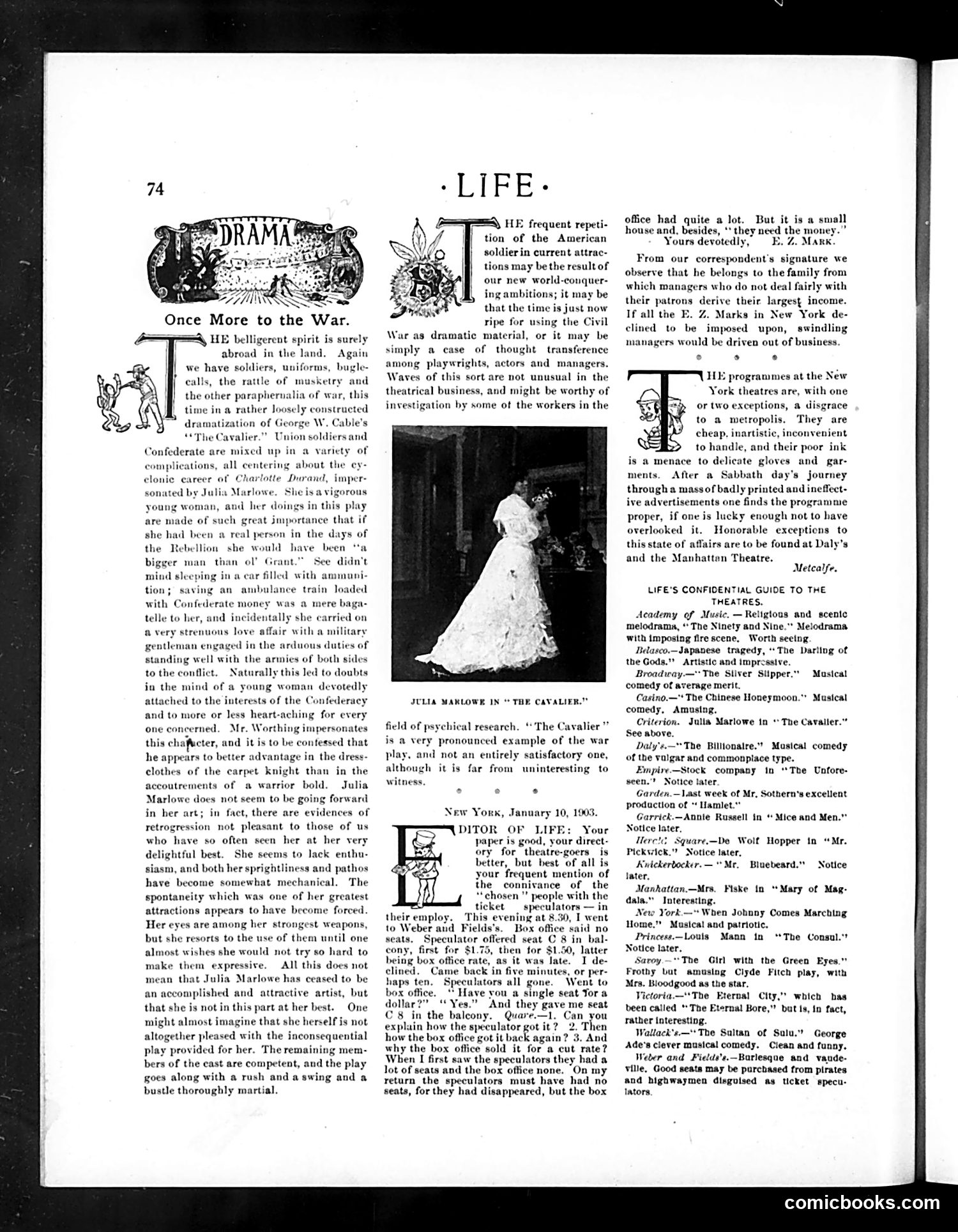
This page features theater criticism and reviews from January 10, 1903. The main drama section discusses a play called "The Cavalier," which uses the American Civil War as its subject matter. The article notes this reflects a trend of Civil War dramatizations becoming popular theatrical material. The accompanying photograph shows Julia Marlowe in "The Cavalier," a prominent actress of the era. The text critiques the play's dramatic effectiveness and historical accuracy regarding the Confederacy. The page also includes a "Life's Confidential Guide to the Theatres" listing current New York productions, including musicals and comedies. The focus is theatrical entertainment and contemporary Broadway offerings, not political satire.
📄 Transcribed text from this page (OCR, searchable)
Machine-transcribed from the original scan — historical spelling and the odd misread are preserved.
Once More to the War. HE belligerent spirit is surely abroad in the land. Again we have soldiers, u bugle- calls, the rattle of musketry and the other paraphernalia of war, this ina rather Joosely constructed dramatization of George W. Cable's “The Cavalier.” Confederate are mixed up in a variety of L centering about the ey- Charlotte Durand, imper- orms, Union soldiers and complications, clonic career of sonated by Julia Marlowe, young woman, aud her doings in this play are made of such great importance that if 1 been a real person in the days of a She isa vigorous she ha the Rebel have bigger man than ol’ Grant.” See didn't mind sleeping in a car filled with ammuni- tion; loaded with Confederate mon telle to her, and incidentally she a very strenuous love affair with am gentleman engaged in the arduous duties of standing well with the armies of both sides to the conflict. Naturally this led to doubts in the mind of a young woman devotedly attached to the interests of the Confederacy and to more or less heart-aching for every Mr. Worthing impersonates 1 she would been saving an ambulance train was a mere baga- arried on litary one concerned this chafucter, and itis to be contessed that he appears to better advantage in the dress- clothes of the carpet knight than in the accoutrements of a warrior bold. Julia Marlowe does not seem to be going forward in her art; in fact, there are evidences of retrogression not pleasant to those of us who have so often seen her at her very delightful best. She seems to lack enthu- siasm, and both her sprightliness and pathos have become somewhat mechanical. The spontaneity which was one of her greatest attractions appears to have become forced. Her eyes are among her strongest weapons, but she resorts to the use of them until one almost wishes she would not try so hard to make them expressive. All this does not mean that Julia Marlowe has ceased to be an accomplished and attractive artist, but that she is not in this part at her best. One ight almost imagine that she herself is not altogether pleased with the inconsequential play provided for her. The remaining mem- bers of the cast are competent, and the play goes along with a rush and a swing and a bustle thoroughly martial. HE frequent repeti- tion of the American soldier in current attrac- tions may be the result of our new world-couquer- ing ambitions; it may be that the time is just now ripe for using the Civil War as dramatic material, or it may be simply a case of thought transference among playwrights, actors and managers. Waves of this sort are not unusual in the theatrical business, and might be worthy of investigation by some ot the workers in the JULIA MARLOWE IN“ THE CAVALIER.” field of psychical research. ‘The Cavalier is a very pronounced example of the war play, and not an entirely satisfactory one, although it is far from uninteresting to witness, ‘ ‘ . New York, January 10, 1903. DITOR OF LIFE: Your paper is good, your direct- ory for theatre-goers is better, but best of all is your frequent mention of the connivance of the “chosen " people with the ticket speculators — in theiremploy. This evening at 8.50, I went to Weber and Fields’s. Box office said no seats. Speculator offered seat C 8 in bal- » first for $1.75, then for $1.50, latter being box office rate, as it was late. I de- ack in five minutes, or per- tors all gone. Went to you a single seat Tor a dollar? ‘And they gave me seat C8 in the balcony. Quaré.—1. Can you explain how the speculator got it ? ‘Then how the box office got it back again? 3. And why the box office sold it for a cut rate? When I first saw the speculators they had a lot of seats and the box office none. On my return the speculators must have had no seats, for they had disappeared, but the box office had quite a lot. But it is a small house and, besides, “* they need the money.” Yours devotedly, —E. Z. Mark. From our correspondent’ signature we observe that he belongs to the family from which managers who do not deal fairly with their patrons derive their largest income. If all the E. % Marks in New York de- clined to be imposed upon, swindling managers would be driven out of business. ° . ° HE programmes at the New York theatres are, with one or two exceptions, a disgrace to a metropolis. They are cheap, inartistic, inconvenient to handle, and their poor ink is a menace to delicate gloves and gar- ments. After a Sabbath day's journey through a mass of badly printed and ineffect- ive advertisements one finds the programme proper, if one is lucky enough not to have overlooked it. Honorable exceptions to this state of affairs are to be found at Daly's and the Manhatten Theatre. Metcalfe. LIFE’S CONFIDENTIAL GUIDE TO THE THEATRES. Academy of Music. — Religions and scenic melodrama, “ The Ninety and Nine.” Melodrama with imposing fire scene, Worth seeing. Belasco.—Japanese tragedy, The Darling of the Gods."* Artistic and impressive. Broadway—"The Sliver Slipper.” comedy of average merit. Casino.—"* The Chinese Honeymoon.” Musical comedy, Amusing, Criterion. Julia Marlowe in © The Cavaller.* See above. Daly's.—"The Billionaire." Masical comedy of the valgar and commonplace type. Empire—Stock company in “Tbe Unfore- seen.” Notice later. Garden.—\ast week of Mr, Sothern’s excellent production of “ Hamlet." Garrick.—Annie Russell in + Mice and Men.” Nottce later, Mere! Square.—De Woit Hopper in “Mr. Pickwick.” Notice later, Knickerbocker. — "Me, Jater, Manhattan.—Mrs. Fiske in “Mary of Mag. dala.” Interesting. New York.—“ When Johnny Comes Marching Home." Musical and patriotic, Princess.—Louis Mann in Notice later. Saroy—"The Girl with the Green Eyes. Frothy but amusing Clyde Fitch play, with Mrs. Bloodgood as the star, Victoria.—'The Eternal City," which bas been called "The Eternal Bore,” but is, in fact, rather Interesting. Watlack's—" The Sultan of Sulu.” George Ade’s clever musical comedy. Ciean and funny. Weber and Fields's.—Barlesqae and vande- ville, Good seats may be purchased from pirates and highwaymen disguised as ticket specu- Intors. Mastcal Bluebeard." Notice “The Consul." comicbooks.com