
Life, 1903-01-22 · page 6 of 20
Life — January 22, 1903 — page 6: what you’re looking at
What you’re looking at
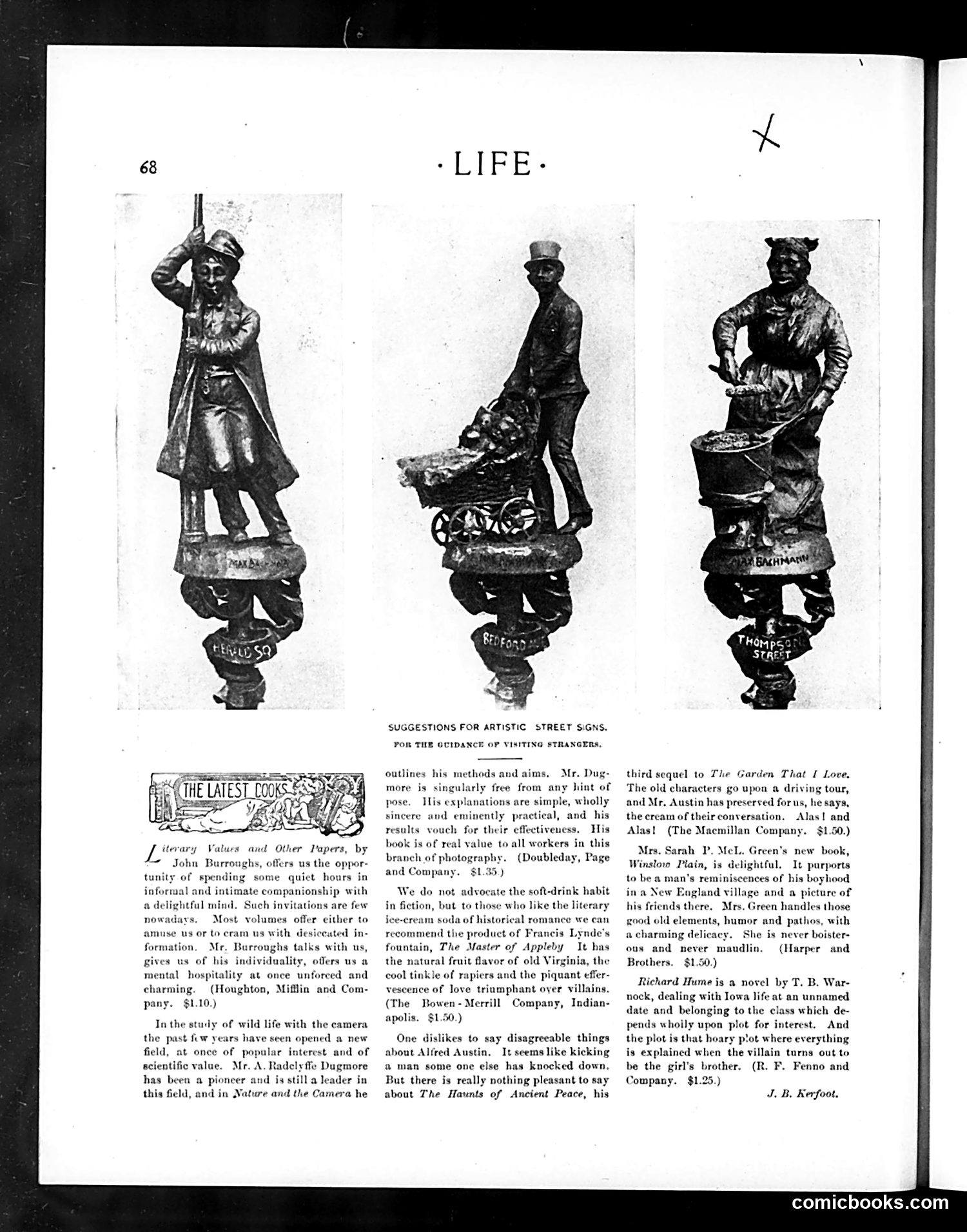
**The Image:** Three ornamental street signs showing figures engaged in activities—woodcutting, pushing a baby carriage, and stirring a large pot. The caption reads "SUGGESTIONS FOR ARTISTIC STREET SIGNS FOR THE GUIDANCE OF VISITING STRANGERS." **The Satire:** This appears to be mockery of decorative street signage, likely Victorian-era ornamental signs meant to beautify public spaces. The humor lies in suggesting absurd, mundane domestic activities as subjects for artistic public monuments—reducing grand civic art to the ridiculous. Rather than depicting heroic or noble figures, the proposal shows ordinary people doing humble tasks, mocking both the pretentiousness of decorative street furniture and perhaps contemporary attitudes about labor and class. The joke satirizes the gap between artistic pretension and everyday reality.
📄 Transcribed text from this page (OCR, searchable)
Machine-transcribed from the original scan — historical spelling and the odd misread are preserved.
L iterary Values and Other Papers, by ‘~ John Burroughs, offers us the oppor- tunity of quiet hours in inforwal and intimate companionship with a delightful mind, Such invi nowadays. Most volumes offer either to spending som amuse us or to cram us with desiccated in- Mr. Burroughs talks with us, sus of his individuality, offers us a mental hospitality at once unforeed and charming. (Houghton, Mifflin and Com- pany. $1.10.) formation In the study of wild life with the camera the past fow years have seen opened a new field, at once of popular interest and of scientific value. Mr. A. Radclyffe Dugmore has been a pioneer and is still a leader in this field, and in Nature and the Camera he SUGGESTIONS FOR ARTISTIC STREET SiGNS. POR THE GUIDANCE OF VISITING STRANGERS, outlines his methods and aims. Mr. Dug- more is singularly free from any hint po i sincere a results vouch for their effe book is of real value to all workers in this branch of photography. (Doubleday, Page and Company. We do not advocate the soft-drink habit in fiction, but to those who like the lite ice-cream soda of historical romance we can recommend the product of Francis Lynde’s fountain, The Master of Appleby It has the natural fruit flavor of old Virginia, the cool tinkle of rapiers and the piquant effer- vescence of love triumphant oyer villains, (The Bowen-Merrill Company, Indian- apolis. $1.50.) One dislikes to say disagreeable things about Alfred Austin, It seems like kicking a man some one else has knocked down. But there is really nothing pleasant to say about The Haunts of Ancient Peace, his third sequel to The Garden That I Love. ‘The old characters go upon a driving tour, and Mr, Austin has preserved forus, he says, the cream of theirconversation. Alas! and Alas! (The Macmillan Company. $1.50.) Mrs. Sarah P. MeL, Green's new book, Winslow Plain, is delightful. It purports to be a man’s reminiscences of his boyhood in a New England village and a picture of his friends there, Mrs. Green handles those good old elements, humor and pathos, with acharming delicacy. She is never boister- ous and never maudlin. (Harper and Brothers. $1.50.) Richard Hume is a novel by T. B. War- nock, dealing with Iowa life at an unnamed date and belonging to the class which de- pends whoily upon plot for interest. And the plot is that hoary plot where everything is explained when the villain turns out to be the girl's brother. (R. F. Fenno and Company. $1.25.) J.B. Kerfoot. comicbooks.com