
A complete issue · 22 pages · 1902
Life — November 13, 1902
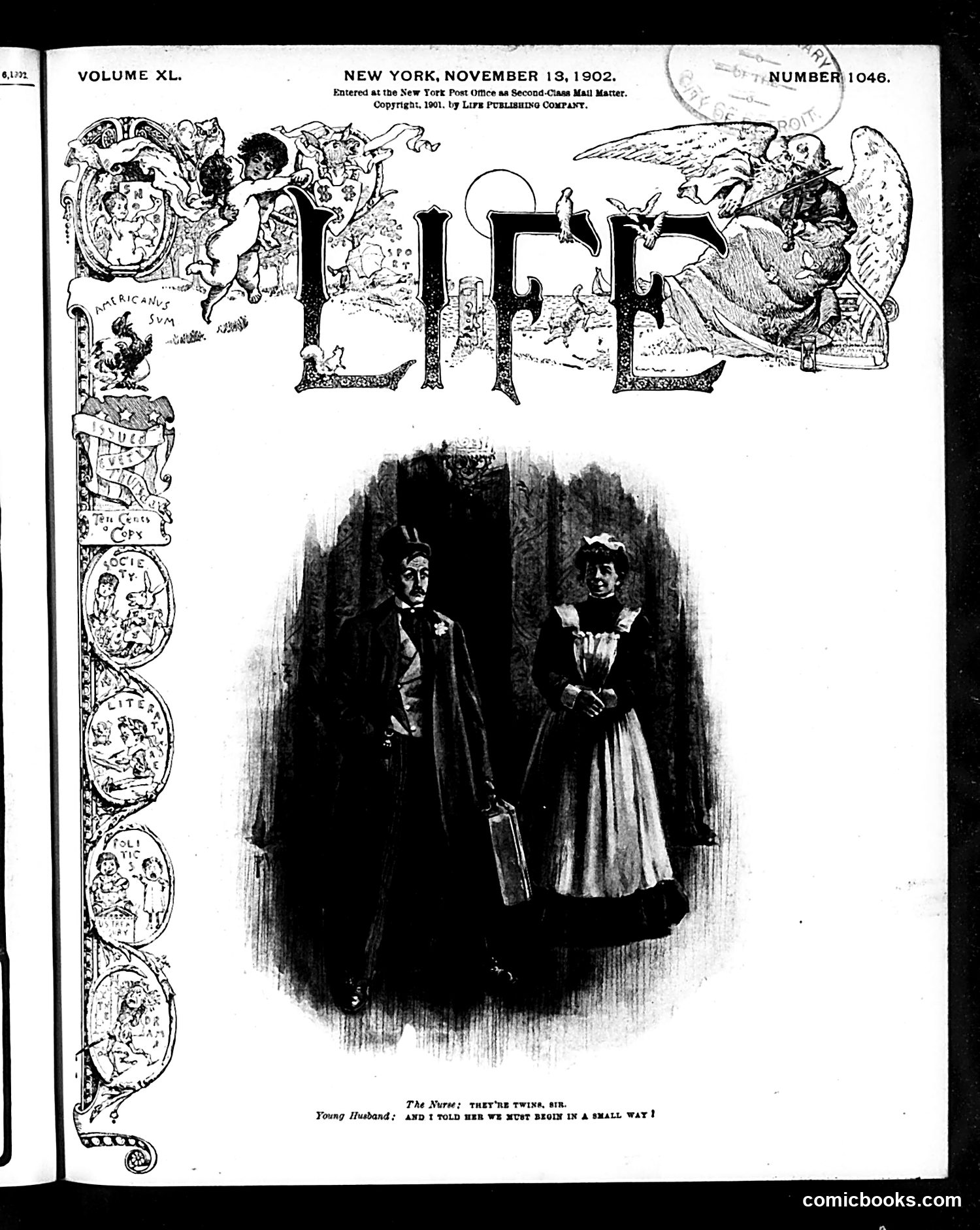
This page features a domestic humor cartoon titled "The Nurse: 'They're twins, sir.'" The scene depicts a young husband and nurse in what appears to be a bedroom or nursery, with the husband's stunned reaction to learning of twins. The caption reads: "Young Husband: 'And I told her we must begin in a small way!'" The joke plays on the contrast between the husband's stated intention to have children gradually and the unexpected arrival of twins—doubling his reproductive responsibilities immediately. This is straightforward domestic comedy about family planning, common in early 1900s satirical magazines. The ornate left border contains decorative vignettes typical of Life's design aesthetic of this era.
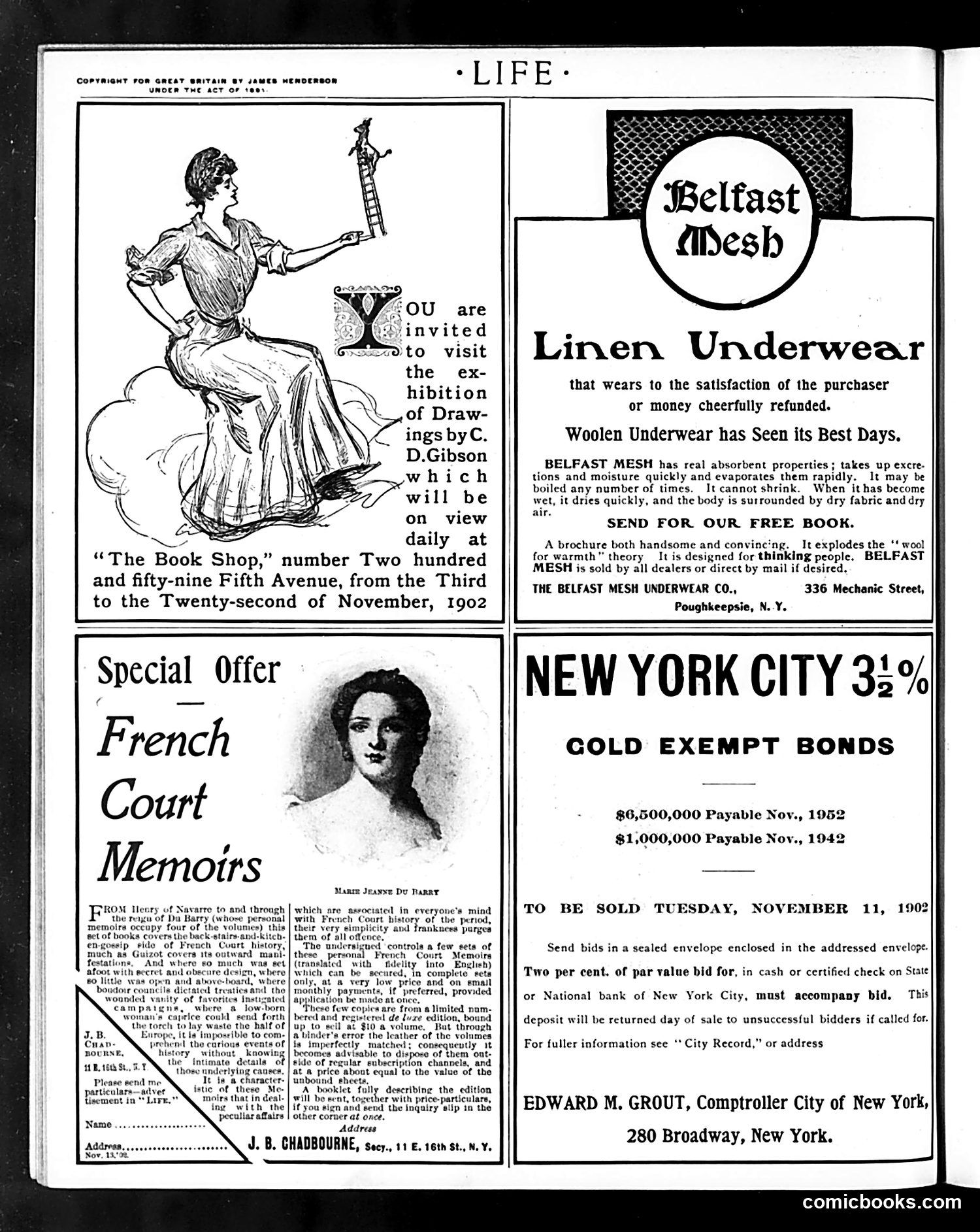
This page is primarily **advertising**, not political satire. The dominant content consists of four commercial advertisements from 1902: 1. **C.D. Gibbon exhibition announcement** - promotes drawings on view at "The Book Shop" on Fifth Avenue 2. **Belfast Mesh linen underwear** - marketed as absorbent and durable, with money-back guarantee 3. **French Court Memoirs** - a book offer covering French history from Henry of Navarre onward 4. **New York City bonds** - municipal financial offering with 3½% interest, to be sold November 11, 1902 The only illustration with potential satirical intent is the stylized female figure in the Gibbon exhibition ad, but it appears decorative rather than satirical. There are no identifiable political figures or social commentary visible. This is a straightforward commercial page typical of early 20th-century magazine advertising.
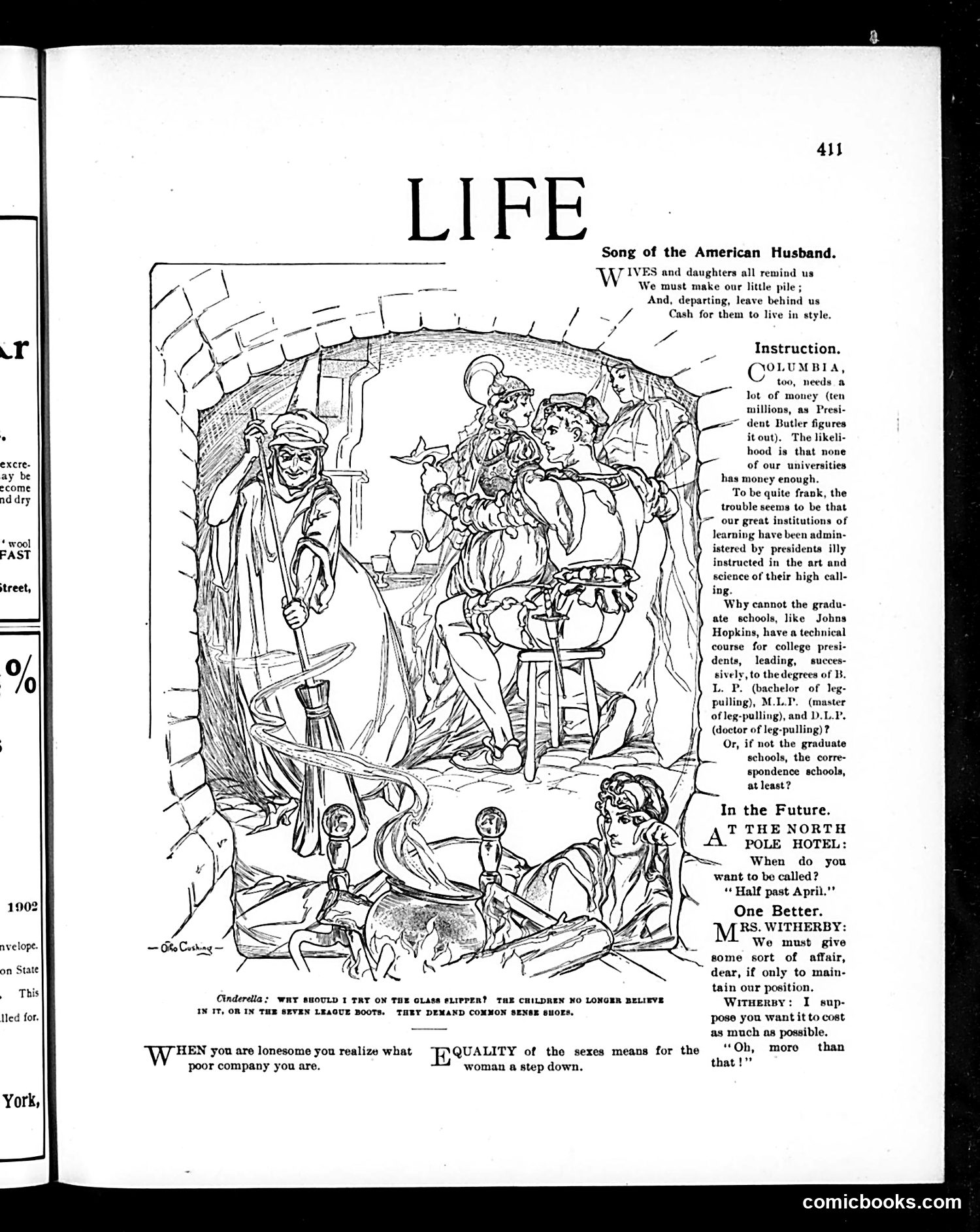
This page contains satirical commentary on American higher education and gender equality circa early 1900s. The main cartoon depicts Cinderella in a glass slipper scenario, with a caption questioning why children believe in the fairy tale when "seven league boots" (magical speed) and "common sense shoes" would be more practical—a metaphor for impractical education. The accompanying text sections critique university leadership, suggesting college presidents are poorly trained in educational administration. The "Instruction" piece argues that Columbia University and similar institutions lack proper technical training for their leaders. The "In the Future" and "One Better" sections satirize gender equality debates, with a woman demanding equality while maintaining that such parity would cause "a step down" for women—exposing the contradiction in anti-feminist arguments of the era.
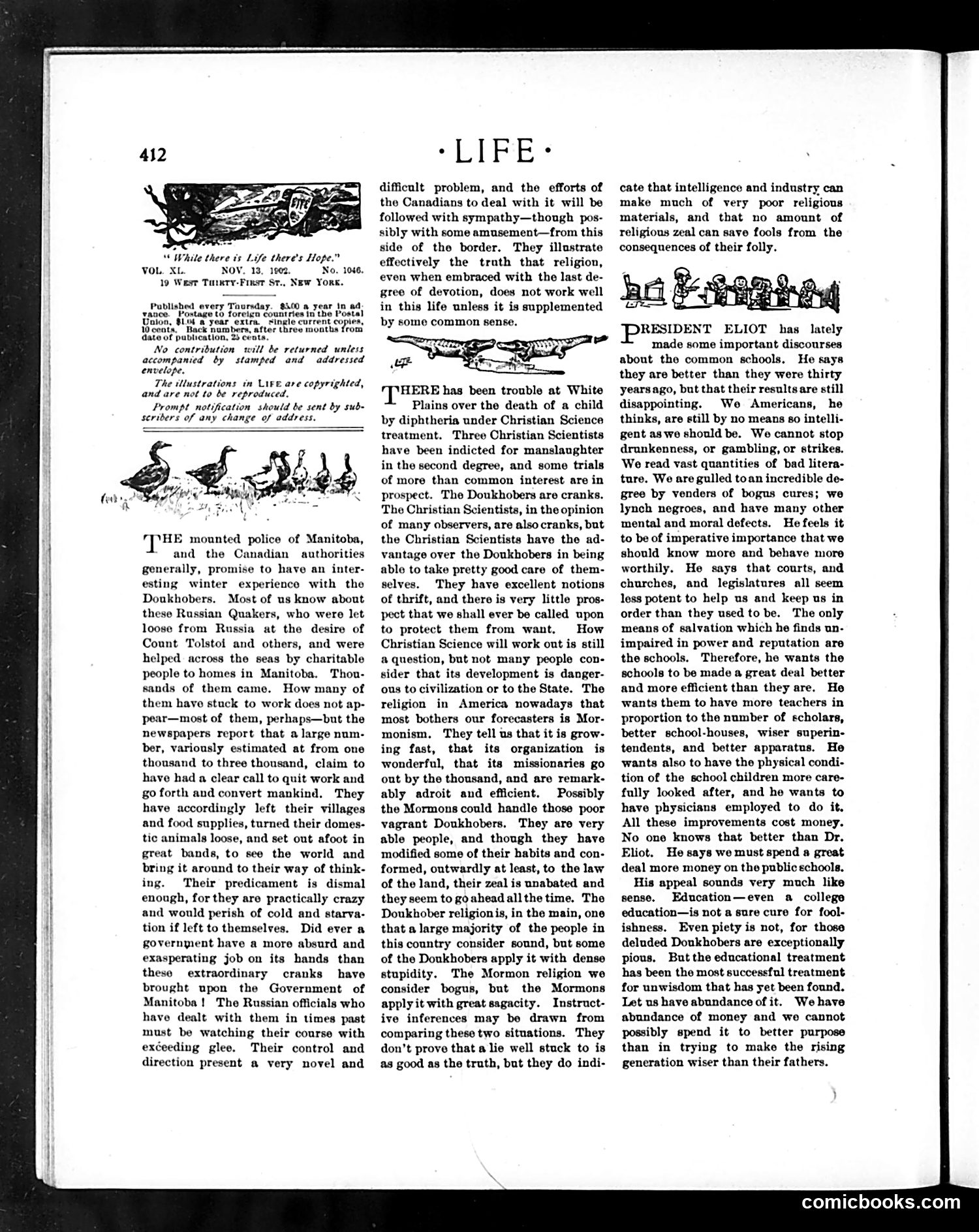
This page contains two political cartoons and editorial commentary from early 20th-century Life magazine. The top cartoon, titled "While there is Life there's Hope," depicts mounted Canadian police confronting Doukhobors (Russian religious dissenters who immigrated to Manitoba). The text criticizes these "cranks" and their practices, while also satirizing Christian Scientists for similar "crankish" behavior, particularly regarding their handling of a diphtheria death. The lower section features an illustration of ducks, accompanying text that appears to mock religious extremism and governmental mismanagement in Manitoba. Life's satire targets religious zealotry on multiple fronts—from the Doukhobors' practices to Christian Science—while critiquing government authorities for their inconsistent handling of these groups.
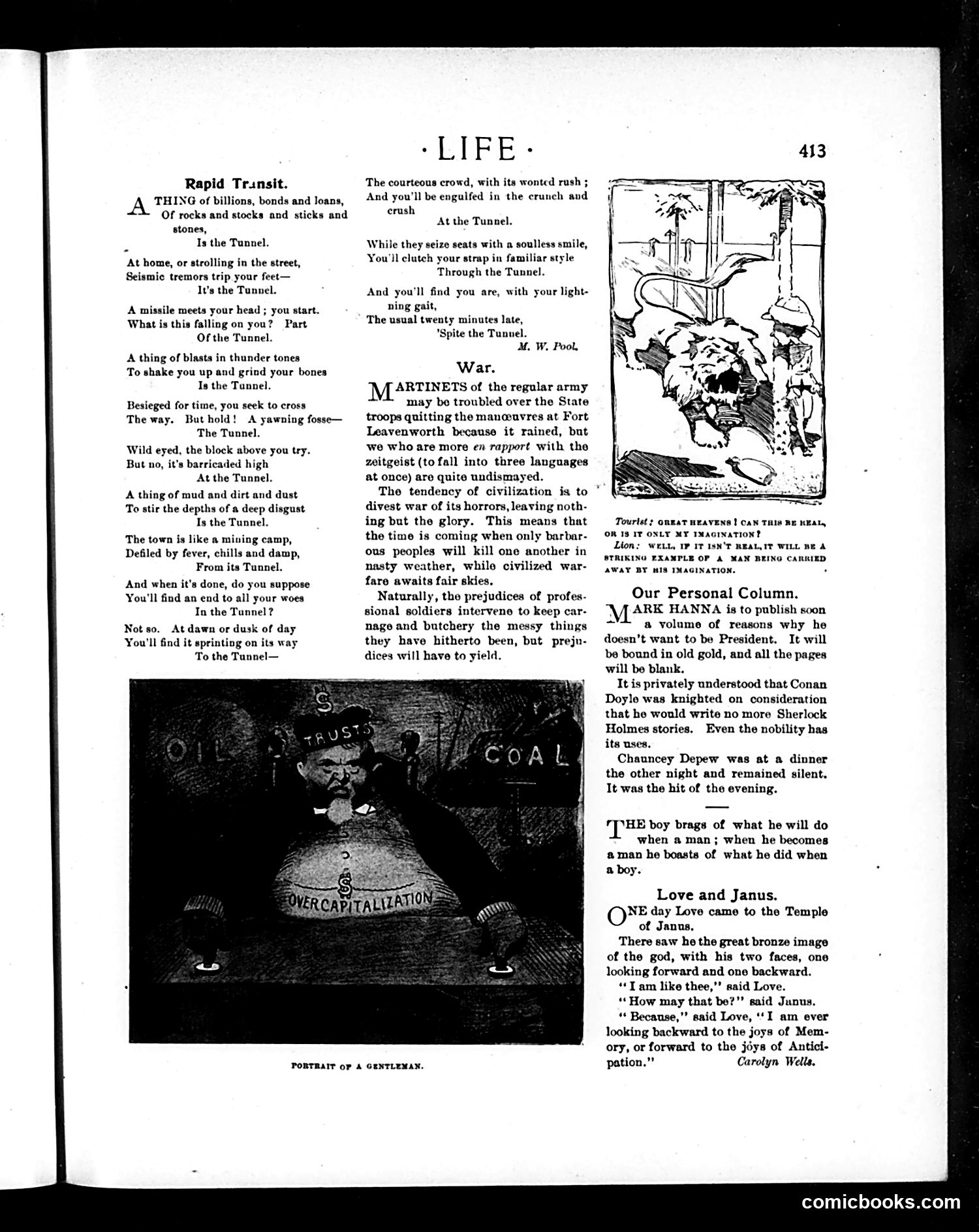
The central image is titled "Portrait of a Gentleman" and depicts a bloated figure labeled with terms like "Oil Trust," "Coal," and "Over Capitalization." This appears to be a Gilded Age satirical attack on industrial monopolists and corrupt capitalists who accumulated excessive wealth through trusts and overcapitalization schemes. The cartoon criticizes wealthy industrialists for their predatory business practices. The grotesque proportions suggest moral corruption accompanying financial excess. The specific labels reference actual business abuses of the era—oil and coal trusts that dominated American markets through anticompetitive practices, and financial manipulation through inflated capitalization. This reflects Progressive Era anxieties about unchecked corporate power and wealth inequality, likely from the early 1900s.
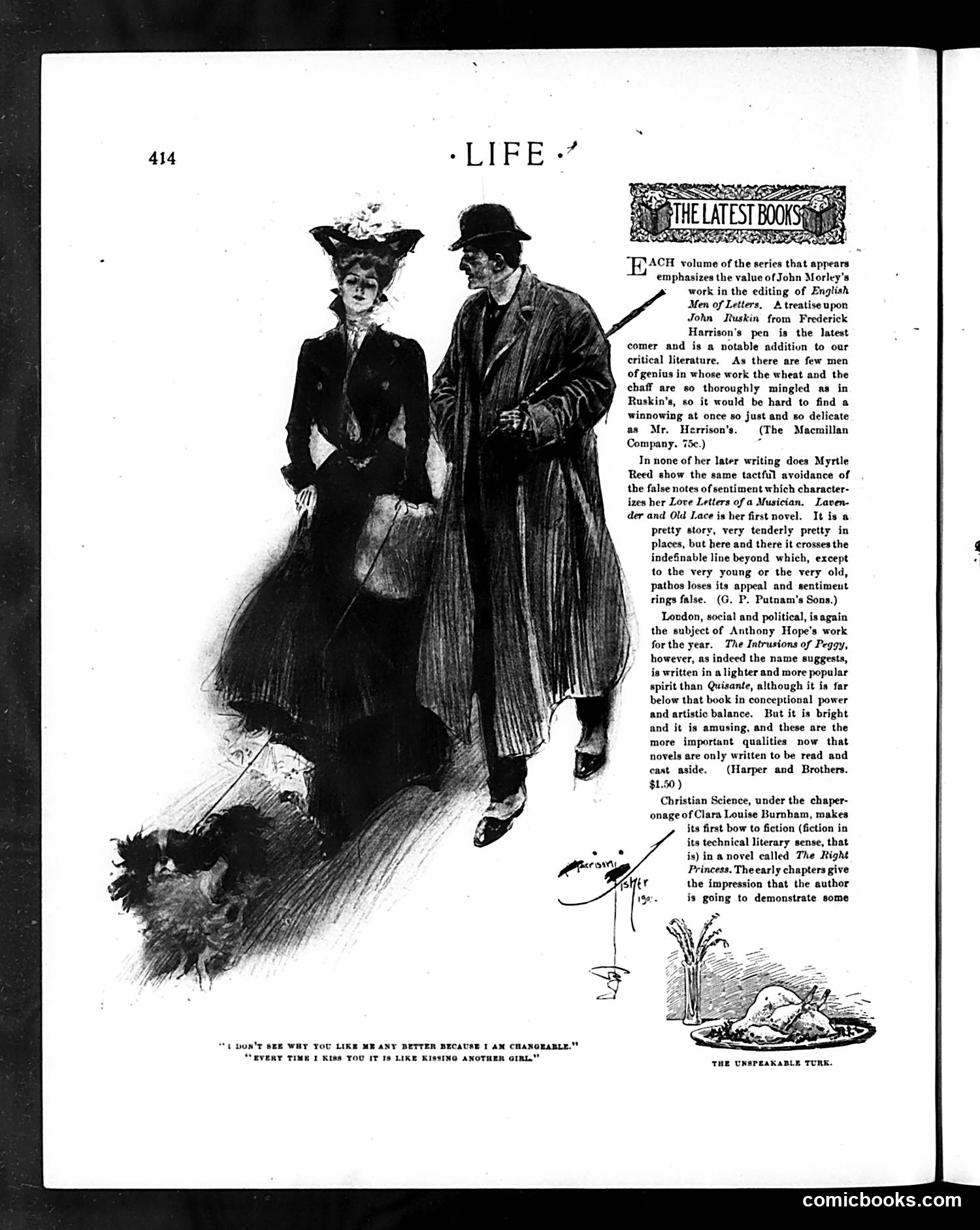
This page contains a book review section titled "The Latest Books" rather than political satire. The main illustration shows a fashionably dressed woman and man in early 1900s attire, accompanying reviews of contemporary novels. The featured books include works by John Ruskin (edited by Frederick Harrison), Myrtle Reed's *Love Letters of a Musician* and *Lavender and Old Lace*, Anthony Hope's *The Intrusions of Peggy*, and Clara Louise Burnham's *The Right Princess*. The dialogue beneath the illustration ("I don't see why you like me any better because I am changeable...") appears to reference romantic themes in the reviewed works. The small illustration at bottom right labeled "The Unspeakable Turk" suggests contemporary geopolitical concerns, though its specific context remains unclear from this page alone.
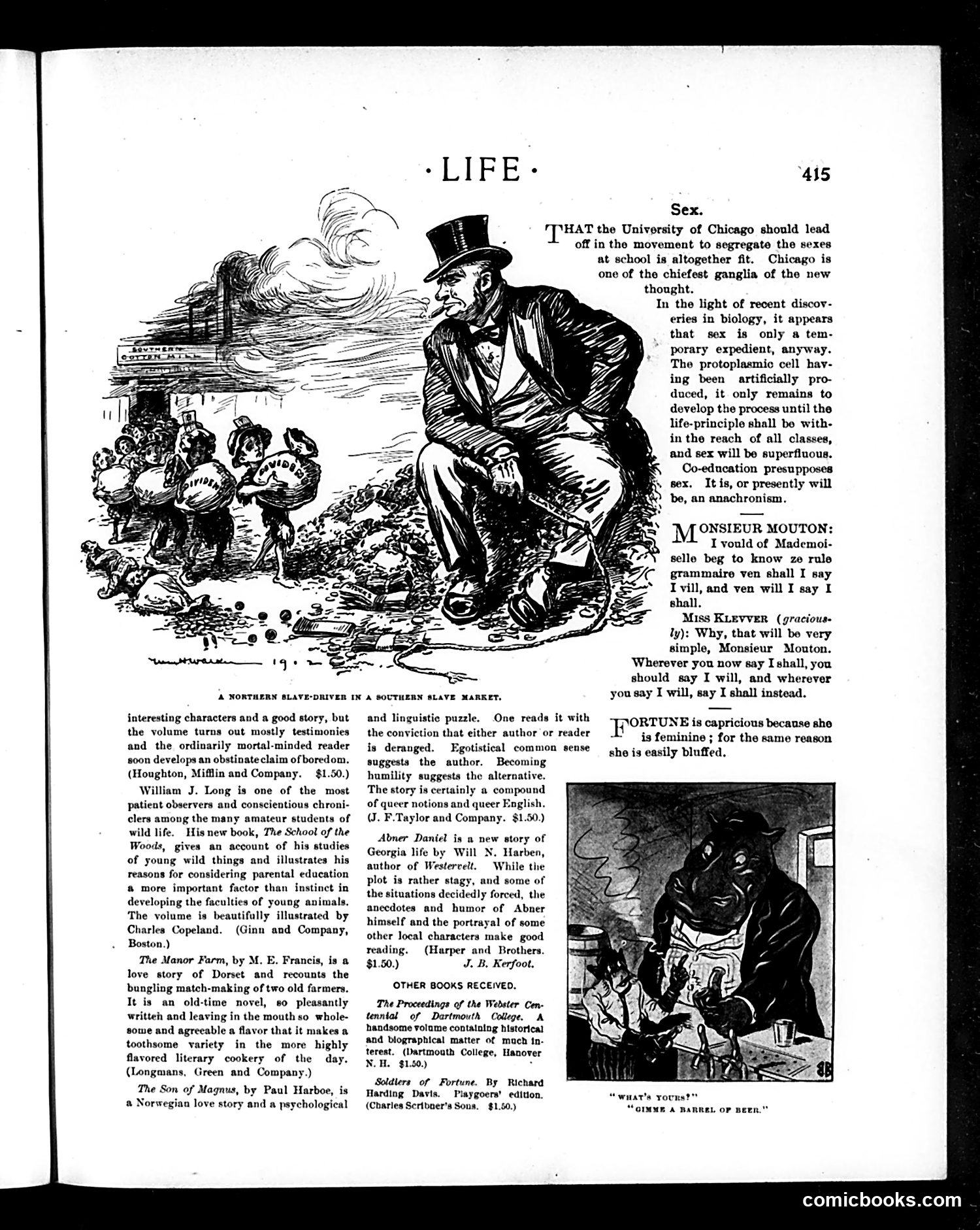
This political cartoon satirizes Northern industrial capitalism through the contrast of two figures: a wealthy, top-hatted industrialist oversees laborers (appearing as enslaved or exploited workers) near a factory with smokestacks. The caption's wordplay equates Northern factory owners with Southern slave-drivers, suggesting that industrial wage labor constitutes a form of slavery. The satire critiques the North's moral superiority claims about slavery abolition while ignoring their own exploitative labor practices. The cartoon appears designed to challenge hypocrisy: Northern industrialists profit from workers' suffering just as Southern slaveholders did, only through different mechanisms (factory wages instead of chattel slavery). This reflects 19th-century debates about labor conditions and economic justice.
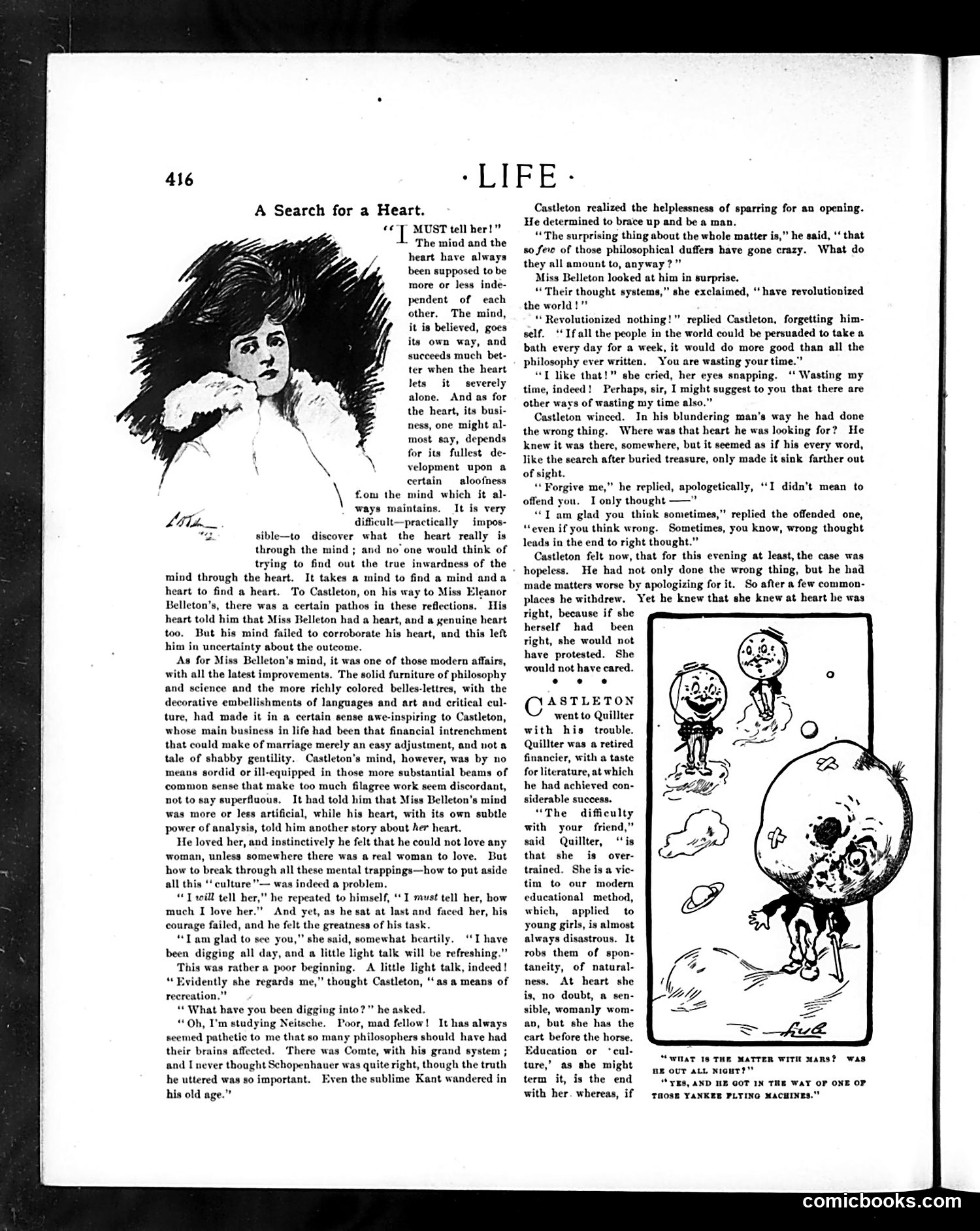
This page illustrates a satirical story about a character named Castleton seeking genuine emotion and authenticity. The narrative mocks philosophical pretension—Castleton's Miss Helleston supposedly lacks a "real" heart despite their relationship. The accompanying cartoon (right) depicts whimsical figures on a planet with flying machines, illustrating the story's fantastical elements about searching for authentic human connection amid modern complications. The satire targets the intellectual posturing of the era: characters debate whether mind or heart should govern human relationships, with the implication that excessive philosophy obscures simple human truths. The piece critiques over-educated, emotionally detached society—a common Life magazine theme mocking the pretensions of refined culture.
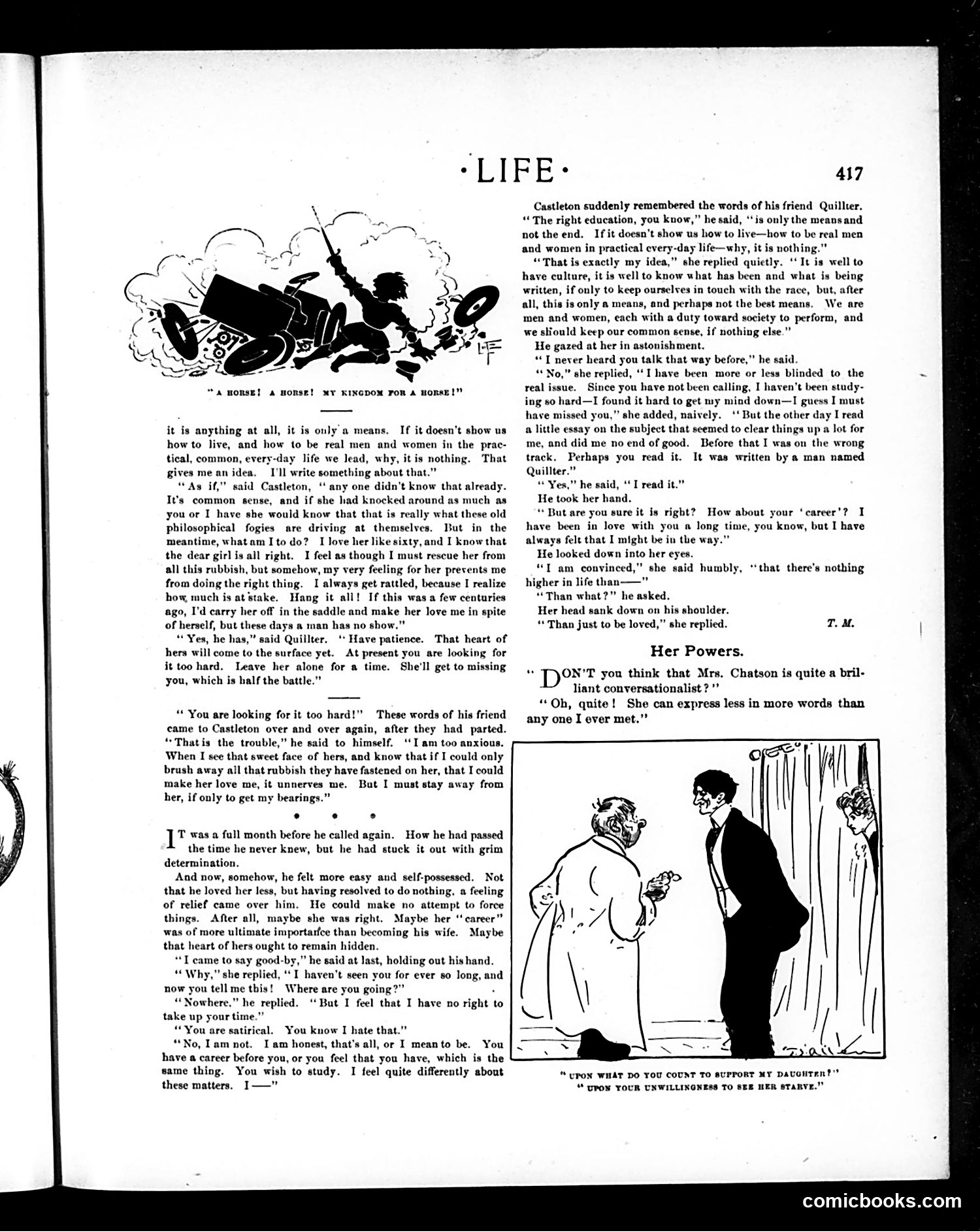
This page contains a short story narrative with an embedded cartoon illustration. The cartoon shows a domestic scene where a man confronts a woman about supporting their daughter, with the caption: "UPON WHAT DO YOU COUNT TO SUPPORT MY DAUGHTER?" / "UPON YOUR UNWILLINGNESS TO SEE HER STARVE." The scene satirizes early-20th-century gender dynamics and economic dependency. The woman's response is sardonic—she's pointing out the man's moral obligation to provide, since he won't allow her to starve despite their apparent marital conflict. The cartoon mocks both the man's attempt to shirk financial responsibility and society's expectation that women remain economically dependent on men regardless of relationship status. The accompanying text explores themes of education, love, and life choices between characters named Castleton and Quillier.
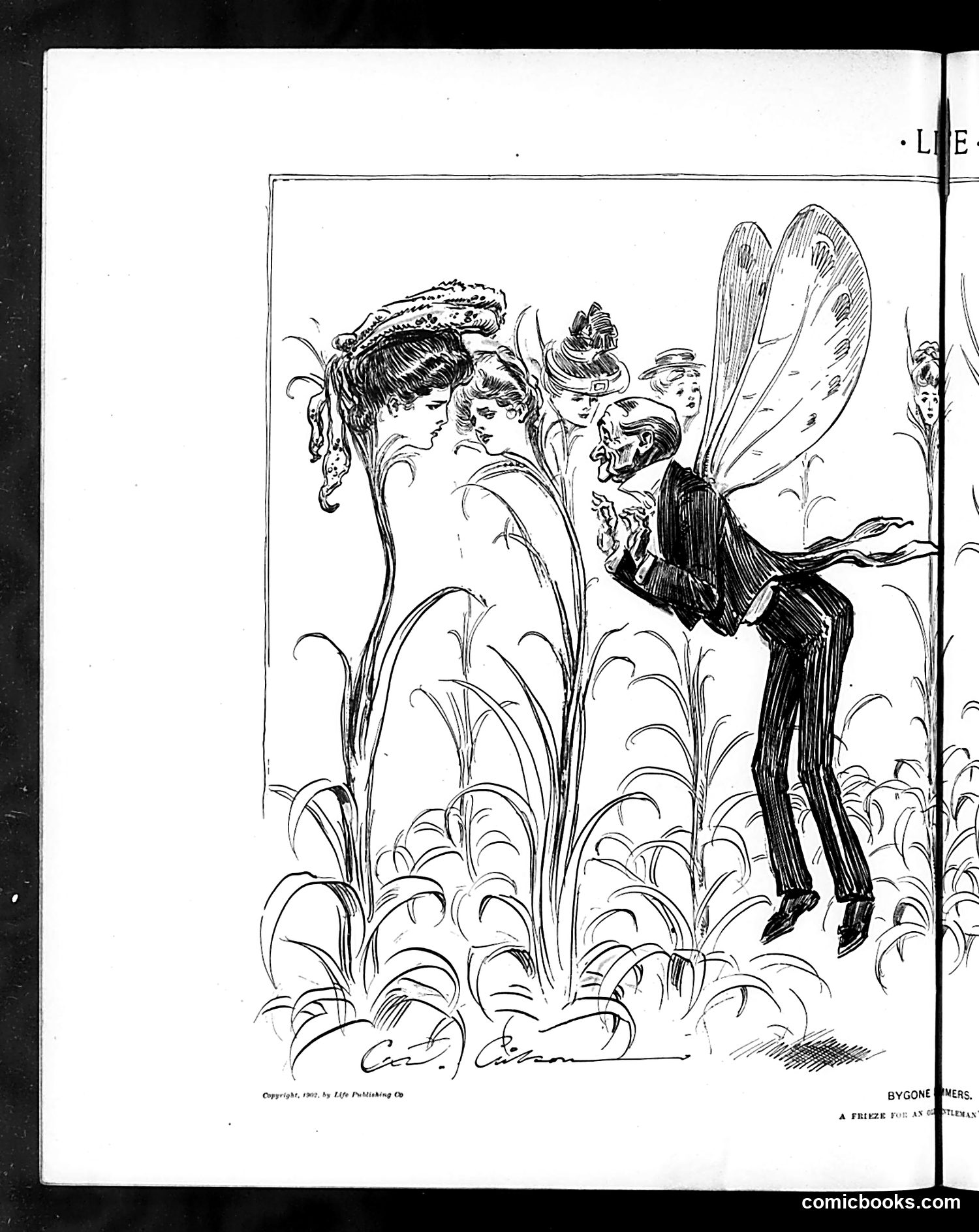
This cartoon depicts a man in formal attire appearing to court or admire a group of women's faces arranged like decorative architectural elements (a "frieze"). The women wear elaborate hats and hairstyles typical of the early 1900s. The satire likely mocks either: - A wealthy man's pursuit of multiple women - The superficiality of high society courtship rituals - Perhaps a specific public figure known for romantic escapades The exaggerated, decorative arrangement of the women's faces suggests they're being treated as ornamental objects rather than individuals—a critique of how society (or this particular man) objectifies women. The formal clothing and refined setting emphasize that this frivolous behavior occurs among the upper classes. Without additional context, the specific identity of the man and any particular scandal referenced remains unclear.
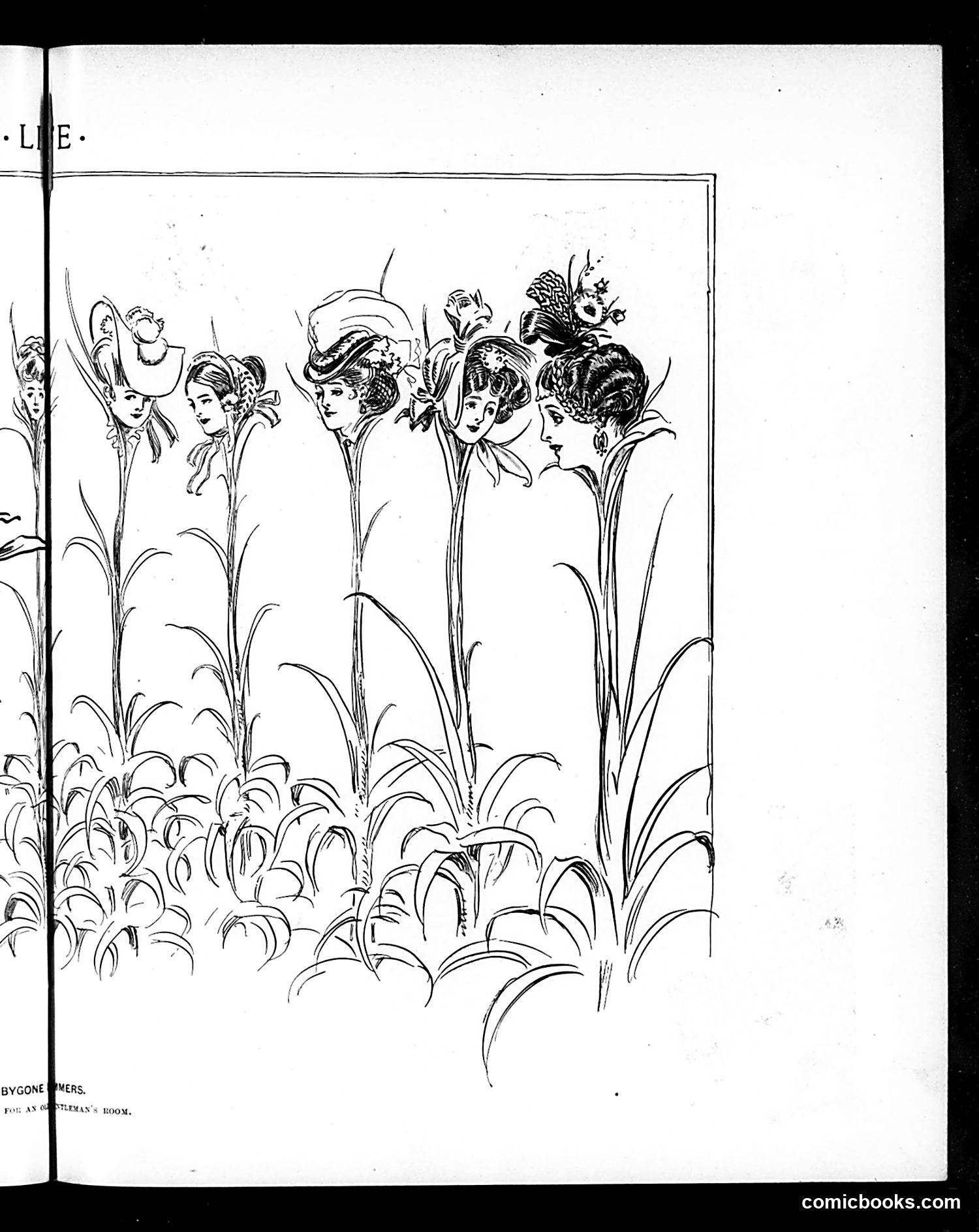
This appears to be a satirical illustration from *Life* magazine depicting women's heads emerging from corn stalks like plants in a field. The women wear elaborate Edwardian-era hats and hairstyles, suggesting upper-class fashion. The cartoon likely satirizes either: 1. Women's fashion excess (particularly the ornate hats popular in the early 1900s), or 2. Women's roles in society, possibly commenting on how women were treated as decorative objects or commodities The "corn field" setting may mock the notion of women being "grown" or produced like agricultural goods, reducing them to mere products rather than individuals. The credit line reads "BYGONE HUMMERS" and references "SPORTSMAN'S BOOK," though the precise publication date remains unclear from this image alone.
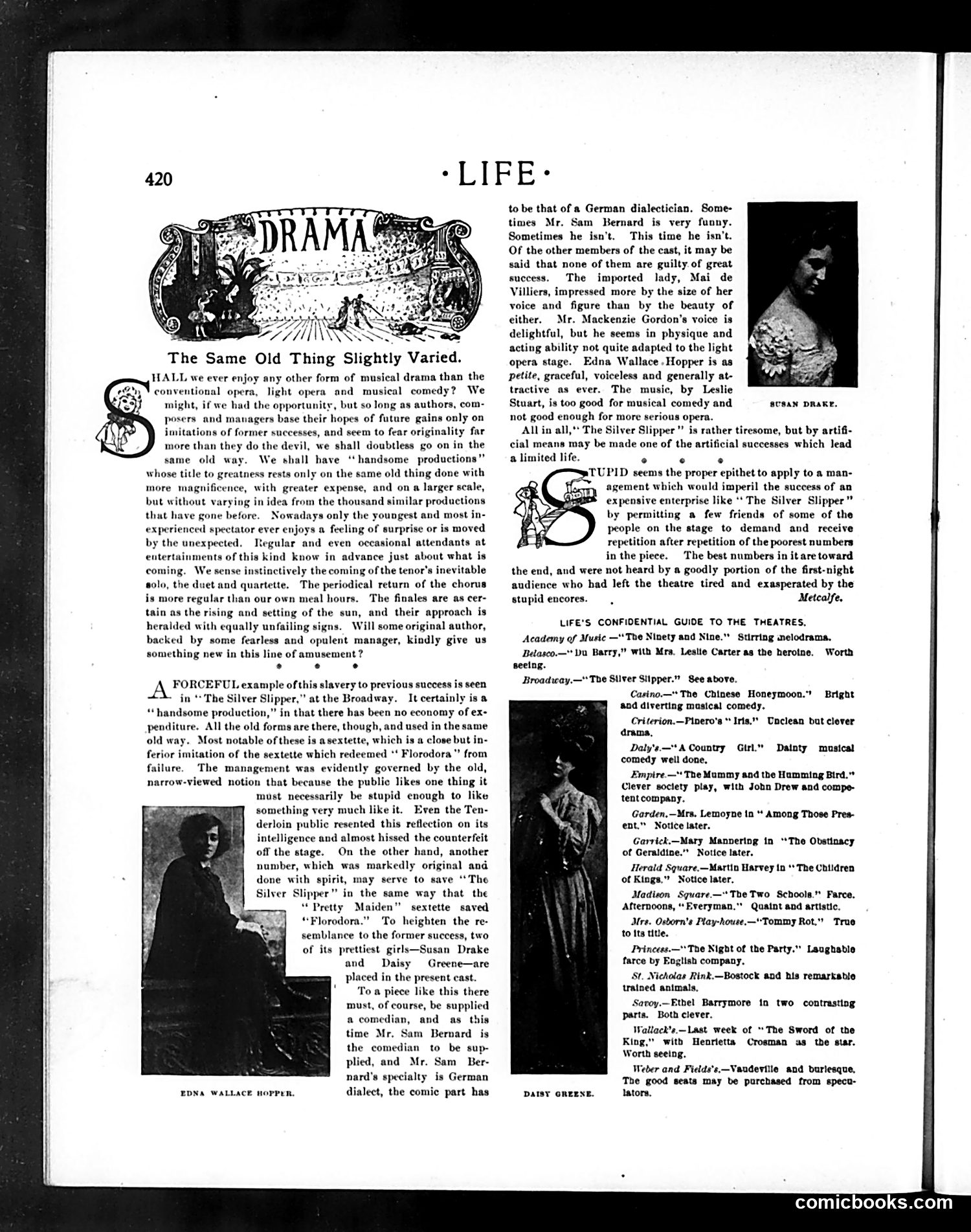
This is a **theater review page** from Life magazine's "Drama" section, not a political cartoon. The page discusses musical comedies and operettas playing on Broadway and other theaters. The main article critiques "The Silver Slipper," calling it a "forceful example of slavery to previous success." The text argues the show merely copies successful formulas rather than offering originality, using familiar plot devices and character types seen repeatedly. The accompanying photographs show performers from these productions, including **Edna Wallace Hopper** and **Daisy Greene**. The bottom section provides a "Confidential Guide to the Theatres," listing current shows with brief reviews—some complimentary, others dismissive. This is standard theater criticism and entertainment journalism, not political or social satire.
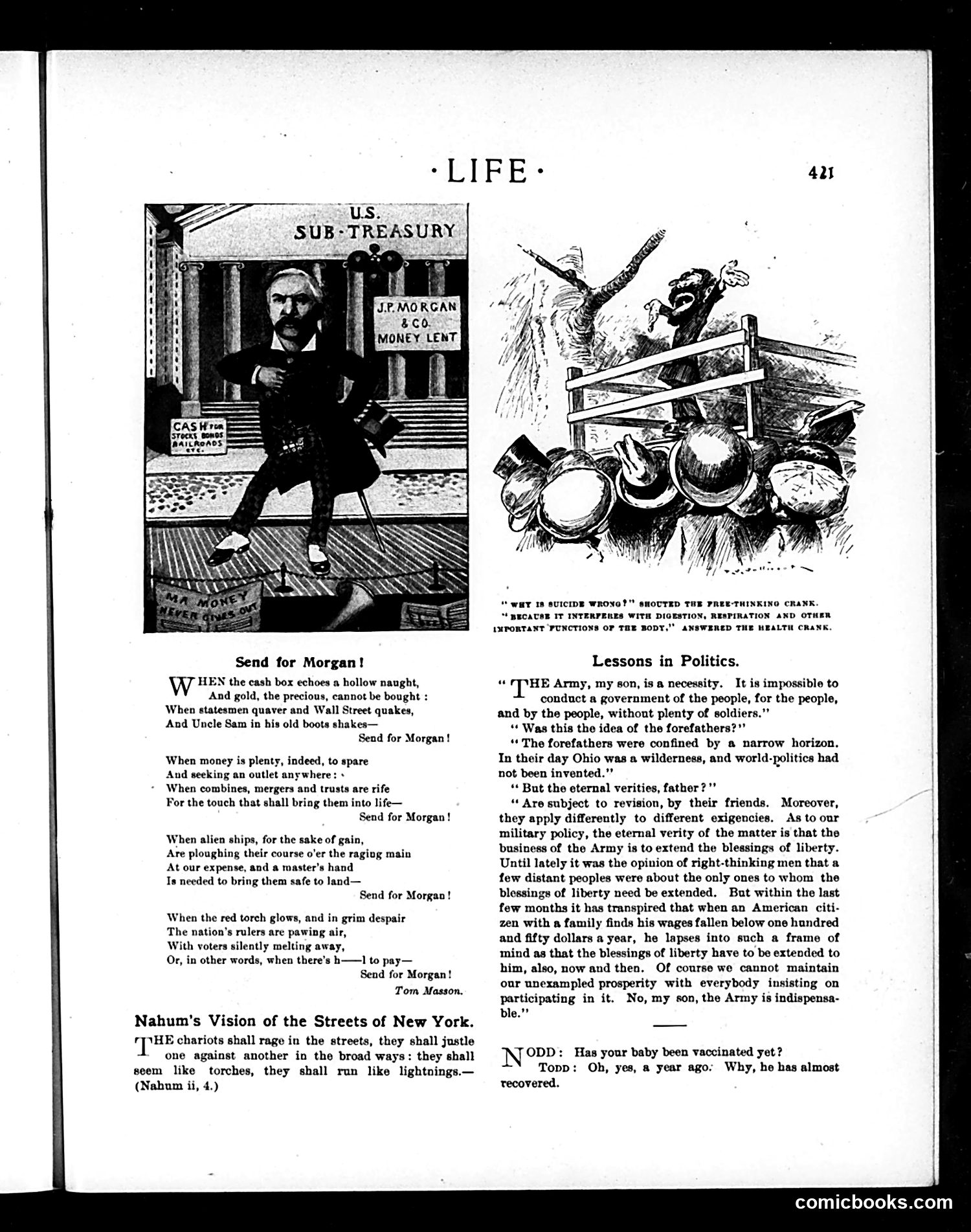
**"Send for Morgan!"** lampoons J.P. Morgan, the powerful banker whose financial interventions repeatedly "rescued" the U.S. economy during crises. The poem mocks how politicians and Wall Street depend on Morgan to solve every problem—from currency shortages to labor unrest to foreign competition. The cartoon shows Morgan at the Sub-Treasury, controlling the nation's money supply. The satire suggests America has outsourced governance to a private banker. **"Lessons in Politics"** critiques imperial expansion and wealth inequality. A father justifies maintaining a large military, claiming it "extends the blessings of liberty" to distant peoples—but admits the real purpose is preventing poor American workers from demanding fair wages. The irony underscores how the ruling class uses nationalism to suppress domestic dissent. **The vaccination joke** mocks anti-vaccine skeptics by having the father respond that vaccination worked so well his child "almost recovered"—implying it caused severe illness rather than preventing it.
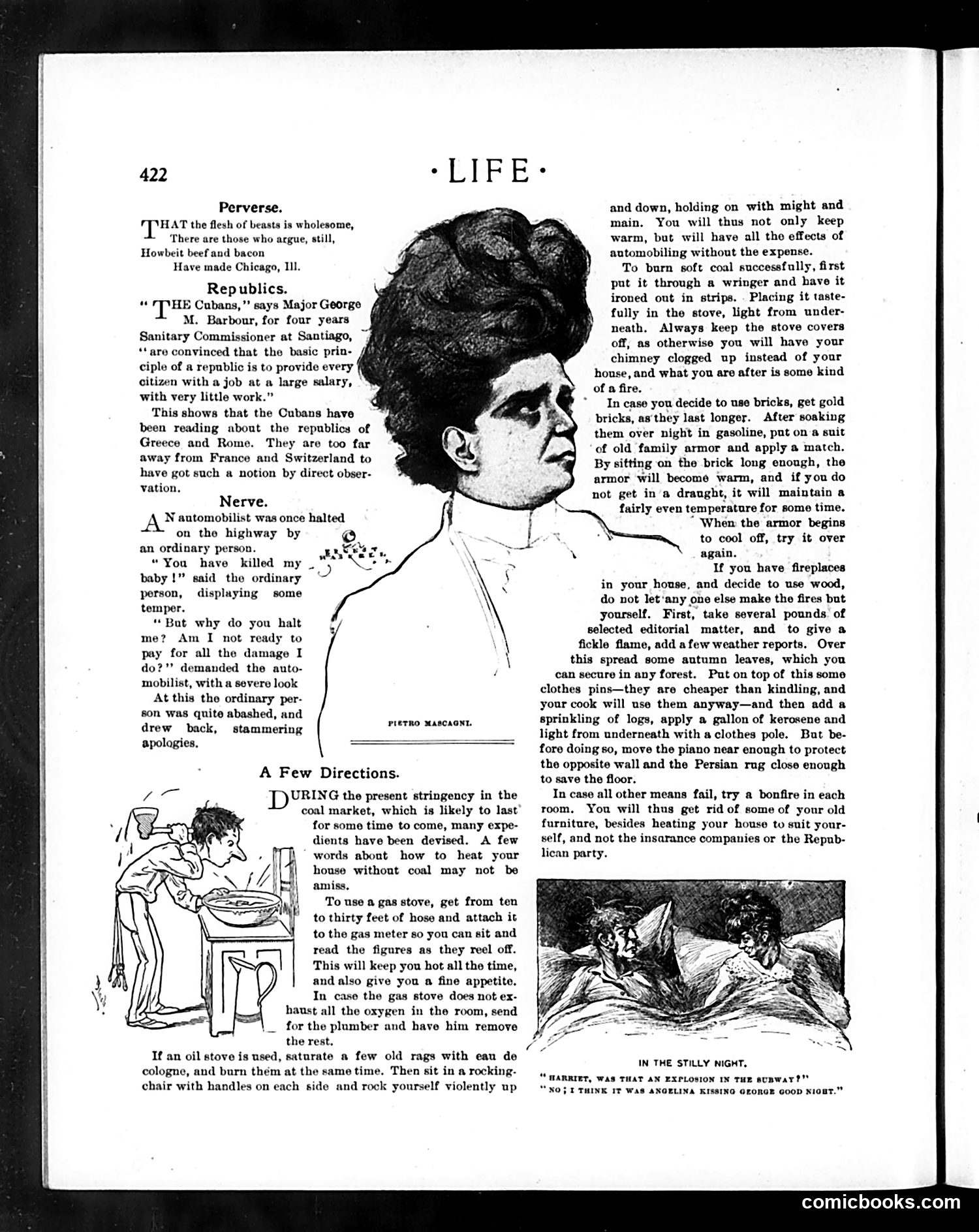
This page satirizes early 20th-century American social absurdities during a coal shortage. The main sections mock: **"Republics"**: Ridicules Cubans' supposed belief that republican government means high-paying jobs with minimal work—a dig at post-Spanish American War Cuba and naive democratic expectations. **"Nerve"**: A dark joke about an automobilist who kills a pedestrian's child but calmly offers payment, treating human tragedy as a mere financial transaction. The pedestrian's meek apology satirizes how wealth and entitlement intimidate ordinary people into accepting injustice. **"A Few Directions"**: The main satirical thrust—absurd "heating solutions" during coal rationing. Each suggestion is deliberately ridiculous (soaking bricks in gasoline, burning editorial matter and weather reports, risking pianos and Persian rugs). This mocks both the desperation of the shortage and the era's class-based indifference (suggesting readers own such luxuries). The final illustration about an explosion references the dangerous improvisation people resorted to when fuel was scarce—a dark undercurrent to the humor.
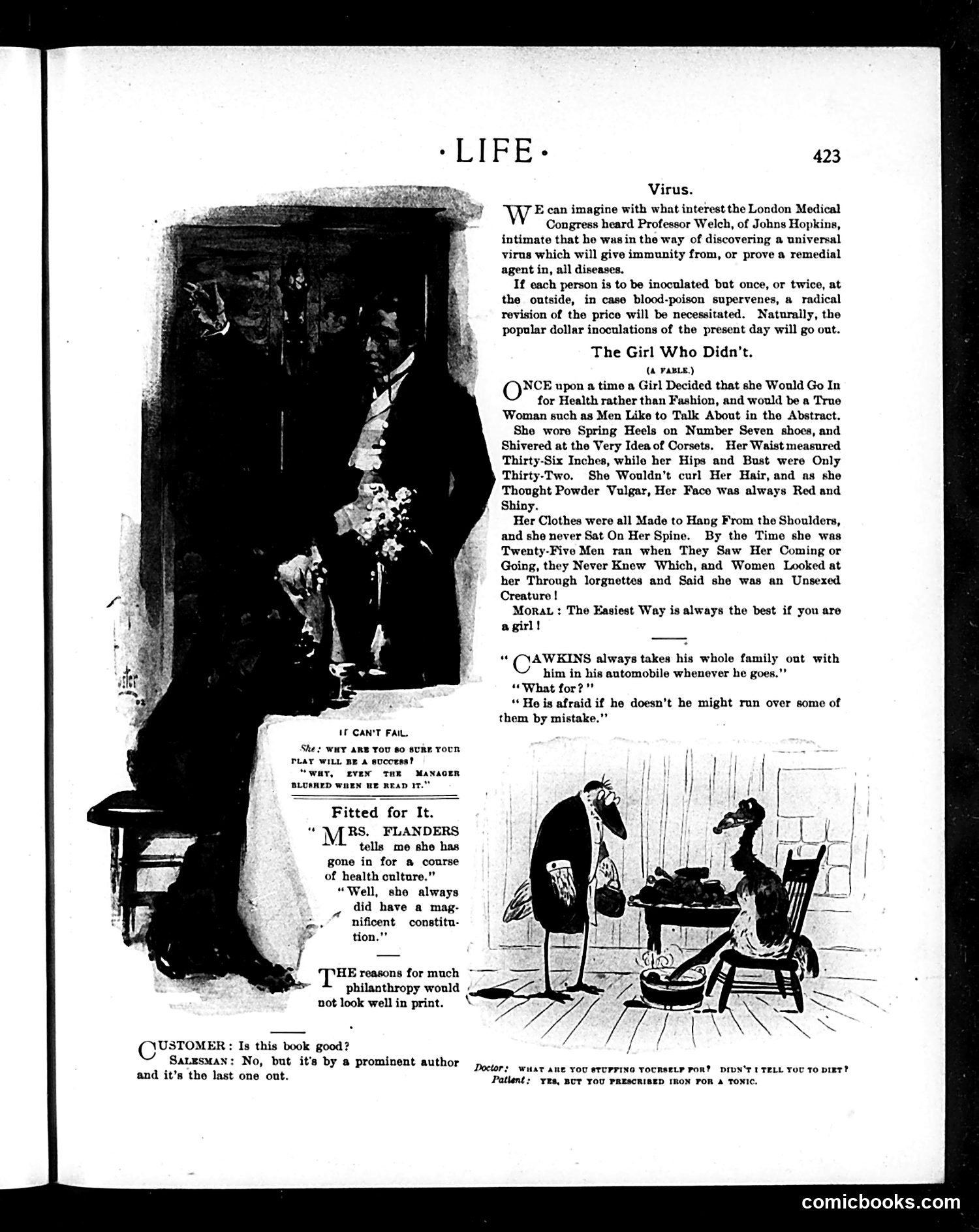
This page contains multiple brief satirical pieces mocking early 20th-century attitudes toward health and medicine. **"Virus"** jokes about Professor Welch's (Johns Hopkins) reported discovery of a universal virus cure. The satire suggests that if inoculations become routine and affordable, it will disrupt the lucrative dollar-per-inoculation medical business model. **"The Girl Who Didn't"** ridicules women who prioritize health over fashion. The fable describes a girl who avoids corsets, makeup, and elaborate dress—following actual "health culture" advice—only to become socially ostracized as "unsexed." The moral cynically advises girls to take "the easiest way." The remaining items mock hypocrisy: a husband's dark humor about automobile safety, a playwright's delusional confidence, and a patient sarcastically noting their doctor prescribed iron as a tonic while simultaneously prescribing a restrictive diet. Throughout, Life satirizes contradictions in contemporary medical advice, social expectations for women, and the gap between professionals' counsel and practice.
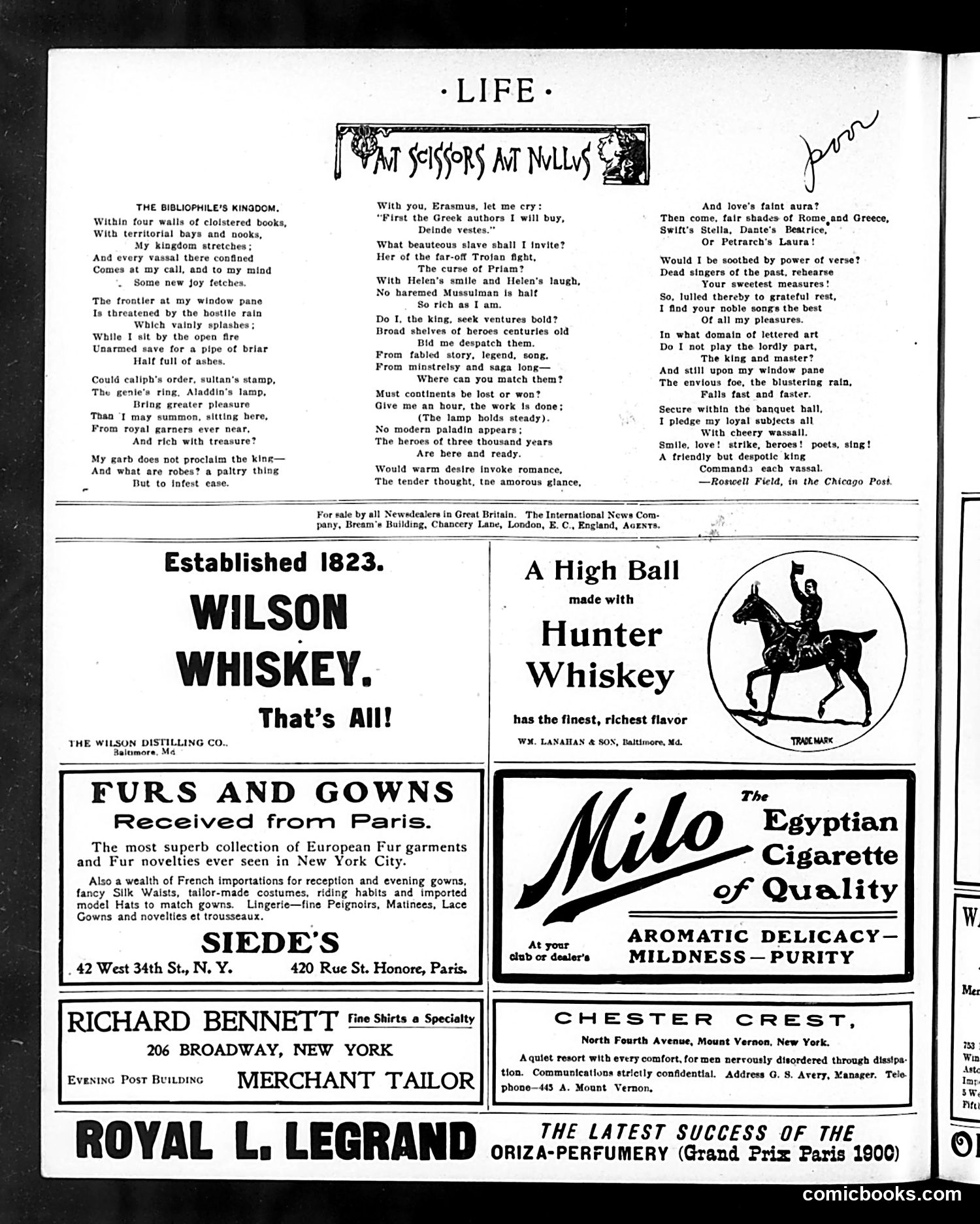
This page contains a poem titled "I Am Scissors at Nullus" (the meaning unclear) and period advertisements. The poem, credited to Roswell Field in the Chicago Post, is the main content—a whimsical meditation on intellectual wealth. The speaker imagines himself a "king" ruling a "kingdom" of books, claiming greater pleasure from classical literature, mythology, and poetry than from actual power or romance. He summons Helen of Troy, Dante's Beatrice, and dead poets as loyal subjects, finding contentment in solitary reading despite rain battering his window. The satire is gentle: it mocks the bibliophile's retreat from reality into fantasy, positioning book-learning as escapism. The repeated paradox—a "king" with no actual authority—underscores the irony of finding dominion only in imagination. The surrounding advertisements (Wilson Whiskey, Hunter Whiskey, furs from Paris, cigarettes, tailoring) reflect typical early-1900s luxury marketing aimed at Life's affluent readership.
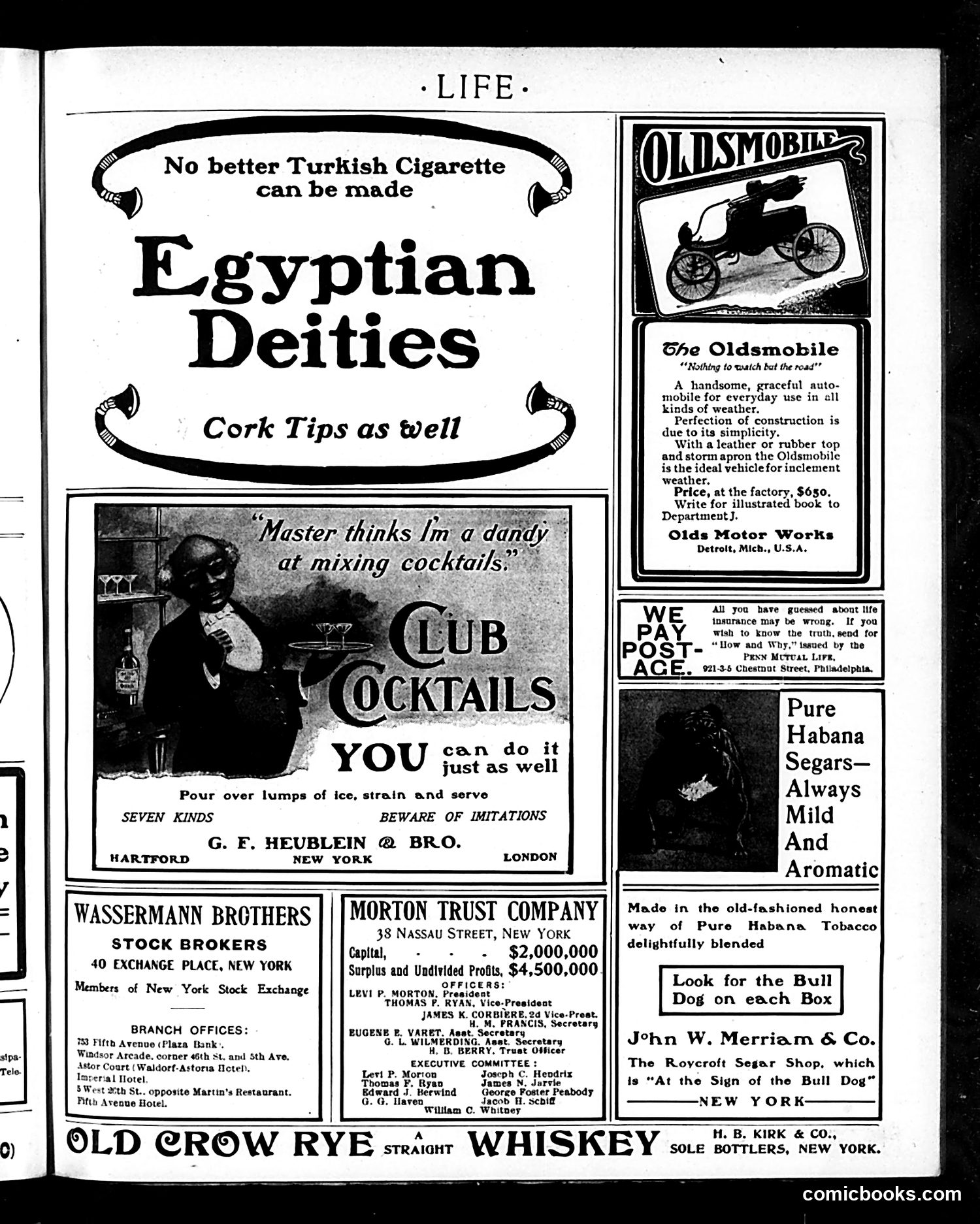
This page is primarily **advertising**, not satire or political commentary. The content consists of various product advertisements typical of early 20th-century American magazines. The main illustrated advertisement features "Club Cocktails" by G. F. Heublein & Bro., showing a bartender mixing drinks with the caption "Master thinks I'm a dandy at mixing cocktails." The joke is straightforward: anyone can mix cocktails as easily as the professional bartender by following Heublein's simple instructions—"YOU can do it just as well." Other ads promote Egyptian Deities cigarettes, Oldsmobile automobiles ($650), Pure Habana cigars, life insurance, and whiskey. The Egyptian Deities ad uses exotic branding common for the era. This reflects pre-Prohibition American consumer culture, where alcohol advertising was openly displayed in mainstream magazines. The "Club Cocktails" ad represents the cocktail trend that was gaining popularity in the early 1900s before Prohibition (1920-1933) eliminated such advertising.
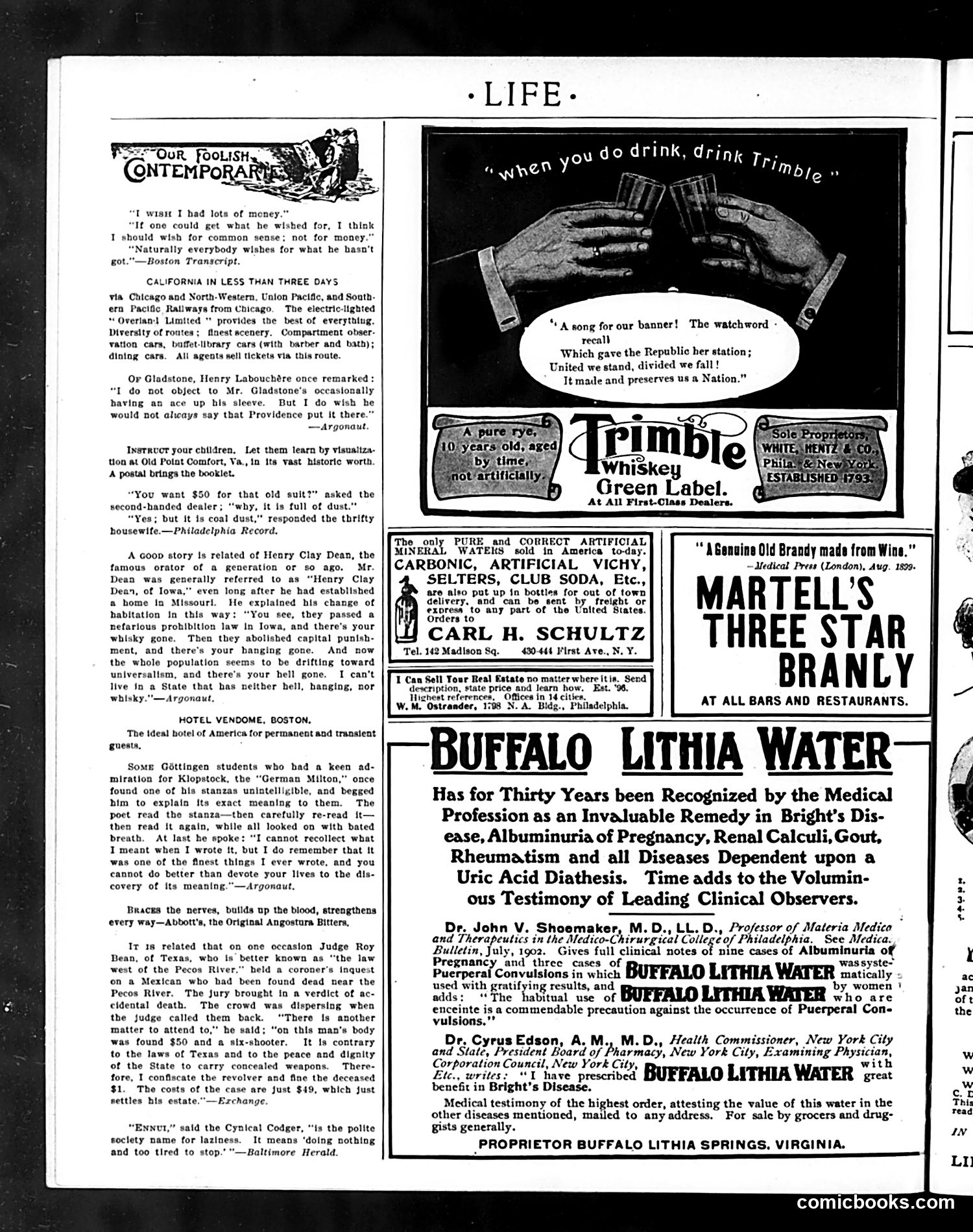
This page from *Life* magazine (a satirical publication, not the photo magazine) mixes brief humorous anecdotes with period advertisements. **The cartoons/satirical content** are minor—mostly short, moralistic jokes about human nature. The opening quote contrasts wishing for money versus common sense. Other anecdotes mock pretension (a poet who can't explain his own work) and corruption (Judge Roy Bean confiscating a dead man's money as "court costs"). **The dominant content is advertising**, promoting: - Railroad travel to California - Whiskey (Trimble brand, with patriotic imagery) - Patent medicines (Buffalo Lithia Water for kidney/pregnancy ailments, Martell's brandy, Abbott's bitters) - Hotels and real estate The ads employ pseudo-medical endorsements and nationalist appeals typical of early 20th-century advertising—claims now recognized as misleading or fraudulent. The page reflects an era when *Life* balanced light satire with lucrative ad revenue.
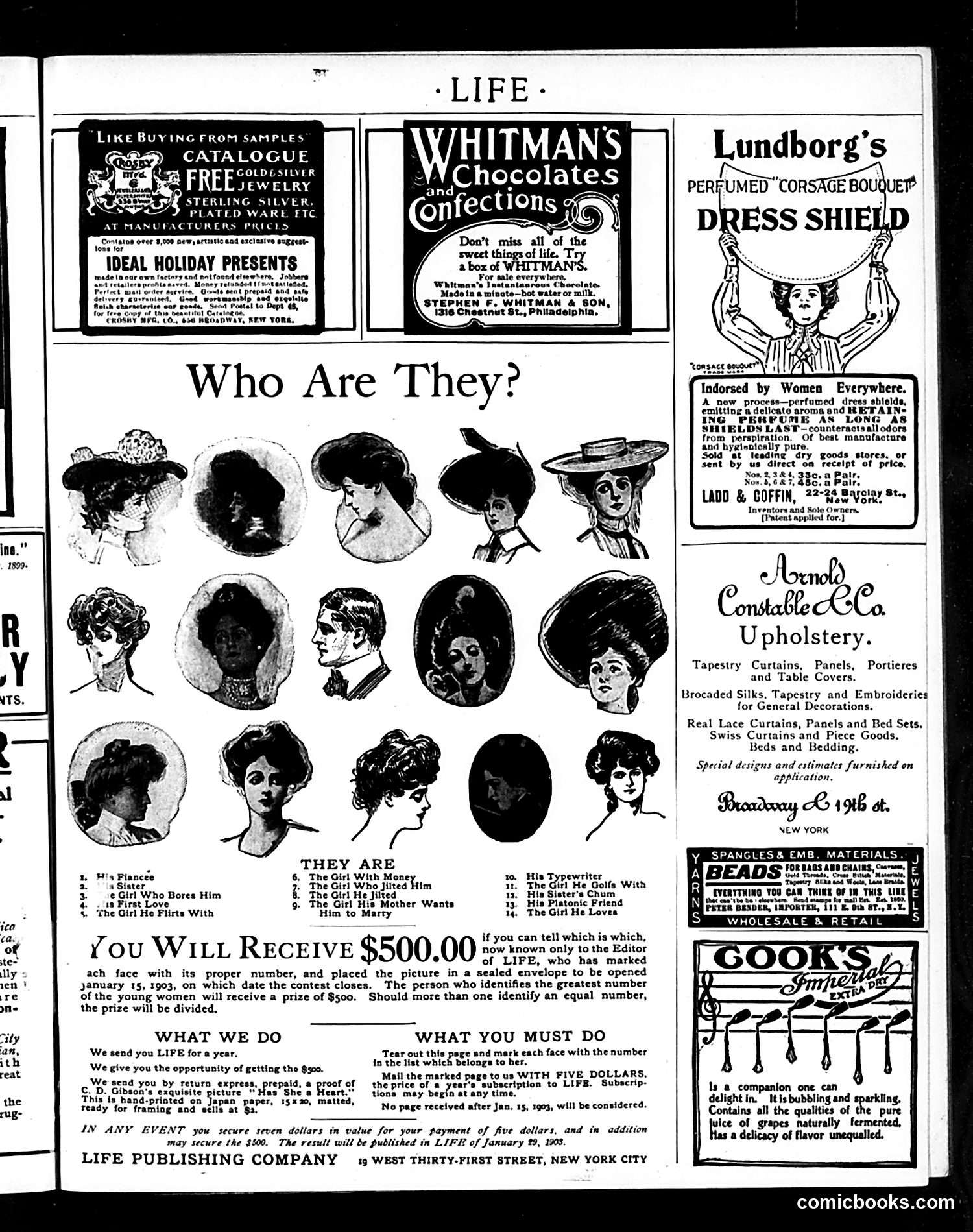
This is primarily a **contest advertisement** rather than political satire. Life Publishing Company presents a puzzle featuring 14 illustrated female faces with accompanying character descriptions (fiancée, sister, girl with money, etc.). Readers must match each face to its corresponding role. The contest offers **$500 prize money** (substantial for 1903) to whoever correctly identifies the most faces. The subscription cost is $5, but participants receive $7 value in goods, including a Gibson Girl print—making this an incentive to subscribe. This reflects early-1900s popular entertainment: **visual puzzles and contests** were common magazine features. The "Gibson Girl" aesthetic dominates the illustrations, representing idealized feminine beauty of the era. The contest capitalizes on readers' interest in identifying social "types" and romantic scenarios—themes central to contemporary popular culture. No political satire is evident; this is straightforward commercial promotion dressed as interactive entertainment.
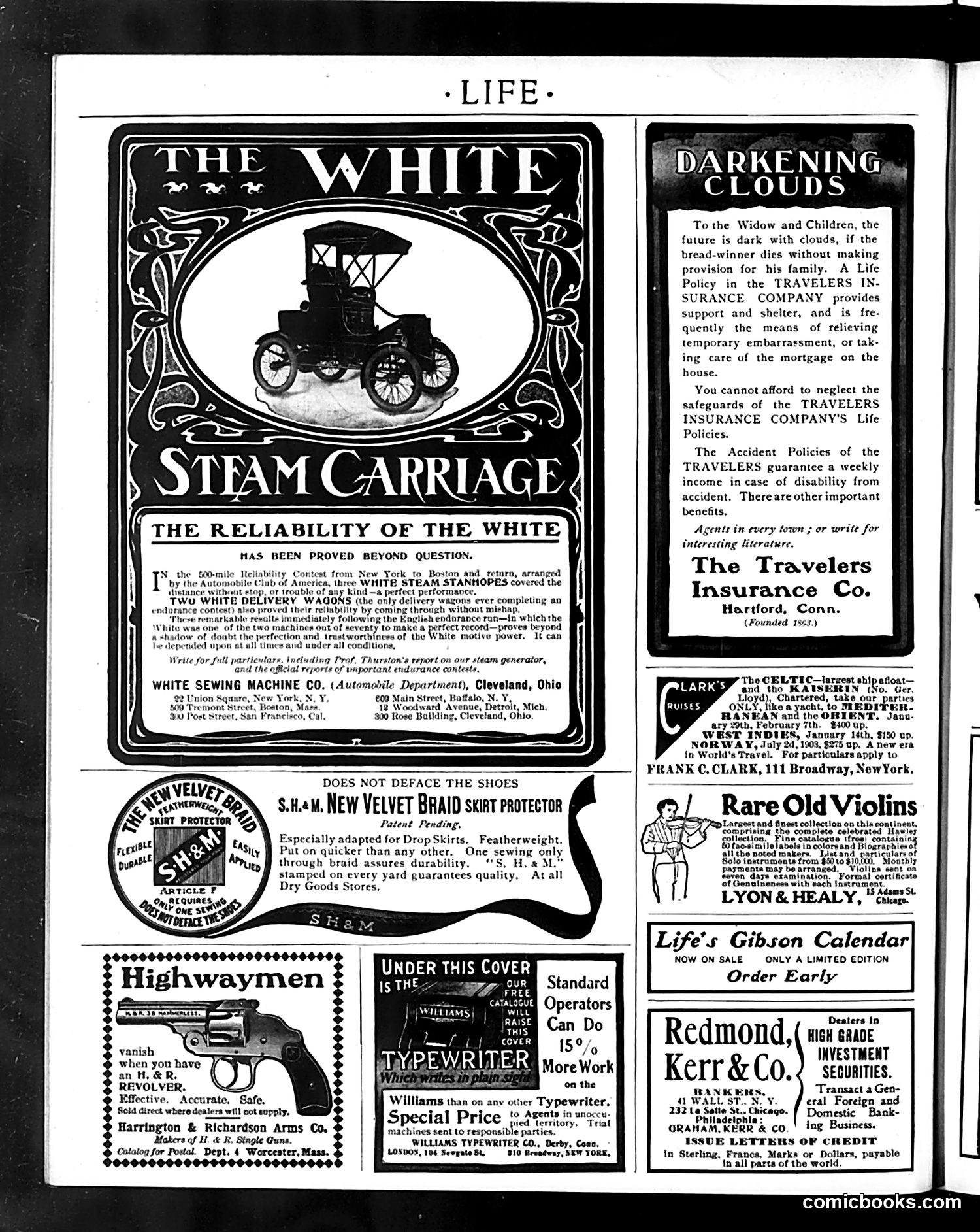
This is primarily an **advertising page**, not a satirical cartoon section. The page contains numerous product advertisements from the early 1900s, reflecting period concerns and consumer goods. The largest advertisement promotes the **White Steam Carriage**, emphasizing reliability through endurance contest victories. Below that, the **S.H. & M. New Velvet Braid Shirt Protector** addresses a practical concern: keeping detachable collars clean—a crucial issue when these were expensive, replaceable items. Other notable ads include the **Travelers Insurance Company** (life and accident insurance), addressing the vulnerability of families if breadwinners died without provision—a genuine anxiety in this era. The **Williams Typewriter**, **Harrington & Richardson Revolver**, and luxury travel packages (Mediterranean cruises) reflect the magazine's audience: middle to upper-class readers. The page reveals what mattered to early 1900s Life readers: mechanical reliability, practical clothing solutions, financial security, and leisure travel—with minimal political or satirical content present.
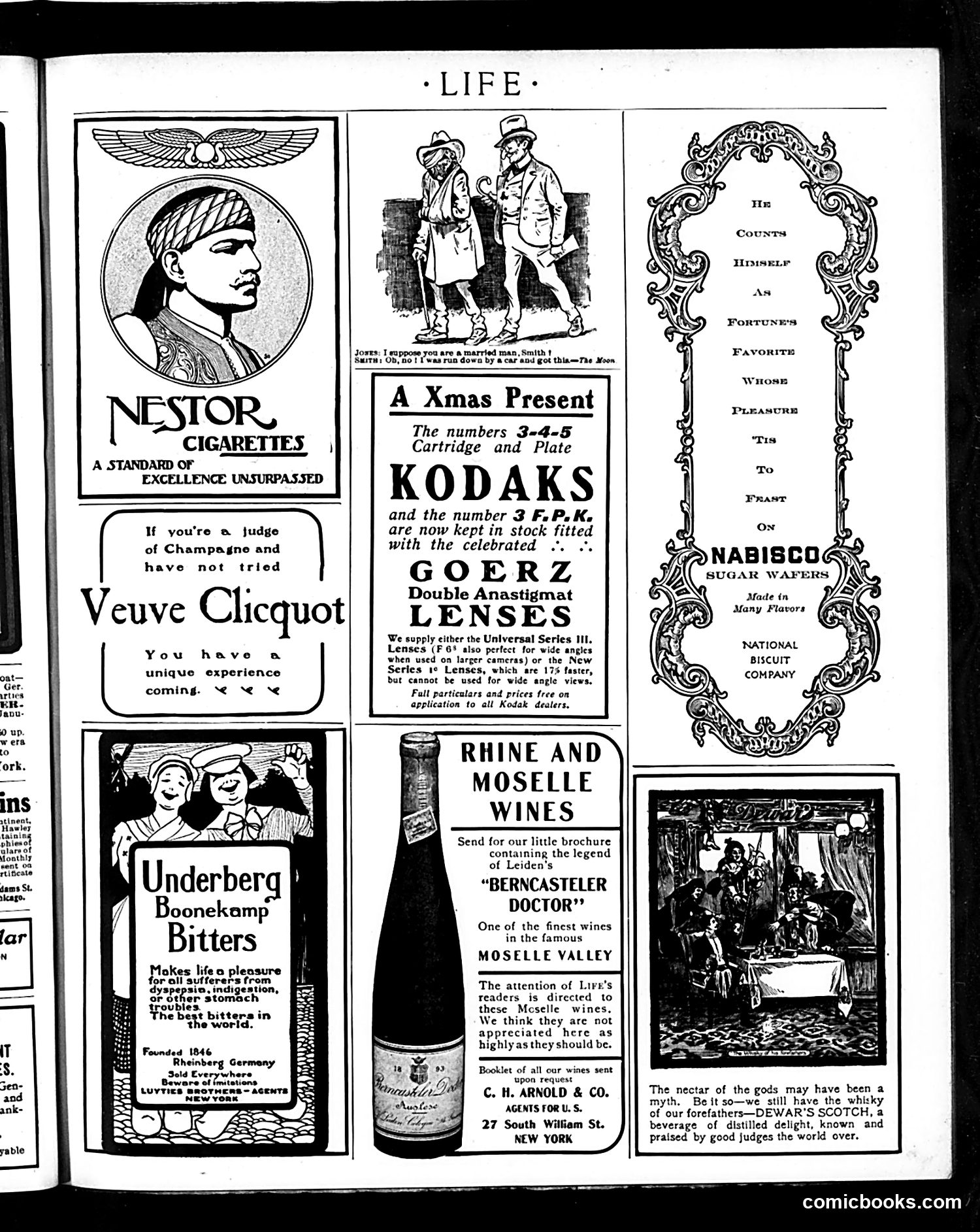
This page is primarily **advertising**, not satirical content. It showcases luxury consumer goods targeting affluent readers circa early 1900s. Key advertisements include: - **Nestor Cigarettes**: Positioned as a premium product with classical imagery - **Veuve Clicquot champagne**: Appeals to connoisseurship ("If you're a judge of Champagne") - **Kodak cameras**: Christmas gift suggestion with technical specifications - **Underberg Boonekamp Bitters**: Patent medicine claiming digestive benefits - **Rhine and Moselle wines**: German imports marketed as underappreciated luxuries - **Dewar's Scotch whisky**: Final ad humorously compares whisky to "nectar of the gods" - **Nabisco Sugar Wafers**: Decorative packaging appeal The cartoon showing two men discussing marriage appears to be a joke setup related to the Kodak camera placement, though context is unclear. The overall page reflects turn-of-century consumer culture and advertising strategies targeting the wealthy.
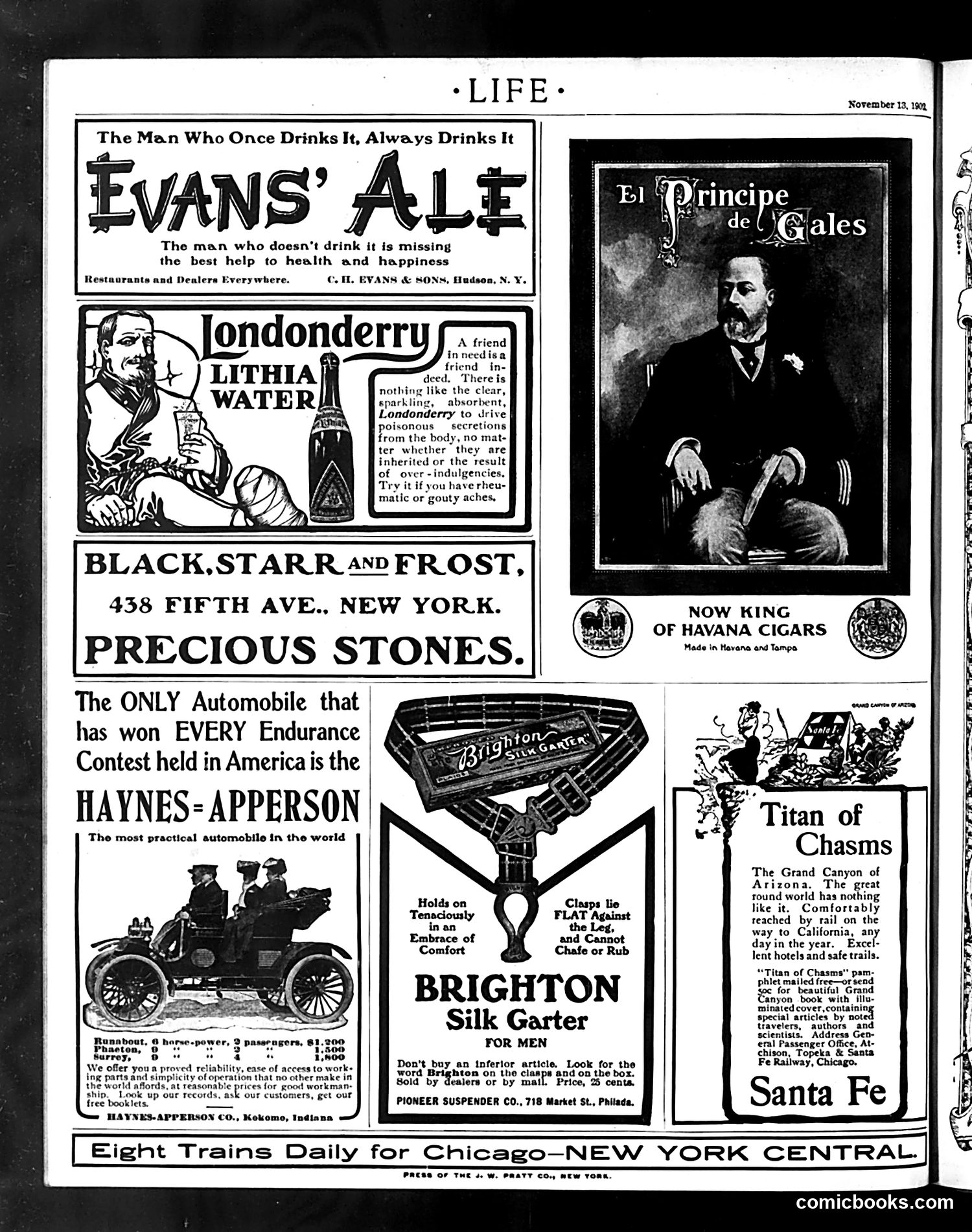
This is primarily a **advertising page** from an early 1900s American satirical magazine, not a political cartoon. The page features product advertisements typical of the era: **Key advertisements include:** - **Evans' Ale**: Marketed as a health drink, claiming to aid digestion and treat rheumatism—reflecting common medical misconceptions of the period when alcohol was widely promoted for medicinal purposes. - **Londonderry Lithia Water**: Similar health-drink marketing, claiming to expel "poisonous secretions." - **Haynes-Apperson automobile**: Claims to have won every American endurance contest, representing early automobile industry competition. - **Brighton Silk Garter**: A men's accessory ad. - **El Príncipe de Gales cigars**: A Havana cigar brand. - **Santa Fe Railway and Chicago-New York Central Railroad**: Travel advertisements. The page reflects early 1900s consumer culture, medicinal alcohol marketing, and emerging automobile/rail industries. No satire or political commentary appears evident—it's a straightforward advertising compilation.