
Life, 1902-11-13 · page 8 of 22
Life — November 13, 1902 — page 8: what you’re looking at
What you’re looking at
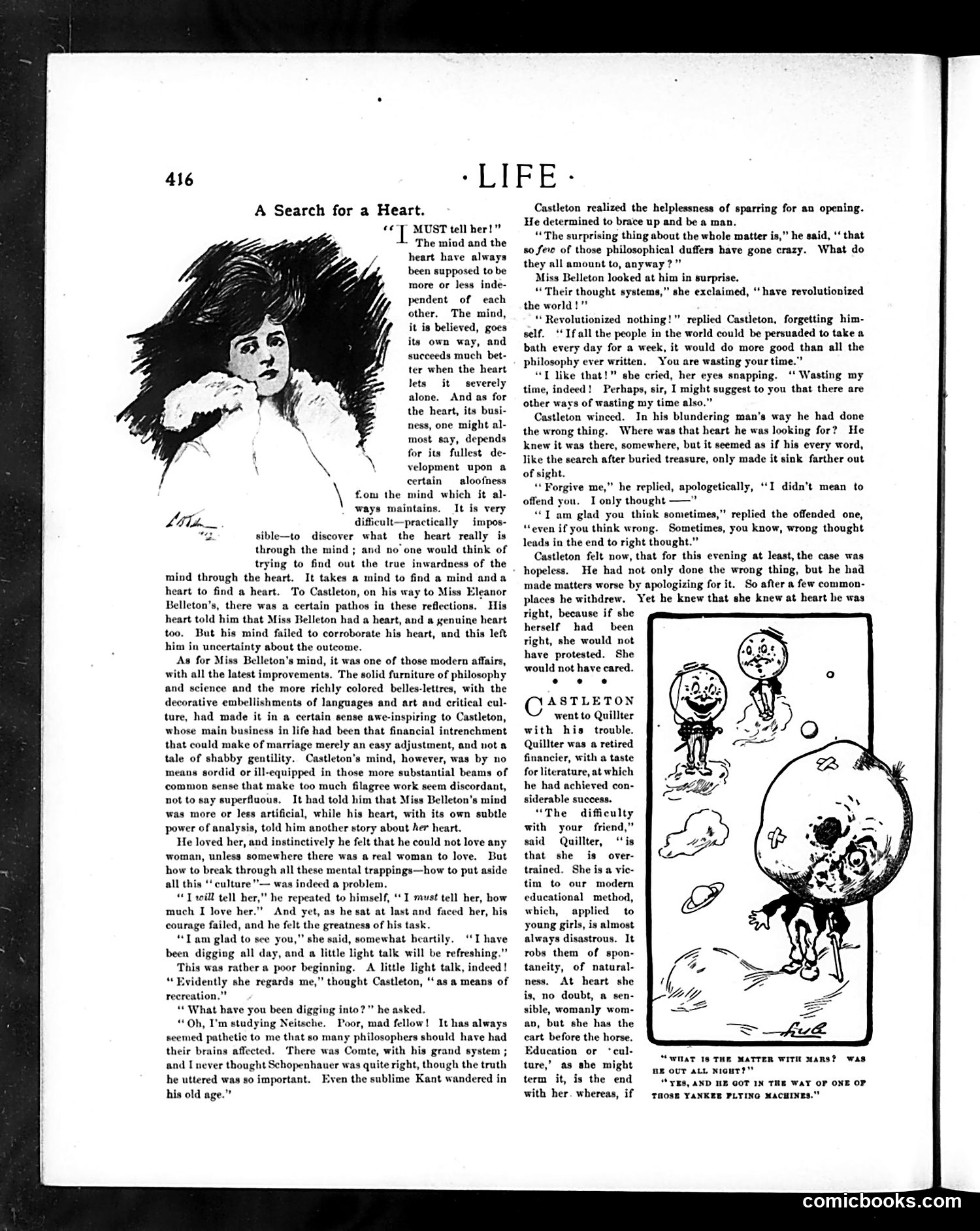
This page illustrates a satirical story about a character named Castleton seeking genuine emotion and authenticity. The narrative mocks philosophical pretension—Castleton's Miss Helleston supposedly lacks a "real" heart despite their relationship. The accompanying cartoon (right) depicts whimsical figures on a planet with flying machines, illustrating the story's fantastical elements about searching for authentic human connection amid modern complications. The satire targets the intellectual posturing of the era: characters debate whether mind or heart should govern human relationships, with the implication that excessive philosophy obscures simple human truths. The piece critiques over-educated, emotionally detached society—a common Life magazine theme mocking the pretensions of refined culture.
📄 Transcribed text from this page (OCR, searchable)
Machine-transcribed from the original scan — historical spelling and the odd misread are preserved.
«LIFE « A Search for a Heart. ¢-7T MUST tell her!” The mind and the heart have always been supposed to be more or less inde- pendent of each other, The mind, it is believed, goes its own way, and succeeds much bet- ter when the heart lets it severely alone. And as for the heart, its busi- ness, one might al- most say, depends for its fullest de- velopment upon a certain aloofness \ fom the mind which it al- ways maintains. It is very difficult—practically _impos- sible—to discover what the heart really is through the mind; and no’ one would think of trying to find out the true inwardness of the mind through the heart. It takes a mind to find a mind anda heart to find a heart. To Castleton, on his way to Miss Eleanor Belleton’s, there was a certain pathos in these reflections. His heart told him that Miss Belleton had a heart, and a genuine heart too. But his mind failed to corroborate his heart, and this left him in uncertainty about the outcome. As for Miss Belleton's mind, it was one of those modern affairs, with all the latest improvements. The solid furniture of philosophy and science and the more richly colored belles-lettres, with the decorative embellishments of languages and art and critical cul- ture, had made it in a certain sense awe-inspiring to Castleton, whose main business in life had been that financial intrenchment that could make of marriage merely an easy adjustment, and not a tale of shabby gentility. Castleton’s mind, however, was by no means sordid or ill-equipped in those more substantial beams of common sense that make too much filagree work seem discordant, not to say superfluous. It had told him that Miss Belleton's mind was more or less artificial, while his heart, with its own subtle power of analysis, told him another story about her heart. He loved her, and instinctively he felt that he could not love any woman, unless somewhere there was a real woman to love. But how to break through all these mental trappings—how to put aside all this ‘‘culture""— was indeed a problem. “will tell her,” he repeated to himself, ‘I must tell her, how much I love her.” And yet, as he sat at last and faced her, his courage failed, and he felt the greatness of his task. “Tam glad to see you,” she said, “Thave been digging all day, and a little light talk will be refreshing.” This was rather a poor beginning. A little light talk, indeed! “Evidently she regards me,” thought Castleton, ‘asa means of recreation,” “What have you been digging into?” he asked. “Oh, I'm studying Neitsche. Poor, mad fellow! It has always. seemed pathetic to me that so many philosophers should have had their brains affected. There was Comte, with his grand system ; and I never thought Schopenhauer was quite right, though the truth he uttered was so important. Even the sublime Kant wandered in his old age.” Castleton realized the helplessness of sparring for an opening. He determined to brace up and be a man. “The surprising thing about the whole matter is,” he said, ‘‘ that 80 few of those philosophical duffers have gone crazy. What do they all amount to, anyway?” Miss Belleton looked at him in surprise. “Their thought systems,” she exclaimed, “have revolutionized the world!" “Revolutionized nothing!” replied Castleton, forgetting him- self. ‘“Ifall the people in the world could be persuaded to take a bath every day for a week, it would do more good than all the philosophy ever written. You are wasting your time.” “TL like that!” she cried, her eyes snapping. ‘ Wasting my time, indeed! Perhaps, sir, I might suggest to you that there are other ways of wasting my time also.” Castleton winced. In his blundering man’s way he had done the wrong thing. Where was that heart he was looking for? He knew it was there, somewhere, but it seemed as if his every word, like the search after buried treasure, only made it sink farther out of sight. “Forgive me,” he replied, apologetically, ‘I didn't mean to offend you. I only thought —” “Tam glad you think sometimes,” replied the offended one, “even if you think wrong. Sometimes, you know, wrong thought leads in the end to right thought.” Castleton felt now, that for this evening at least, the case was hopeless. He had not only done the wrong thing, but he had made matters worse by apologizing for it. So after a few common- places he withdrew. Yet he knew that she knew at heart he was right, because if she herself had been right, she would not have protested. She would not have cared. oe ASTLETON went to Quillter with his trouble. Quillter was a retired financier, with a taste for literature, at which he had achieved con- siderable success. “The difficulty with your friend,” said Quilter, ‘is that she is over- trained. She is a vie- tim to our modern educational ethod, which, applied to young girls, is almost always disastrous. It robs them of spon- taneity, of natural- ness, At heart she is, no doubt, a sen- sible, womanly wom- ap, but she has the cart before the horse. Education or ‘cul- ture,’ as she might term it, is the end with her. whereas, if “WHAT 189 THE MATTER WITH MARS? WAS me OUT ALL NiouT?" “YES, AND IME GOT IN THR WAY OF ONE OF THOSE YANKER PLYING MACHINES.” comicbooks.com