
Life, 1902-11-13 · page 7 of 22
Life — November 13, 1902 — page 7: what you’re looking at
What you’re looking at
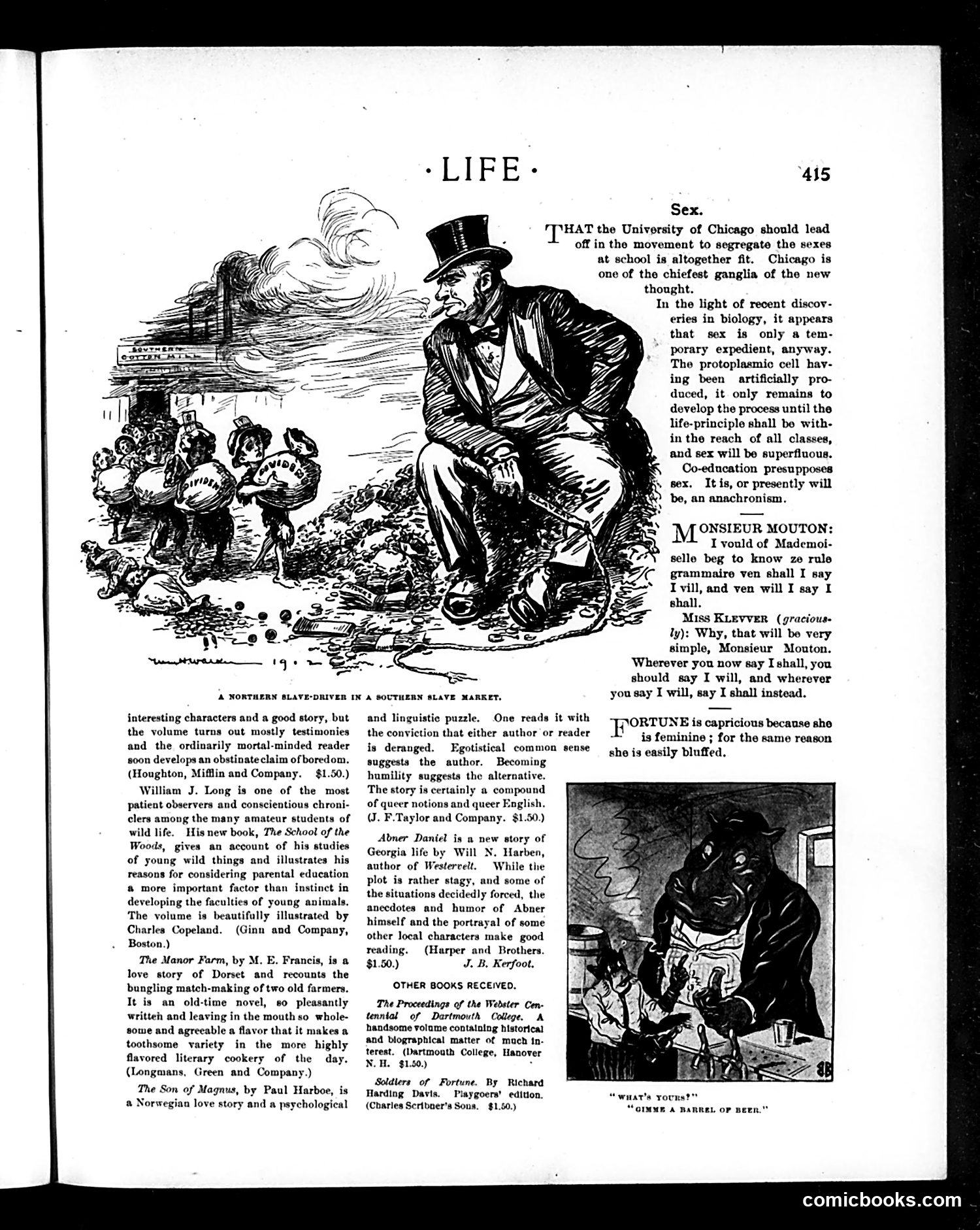
This political cartoon satirizes Northern industrial capitalism through the contrast of two figures: a wealthy, top-hatted industrialist oversees laborers (appearing as enslaved or exploited workers) near a factory with smokestacks. The caption's wordplay equates Northern factory owners with Southern slave-drivers, suggesting that industrial wage labor constitutes a form of slavery. The satire critiques the North's moral superiority claims about slavery abolition while ignoring their own exploitative labor practices. The cartoon appears designed to challenge hypocrisy: Northern industrialists profit from workers' suffering just as Southern slaveholders did, only through different mechanisms (factory wages instead of chattel slavery). This reflects 19th-century debates about labor conditions and economic justice.
📄 Transcribed text from this page (OCR, searchable)
Machine-transcribed from the original scan — historical spelling and the odd misread are preserved.
“415 Sex. Tuar the University of Chicago should lead off in the movement to segregate the sexes A NORTHERN SLAVE-DRIVER IN A SOUTHERN SLAVE MARKET, interesting characters and a good story, but the volume turns out mostly testimonies and the ordinarily mortal-minded reader soon develops an obstinate claim of boredom. (Houghton, Mifflin and Company. $1.50.) William J. Long is one of the most patient observers and conscientious chroni- clers among the many amateur students of wild life. His new book, The School of the Woods, gives an account of his studies of young wild things and illustrates his reasons for considering parental education & more important factor than instinct in developing the faculties of young animals, The volume is beautifully illustrated by Charles Copeland. (Ginn and Company, Boston.) The Manor Farm, by M. E. Francis, is a love story of Dorset and recounts the bungling match-making of two old farmers. It is an old-time novel, so pleasantly writteh and leaving in the mouth so whole- sowe and agreeable a flavor that it makes a toothsome variety in the more highly flavored literary cookery of the day. (Longmans, Green and Company.) The Son of Magnus, by Paul Harboe, is a Norwegian love story and a psychological and linguistic puzzle. One reads it with the conviction that either author or reader is deranged. Egotistical common sense suggests the author. Becoming humility suggests the alternative. The story is certainly a compound of queer notions and queer English. (J. F.Taylor and Company. $1.50.) Abner Daniel is a new story of Georgia life by Will N. Harben, author of Westervelt. While the plot is rather stagy, and some of the situations decidedly forced, the anecdotes and humor of Abner himself and the portrayal of some other local characters make good reading. (Harper and Brothers. $1.50.) J.B, Kerfoot. OTHER BOOKS RECEIVED. The Proceedings of the Wedster Cen- tenntal of Dartmouth Coltege. A handsome volume contatning historical and biographical matter of mach in- terest. (Dartmouth College, Hanover N.H. $1.50.) : Soldiers of Fortune. By Richard Harding Davis. Piaygoera’ edition. (Charles Scribuer’s Sons. $1.60.) at school is altogether fit. Chicago is one of the chiefest ganglia of the new thought. In the light of recent discov- eries in biology, it appears that sex is only a tem- porary expedient, anyway. The protoplasmic cell hay- ing been artificially pro- duced, it only remains to develop the process until the life-principle shall be with- in the reach of all classes, and sex will be superfluous. Co-education presupposes sex. It is, or presently will » be, an anachronism. ONSIEUR MOUTON: I vould of Mademoi- selle beg to know ze rule grammaire ven shall I say I vill, and ven will I say I shall. Miss KLEvvVER (gracious- ly): Why, that will be very simple, Monsieur Mouton. Wherever you now say I shall, you should say I will, and wherever you say I will, say I shall instead. PPORTUNE is capricious because sho = is feminine ; for the same reason. she is easily bluffed. war's yours?” “GIMME A BARRgL oF Been.” comicbooks.com