
Life, 1902-11-13 · page 4 of 22
Life — November 13, 1902 — page 4: what you’re looking at
What you’re looking at
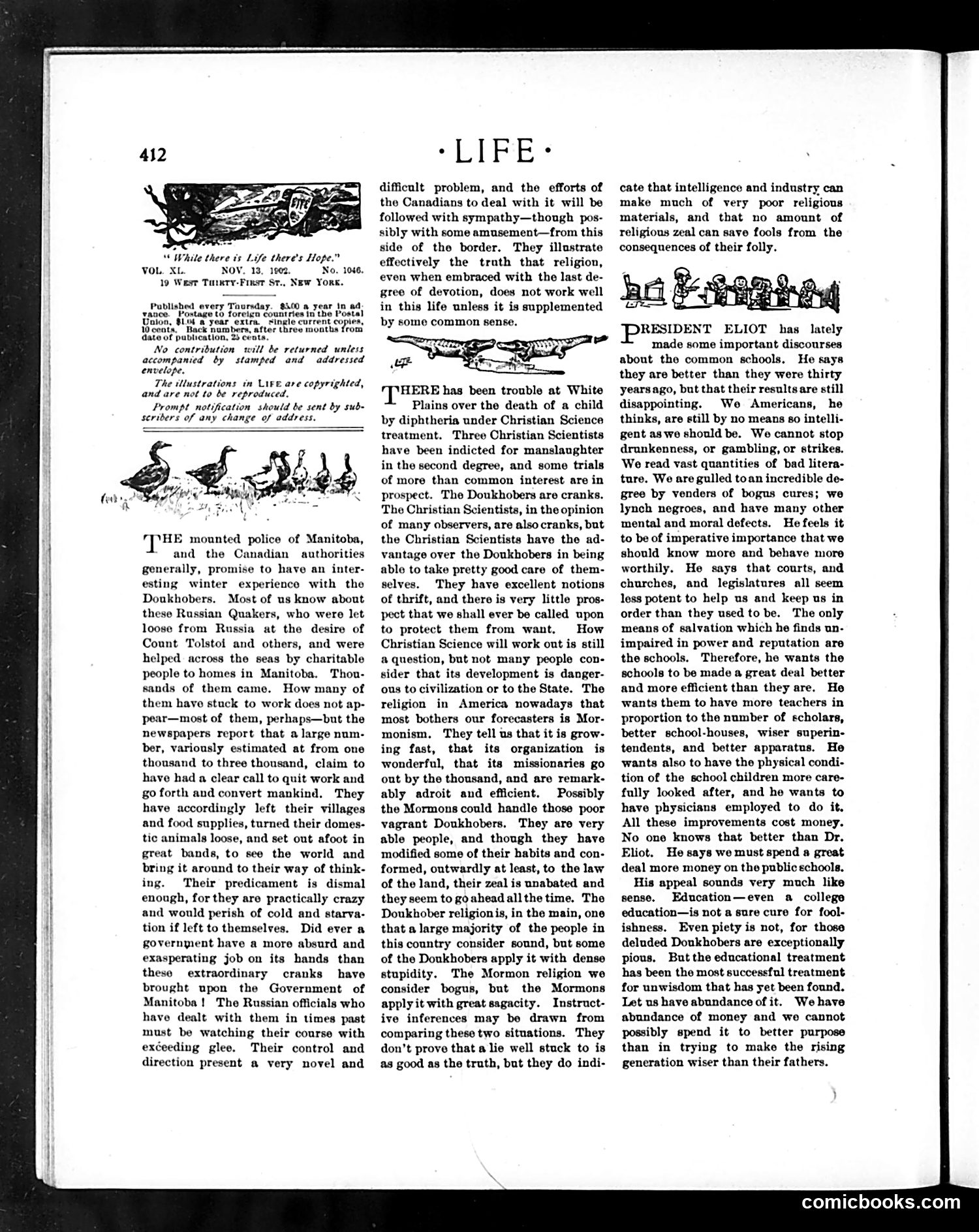
This page contains two political cartoons and editorial commentary from early 20th-century Life magazine. The top cartoon, titled "While there is Life there's Hope," depicts mounted Canadian police confronting Doukhobors (Russian religious dissenters who immigrated to Manitoba). The text criticizes these "cranks" and their practices, while also satirizing Christian Scientists for similar "crankish" behavior, particularly regarding their handling of a diphtheria death. The lower section features an illustration of ducks, accompanying text that appears to mock religious extremism and governmental mismanagement in Manitoba. Life's satire targets religious zealotry on multiple fronts—from the Doukhobors' practices to Christian Science—while critiquing government authorities for their inconsistent handling of these groups.
📄 Transcribed text from this page (OCR, searchable)
Machine-transcribed from the original scan — historical spelling and the odd misread are preserved.
“* While there is Life there’s Hope.” VOL. XL. NOY. 13, 1902. 19 Wesr Tuixty-Finst St., New York. Published every Taursday. $400 a year In ad vance. Postage to foreign countries in the Postal Union, $l a year extra. single current copies, Weents. Back numbers, after three mouths fom dato of publication, 25 cents. No contribution witl be returned unless accompanied by stamped and addressed envelope. The illustrations in Lie are copyrighted, and are not to be reproduced. Prompt notification should be sent by sub seribers of any change of address. ‘THE mounted police of Manitoba, and the Canadian authorities generally, promise to have an inter- esting winter experience with the Doukhobers. Most of us know about these Russian Quakers, who were let loose from Russia at the desire of Count Tolstoi and others, and were helped across the seas by charitable people to homes in Manitoba. Thou- sands of them came. How many of them have stuck to work does not ap- pear—most of them, perhaps—but the newspapers report that a large num- ber, variously estimated at from one thousand to three thousand, claim to have had a clear call to quit work and go forth and convert mankind. They have accordingly left their villages and food supplies, turned their domes- tic animals loose, and set out afoot in great bands, to see the world and bring it around to their way of think- ing. Their predicament is dismal enough, for they are practically crazy and would perish of cold and starva- tion if left to themselves. Did ever a governent have a more absurd and exasperating job on its hands than these extraordinary cranks havo brought upon the Government of Manitoba! The Russian officials who have dealt with them in times past must be watching their course with exceeding glee. Their control and direction present a very novel and *LIFE« difficult problem, and the efforts of the Canadians to deal with it will be followed with sympathy—though pos- sibly with some amusement—from this side of the border. They illustrate effectively the trath that religion, even when embraced with the last de- gree of devotion, does not work well in this life unless it is supplemented by some common sense. HERE has been trouble at White Plains over the death of a child by diphtheria under Christian Science treatment. Three Christian Scientists have been indicted for manslaughter in the second degree, and some trials of more than common interest are in prospect. The Doukhobers are cranks. The Christian Scientists, in the opinion of many observers, are also cranks, but the Christian Scientists have the ad- vantage over the Doukhobers in being able to take pretty good care of them- selves. They have excellent notions of thrift, and there is very little pros- pect that we shall ever be called upon to protect them from want. How Christian Science will work ont is still a question, but not many people con- sider that its development is danger- ous to civilization or to the State. The religion in America nowadays that most bothers our forecasters is Mor- monism. They tell us that it is grow- ing fast, that its organization is wonderful, that its missionaries go out by the thousand, and are remark- ably adroit and efficient. Possibly the Mormons could handle those poor vagrant Doukhobers. They are very able people, and though they have modified some of their habits and con- formed, outwardly at least, to the law of the land, their zeal is unabated and they seem to go ahead allthe time. The Doukhober religionis, in the main, one that a large majority of the people in this country consider sound, but some of the Doukhobers apply it with dense stupidity. The Mormon religion we consider bogus, but the Mormons apply it with great sagacity. Instruct- ive inferences may be drawn from comparing these two situations. They don’t prove that a lie well stuck to is as good as the truth, but they do indi- cate that intelligence and industry can make much of very poor religious materials, and that no amount of religious zeal can save fools from the consequences of their folly. ‘PRESIDENT ELIOT has lately made some important discourses about the common schools. He says they are better than they were thirty years ago, but that their results are still disappointing. We Americans, he thinks, are still by no means go intelli- gent aswe should be. We cannot stop drunkenness, or gambling, or strikes, We read vast quantities of bad litera- ture. We are gulled toan incredible de- gree by venders of bogus cures; we lynch negroes, and have many other mental and moral defects. He feels it to be of imperative importance that we should know more and behave more worthily. He says that courts, and churches, and legislatures all seem less potent to help us and keep us in order than they used to be. The only means of salvation which he finds un- impaired in power and reputation are the schools. Therefore, he wants the schools to be made a great deal better and more efficient than they are. He wants them to have more teachers in proportion to the number of scholars, better school-houses, wiser superin- tendents, and better apparatus. He wants also to have the physical condi- tion of the school children more care- fully looked after, and he wants to have physicians employed to do it. All these improvements cost money. No one knows that better than Dr. Eliot. He says we must spend a great deal more money on the public echools. His appeal sounds very much like sense. Education—even a college education—is not a sure cure for fool- ishness. Even piety is not, for those deluded Doukhobers are exceptionally pious, But the educational treatment has been the most successful treatment for unwisdom that has yet been found. Let us have abundance of it. We have abundance of money and we cannot possibly spend it to better purpose than in trying to make the rising generation wiser than their fathers. comicbooks.com