
Life, 1902-11-13 · page 9 of 22
Life — November 13, 1902 — page 9: what you’re looking at
What you’re looking at
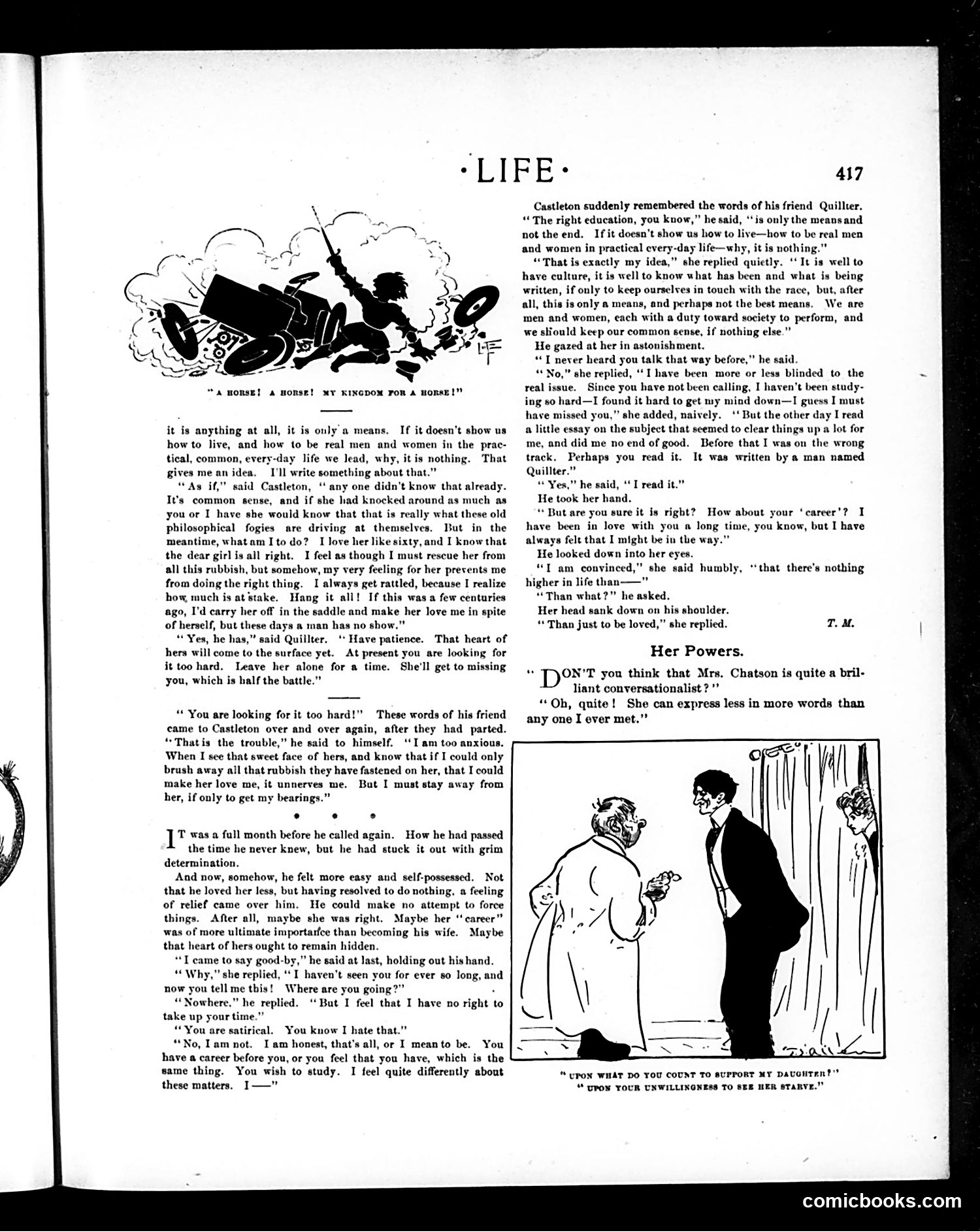
This page contains a short story narrative with an embedded cartoon illustration. The cartoon shows a domestic scene where a man confronts a woman about supporting their daughter, with the caption: "UPON WHAT DO YOU COUNT TO SUPPORT MY DAUGHTER?" / "UPON YOUR UNWILLINGNESS TO SEE HER STARVE." The scene satirizes early-20th-century gender dynamics and economic dependency. The woman's response is sardonic—she's pointing out the man's moral obligation to provide, since he won't allow her to starve despite their apparent marital conflict. The cartoon mocks both the man's attempt to shirk financial responsibility and society's expectation that women remain economically dependent on men regardless of relationship status. The accompanying text explores themes of education, love, and life choices between characters named Castleton and Quillier.
📄 Transcribed text from this page (OCR, searchable)
Machine-transcribed from the original scan — historical spelling and the odd misread are preserved.
-LIFE: “a monsE! 4 nonse! xY KINGDOM FoR 4 HoRsE!” it is anything at all, it is only a means. If it doesn’t show us how to live, and how to be real men and women in the prac- tical, common, every-day life we lead, why, it is nothing. That gives mean idea. I'll write something about that.” “As if,” said Castleton, ‘any one didn’t know that already. It's common sense, and if she had knocked around as much as you or I have she would know that that is really what these old philosophical fogies are driving at themselves. But in the meantime, whatam Ito do? I love her like sixty, and I know that the dear girl is all right. I feel as though I must rescue her from all this rubbish, but somehow, my very feeling for her prevents me from doing the right thing. I always get rattled, because I realize how, much is at stake. Hang it all! If this was a few centuries ago, I'd carry her off in the saddle and make her love me in spite of herself, but these days a man has no show.” “Yes, he has,” said Quiilter. ‘* Have patience. That heart of hers will come to the surface yet. At present you are looking for it too hard. Leave her alone for a time. She'll get to missing you, which is half the battle.” “* You are looking for it too hard!'’ These words of his friend came to Castleton over and over again, after they had parted. “Thatis the trouble,” he said to himself. ‘I am too anxious. When I sce that sweet face of hers, and know that if I could only brush away all that rubbish they have fastened on her, that I could make her love me, it unnerves me. But I must stay away from her, if only to get my bearings.” . . ° J" was a full month before he called again. How he had passed the time he never knew, but he had stuck it out with grim determination. And now, somehow, he felt more easy and self-possessed. Not that he loved her less, but having resolved to do nothing, a feeling of relief came over him. He could make no attempt to force things. After all, maybe she was right. Maybe her “career” was of more ultimate importarfce than becoming his wife. Maybe that heart of hers ought to remain hidden. “Tame to say good-by,” he said at last, holding out his hand. “ Why,” she replied, “I haven't seen you for ever so long, and now you tell me this!’ Where are you going?” * “Nowhere.” he replied. ‘But I feel that I have no right to take up your time.” “You are satirical. You know I hate that.” “No, Lam not. Iam honest, that’s all, or I meanto be. You have a career before you, or you feel that you have, which is the same thing. You wish to study. I feel quite differently about these matters, I—" 417 Castleton suddenly remembered the words of his friend Quillter. “The right education, you know,” he said, ‘is only the means and not the end. If it doesn’t show us how to live—how to be real men and women in practical every-day life—why, it is nothing.” “That is exactly my idea,” she replied quietly. ‘It is well to have culture, it is well to know what has been and what is being written, if only to keep ourselves in touch with the race, but, after all, this is only a means, and perhaps not the best means. We are men and women, each with a duty toward society to perform, and we sliould keep our common sense, if nothing else.” He gazed at her in astonishment. “T never heard you talk that way before,” he said. “No,” she replied, ‘I have been more or less blinded to the real issue. Since you have not been calling, I haven’t been study- ing so hard—I found it hard to get my mind down—I guess I must have missed you,” she added, naively. ‘‘ But the other day I read a little essay on the subject that seemed to clear things up a lot for me, and did me no end of good. Before that I was on the wrong track. Perhaps you read it. It was written by a man named Quilter. “Yes,” he said, ‘I read it.” He took her hand. “But are you sure it is right? How about your ‘career’? I have been in love with you a long time, you know, but I have always felt that I might be in the way.” He looked down into her eyes. “Tam convinced,” she said humbly, “that there's nothing higher in life than— “Than what?” he asked. Her head sank down on his shoulder. “Than just to be loved,” she replied. Her Powers. “ Dok you think that Mrs. Chatson is quite a bril- liant conversationalist ?”’ “Oh, quite! She can express less in more words than any one I ever met.” FON WHAT DO YOU COUNT TO SUPPORT MY Davotitent" © UPOW YOUR UNWILLINGNESS TO SEE IER STARVE.” comicbooks.com