
A complete issue · 24 pages · 1902
Life — November 6, 1902
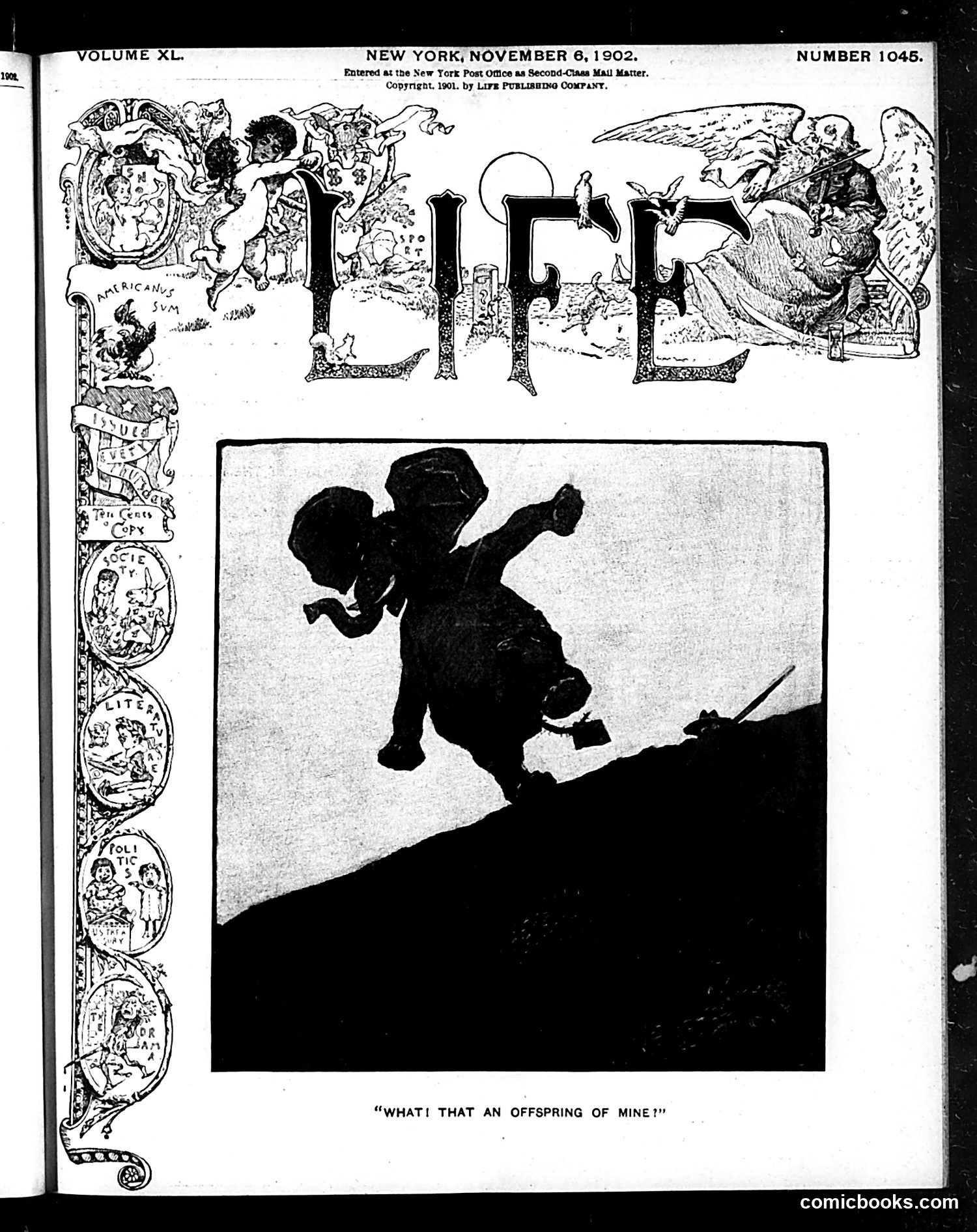
The main cartoon, captioned "What I That An Offspring of Mine!!", shows a bear recoiling in horror from a small human figure on a hillside. This is political satire, likely referencing **President Theodore Roosevelt** (the bear was his common caricature symbol) reacting with dismay to some controversial policy outcome or political development of 1902. The elaborate decorative border on the left contains classical and allegorical scenes. The ornate header typography spells "LIFE" with elaborate illustrated letterforms featuring cherubs and decorative elements typical of early 1900s magazine design. Without additional context about specific 1902 events, the precise political reference remains unclear, though the satire clearly mocks a Roosevelt administration embarrassment or unintended consequence.
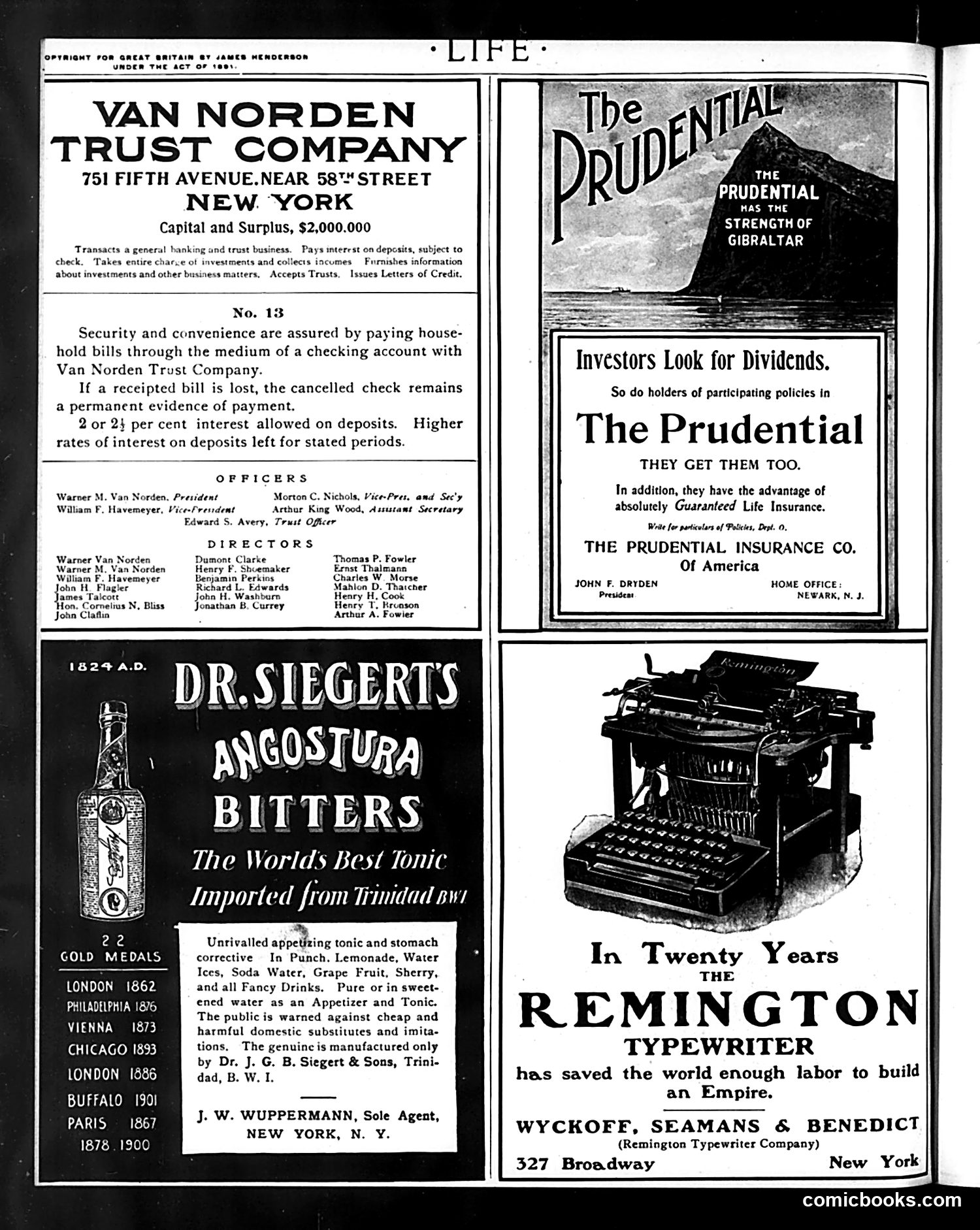
This page contains **no political cartoons or satire**—it's primarily advertising from an early 1900s Life magazine issue. The four advertisements are: 1. **Van Norden Trust Company** (New York bank)—straightforward business notice about checking accounts and interest rates. 2. **Prudential Insurance**—uses Gibraltar's Rock as a metaphor for strength and stability, promising dividends and guaranteed life insurance. 3. **Dr. Siegert's Angostura Bitters**—medicinal tonic imported from Trinidad, listing international gold medals and warning against cheap imitations. 4. **Remington Typewriter**—claims the machine has "saved the world enough labor to build an Empire" in twenty years. The page reflects early 20th-century consumer advertising targeting middle-class professionals seeking financial security and modern conveniences.
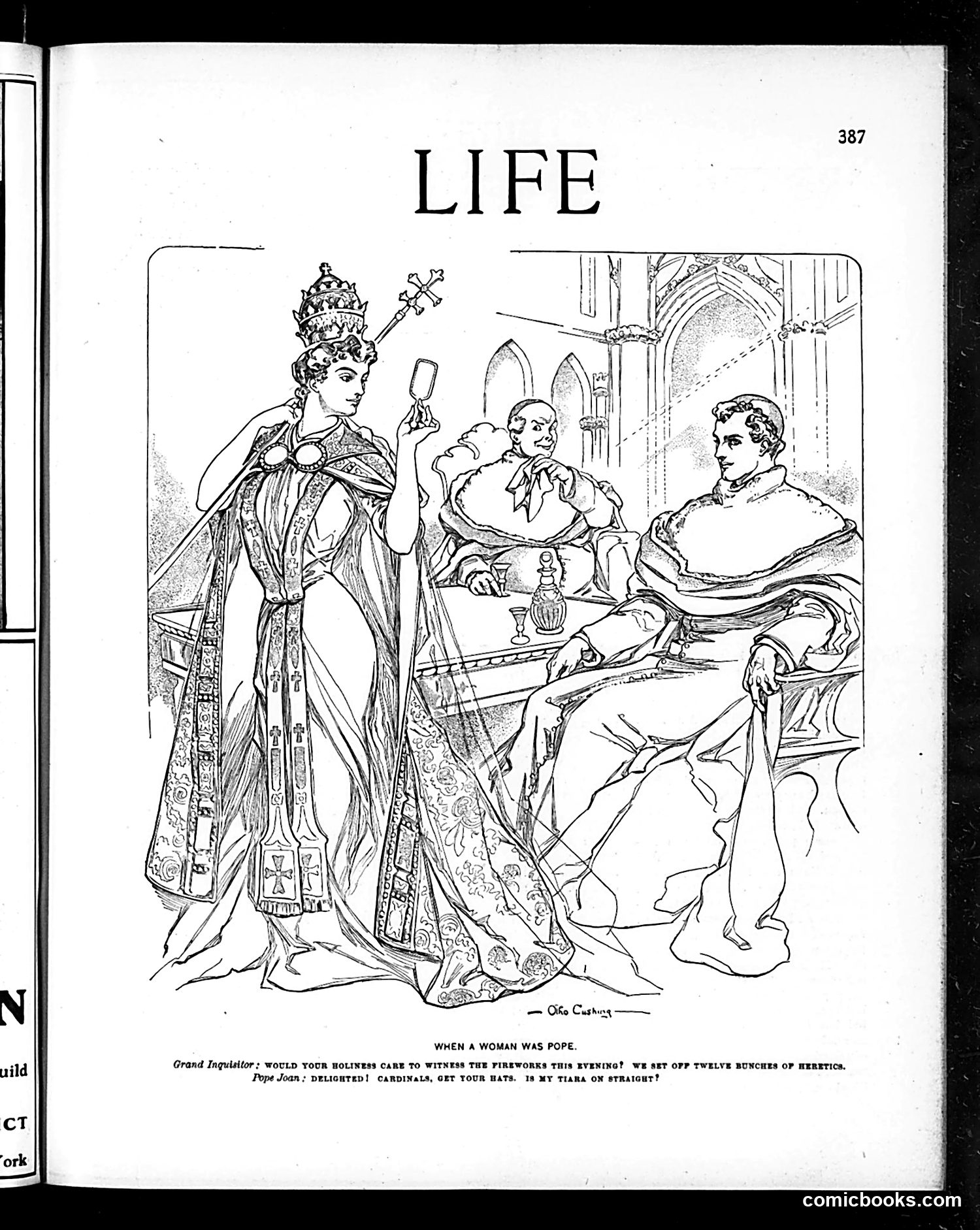
This satirical cartoon from Life magazine depicts a fictional scenario of a female Pope, mocking both women in religious authority and the Catholic Church hierarchy. The central figure is an ornately dressed Pope in elaborate vestments and crown, addressing two male cardinals. The caption references a "Grand Inquisitor" commenting on witnessing "fireworks this evening" and mentions "twelve bunches of heretics," while "Pope Joan" responds about getting "your hats" and her "tiara on straight." The satire targets the absurdity of imagining female leadership in the Church, treating it as inherently ridiculous. The joke suggests a female Pope would be distracted by fashion ("tiara on straight") rather than serious ecclesiastical duties. This reflects late 19th/early 20th-century attitudes dismissing women's intellectual capacity for religious authority.
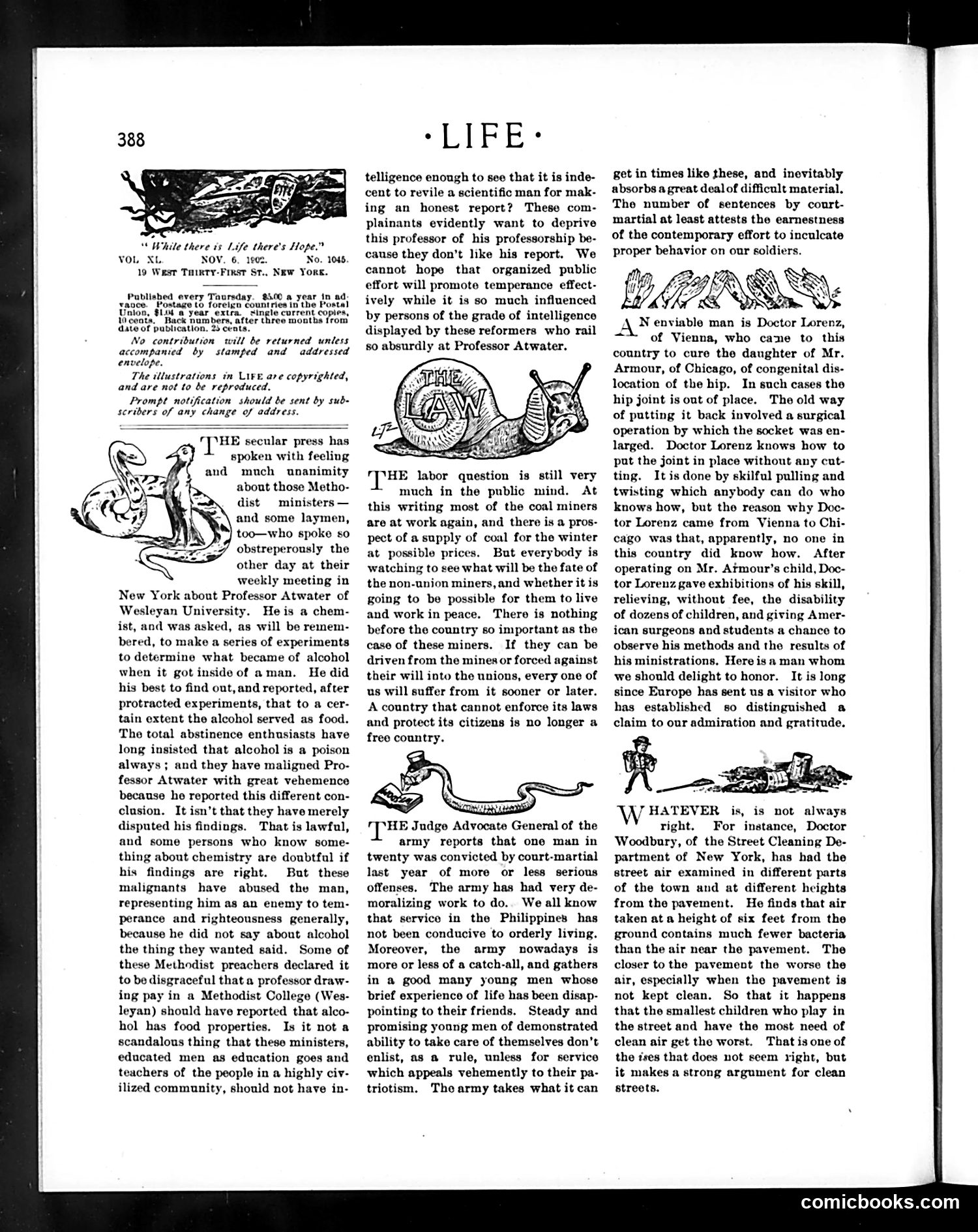
This page contains several editorial commentaries rather than single unified cartoons. The main illustrations appear to be small decorative vignettes rather than political cartoons with clear targets. The text discusses Professor Atwater of Wesleyan University, who conducted experiments on alcohol's effects on humans. Critics accused him of misrepresenting findings, though the article suggests his conclusions were accurate. Other sections address labor disputes among coal miners, court-martial sentencing of soldiers, and Doctor Lorenz of Vienna (a real orthopedic surgeon known for treating congenital hip dislocation). A final item mentions Doctor Woodbury examining street cleanliness in New York. The small illustrations—a snail, figures in motion, and cleaning workers—serve as decorative accompaniment to these social commentary pieces rather than as political satire requiring specific historical context beyond the text provided.
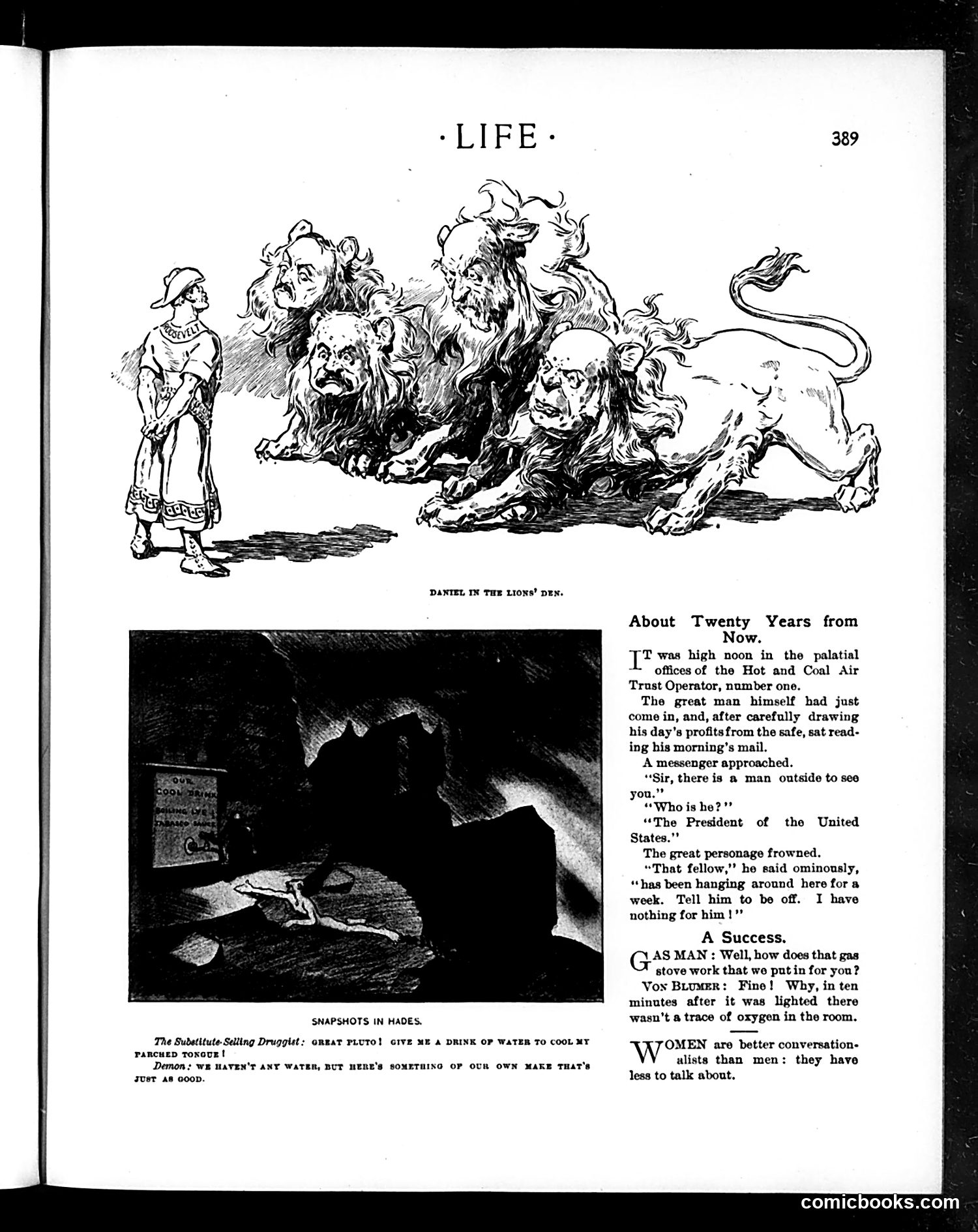
**Top cartoon "Daniel in the Lions' Den":** This biblical allusion satirizes a political figure (likely a U.S. President, given the text reference) facing hostile opposition—depicted as ravenous lions with human faces. The lone figure represents vulnerability amid threats. **Middle photograph "Snapshots in Hades":** Appears to be a theatrical or artistic scene depicting an underworld setting, possibly commenting on contemporary politics or morality through classical mythology. **Text sections:** - "About Twenty Years from Now" mocks a powerful industrialist (the "great man" and "Hot and Coal Air Trust Operator") dismissing the U.S. President as insignificant. - "A Success" jokes about a gas stove's efficiency. - Brief observations on women as conversationalists. The page satirizes wealth, power, and the trivialization of high office.
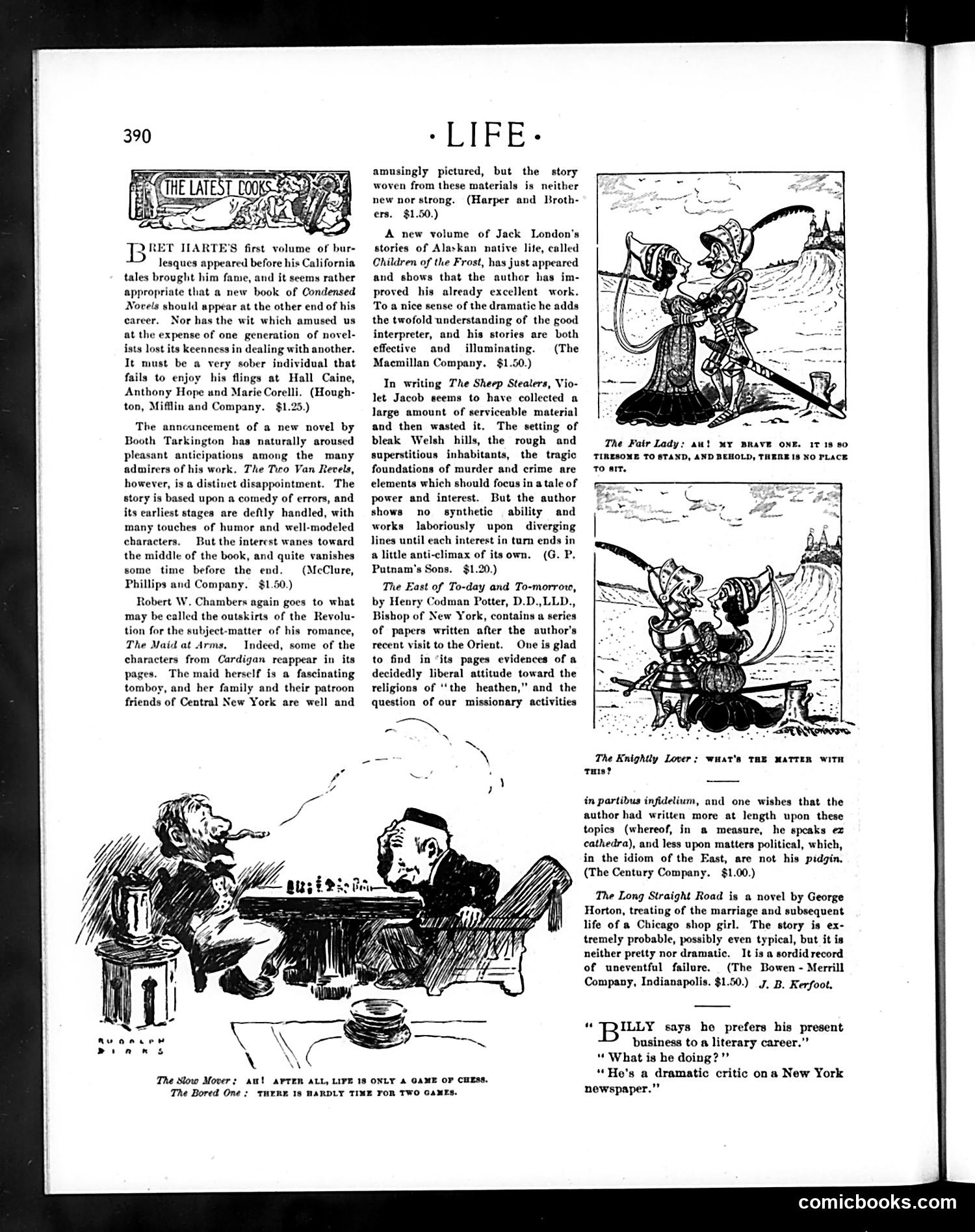
This page contains book reviews rather than political cartoons. The illustrations are literary in nature—sketches accompanying commentary on recently published novels. The three captioned drawings appear to be humorous scenes from the books being reviewed: "The Fair Lady," "The Knightly Lover," and illustrations labeled "The Slow Mover" and "The Bored One" (depicting two men at a chess game, with the caption "After all, life is only a game of chess" and "There is hardly time for two games"). The chess illustration is the only item with satirical intent—a gentle joke about how chess players consume time. The page functions primarily as a literary review section rather than as political or social satire. The drawings serve to entertain readers while discussing contemporary fiction.
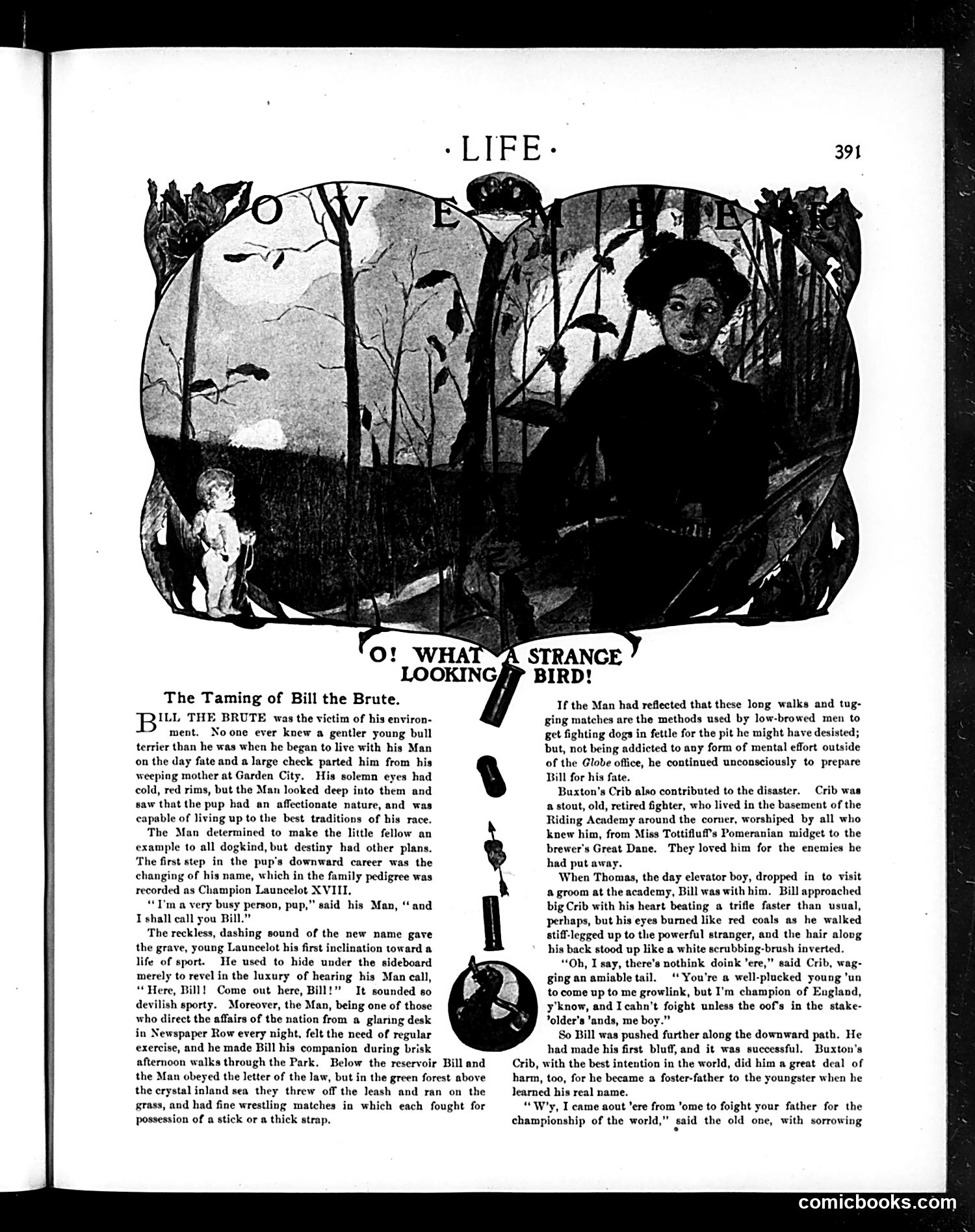
This is a fictional narrative story, not a political cartoon. It tells of a rough bull terrier named Bill who is reformed through patient training by a Man. The story critiques lower-class fighting culture: Bill's original owner used him in dogfighting, a brutal practice involving "low-bred men" and betting. The narrative contrasts this with genteel society—Bill eventually becomes a respectable companion. The story also mentions Baxton's Crib, a stout old fighting dog, and includes commentary about someone named Thomas visiting an academy. The satirical point appears to be about civilization and redemption: even the roughest "brute" can be trained and elevated through proper treatment, implicitly mocking working-class brutality while celebrating upper-class refinement and compassion.
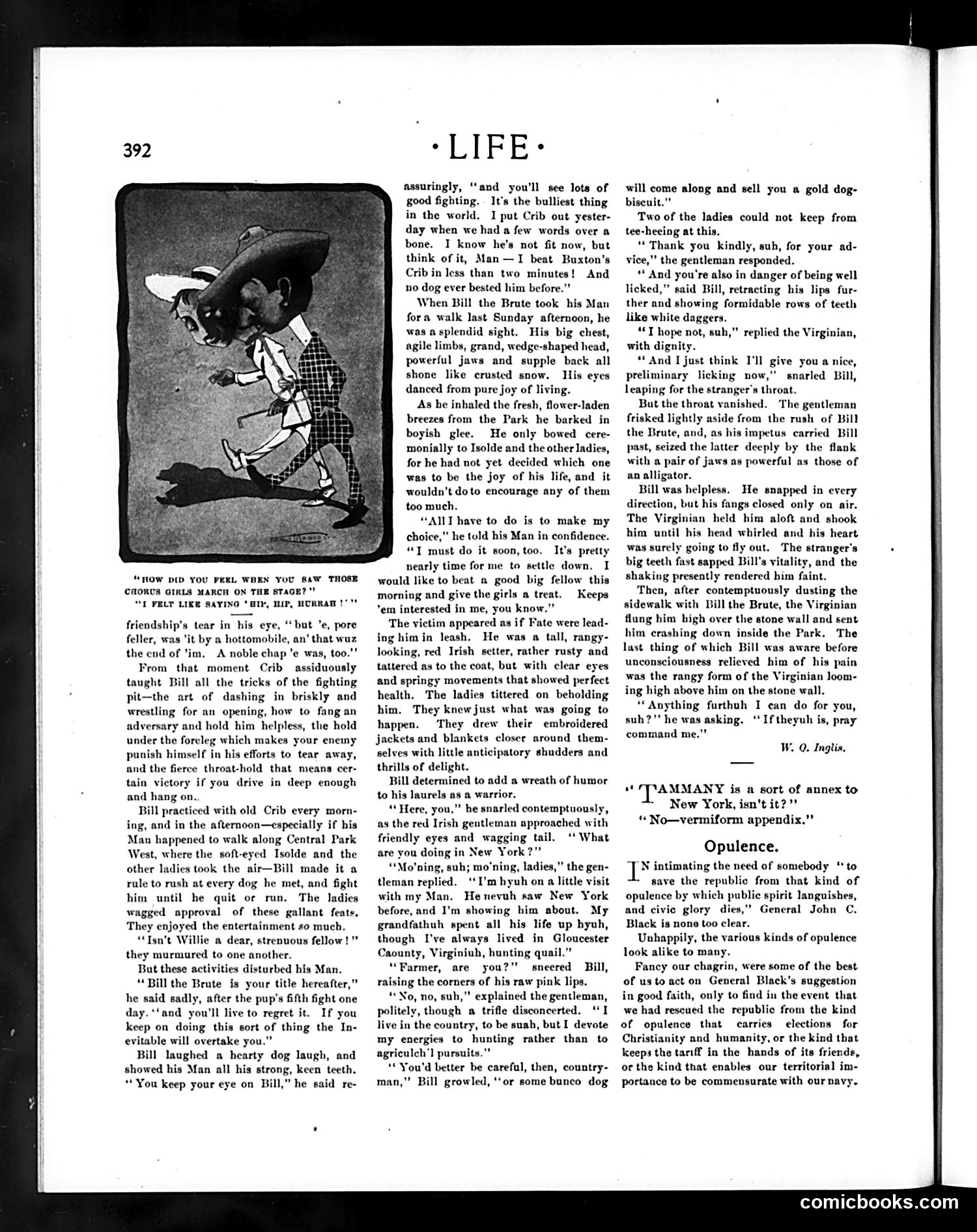
The cartoon depicts "Bill the Brute," a boxing dog character who serves as the page's central illustration. The accompanying narrative describes Bill as a fighting dog of impressive physical prowess—muscular, with "crusted snow" coloring and a "wedge-shaped head." The humor centers on Bill's contrasting personalities: he's a fierce fighter in the ring yet becomes comically gentle and affectionate in social situations, particularly around ladies. The joke satirizes performative masculinity—Bill adopts an exaggerated "tough guy" persona for sport while proving incapable of actual aggression in civilized company. The accompanying article "Opulence" discusses political satire regarding public spirit and national concerns, unrelated to the Bill cartoon narrative.
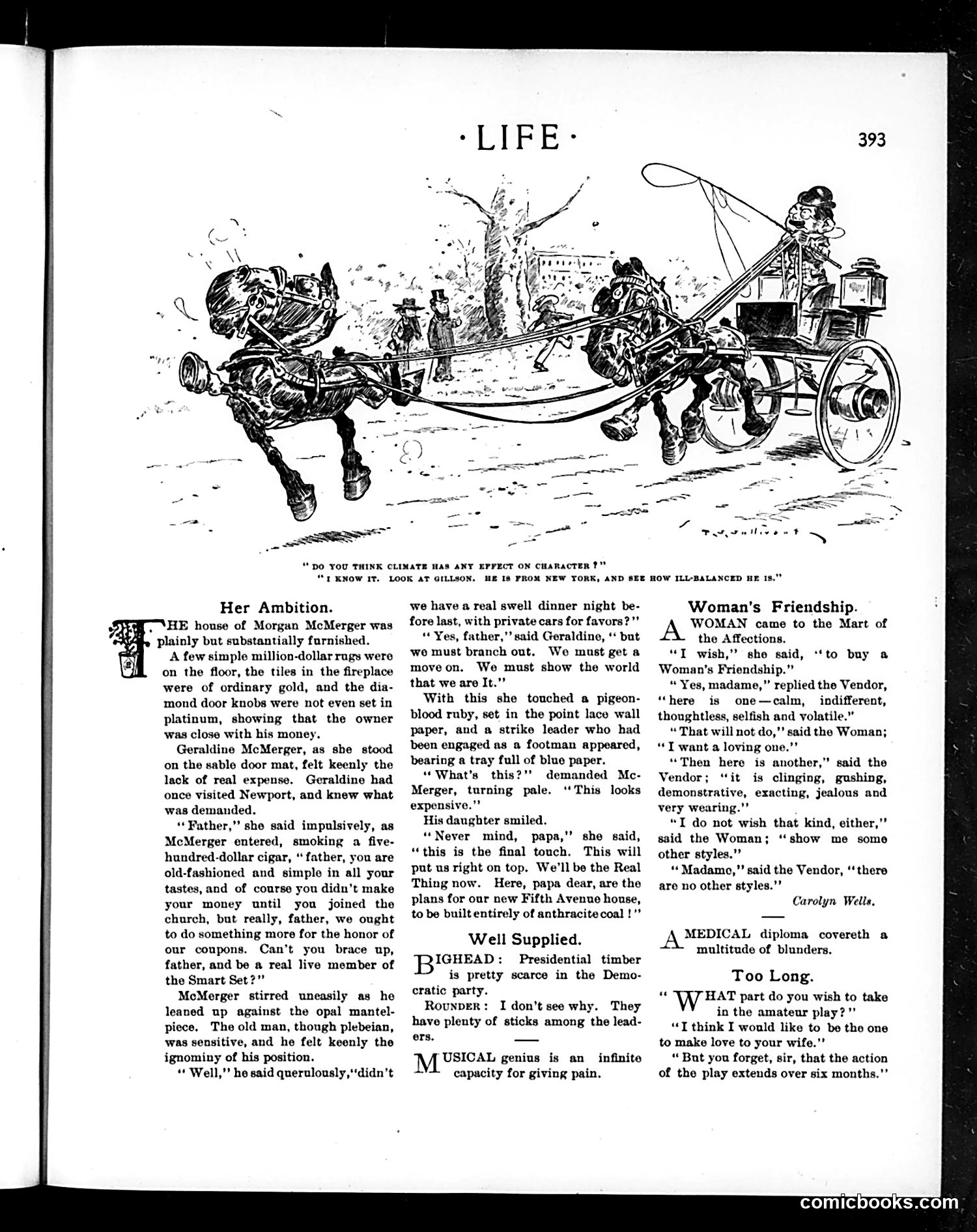
This page from *Life* magazine contains three separate satirical pieces: **Top cartoon**: Shows a man in a carriage being pulled by a skeletal horse, with the caption about climate affecting character. The joke targets wealthy New Yorkers' pretensions—specifically someone from New York trying to appear refined despite obvious moral decay (represented by the skeletal horse). **"Her Ambition"**: Satirizes nouveau-riche social climbing. McMerger's daughter wants lavish displays of wealth (Fifth Avenue house, anthracite coal fires) to gain social status, while her father feels the expense is undignified. The satire mocks both aggressive materialism and old money's resistance to it. **Small quips** ("Woman's Friendship," "Well Supplied," etc.): Brief satirical observations about social types—vendor behavior, medical incompetence, and theatrical culture. The overall tone ridicules Gilded Age wealth-obsession and social pretension.
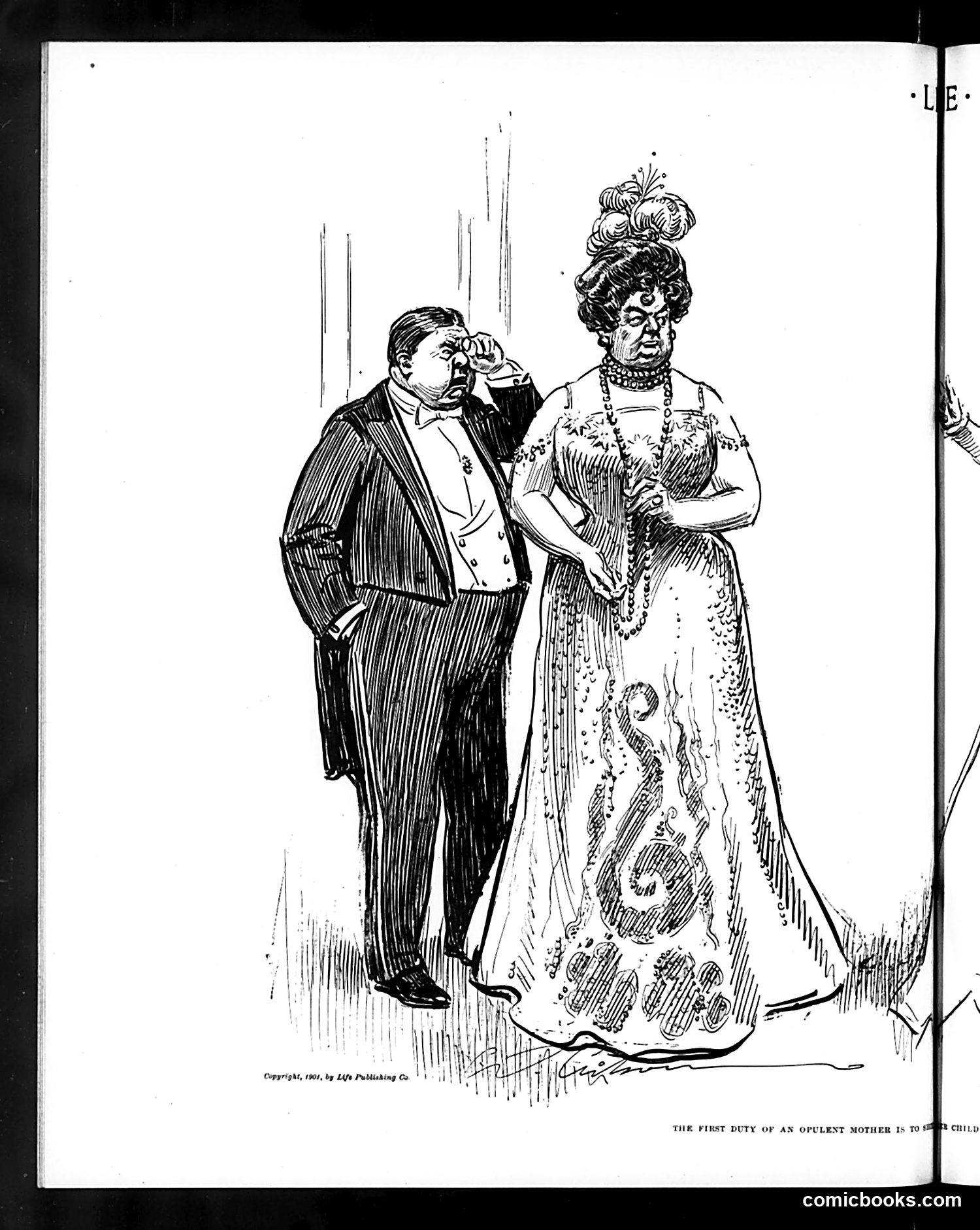
The caption reads "THE FIRST DUTY OF AN OLDEST MOTHER IS TO HER CHILD," which appears to be a satirical commentary on maternal priorities and social expectations. The image depicts a well-dressed man in formal evening wear (tuxedo with bow tie) appearing distressed or tearful, while a fashionably dressed woman in an elaborate gown with jewels and an ornate hairstyle stands beside him with a stern or disapproving expression. The satire likely critiques wealthy or upper-class mothers who prioritize social obligations, fashion, and their own pursuits over their children's welfare. The man's emotional distress contrasts with the woman's composed, decorated appearance, suggesting she is neglecting family duties in favor of maintaining her social status and appearance. This was a common theme in early 20th-century social satire about elite women.
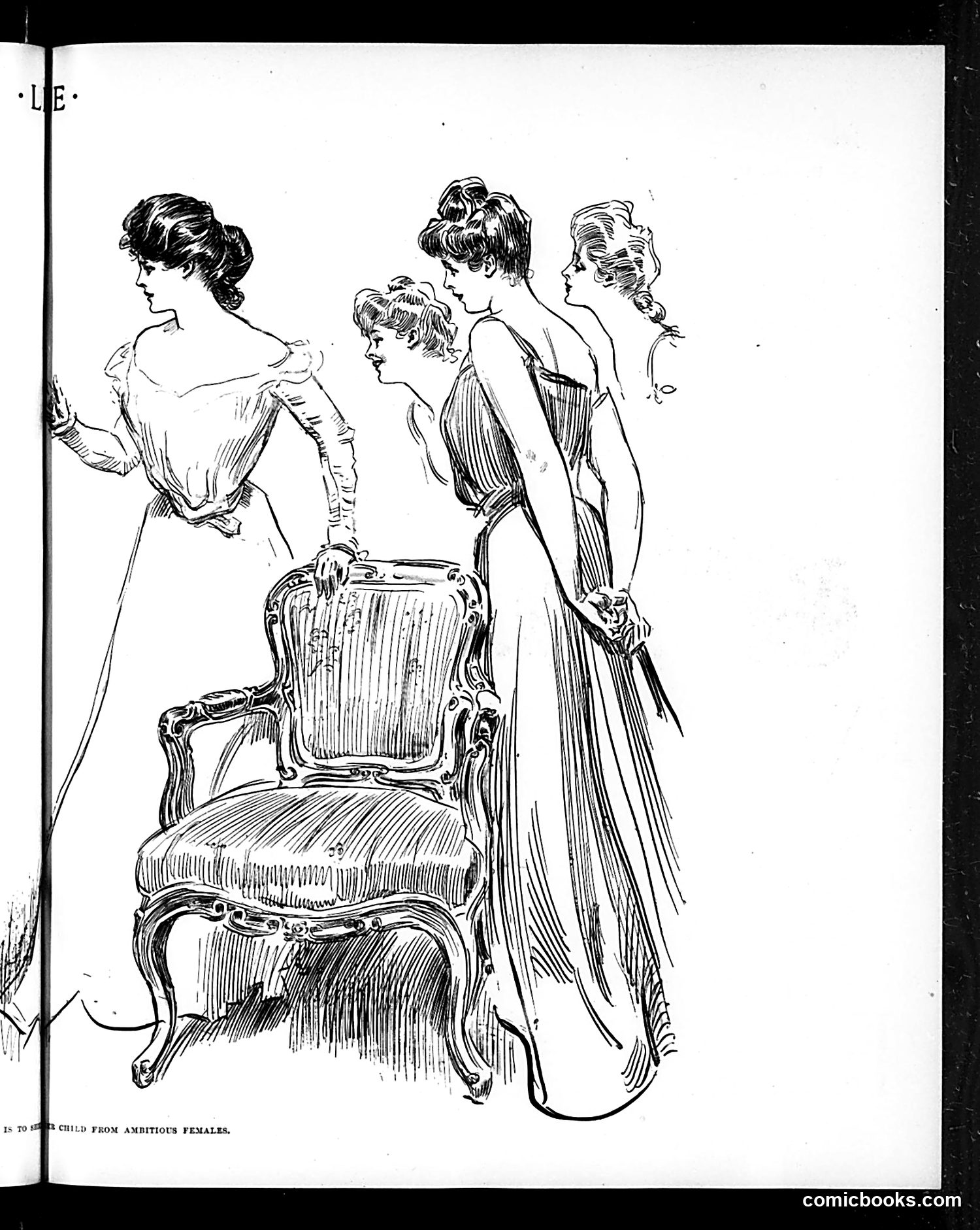
This appears to be a satirical illustration from Life magazine depicting four fashionably dressed women in early 1900s attire examining or admiring an ornate chair. The caption reads "IS TO BE A CHILD FROM AMBITIOUS FEMALES" (likely incomplete OCR). The satire seems to mock women's social ambitions and materialism of the Gilded Age era. The women are drawn in an exaggerated style characteristic of Life's social commentary, suggesting they represent a particular social type—possibly newly wealthy or aspiring upper-class women obsessed with fashionable furnishings and status symbols. The ornate chair serves as a symbol of wealth and gentility they're pursuing. The joke likely critiques how such women prioritize material possessions and social climbing over other values, reflecting period anxieties about changing gender roles and consumption patterns among the rising middle and upper classes.
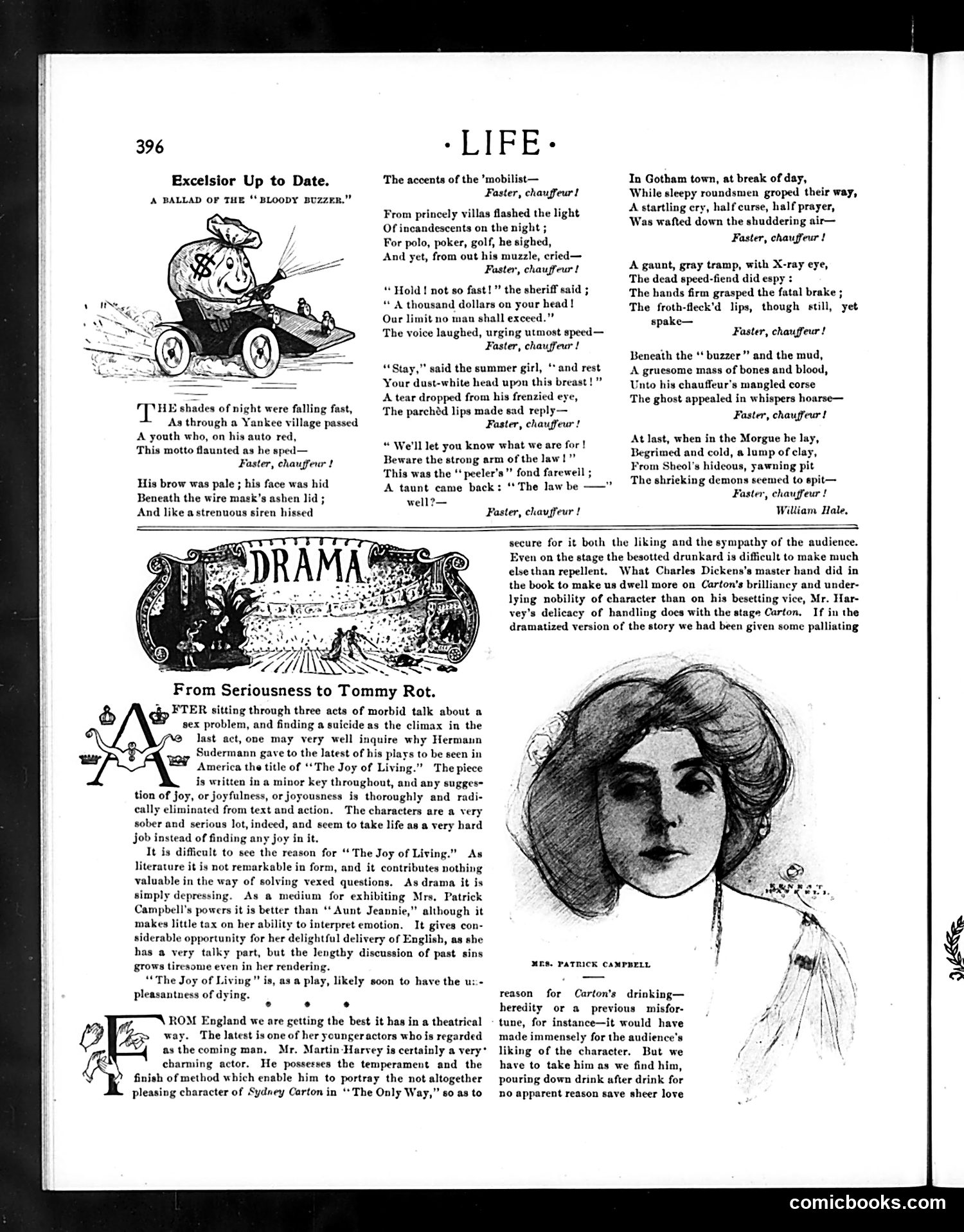
This illustrated ballad satirizes early automobile culture. The cartoon depicts a reckless motorist in a primitive "buzzer" (slang for early automobiles) speeding through a village, causing chaos and death. The poem mockingly recounts how the driver, initially confident and dismissive of speed limits, encounters a sheriff's warning but ignores it. The vehicle ultimately crashes, leaving "a gruesome mass of bones and blood" at a morgue. The satire targets both the dangerous, reckless behavior of early drivers and society's anxiety about new automobile technology. The phrase "Bloody Buzzer" puns on both the vehicle's nickname and the literal bloody consequences of uncontrolled speed—a common concern when automobiles were new and unregulated.
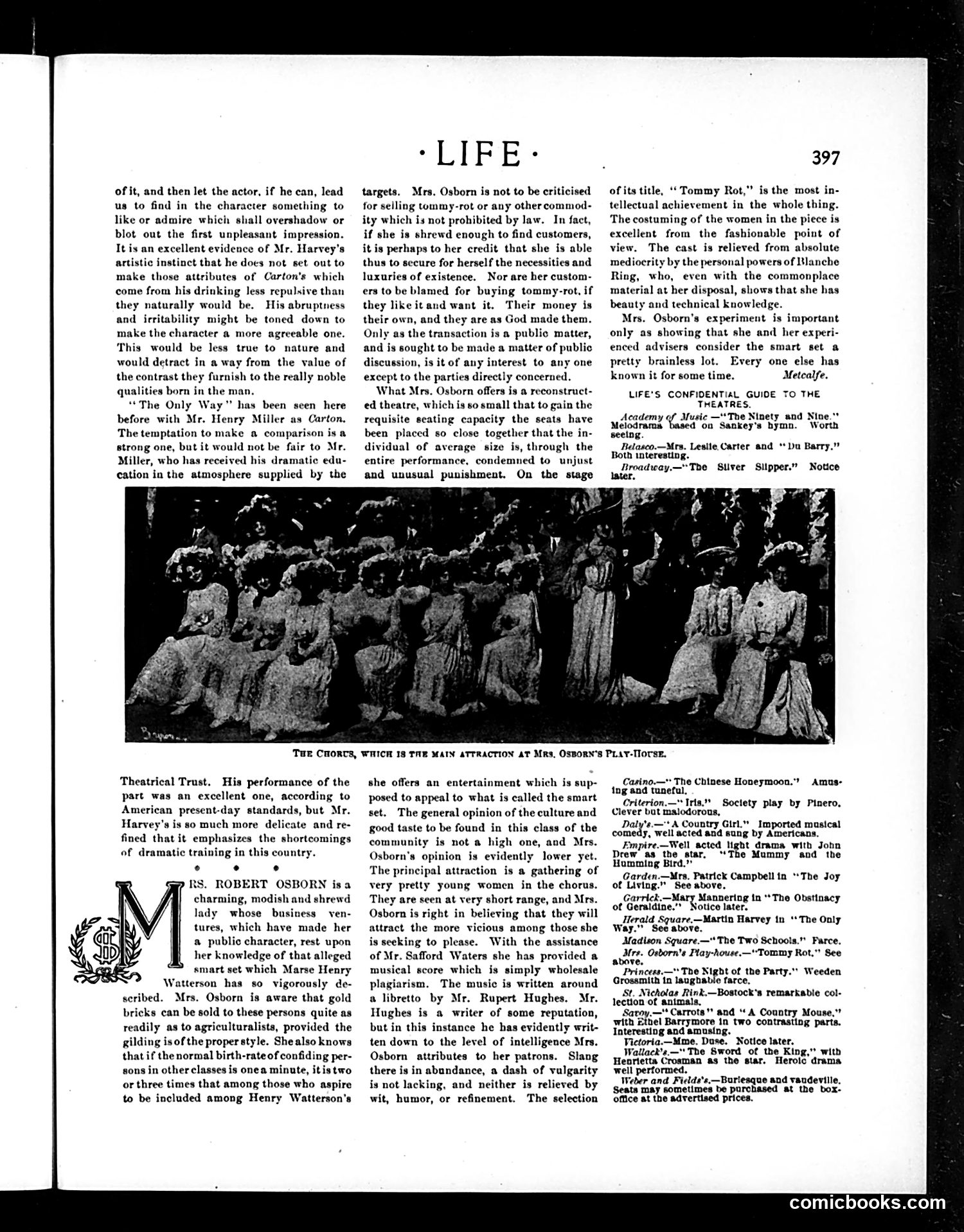
This page contains **theatrical reviews**, not political cartoons. The main content critiques Mrs. Robert Osborn's playhouse production. **Key figures and context:** - **Mrs. Robert Osborn**: A shrewd businesswoman running a small, fashionable theater targeting wealthy "smart set" audiences - **"The Only Way"**: A theatrical production being reviewed; previously performed with actor Henry Miller - **Harvey** (likely John Martin Harvey): An actor whose refined performance is praised as superior to Miller's - **Blanche Ring**: Actress credited with elevating the mediocre cast through her talent **The satire's point:** Life mocks Mrs. Osborn's venture as exploitative—she sells "tommy-rot" (nonsense entertainment) to gullible wealthy patrons. The reviewer sarcastically notes the play's title is the "most intellectual achievement" and suggests Osborn's success proves the wealthy elite are "a pretty brainless lot." The photograph shows the theater's chorus line cramped into absurdly close seating. The tone is one of class-based mockery: wealthy people are foolish enough to pay for inferior entertainment in uncomfortable conditions.
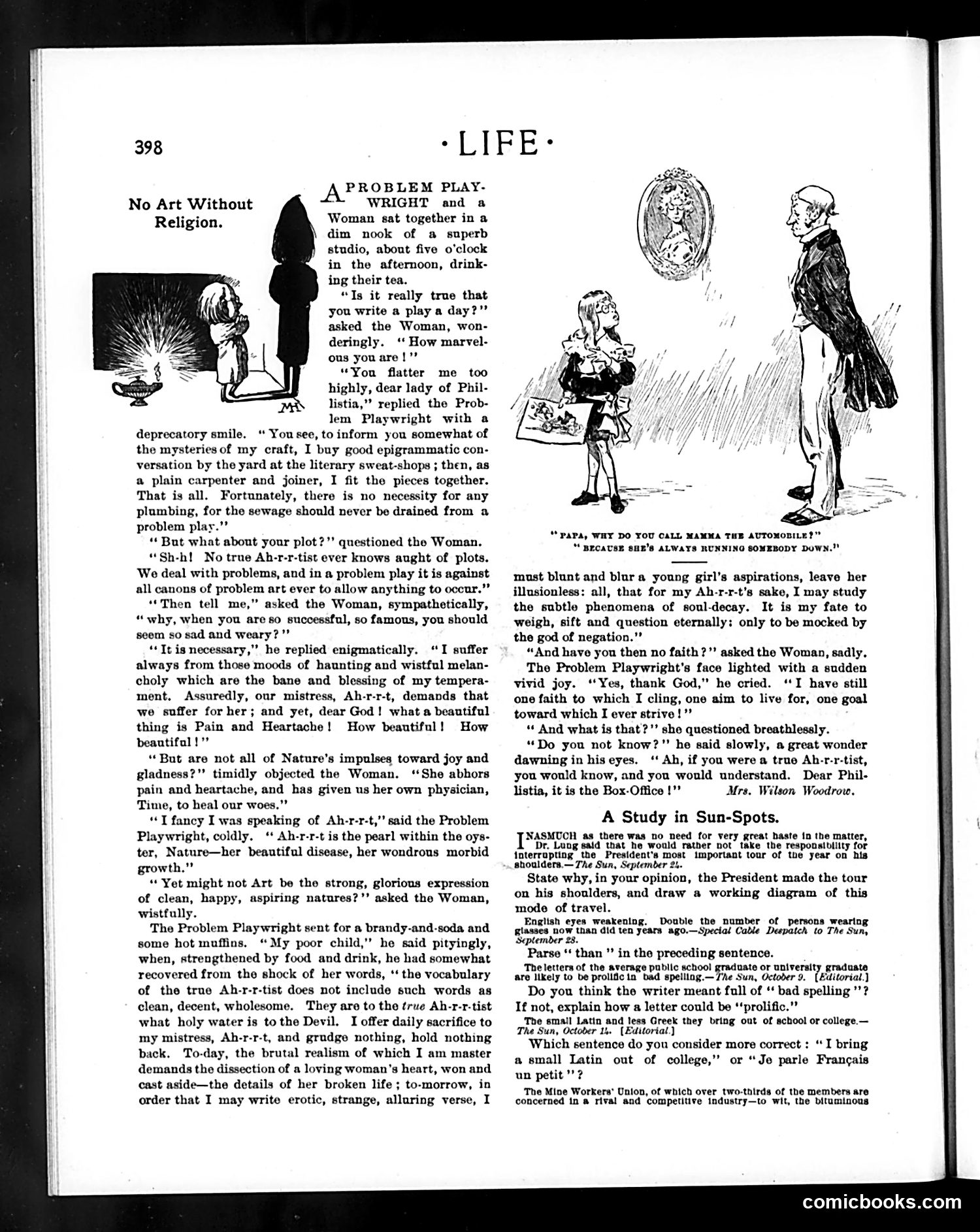
This page satirizes pretentious avant-garde artists, particularly playwrights of the late 19th/early 20th century who claimed to pursue "Art" (spelled "Ah-r-r-t" mockingly) above all else. **The main story** features a self-important "Problem Playwright" lecturing a skeptical Woman about his craft. He claims true artists buy "epigrammatic conversation by the yard," avoid plots entirely, and must suffer morbidly—rejecting joy, cleanliness, and decency as incompatible with real Art. When pressed about his faith, he reveals his true god: **the Box Office**—a devastating punchline exposing his hypocrisy. **The small cartoon** shows a father explaining to his child why he calls his mother "the automobile": "Because she's always running somebody down"—a domestic joke about gossip. The satire mocks artistic pretension and the gap between bohemian ideology and commercial reality.
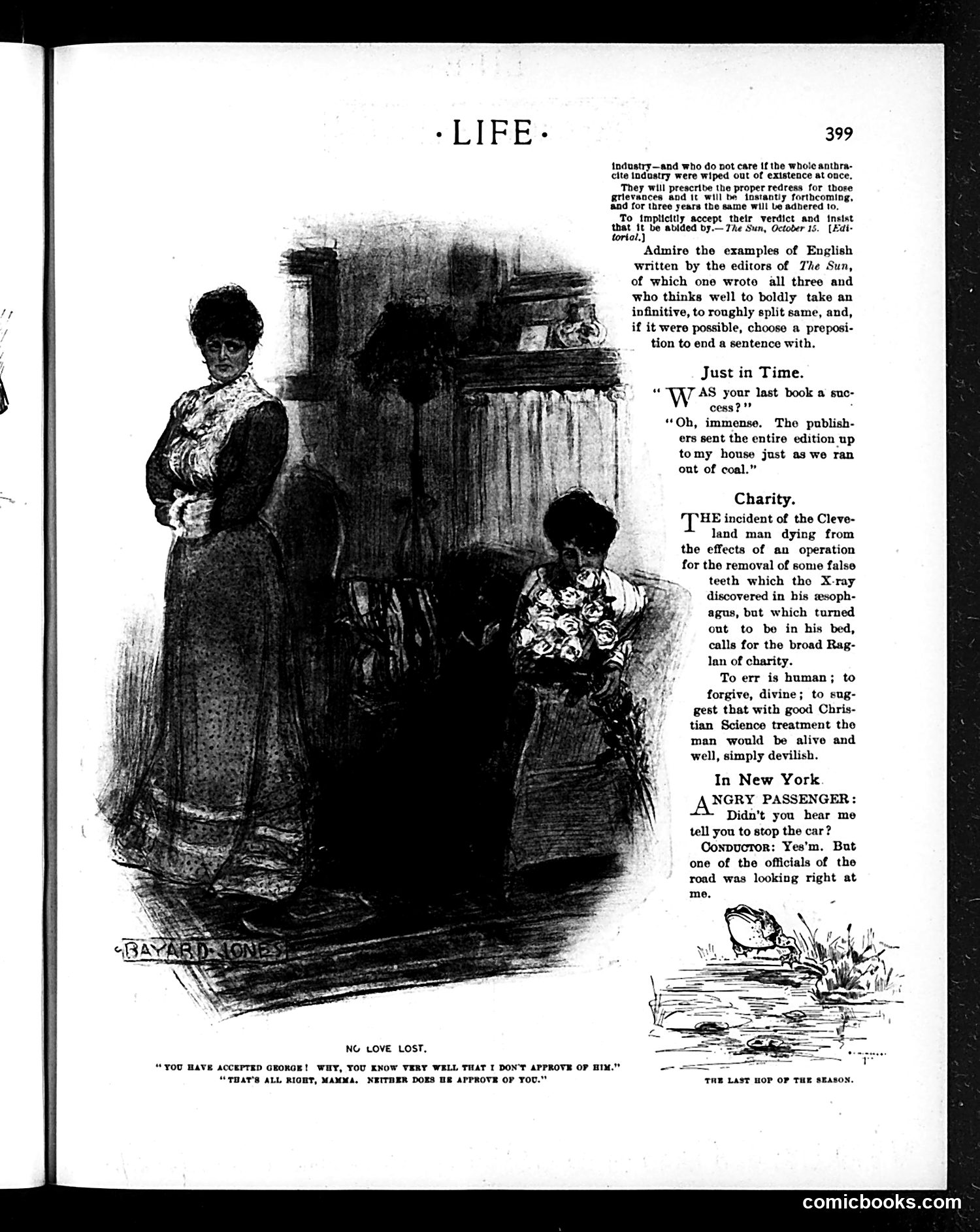
This page contains several satirical pieces typical of early 1900s *Life* magazine humor: **Main cartoon ("No Love Lost")**: A mother confronts her daughter about accepting a suitor named George. The joke relies on the daughter's witty comeback—George doesn't approve of the mother either—suggesting mutual dislike between prospective in-laws. The satire mocks Victorian courtship customs and family interference. **Smaller pieces** include: - "Just in Time": A quip about a publisher sending an author's unsold books as fuel during a coal shortage—economic satire about publishing failures - "In New York": A conductor's excuse for not stopping a streetcar; he feared an official was watching, satirizing workplace incompetence and bureaucratic cowardice - Editorial critique of *The Sun* newspaper's awkward grammar (split infinitives, dangling prepositions) The page mockingly critiques contemporary American life: class relations, publishing, public transportation, and journalistic standards. The tone is lighthearted social commentary rather than sharp political satire.
This page contains **mostly humorous short anecdotes and jokes** rather than political cartoons. The content includes: **The "Defiance of the Moro"** — a poem satirizing the Sultan of Bacolod (in the Philippines, recently acquired by the U.S. after the Spanish-American War). The poem mockingly presents the Moro leader as defiantly rejecting American authority, using bombastic language about his sovereignty while ultimately powerless against U.S. military force ("swaggering sons of the Land of God"). **Other jokes** target common themes: a sharp-tongued wife, a lawyer adjusting fees, mistaking a calf for deer, pretentious wealthy women having portraits painted abroad, and an optimistic Chicagoan finding silver linings. The page is primarily **advertising** (Wilson Whiskey, Chester Crest resort, Esterbrook pens, women's fashion). The Moro poem reflects early-1900s American imperialist sentiment—mocking colonial resistance as futile bombast while celebrating U.S. military dominance.
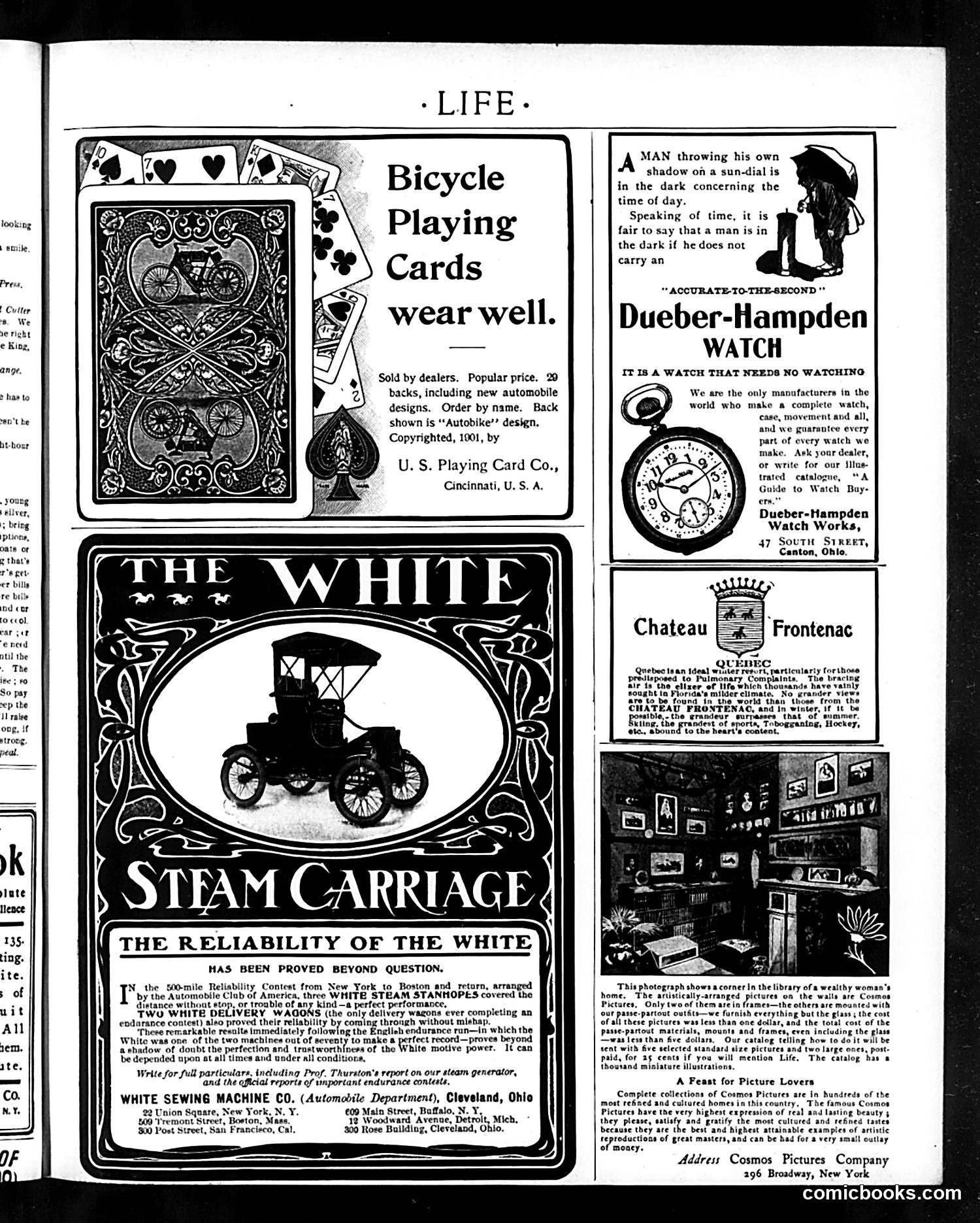
This is primarily an **advertising page** from Life magazine (circa 1901, based on copyright dates visible). The content consists of four distinct advertisements with no political cartoons or satire. The ads showcase products of the era: 1. **Bicycle Playing Cards** - standard product advertisement 2. **Dueber-Hampden Watch** - emphasizes reliability with a visual gag: a man checking time by his sundial shadow, contrasting with the watch's precision ("accurate-to-the-second") 3. **White Steam Carriage** - highlights a new automobile's proven reliability through endurance racing contests, positioning it against competitors 4. **Cosmos Pictures** - art reproductions marketed as affordable luxury for cultured homes The page reflects **early 1900s consumer culture**: advertising targets middle-to-upper-class readers with new technologies (automobiles, precision watches) and cultural refinement (art reproductions). The only mild humor appears in the watch ad's visual contrast between old (sundial) and new (mechanical precision) timekeeping methods—reflecting the era's embrace of modernity and mechanization.
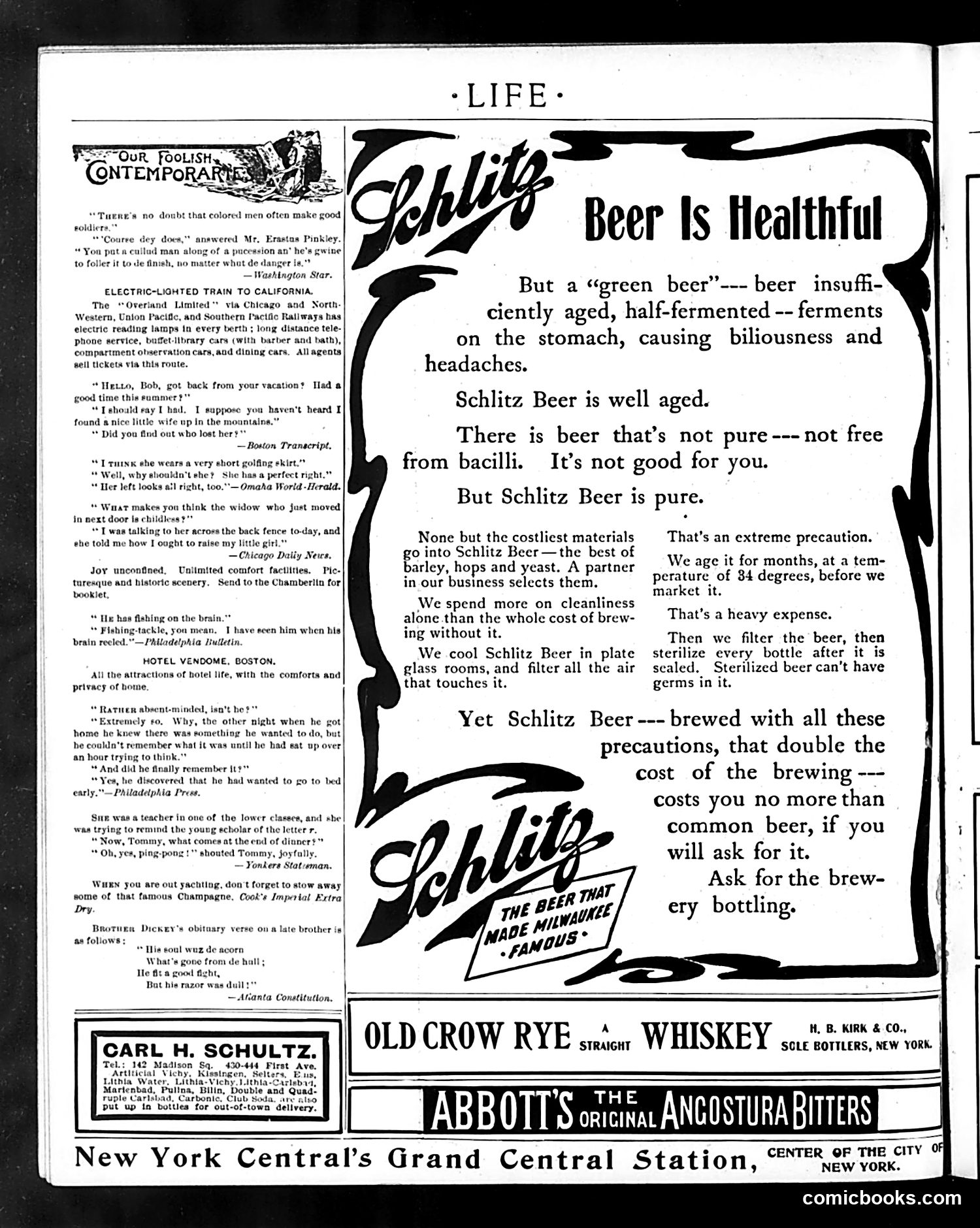
This page combines satirical commentary with period advertising. The left column features "Our Foolish Contemporaries"—a regular Life feature mocking absurd statements from newspapers and public figures. The jokes target racial stereotypes, marital discord, and absent-mindedness typical of early 20th-century humor. The dominant right side is a **Schlitz Beer advertisement** presenting health claims common to the era. It emphasizes purity, aging, sterilization, and cleanliness as selling points—addressing genuine public concerns about contaminated food and drink. The ad distinguishes Schlitz from "green beer" (underaged, prone to fermentation problems in the stomach), a real concern before modern refrigeration. The page reflects **early 1900s anxieties**: germ theory was newly popularized, food safety was uncertain, and breweries competed by claiming superior sanitation. The railroad and hotel advertisements below similarly emphasize modern comforts and facilities as luxury markers. The humor and marketing reflect assumptions of a wealthy, primarily male readership interested in travel, business, and consumption.
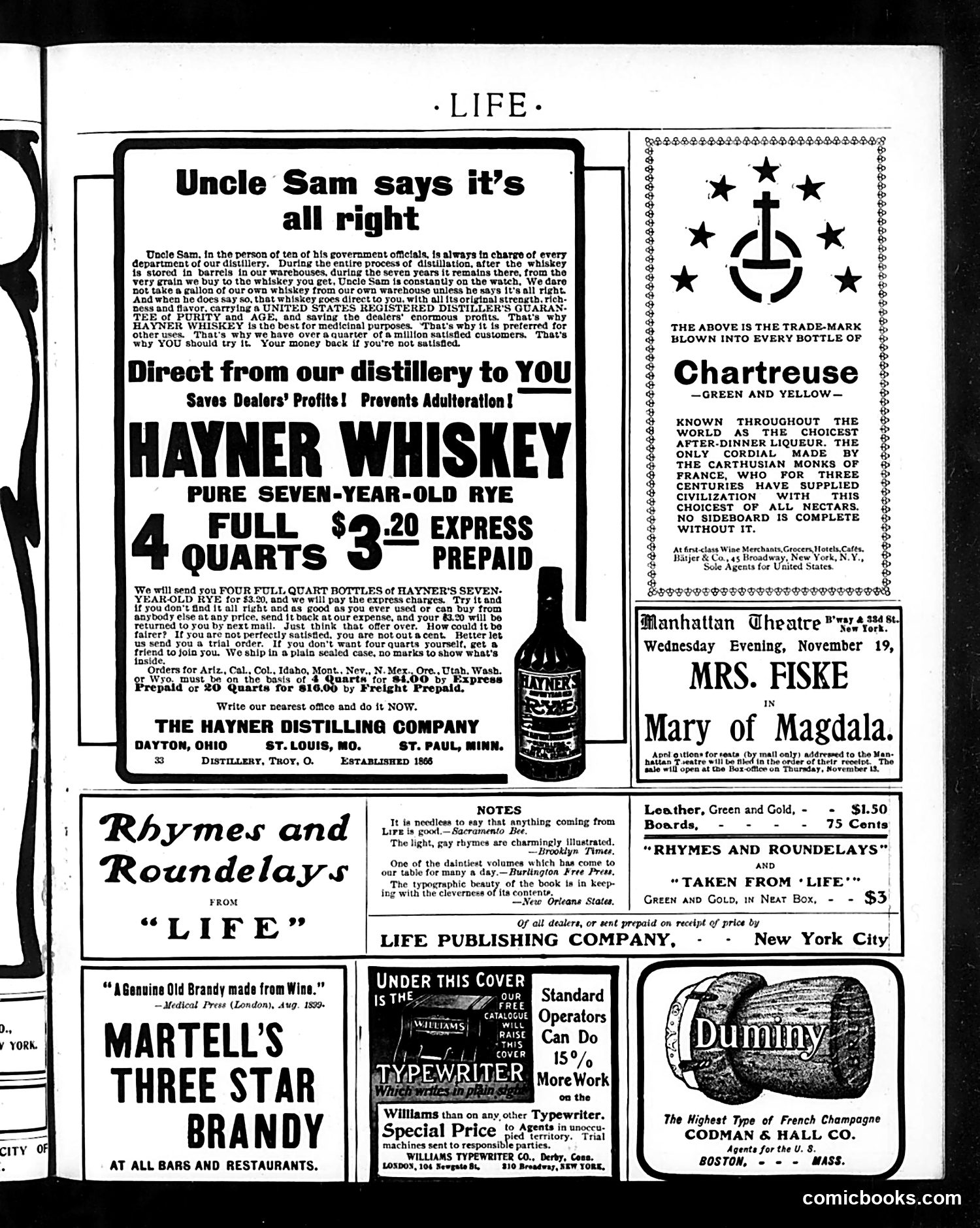
This is primarily an **advertising page** from Life magazine, not a political cartoon. The dominant content is a large advertisement for Hayner Whiskey, which uses "Uncle Sam" as a marketing figure. ## The Hayner Whiskey Ad The ad depicts Uncle Sam (representing federal government oversight) claiming the whiskey is "all right"—meaning federally approved. This appeals to consumers by emphasizing **government regulation and purity guarantees**, positioning the product as trustworthy during the Prohibition era context (though Prohibition hadn't yet begun when this ran). The ad highlights direct-from-distillery sales that bypass dealers, ostensibly preventing adulteration. ## Supporting Content The page also includes advertisements for: - **Martell's Three Star Brandy** - **Chartreuse liqueur** (made by Carthusian monks) - **Dummy champagne** - A **Williams typewriter** ad - Theater listings and book advertisements The "Uncle Sam says it's all right" framing uses patriotic authority to market an alcoholic product—a common advertising strategy of the era exploiting government credibility for commercial purposes.
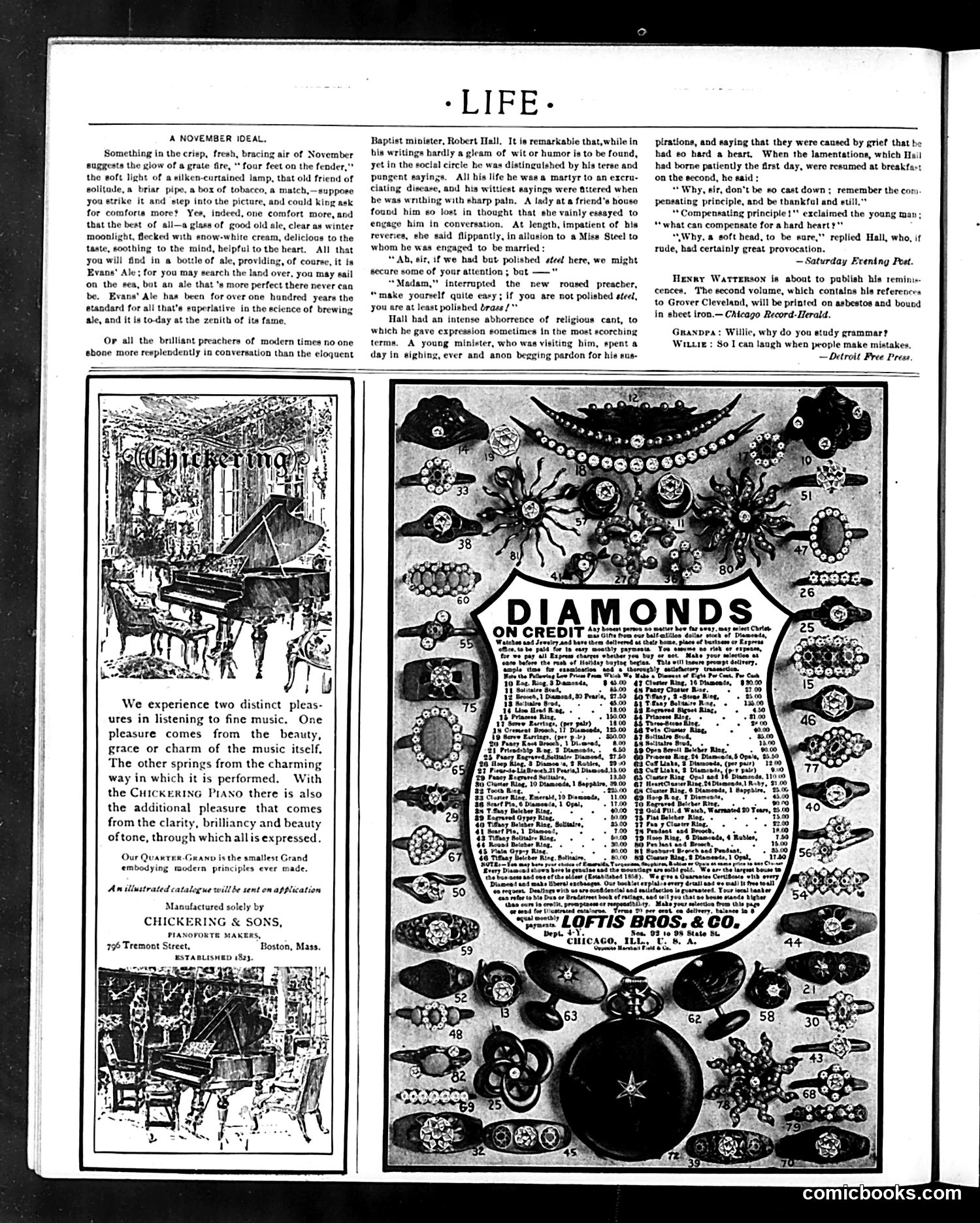
This page is primarily **advertising**, dominated by a large diamond catalog from Loftis Bros. & Co. (Chicago) showing numbered jewelry items available on credit. The left side contains two distinct editorial pieces: 1. **"A November Ideal"** — an advertisement for Evans' Ale, romanticizing winter comfort (fireplace, pipe, ale) in sentimental Victorian language. 2. **Robert Hall anecdote** — a biographical sketch of an 18th-century Baptist minister known for witty conversation despite chronic illness. The text illustrates Hall's sharp humor through exchanges with a woman and a young clergyman, emphasizing the contrast between his dull writings and brilliant spoken wit. The final quip about "soft head" compensating for a "hard heart" exemplifies the caustic humor he was famous for. Brief **lighter items** follow: a quip about Henry Watterson's memoir being printed on asbestos (mocking Grover Cleveland controversy), and a joke about learning grammar to mock others' mistakes. The page reflects *Life*'s mix of advertising revenue, biographical/anecdotal humor, and light satirical commentary typical of early 20th-century magazines.
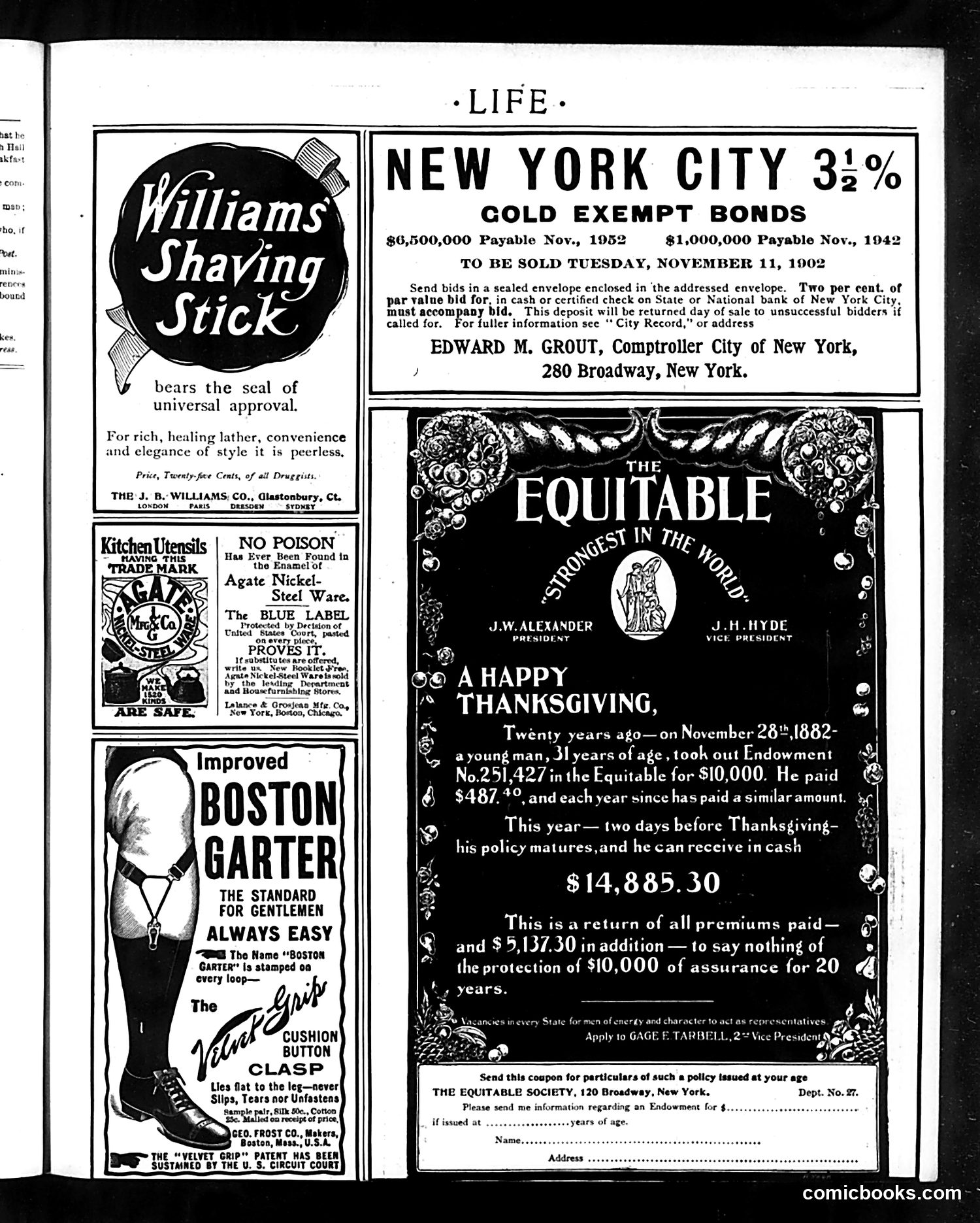
This page is primarily **advertising**, not satire or editorial cartooning. It contains five commercial advertisements typical of early 1900s publications: 1. **Williams Shaving Stick** — product advertisement emphasizing quality 2. **New York City Bond offering** — municipal financial announcement 3. **Kitchen Utensils (Agate Nickel-Steel)** — reassurance ad addressing safety concerns about enamel coating toxicity 4. **Boston Garter** — men's hosiery with anatomical diagram showing the product's function 5. **The Equitable Life Insurance Society** — insurance company showcasing a customer success story: a policyholder who invested $487.40 annually for 20 years and received $14,885.30 at maturity, presented as a Thanksgiving gratitude narrative The only potentially satirical element is subtle: the Equitable ad's emotional framing—positioning insurance as enabling family prosperity and holiday celebration—represents early corporate advertising's shift toward emotional appeals rather than bare product information.
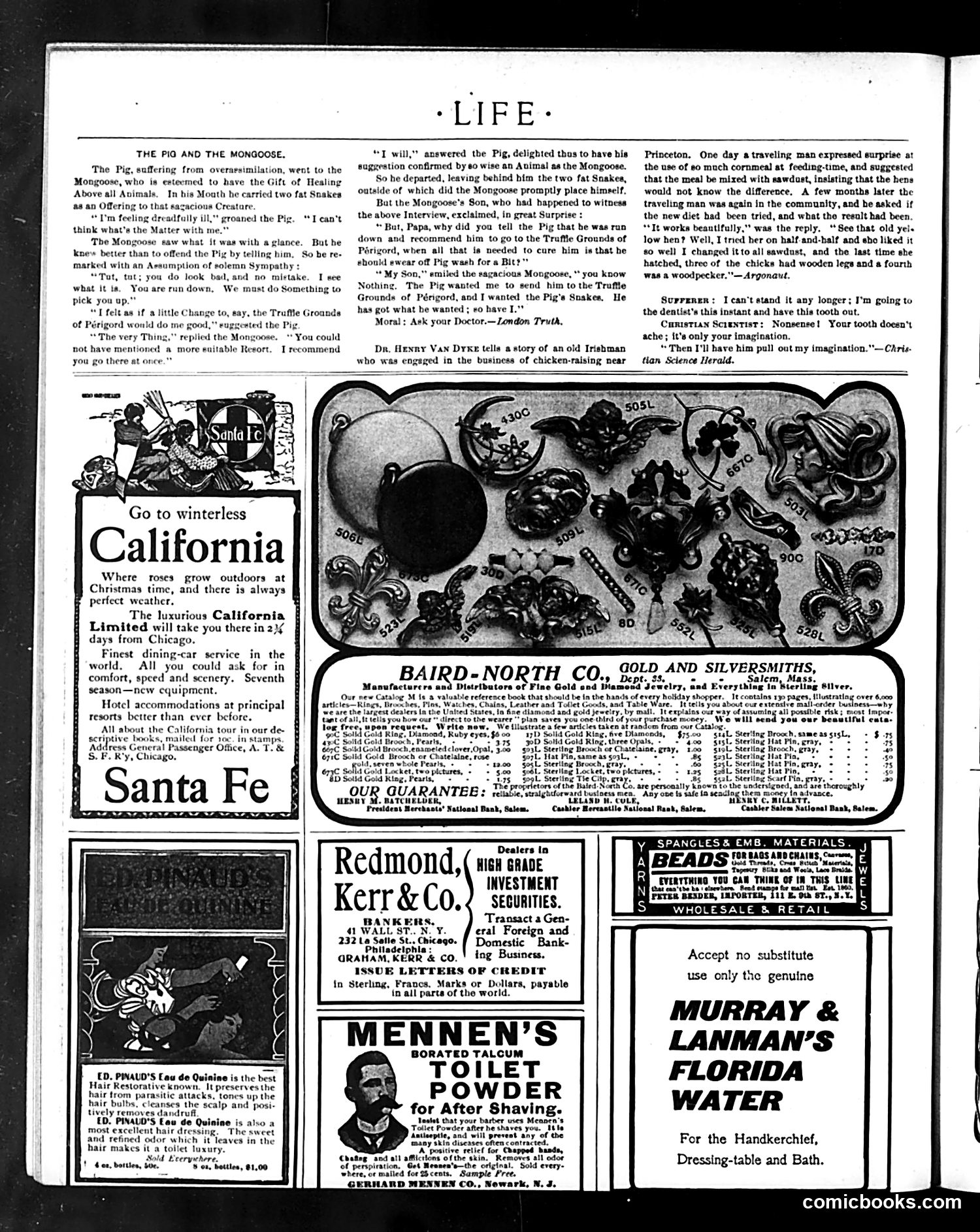
This page from *Life* magazine contains **three distinct pieces of satirical content**: 1. **"The Pig and the Mongoose"** (top): A fable-style story mocking self-interested advice. A mongoose, asked to help a suffering pig, recommends an unnecessary trip to Périgord's truffle grounds—not because it will help, but because the mongoose wants the pig's snake offerings. The moral ("Ask your Doctor") satirizes quack medical advice and snake-oil salesmen who profit from the gullible. 2. **Dr. Henry Van Dyke's anecdote** (right): A humorous story about an Irishman who mixes cornmeal with sawdust to feed chickens. The punchline—that hatched chicks have wooden legs and one becomes a woodpecker—absurdly illustrates the consequences of foolish cost-cutting. 3. **"Nonsense! Your tooth doesn't ache"** (bottom right): Satire of Christian Science doctrine, which denies physical illness as real, treating pain as mere imagination. The dentist's patient threatens to have him "pull out my imagination" instead—mocking the movement's rejection of medical reality. The page is otherwise filled with period advertisements.
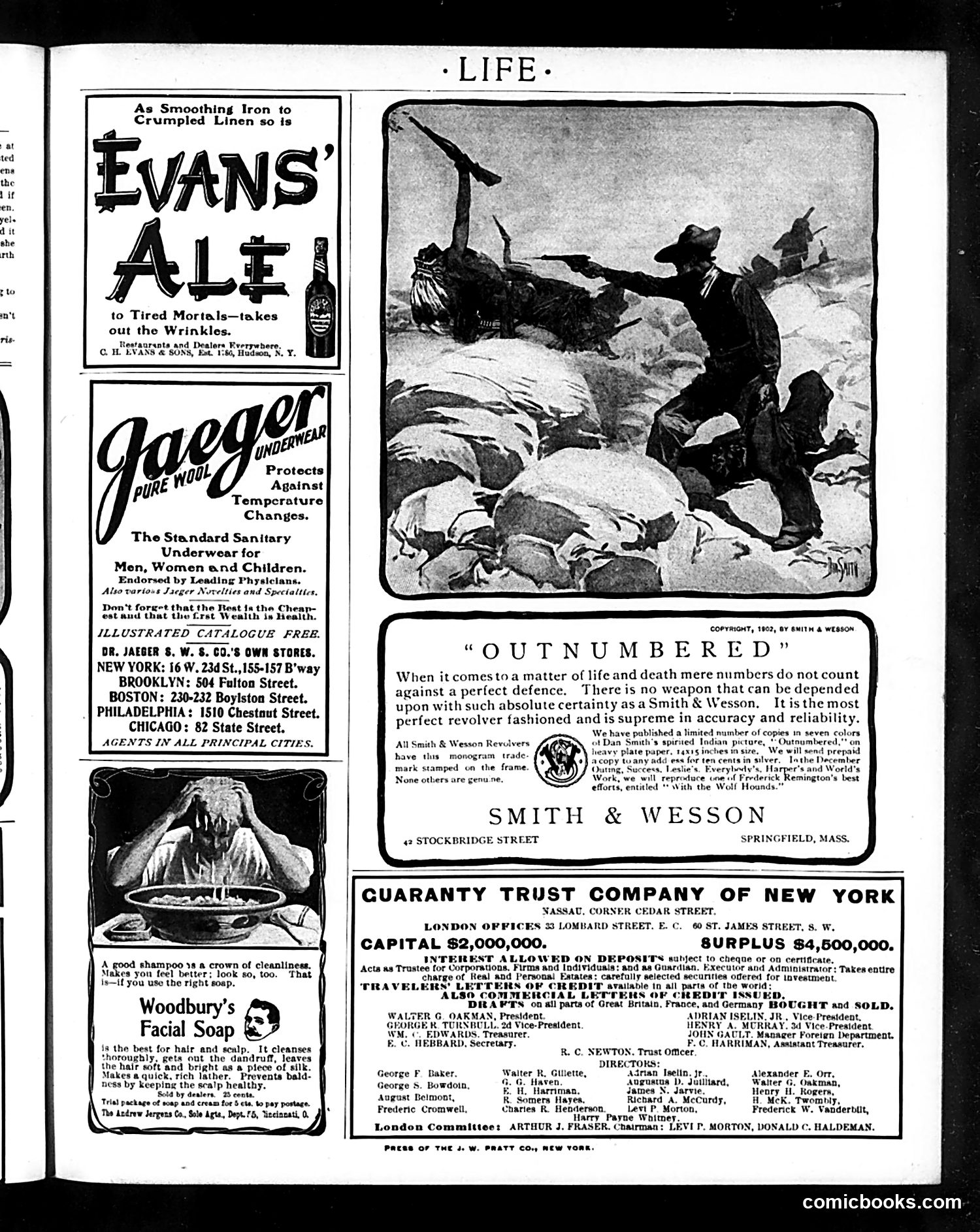
This page is primarily **advertising**, not political satire. The main image shows a dramatic scene titled "Outnumbered"—a Western confrontation where a lone armed man faces multiple Native American opponents. The accompanying text promotes Smith & Wesson revolvers, arguing that numerical disadvantage doesn't matter when one possesses superior weaponry: "When it comes to a matter of life and death mere numbers do not count against a perfect defence." The ad references a painting by Dan Smith and promises to send reproductions to readers. The surrounding ads promote Evans' Ale, Jaeger thermal underwear, Woodbury's Facial Soap, and the Guaranty Trust Company. This reflects early 1900s consumer culture targeting middle and upper-class readers with health, beauty, and financial services products.
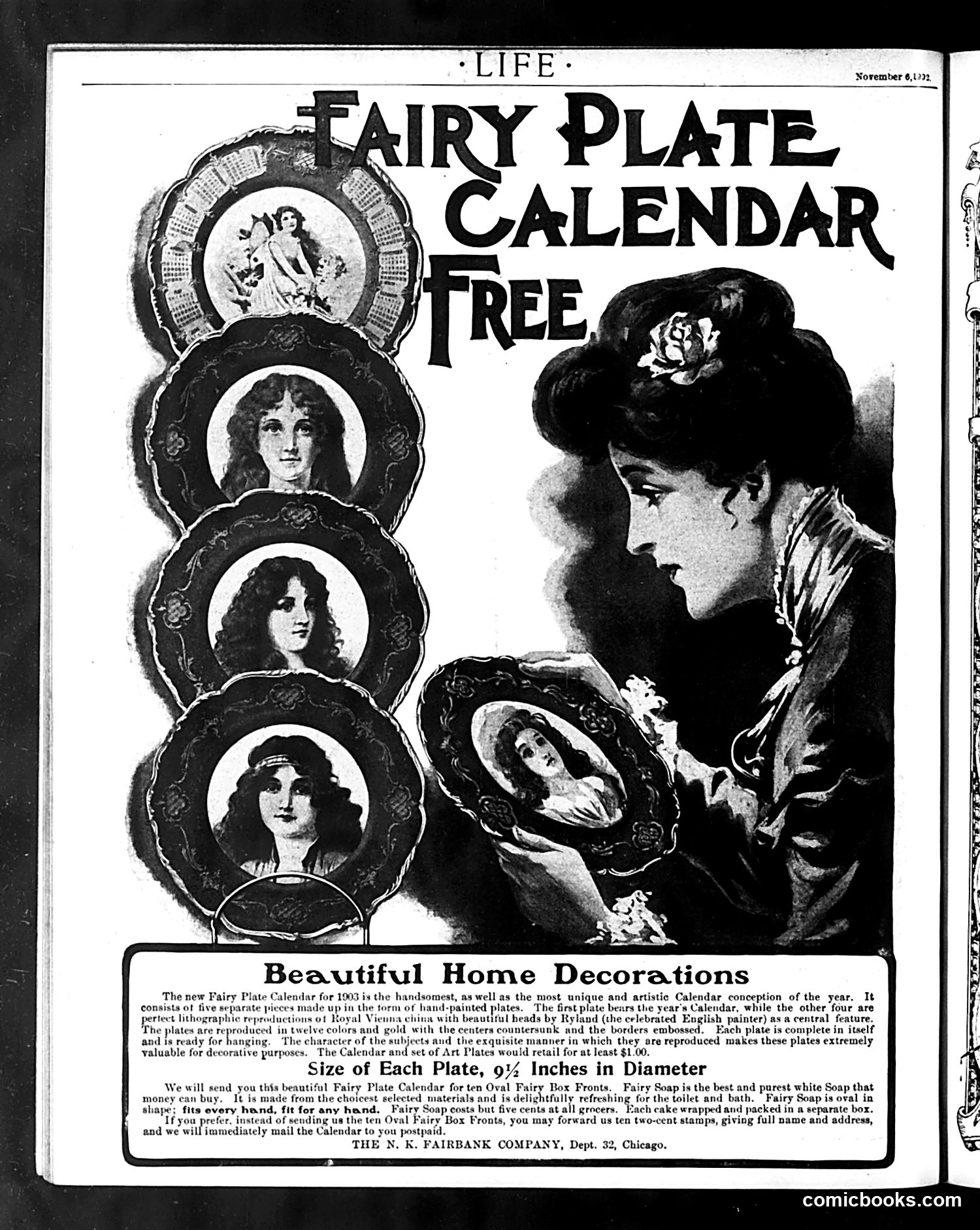
This is primarily a **product advertisement**, not political satire. The N.K. Fairbank Company promoted their "Fairy Soap" by offering a decorative calendar as a premium incentive. **The Offer:** Consumers who collected ten oval Fairy Soap box fronts (or sent ten two-cent stamps) received a set of five decorative plates, 9½ inches in diameter. One plate displayed the 1903 calendar; the other four featured portraits by English painter Ryland. **The Appeal:** Marketed as "Beautiful Home Decorations," these lithographed china plates with gold embossing were positioned as valuable collectibles worth over $1.00—a significant sum in 1903. The accompanying illustration shows a woman admiring the plates. **The Strategy:** This reflects early 20th-century **advertising by premium collectibles**—companies incentivized repeat purchases by offering desirable items, making soap-buying feel like acquiring fine art rather than a routine purchase.