
Life, 1902-11-06 · page 12 of 24
Life — November 6, 1902 — page 12: what you’re looking at
What you’re looking at
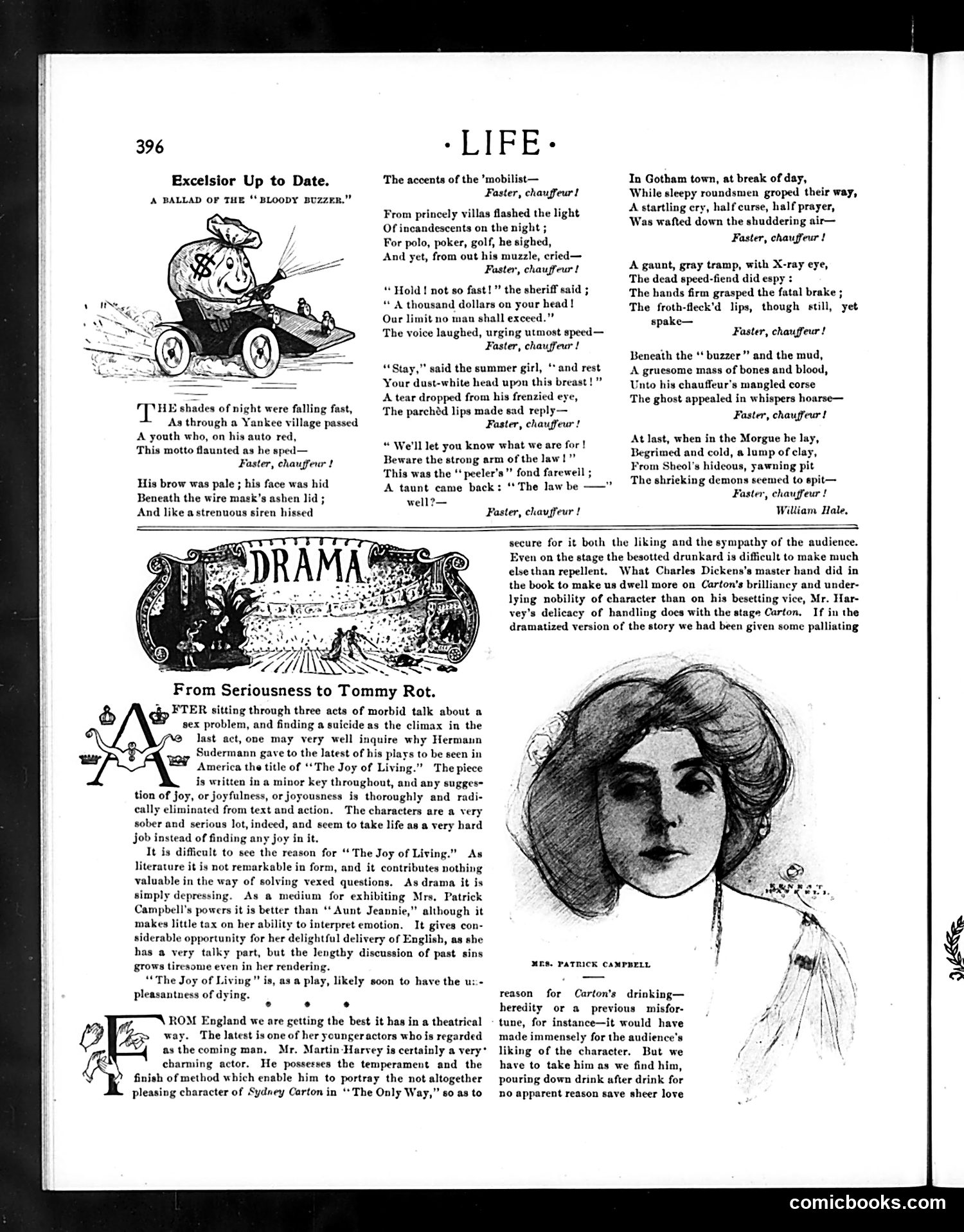
This illustrated ballad satirizes early automobile culture. The cartoon depicts a reckless motorist in a primitive "buzzer" (slang for early automobiles) speeding through a village, causing chaos and death. The poem mockingly recounts how the driver, initially confident and dismissive of speed limits, encounters a sheriff's warning but ignores it. The vehicle ultimately crashes, leaving "a gruesome mass of bones and blood" at a morgue. The satire targets both the dangerous, reckless behavior of early drivers and society's anxiety about new automobile technology. The phrase "Bloody Buzzer" puns on both the vehicle's nickname and the literal bloody consequences of uncontrolled speed—a common concern when automobiles were new and unregulated.
📄 Transcribed text from this page (OCR, searchable)
Machine-transcribed from the original scan — historical spelling and the odd misread are preserved.
396 Excelsior Up to Date. A BALLAD OF THE “BLOODY BUZZER.” TTPHE shades of night were falling fast, As through a Yankee village passed A youth who, on his auto red, This motto flaunted as he sped— Faster, chauffeur ! -LIFE- The accents of the ’mobilist— Faster, chauffeur! From princely villas flashed the light Of incandescents on the night ; For polo, poker, golf, he sighed, And yet, from out his muzzle, eried— Faster, chauffeur! “ Hold | not so fast!” the sheriff said ; “A thousand dollars on your head! Our limit no man shall exceed.” The voice laughed, urging utmost speed— Faster, chauffeur ! “Stay,” said the summer girl, ‘and rest Your dust-white head upon this breast!” A tear dropped from his frenzied eye, The parchéd lips made sad reply— Faster, chauffeur! “ We'll let you know what we are for! Beware the strong arm of the law!” In Gotham town, at break of day, While sleepy roundsmen groped their way, A startling cry, half curse, half prayer, ‘Was wafted down the shuddering air— Faster, chauffeur ! A gaunt, gray tramp, with X-ray eye, The dead speed-fiend did espy : The hands firm grasped the fatal brake ; The froth-fleck'd lips, though still, yet spake— Faster, chauffeur! Beneath the “ buzzer” and the mud, ‘A gruesome mass of bones and blood, Unto his chauffeur’s mangled corse ‘The ghost appealed in whispers hoarse— Faster, chauffeur! At last, when in the Morgue he lay, Begrimed and cold, @ lump of clay, From Sheol’s hideous, yawning pit This was the “peeler’s” fond farewell ; A taunt came back: ‘The law be —' well?— The shrieking demons seemed to spit— Faster, chauffeur ! William Hale, His brow was pale ; his face was hid Beneath the wire mask's ashen lid ; And like a strenuous siren hissed Faster, chausfeur ! secure for it both the liking and the sympathy of the audience. Even on the stage the besotted drunkard is difficult to make much else than repellent. What Charles Dickens’s master hand did in the book to make us dwell more on Carton’s brilliancy and under- lying nobility of character than on his besetting vice, Mr. Har- vey's delicacy of handling docs with the stage Carton. If in the dramatized version of the story we had been given some palliating From Seriousness to Tommy Rot. Gp FTER sitting through three acts of morbid talk about a sex problem, and finding a suicide as the climax in the last act, one may very well inquire why Hermann Sudermann gave to the latest of his plays to be seen in America the title of ‘The Joy of Living.” The piece is written ina minor key throughout, and any sugges= tion of joy, or joyfulness, or joyousness is thoroughly and radi- cally eliminated from text and action. The characters are a very sober and serious lot, indeed, and seem to take life as a very hard Job instead of finding any joy in it. It is difficult to see the reason for “ The Joy of Living.” As literature it is not remarkable in form, and it contributes nothing valuable in the way of solving vexed questions. As drama it is simply depressing. As a medium for exhibiting Mrs. Patrick Campbell's powers it is better than ‘* Aunt Jeannie,” although it makes little tax on her ability to interpret emotion. It gives con- siderable opportunity for her delightful delivery of English, as she has a very talky part, but the lengthy discussion of past sins grows tiresome even in her rendering. “The Joy of Living" is, as a play, likely soon to have the u::- pleasantness of dying. ‘MES. PATRICK CAMPBELL reason for Carton's drinking— ° ° ROM England we are getting the best it has in a theatrical way. The latest is one of her younger actors who is regarded as the coming man. Mr. Martin-Harvey is certainly a very* charming actor. He possesses the temperament and the finish of method which enable him to portray the not altogether pleasing character of Sydney Carton in “The Only Way,” 0 as to heredity or a previous misfor- tune, for instance—it would have made immensely for the audience's liking of the character. But we have to take him as we find him, pouring down drink after drink for no apparent reason save sheer love comicbooks.com