
Life, 1902-11-06 · page 4 of 24
Life — November 6, 1902 — page 4: what you’re looking at
What you’re looking at
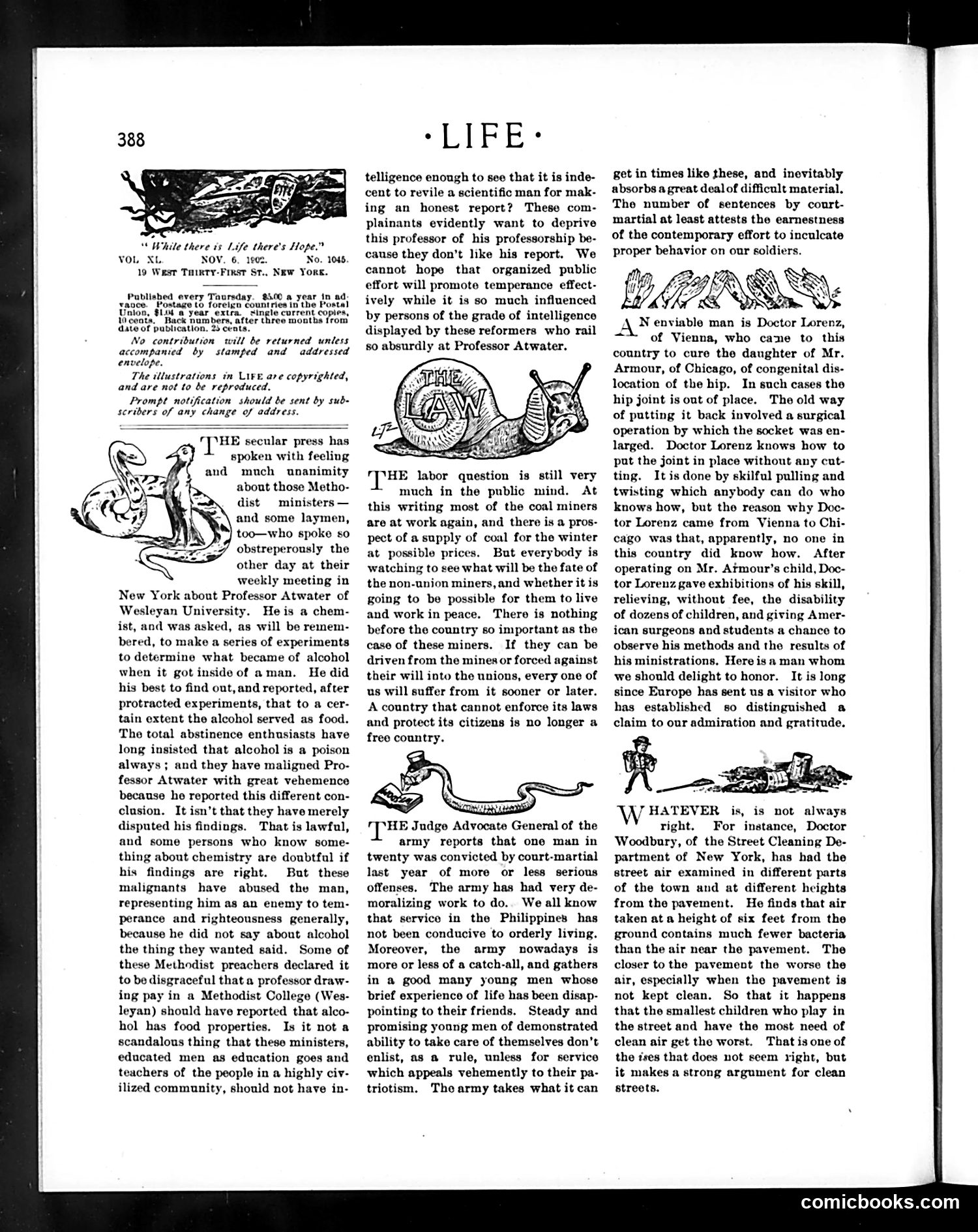
This page contains several editorial commentaries rather than single unified cartoons. The main illustrations appear to be small decorative vignettes rather than political cartoons with clear targets. The text discusses Professor Atwater of Wesleyan University, who conducted experiments on alcohol's effects on humans. Critics accused him of misrepresenting findings, though the article suggests his conclusions were accurate. Other sections address labor disputes among coal miners, court-martial sentencing of soldiers, and Doctor Lorenz of Vienna (a real orthopedic surgeon known for treating congenital hip dislocation). A final item mentions Doctor Woodbury examining street cleanliness in New York. The small illustrations—a snail, figures in motion, and cleaning workers—serve as decorative accompaniment to these social commentary pieces rather than as political satire requiring specific historical context beyond the text provided.
📄 Transcribed text from this page (OCR, searchable)
Machine-transcribed from the original scan — historical spelling and the odd misread are preserved.
“* While there is Life there's Hope.” VOL Xb. NOY. 6. 19 No. 1046. 19 West Tairty-Frest St.. NEw YORE. Pablished overy Taureday.. S400 a year In ace. 1 Torelge Countries is the Postal Union, #1bt'e year estes ‘cingle current copies, A cents, Back numbers, after three months from date of publication, 25 ceats. No contribution will be returned unless accompanied by stamped and addressed envelope. The illustrations in Live are copyrighted, and are not to be reproduced. Prompt notification should be sent by sub- scribers of any change of address. TE secular press has spoken with feeling much unanimity about those Metho- dist ministers — and some laymen, too—who spoke so obstreperously the other day at their weekly meeting in New York about Professor Atwater of Wesleyan University. He is a chem- ist, and was asked, as will be remem- bered, to make a series of experiments to determine what became of alcohol when it got inside of aman. He did his best to find out, and reported, after protracted experiments, that to a cer- tain extent the alcohol served as food. The total abstinence enthusiasts have long insisted that alcohol is a poison always ; and they have maligned Pro- fessor Atwater with great vehemence because he reported this different con- clusion. It isn’t that they have merely disputed his findings. That is lawful, and some persons who know some- thing about chemistry are doubtfal if his findings are right. But these malignants have abused the man, representing him as an enemy to tem- perance and righteousness generally, because he did not say about alcohol the thing they wanted said. Some of these Methodist preachers declared it to be disgraceful that a professor draw- ing pay in a Methodist College (Wes- leyan) should have reported that alco- hol has food properties. Is it not a scandalous thing that these ministers, educated men as education goes and teachers of the people in a highly civ- ilized community, should not have in- and LIPE telligence enough to see that it is inde- cent to revile a scientific man for mak- ing an honest report? These com- plainants evidently want to deprive this professor of his professorship be- cause they don’t like his report. We cannot hope that organized public effort will promote temperance effect- ively while it is so much influenced by persons of the grade of intelligence displayed by these reformers who rail so absurdly at Professor Atwater. ‘HE labor question is still very much in the public mind. At this writing most of the coal miners are at work again, and there is a pros- pect of a supply of coal for the winter at possible prices. But everybody is watching to see what will be the fate of the non-union miners, and whether it is going to be possible for them to live and work in peace. There is nothing before the country so important as the case of these miners. If they can be driven from the mines or forced against their will into the unions, every one of us will suffer from it sooner or later. A country that cannot enforce its laws and protect its citizens is no longer a free country. THE Judge Advocate General of the army reports that one man in twenty was convicted by court-martial last year of more or less serious offenses. The army has had very de- moralizing work to do.. We all know that service in the Philippines has not been conducive to orderly living. Moreover, the army nowadays is more or less of a catch-all, and gathers in a good many young men whose brief experience of life has been disap- pointing to their friends. Steady and promising young men of demonstrated ability to take care of themselves don’t enlist, as a rule, unless for servico which appeals vehemently to their pa- triotism. The army takes what it can get in times like these, and inevitably absorbs a great deal of difficult material. The number of sentences by court- martial at least attests the earnestness of the contemporary effort to inculcate proper behavior on our soldiers. OLRRZ, AL Y enviable man is Doctor Lorenz, en of Vienna, who cane to this country to cure the daughter of Mr. Armour, of Chicago, of congenital dis- location of the hip. In such cases the hip joint is out of place. The old way of putting it back involved a surgical operation by which the socket was en- larged. Doctor Lorenz knows how to put the joint in place without any cut- ting. Itis done by skilful pulling and twisting which anybody can do who knows how, but the reason why Doc- tor Lorenz came from Vienna to Chi- cago was that, apparently, no one in this country did know how. After operating on Mr. Armour’s child, Doc- tor Lorenz gave exhibitions of his skill, relieving, without fee, the disability of dozens of children, and giving Amer- ican surgeons and students a chance to observe his methods and the results of his ministrations. Here is a man whom we should delight to honor. It is long since Europe has sent us a visitor who has established so distinguished a claim to our admiration and gratitude, —: W HATEVER is, is not always right. For instance, Doctor Woodbury, of the Street Cleaning De- partment of New York, has had the street air examined in different parts of the town and at different heights from the pavement. He finds that air taken at a height of six feet from the ground contains much fewer bacteria than the air near the pavement. The closer to the pavement the worse the air, especially when the pavement is not kept clean. So that it happens that the smallest children who play in the street and have the most need of clean air get the worst. That is one of the tses that does not seem right, but it makes a strong argument for clean streets. comicbooks.com