
Life, 1902-11-06 · page 6 of 24
Life — November 6, 1902 — page 6: what you’re looking at
What you’re looking at
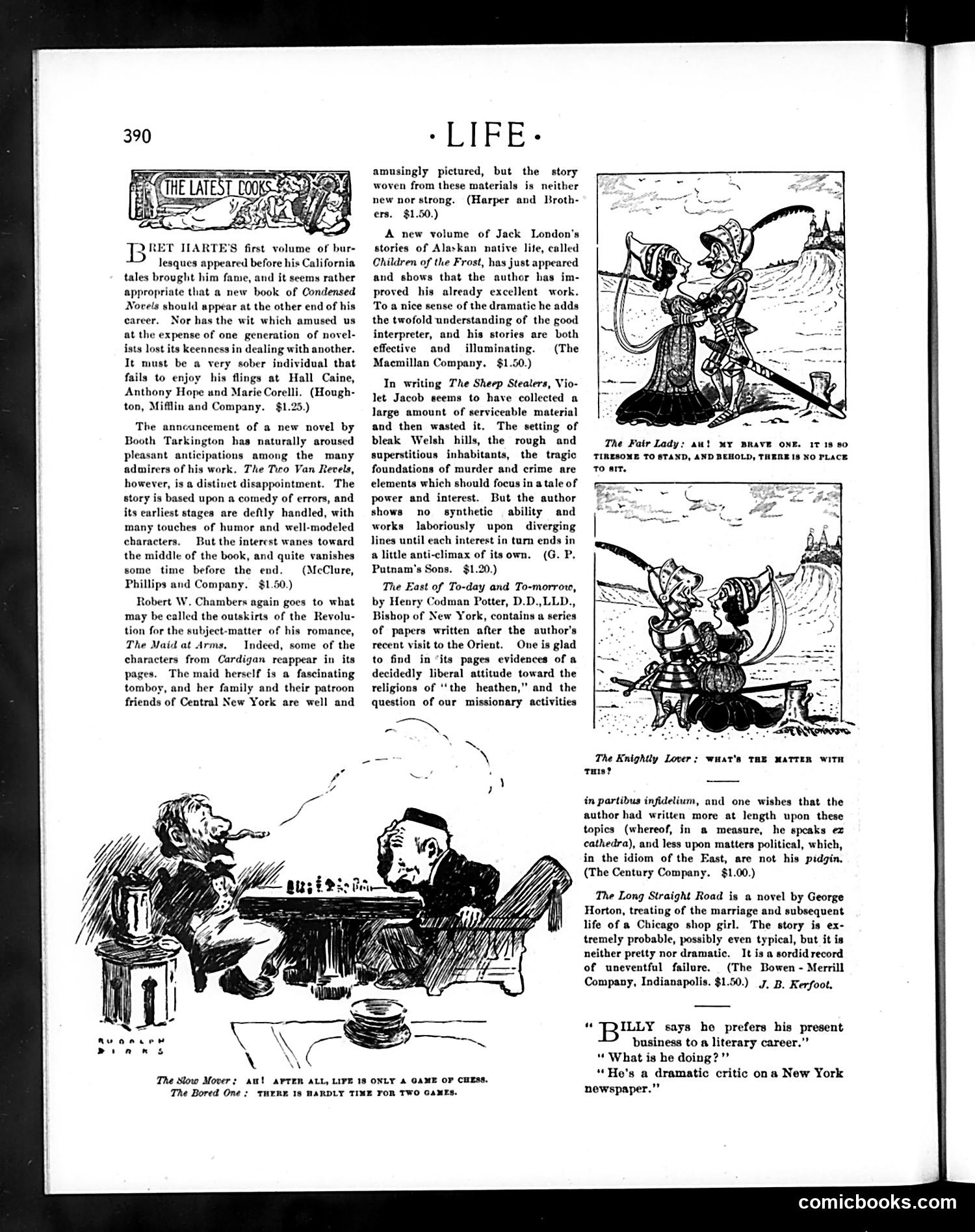
This page contains book reviews rather than political cartoons. The illustrations are literary in nature—sketches accompanying commentary on recently published novels. The three captioned drawings appear to be humorous scenes from the books being reviewed: "The Fair Lady," "The Knightly Lover," and illustrations labeled "The Slow Mover" and "The Bored One" (depicting two men at a chess game, with the caption "After all, life is only a game of chess" and "There is hardly time for two games"). The chess illustration is the only item with satirical intent—a gentle joke about how chess players consume time. The page functions primarily as a literary review section rather than as political or social satire. The drawings serve to entertain readers while discussing contemporary fiction.
📄 Transcribed text from this page (OCR, searchable)
Machine-transcribed from the original scan — historical spelling and the odd misread are preserved.
‘T ILARTE'S first volume of bur- lesques appeared before his California tales brought him fame, and it seems rather appropriate that a new book of Condensed Novels should appear at the other end of his career. Nor has the wit which amused us at the expense of one generation of novel- ists lost its keenness in dealing with another. It must be a very sober individual that fails to enjoy his flings at Hall Caine, Anthony Hope and Marie Corelli. (Hough- ton, Mifflin and Company. $1.25.) The announcement of a new novel by Booth Tarkington has naturally aroused pleasant anticipations among the many admirers of his work, The Tiro Van Revels, however, is a distinct disappointment. The story is based upon a comedy of errors, and its earliest stages are deftly handled, with many touches of humor and well-modeled characters. But the intercst wanes toward the middle of the book, and quite vanishes some time before the end. (McClure, Phillips and Company. $1.50.) Robert W. Chambers again goes to what may be called the outskirts of the Revolu- tion for the subject-matter of his romance, The Maid at Arms, Indeed, some of the characters from Cardigan reappear in its pages. The maid herself is a fascinating tomboy, and her family and their patroon friends of Central New York are well and «LIPE- amusingly pictured, but the story woven from these materials is neither new nor strong. (Harper and Broth- ers. $1.50.) A new volume of Jack London's stories of Alaskan native lite, called Children of the Frost, has just appeared and shows that the author has im- proved his already excellent work. To a nice sense of the dramatic he adds the twofold understanding of the good interpreter, and his stories are both effective and illuminating. (The Macmillan Company. $1.50.) In writing The Sheep Stealers, Vio- let Jacob seems to have collected a large amount of serviceable material and then wasted it. The setting of bleak Welsh hills, the rough and superstitious inhabitants, the tragic foundations of murder and crime are elements which should focus in atale of power and interest. But the author shows no synthetic ability and works laboriously upon diverging lines until each interest in turn ends in a little anti-climax of itsown. (G. P. Putnam's Sons. $1.20.) The East of To-day and To-morrow, by Henry Codman Potter, D.D.,LLD., Bishop of New York, contains a series of papers written after the author's recent visit to the Orient. One is glad to find in ‘its pages evidences of a decidedly liberal attitude toward the religions of ‘‘the heathen,” and the question of our missionary activities f AN Ww / Ds The Fair Lady: au! MY BRAVE ONE. 17 18 80 TIRESOME TO STAND, AND BEHOLD, THERE 18 NO PLACE To art. The Knightly Lover; wat's THE MATTER WITH tus? in partibus infidelium, and one wishes that the author had written more at length upon these topics (whereof, in a measure, he speaks ex cathedra), and less upon matters political, which, in the idiom of the East, are not his pidgin, (The Century Company. $1.00.) The Long Straight Road is a novel by George Horton, treating of the marriage and subsequent life of a Chicago shop girl. The story is ex- tremely probable, possibly even typical, but it is neither pretty nor dramatic. It is a sordid record of uneventful failure. (The Bowen - Merrill Company, Indianapolis. $1.50.) J, B. Kerfoot, “ BH says ho prefers his present business to a literary career.” “ What is he doing?” “He's a dramatic critic ona New York The Slow Mover: au! APTER ALL, LIFE 18 ONLY 4 GAME OF CHESS. ” The Bored One; THERE 18 BARDLY TIME FOR TWO GAMES. newspaper. comicbooks.com