
A complete issue · 22 pages · 1902
Life — October 9, 1902
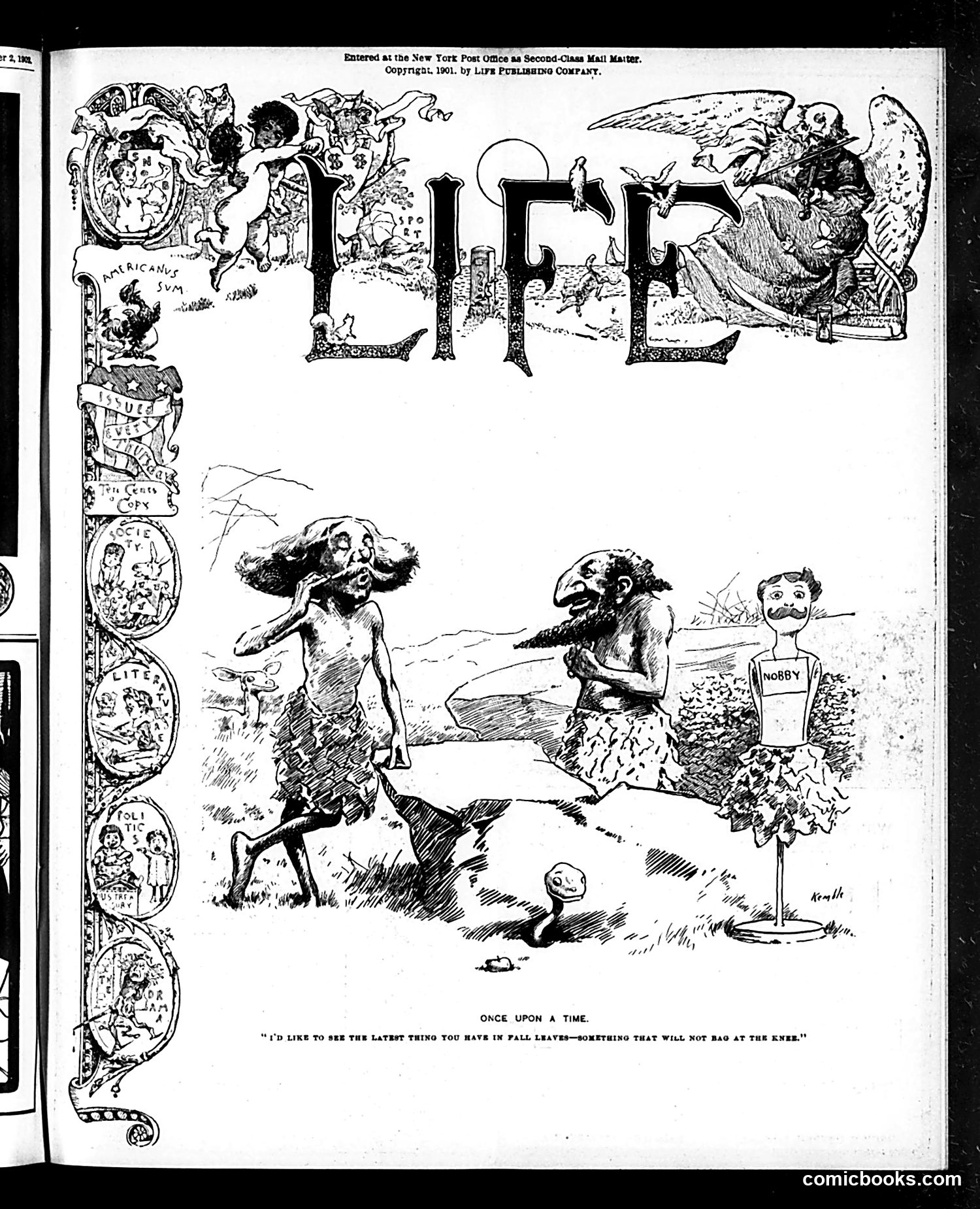
This page from Life magazine (copyright 1901) features a fairy-tale themed cartoon titled "Once Upon a Time." The bottom caption reads: "I'd like to see the latest thing too have in fall leaves—something that will not bad at the end." The cartoon depicts characters in a pastoral setting discussing fashion trends. One figure wears a shirt labeled "NOBBY" (slang for fashionable). The satirical point appears to mock fall fashion pretensions—specifically, the desire for clothing made from fall leaves that won't deteriorate by season's end, an obvious impossibility. This is gentle social satire targeting fashion-conscious society's absurd seasonal demands and aspirations for impractical luxury items. The ornate left border contains decorative emblems typical of Life's design aesthetic from this era.
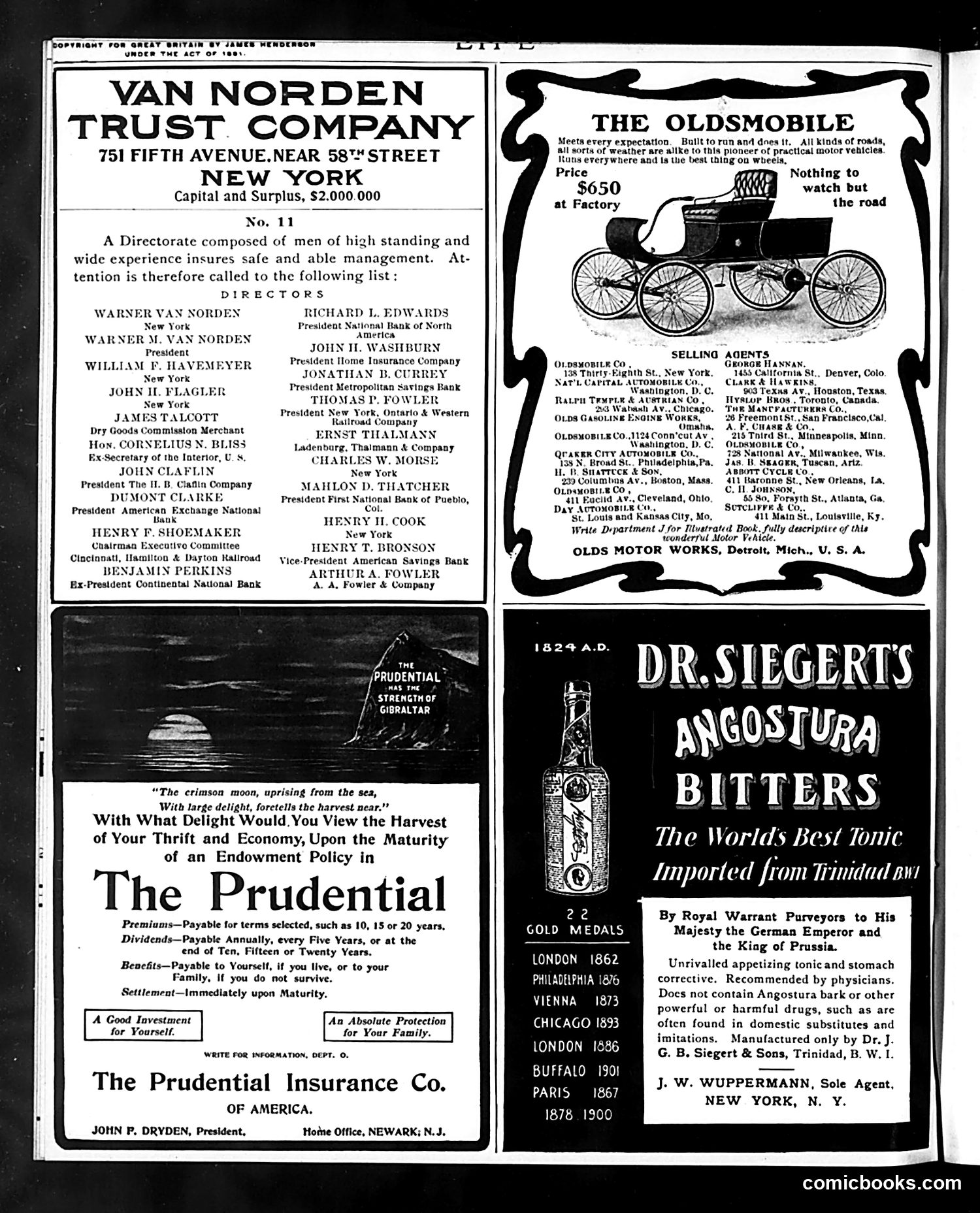
This page is **primarily advertising**, not satirical content. It contains four commercial advertisements: 1. **Van Norden Trust Company** (top left) — lists the company's directorate of prominent businessmen 2. **The Oldsmobile** (top right) — automobile advertisement featuring an early motorcar, priced at $650 3. **The Prudential Insurance Company** (bottom left) — endowment insurance policy with poetic tagline about harvests and thrift 4. **Dr. Siegert's Angostura Bitters** (bottom right) — imported medicinal tonic from Trinidad, marketed as a stomach corrective The Prudential ad is the only one with quasi-artistic content: a moonlit seascape accompanying insurance messaging about economic security for families. No political satire or caricature appears on this page.
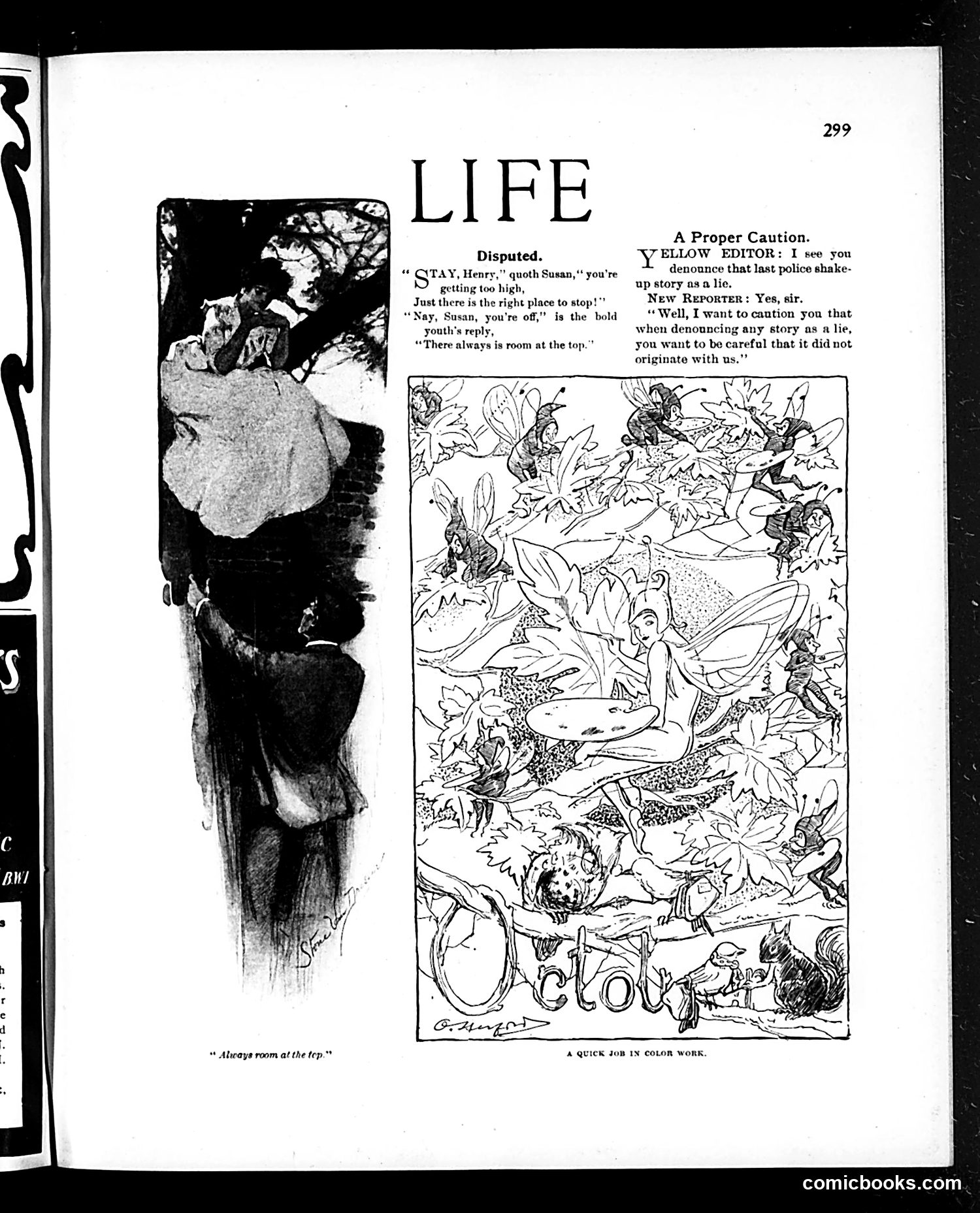
This page contains two separate items: **"Disputed"** (top): A dialogue between Susan and Henry about climbing too high, with Henry asserting "There always is room at the top." The accompanying sketch shows a figure ascending, likely satirizing ambition and competitive social climbing—a common turn-of-the-century theme. **"A Proper Caution"** (right): A conversation between a Yellow Editor and New Reporter about cautiously attributing stories as lies to avoid legal liability. This is workplace satire about journalistic ethics and the risks of publishing unverified claims. **"A Quick Job in Color Work"** (bottom right): An illustration of fairies in a garden scene, appears to be decorative rather than satirical. The page reflects early-1900s concerns about ambition, journalistic responsibility, and editorial standards.
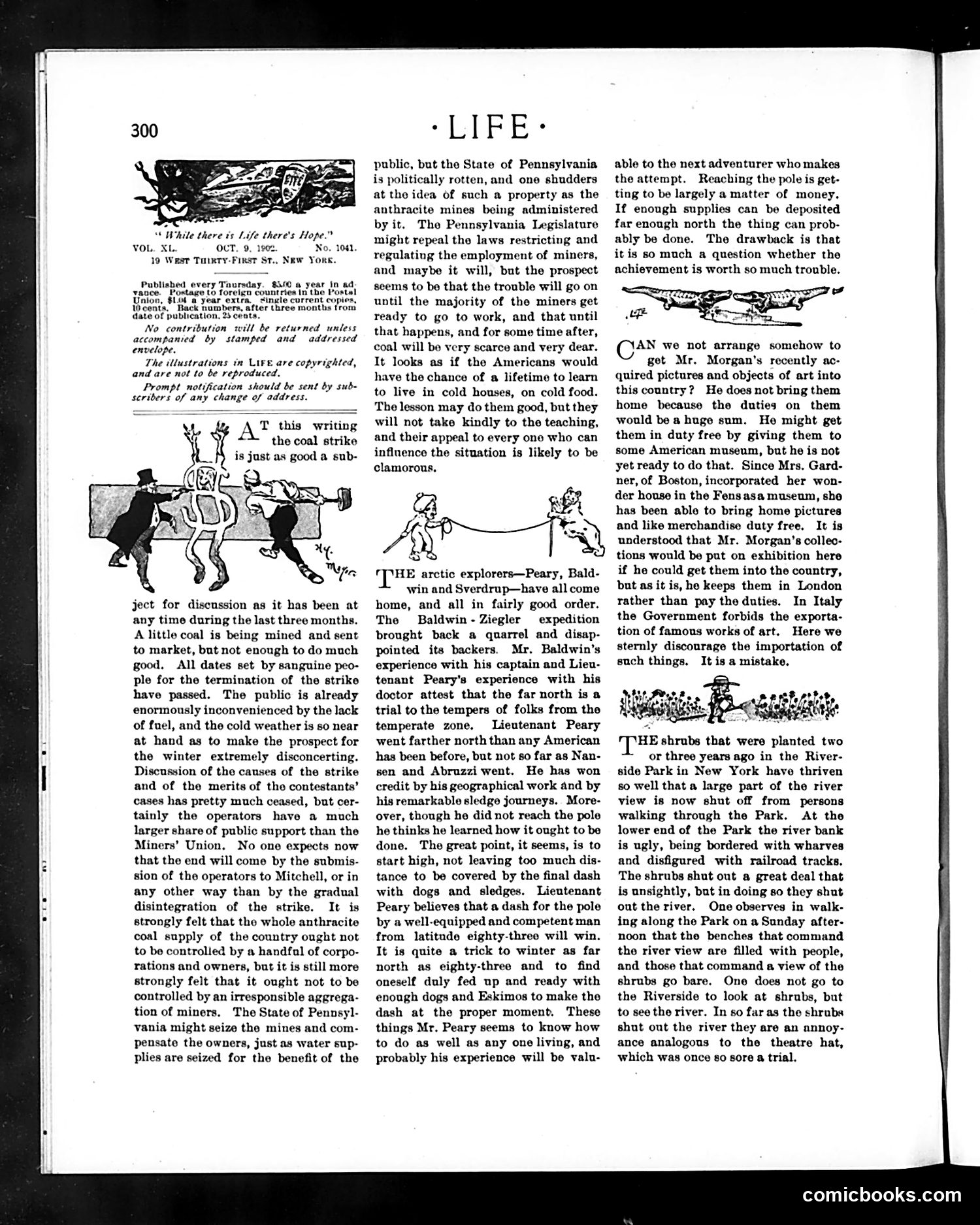
The page contains three illustrated vignettes satirizing American social issues: 1. **Top cartoon**: Shows figures in formal dress apparently "discussing" the coal strike—likely referencing the contentious 1921 anthracite coal labor dispute mentioned in the text. The satire suggests strikes are merely "good subjects for discussion" rather than being seriously addressed. 2. **Middle cartoon**: Depicts arctic explorers (Peary, Baldwin, Sverdup) with a rope-pulling scene, illustrating the text's discussion of polar expeditions and their challenges—possibly mocking the competitive nature of exploration or the physical hardships involved. 3. **Bottom section**: References the Riverside Park shrubs controversy, satirizing how riverfront improvements fail to improve public access or enjoyment—the shrubs literally obscure views of the river they're meant to enhance. The overall tone critiques governmental inaction and failed urban planning.
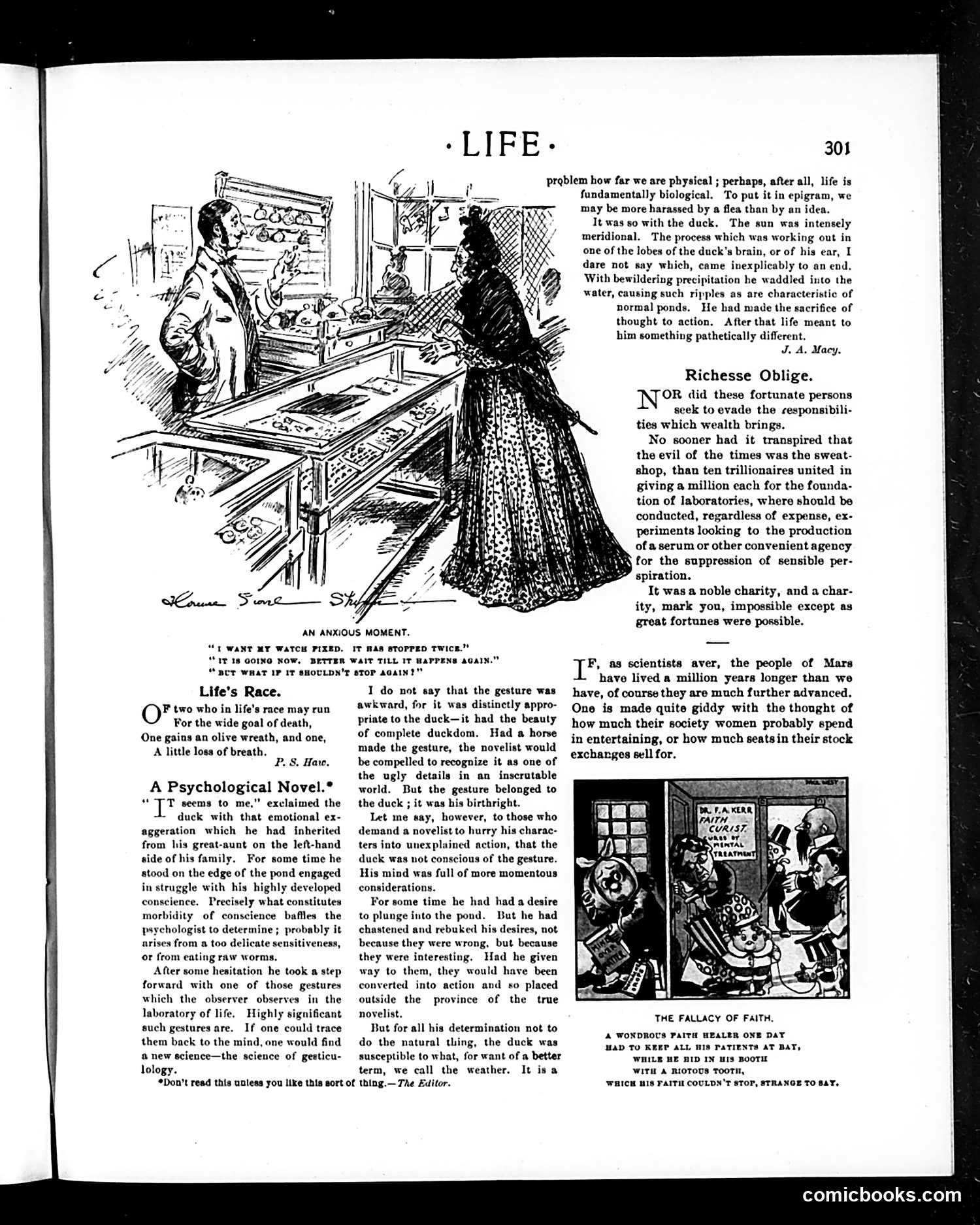
This page contains three separate satirical pieces: 1. **"An Anxious Moment"** (top): A sketch showing a man at what appears to be a scientific apparatus while a woman watches. The caption references a broken watch, using the mechanical malfunction as a metaphor for relationship tension. The humor plays on the man's inability to fix something, questioning his competence. 2. **"A Psychological Novel"** (middle): A lengthy editorial mocking psychological analysis of animal behavior—specifically a duck's "consciousness" and "morbidity of conscience." It satirizes pseudo-scientific attempts to attribute human emotional complexity to animals. 3. **"The Fallacy of Faith"** (bottom right): A cartoon mocking faith healers or alternative medicine practitioners who claim to heal patients despite lacking actual medical qualifications or understanding. The page overall ridicules pseudoscience and overinterpretation of behavior.
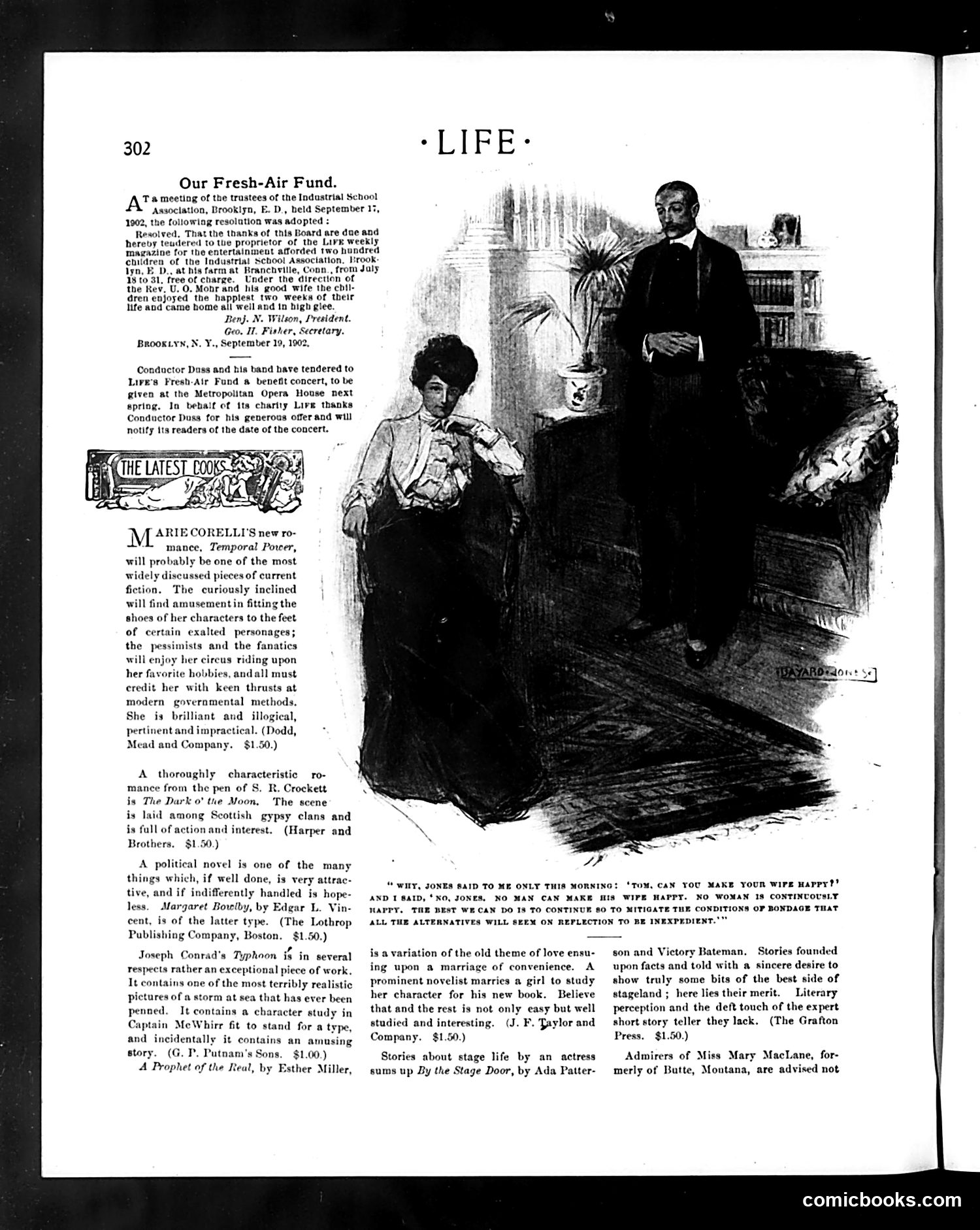
This page features a single cartoon captioned "WHY, JONES SAID TO ME ONLY THIS MORNING: 'TOM, CAN YOU MAKE YOUR WIFE HAPPY?' AND I SAID, 'NO, JONES. NO MAN CAN MAKE HIS WIFE HAPPY...'" The cartoon depicts a domestic scene with a man speaking to what appears to be his wife or a female companion. The joke satirizes marital discord and contemporary attitudes about marriage—specifically the impossibility of satisfying spouses. This reflects early 1900s social commentary on gender relations and matrimonial expectations. The remainder of the page contains book reviews under "The Latest Books," discussing new novels and their merits. The cartoon's humor relies on recognizing the sardonic, cynical attitudes toward marriage common in the era's satirical publications.
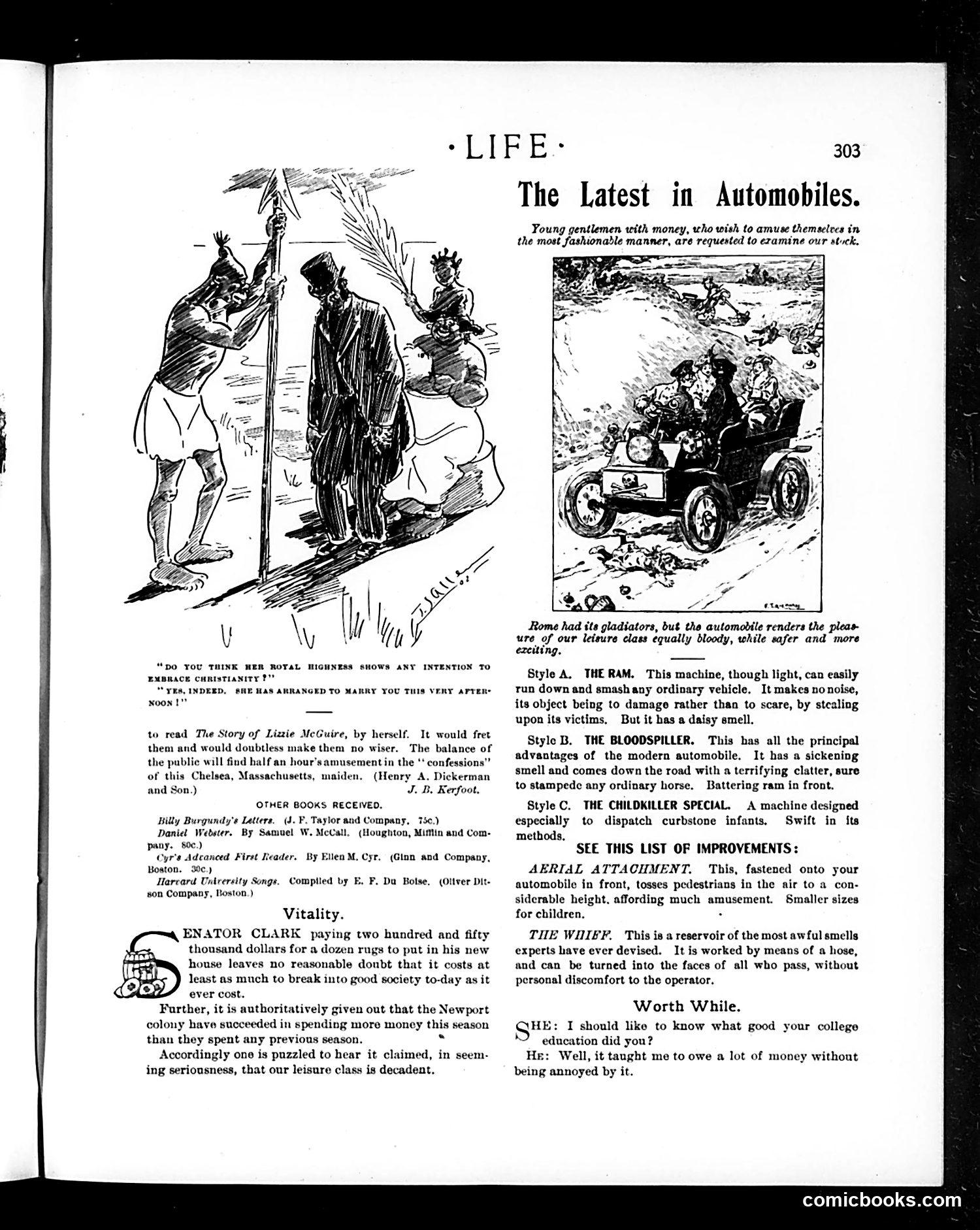
This page satirizes the early automobile era through "The Latest in Automobiles," featuring humorous fictional car models: **The Left Cartoon** depicts what appears to be a colonial or biblical scene where figures discuss religion, titled with a quote about "Royal Highness" and "Christianity"—likely mocking wealthy society's pretensions. **The Right Section** presents invented automobile "styles" with names like "THE RAM" (designed to damage rather than scare), "THE BLOODSPILLER" (emitting terrible smells), and "THE CHILDKILLER SPECIAL" (for dispatching infants). These grotesque names sarcastically critique actual automobile dangers—early cars were genuinely hazardous to pedestrians and society, yet treated as desirable luxury items by the wealthy. The satire mocks how fashionable society embraces dangerous technology without acknowledging its social costs.
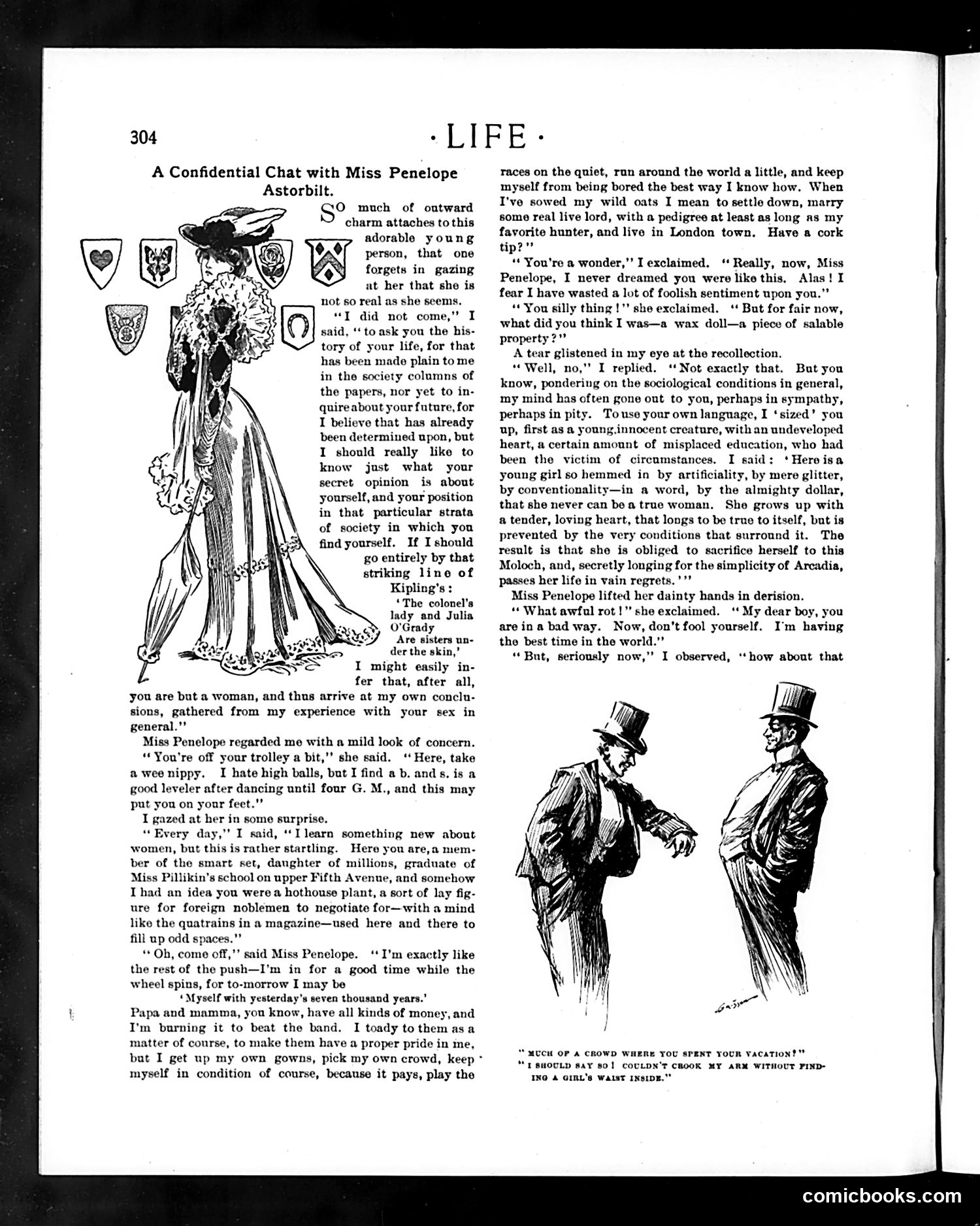
This satirical article mocks wealthy young women of the American upper class. Miss Penelope represents a fictional heiress educated at exclusive institutions like Miss Pillikin's school on Fifth Avenue. The satire targets her superficial worldview: she speaks casually about wealth, travel, marriage prospects, and social conventions while claiming independence. The cartoon critiques how privileged women were constrained by artificiality and social expectations despite their advantages. The dialogue suggests Miss Penelope seeks excitement but remains trapped by her class position and gender roles—she can "pick her own gown" and travel, yet remains fundamentally limited by her status. The two bottom sketches of men in top hats appear to illustrate social encounters referenced in the text.
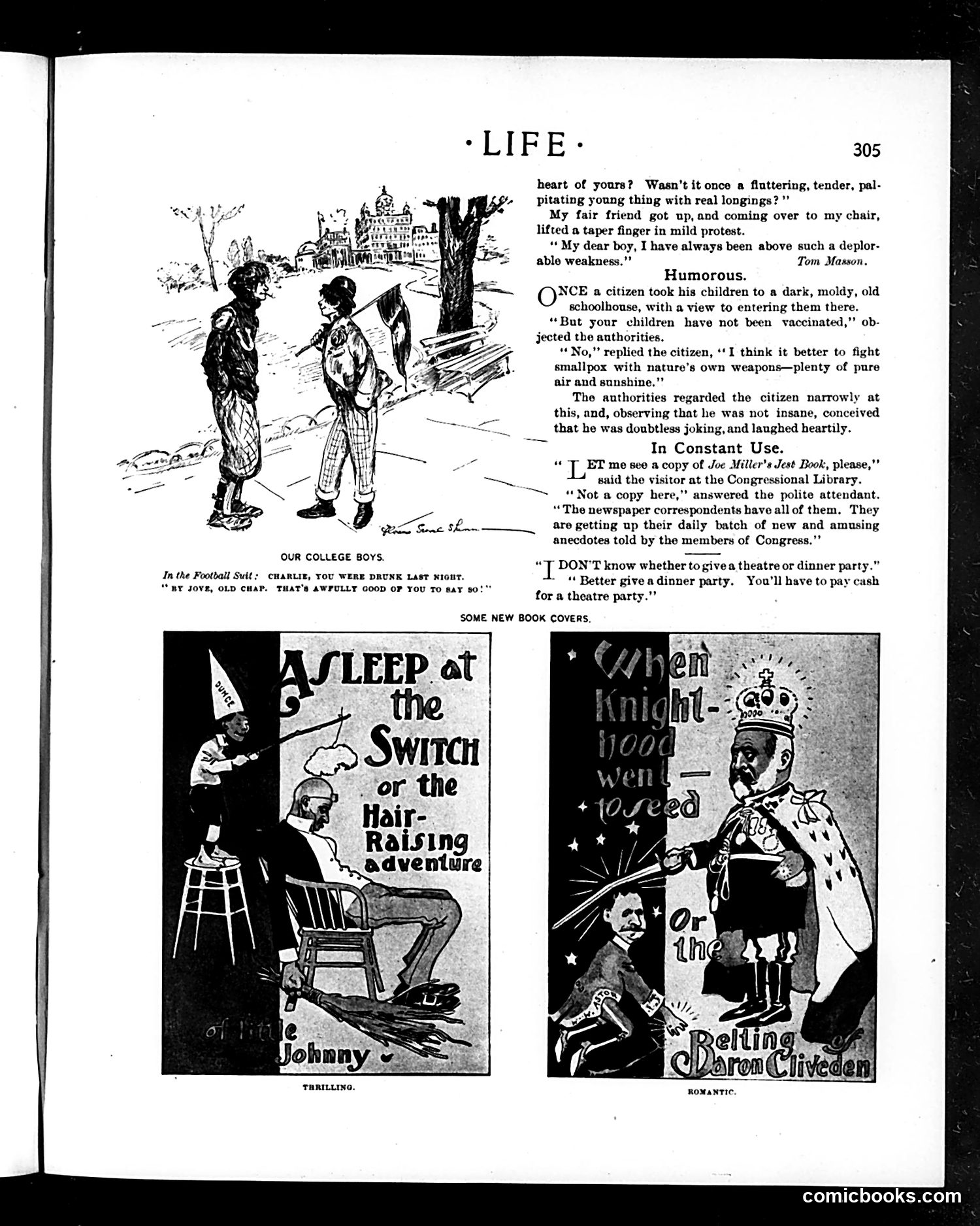
This page from *Life* magazine contains humor pieces and book cover advertisements rather than political cartoons. The main cartoon shows two college boys, with dialogue about one having drunk too much the previous night. The humor is domestic/social rather than political. The three short humor pieces mock everyday situations: a citizen arguing against smallpox vaccination using "natural" remedies, a librarian noting that newspaper correspondents constantly request Joe Miller's *Jests Book*, and a debate about whether dinner parties are preferable to theater parties for entertainment. Below are advertisements for two book covers: *Asleep at the Switch* (described as "thrilling") and *When Knighthood Was in Flower* or *Belting Baron Civveden* (marked "romantic"). The page reflects early 20th-century American magazine humor—light, social satire without partisan political content.
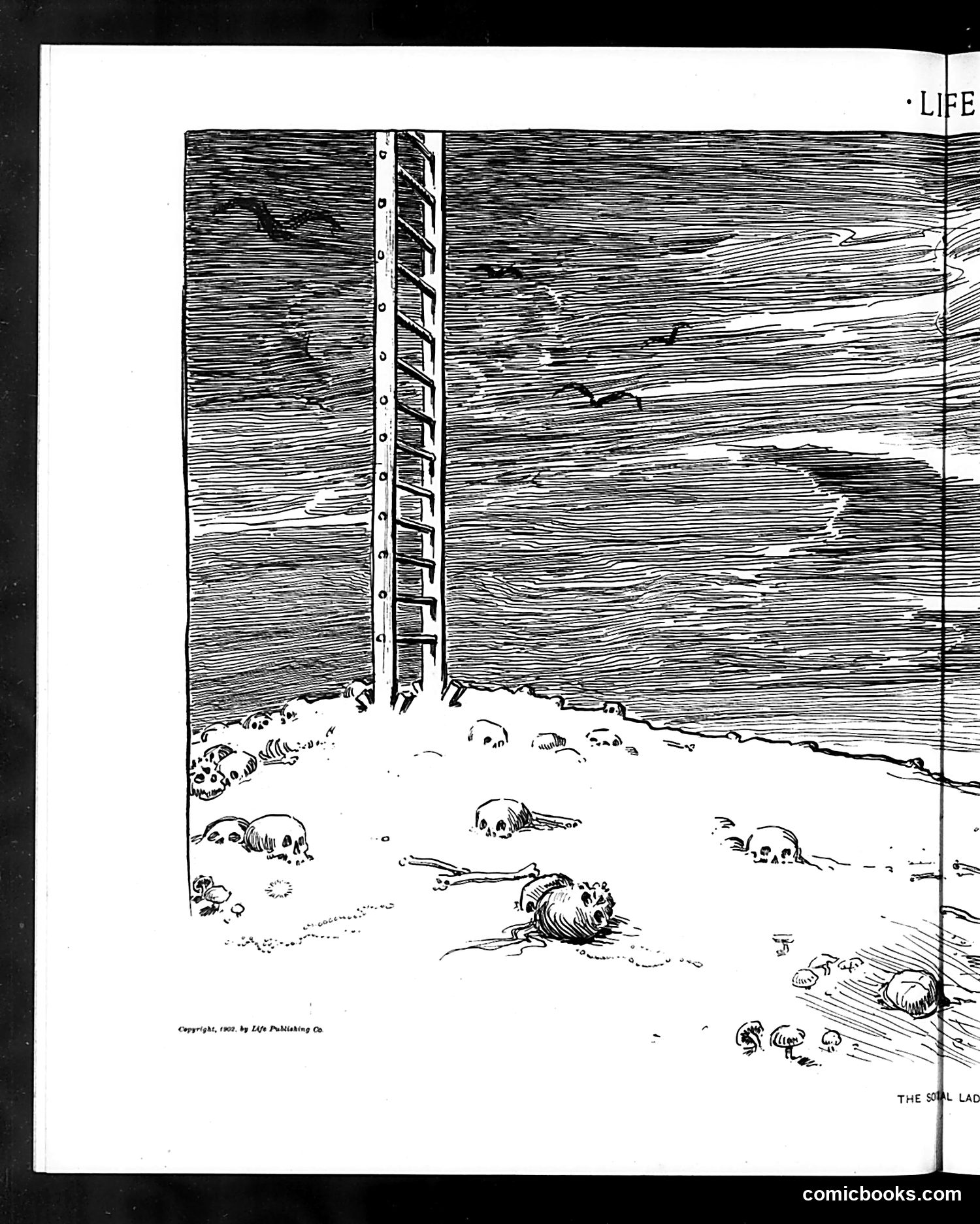
This is a darkly satirical illustration showing a beach or shoreline littered with human skulls and skeletal remains. A tall industrial structure (appears to be a factory or pier) dominates the left side. The water in the background shows horizontal line work suggesting turbulent or polluted conditions. The copyright attribution reads "Copyright, 1908 by Life Publishing Co," and partial text at bottom right reads "THE SOUL LAD[...]" (likely "The Soul Ladder" or similar). **The satire likely critiques**: Industrial development's human cost—possibly referencing industrial accidents, worker deaths, or the dehumanizing effects of rapid industrialization in early 1900s America. The juxtaposition of the imposing industrial structure with the graveyard of human remains suggests industrialization as a death machine. Without the full caption and context, the exact target remains somewhat unclear, but the graphic imagery unmistakably comments on industrial society's lethal consequences.
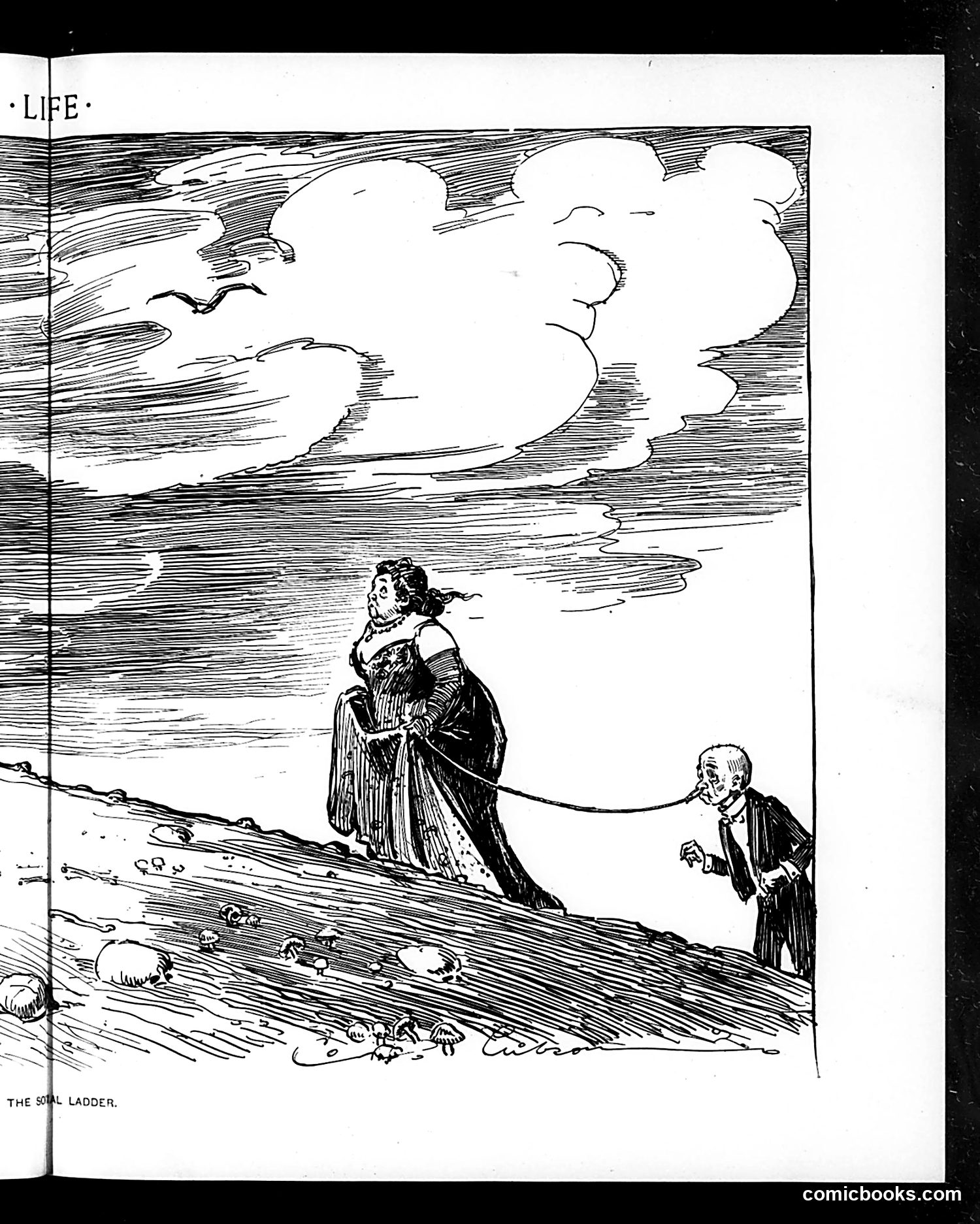
This allegorical cartoon depicts a woman climbing a rope ladder while a small, bald man below holds the rope steady. The title "The Soul Ladder" suggests this illustrates spiritual or moral ascension. The imagery appears to reference Victorian-era anxieties about gender roles and women's advancement. The woman, dressed in period clothing, literally depends on a man to support her upward progress—a commentary on women's social dependency. The clouds above suggest aspiration toward higher ideals or heaven. The satirical point likely critiques either women's limitations in society or contemporary debates about women's independence and education. Without additional context about the specific publication date, the exact social issue referenced remains unclear, though the visual metaphor of dependency during upward mobility is unmistakable.
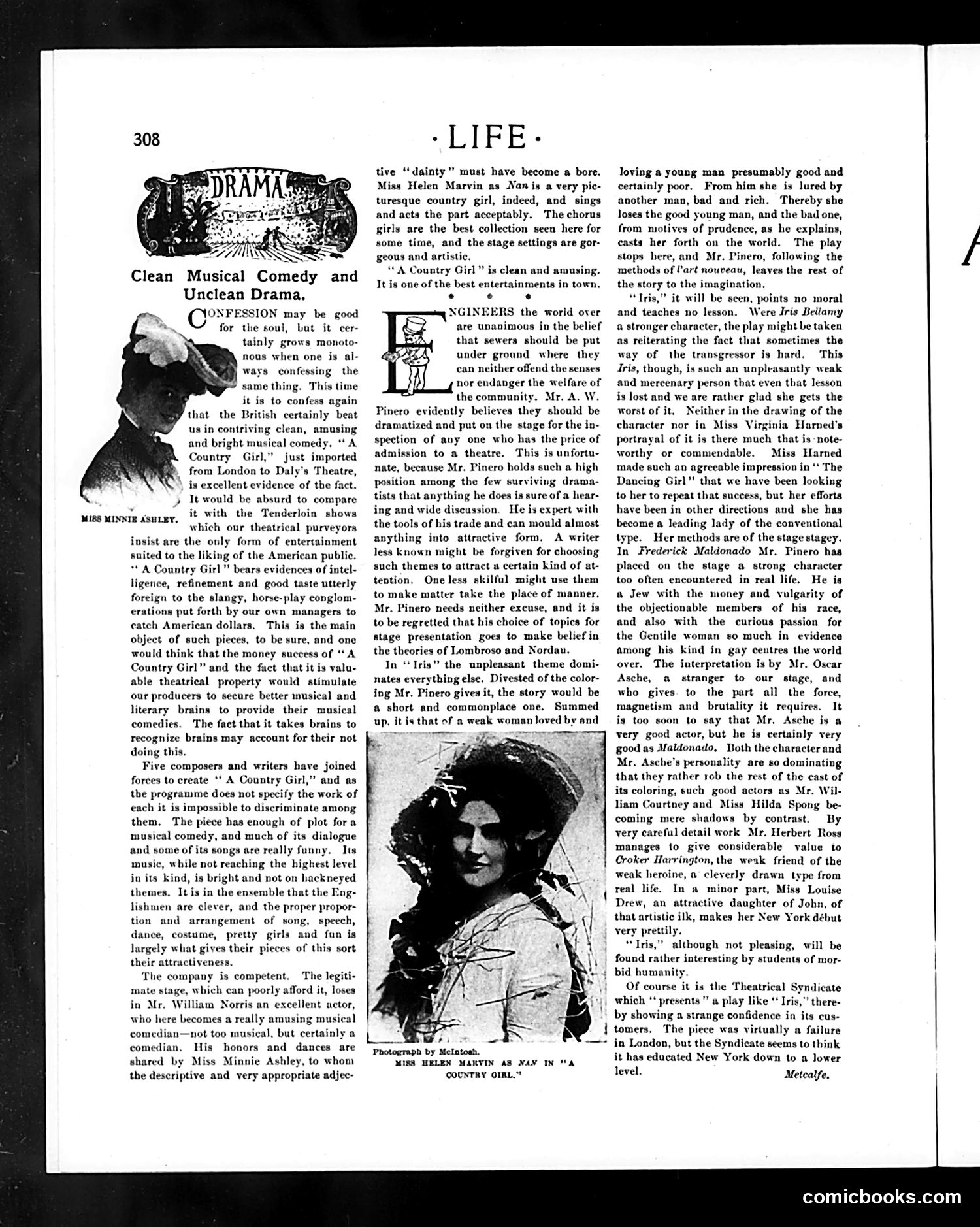
This page reviews theatrical productions, primarily discussing "A Country Girl," a musical comedy imported from London's Daly's Theatre. The review praises the show as clean entertainment featuring actress Miss Minnie Ashley, though it notes the plot is somewhat thin. The main photograph shows **Miss Helen Marvin as "Man" in "A Country Girl."** The reviews discuss various theatrical productions including "Engineers," "Iris," and "Wig" — critiquing their moral content and artistic merit. The text emphasizes preferences for wholesome entertainment over morally questionable themes. This reflects early 1900s theatrical criticism emphasizing propriety and "clean" entertainment as markers of quality, contrasting with more sensational dramatic works of the period.
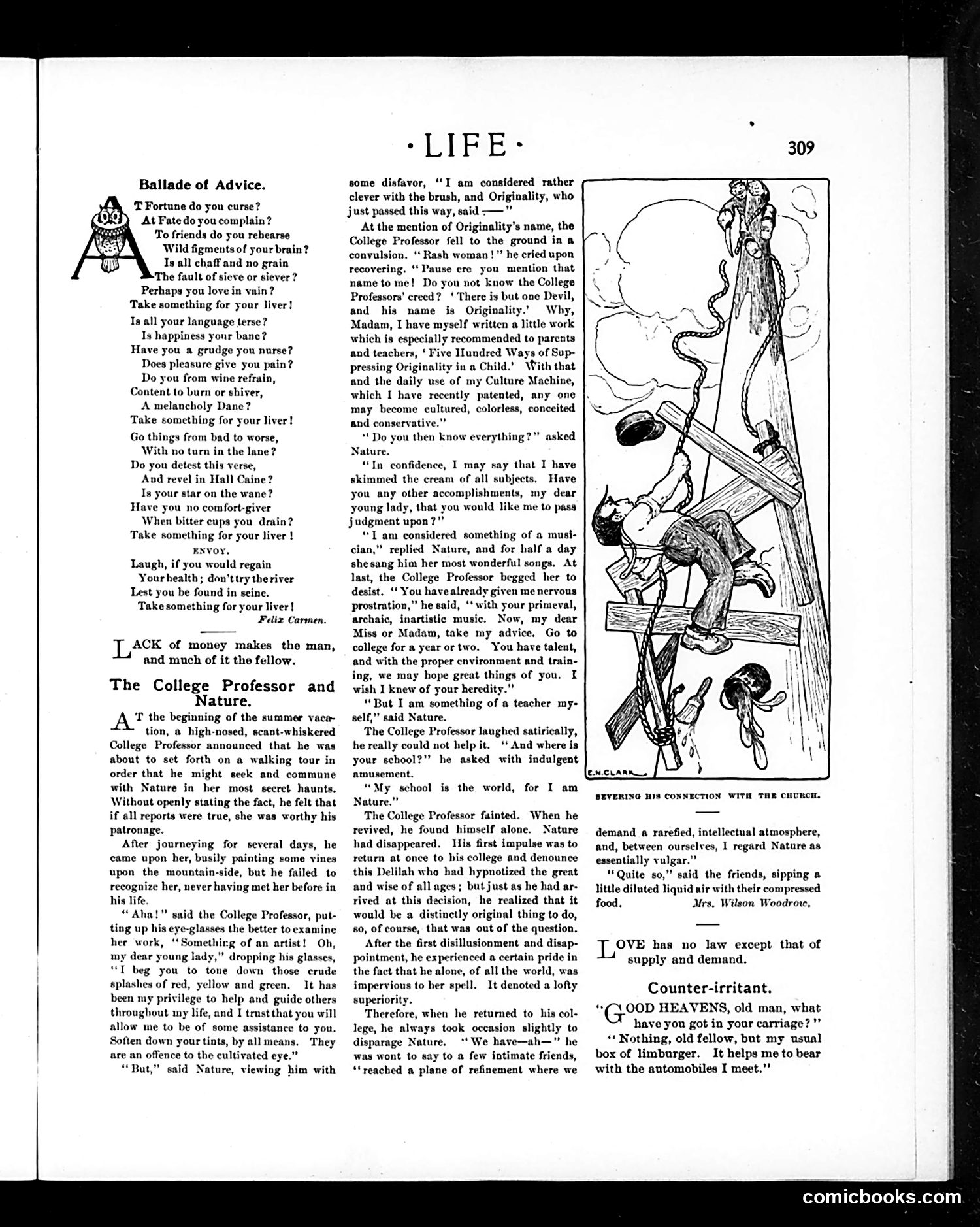
This satirical story mocks academic pretension and institutional education's hostility toward genuine creativity. The College Professor—a pompous academic archetype—encounters Nature herself while on a walking tour, but fails to recognize her. He condescendingly critiques her artistic work and boasts of his patented "Culture Machine" and his book on "Five Hundred Ways of Suppressing Originality in a Child." The satire's target: educators who have memorized conventional knowledge but lack imagination, who view originality as dangerous, and who believe formal training can "improve" natural talent. Nature's response—that she is "something of a teacher" herself—delivers the punchline: true education comes from nature and experience, not stuffy collegiate institutions. The cartoon illustrates Nature as an elegant female figure, while the Professor represents institutional arrogance divorced from reality. This reflects late 19th/early 20th-century tensions between Romantic ideals of nature and industrial-age educational conformity.
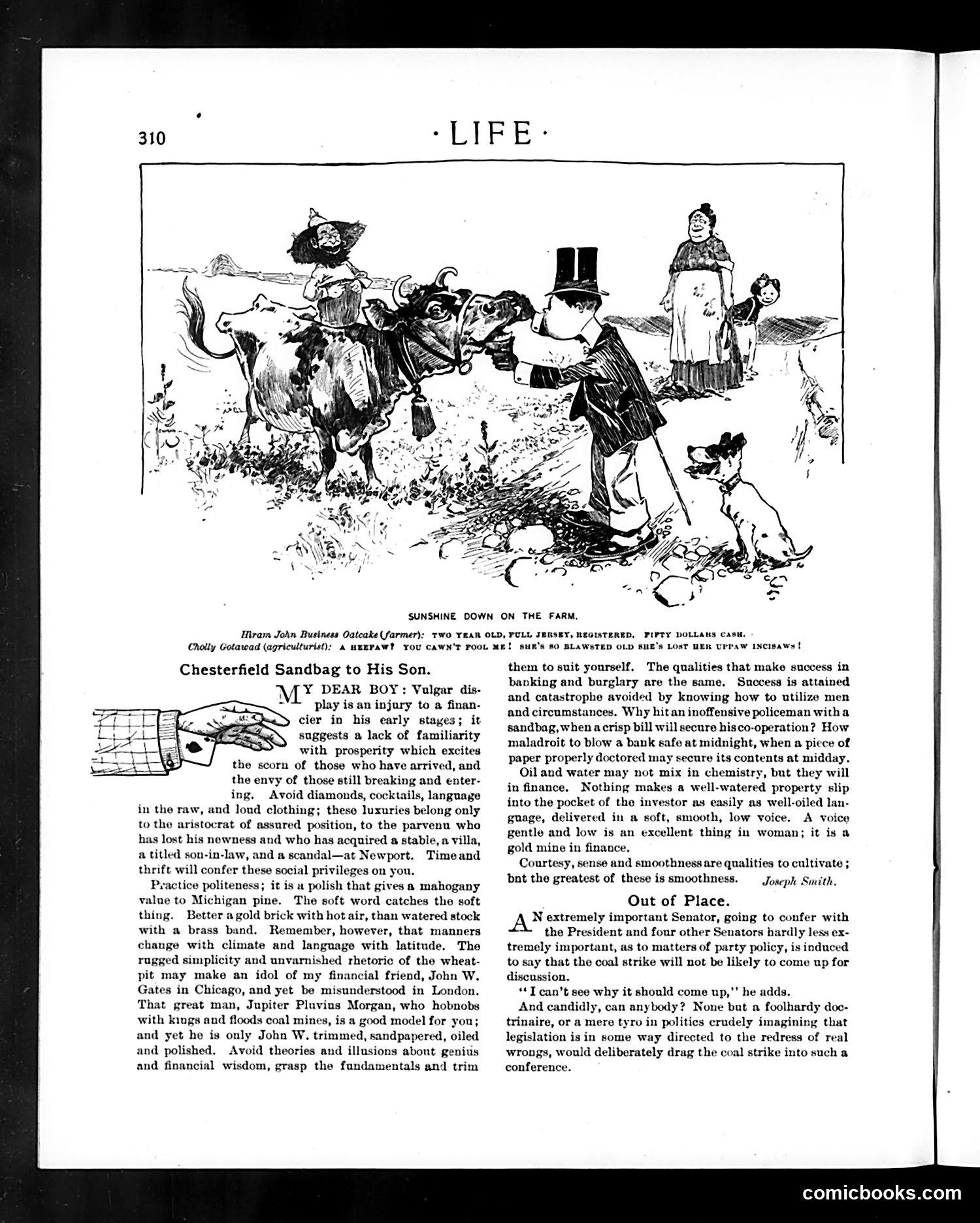
**The Farm Scene (top):** A cartoon mocking rural pretension. "Hiram John Business Oatcake," a farmer, tries to impress "Cholly Gotawad" by claiming his cow is a registered Jersey worth fifty dollars. Cholly dismissively replies the animal has lost her "upstairs faculties"—she's senile. The joke targets nouveau riche farmers aping wealthy affectations. **"Chesterfield Sandbag to His Son":** A cynical advice column disguised as genteel etiquette. "Sandbag" (likely a pun on financial manipulation) counsels his son that success in banking and burglary follow identical principles: use charm and deception rather than force. References to John W. Gates (a notorious railroad speculator) and J.P. Morgan suggest the wealthy operate through smoothness and corruption, not honest conduct. **"Out of Place":** A brief political jab. A Senator claims the coal strike won't come up in presidential discussions—absurdly ignoring real labor unrest affecting the nation, suggesting politicians deliberately avoid addressing genuine public grievances.
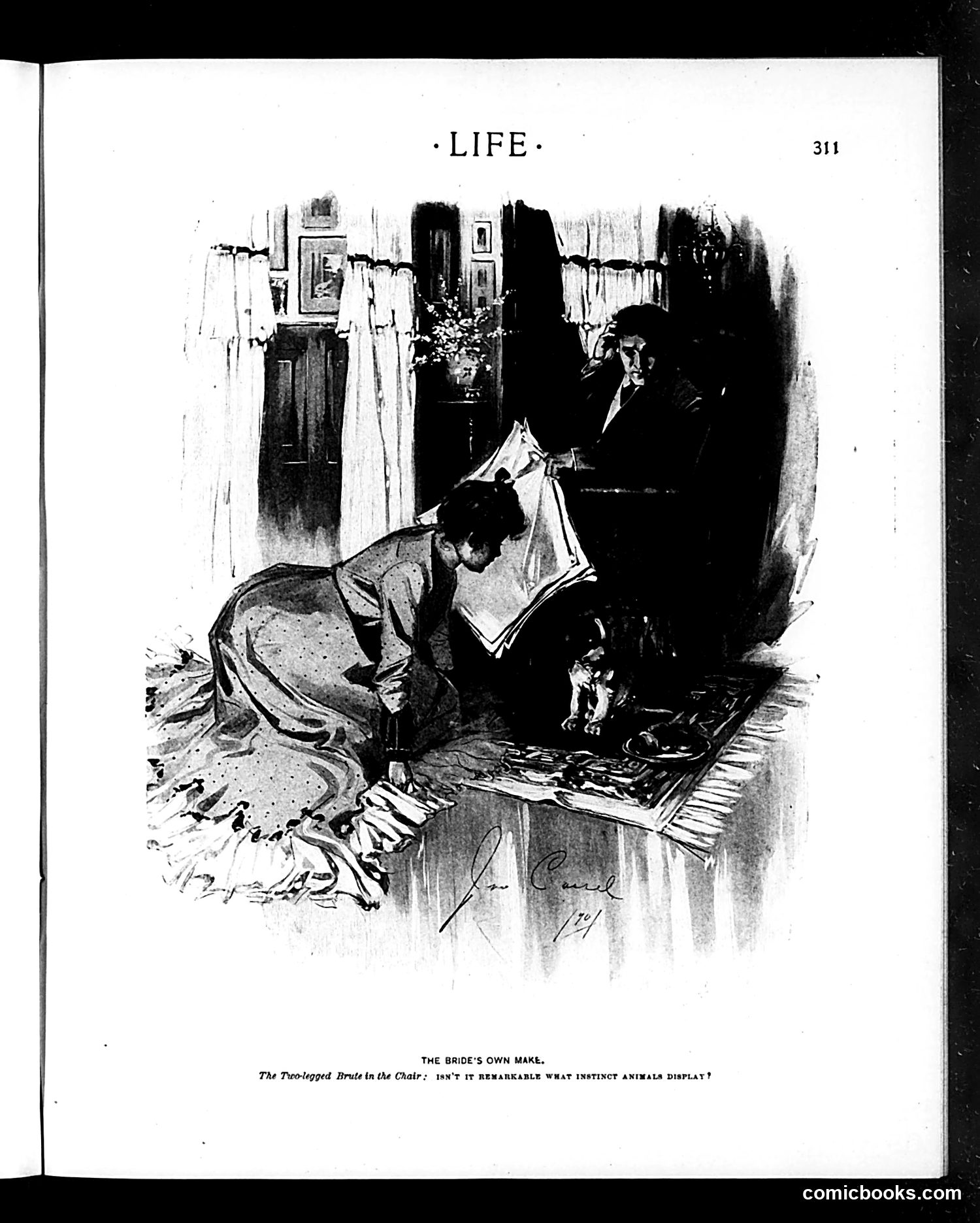
This cartoon satirizes Victorian attitudes about women and domestic life. The image shows a woman crouched on the floor doing housework or cleaning, while a man sits comfortably in a chair, observing her with apparent satisfaction. The caption's irony is the joke: the man remarks how "remarkable" it is that animals display instinct—while his companion, a woman performing domestic labor, is implicitly being compared to an animal following instinctive behavior. The title "The Bride's Own Make" suggests this is the bride's "natural" role—housework and servitude. The satire mocks both the man's condescension and the social expectation that women should accept subordinate domestic positions as instinctive rather than imposed. The cartoon critiques how society naturalizes women's unpaid labor and inferior social status.
This page is primarily **humorous anecdotes and social satire** rather than political cartoons. The main content includes three comedic stories: 1. **"Topsy-Turvy Room"**: A wealthy Parisian's prank where guests awaken in an inverted room with furniture attached to the ceiling and floor, creating disorientation—satirizing aristocratic frivolity and elaborate practical jokes. 2. **Schoolchildren Drawing**: A rural farming community's children, unfamiliar with Plymouth Rock, ask if they should draw a chicken or rooster instead—satirizing how environment limits knowledge and the disconnect between urban history lessons and rural children's lived experience. 3. **Hotel Rules**: Absurdly contradictory regulations (charging per square foot of floor space, offering "self-rising flour" for lunch, suggesting customers "take a soda" as a light source)—mocking incompetent or fraudulent hotel management. The satire targets **class pretension, educational gaps, and commercial exploitation**. No specific political figures are referenced; rather, these are general social commentaries typical of *Life* magazine's humorous approach to contemporary absurdities.
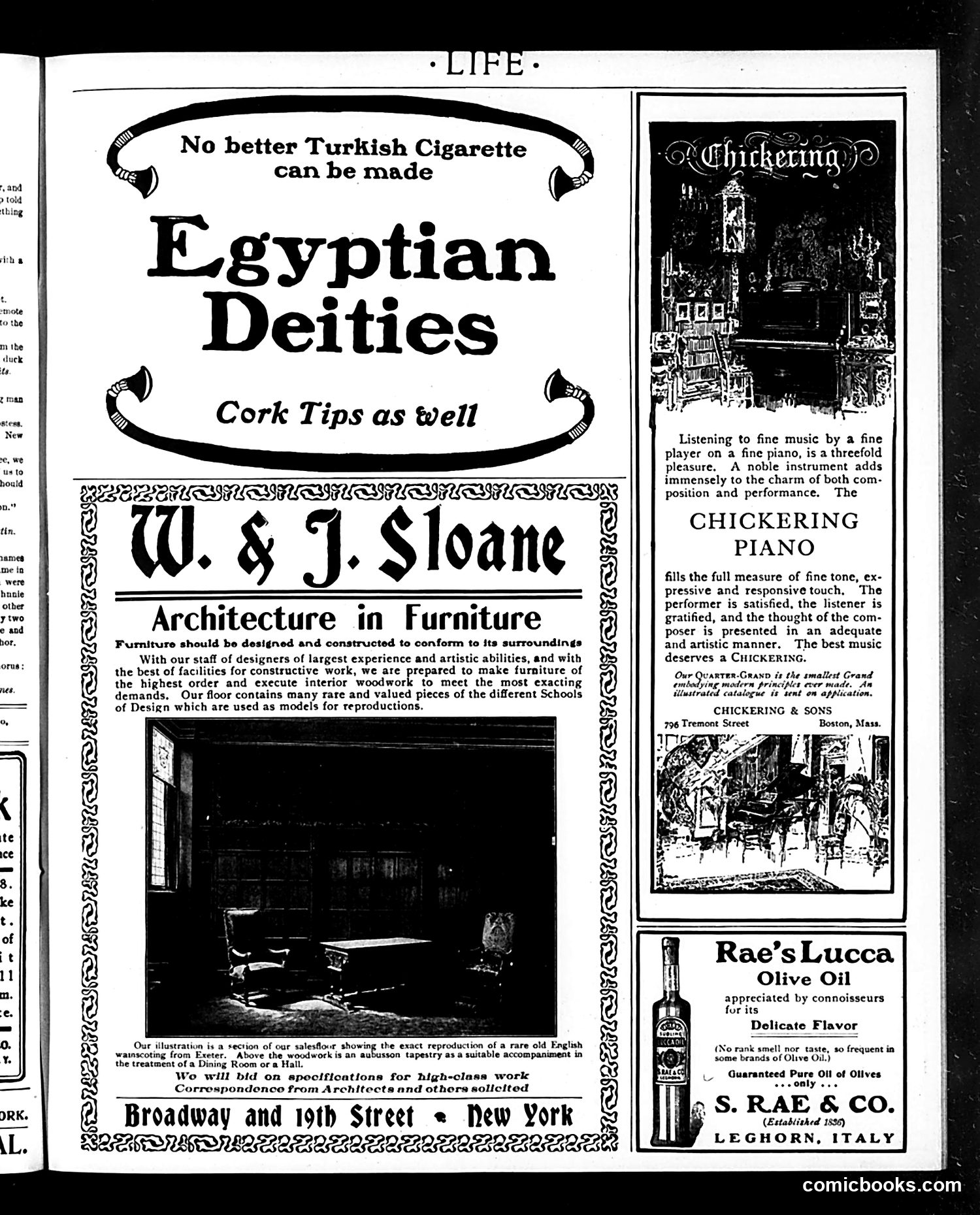
This page is primarily **advertising**, not satirical content. The "Egyptian Deities" headline is a product name for Turkish cigarettes with cork tips, made by W. & J. Sloane. The term appears designed to evoke exotic luxury rather than to satirize anything. The page features three major advertisements: Egyptian Deities cigarettes, W. & J. Sloane furniture with an interior room photograph, and Chickering pianos. A smaller ad for Rae's Lucca Olive Oil appears on the right. There is **no discernible political or social satire** visible. The content reflects early 20th-century consumer marketing emphasizing quality, artistry, and refined taste—targeting wealthy customers through appeals to aesthetic sophistication and imported prestige goods. The "Egyptian" branding likely exploited contemporary fascination with Egyptology following archaeological discoveries.
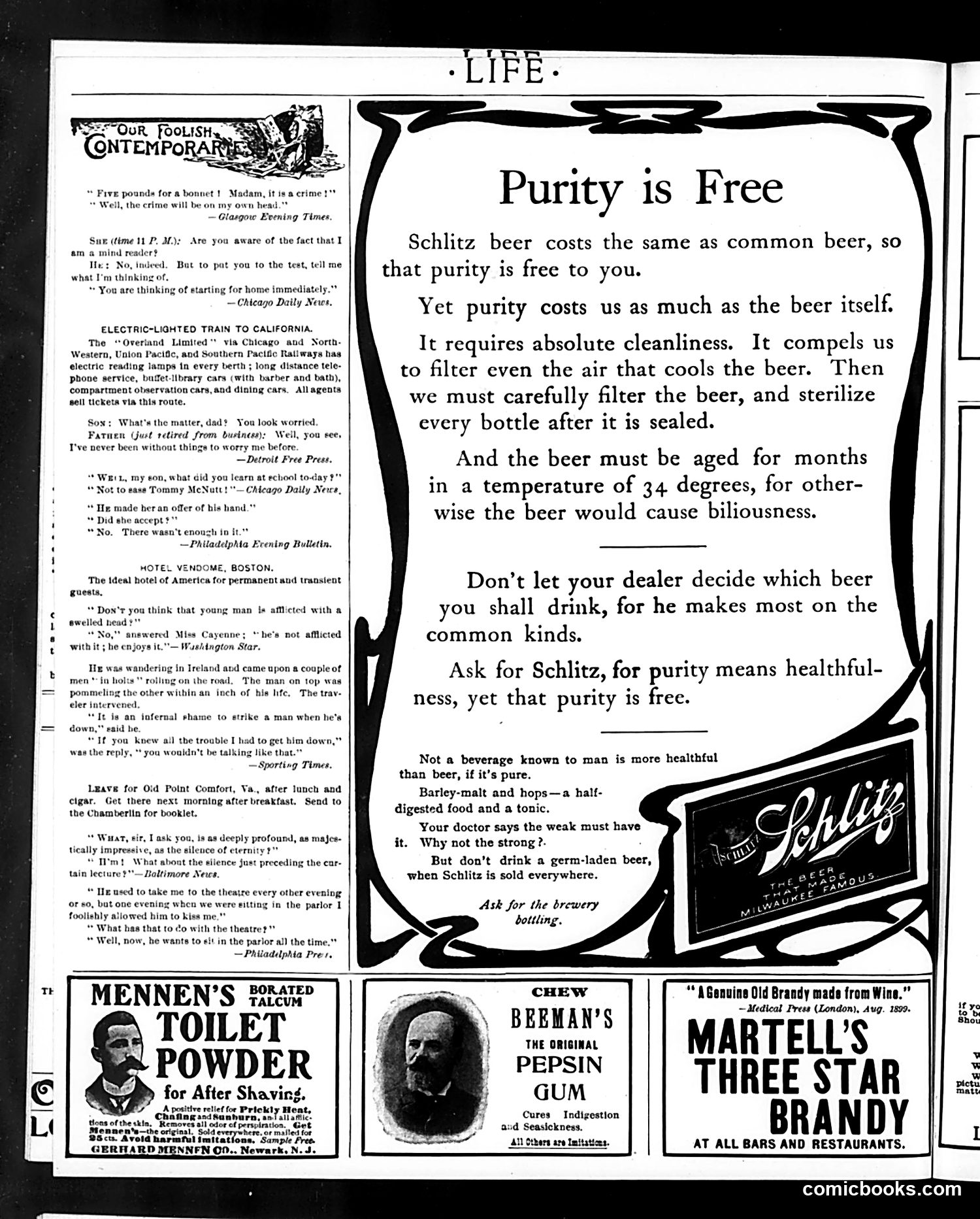
This page combines satirical humor with period advertising. The left column features short jokes typical of Life's satirical style—quips about marriage, mind-reading, and social pretension from various newspapers. These are light domestic humor and observations about contemporary life. The dominant content is a large Schlitz beer advertisement disguised as editorial. It argues that "purity is free"—meaning Schlitz costs the same as inferior beers despite expensive purification processes (filtering, sterilization, temperature control). The ad frames beer drinking as health-conscious, claiming "not a beverage known to man is more healthful than beer, if it's pure," and noting doctors recommend it for the weak. Below are period advertisements for Mennen's shaving powder, Beeman's pepsin gum, and Martell brandy—typical early 20th-century patent remedies and consumer goods. The page reflects pre-Prohibition attitudes toward alcohol as healthful and sophisticated, and advertising's early blending with editorial content.
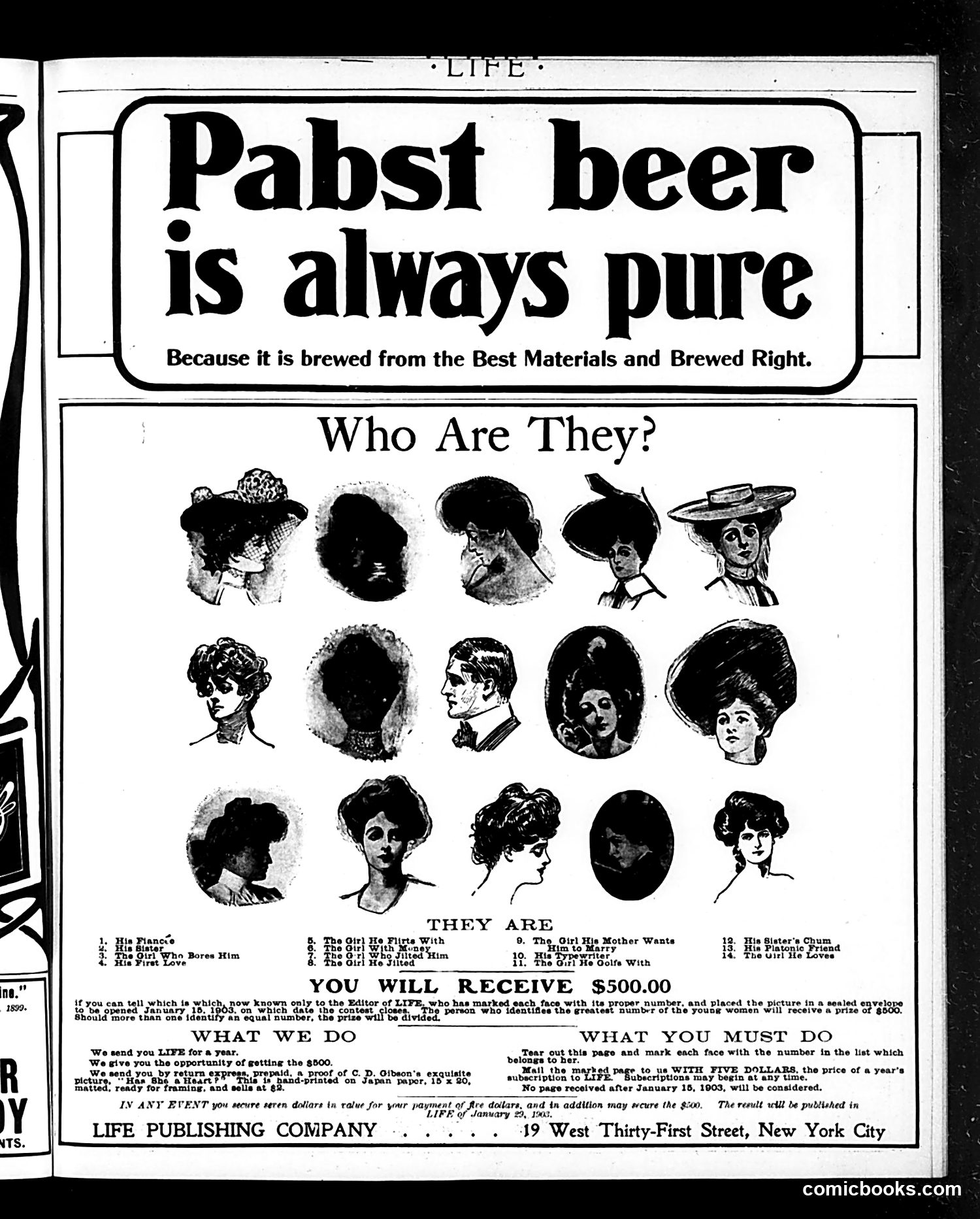
This is primarily a **Pabst beer advertisement** combined with a **contest promotion** from Life magazine (circa 1905, based on the January 18, 1903 reference). The ad uses a common early-1900s marketing strategy: readers must identify fifteen silhouetted female faces labeled with relationship categories ("The Girl He Flirts With," "His Sister's Chum," etc.). The implicit humor—unstated but clear to the era—plays on male anxiety about distinguishing between women in various romantic/social roles, a concern reflecting genteel society's rigid courtship conventions. For a $5 subscription to Life magazine, entrants could win $500 by correctly identifying the most faces. The advertisement promises readers get "$7 in value" regardless of winning, attempting to justify the subscription cost. The satirical point appears subtle: Pabst equates beer purity with social certainty, while the contest itself gently mocks men's presumed inability to tell women apart—a commentary on superficial social categorization and masculine confusion about female identity.
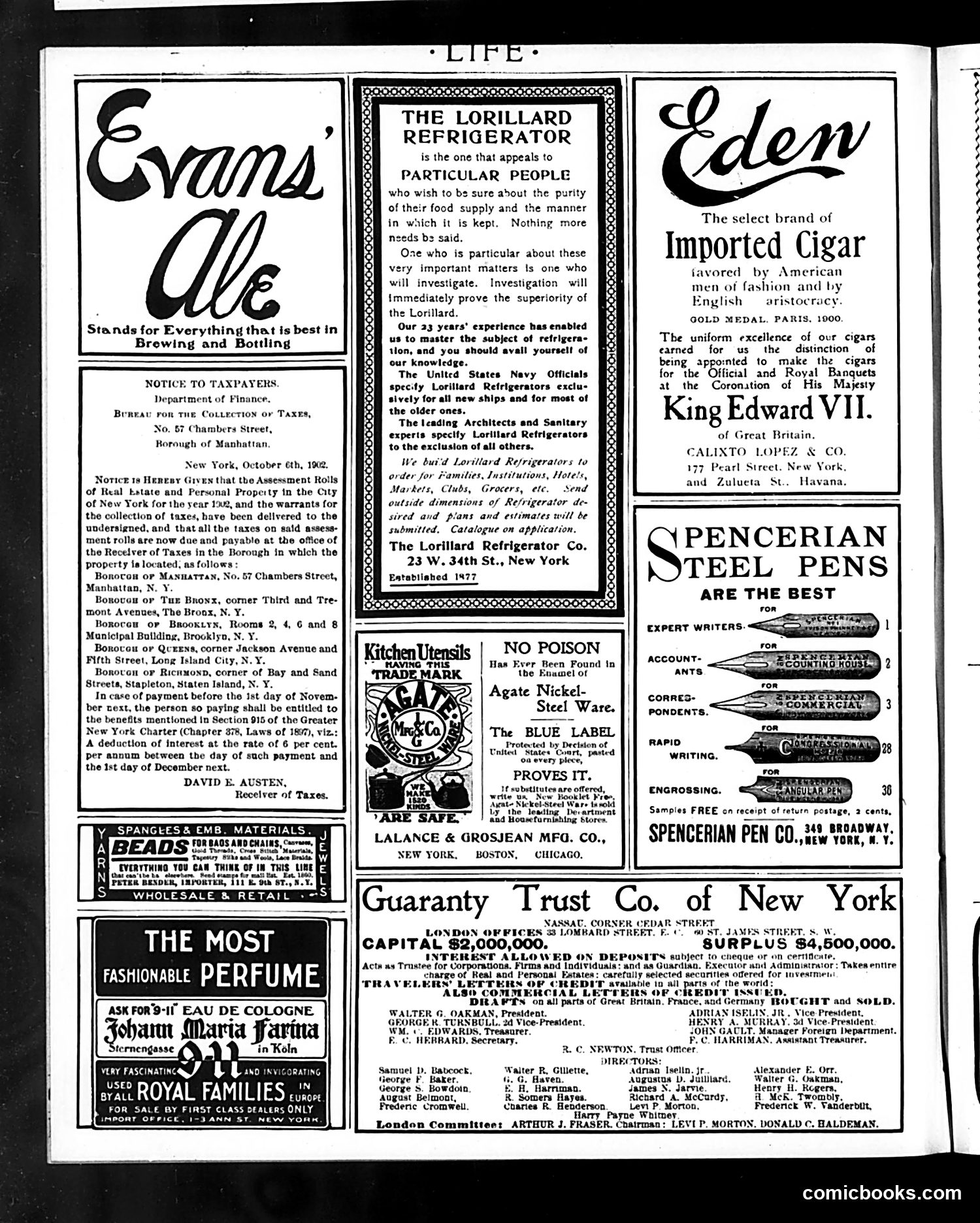
This page is primarily **advertisements**, not satire or cartoons. There is no political cartoon content to interpret for a modern reader. The page consists entirely of commercial ads from 1902: Evans brewery, a NYC tax notice, Lorillard refrigerators (endorsed by the U.S. Navy), Spangles beads and trim, a French perfume brand marketed to royalty, Agate Nickel-Steel cookware, Calixto Lopez imported cigars (promoted as good enough for King Edward VII's coronation banquets), and the Guaranty Trust Company of New York. These ads reflect early 1900s marketing strategies: appeals to authority (government, aristocracy), promises of purity and safety (refrigeration, "no poison" in cookware), and luxury goods positioning. The tone emphasizes quality and exclusivity for the "particular people" with purchasing power.
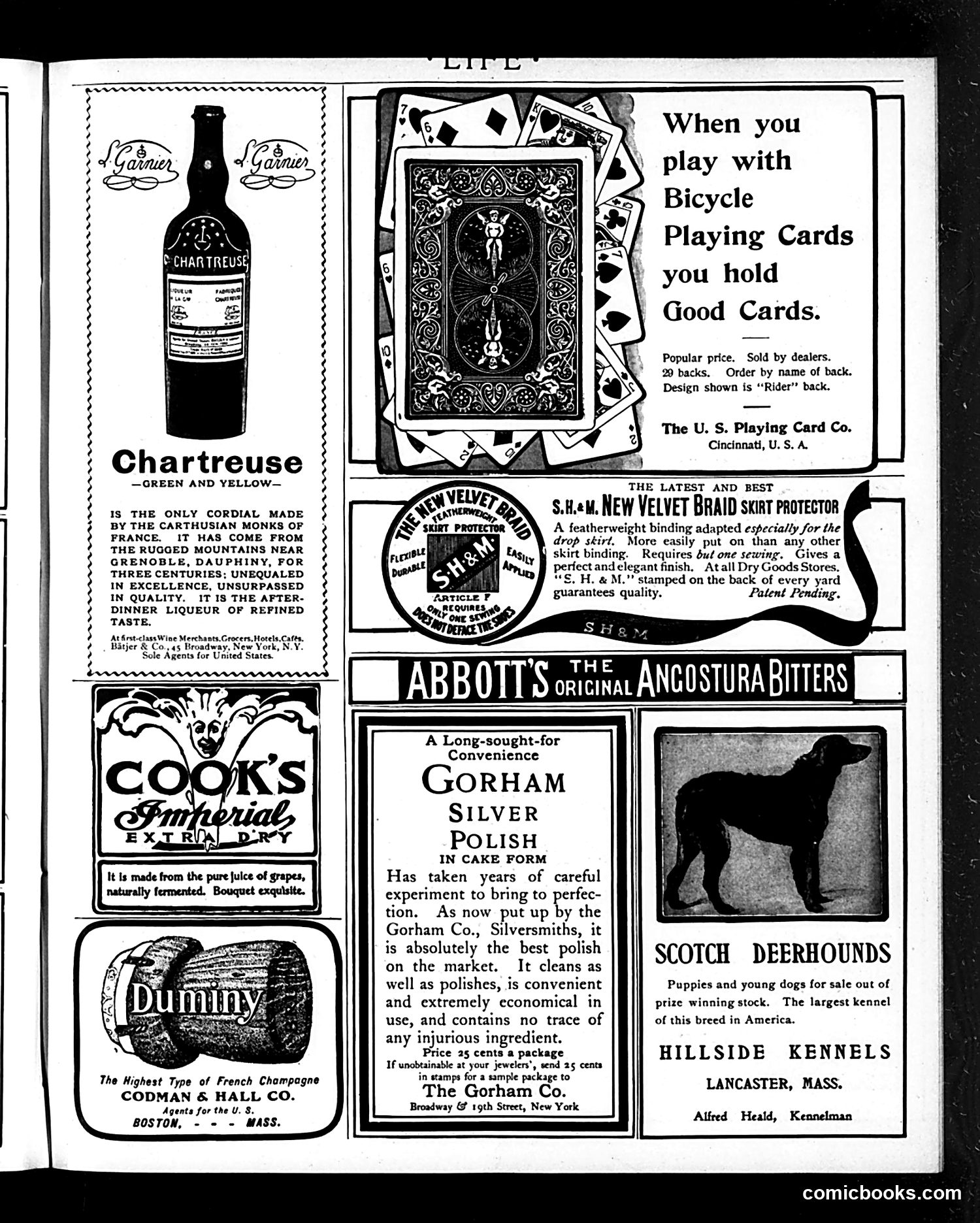
This page is **primarily advertisements**, not satirical cartoons. It contains product promotions typical of early 20th-century magazines: **Notable ads include:** - **Chartreuse liqueur**: Marketed as a French digestif made by Carthusian monks, emphasizing its three-century tradition and refined taste - **Bicycle Playing Cards**: Promises quality cards for card players - **Cook's Imperial Champagne** and **Duminy Champagne**: French wine products - **S.H. & M. Velvet Braid Skirt Protector**: A practical garment accessory for women's drop skirts - **Gorham Silver Polish**: A convenience product in cake form - **Hillside Kennels**: Breeding Scotch Deerhounds The page reflects **consumer culture and luxury goods marketed to affluent readers**. There is no political satire or social commentary visible—it's straightforward product advertising emphasizing quality, European origins, and convenience for middle/upper-class households of the era.
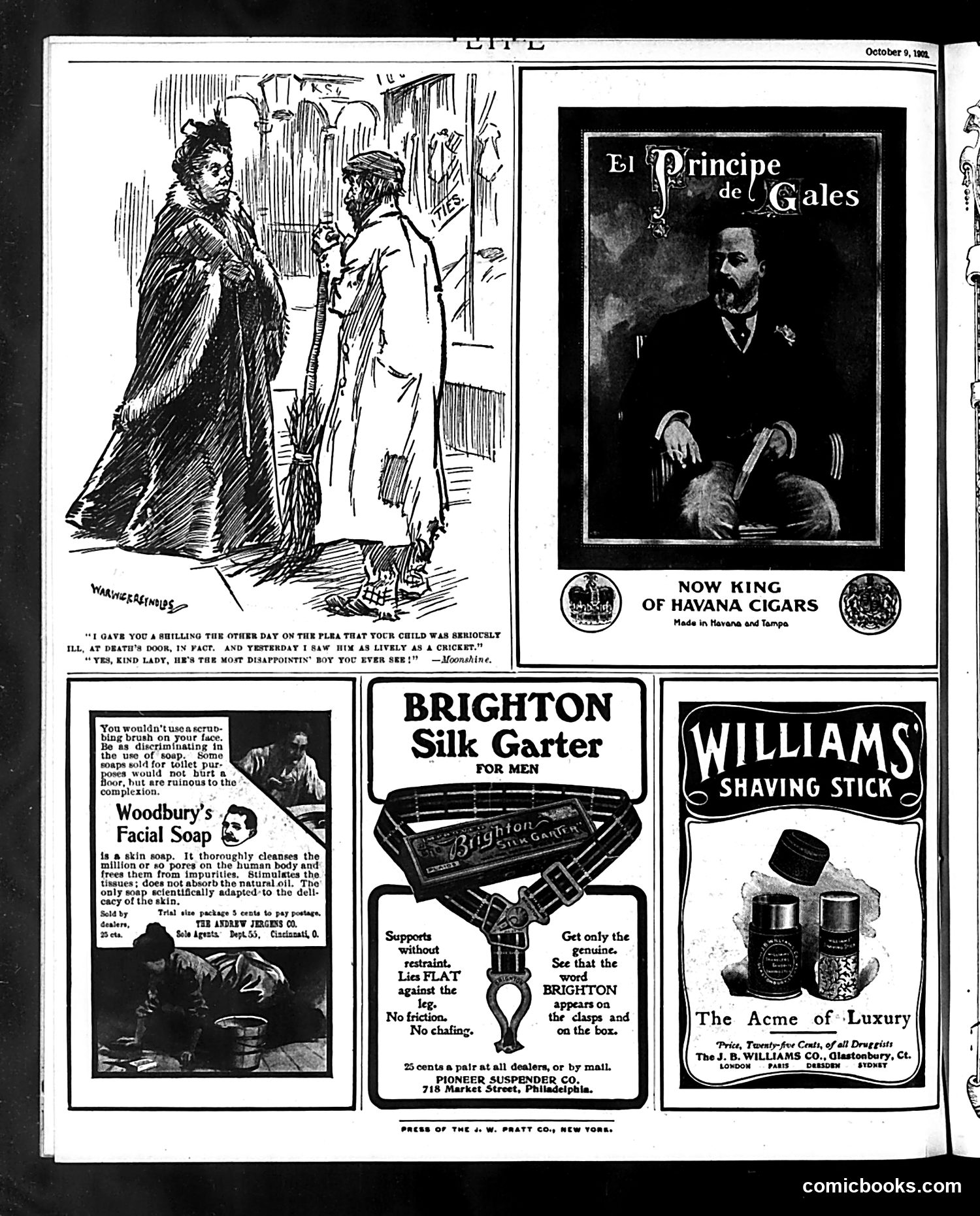
The main cartoon satirizes parental disappointment. A woman tells another that she'd heard her child was gravely ill ("at death's door"), but saw him healthy and lively the next day. The mother responds he's "the most disappointin' boy you ever see!"—the joke being her ironic displeasure that her sick child recovered rather than died. This reflects period humor about difficult children and parental exasperation, using dark comedy common to early-1900s satire. The page is otherwise advertising: "El Príncipe de Gales" cigars (now made in Havana and Tampa, likely capitalizing on American interests following the Spanish-American War), along with contemporary grooming products (Woodbury's Facial Soap, Brighton Silk Garters, and Williams Shaving Stick). These ads reveal consumer culture and gender-specific marketing of the era.