
Life, 1902-10-09 · page 12 of 22
Life — October 9, 1902 — page 12: what you’re looking at
What you’re looking at
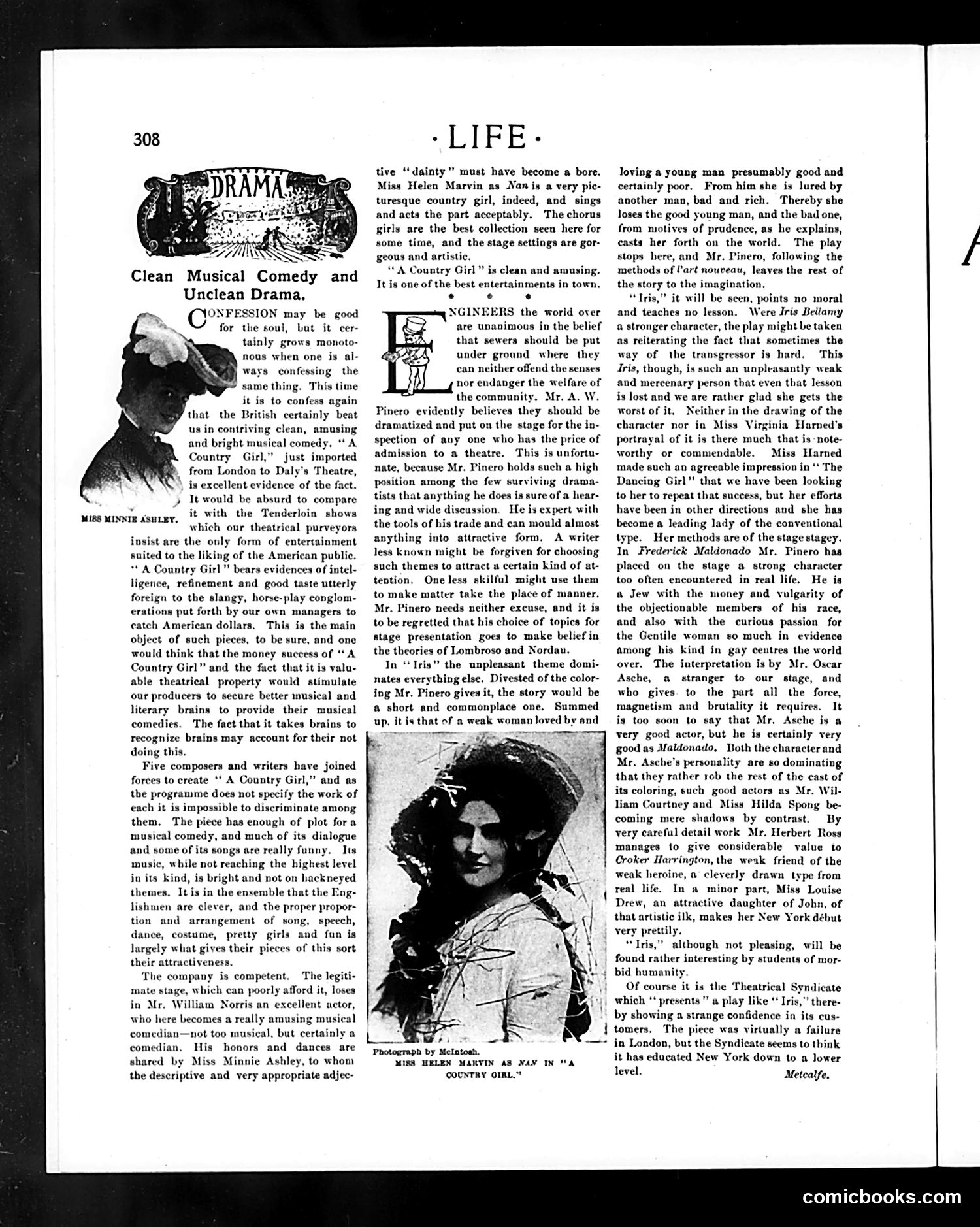
This page reviews theatrical productions, primarily discussing "A Country Girl," a musical comedy imported from London's Daly's Theatre. The review praises the show as clean entertainment featuring actress Miss Minnie Ashley, though it notes the plot is somewhat thin. The main photograph shows **Miss Helen Marvin as "Man" in "A Country Girl."** The reviews discuss various theatrical productions including "Engineers," "Iris," and "Wig" — critiquing their moral content and artistic merit. The text emphasizes preferences for wholesome entertainment over morally questionable themes. This reflects early 1900s theatrical criticism emphasizing propriety and "clean" entertainment as markers of quality, contrasting with more sensational dramatic works of the period.
📄 Transcribed text from this page (OCR, searchable)
Machine-transcribed from the original scan — historical spelling and the odd misread are preserved.
MISS MINNIE ASHLEY. omedy and Unclean Drama, or ION may be good for the soul, but it cer- tainly grows monoto- nous when one is al- ways confessing the same thing. This time it is to confess again that the British certainly beat us in contriving clean, amusing and bright musical comedy. ‘A Country Girl,” just imported . from London to Daly's Theatre, is excellent evidence of the fact. It would be absurd to compare it with the Tenderloin shows which our theatrical purveyors insist are the only form of entertainment suited to the liking of the American public. * A Country Girl” bears evidences of intel- ligence, refinement and good taste utterly foreign to the slangy, horse-play conglom- erations put forth by our own managers to catch American dollars. This is the main object of such pieces, to be sure, and one would think that the money success of ** A Country Girl” and the fact that it is valu- able theatrical property would stimulate our producers to secure better musical and literary brains to provide their musical comedies. The fact that it takes brains to recognize brains may account for their not doing this. Five composers and writers have joined forces to create ‘‘ A Country Girl,” and as the programme does not specify the work of each it is impossible to discriminate among them. The piece has enough of plot for a musical comedy, and much of its dialogue and some of its songs are really funny. Its music, while not reaching the highest level in its kind, is bright and not on hackneyed themes. It is in the ensemble that the Eng- lishmen are clever, and the proper propor- tion and arrangement of song, speech, dance, costume, pretty girls and fun is largely what gives their pieces of this sort their attractiveness. ‘The company is competent. The legiti- mate stage, which can poorly afford it, loses in Mr. William Norris an excellent actor, who here becomes a really amusing musical comedian—not too musical, but certainly a comedian. His honors and dances are shared by Miss Minnie Ashley, to whom the descriptive and very appropriate adjec- - LIFE; tive “dainty” must have become a bore. Miss Helen Marvin as Nan is a very pic- turesque country girl, indeed, and sings and acts the part acceptably. The chorus girls are the best collection seen here for some time, and the stage settings are gor- geous and artistic. “A Country Girl” is clean and amusing. It is one of the best entertainments in town. . e . GINEERS the world over are unanimous in the belief that sewers should be put under ground where they can neither offend the senses nor endanger the welfare of the community, Mr. A. W. Pinero evidently believes they should be dramatized and put on the stage for the in- spection of any one who has the price of admission to a theatre. This is unfortu- nate, because Mr. Pinero holds such a high position among the few surviving drama- tists that anything he does is sure of a hear- ing and wide discussion. He is expert with the tools of his trade and can mould almost anything into attractive form. A writer less known might be forgiven for choosing such themes to attract a certain kind of at- tention. One less skilful might use them to make matter take the place of manner, Mr. Pinero needs neither excuse, and it is to be regretted that his choice of topics for stage presentation goes to make belief in the theories of Lombroso and Nordau. In “Iris” the unpleasant theme domi- nates everything else. Divested of the color- ing Mr. Pinero gives it, the story would be a short and commonplace one. Summed is that of a weak woman loved by and Photograph by McIntosh. MIS$ HELEN MARVIN AS NAV IN 4 COUNTRY GIRL.” loving a young man presumably good and certainly poor. From him she is lured by another man, bad and rich. Thereby she loses the good young man, and the bad one, from motives of prudence, as he explains, casts her forth on the world. The play stops here, and Mr. Pinero, following the methods of V'art nouveau, leaves the rest of the story to the imagination. “Tris,” it will be seen, points no moral and teaches no lesson, Were Iris Bellamy a stronger character, the play might be taken as reiterating the fact that sometimes the way of the transgressor is hard. This Iria, though, is such an unpleasantly weak and mercenary person that even that lesson is lost and we are rather glad she gets the worst of it, Neither in the drawing of the character nor in Miss Virginia Harned's portrayal of it is there much that is note- worthy or commendable. Miss Hamed made such an agreeable impression in The Dancing Girl" that we have been looking to her to repeat that success, but her efforts have been in other directions and she has become a leading lady of the conventional type. Her methods are of the stage stagey. In Frederick Maldonado Mr. Pinero has placed on the stage a strong character too often encountered in real life. He is a Jew with the money and vulgarity of the objectionable members of his race, and also with the curious passion for the Gen woman so much in evidence among his kind in gay centres the world The interpretation is by Mr. Oscar Asche, a stranger to our stage, and who gives. to the part all the force, magnetism and brutality it requires. It is too soon to say that Mr. Asche is a very good actor, but he is certainly very good as Maldonado, Both the character and Mr. Asche’s personality are so dominating that they rather rob the rest of the cast of its coloring, such good actors as Mr. Wil- liam Courtney and Miss Hilda Spong be- coming mere shadows by contrast. By very careful detail work Mr. Herbert Ross manages to give considerable value to Croker Harrington, the weak friend of the weak heroine, a cleverly drawn type from real life. In a minor part, Miss Louise Drew, an attractive daughter of John, of that artistic ilk, makes her New York début very prettily. “Iris,” although not pleasing, will be found rather interesting by students of mor- it is the Theatrical Syndicate which “‘ presents” a play like “Iris,” there- by showing a strange confidence in its cus- tomers. The piece was virtually a failure in London, but the Syndicate seems to think it has educated New York down to a lower level. Metcalfe, comicbooks.com