
Life, 1902-10-09 · page 4 of 22
Life — October 9, 1902 — page 4: what you’re looking at
What you’re looking at
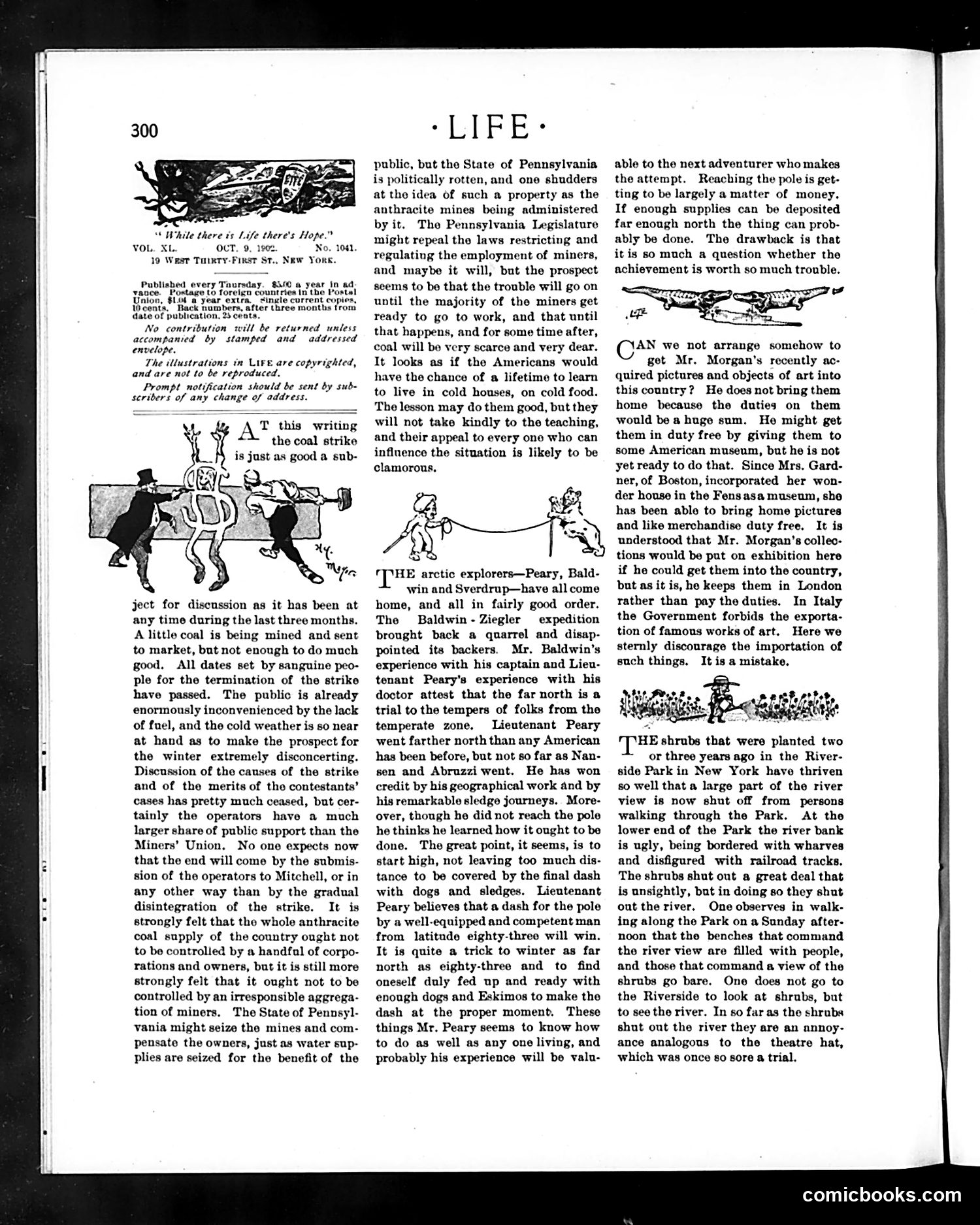
The page contains three illustrated vignettes satirizing American social issues: 1. **Top cartoon**: Shows figures in formal dress apparently "discussing" the coal strike—likely referencing the contentious 1921 anthracite coal labor dispute mentioned in the text. The satire suggests strikes are merely "good subjects for discussion" rather than being seriously addressed. 2. **Middle cartoon**: Depicts arctic explorers (Peary, Baldwin, Sverdup) with a rope-pulling scene, illustrating the text's discussion of polar expeditions and their challenges—possibly mocking the competitive nature of exploration or the physical hardships involved. 3. **Bottom section**: References the Riverside Park shrubs controversy, satirizing how riverfront improvements fail to improve public access or enjoyment—the shrubs literally obscure views of the river they're meant to enhance. The overall tone critiques governmental inaction and failed urban planning.
📄 Transcribed text from this page (OCR, searchable)
Machine-transcribed from the original scan — historical spelling and the odd misread are preserved.
“While there ts Life there's Hope.” VOL. XL. OCT. 9, 1902. No, 1041. 19 West Tuinty-Finst St. New Yors. Published every Toursday. $10 a yea! vance. Postage to foreign countries in the Union, $1.4 @ year extra. single current os, Weents. Back numbers, after three months trom date of publication, 25 cents. No contribution will be returned unless accompanied by stamped and addressed envelope. The illustrations in LIFE are copyrighted, and are not to be reproduced. Prompt notification should be sent by sub- seribers of any change of address. At this writing the coal strike is just as good a sub- ject for discussion as it has been at any time during the last three months. A little coal is being mined and sent to market, but not enough to do much good. All dates set by sanguine peo- ple for the termination of the strike have passed. The public is already enormously inconvenienced by the lack of fuel, and the cold weather is so near at hand as to make the prospect for the winter extremely disconcerting. Discussion of the causes of the strike and of the merits of the contestants’ cases has pretty much ceased, but cer- tainly the operators have a much larger share of public support than the Miners’ Union. No one expects now that the end will come by the submis- sion of the operators to Mitchell, or in any other way than by the gradual disintegration of the strike. It is strongly felt that the whole anthracite coal supply of the country ought not to be controlied by a handfal of corpo- rations and owners, but it is still more strongly felt that it ought not to be controlled by an irresponsible aggrega- tion of miners. The State of Pennsyl- vania might seize the mines and com- pensate the owners, just as water sup- plies are seized for the benefit of the ‘LIFE public, but the State of Pennsylvania is politically rotten, and one shudders at tho idea of such a property as the anthracite mines being administered by it. Tho Pennsylvania Legislature might repeal the laws restricting and regulating the employment of miners, and maybe it will, but the prospect seems to be that the trouble will go on until the majority of the miners get ready to go to work, and that until that happens, and for some time after, coal will be very scarce and very dear. It looks as if the Americans would have the chance of a lifetime to learn to live in cold houses, on cold food. The lesson may do them good, but they will not take kindly to the teaching, and their appeal to every one who can infinence the situation is likely to be clamorous, s iPHE arctic explorers—Peary, Bald- win and Sverdrup—have all come home, and all in fairly good order. The Baldwin- Ziegler expedition brought back a quarrel and disap- pointed its backers. Mr. Baldwin's experience with his captain and Lieu- tenant Peary's experience with his doctor attest that the far north is a trial to the tempers of folks from the temperate zone. Lieutenant Peary went farther north than any American has been before, but not so far as Nan- sen and Abruzzi went. He has won credit by his geographical work and by his remarkable sledge journeys. More- over, though he did not reach the pole he thinks he learned how it ought to be done. The great point, it seems, is to start high, not leaving too much dis- tance to be covered by the final dash with dogs and sledges. Lieutenant Peary believes that a dash for the pole by a well-equipped and competent man from latitude eighty-three will win. It is quite a trick to winter as far north as eighty-three and to find oneself duly fed up and ready with enough dogs and Eskimos to make the dash at the proper moment. These things Mr. Peary seems to know how to do as well as any one living, and probably his experience will be valu- able to the next adventurer who makes the attempt. Reaching the pole is get- ting to be largely a matter of money. If enough supplies can be deposited far enough north the thing can prob- ably be done. The drawback is that itis so much a question whether the achievement is worth so much trouble. Sy” AN we not arrange somehow to get Mr. Morgan's recently ac- quired pictures and objects of art into this country? He does not bring them home because the duties on them would be a huge sum. He might get them in duty free by giving them to some American museum, but he is not yet ready to do that. Since Mrs. Gard- ner, of Boston, incorporated her won- der house in the Fens asa museum, she has been able to bring home pictures and like merchandise duty free. It is understood that Mr. Morgan’s collec- tions would be put on exhibition here if he could get them into the country, but as it is, he keeps them in London rather than pay the duties. In Italy the Government forbids the exporta- tion of famous works of art. Here we sternly discourage the importation of such things. It is a mistake. [HE shrate that were planted two or three years ago in the River- side Park in New York have thriven so well that a large part of the river view is now shut off from persons walking through the Park. At the lower end of the Park the river bank is ugly, being bordered with wharves and disfigured with railroad tracks. The shrubs shut out a great deal that is unsightly, but in doing so they shut out the river. One observes in walk- ing along the Park on a Sunday after- noon that the benches that command the river view are filled with people, and those that command a view of the shrubs go bare. One does not go to the Riverside to look at shrubs, but to see the river. In so far as the shrubs shut out the river they are an annoy- ance analogous to the theatre hat, which was once so sore a trial. comicbooks.com