
A complete issue · 22 pages · 1902
Life — September 11, 1902
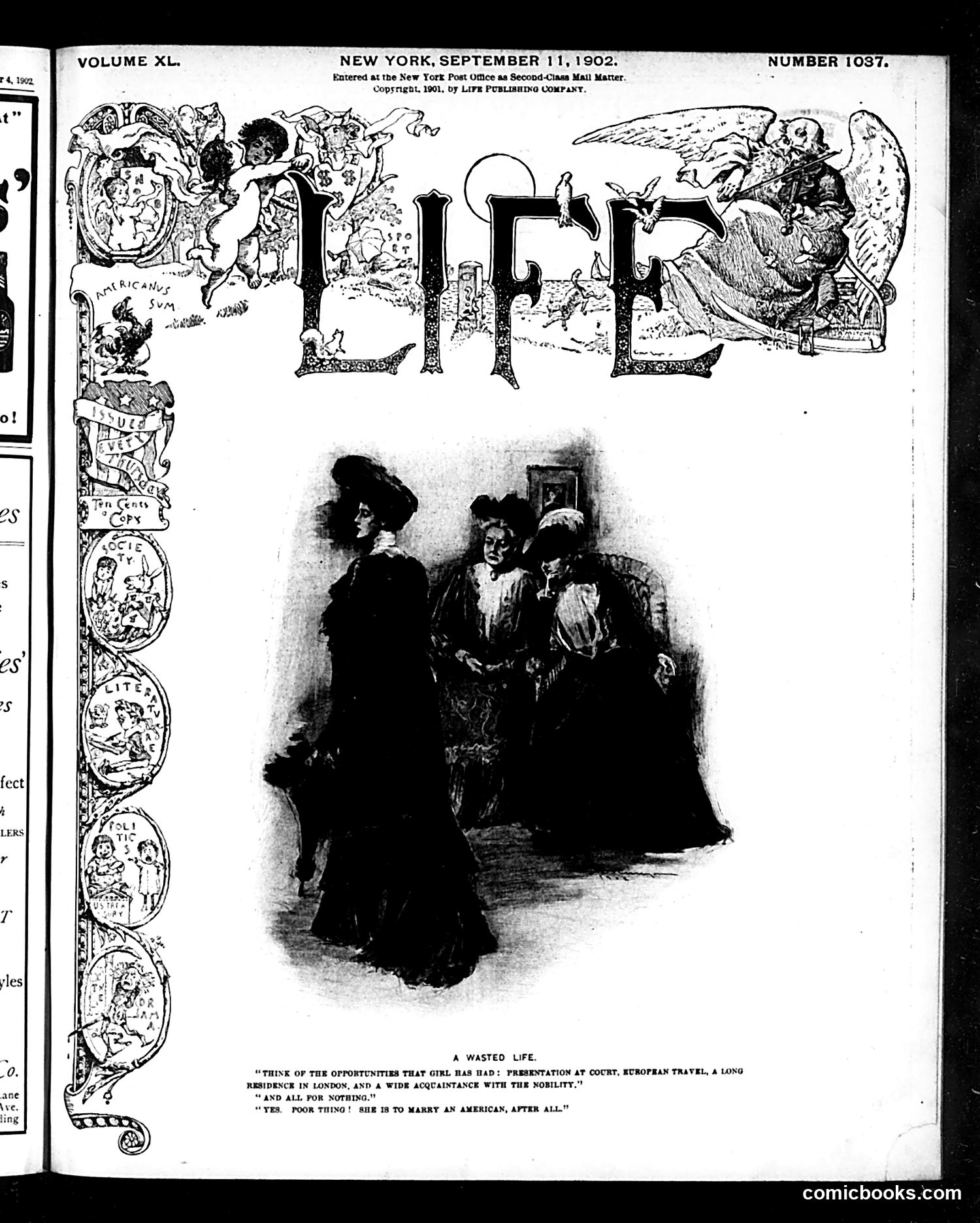
This satirical cartoon criticizes a young woman's squandered potential. The caption lists her accomplishments: "Presentation at court, European travel, a long residence in London, and a wide acquaintance with the nobility"—all markers of upper-class privilege and cultural refinement. However, the final line delivers the bitter punchline: "Poor thing! She is to marry an American, after all." The satire targets the marriage market anxieties of Gilded Age America. To American readers, an advantaged woman's European accomplishments and aristocratic social connections represented the pinnacle of female achievement—yet all were deemed worthless if she married an American rather than securing a titled European husband. The cartoon mocks both American social insecurity and the era's obsession with transatlantic marriages as status symbols.
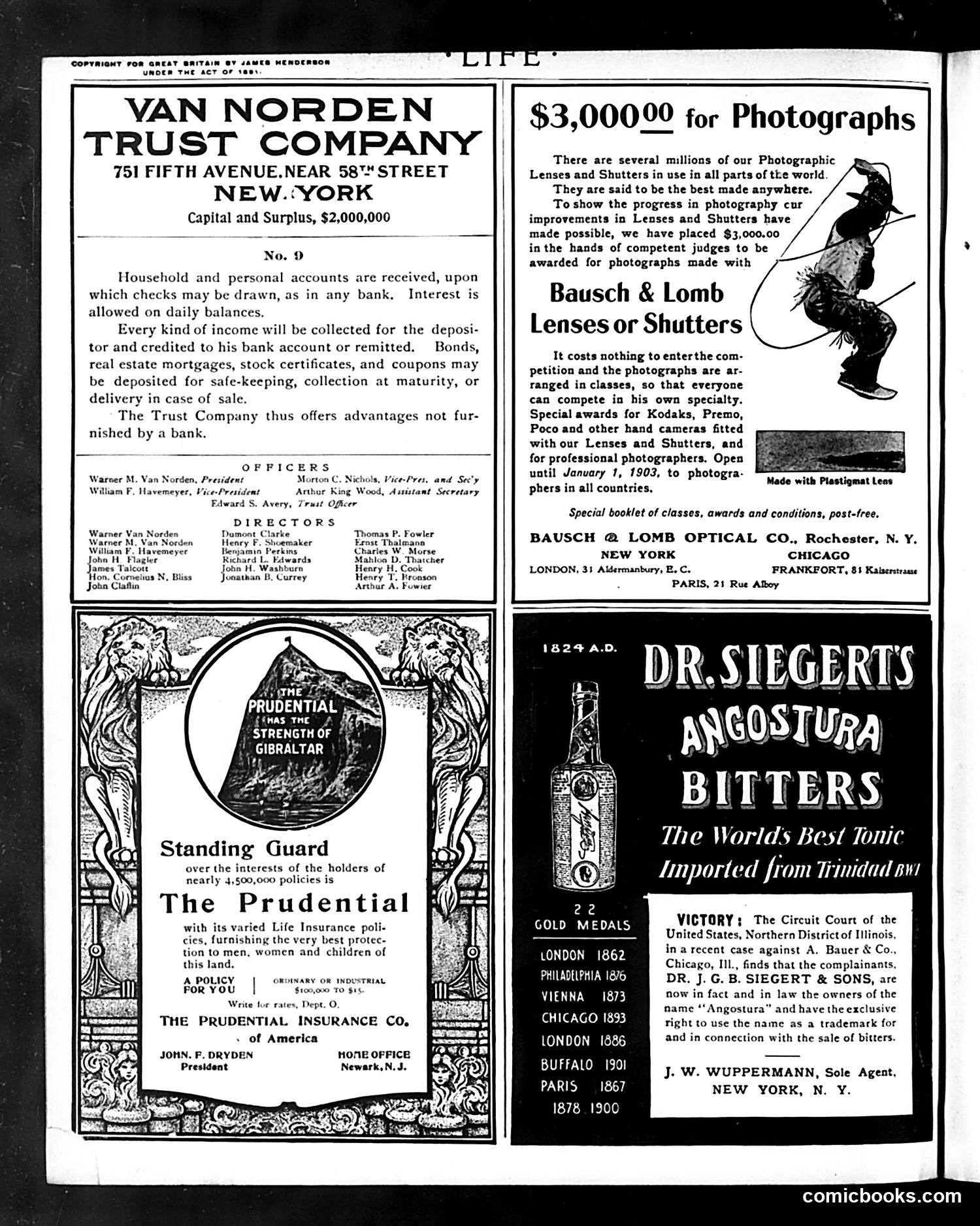
This page is primarily **advertising, not political commentary**. The top left contains a Van Norden Trust Company bank advertisement listing officers and services. The top right advertises a $3,000 photography competition for images shot with Bausch & Lomb lenses and shutters, open until January 1, 1906. The bottom left shows The Prudential Insurance Company's "Standing Guard" advertisement, featuring decorative lions and emphasizing life insurance protection. The bottom right advertises Dr. Siegert's Angostura Bitters, a medicinal tonic imported from Trinidad, noting a recent court victory establishing their exclusive trademark rights. No political cartoons or satire appear on this page—it's a straightforward collection of early 1900s advertisements.
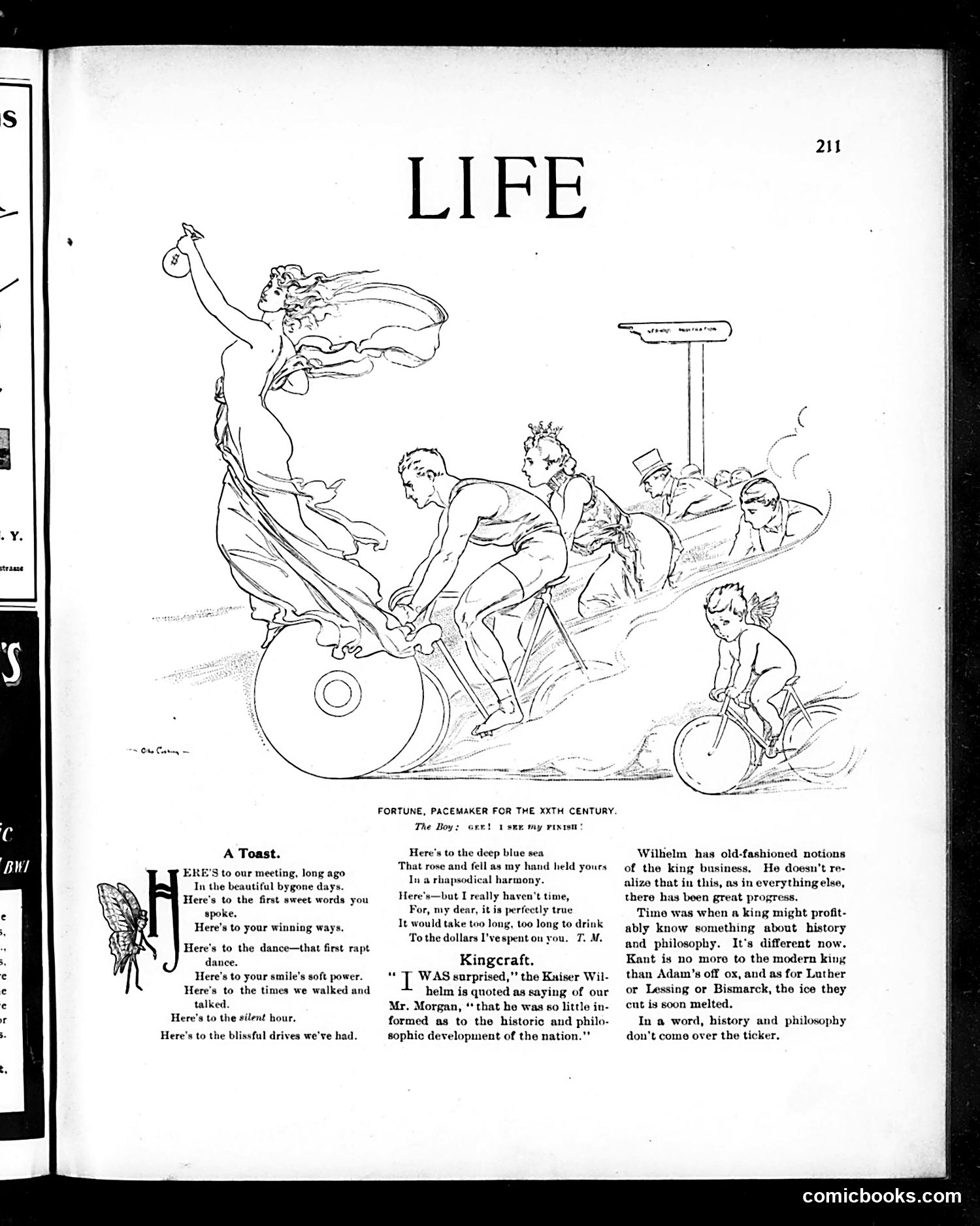
The main cartoon, titled "Fortune, Pacemaker for the XXth Century," depicts Lady Fortune (the classical allegorical figure at top) leading various figures—appearing to represent different social classes and professions—on a chaotic journey via bicycle and other conveyances. The subtitle "The Boy" and caption "GET I SEE MY FISHIN'" suggests satirical commentary on modern life's rapid pace and unpredictability. Below, three brief pieces ("A Toast," "Kingcraft," and an untitled column) offer sardonic observations on contemporary society, including references to history, philosophy, and leadership. The overall satire critiques early 20th-century modernity: Fortune (fate/luck) driving progress chaotically rather than rationally, with ordinary people caught in its turbulent wake. The tone suggests skepticism about whether technological and social "progress" genuinely improves human life.
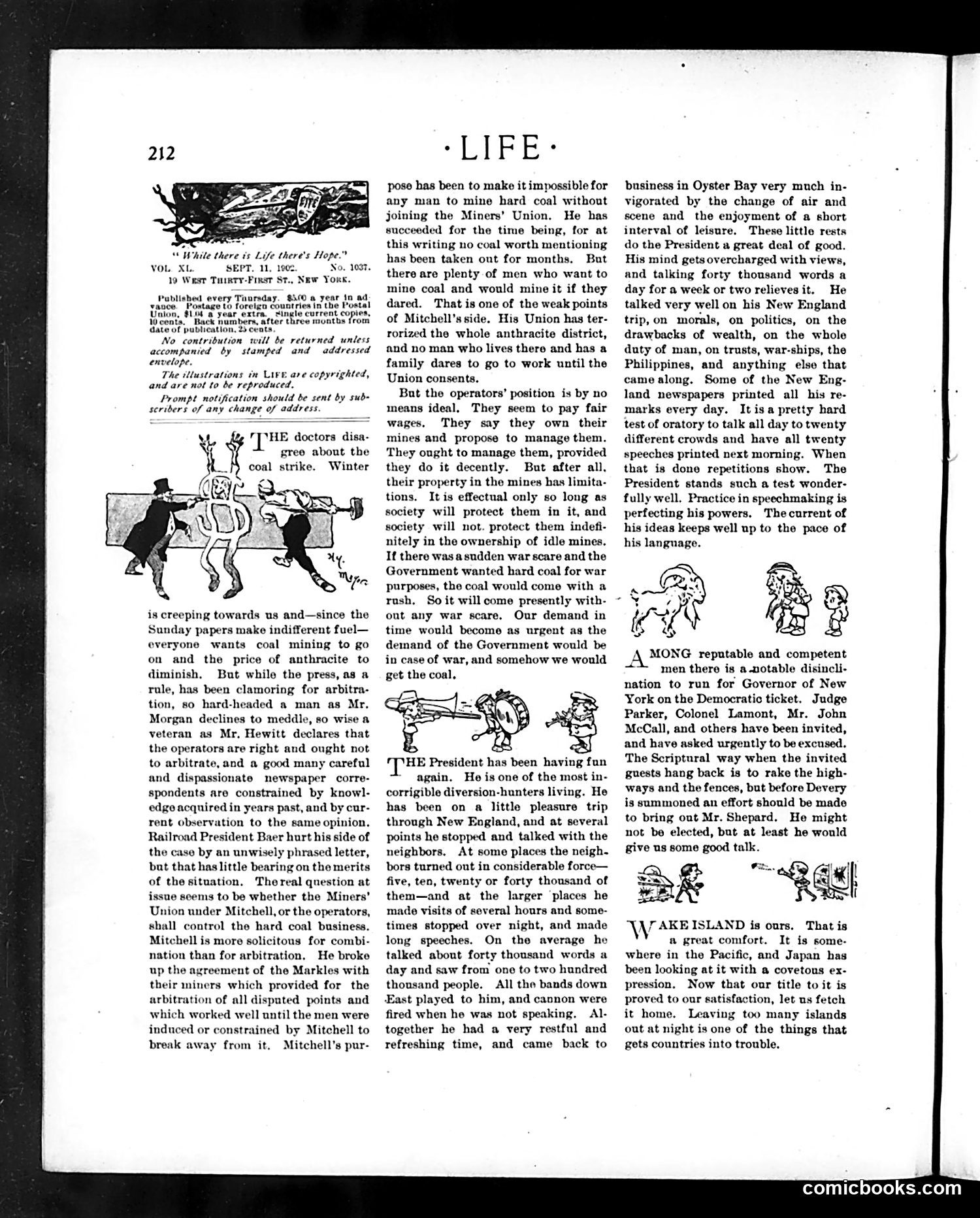
The page contains political commentary about coal mining labor disputes. The main cartoon shows a skeletal figure (representing hard coal/the coal industry) being attacked or manipulated by multiple figures, likely representing competing interests—the Miners' Union, operators, and government. The text discusses the anthracite coal strike crisis: operators claim they own and should manage the mines, while the Miners' Union has "terrorized the whole anthracite district." The passage notes that Mitchell (the Union leader) broke agreements, forcing government arbitration. The commentary criticizes both sides' positions, arguing that without proper legal protections, society cannot safely allow private ownership of essential resources like coal mines. The satire targets the intransigence of labor and management in an industry vital to national welfare.
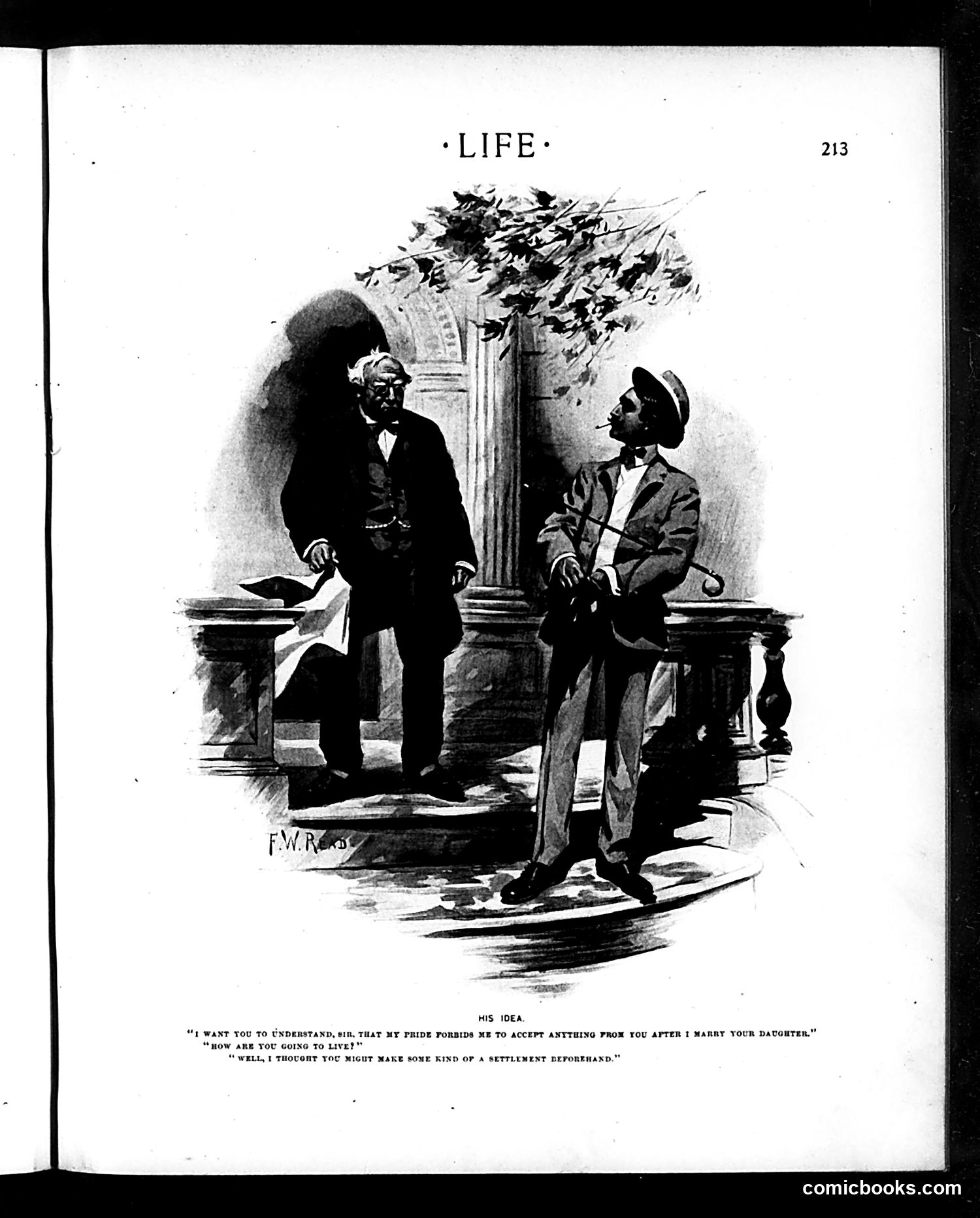
This cartoon titled "His Idea" depicts two men in conversation beneath a decorative column with foliage. The dialogue reveals the humor: one man states he wants the other to understand that "by pride forbids me to accept anything from you after I marry your daughter," to which the other responds, "Well, I thought you might make some kind of a settlement beforehand." The satire mocks a common marriage negotiation scenario of the era. The suitor insists on pride and independence, yet the prospective father-in-law immediately suggests a financial settlement is still expected. The joke exposes the contradiction between declared moral principles and practical financial self-interest in marriage arrangements—a commentary on the hypocrisy of upper-class marriage customs where money fundamentally determines unions despite romantic pretenses.
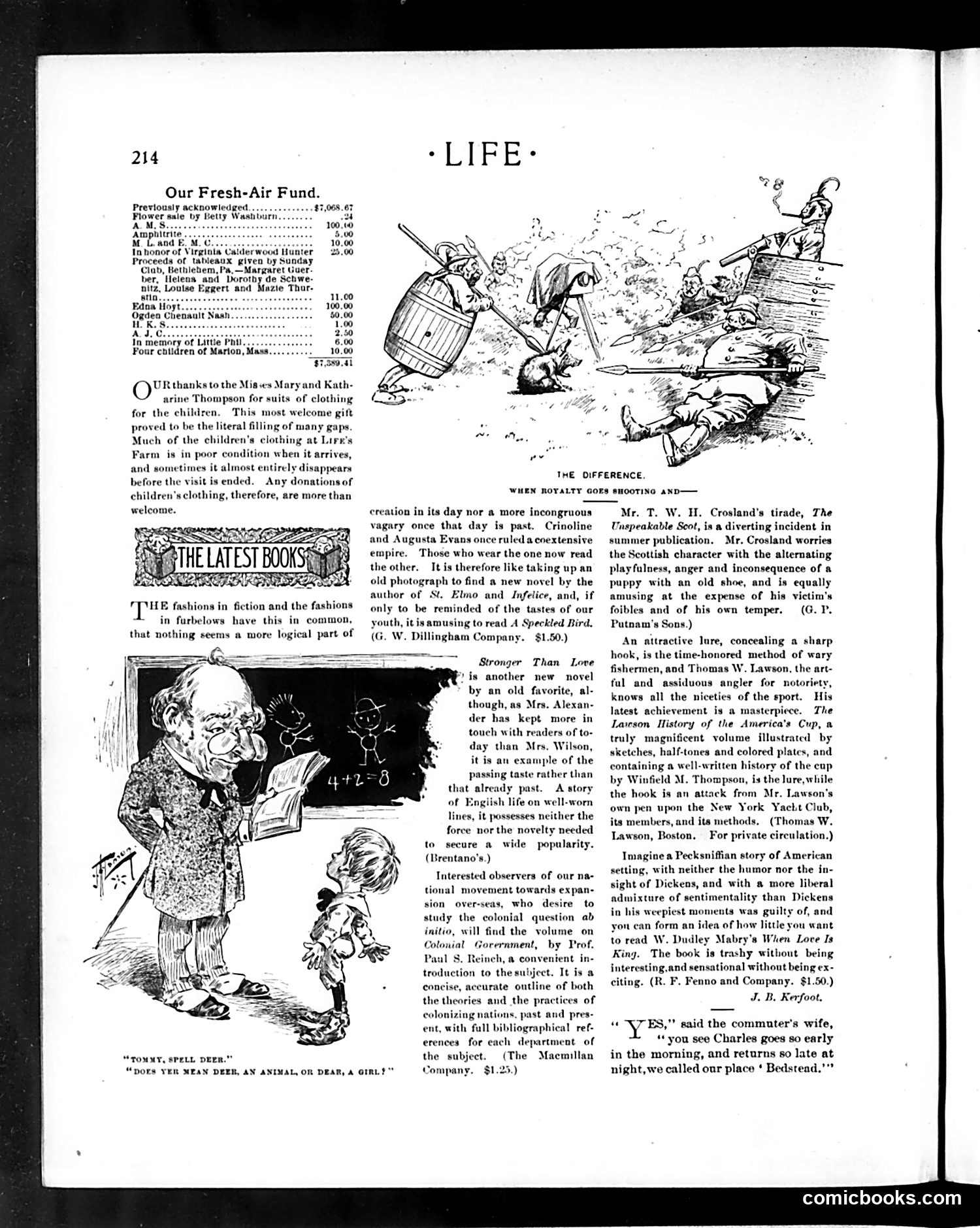
The main cartoon, titled **"The Difference,"** compares two literary works. The left illustration shows an old man reading, labeled with a quote about spelling ("Tommy, spell deer... does yer mean deer, an animal, or dear, a girl?"). This appears to be satirizing the contrast between **realistic, vernacular fiction** (represented by the crude dialect spelling) and more refined literary tastes. The cartoon critiques how fashionable fiction prioritizes linguistic authenticity and colloquial speech over polished prose—a debate about literary realism versus genteel writing conventions. The page also reviews several contemporary books, including works by T.W.H. Crosland and discussions of colonial literature, reflecting early 20th-century literary criticism and publishing trends.
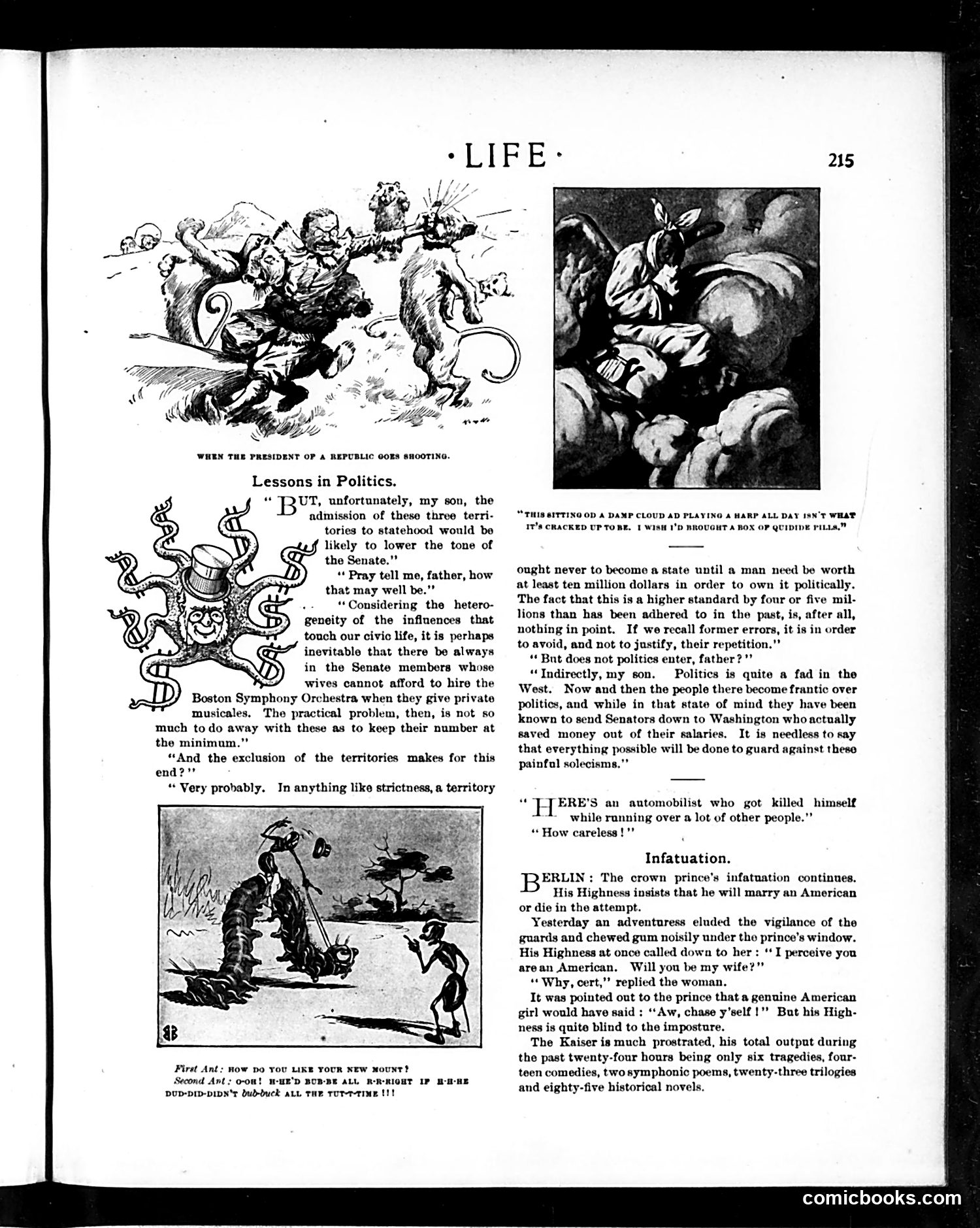
The top cartoon illustrates "Lessons in Politics," satirizing the admission of territories to statehood. The dialogue suggests senators resist expansion because they cannot afford to hire orchestras for private musicales or maintain their current lifestyle standards. The satire attacks senators as self-interested and indifferent to the genuine political and economic arguments for territorial statehood. The lower cartoon ("First Aid: How Do You Like Your New House?") appears to mock housing or construction issues, though the specific context is unclear from the visible text. The "Infatuation" section discusses the German crown prince's marriage prospects, mocking his expectation that an American woman would accept his authority—satirizing aristocratic presumption versus American independence. The overall page criticizes political corruption, territorial politics, and European royalty pretension.
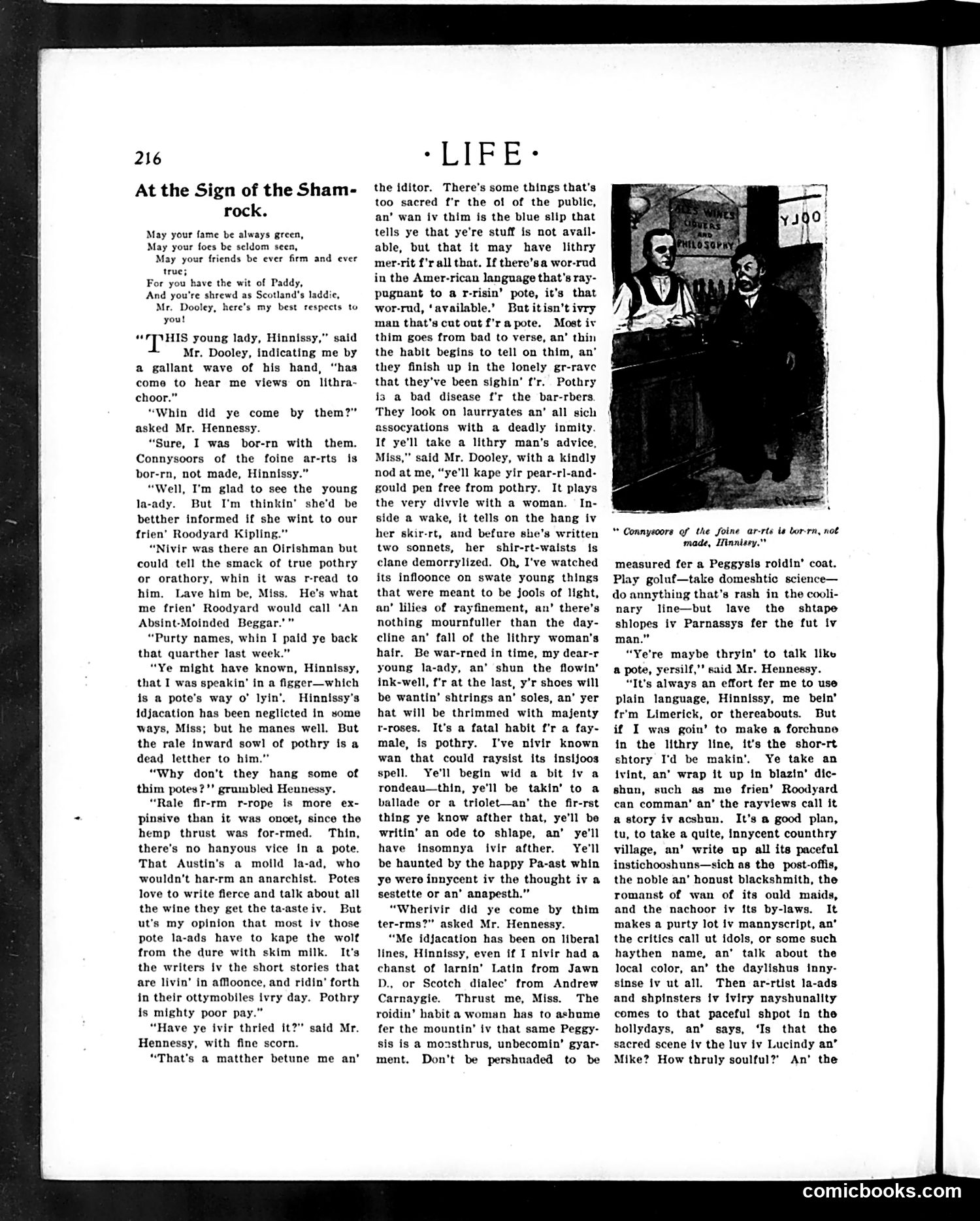
This appears to be a satirical dialogue between Mr. Dooley (a famous Irish-American character from Life magazine) and a young woman named Hinnissy about literary pretension and bad poetry. The accompanying illustration shows two men in conversation, likely representing Dooley and Hennessy, Life's stock Irish-American characters used for social commentary. The text mocks poets and literary circles who adopt affected language and produce mediocre work while maintaining airs of sophistication. Dooley ridicules those who write "fierce and talk about all the whin they get the leather" and warns against pretentious "lithry" (literary) aspirations. The satire targets both amateur writers chasing literary fame and the broader cultural affectation of the educated classes toward art and literature.
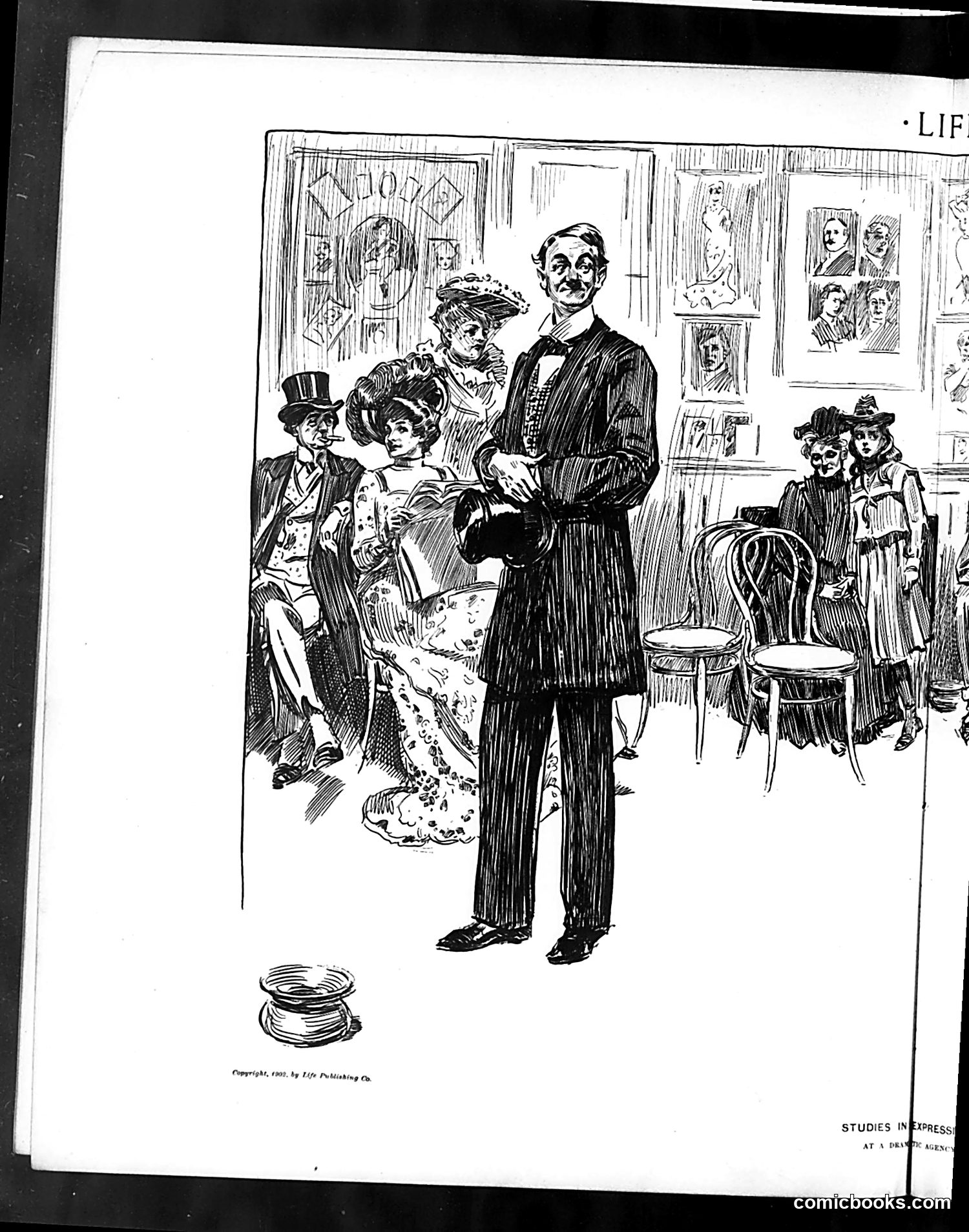
This appears to be a satirical illustration from Life magazine (copyright 1902) depicting a scene at what looks like an art gallery or studio reception. The image shows a well-dressed man in formal attire (center) presenting or displaying a woman to seated observers, while other figures—including children and adults in period dress—watch from the sides. The title "STUDIES IN PROGRESS" (visible at bottom right) suggests commentary on artistic or social pretension. The formal presentation style and observers' varied reactions likely satirize either the art world's affectations or social climbing through cultural display. The specific figures and event remain unclear without additional context, but the composition mocks the performative nature of high society or artistic circles circa 1902.
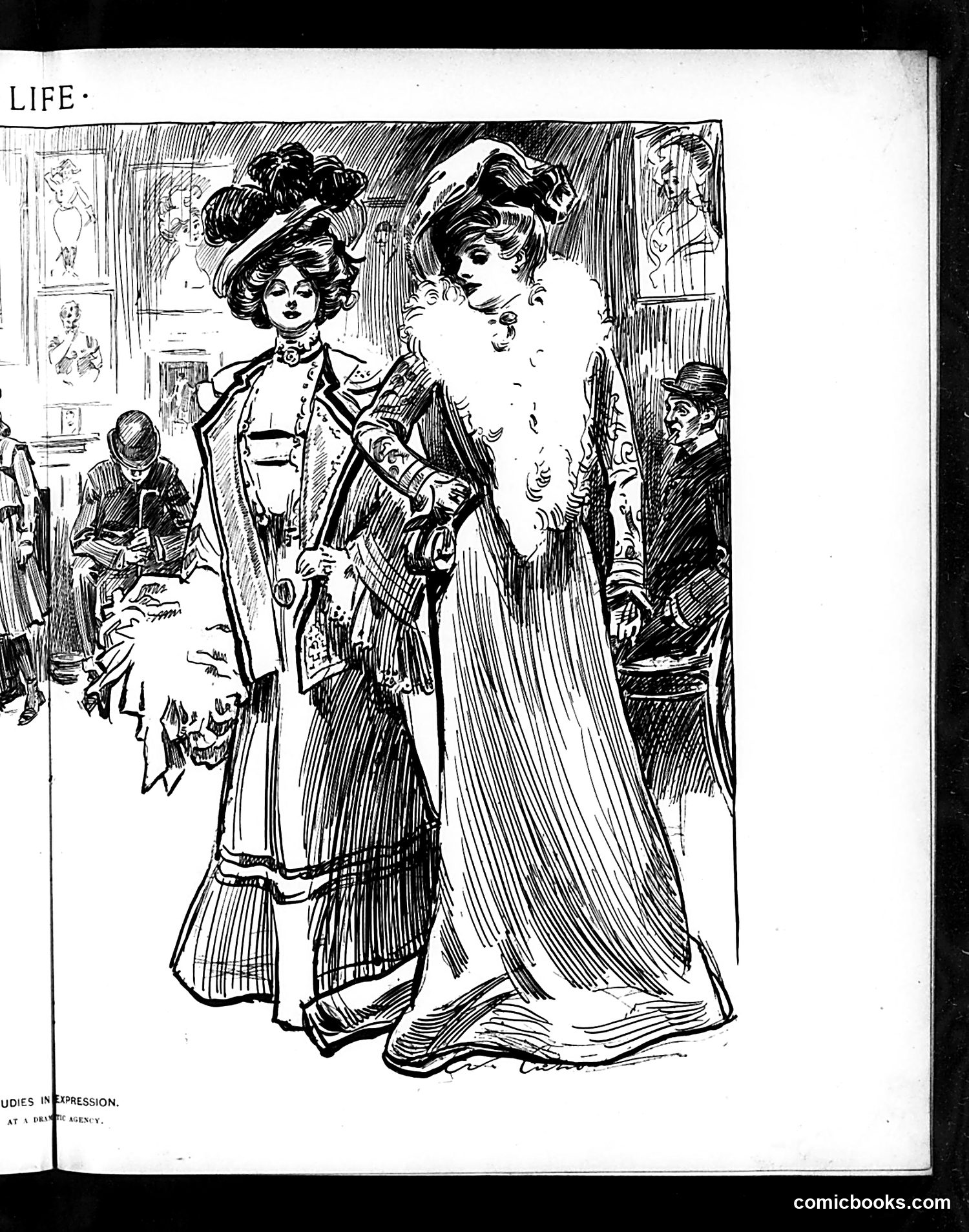
This is a satirical illustration titled "Studies in Expression" depicting fashionable women at what appears to be a social gathering or theater. The cartoon mocks the exaggerated affectations and expressions of upper-class women of the era—their dramatic poses, elaborate upswept hairstyles, ornate clothing with fur stoles, and theatrical demeanor. The satire targets the artificiality and pretension of Edwardian high society, where women performed elaborate social rituals. The background figures watching suggest these women are performing for an audience, emphasizing the "studied" (insincere) nature of their expressions and comportment. This reflects *Life* magazine's recurring theme of mocking the vanity and social pretension of the wealthy leisure class.
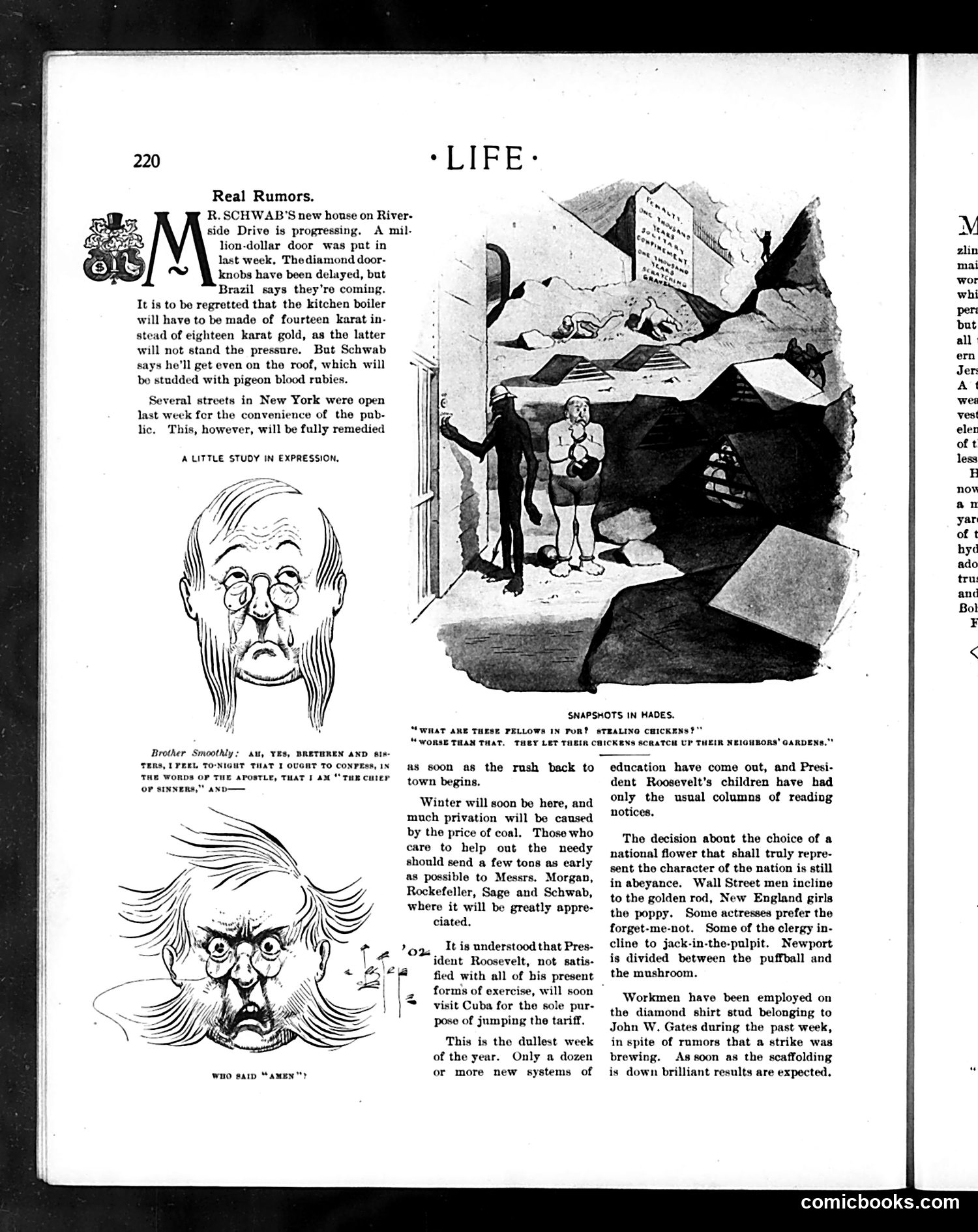
This page contains political satire from the early 1900s. The main cartoon, titled "Snapshots in Hades," depicts a scene in the underworld where damned souls converse. One figure asks another about "fellows in fur" who are "stealing chickens" from neighbors' gardens—likely referencing wealthy robber barons or corrupt businessmen engaging in unethical behavior. The two expressive facial caricatures below ("A Little Study in Expression") appear to represent stock character types used for comic effect, typical of the era's satirical conventions. The "Real Rumors" column mocks various contemporary New York society gossip, including references to diamond jewelry and the Schwaab family. The overall tone ridicules the wealthy elite's behavior and pretensions during the Progressive Era.
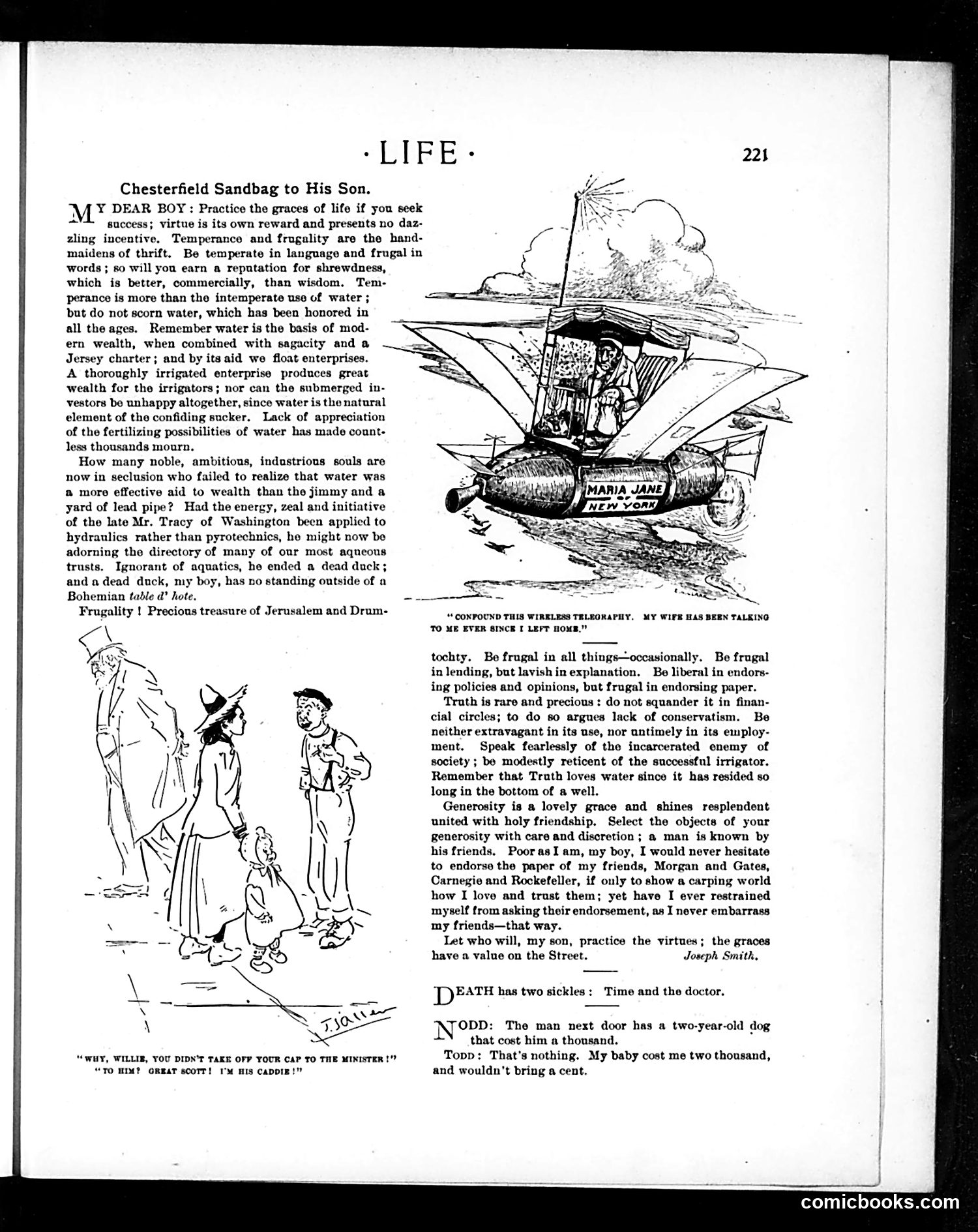
This page contains satirical commentary on American business practices and social hypocrisy circa early 1900s. **Main Piece: "Chesterfield Sandbag to His Son"** A mock-aristocratic letter advises a son on achieving wealth through deception. It cynically reframes water as a tool for financial manipulation—praising irrigation enterprises while noting investors become "confiding suckers." The reference to "the late Mr. Tracy of Washington" appears to reference a real embezzler or fraudster whose criminal energy went "unappreciated." The satire mocks corrupt businessmen who exploit public trust while preaching virtue. **Three Cartoon Vignettes:** 1. A minister ignored by a boy who claims to be the minister's "caddie" (golf assistant)—mocking class pretension 2. Wireless telegraphy joke about a nagging wife 3. Economic jest: a baby costing $2,000 but having no resale value, contrasting with expensive dogs—satirizing wasteful spending The page satirizes Gilded Age greed, business fraud presented as respectability, and social climbing.
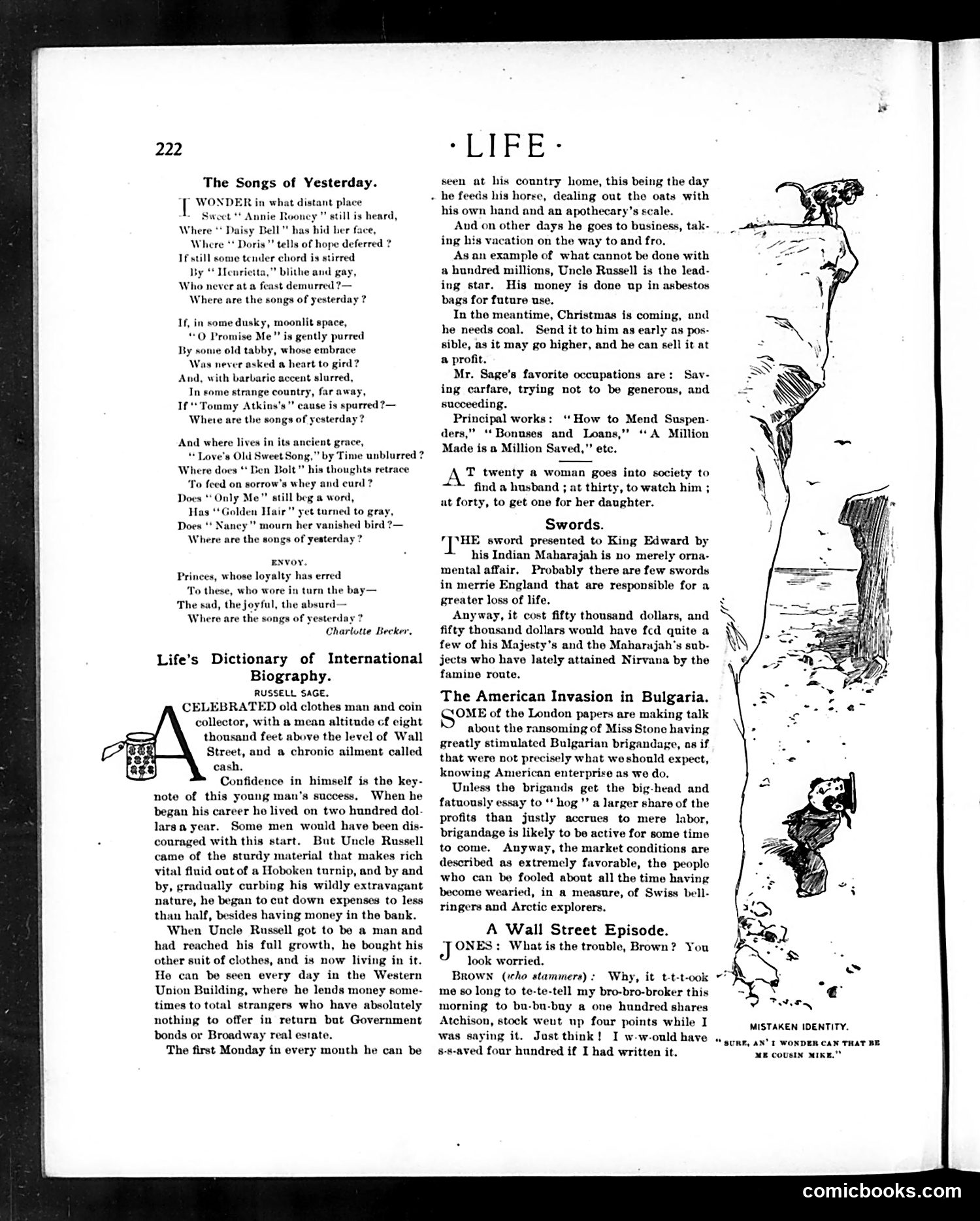
This page from Life magazine (a satirical publication) contains three distinct pieces: **"The Songs of Yesterday"** — A nostalgic poem by Charlotte Becker lamenting popular songs that have faded from memory, asking where bygone melodies like "Annie Rooney" and "Daisy Bell" have gone. It's sentimental commentary on changing tastes. **"Russell Sage" (Dictionary of International Biography)** — A sharp satirical biography mocking the famously miserly millionaire Russell Sage. The humor emphasizes his extreme frugality: he owns only two suits of clothes, lives in the Western Union Building where he lends money secured by bonds, and meticulously rations oats to his horse with an apothecary's scale. The satire suggests his vast wealth (stored in asbestos bags) is useless because he refuses to spend or enjoy it. **Brief items on swords and Bulgaria** — These appear to be satirical news commentary criticizing waste (an ornate sword gift) and American intervention in Bulgarian brigandage. The page overall exemplifies Life's trademark witty social critique of wealthy misers and cultural nostalgia.
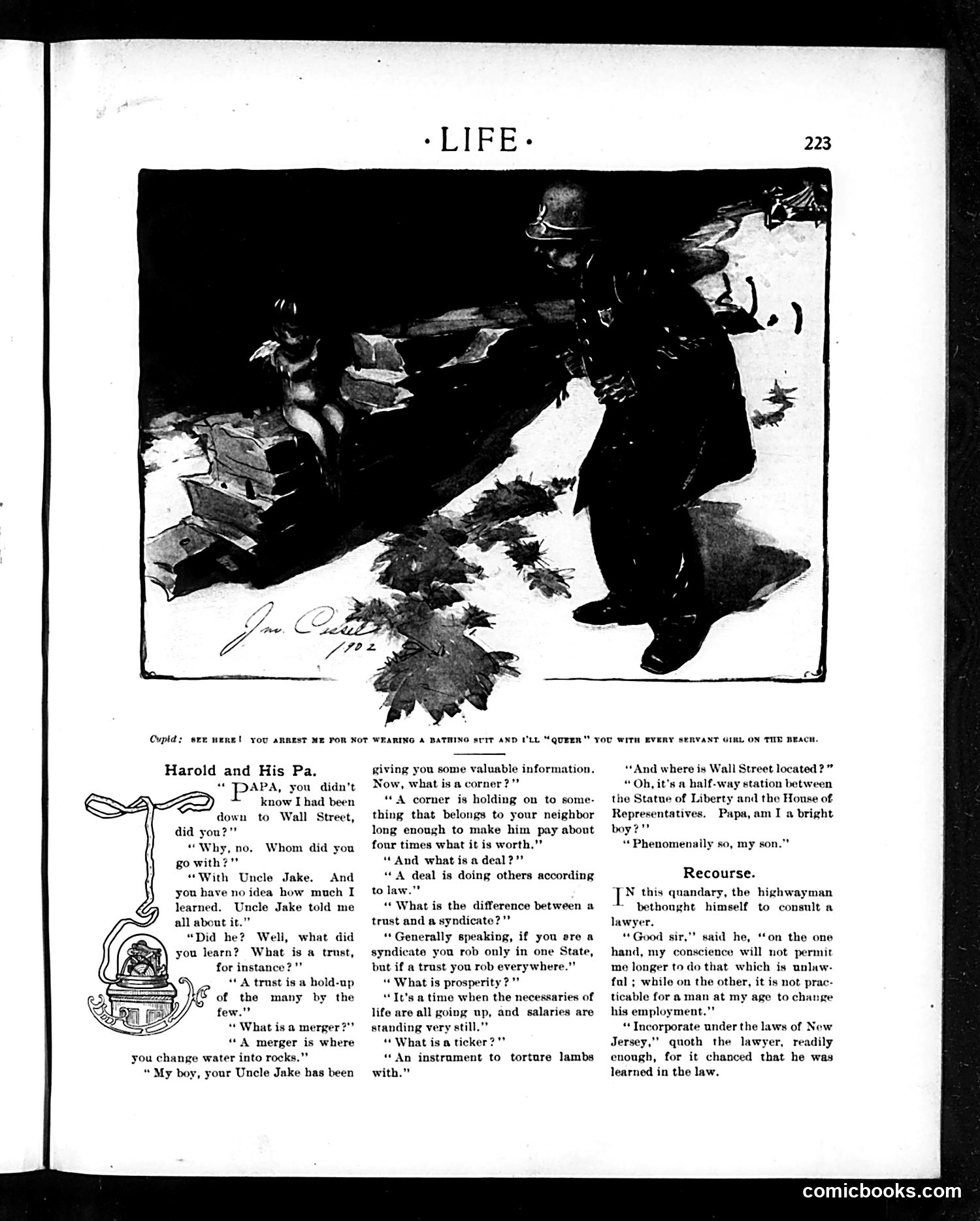
This page contains two satirical pieces mocking American capitalism and finance circa the early 1900s. **"Harold and His Pa"** is a comic dialogue where a boy repeats cynical definitions of financial terms learned from Uncle Jake on Wall Street. The satire targets robber-baron capitalism: a "trust" is a "hold-up," a "merger" is fraud, a "corner" is extortion, and Wall Street itself sits between Liberty and Congress—suggesting corruption pervades government. The joke is that the boy's crude, honest definitions actually describe how these financial instruments *really* operate, exposing the hypocrisy of respectable business. **"Recourse"** satirizes how the legal system enables crime. A highwayman consults a lawyer about his guilty conscience, and the lawyer's solution is simply to "incorporate under the laws of New Jersey"—implying that incorporation is merely legalized robbery. The cartoon suggests corporate structures allow wealthy criminals to escape moral and legal consequences through technicalities. Both pieces express Progressive-era skepticism about Wall Street finance and corporate law as instruments of exploitation rather than legitimate business.
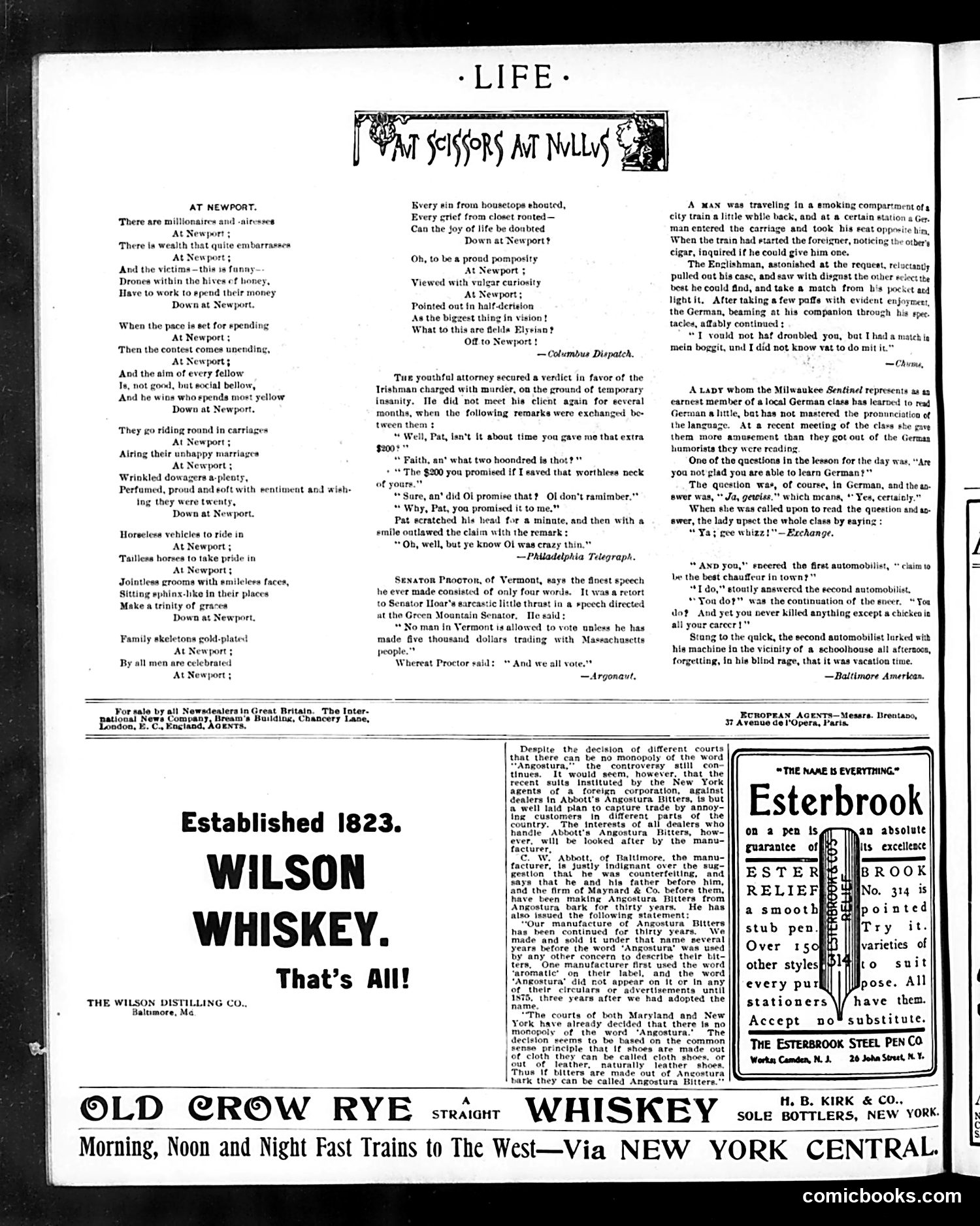
This page contains three distinct pieces of social satire targeting American upper-class life: 1. **"At Newport"** (main poem): Mocks the wealthy Newport, Rhode Island resort community for their obsessive, competitive spending and social climbing. The satire ridicules their hollow pursuits—riding in carriages to display unhappy marriages, employing skeletal servants, and treating conspicuous consumption as life's purpose. The repeated refrain "Down at Newport" emphasizes how removed this world is from normal society. 2. **Irish Client anecdote**: A lawyer secures a murder acquittal for an Irish client on temporary insanity grounds, then demands promised payment. The client claims he "was crazy then"—suggesting his insanity defense was so successful that it applied retroactively to his promise. 3. **Vermont Senator Proctor story**: Satirizes political bluster by recounting how Proctor's "finest speech" was merely four words—a curt retort to Senator Hoar. The joke undermines pretentious political oratory. All three pieces target vanity, pretension, and hypocrisy across social classes.
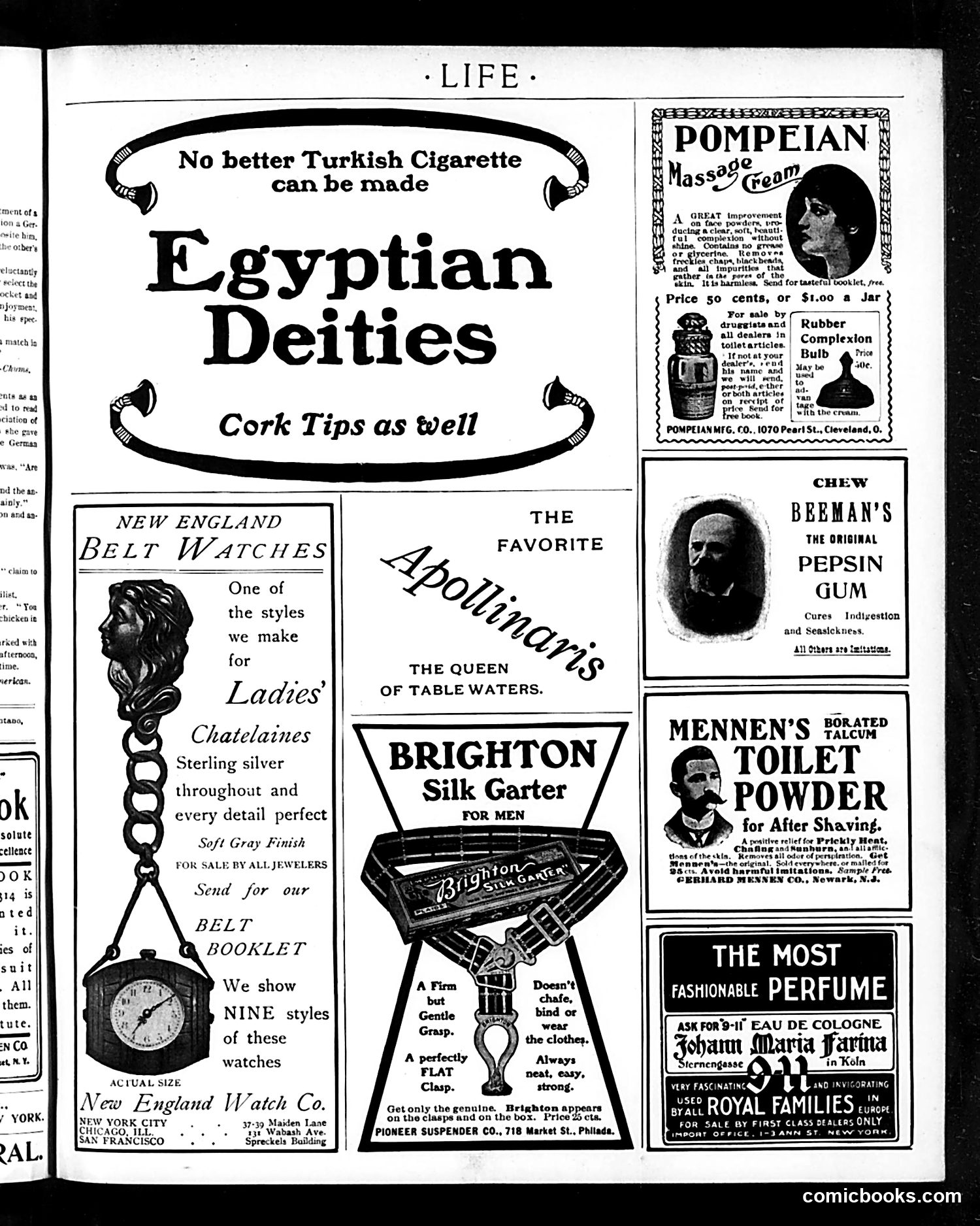
This page is primarily **advertising**, not satire or political commentary. It contains product advertisements typical of early 20th-century magazines: **Main Advertisement**: Egyptian Deities cigarettes, claiming superiority as a Turkish cigarette with cork tips. **Other Advertisements Include**: - New England Belt Watches for ladies - Apollinaris table water - Brighton silk garters for men - Beeman's Pepsin gum - Mennen's toilet powder - Johann Maria Farina perfume **Historical Context for Modern Readers**: These ads reflect period attitudes—notably the casual use of "Egyptian Deities" branding, which exploited exotic Orientalism popular in the era. The gendered product targeting (ladies' watches, men's garters) reflects strict Victorian gender norms. Product claims (gum "curing" seasickness, powder for "after shaving") would face regulatory challenges today. This represents pre-FDA advertising when health claims were largely unregulated and manufacturers made expansive promises without scientific backing.
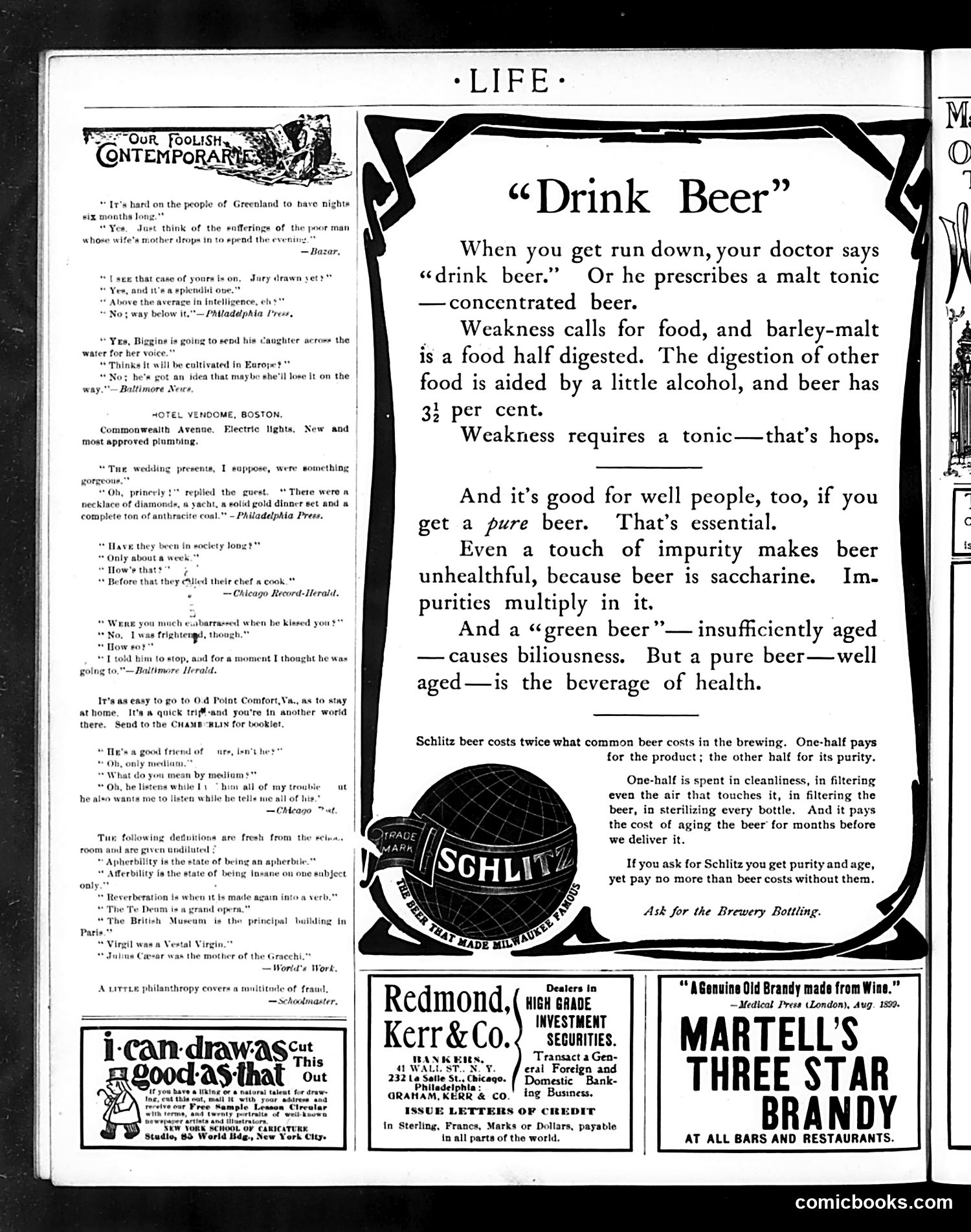
This page is primarily a **Schlitz beer advertisement** disguised as health advice—a common marketing tactic of the early 1900s. The ad claims beer is medicinal: doctors prescribe it for weakness, its alcohol aids digestion, and hops provide tonic benefits. The key selling point is **purity**—Schlitz emphasizes that "pure beer, well aged" is healthy, while impure or insufficiently aged ("green") beer causes illness. The advertisement addresses class anxieties by noting beer is "good for well people, too"—reassuring middle-class readers that beer consumption wasn't solely working-class behavior. The satire in "Our Foolish Contemporaries" (left column) mocks social pretension and marital discord through brief jokes, unrelated to the beer pitch. **Modern context**: This reflects a pre-FDA era when alcohol was genuinely marketed as medicinal and competing breweries touted purity as a competitive advantage—Schlitz claiming superior filtering and aging justified higher costs.
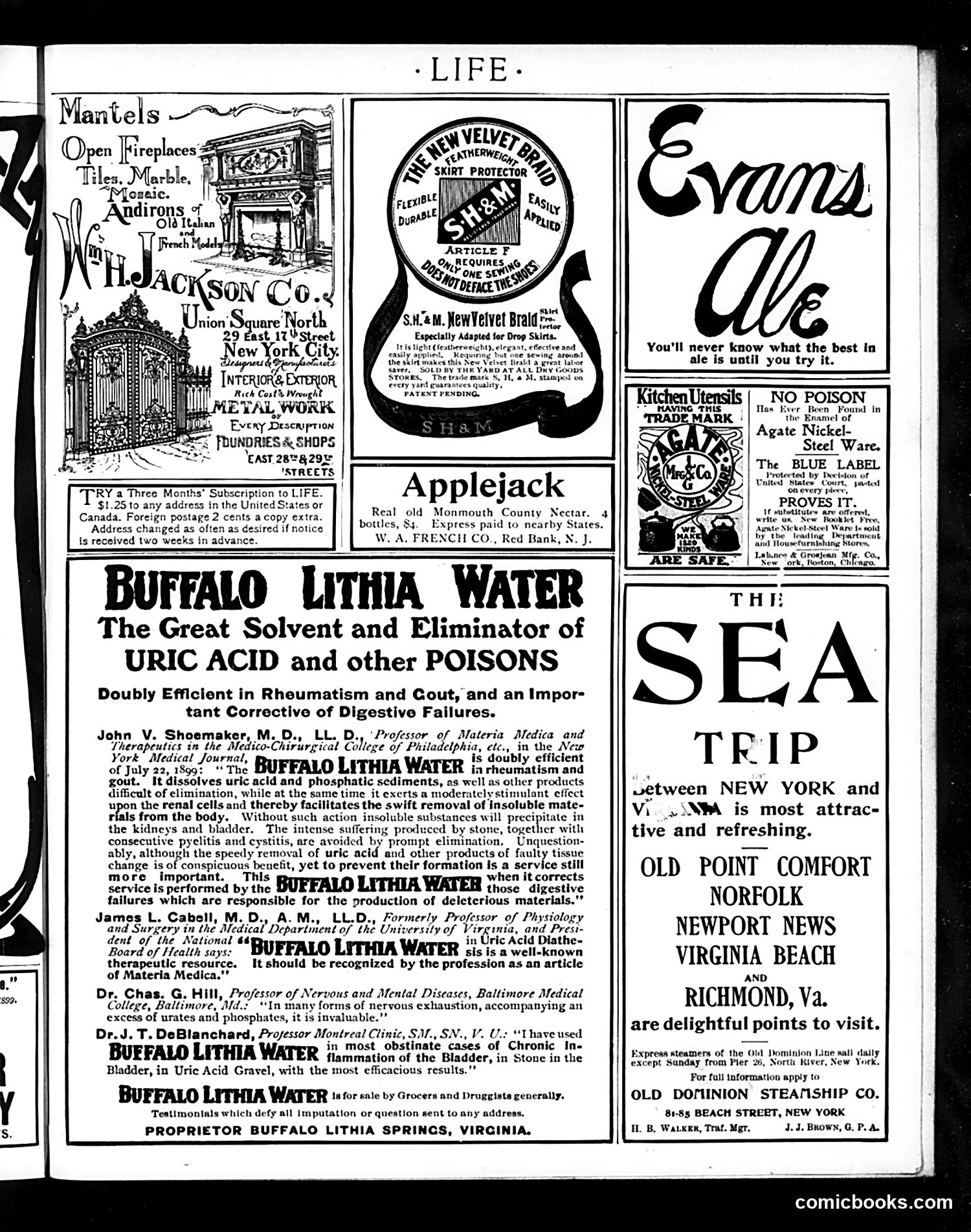
This is primarily an **advertising page** rather than editorial content. The page contains multiple product advertisements typical of early 1900s magazines. The largest ad promotes **Buffalo Lithia Water**, marketed as a cure-all for rheumatism, gout, and uric acid poisoning. It features testimonials from named physicians claiming the water "dissolves uric acid" and corrects digestive problems. This reflects the era's popular belief in mineral water remedies and the prevalence of unregulated patent medicine claims before FDA oversight. Other notable ads include: - **Evans Ale** ("You'll never know what the best in ale is until you try it") - **Agate Nickel-Steel kitchen ware** emphasizing safety and lack of poison - **Old Dominion Steamship Company** promoting Virginia coastal tourism - Various fireplace and building material suppliers There is **no apparent satire or political cartoon** on this page. It represents standard commercial advertising from the era, when dubious health claims and unproven remedies were legally advertised in mainstream publications.
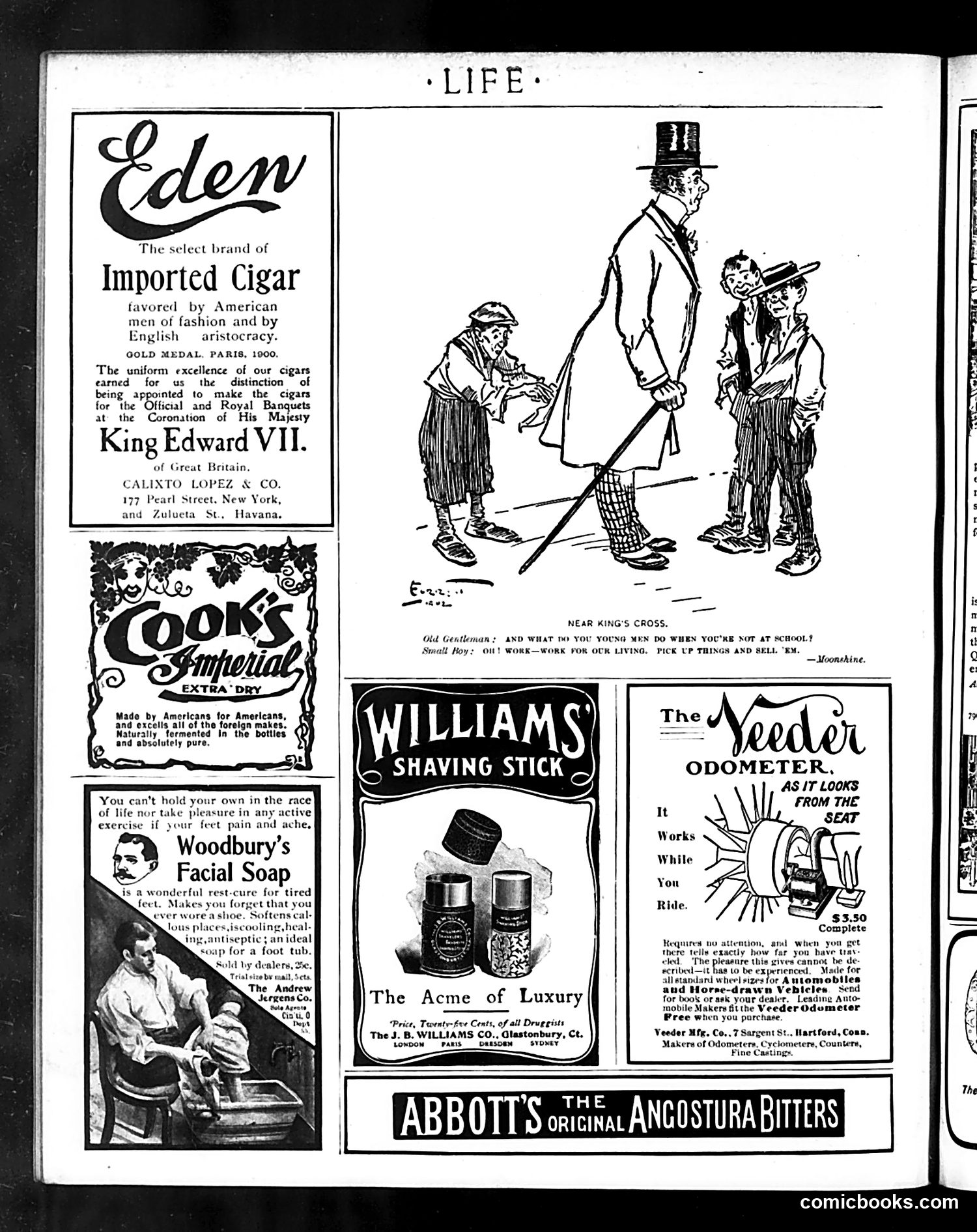
This page is primarily **advertising**, with one cartoon at top center. The cartoon, captioned "Near King's Cross," depicts a well-dressed gentleman asking two working-class boys what they do when not in school. They respond they work to support themselves, "picking up things and selling 'em." The satire comments on **child labor and street vending** in Edwardian England—a common social problem where poor children supplemented family income by scavenging and reselling items. The humor is grim: the gentleman seems naively surprised that boys work for survival rather than attending school. The cartoon critiques both class inequality and the acceptability of child labor among the comfortable classes. The advertisements surrounding it (Eden cigars, Woodbury's Facial Soap, Williams Shaving Stick, Veeder Odometer, Abbott's Bitters) are period luxury goods marketed to affluent readers—the very audience the cartoon implicitly satirizes for their obliviousness to working-class hardship.
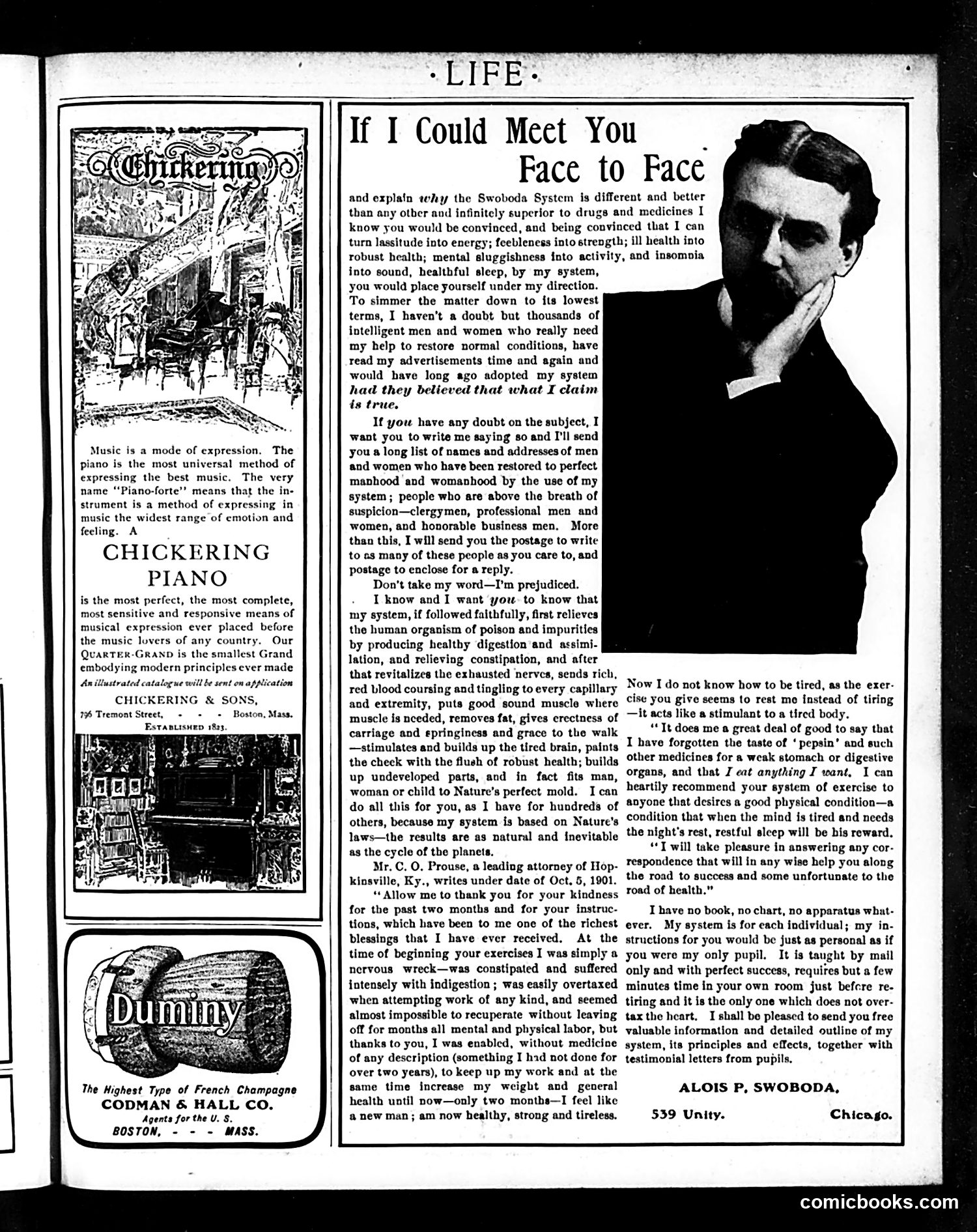
This page contains **advertisements disguised as editorial content**—a common early 20th-century marketing practice. The left side advertises **Chickering pianos** and French champagne through conventional ads. The dominant right-hand content is a testimonial letter from **Alois P. Swoboda** (Chicago), promoting his "Swoboda System"—a health/wellness regimen claiming to cure fatigue, digestive problems, constipation, and insomnia without medicine. He offers to send readers a list of supposed testimonials (including a lawyer named "C.O. Prouse") as "proof." **The satire/criticism**: This appears to be Life magazine's mockery of **quack medical claims and testimonial marketing**. Swoboda's promises are absurdly comprehensive ("builds up undeveloped parts," restores people to "Nature's perfect mold"), his appeals to authority suspicious, and his offer to send postage for verification seems designed to look legitimate while remaining unverifiable—classic snake-oil tactics. The juxtaposition with legitimate piano advertising highlights the contrast between honest business and fraudulent health claims.
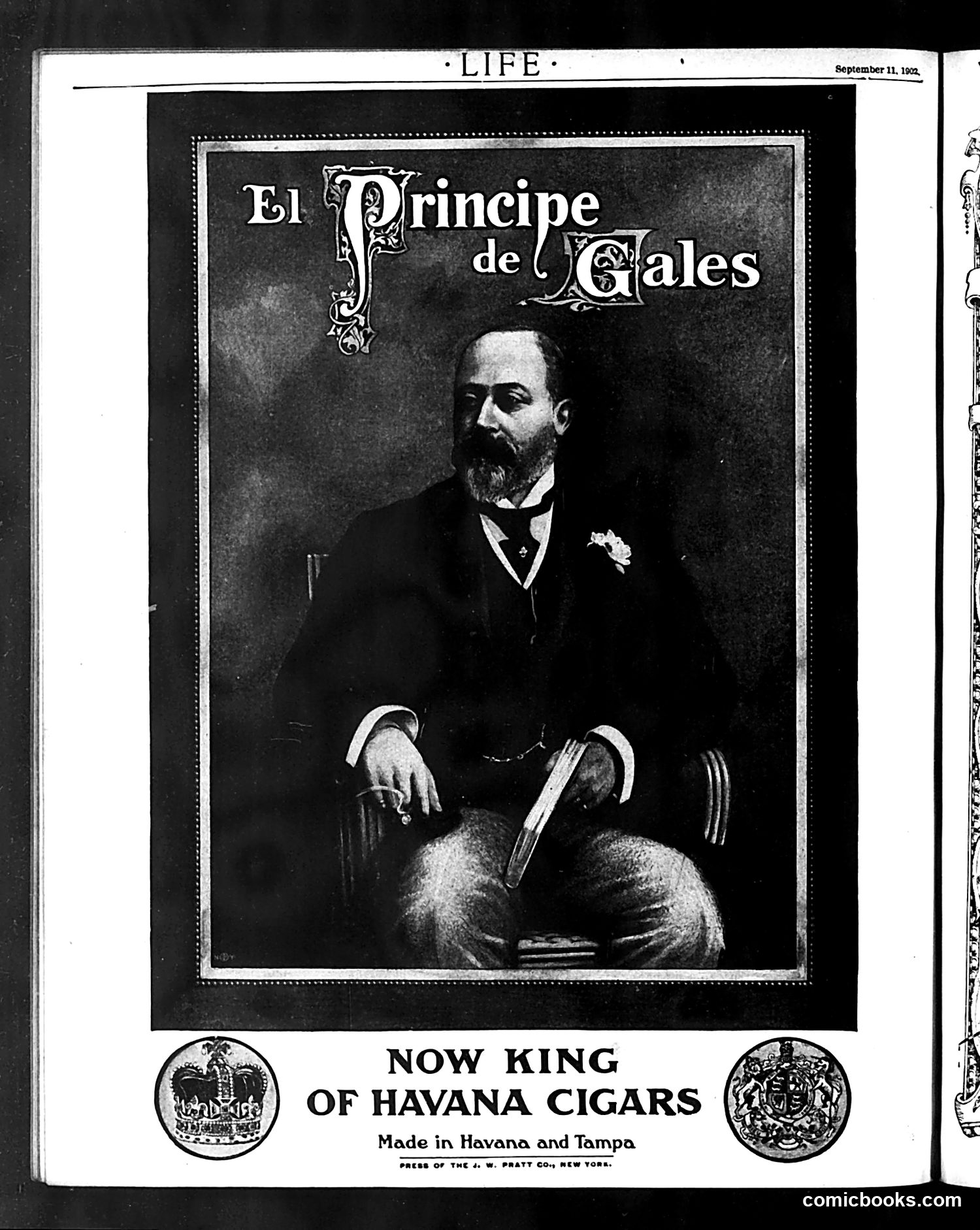
This is primarily a **cigar advertisement** masquerading as magazine content. The page features a formal portrait of a distinguished bearded man in formal dress, titled "El Príncipe de Gales" (The Prince of Wales) in Spanish. The advertisement claims this person is "NOW KING OF HAVANA CIGARS" made in Havana and Tampa. The title appears to be a **pun or marketing joke**—the "Prince" has become "King" of the cigar world. Two official seals flank the text, lending false authority. Without identifying the specific individual pictured, this represents early 1900s advertising strategy: using aristocratic imagery and foreign titles to market American-made cigars as premium products, exploiting consumer associations between European nobility and luxury goods.