
Life, 1902-09-11 · page 8 of 22
Life — September 11, 1902 — page 8: what you’re looking at
What you’re looking at
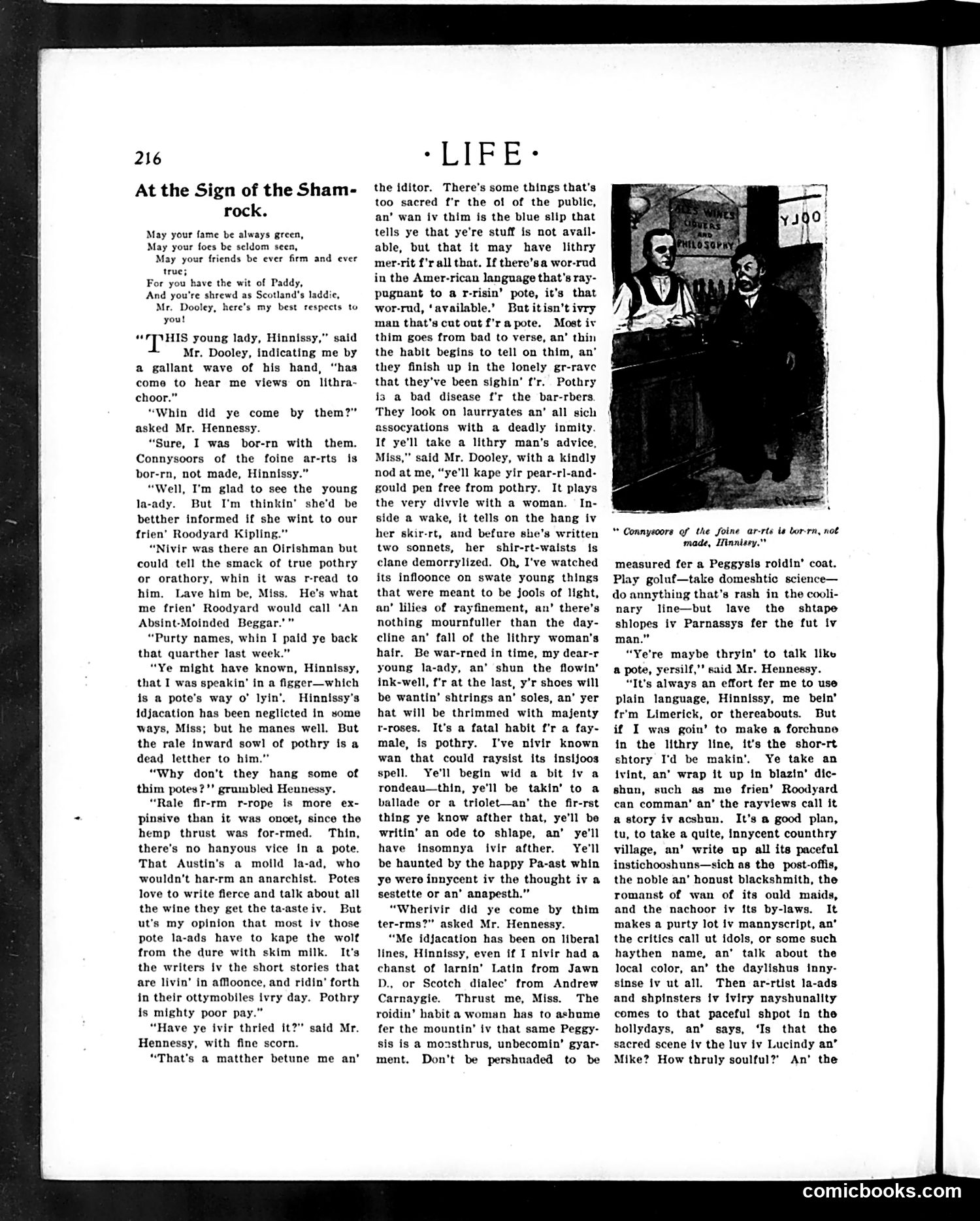
This appears to be a satirical dialogue between Mr. Dooley (a famous Irish-American character from Life magazine) and a young woman named Hinnissy about literary pretension and bad poetry. The accompanying illustration shows two men in conversation, likely representing Dooley and Hennessy, Life's stock Irish-American characters used for social commentary. The text mocks poets and literary circles who adopt affected language and produce mediocre work while maintaining airs of sophistication. Dooley ridicules those who write "fierce and talk about all the whin they get the leather" and warns against pretentious "lithry" (literary) aspirations. The satire targets both amateur writers chasing literary fame and the broader cultural affectation of the educated classes toward art and literature.
📄 Transcribed text from this page (OCR, searchable)
Machine-transcribed from the original scan — historical spelling and the odd misread are preserved.
216 At the Sign of the Sham- rock. May your fame be always green, May your foes be seldom seen, May your friends be ever firm and ever true; For you have the wit of Paddy, And you're shrewd as Scotland's laddie, Mr. Dooley, here's my best respects to you! “HIS young lady, Hinnissy,” said Mr. Dooley, indicating me by a gallant wave of his hand, “has come to hear me views on lithra- choor.” “Whin did ye come by them?” asked Mr. Hennessy. “Sure, I was bor-rn with them. Connysoors of the foine ar-rts is bor-rn, not made, Hinnissy.” “Well, I'm glad to see the young la-ady. But I'm thinkin’ she'd be betther informed if she wint to our frien’ Roodyard Kipling.” “Nivir was there an Oirishman but could tell the smack of true pothry or orathory, whin it was r-read to him. Lave him be, Miss. He's what me frien’ Roodyard would call ‘An Absint-Moinded Beggar.’” “Purty names, whin I paid ye back that quarther last week.” “Ye might have known, Hinnissy, that I was speakin’ in a figger—which is a pote’s way o’ lyin’. Hinnissy’s idjacation has been neglicted in some ways, Miss; but he manes well. But the rale inward sowl of pothry is a dead letther to him.” “Why don't they hang some of thim potes?’’ grumbled Hennessy. “Rale fir-rm r-rope is more ex- pinsive than it was oncet, since the hemp thrust was for-rmed. Thin, there's no hanyous vice In a pote. That Austin's a moild la-ad, who wouldn't har-rm an anarchist. Potes love to write flerce and talk about all the wine they get the ta-asteiv. But ut’s my opinion that most iv those pote la-ads have to kape the wolt from the dure with skim milk. It’s the writers iv the short stories that are livin’ in afMoonce, and ridin’ forth in their ottymobiles ivry day. Pothry is mighty poor pay.” “Have ye ivir thried it?” said Mr. Hennessy, with fine scorn. “That's a matther betune me an’ -LIFE- the iditor. There's some things that's too sacred f'r the of of the public, an’ wan iv thim is the blue slip that tells ye that ye're stuff is not avail- able, but that it may have lithry mer-rit f’r all that. If there’sa wor-rad in the Amer-rican language that’s ray- pugnant to a r-risin’ pote, it’s that wor-rud, ‘available.’ But itisn’t ivry man that's cut out f’rapote. Most iv thim goes from bad to verse, an’ thin the habit begins to tell on thim, an’ they finish up in the lonely gr-rave that they've been sighin’ f'r. Pothry is a bad disease f'r the bar-rbers. They look on laurryates an’ all sich assocyations with a deadly inmity. I¢ ye'll take a lithry man’s advice, Miss," said Mr. Dooley, with a kindly nod at me, “ye'll kape yir pear-rl-and- gould pen free from pothry. It plays the very divvle with a woman. In- side a wake, it tells on the hang iv her skir-rt, and befure she’s written two sonnets, her shir-rt-waists is clane demorrylized. Oh, I've watched its infloonce on swate young things that were meant to be jools of light, an’ lilies of rayfinement, an’ there’s nothing mournfuller than the day- cline an’ fall of the lithry woman's hair. Be war-rned in time, my dear-r young la-ady, an’ shun the flowin’ ink-well, f’r at the last, y’r shoes will be wantin’ shtrings an’ soles, an’ yer hat will be thrimmed with majenty r-roses. It’s a fatal habit f'r a fay- male, is pothry. I've nivir known wan that could raysist its insijoos spell. Ye'll begin wid a bit iv a rondeau—thin, ye'll be takin’ to a ballade or a triolet—an’ the fir-rst thing ye know afther that, ye'll be writin’ an ode to shlape, an’ ye'll have insomnya ivir afther. Ye'll be haunted by the happy Pa-ast whin ye were innycent iv the thought iv a sestette or an’ anapesth.” “Wherivir did ye come by thim ter-rms?” asked Mr. Hennessy. “Me idjacation has been on liberal lines, Hinnissy, even if I nivir had a chanst of larnin’ Latin from Jawn D., or Scotch dialec’ from Andrew Carnaygie. Thrust me, Miss. The roidin’ habit a woman has to ashame fer the mountin’ iv that same Peggy- sis is a monsthrus, unbecomin’ gyar- ment. Don't be pershuaded to be “ Connysoors of the foine ar-rts is lorrn, not made, Hinnisry.” measured fer a Peggysis roidin’ coat. Play goluf—take domeshtic science— do annything that’s rash in the cooli- nary line—but lave the shtape shlopes iv Parnassys fer the fut iv man. “Ye're maybe thryin’ to talk like a pote, yersilf,” said Mr. Hennessy. “It's always an effort fer me to use plain language, Hinnissy, me bein’ fr’'m Limerick, or thereabouts. But if I was goin’ to make a forchune in the Hthry line, it's the shor-rt shtory I'd be makin’. Ye take an ivint, an’ wrap it up in blazin’ dic- shun, such as me frien’ Roodyard can comman’ an’ the rayviews call it a story iv acshun. It’s a good plan, tu, to take a quite, innycent counthry village, an’ write up all its paceful instichooshuns—sich as the post-offis, the noble an’ honust blackshmith, the romanst of wan of its ould maids, and the nachoor iv {ts by-laws. It makes a purty lot iv mannyscript, an’ the critics call ut idols, or some such haythen name, an’ talk about the local color, an’ the daylishus inny- sinse iv ut all. Then ar-rtist la-ads and shpinsters iv iviry nayshunality comes to that paceful shpot in the hollydays, an’ says, ‘Is that the sacred scene iv the luv iv Lucindy an’ Mike? How thruly soulful?’ An’ the comicbooks.com