
Life, 1902-09-11 · page 6 of 22
Life — September 11, 1902 — page 6: what you’re looking at
What you’re looking at
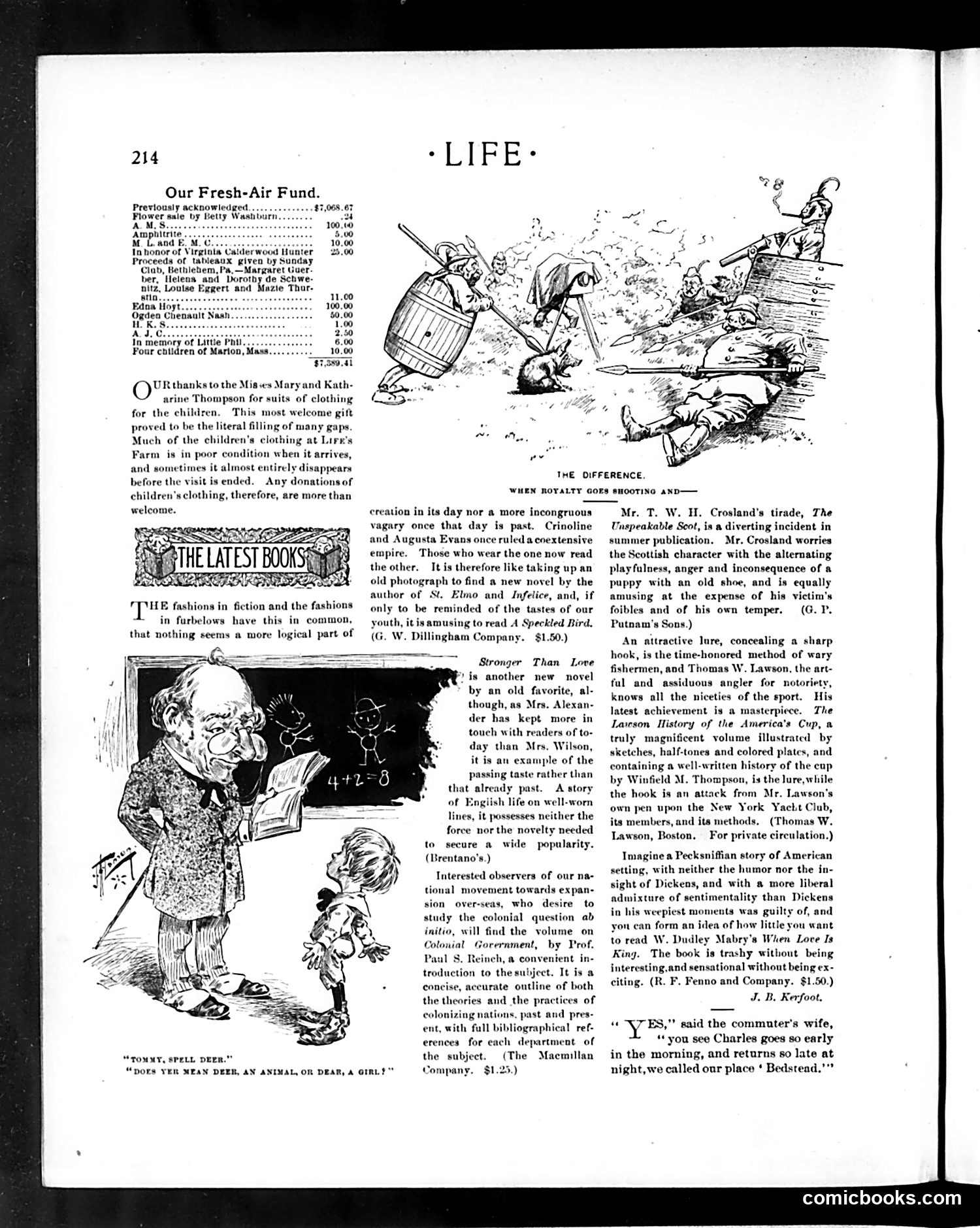
The main cartoon, titled **"The Difference,"** compares two literary works. The left illustration shows an old man reading, labeled with a quote about spelling ("Tommy, spell deer... does yer mean deer, an animal, or dear, a girl?"). This appears to be satirizing the contrast between **realistic, vernacular fiction** (represented by the crude dialect spelling) and more refined literary tastes. The cartoon critiques how fashionable fiction prioritizes linguistic authenticity and colloquial speech over polished prose—a debate about literary realism versus genteel writing conventions. The page also reviews several contemporary books, including works by T.W.H. Crosland and discussions of colonial literature, reflecting early 20th-century literary criticism and publishing trends.
📄 Transcribed text from this page (OCR, searchable)
Machine-transcribed from the original scan — historical spelling and the odd misread are preserved.
214 Our Fresh-Air Fund. Previously acknowledged $7,068.67 Flower sale by etry W: rag gtk Land Thnneor of Virginta Ca! jer wood Hunter Proceeds of tableaux given by Sunday ber, Helens and Doroth: nitz, Louise Eggert and ‘de Schwe. jazie Thar. sf= SevrSss S8essss In me: Four children of Marton, Mass JR thanks to the Miases Mary and Kath arine Thompson for suits of clothing for the children. This most welcome gift proved to be the literal filling of many gaps. Much of the children's clothing at Lire’s Farm is in poor condition when it arrives, and sometimes it almost entirely disappears before the visit is ended. Any donations of children’s clothing, therefore, are more than welcome. a TELAT i HE fashions in fiction and the fashions in furbelows have this in common, that nothing seems a more logical part of THE DIFFERENCE. N ROYALTY GOES @HOOTING AND— creation in its day nor a more incongruous vagary once that day is past. Crinoline and Augusta Evans once ruled a coextensive empire. Those who wear the one now read the other. It is therefore like taking up an old photograph to find a new novel by the author of St. Elmo and Infelice, and, if only to be reminded of the tastes of our uth, itis amusing to read A Speckled Bird. G W. Dillingham Company. $1.50.) “TOMMY, SPELL DEER.” “Dors YER NEAN DEER, AN ANIMAL, OR DEAR, A GIRL” Stronger Than Love is another new novel by an old favorite, al- though, as Mrs. Alexan- der has kept more in touch with readers of to- day than Mrs. Wilson, it is an example of the passing taste rather than that already past. A story of English life on well-worn lines, it possesses neither the force nor the novelty needed secure a wide popularity. (Brentano’s.) Interested observers of our na- tional movement towards expan- sion who desire to study the colonial question ab initio, will find the volume on Colonial Government, by Prof. Paul 8. Reinch, a convenient in- troduction to the subject. It is a concise, accurate outline of both the theories and the practices of colonizing nations, past and pres- ent, with full bibliographical ref- erences for each department of the subject. (The Macmillan Company. $1.25.) over-seas, Mr. T. W. H. Crosland’s tirade, The Unspeakable Scot, is a diverting incident in summer publication. Mr. Crosland worries the Scottish character with the alternating playfulness, anger and inconsequence of a puppy with an old shoe, and is equally amusing at the expense of his victim's foibles and of his own temper. (G. P. Putnam's Sons.) An aitractive lure, concealing a sharp hook, is the time-honored method of wary fishermen, and Thomas W. Lawson, the art- ful and assiduous angler for notoriety, knows all the niceties of the sport. His latest achievement is a masterpiece. The Larson History of the America’s Cup, a truly magnificent volume illustrated by sketches, half-tones and colored plates, and containing a well-written history of the cup by Winfield M. Thompson, is the lure, while the hook is an attack from Mr. Lawson's own pen upon the New York Yacht Club, its members, and its methods, (Thomas W. Lawson, Boston. For private circulation.) Imagine a Pecksniffian story of American setting, with neither the humor nor the in- sight of Dickens, and with a more liberal admixture of sentimentality than Dickens in his weepiest moments was guilty of, and you can form an idea of he to read W. Dudley Mabry’s When Love Is King. The book is trashy without being interesting,and sensational without being ex- citing. (R. F. Fenno and Company. $1.50.) J.B. Kerfoot. yes. said the commuter's wife, “you see Charles goes so early in the morning, and returns so late at night, we called our place ‘ Bedstead.’” comicbooks.com