
Life, 1902-09-11 · page 3 of 22
Life — September 11, 1902 — page 3: what you’re looking at
What you’re looking at
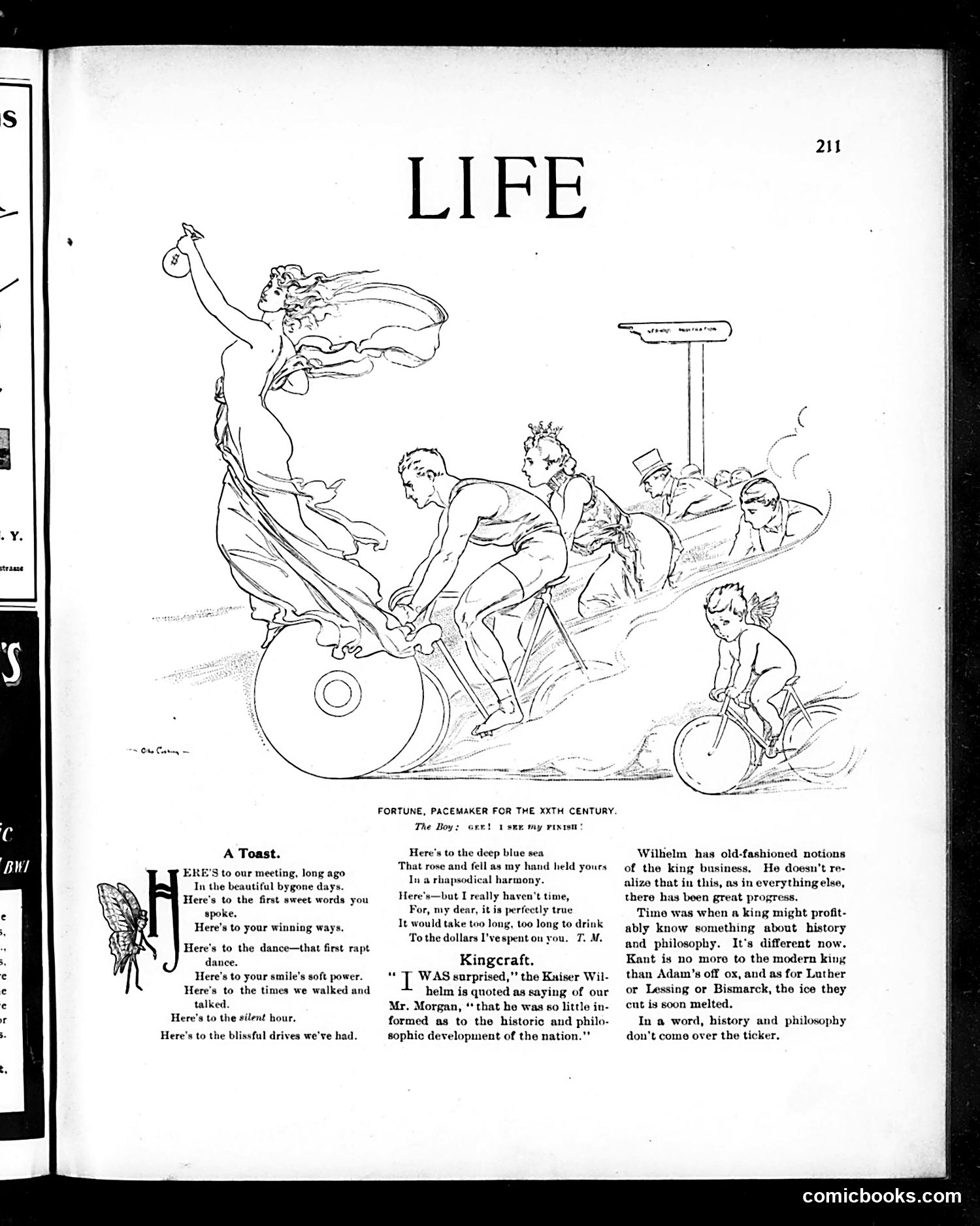
The main cartoon, titled "Fortune, Pacemaker for the XXth Century," depicts Lady Fortune (the classical allegorical figure at top) leading various figures—appearing to represent different social classes and professions—on a chaotic journey via bicycle and other conveyances. The subtitle "The Boy" and caption "GET I SEE MY FISHIN'" suggests satirical commentary on modern life's rapid pace and unpredictability. Below, three brief pieces ("A Toast," "Kingcraft," and an untitled column) offer sardonic observations on contemporary society, including references to history, philosophy, and leadership. The overall satire critiques early 20th-century modernity: Fortune (fate/luck) driving progress chaotically rather than rationally, with ordinary people caught in its turbulent wake. The tone suggests skepticism about whether technological and social "progress" genuinely improves human life.
📄 Transcribed text from this page (OCR, searchable)
Machine-transcribed from the original scan — historical spelling and the odd misread are preserved.
A Toast. ERE’S to our meeting, long ago In the beautiful bygone days. Here's to the first sweet words you spoke, Here's to your winning ways. Here's to the dance—that first rapt dance. Here’s to your smile’s soft power. Here's to the times we walked and talked. Here's to the silent hour, Here's to the blissful drives we've had. FORTUNE, PACEMAKER FOR THE XXTH CENTURY. The Boy: cert 1 snr my rinren! Here's to the deep blue sea That ro nd fellas my hand held yours In a rhapsodical harmony. Here's—but I really haven't time, For, my dear, it is perfectly true It would take too long, too long to drink ‘To the dollars 'vespent on you. 7. Mf. Kingcraft. “TWAS sarprised,” the Kaiser Wil- helm is quoted as saying of our Mr. Morgan, “that he was 80 little in- formed as to the historic and philo- sophic development of the nation.’ Wilhelm has old-fashioned notions of the king business, He doesn't re- alize that in this, as in everything else, there has been great progress. Time was when a king might profit- ably know something about history and philosophy. It's different now. Kant is no more to the modern king than Adam’s off ox, and as for Luther or Lessing or Bismarck, the ice they cut is soon melted. In a word, history and philosophy don’t come over the ticker, comicbooks.com