
A complete issue · 20 pages · 1902
Life — August 28, 1902
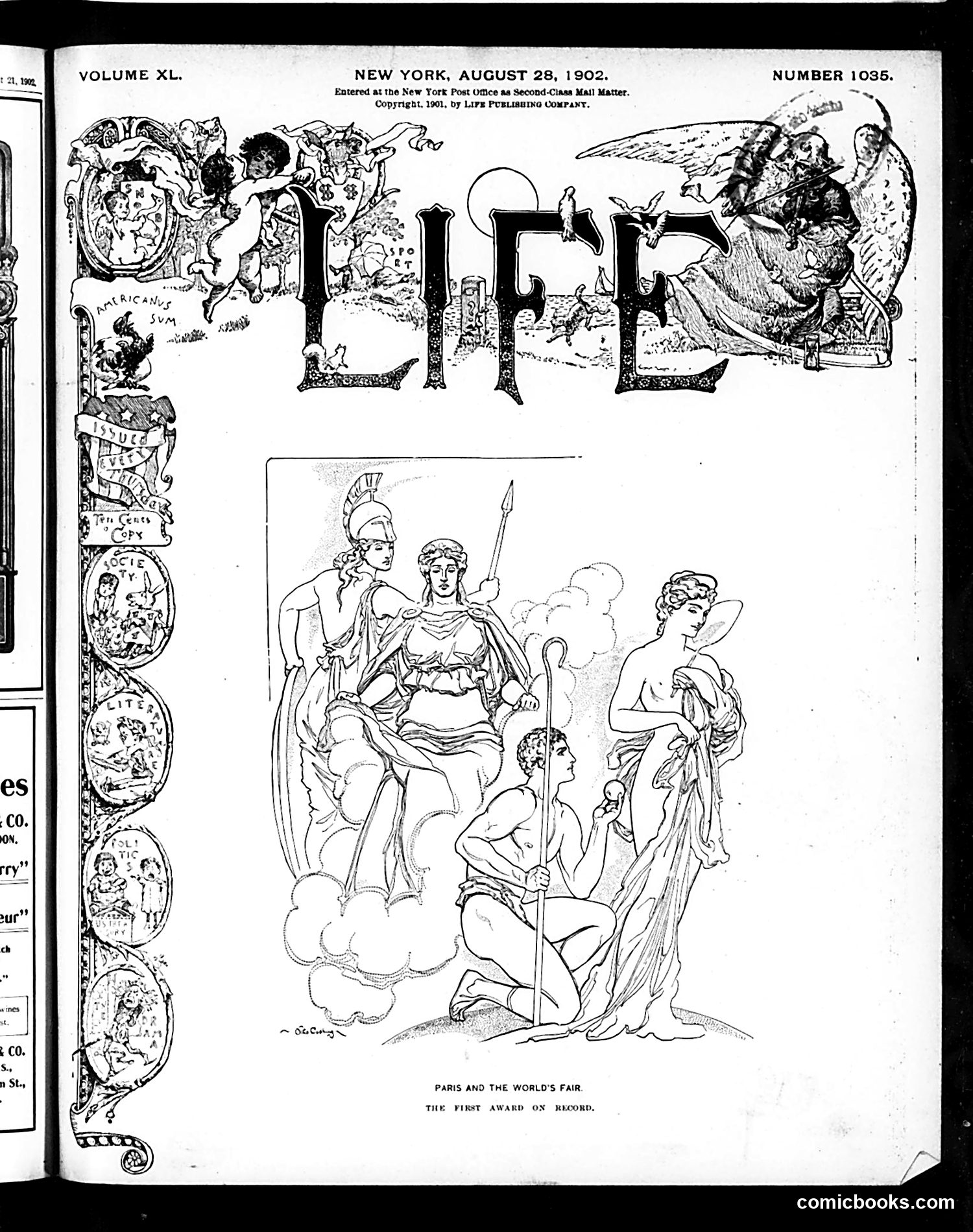
This satirical cartoon from *Life* magazine (August 28, 1902) depicts classical allegorical figures—likely representing Justice, Wisdom, and other virtues—presenting an award to Paris (the Trojan prince, identifiable by his position among goddesses). The title references the famous mythological "Judgment of Paris," where Paris awarded a golden apple to the goddess he deemed most beautiful, sparking the Trojan War. The satire likely comments on the 1900 Paris Exposition or contemporary international competitions, suggesting Paris's consistent tendency to award itself first prize—a witty jab at French self-regard and favoritism in judging. The classical setting underscores the absurdity by connecting modern vanity to ancient myth.
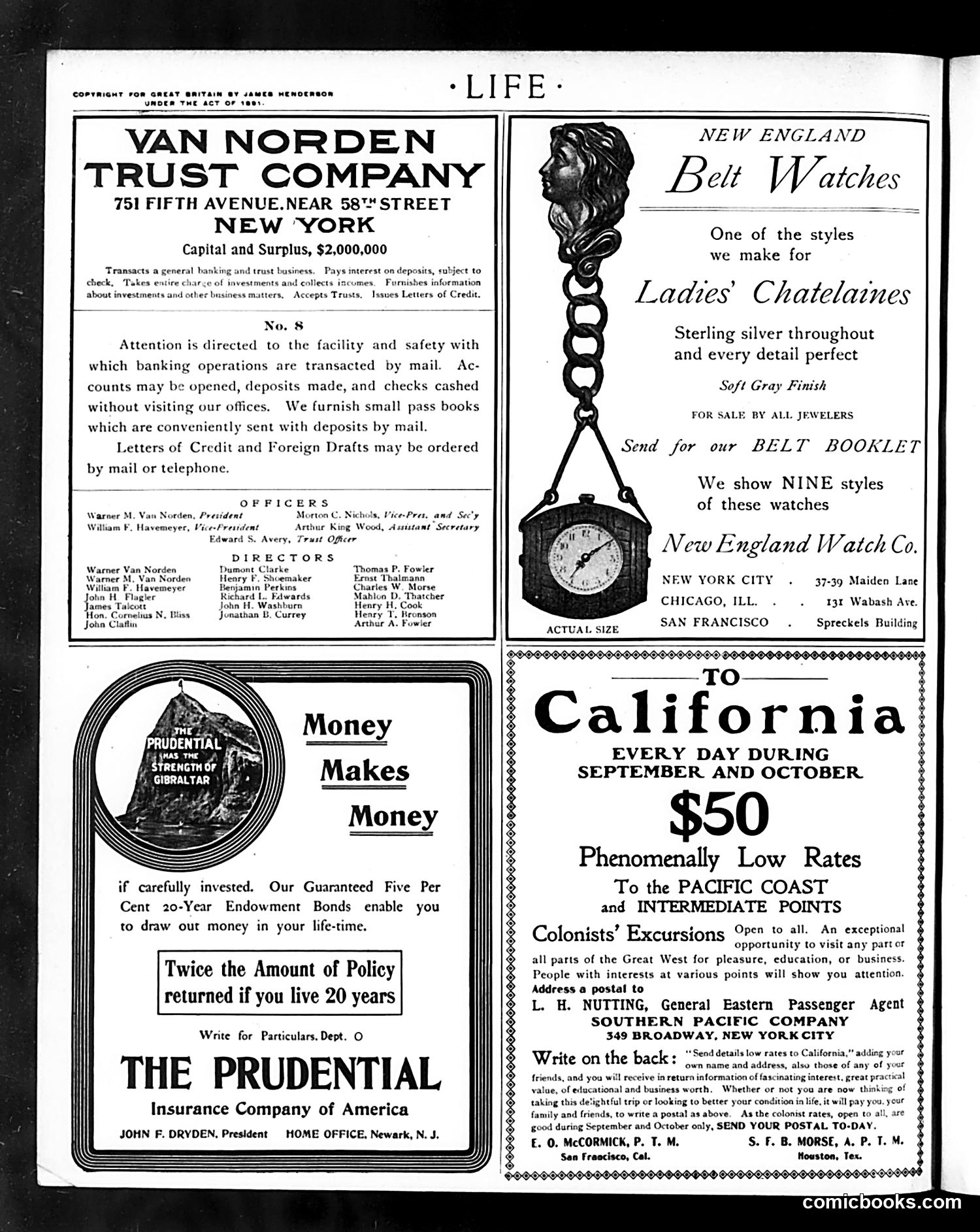
This page is **primarily advertising** from an early 20th-century American magazine. There are no political cartoons or satirical illustrations requiring historical interpretation. The ads include: - Van Norden Trust Company (banking services) - New England Belt Watches (jewelry for women) - The Prudential Insurance Company (endowment bonds) - Southern Pacific Company (California travel excursions at $50) The Prudential ad uses the company's famous logo (a rock, symbolizing strength) and promotes a "20-Year Endowment Bond" investment product—a type of life insurance popular in this era that promised returns if the policyholder survived the term. The Southern Pacific ad advertises discounted train travel to California during September-October, targeting "colonists" (settlers/migrants) and tourists interested in westward expansion or tourism.
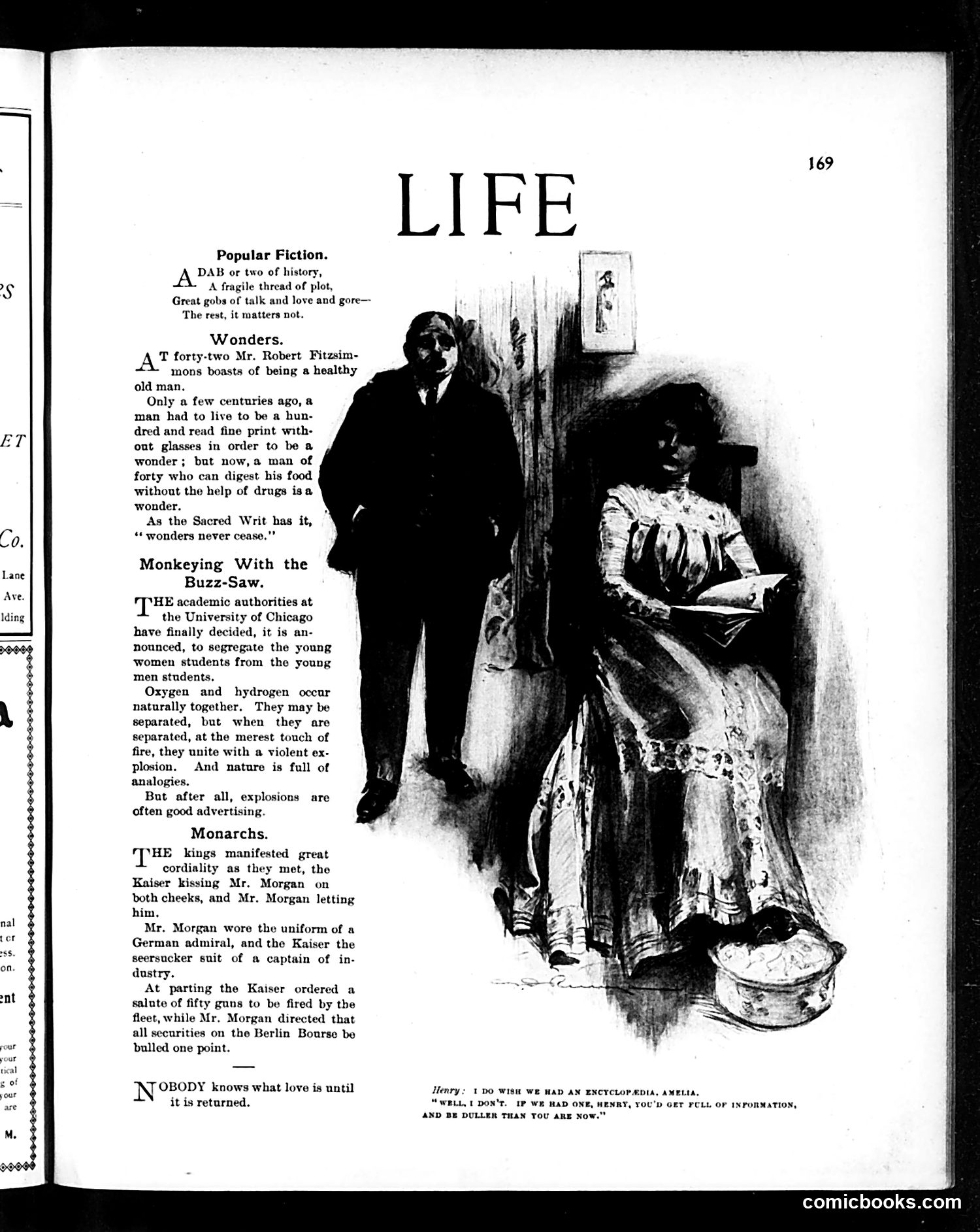
This page contains three separate humorous articles rather than a unified cartoon: 1. **"Popular Fiction"** - A brief satirical poem about formulaic literature. 2. **"Wonders"** - Jokes about Mr. Robert Fitzimmons (likely the boxer) being healthy at forty-two, and a pun about digestion without drug assistance. 3. **"Monkeying With the Buzz-Saw"** - Satirizes the University of Chicago's decision to segregate male and female students, using a chemistry analogy comparing oxygen and hydrogen to men and women, and arguing that separation prevents "explosions"—implying romantic entanglements. 4. **"Monarchs"** - References a meeting between Kaiser Wilhelm and J.P. Morgan (identifiable by context), depicting diplomatic/commercial relations between German and American powers. The illustration shows two figures in formal dress, likely depicting the Morgan-Kaiser meeting referenced in the text.
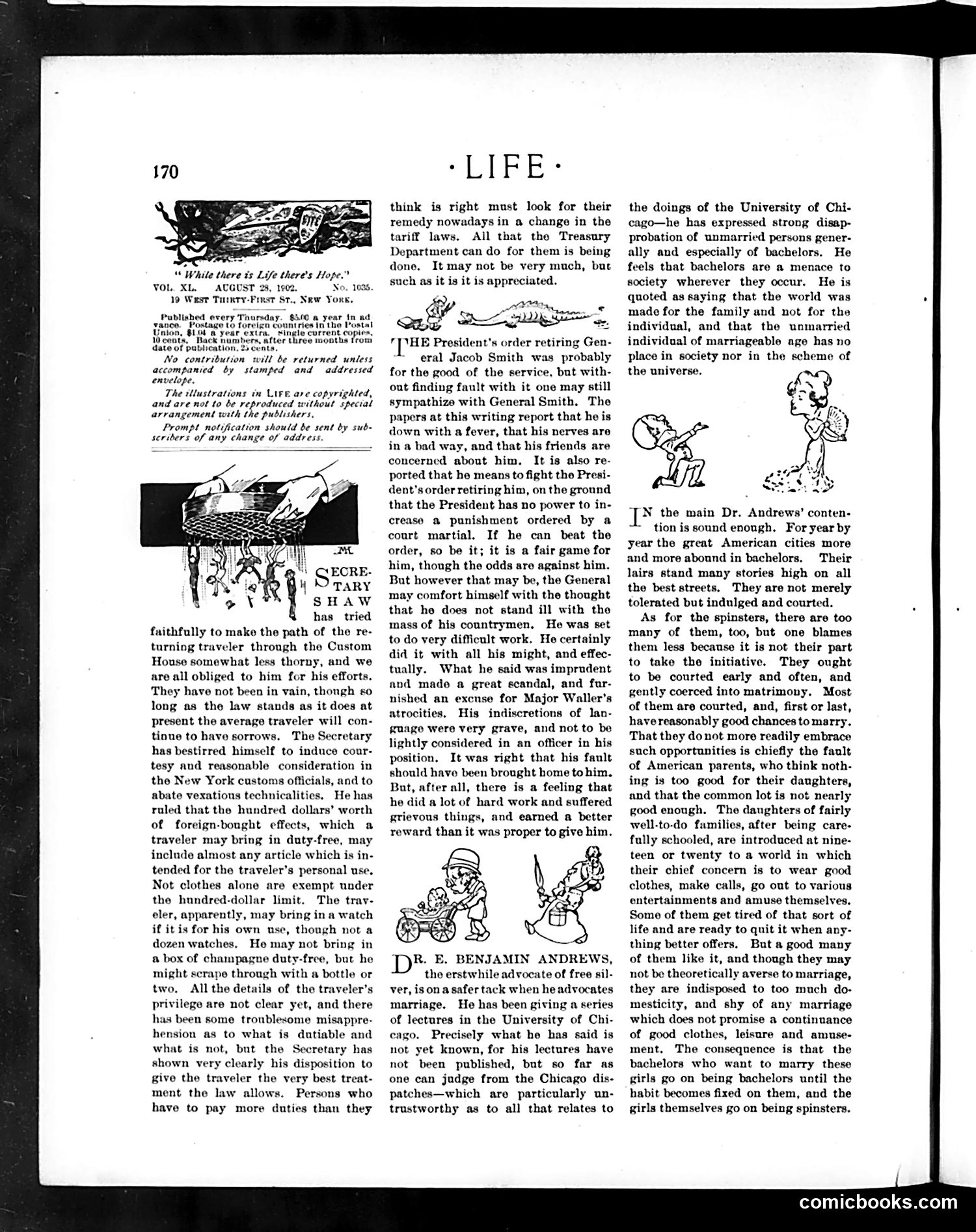
The page discusses **General Jacob Smith's retirement** from military service. The text notes he's ill and his friends worry about him, while acknowledging he worked hard. It mentions the President lacks power to increase punishments ordered by court martial, though Smith might appeal. The central cartoon criticizes **Dr. E. E. Benjamin Andrews** regarding his lectures at the University of Chicago on free silver (monetary policy). The text satirizes his advocacy for unmarried women gaining independence, suggesting this produces "spinsters" rather than wives. The cartoons show children and women, likely mocking Andrews' positions on economics and gender roles as threats to traditional family structure. The humor targets Progressive-era social reformers.
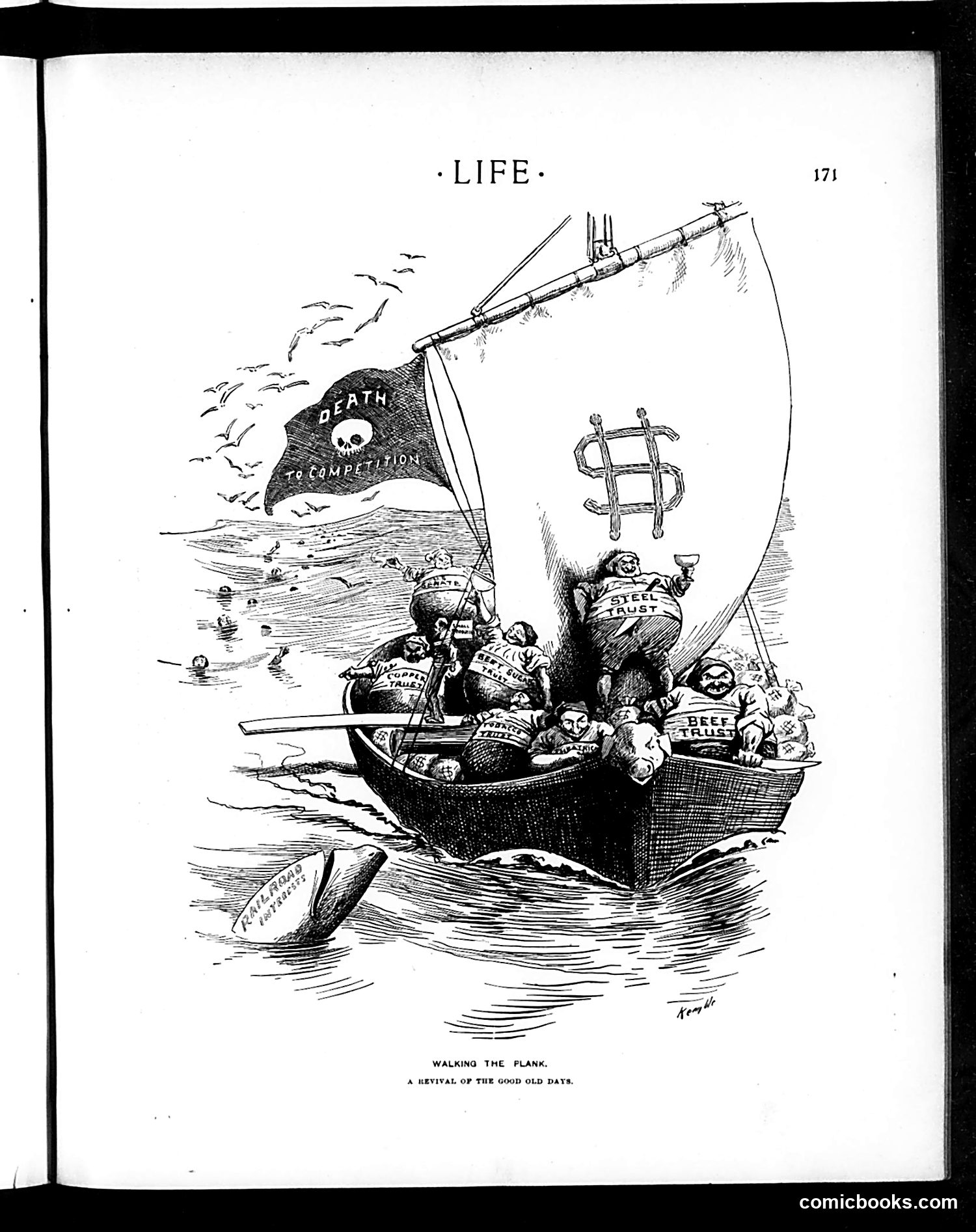
This political cartoon depicts various corporate interests—labeled "Steel Trust," "Beef Trust," and "Copper Trust"—being forced to walk the plank from a ship flying the "Death to Competition" flag. The cartoon satirizes trust-busting efforts, likely from the early 1900s progressive era when antitrust actions targeted major monopolies. The cartoon's caption suggests nostalgia for piracy's "good old days," implying that these modern trusts operate like ruthless pirates exploiting commerce. The drowning figures and sharks below represent the dangers these monopolies faced from regulatory action. The satire supports trust-busting by portraying monopolies as villains deserving punishment, aligning with populist and progressive sentiment against concentrated corporate power.
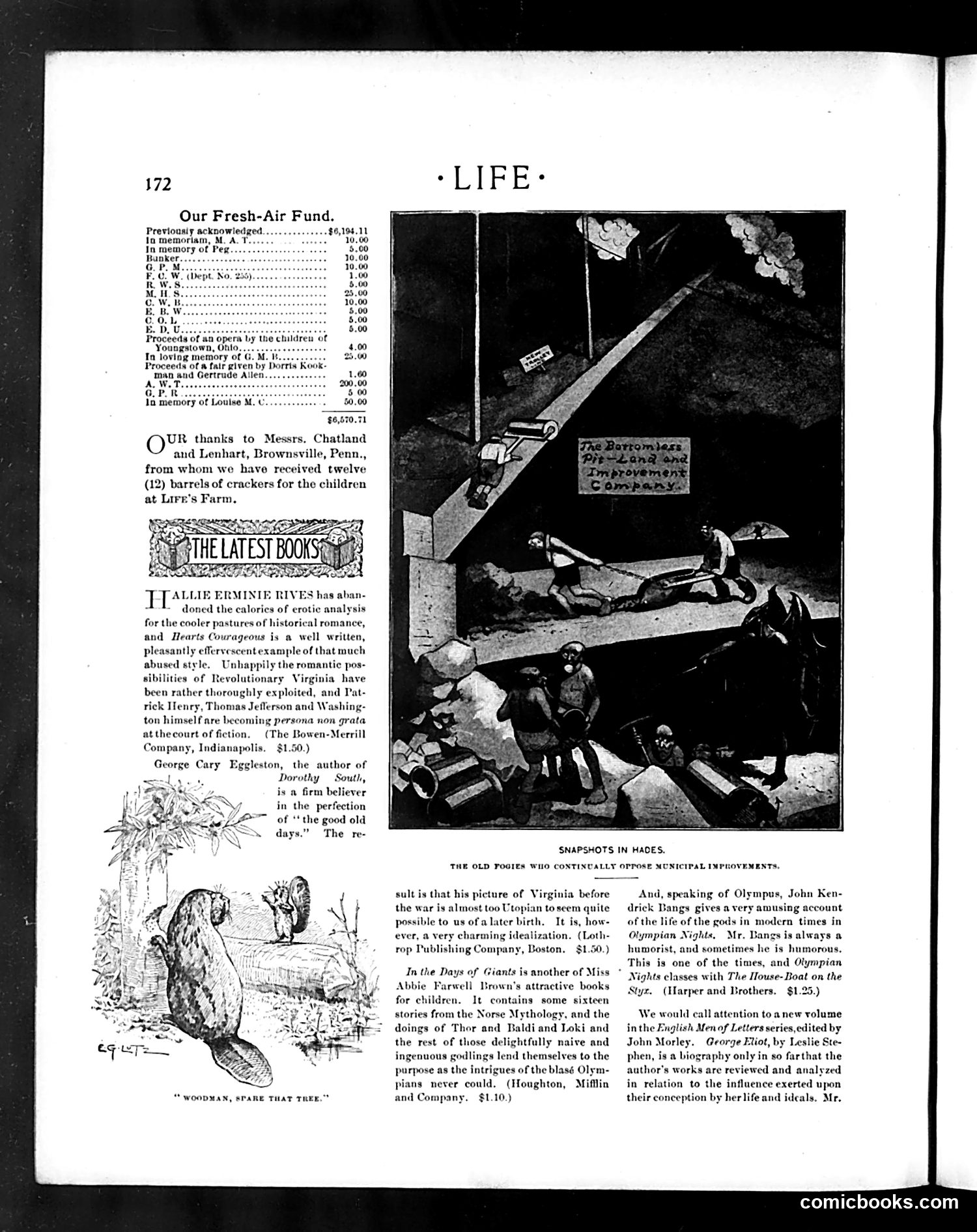
This page contains a "Fresh-Air Fund" donation list and book reviews rather than political cartoons. The main visual content includes: 1. **An illustration titled "Snapshots in Hades"** showing figures in what appears to be a classical underworld scene, depicting "old fogies who continually oppose municipal improvements." This is satirizing conservative opposition to civic progress and modernization—a common Progressive Era critique of old-fashioned resistance to reform. 2. **A smaller illustration labeled "Woodman, Spare That Tree"** showing what appears to be a figure near a tree, likely satirizing environmental or preservation concerns. The page primarily serves as a charitable fundraising record and literary review section rather than political commentary.
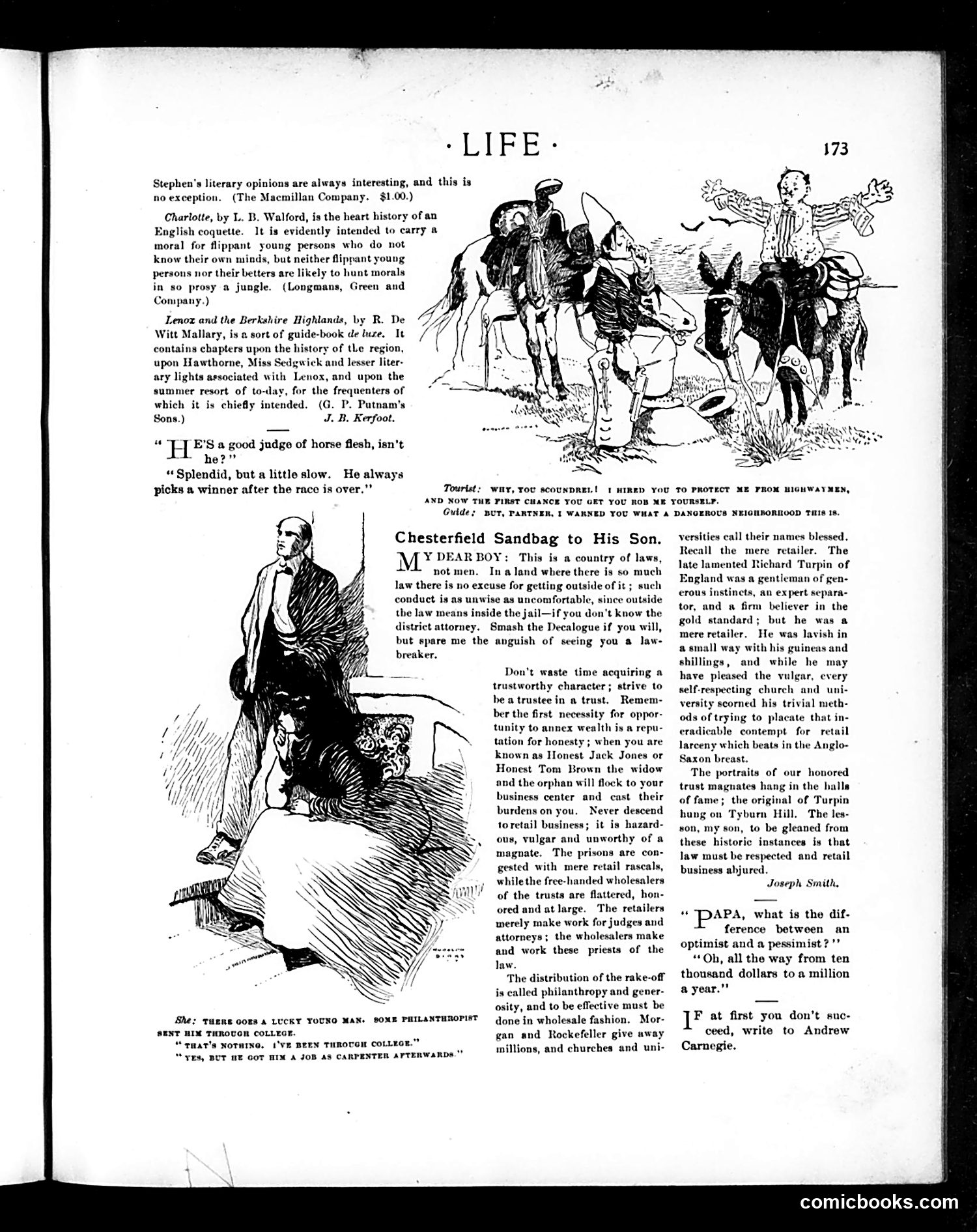
This page contains two distinct pieces of satirical content: **Left illustration**: A sketch depicting a well-dressed man in conversation, accompanying text titled "Chesterfield Sandbag to His Son." The piece satirizes advice from a father figure (Joseph Smith is credited) to a son about building business reputation and trustworthiness. The satire lies in the gap between the moral instruction and implied reality—the father coaches the son on becoming "Honest Jack Jones" or "Honest Tom Brown," suggesting that honesty itself is merely a marketing tool or reputation strategy rather than genuine principle. **Right illustration**: A scene showing travelers or merchants, likely satirizing frontier or business culture. The overall theme critiques how American business culture treats ethics as performative—something to be cultivated for advantage rather than practiced authentically.
This page contains **no political cartoon**. Instead, it features three distinct pieces: 1. **"John D. Rockefeller"** — A biographical dictionary entry about the prominent industrialist, with a decorative initial letter. The text notes his generosity despite his reputation and his frugal lifestyle. 2. **"The Meagre-Minded Man"** — A poem by Joseph Smith mocking Christian Science through the story of "John Hawkins," a man whose wife converts him to the practice. The satire suggests Christian Science practitioners prioritize faith over medical treatment, leaving patients to suffer and die. 3. **"Education"** and **"Gauged"** — Brief humorous anecdotes about school instruction and a husband's marital appointment. The page is primarily **literary and satirical content** rather than visual cartooning.
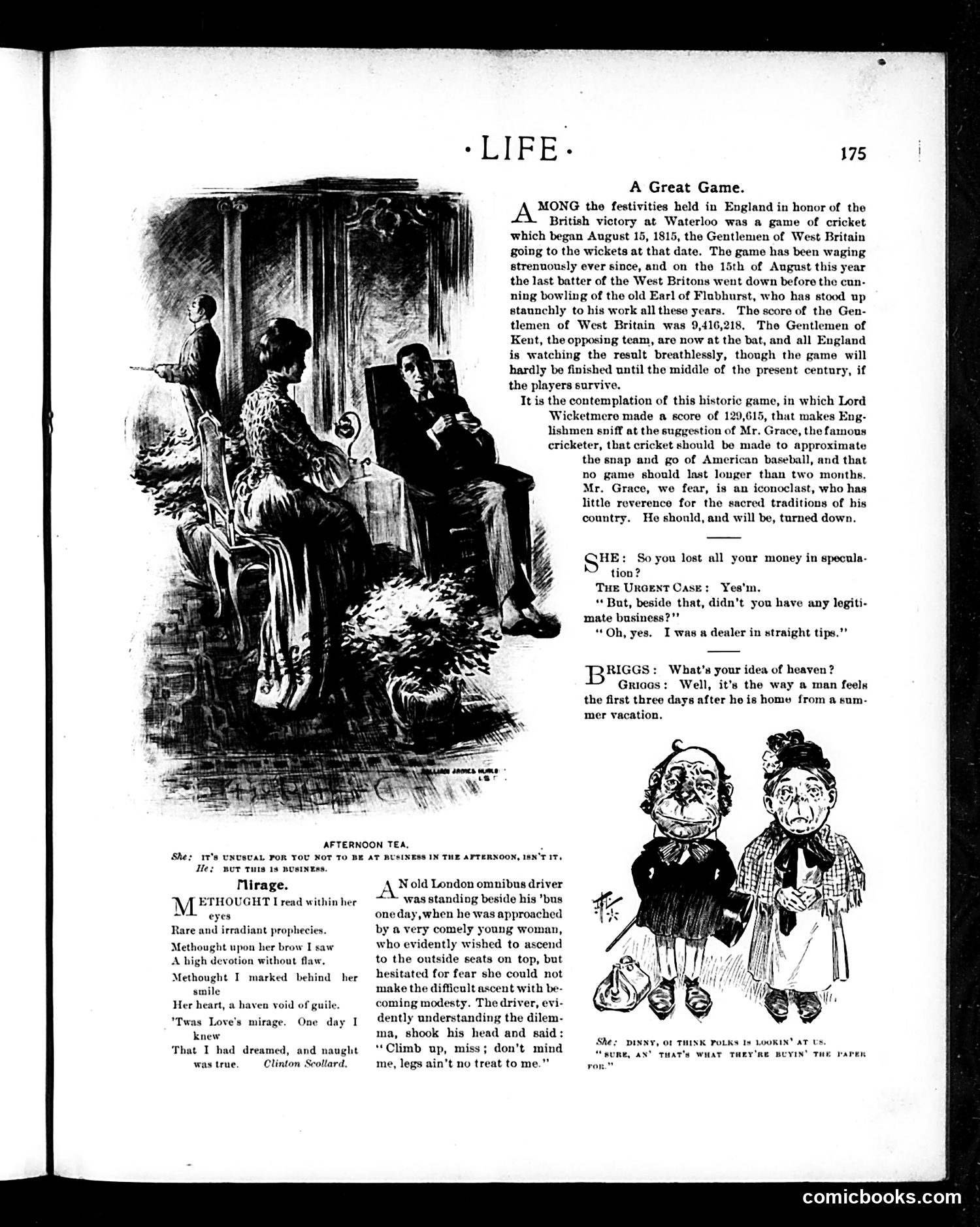
This page satirizes English cricket snobbery. The main article mocks Lord Wickelmere's proposal that cricket matches be limited to two months (like American baseball) to prevent excessive play. The text ridicules Mr. Grace, a famous cricketer, for considering this "iconoclast" idea beneath England's sacred sporting traditions. The lower section contains unrelated short humorous pieces: a dialogue about lost speculation money, a joke about heaven versus summer vacation, and a London bus driver anecdote about a modest young woman requesting the top seats. The cartoon illustrates the bus story, showing the interaction between the driver and passenger. The page combines sports satire with everyday comic vignettes typical of Life's humor format during this era.
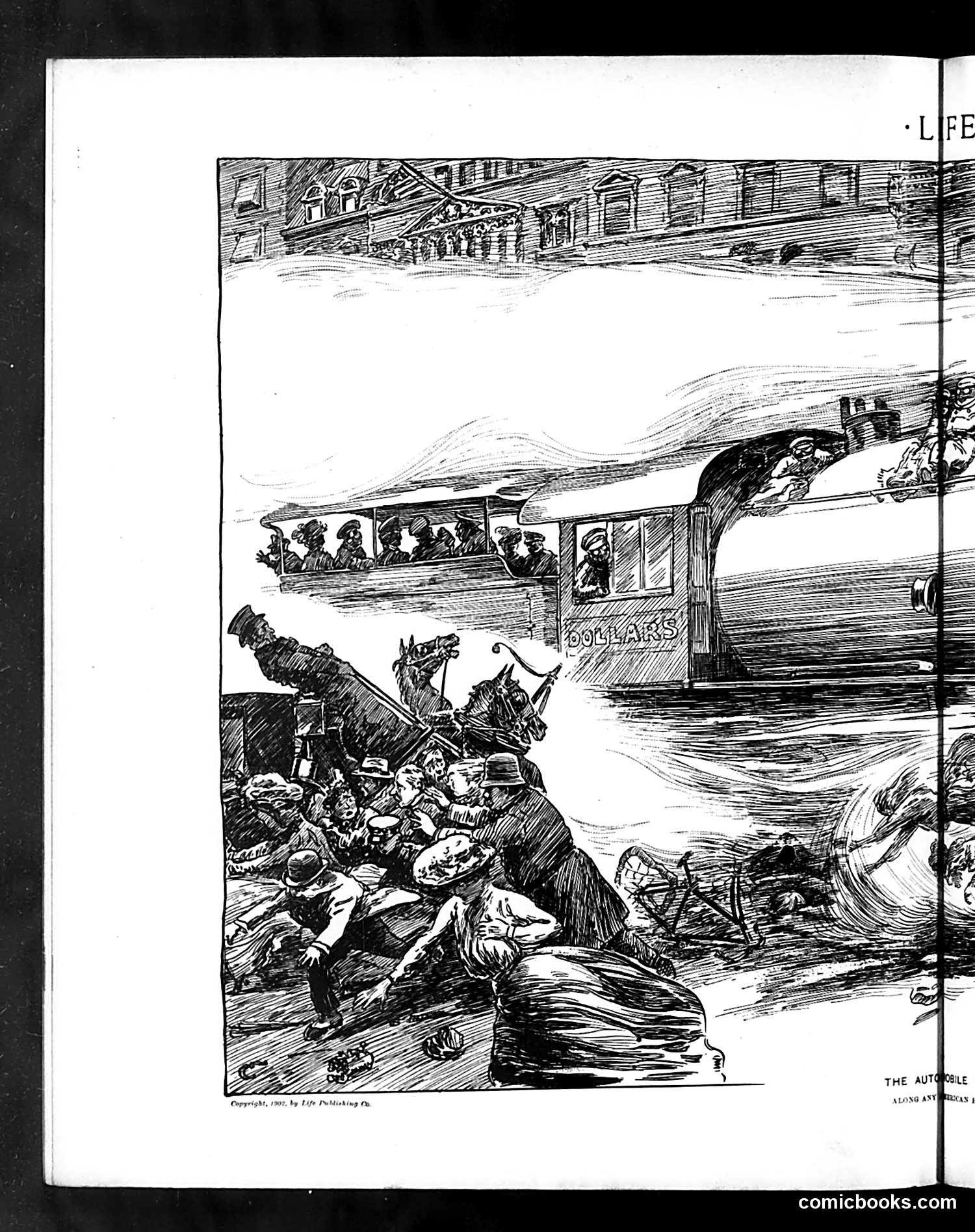
This is a satirical illustration from Life magazine (copyright 1907) depicting early automobile culture colliding with pedestrian street life. The cartoon shows a motorcar labeled "DOLLARS" speeding past a crowded waterfront or dock scene, where working-class people and their belongings are scattered about in chaos—some appearing knocked aside or endangered by the vehicle's passage. The satire critiques the automobile industry's rapid expansion and wealthy owners' disregard for ordinary citizens. The car's label "DOLLARS" emphasizes that this new technology serves the rich, while poor workers occupy the congested streets below. The contrast between the fast-moving motorcar (upper right) and the jumbled human activity (lower left) illustrates class tensions during the early automotive age, when cars were luxury items threatening traditional street life.
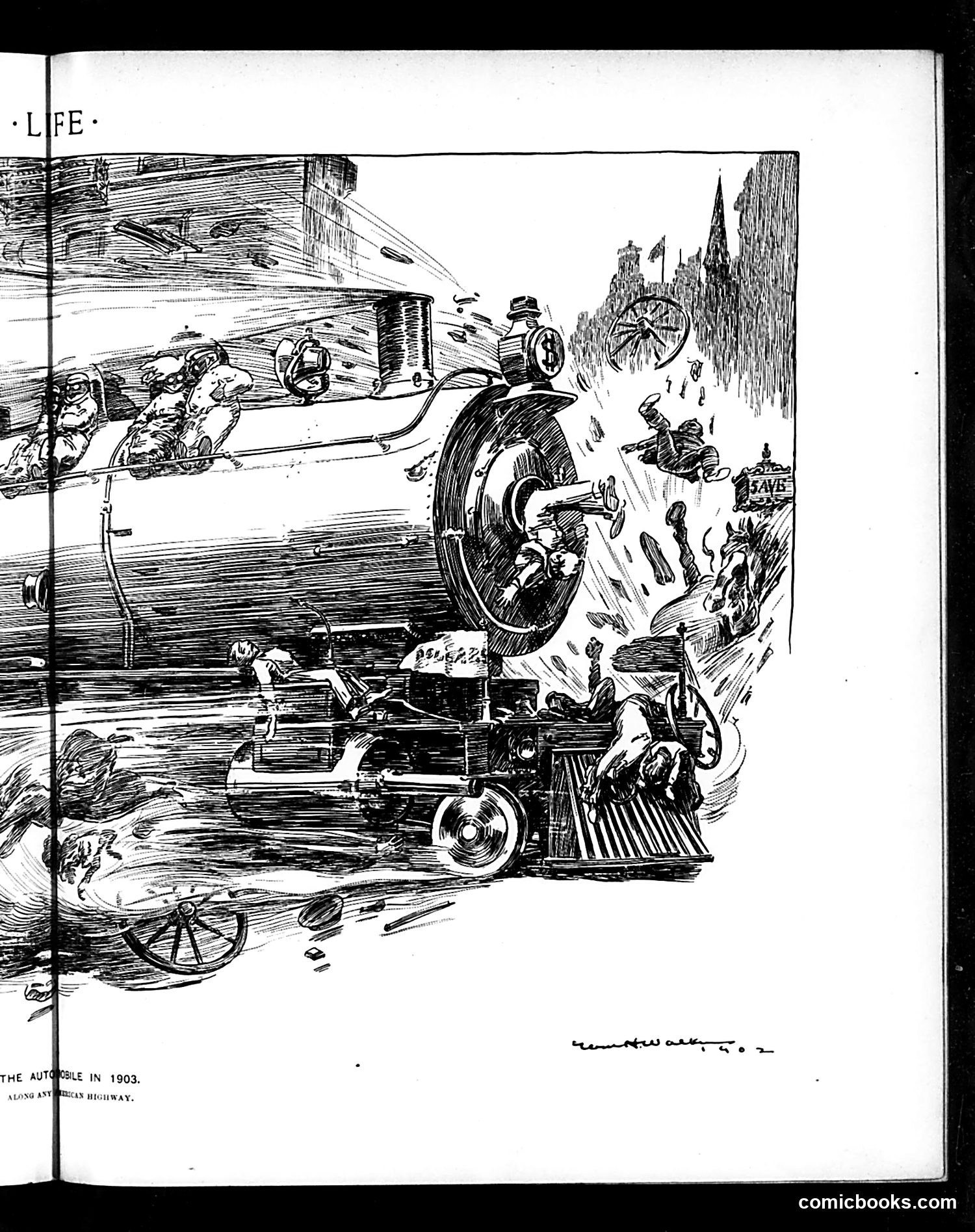
This is a satirical illustration titled "The Automobile in 1903" depicting early automobile culture on an American highway. The sketch shows a chaotic scene where a primitive motorcar has collided with or is attacking traditional forms of transportation and rural life. The satire mocks the dangerous, disruptive impact of automobiles on established society. The vehicle appears to be aggressively demolishing wooden structures, scattering pedestrians, horses, and traditional conveyances. The cityscape visible in the background suggests the contrast between modern mechanization and pre-industrial American life. This reflects genuine early-1900s anxieties: automobiles were genuinely hazardous, unregulated, and represented rapid social upheaval. The cartoon captures period concerns about technological progress steamrolling over traditional ways of life, safety, and social order.
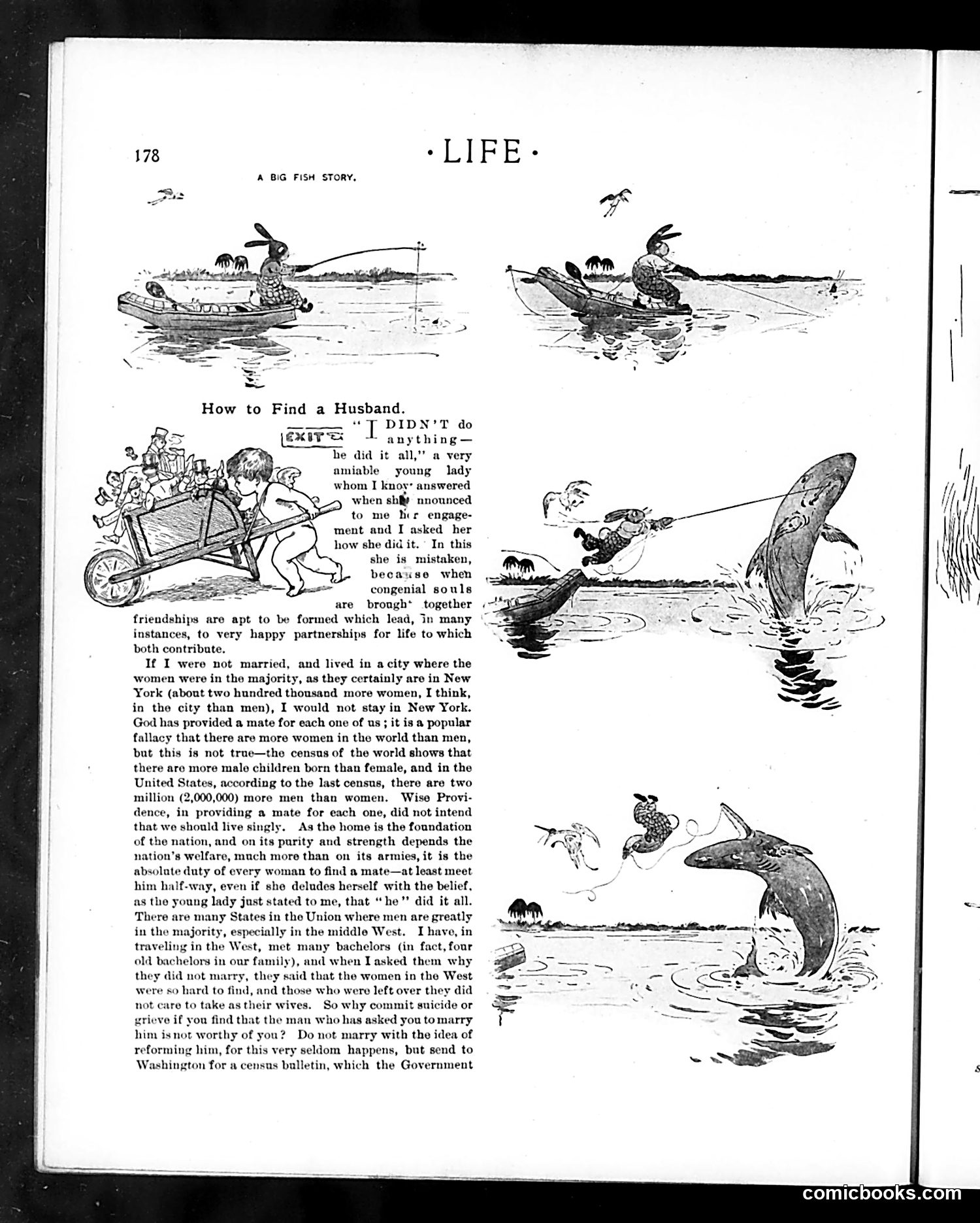
This page satirizes advice columns and courtship customs of the early 20th century. The headline announces "A BIG FISH STORY," with illustrations showing fishermen catching large fish—a visual metaphor for "catching" a husband. The article mocks a young woman's claim that her fiancé "didn't do anything" to win her, suggesting she's being disingenuous. The author argues that marriage requires mutual effort and that women—especially in states with male majorities—have a duty to marry. The fish-catching imagery is the central joke: husbands are portrayed as prizes to be "caught" like fish. The satirical tone critiques both women's passivity in courtship narratives and the transactional nature of marriage discussions in contemporary society.
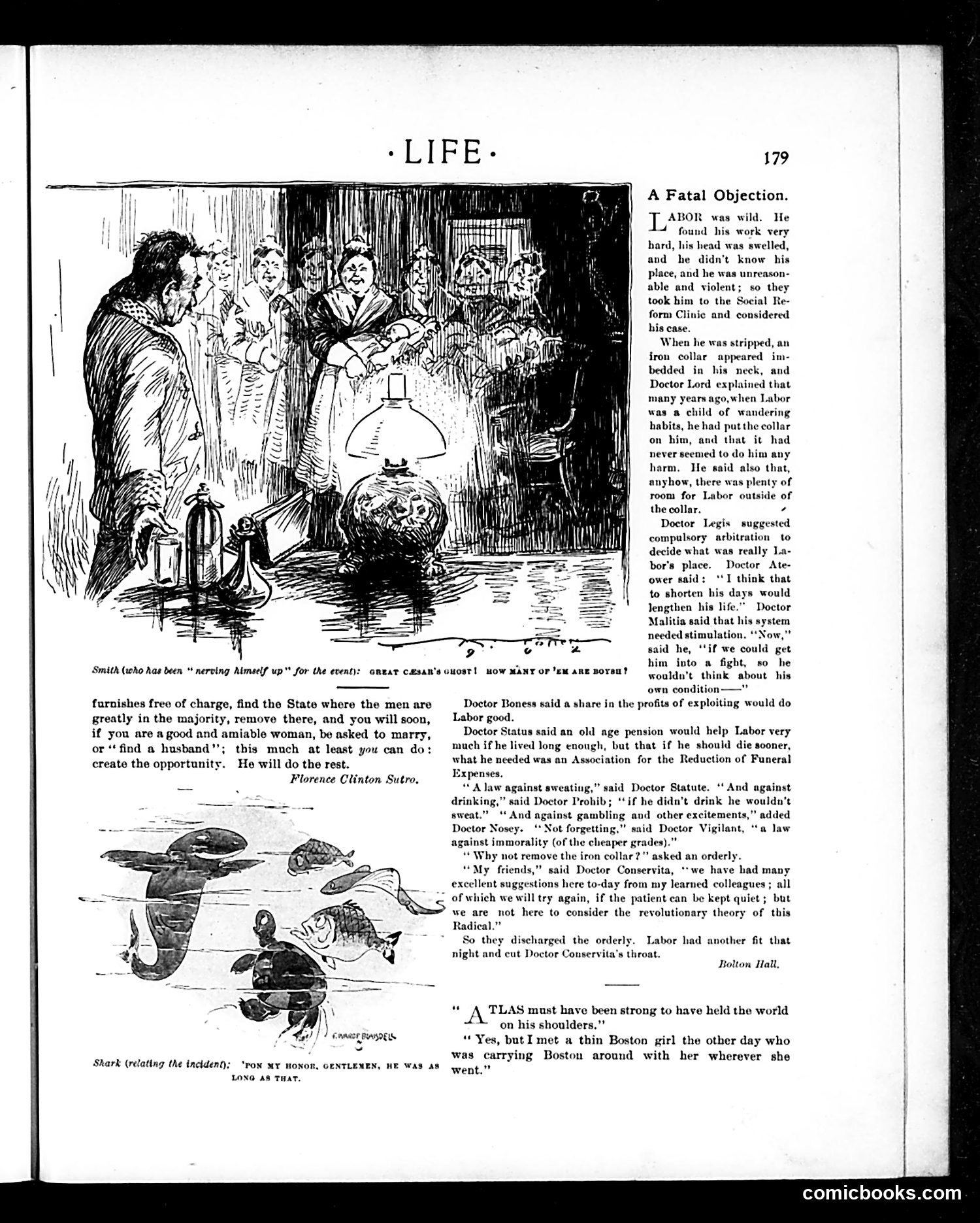
This satirical story critiques various proposed solutions to labor unrest. "Labor," personified as a patient, arrives at a "Social Reform Clinic" with an iron collar embedded in his neck—symbolizing oppression from his past. Rather than remove the collar (addressing root causes), the doctors propose superficial remedies: compulsory arbitration, stimulating fights, profit-sharing, pensions, and laws against sweating, drinking, and immorality. The satire's target is "Doctor Conservita" (conservatives), who rejects removing the collar as "revolutionary" and dismissive of "Radical" solutions. The dark conclusion—Labor murders the doctor—suggests that ignoring fundamental injustices inevitably breeds violent backlash. The page also includes two other cartoons: one showing Smith nervously facing multiple armed opponents, and another about Atlas and a Boston girl, both appearing to be unrelated humorous vignettes.
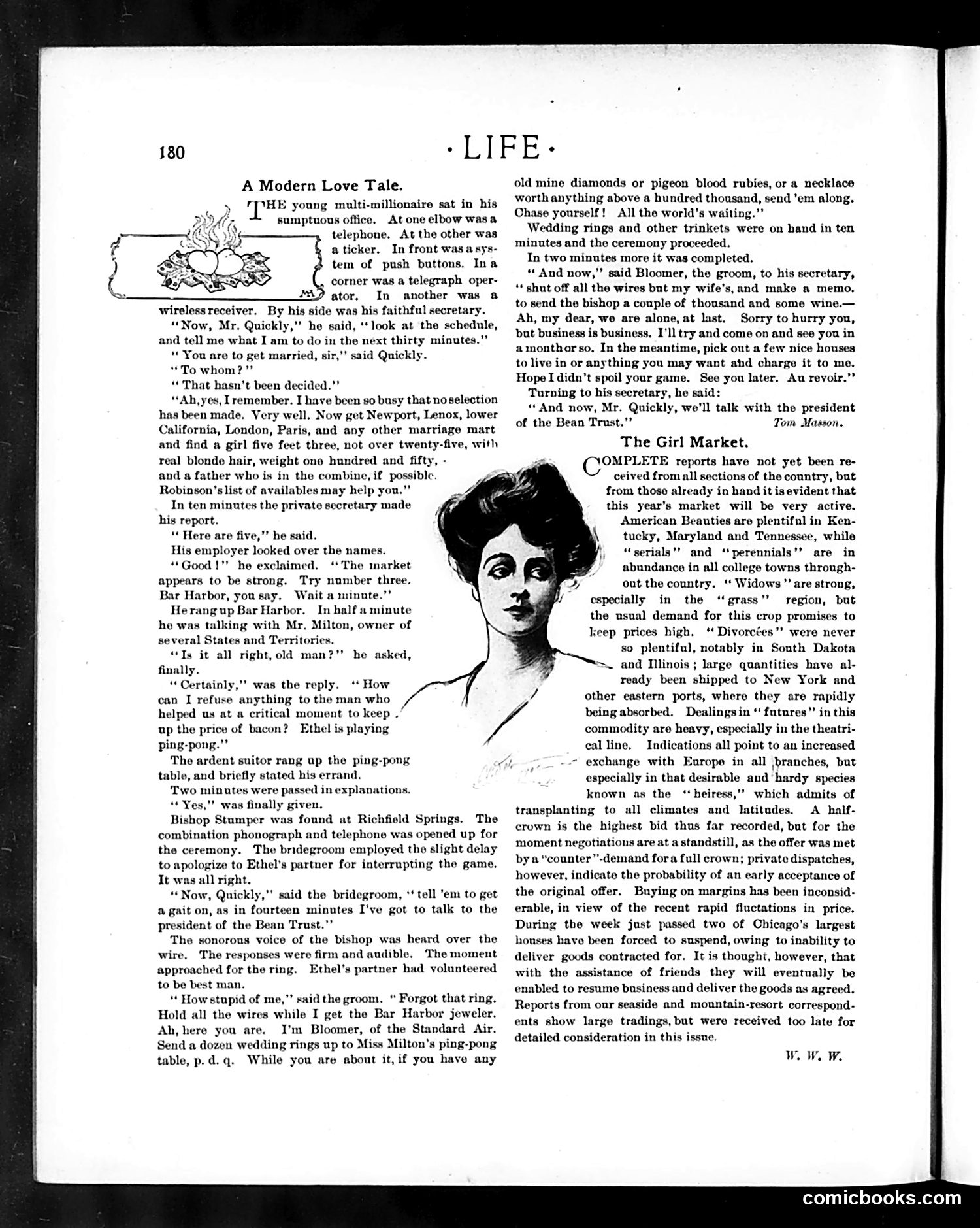
This story mocks the extreme commercialization of marriage among the wealthy elite. A multi-millionaire industrialist treats matrimony as a business transaction—literally interrupting his day to marry a woman he's never met, selected like a commodity from a list compiled by his secretary based on physical specifications and her father's business connections. The satire targets: - **Robber baron capitalism**: The groom efficiently conducts the marriage via telephone, telegraph, and wireless while simultaneously conducting business deals (the "Bean Trust"). - **Transactional marriages**: Wealthy families bartering daughters for business advantage—the bride's father agrees because the groom previously helped him manipulate bacon prices. - **Gilded Age excess**: Everything expedited and purchased (wedding rings delivered in minutes; the bride told to charge house-shopping to his account). The humor lies in treating human relationships with the same cold efficiency as stock trading. The following article, "The Girl Market," extends the satire by treating eligible women like agricultural commodities being bought and sold seasonally.
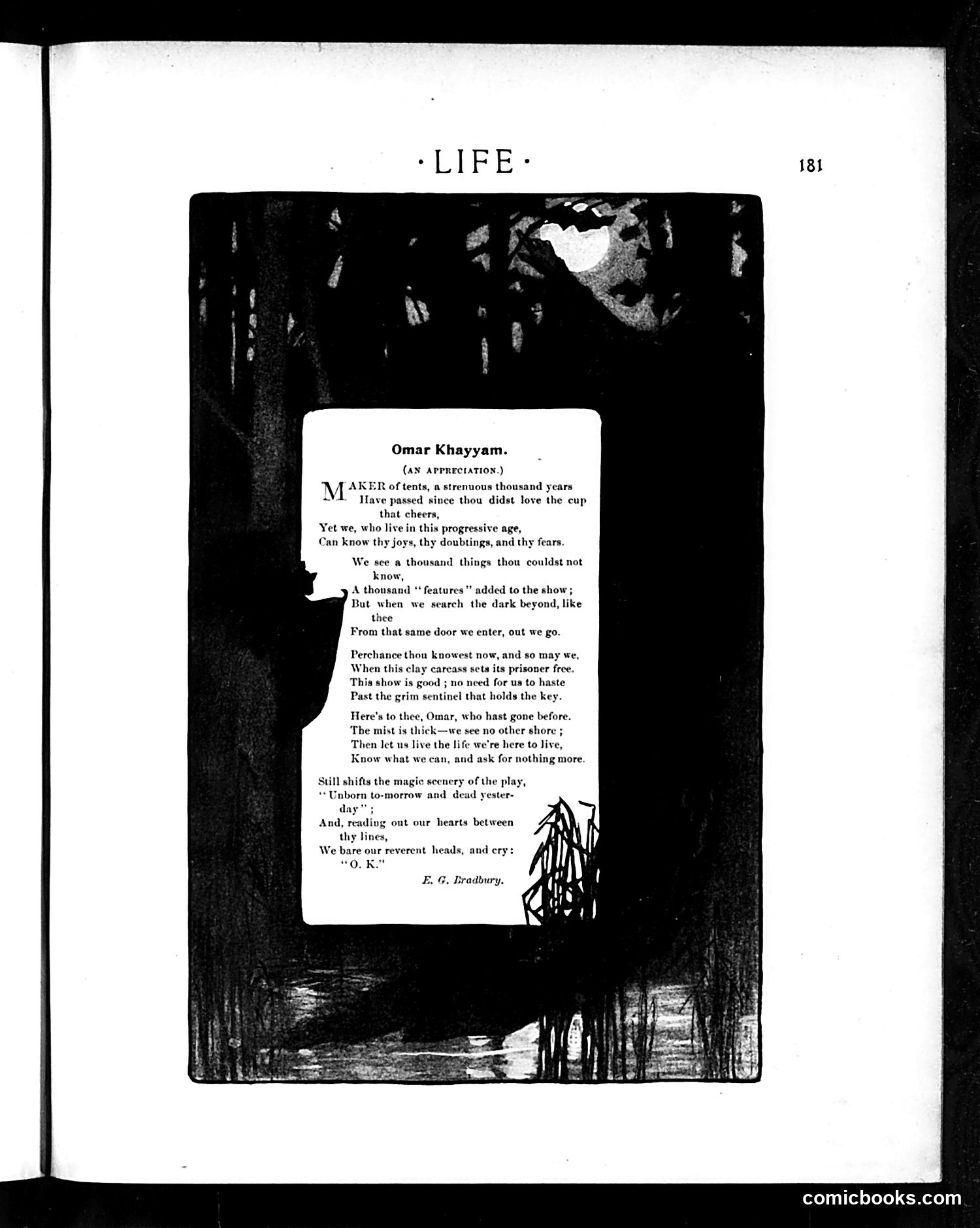
This page features a poem by E.G. Bradbury appreciating the 11th-century Persian poet Omar Khayyam, not a political cartoon. The piece reflects late 19th/early 20th-century American intellectual culture's romanticization of Khayyam, whose *Rubáiyát* had become fashionable among educated readers. Bradbury's poem draws parallels between modern "progressive age" knowledge and Khayyam's ancient wisdom, arguing both ultimately confront the same existential mysteries: mortality and the unknowable afterlife ("From that same door we enter, out we go"). The satire is gentle—mocking contemporary pride in technological advancement while suggesting humans haven't progressed spiritually beyond questions Khayyam pondered centuries ago. The ornamental border and illustration suggest this is a serious literary appreciation rather than satire proper, though the underlying message critiques modern complacency about human progress.
This page from *Life* magazine (a satirical publication) contains **humorous anecdotes** rather than political cartoons. The pieces mock human nature through exaggerated stories: 1. **"Eighteen Year" fisherman**: Satirizes obsessive patience—a man fishes one stream for eighteen years, catching only one fish in that entire span. The joke undercuts romantic notions of devotion to sport. 2. **Mayor Ashbridge anecdote**: Mocks insincere hospitality. The mayor claims he spent "two weeks there one afternoon" in Harrisburg—an absurd impossibility highlighting false politeness. 3. **Mark Twain's enslaved man**: A racially-charged joke (common to the era) where an elderly Black man falsely claims to have known George Washington and participated in famous events. It ridicules gullibility and exaggeration. 4. **The superintendent's boy**: Mocks poor education—when asked what comes after "A," the boy answers "all the rest of the push" (everyone else), missing the alphabet. The page emphasizes human folly, pretense, and ignorance through comedic narratives typical of early-20th-century American humor magazines.
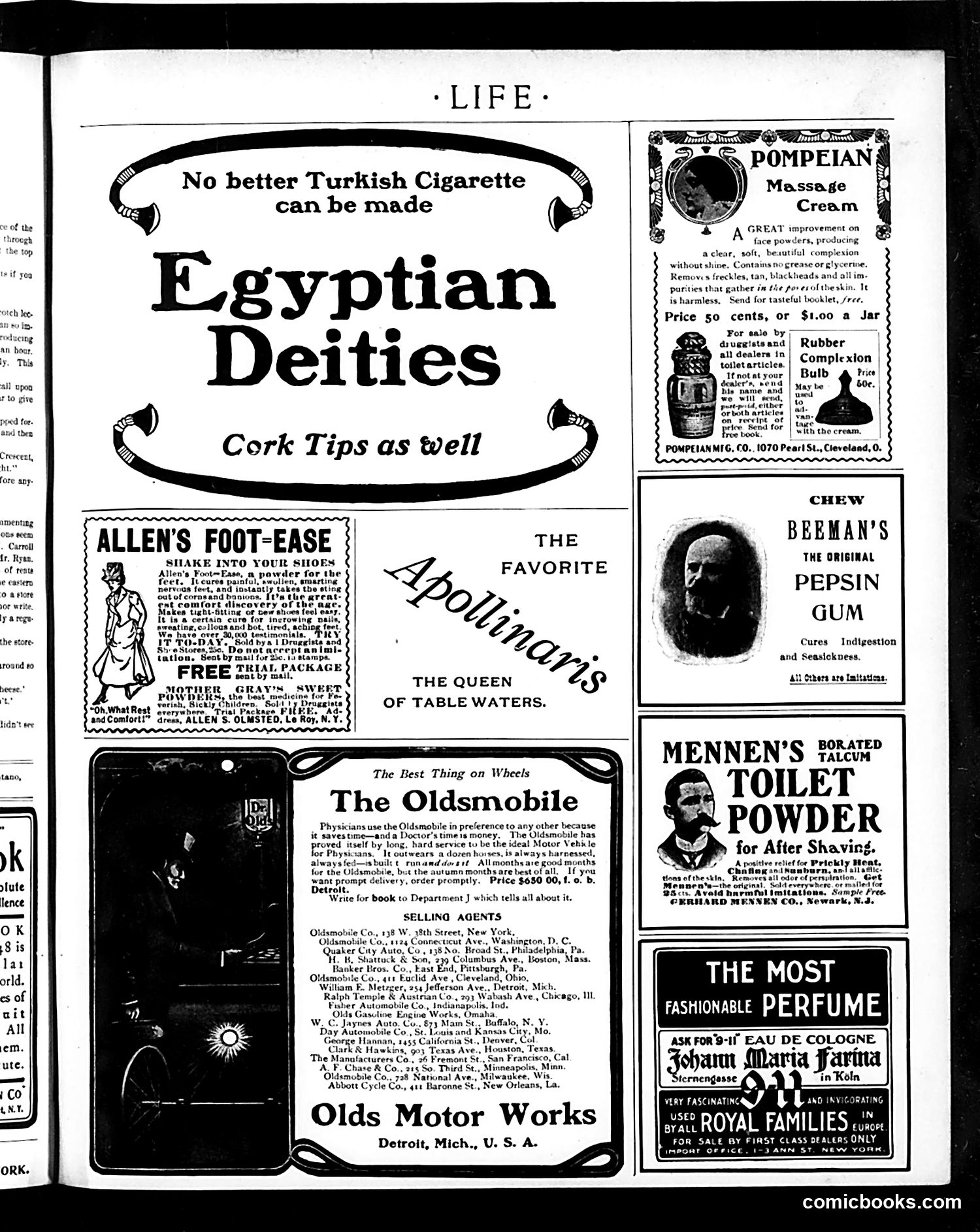
This page is primarily **advertising**, not editorial content or satire. It features early 1900s consumer product advertisements with no apparent political cartoon or satirical message. The dominant advertisements include: - **Egyptian Deities** cigarettes (top) — a Turkish/Egyptian-themed tobacco product - **Pompeian Massage Cream** and beauty products - **Allen's Foot-Ease** powder - **Apollinaris** bottled water - **The Oldsmobile** automobile (prominent, with dealer listings) - **Beeman's Pepsin Gum**, **Mennen's Toilet Powder**, and **Johann Maria Farina** perfume The only potential "satire" is the implicit humor in cigarette and patent medicine marketing conventions of the era—claims of exotic origins (Egyptian, Turkish) and unproven health benefits. However, this reflects genuine period marketing rather than deliberate satire by Life's editors. No identifiable political figures, caricatures, or social commentary appear on this page.
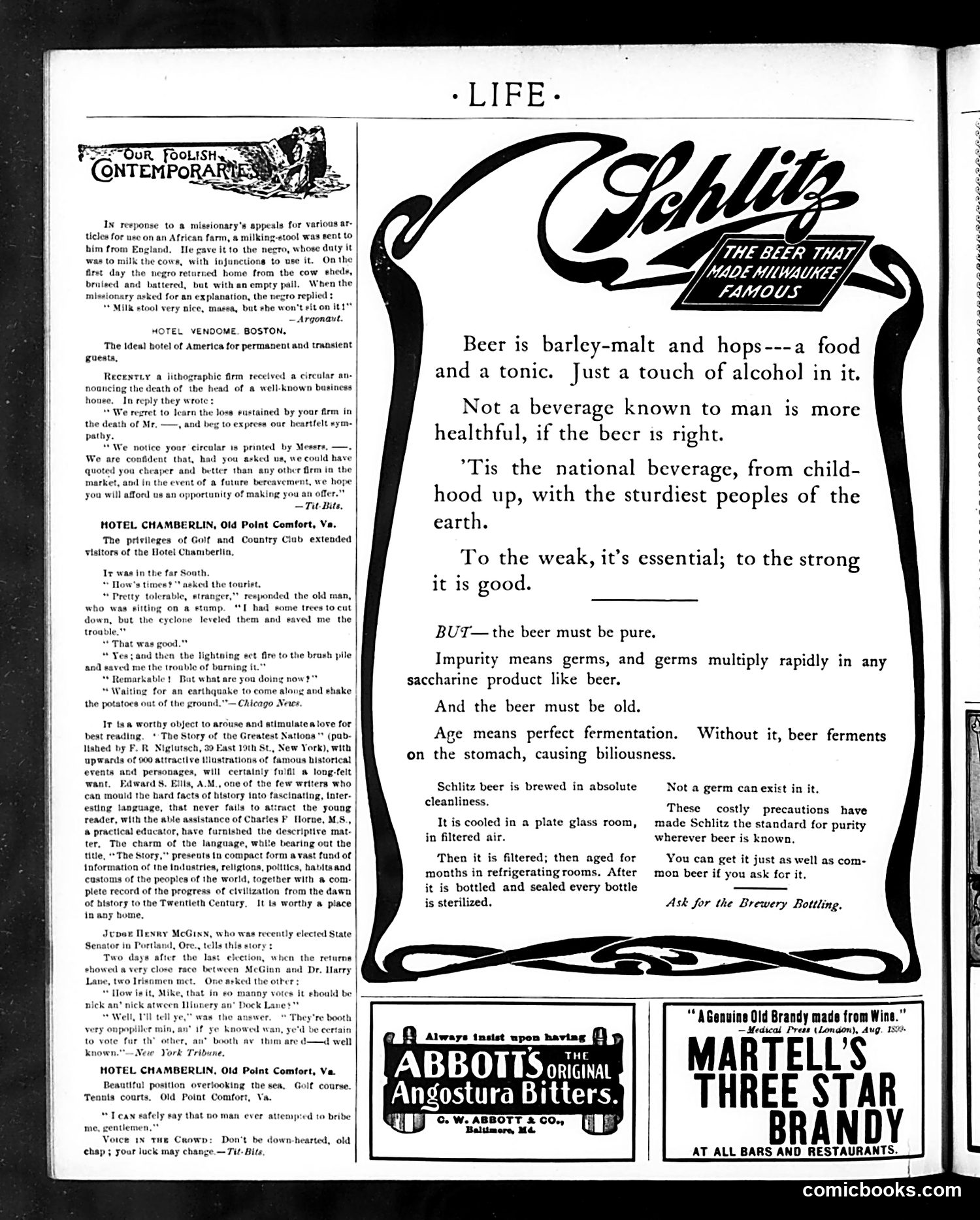
This page contains primarily **advertising and humorous anecdotes** rather than political cartoons. The main content is a **Schlitz beer advertisement** presented as educational copy, emphasizing the beer's purity and health benefits—claims common in early 20th-century alcohol marketing before strict regulations. The ad stresses that Schlitz beer is "healthful" and "the national beverage," language reflecting pre-Prohibition attitudes toward beer as a legitimate food/tonic product. The left column includes several brief **satirical jokes** ("Our Foolish Contemporary"), including one mocking African Americans (the "milking stool" anecdote uses a racist dialect stereotype). Another joke depicts rural American life responding to natural disasters. Below the Schlitz ad are two additional **alcohol advertisements**: Abbott's Bitters and Martell's Three Star Brandy. The page reflects early 1900s American attitudes: casual racism in humor, unregulated health claims for alcohol, and beer positioned as wholesome nutrition rather than mere intoxication.
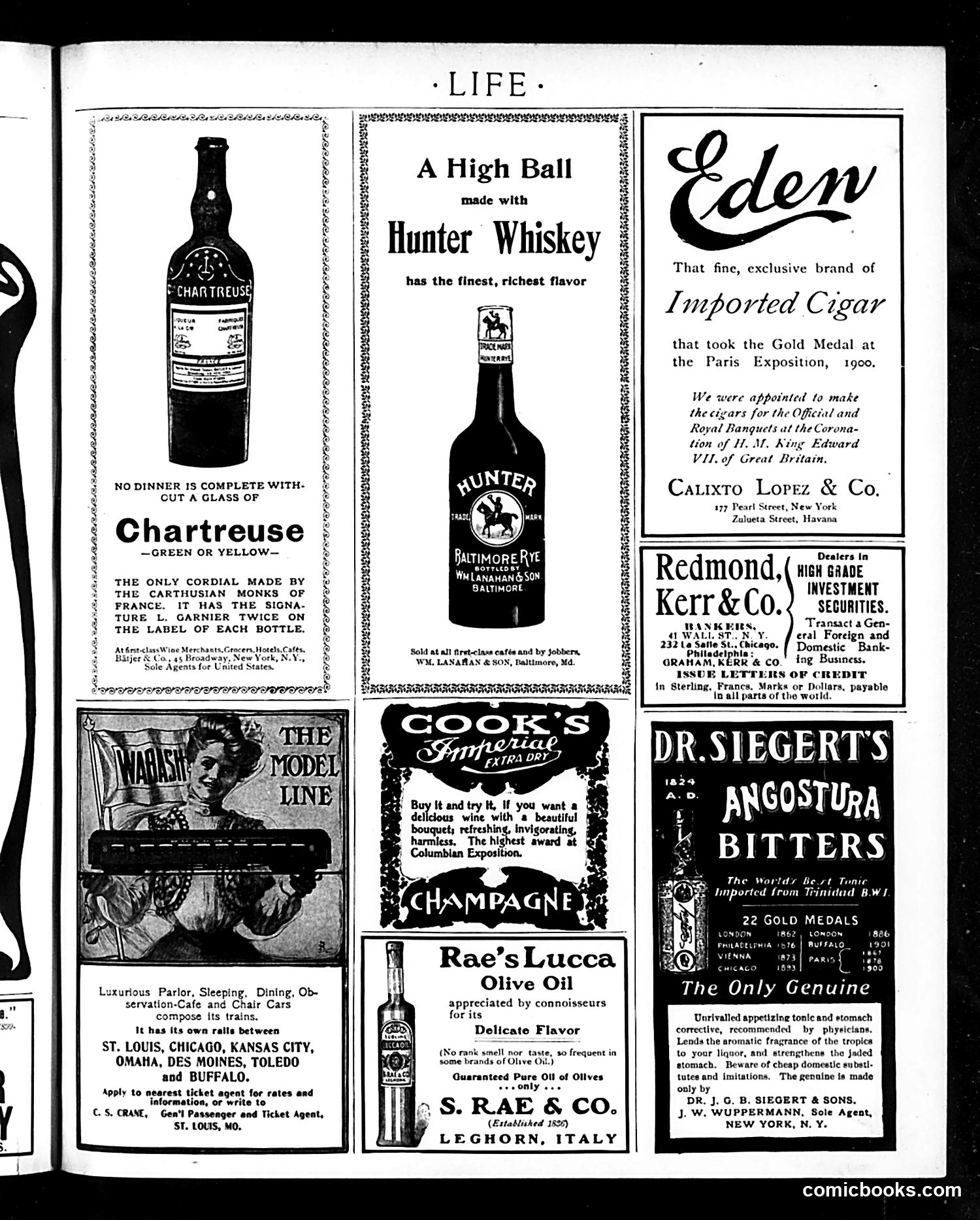
This is primarily a **advertisements page**, not a political cartoon. It showcases luxury consumer goods popular in early 1900s America. The ads reflect the era's aspirations: imported European spirits (Chartreuse liqueur, Hunter whiskey, champagne), fine cigars awarded at the 1900 Paris Exposition, olive oil from Italy, and patent medicines like Dr. Siegert's Angostura Bitters—presented as tonics with curative properties. Notable is the reference to **King Edward VII's coronation**, indicating this page dates to around 1902, when the British monarch was crowned. One cigar maker claims to have supplied the royal banquets. The "Model Line" railroad ad emphasizes luxurious parlor and dining cars, appealing to affluent travelers. Overall, the page targets wealthy readers with messages of exclusivity, European refinement, and medicinal benefits—typical marketing for the Gilded Age audience.
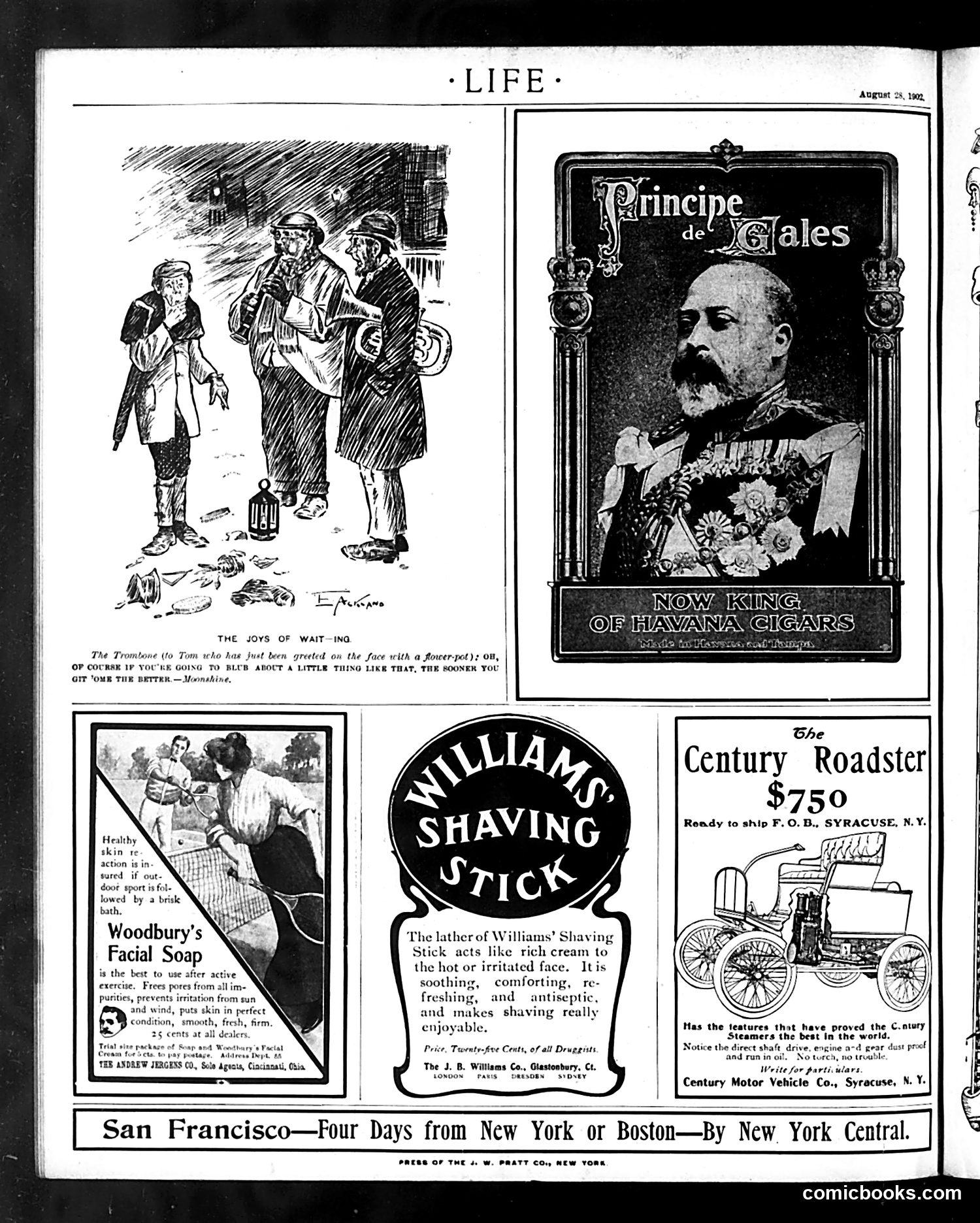
This page is primarily **advertisements interspersed with one cartoon**. **The Cartoon ("The Joys of Waiting"):** The sketch shows three men on a street, with text referencing someone who's "just been greeted on the face with a flower-pot." The joke appears to satirize the British class system: a working-class or servant character has been struck in the face, and the caption suggests this humiliation is acceptable if it results in a "little sting like that"—implying lower-class people should accept minor indignities without complaint, especially if followed by leisure (a bath). The humor relies on dark, sardonic British wit about social hierarchy and physical comeuppance. **The Advertisements:** The page features period products: Woodbury's Facial Soap, Williams' Shaving Stick, and the Century Roadster automobile ($750). These ads reflect early 1900s consumer culture and personal grooming standards for gentlemen.