
Life, 1902-08-28 · page 4 of 20
Life — August 28, 1902 — page 4: what you’re looking at
What you’re looking at
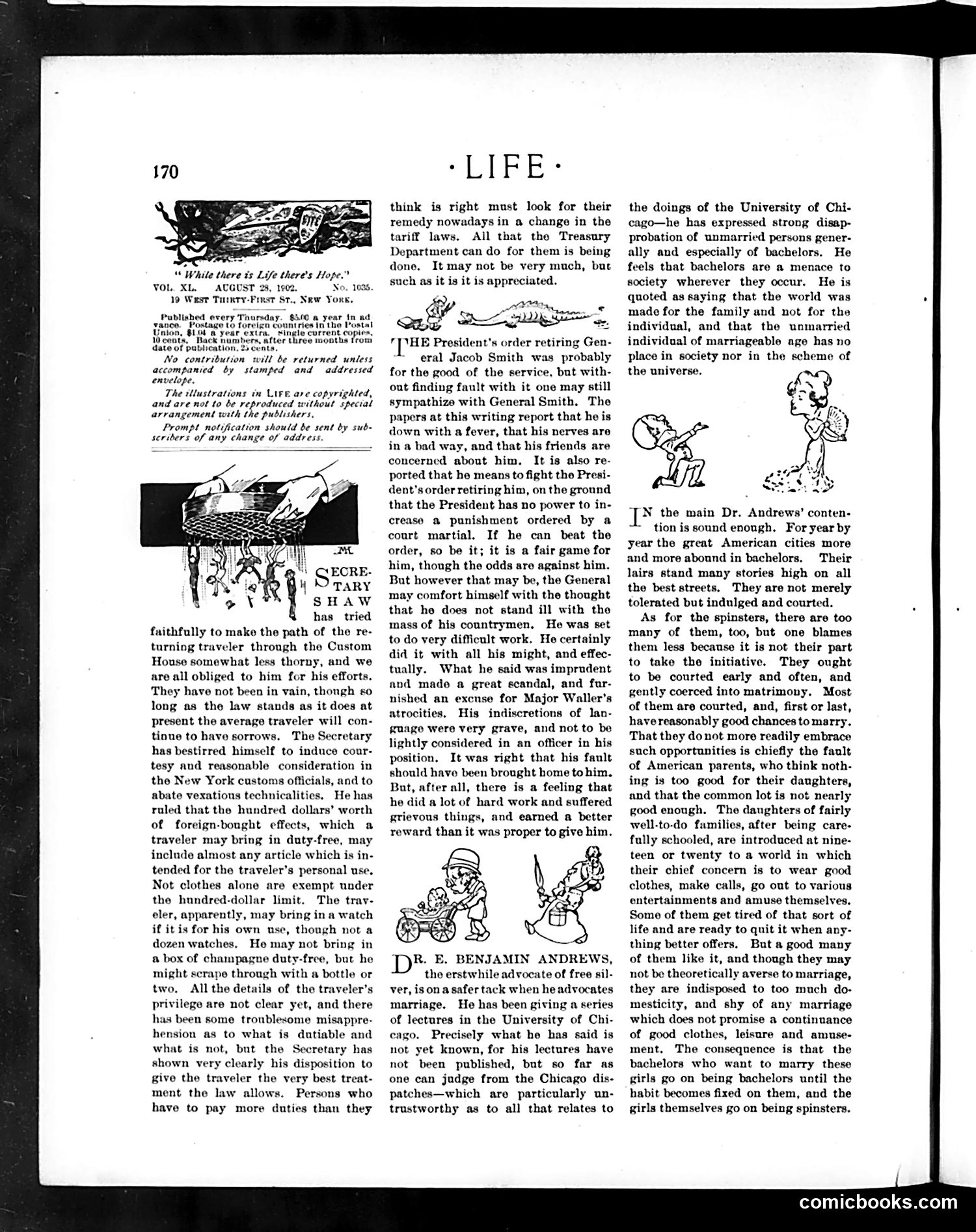
The page discusses **General Jacob Smith's retirement** from military service. The text notes he's ill and his friends worry about him, while acknowledging he worked hard. It mentions the President lacks power to increase punishments ordered by court martial, though Smith might appeal. The central cartoon criticizes **Dr. E. E. Benjamin Andrews** regarding his lectures at the University of Chicago on free silver (monetary policy). The text satirizes his advocacy for unmarried women gaining independence, suggesting this produces "spinsters" rather than wives. The cartoons show children and women, likely mocking Andrews' positions on economics and gender roles as threats to traditional family structure. The humor targets Progressive-era social reformers.
📄 Transcribed text from this page (OCR, searchable)
Machine-transcribed from the original scan — historical spelling and the odd misread are preserved.
“While there ts Life there's Hope.” VOL. XL. AUGUST 28, 19072. 19 West Tuinty-Finst § lay. - $30 a year in jan countries Inthe Pu xtra. Single current Co} after three months from ‘ats. Published every Ta: vance. Postage to for Union, $1.01 a Weents. Back date of publication No contribution will be returned unless accompanied by stamped and addressed envelope. The illustrations in LiFe are copyrighted, and are not to be reproduced without special arrangement with the publishers, Prompt notification should be sent by sub- scribers of any change of address. 4 } TaRY SHAW has tried faithfully to make the path of the re- turning traveler through the Custom House somewhat less thorny, and we are all obliged to him for his efforts. They have not been in vain, though so long as the law stands as it does at present the average traveler will con- tinue to have sorrows. The Secretary has bestirred himself to induce cour- tesy and reasonable consideration in the New York customs officials, and to abate vexations technicalities. He has ruled that the hundred dollars’ worth of foreign-bought effects, which a traveler may bring in duty-free, may include almost any article which is in- tended for the traveler's personal use. Not clothes alone are exempt under the hundred-dollar limit. The trav- eler, apparently, may bring in a watch if itis for his own use, though not a dozen watches, He may not bring in a box of champagne duty-free, but he might scrape through with a bottle or two. All the details of the traveler's privilege are not clear yet, and there has been some troublesome misappre- hension as to what is dutiable and what is not, but the Secretary has shown very clearly his disposition to give the traveler the very best treat- ment the law allows. Persons who have to pay more duties than they *LIFE= think is right must look for their remedy nowadays in a change in the tariff laws. All that the Treasury Department can do for them is being done. It may not be very much, but such as it is it is appreciated. WF [HE Prosident's order retiring Gen- eral Jacob Smith was probably for the good of the service, but with- out finding fault with it one may still sympathize with General Smith, The papers at this writing report that he is down with a fever, that his nerves are in a bad way, and that his friends are concerned about him. It is also re- ported that he means to fight the Presi- dent's order retiring him, on the ground that the President has no power to in- crease a punishment ordered by a court martial. If he can beat tho order, so be it; it is a fair game for him, though the odds are against him. But however that may be, the General may comfort himself with the thought that he does not stand ill with tho mass of his countrymen. He was set to do very difficult work. Ho certainly did it with all his might, and effec- tually. What he said was imprudent and made a great scandal, and fur- nished an excuse for Major Waller's atrocities. His indiscretions of lan- guage were very grave, and not to be lightly considered in an officer in his position, It was right that his fault should have been brought home tohim. But, after all, there is a feeling that he did a lot of hard work and suffered grievous things, and earned a better reward than it was proper to give him. R. E, BENJAMIN ANDREWS the erstwhile advocate of free sil- ver, is ona safer tack when he advocates marriage. He has been giving a series of lectures in the University of Chi- cago. Precisely what he has said is not yet known, for his lectures have not been published, but so far as one can judge from the Chicago dis- patches—which are particularly un- trustworthy as to all that relates to the doings of the University of Chi- cago—he has expressed strong disap- probation of unmarried persons gener- ally and especially of bachelors. He feels that bachelors are a menace to society wherever they occur. He is quoted as saying that the world was made for the family and not for the individual, and that the unmarried individual of marriageable age has no place in society nor in the scheme of the universe, ‘TN the main Dr. Andrews’ conten- tion is sound enough. For yearby year the great American cities more and more abound in bachelors. Their lairs stand many stories high on all the best streets. They are not merely tolerated but indulged and courted. As for the spinsters, there are too many of them, too, but one blames them less becanse it is not their part to take the initiative. They ought to be courted early and often, and gently coerced into matrimony. Most of them are courted, and, first or last, have reasonably good chances to marry. That they donot more readily embrace such opportunities is chiefly the fault of American parents, who think noth- ing is too good for their daughters, and that the common lot is not nearly good enough. The daughters of fairly well-to-do families, after being care- fully schooled, are introduced at nine- teen or twenty to a world in which their chief concern is to wear good clothes, make calls, go out to various entertainments and amuse themselves, Some of them get tired of that sort of life and are ready to quit it when any- thing better offers. But a good many of them like it, and though they may not be theoretically averse to marriage, they are indisposed to too much do- mesticity, and shy of any marriage which does not promise a continuance of good clothes, leisure and amuse- ment. The consequence is that the bachelors who want to marry these girls go on being bachelors until the habit becomes fixed on them, and the girls themselves go on being spinsters. comicbooks.com