
Life, 1902-08-28 · page 7 of 20
Life — August 28, 1902 — page 7: what you’re looking at
What you’re looking at
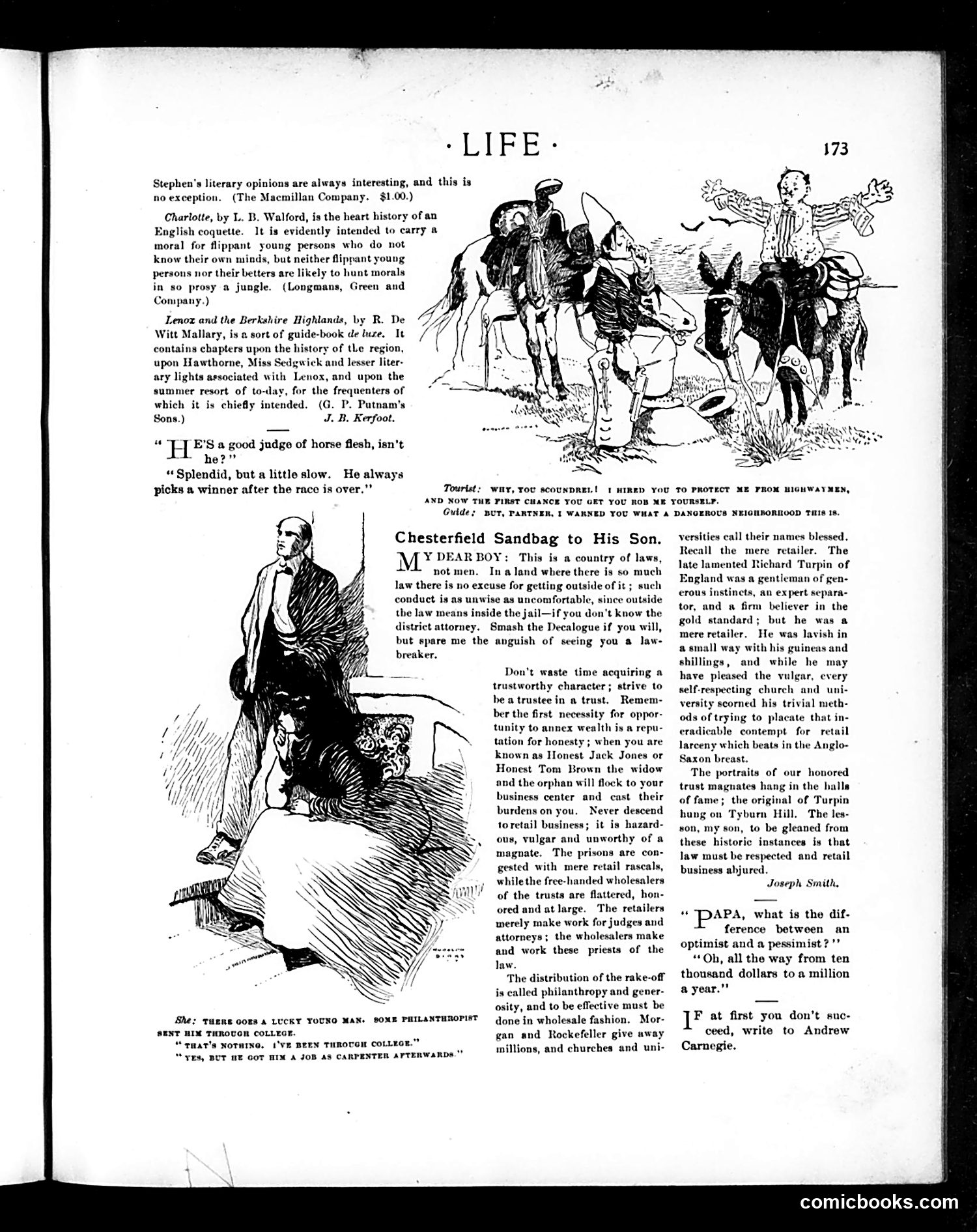
This page contains two distinct pieces of satirical content: **Left illustration**: A sketch depicting a well-dressed man in conversation, accompanying text titled "Chesterfield Sandbag to His Son." The piece satirizes advice from a father figure (Joseph Smith is credited) to a son about building business reputation and trustworthiness. The satire lies in the gap between the moral instruction and implied reality—the father coaches the son on becoming "Honest Jack Jones" or "Honest Tom Brown," suggesting that honesty itself is merely a marketing tool or reputation strategy rather than genuine principle. **Right illustration**: A scene showing travelers or merchants, likely satirizing frontier or business culture. The overall theme critiques how American business culture treats ethics as performative—something to be cultivated for advantage rather than practiced authentically.
📄 Transcribed text from this page (OCR, searchable)
Machine-transcribed from the original scan — historical spelling and the odd misread are preserved.
pe ele Stephen's literary opinions are always interesting, and this is no exception. (The Macmillan Company. $1.00.) Charlotte, by L.. B. Walford, is the heart history of an English coquette. moral for flippant young persons who do not know their own minds, but neither flippant young persons nor their betters are likely to hunt morals in so prosy a jungle. (Longmans, Green and Company.) Lenox and the Berkshire Highlands, by R. De Witt Mallary, is a sort of guide-book de luze, It contains chapters upon the history of tLe region, upon Hawthorne, Miss Sedgwick and lesser liter- ary lights associated with Lenox, and upon the summer resort of to-day, for the frequenters of which it is chiefly intended. (G. P. Putnam's Sons.) J. B. Kerfoot. cs H E'S a good judge of horse flesh, isn't - he?” “Splendid, but a little slow. He always picks a winner after the race is over." It is evidently intended to carry a Tourist: wny, you scounpret.! AND Now Guide: Chesterfield Sandbag to His Son. Y DEAR BOY: M law there This is a country of laws, Ina land where there is so much no excuse for getting outside of it ; such not men. conduct is as unwise as uncomfortable, since outside the law means inside the jail—if you don't know the district attorney. Smash the Decalogue if you will, but spare me the anguish of seeing you a law- breaker. She; TWene GOES A LUCKY YOUNO MAN, SOME PHILANTHROPIST SENT MIM THROUON COLLEGE. “qaat's NoTHING, I'VE BEEN THROTGI COLLEGE.” “yus, BUT ME GOT MIM A JOB AS CARPENTER ATTERWARDS.” Don't waste time acquiring a trustworthy character; strive to be a trustee in a trust. Remem- ber the first necessity for oppor- tunity to annex wealth is a repu- tation for honesty ; when you are known as Honest Jack Jones or Honest Tom Brown the widow and the orphan will flock to your business center and cast their burdens on you. Never descend toretail business; it is hazard- ous, vulgar and unworthy of a magnate. The prisons are con- gested with mere retail rascals, while the free-handed wholesalers of the trusts are flattered, hon- ored and at large. The retailers merely make work for judges and attorneys; the wholesalers make and work these priests of the law. The distribution of the rake-off is called philanthropy and gener- osity, and to be effective must be done in wholesale fashion. Mor- gan and Rockefeller give away millions, and churches and uni- 1 HIRED YoU To PROTECT ME FROM WIGHWAYMEN, FIRST CUANCE YOU GET YOU ROB ME YOURSELF. BUT, PARTNER, 1 WARNED YOU WHAT 4 DANGEROUS NEIOHBORMOOD TiHI8 18. versities call their names blessed. Recall the mere retailer. The late lamented Richard Turpin of England was a gentleman of gen- erous instincts, an expert separa- tor, and a firm believer in the gold standard; but he was a mere retailer. He was lay in a small way with his guineas and shillings, and while he may have pleased the vulgar, every self-respecting church and uni- versity scorned his trivial meth- ods of trying to placate that in- eradicable contempt for retail larceny which beats in the Anglo- Saxon breast. The portraits of our honored trust magnates hang in the halls of fame; the original of Turpin hung on Tyburn Hill. The les- son, my son, to be gleaned from these historic instances is that law must be respected and retail business abjured. Joseph Smith, “PAPA, what is the dif- ference between an optimist and a pessimist?’ “Oh, all the way from ten thousand dollars to a million a year."" JF at first you don't suc- ceed, write to Andrew Carnegie. comicbooks.com