
A complete issue · 18 pages · 1902
Life — July 10, 1902
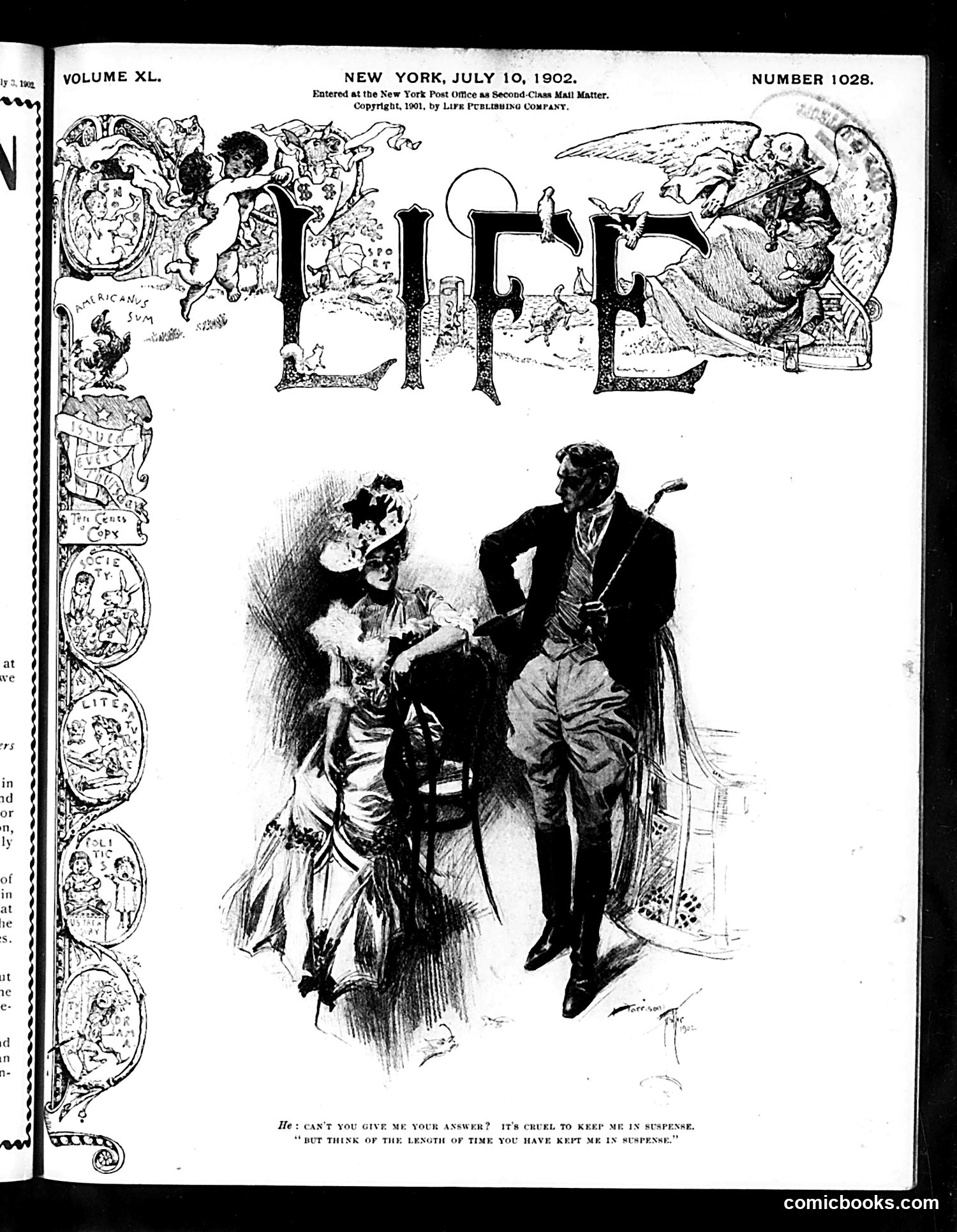
This page features a satirical cartoon with an elaborate decorative header showing fantastical scenes. The main illustration depicts a man in formal attire confronting a woman, with dialogue reading: "He: CAN'T YOU GIVE ME YOUR ANSWER? IT'S CRUEL TO KEEP ME IN SUSPENSE. / 'BUT THINK OF THE LENGTH OF TIME YOU HAVE KEPT ME IN SUSPENSE.'" The cartoon satirizes courtship and marriage proposals—specifically the power dynamics and patience required when a man proposes. The woman's retort suggests she's referencing a long period of courtship during which *she* waited in suspense, turning his impatience back on him. It's social commentary on romantic expectations and gender relations in the Edwardian era, using humor to critique masculine assumptions about women's obligations to answer quickly.
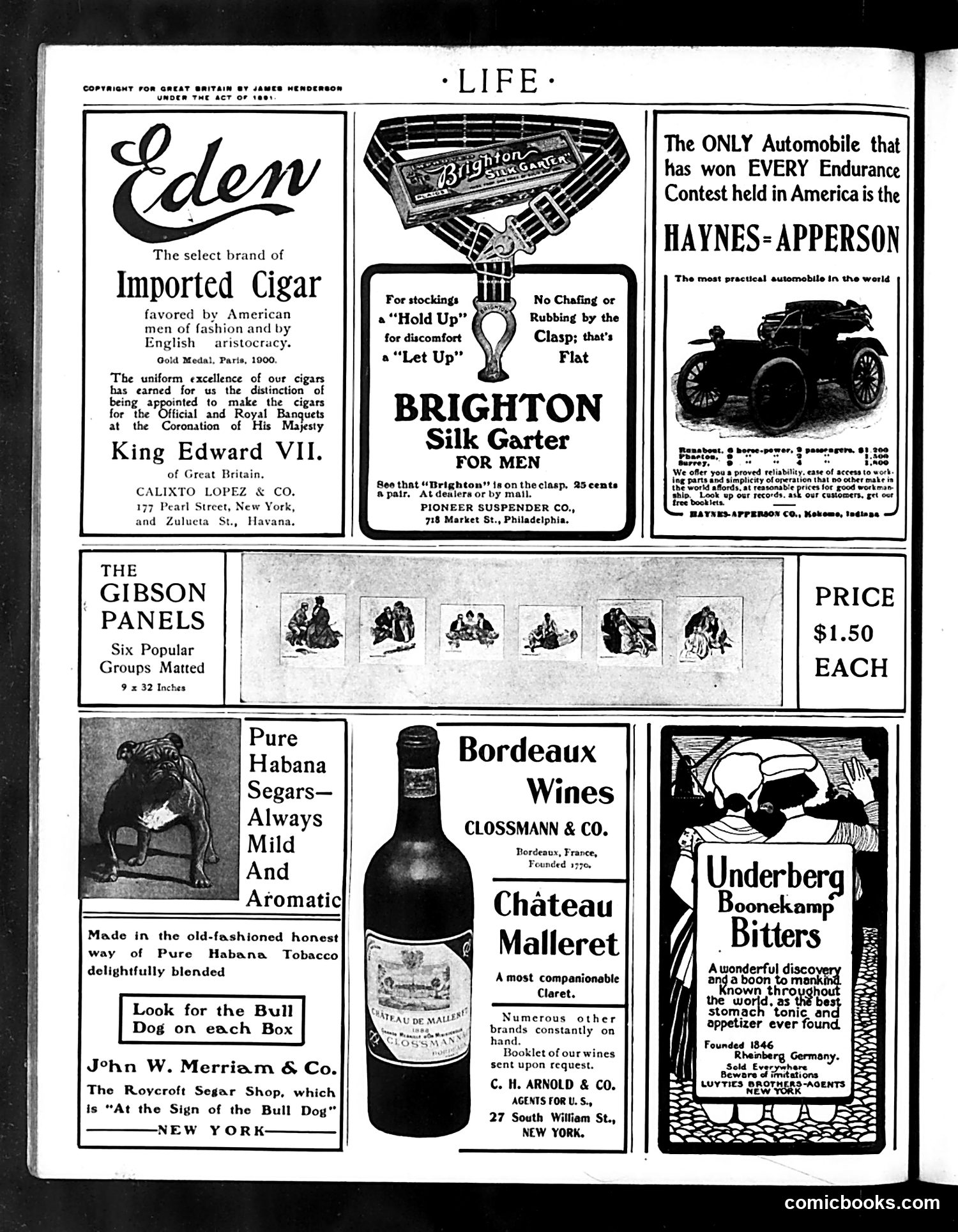
This page is **primarily advertisements**, not satirical content. It contains six product ads from what appears to be an early 1900s issue of *Life* magazine: - **Eden Cigars**: marketed to American aristocrats and English nobility, emphasizing appointment for King Edward VII's coronation - **Brighton Silk Garters**: hosiery supports - **Haynes-Apperson Automobile**: claims endurance contest victories - **Gibson Panels**: decorative art prints ($1.50 each) - **Habana Segars**: pure tobacco cigars - **Bordeaux Wines** and **Underberg Bitters**: luxury imports The page reflects early 20th-century consumer culture targeting affluent readers. The repeated emphasis on British royal connections and European imports suggests *Life*'s audience valued Old World sophistication and status symbols. No political satire is evident—this is straightforward luxury product marketing.
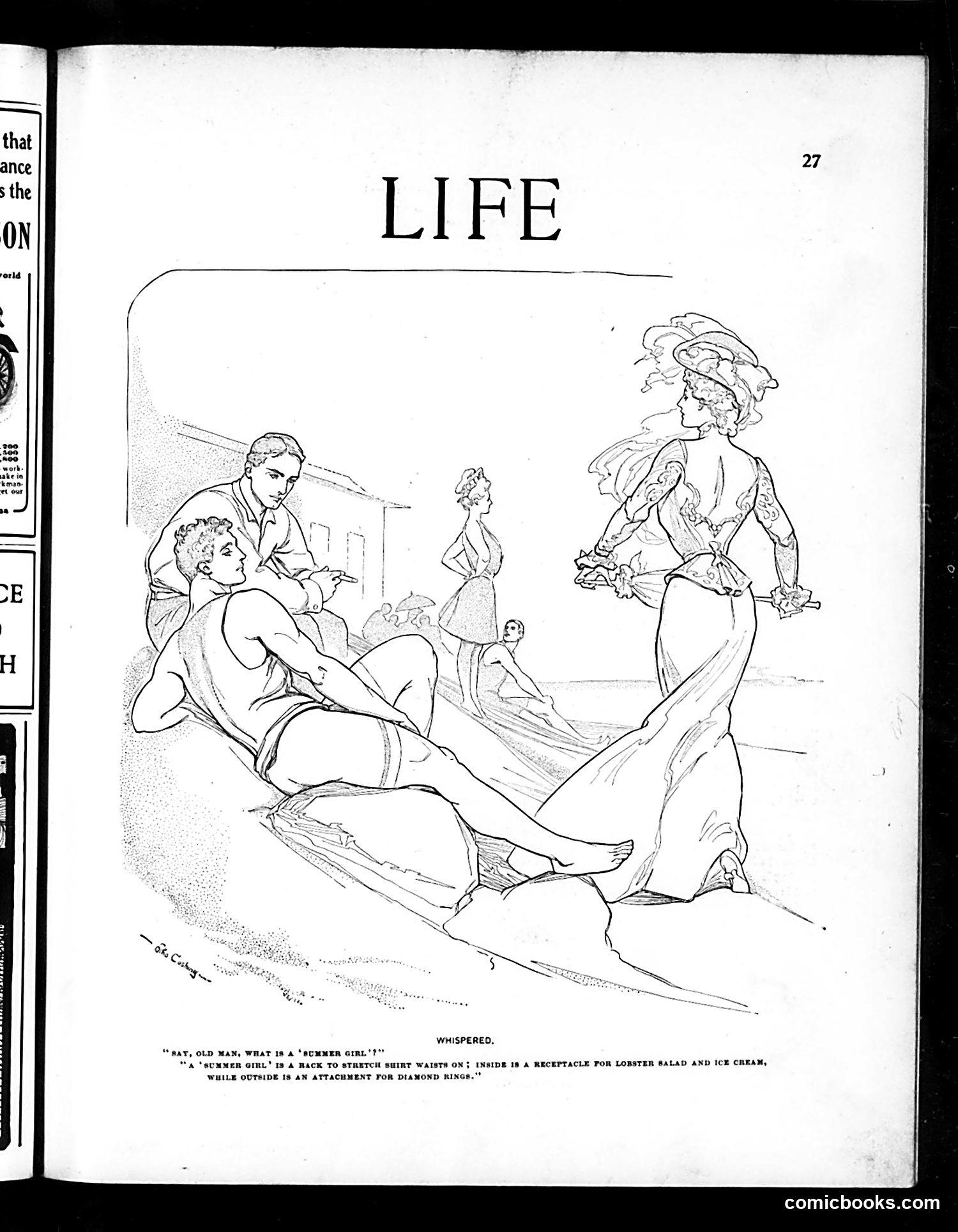
This page features a single cartoon titled "Whispered" depicting a beach or seaside scene. The caption presents a dialogue where an older man asks "what is a 'summer girl'?" and receives an explanation defining her as "a hack to stretch shirt waists on; inside is a receptacle for lobster salad and ice cream, while outside is an attachment for diamond rings." The satire targets wealthy young women of the era who frequented summer resorts. It mocks them as superficial, materialistic figures concerned primarily with fashion (stretched clothing), consumption (food), and jewelry. The crude anatomical humor suggests these women were viewed as decorative objects rather than substantive persons—a commentary on both their perceived vanity and the male gaze objectifying them.
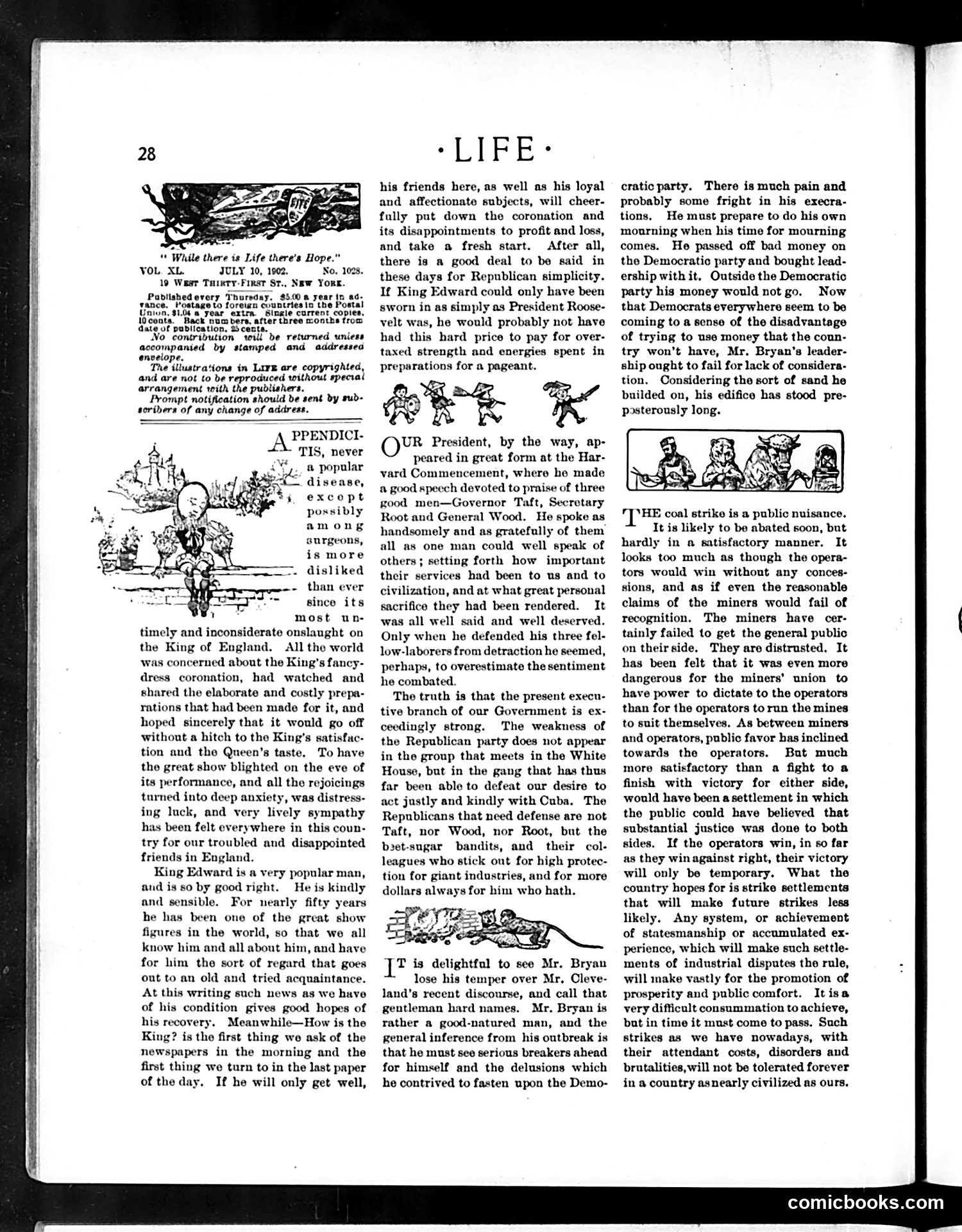
The page's main cartoon depicts **King Edward VII**, shown as a caricatured figure surrounded by symbolic imagery. The accompanying text discusses Edward's popularity and his "hard price to pay" regarding expensive coronation preparations. The satire critiques **Republican political strategy**: the piece argues Republicans underestimated Edward's personal appeal and failed to capitalize on coronation disappointments. It also addresses contemporary labor unrest—specifically a **coal strike**—suggesting public sympathy lies with miners rather than operators, and warning that unresolved industrial disputes pose dangers to the nation. The cartoon mocks Republican miscalculation while simultaneously cautioning that social instability from labor conflicts threatens national stability. The tone is cautiously nationalist.
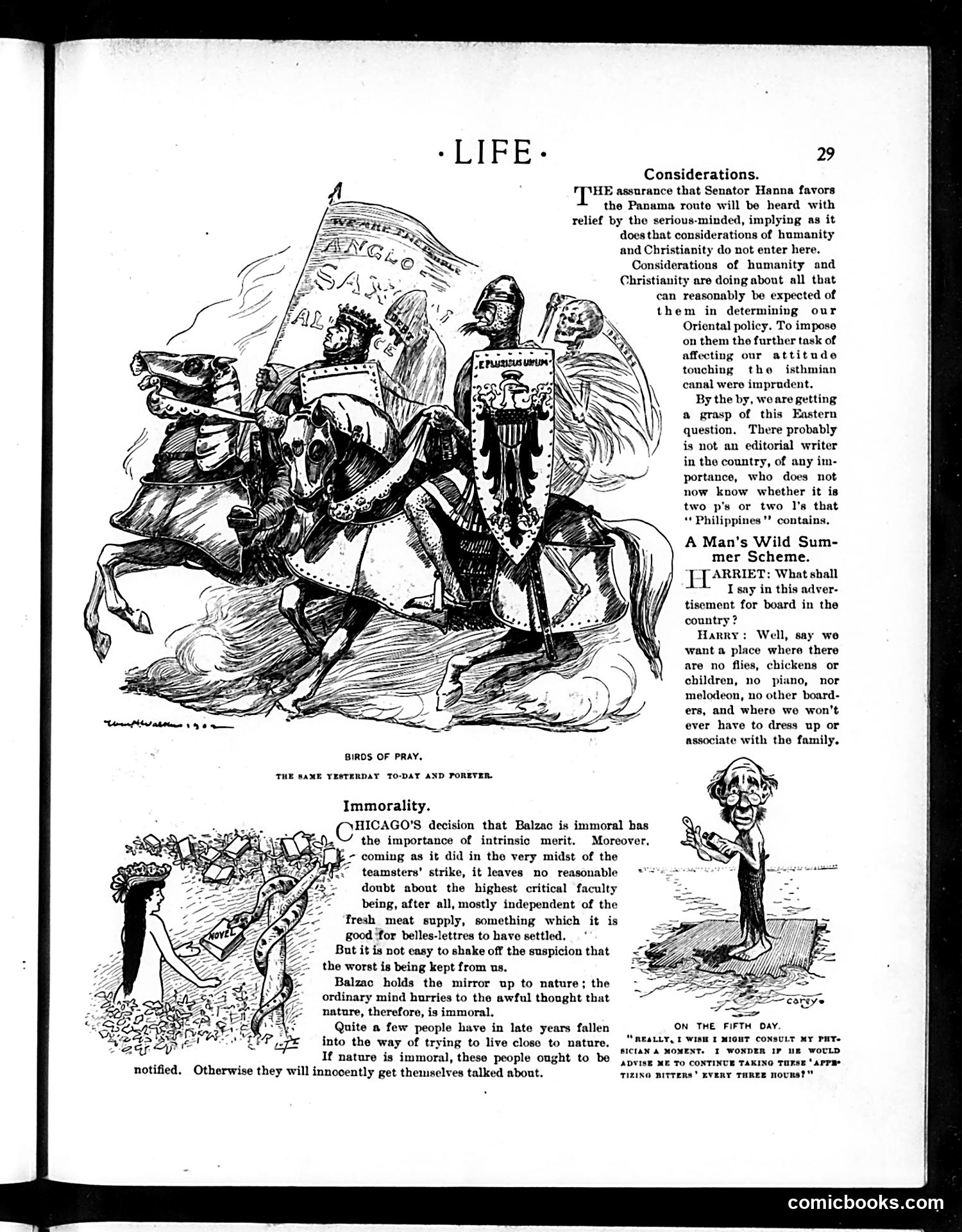
**Top Cartoon ("Birds of Pray"):** This satirical illustration depicts religious and political figures riding horses while carrying banners labeled "Panama" and other text. The title "Birds of Pray" is a pun on "birds of prey." It critiques what appears to be religious leaders or politicians using humanitarian/Christian arguments to justify imperialist positions on the Panama Canal route—suggesting they're predatory despite religious rhetoric. **Bottom Section ("Immortality"):** This discusses Chicago's court decision that author Honoré de Balzac is immortal, mocking the absurdity of declaring a long-dead person "immortal." The satire questions critical standards and suggests nature itself is "immoral," critiquing those who claim to live naturally. The page satirizes hypocrisy in both imperial policy and literary criticism.
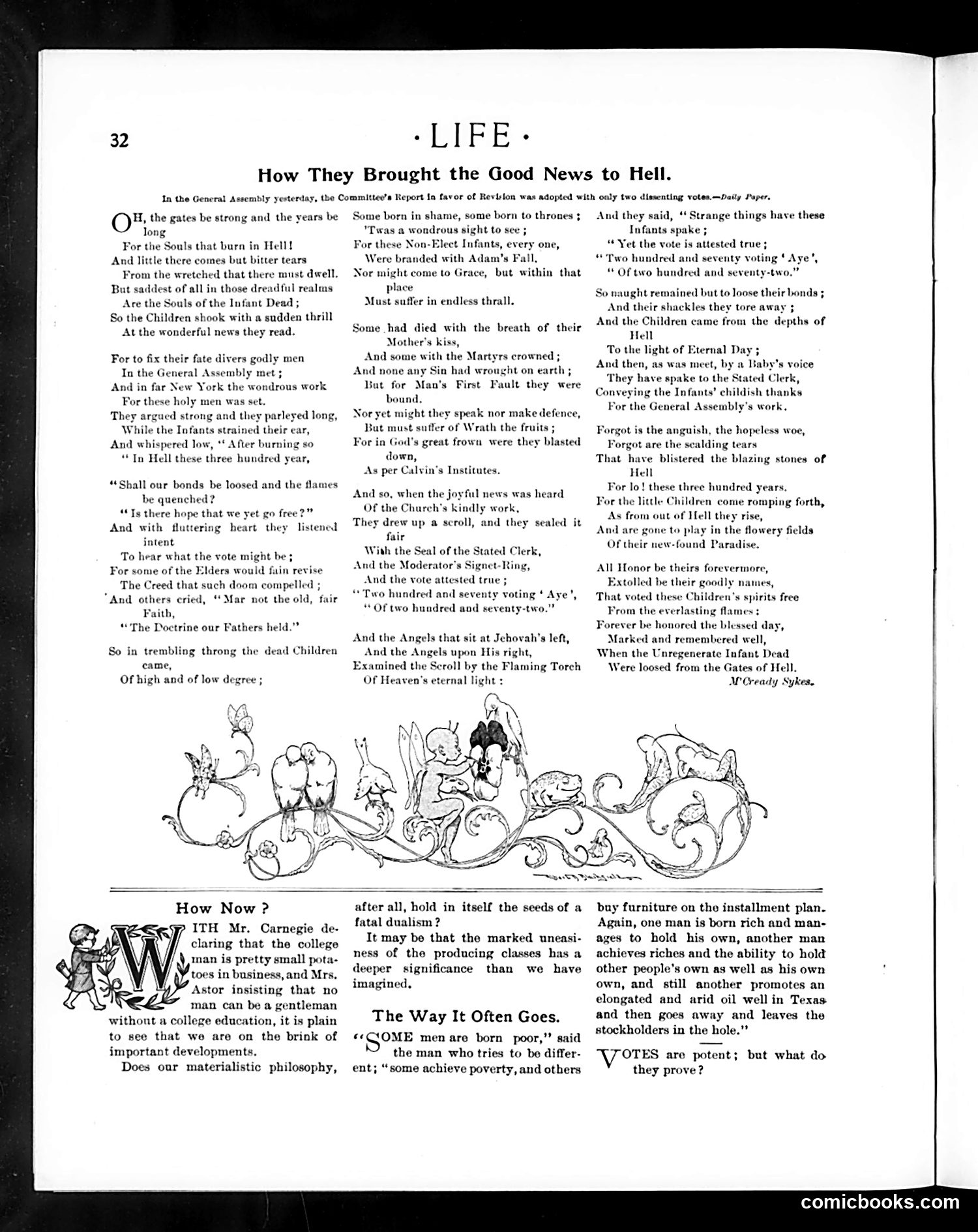
This page contains two satirical pieces addressing social inequality and class mobility in late 19th/early 20th-century America. **"How They Brought the Good News to Hell"** is a poem (by M. Oswald Sykes) satirizing a General Assembly debate on wealth redistribution. It mockingly depicts Hell's inhabitants celebrating news that 300 infants have been converted to Christianity, suggesting ironic commentary on whether moral conversion actually improves material conditions for the poor. **"How Now?" and "The Way It Often Goes"** critique Andrew Carnegie's claim that gentlemen need college education, then present contradictory scenarios showing that regardless of birth circumstances, wealthy men maintain advantages while poor men cannot escape poverty—even through individual achievement. The satire argues that systemic inequality persists despite meritocratic rhetoric. The decorative illustration depicts cherub-like figures, reinforcing the theological/moral dimensions of the wealth debate.
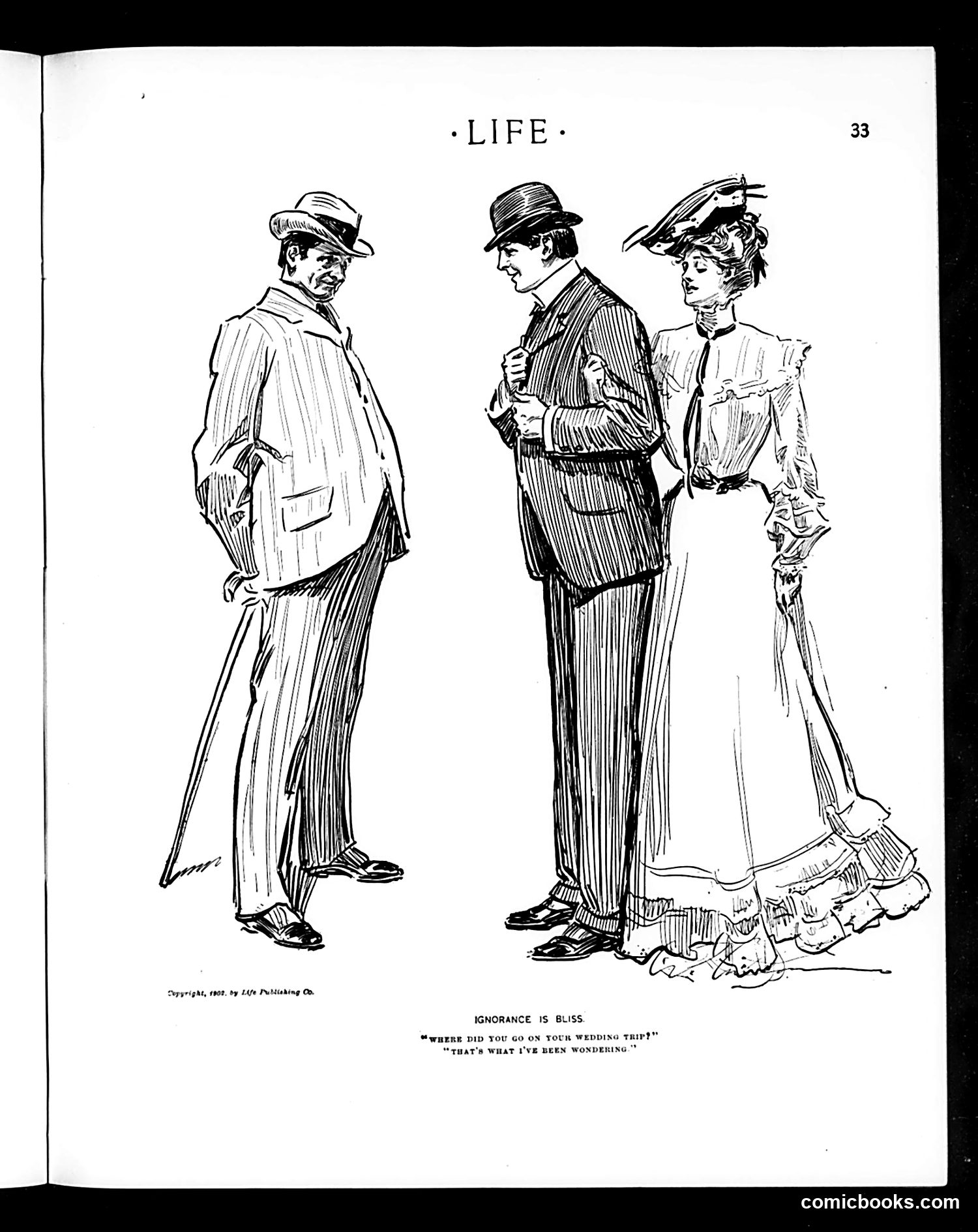
This satirical cartoon depicts three figures in early 1900s attire engaged in conversation. The caption reads: "Where did you go on your wedding trip?" / "That's what I've been wondering." The joke satirizes marital ignorance and suggests a husband who either doesn't know where his wife traveled, or conversely, a spouse deliberately kept in the dark about honeymoon plans. The title "Ignorance is Bliss" reinforces the satirical point—that not knowing details about one's own wedding trip is presented as somehow fortunate. This reflects early 20th-century humor about marriage dynamics, particularly the notion that husbands and wives operated in separate spheres with limited communication or shared knowledge about major life events. The cartoon mocks both marital disconnect and gender-based communication failures.
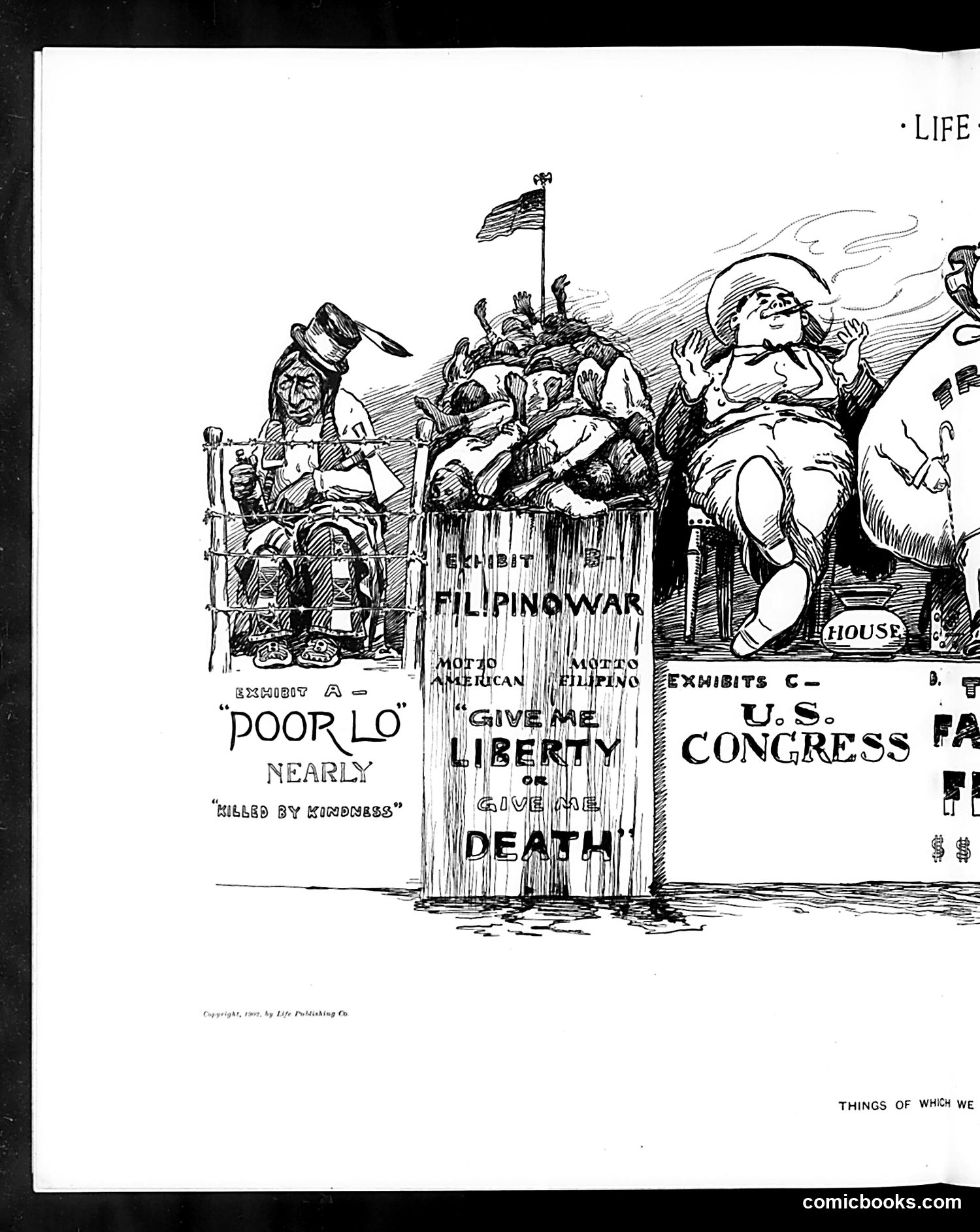
This appears to be a satirical commentary on the Philippine-American War. The central exhibit shows a wooden crate labeled "EXHIBIT B - FILIPINO WAR" containing piled human figures, with signs reading "GIVE ME LIBERTY" and "GIVE ME DEATH" — inverting Patrick Henry's famous American revolutionary motto to suggest the grim choice faced by Filipinos. On the left, "Poor Lo Nearly Killed by Kindness" references historical depictions of Native Americans, suggesting parallel colonial exploitation. On the right, the "U.S. Congress" figure appears bloated or complacent, labeled "House Exhibits C." The cartoon criticizes American military actions in the Philippines as contradicting stated American values of liberty, while drawing uncomfortable parallels between U.S. treatment of Native Americans and current Philippine policy.
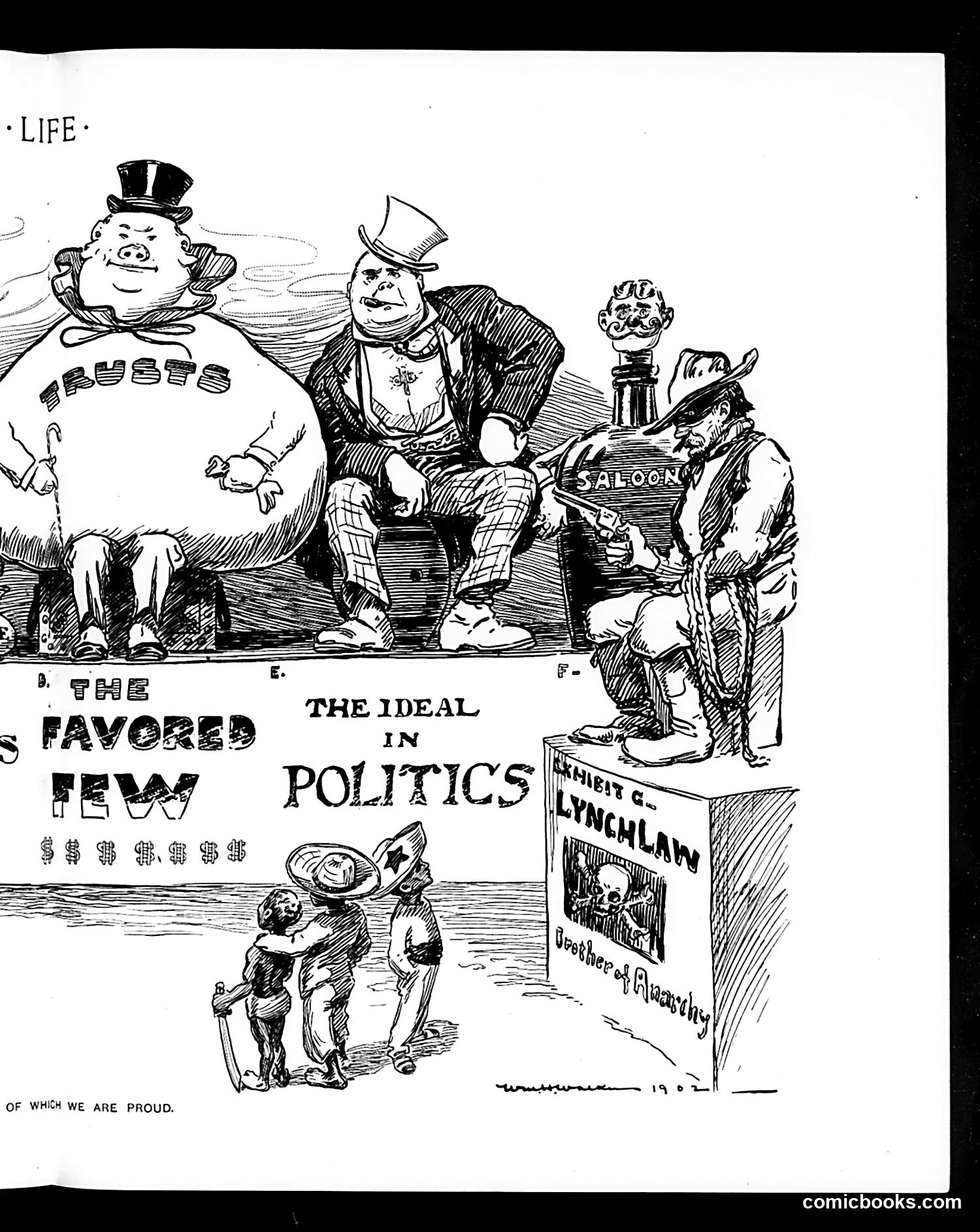
This satirical cartoon critiques corruption in American politics around the early 20th century. The image shows wealthy, caricatured figures labeled "TRUSTS" sitting above common people, illustrating how monopolistic corporations dominated politics. The central message—"THE IDEAL IN POLITICS"—is ironic: the cartoon shows what politicians *claimed* to represent versus reality. References include a "SALOON" (tied to urban political corruption), a "LYNCH LAW" book (referencing lawlessness and racial violence), and dollar signs, emphasizing how money controlled the political system. The small figure at bottom, appearing to represent ordinary citizens or justice, is dwarfed by these corrupt forces—suggesting average Americans had no voice in their own governance. The overall tone condemns the gap between democratic ideals and the actual "favored few" who wielded real power.
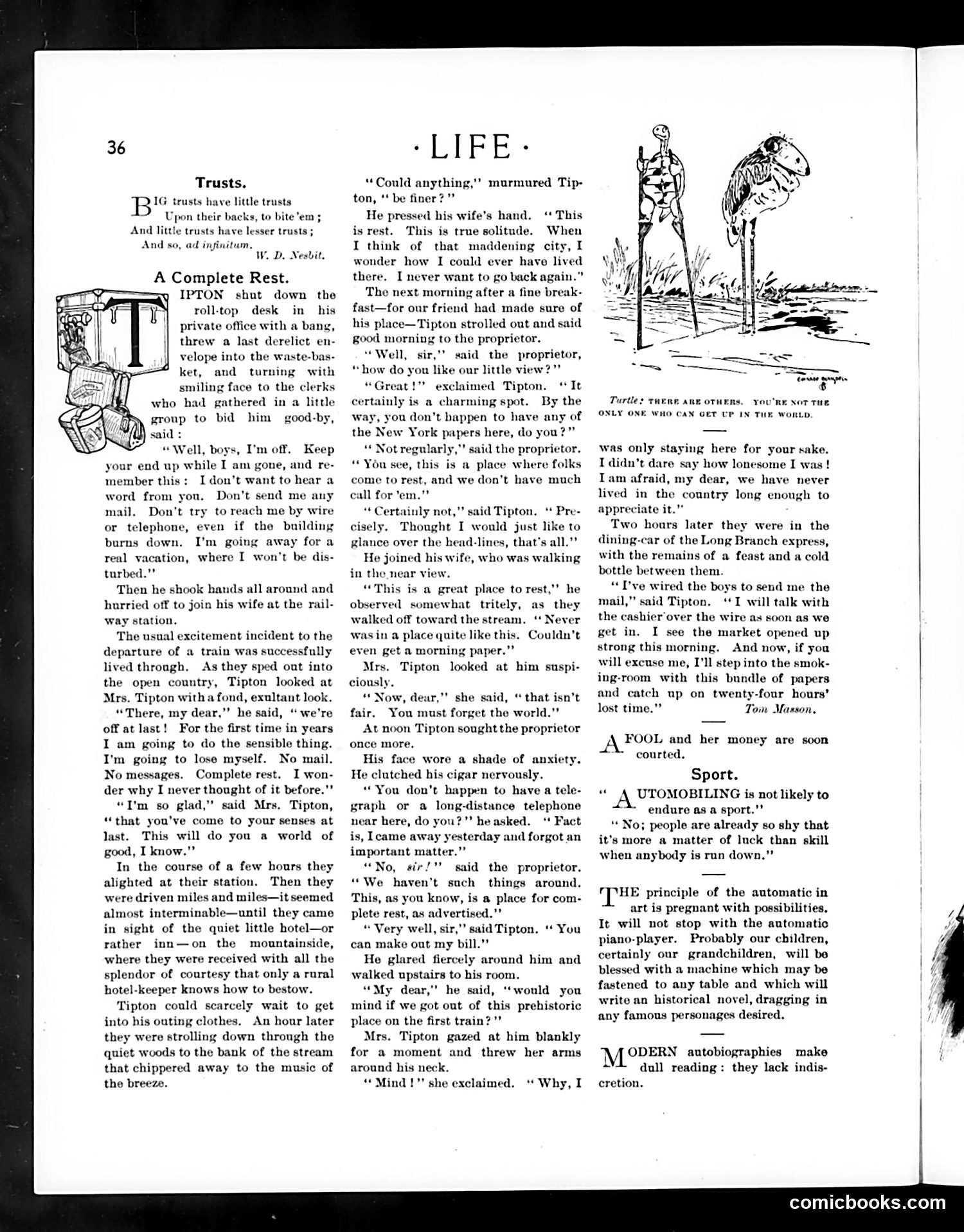
This page contains a short story titled "A Complete Rest" about a businessman named Tipton who takes a vacation to escape work stress. The narrative follows Tipton and his wife as they stay at a quiet country hotel near a stream. The accompanying illustration (by Fay Sargent, per the signature) shows two figures on fence posts near water—likely depicting the couple's peaceful retreat. The page also includes brief satirical comments on unrelated topics: trusts, automobiles as sports, and modern autobiographies. The main satire targets the irony of urban professionals seeking rural escape—Tipton struggles to truly relax despite being in an idyllic setting, reflecting anxieties about modern work culture and the difficulty of genuine rest.
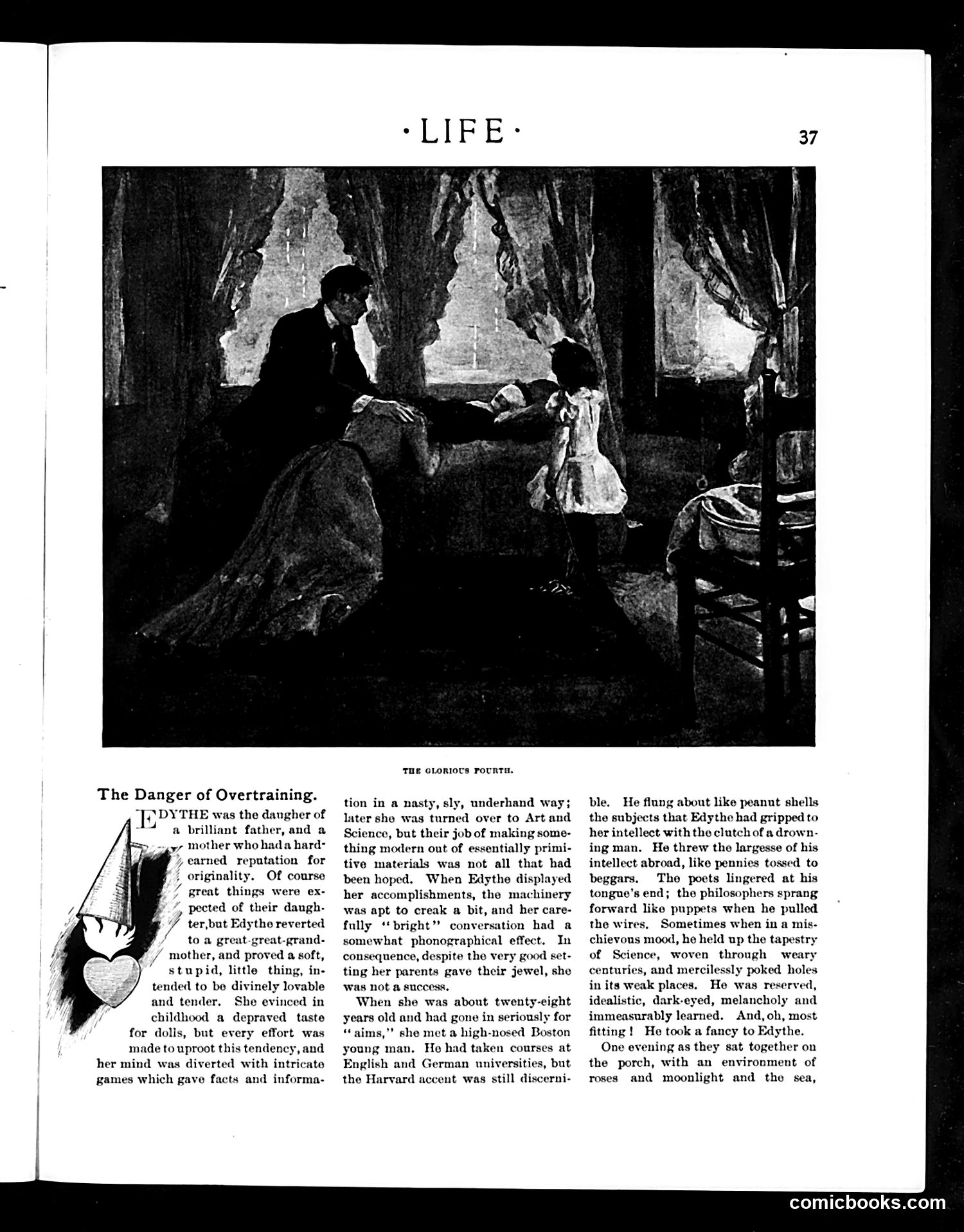
This story illustrates early 20th-century anxieties about over-education, particularly regarding women. The protagonist, Edythe, is the daughter of a brilliant family renowned for intellectual accomplishment. However, her parents' push for academic achievement—courses at English and German universities, Harvard—has backfired. Rather than producing a well-rounded woman, the intensive education has made her pedantic and socially awkward, causing her to fail at the social graces expected of her. The satire warns against prioritizing intellectual development over the cultivation of feminine charm and social skills. The story reflects contemporary concerns that excessive education could render women unmarriageable or unfit for their "proper" domestic roles, a common argument used against women's higher education in this era.
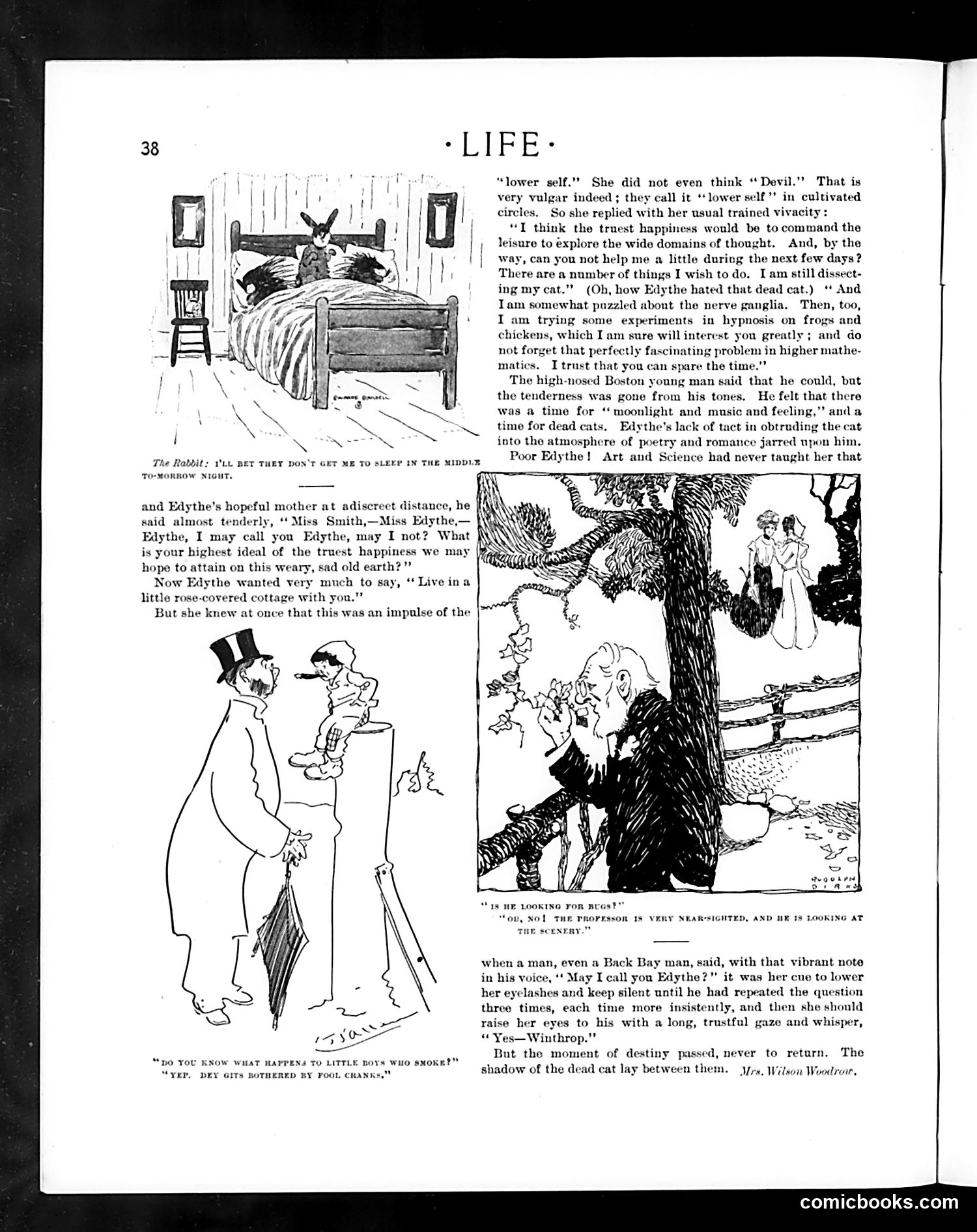
This page contains three separate satirical cartoons: 1. **"The Rabbit"** (top): Shows a rabbit in bed, satirizing someone's excuse-making about sleep disruption. 2. **"Do you know what happens to little boys who smoke?"** (bottom left): Depicts an adult warning a child about smoking, with the caption noting the child's feet are bothered by "fool cramps"—mocking both parental warnings and children's behavior. 3. **"Is he looking for bugs?"** (right): Shows an elderly man examining a tree while children watch. The caption notes "the professor is very near-sighted, and he is looking at the scenery"—a joke about mistaken observations and the gap between appearance and reality. These are gentle, domestic humor pieces typical of Life's satirical style, poking fun at everyday social situations rather than specific political targets.
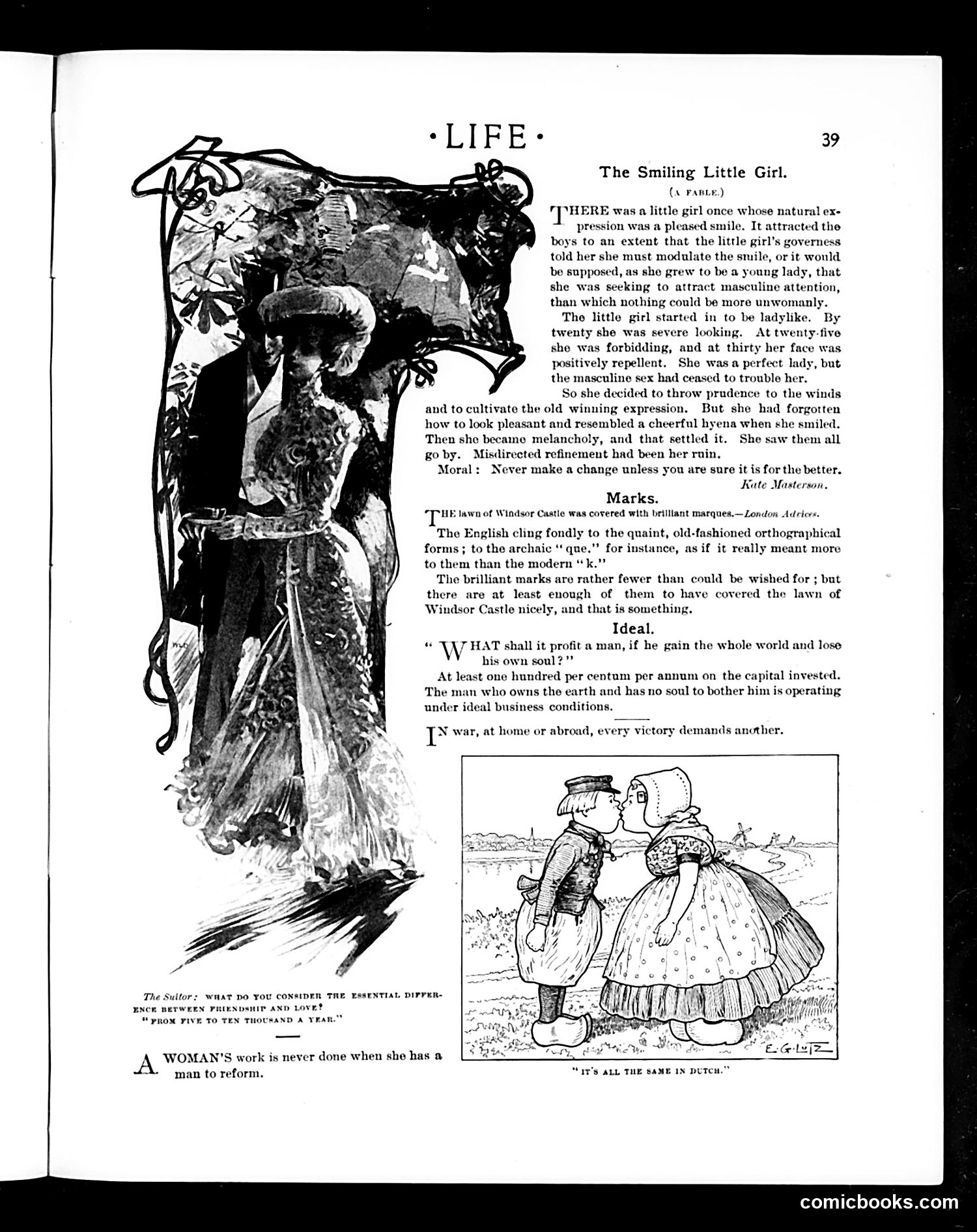
This page contains several satirical pieces targeting early-20th-century social conventions: **"The Smiling Little Girl"** critiques rigid Victorian femininity codes. A girl with a natural pleasant smile is told by her governess that smiling attracts male attention and is therefore "unwomanly." She suppresses her smile to appear proper, becoming severe and repellent. When she tries to smile again as an adult, she's forgotten how and looks grotesque. The moral: don't change your nature to meet impossible social standards—a critique of how women's behavior was policed. **"Marks"** is a brief British joke about Windsor Castle's lawn being decorated with ornate marquees, with a humorous aside about the English preference for archaic spelling ("que" vs. "k"). **"Ideal"** satirizes capitalist greed, twisting the biblical question "What profits a man who gains the world but loses his soul?" into a cynical answer: 100% annual return—implying the soulless businessman has achieved the ideal. The bottom cartoons are social commentary on courtship and gender relations, suggesting cynicism about romantic dynamics and marriage reform.
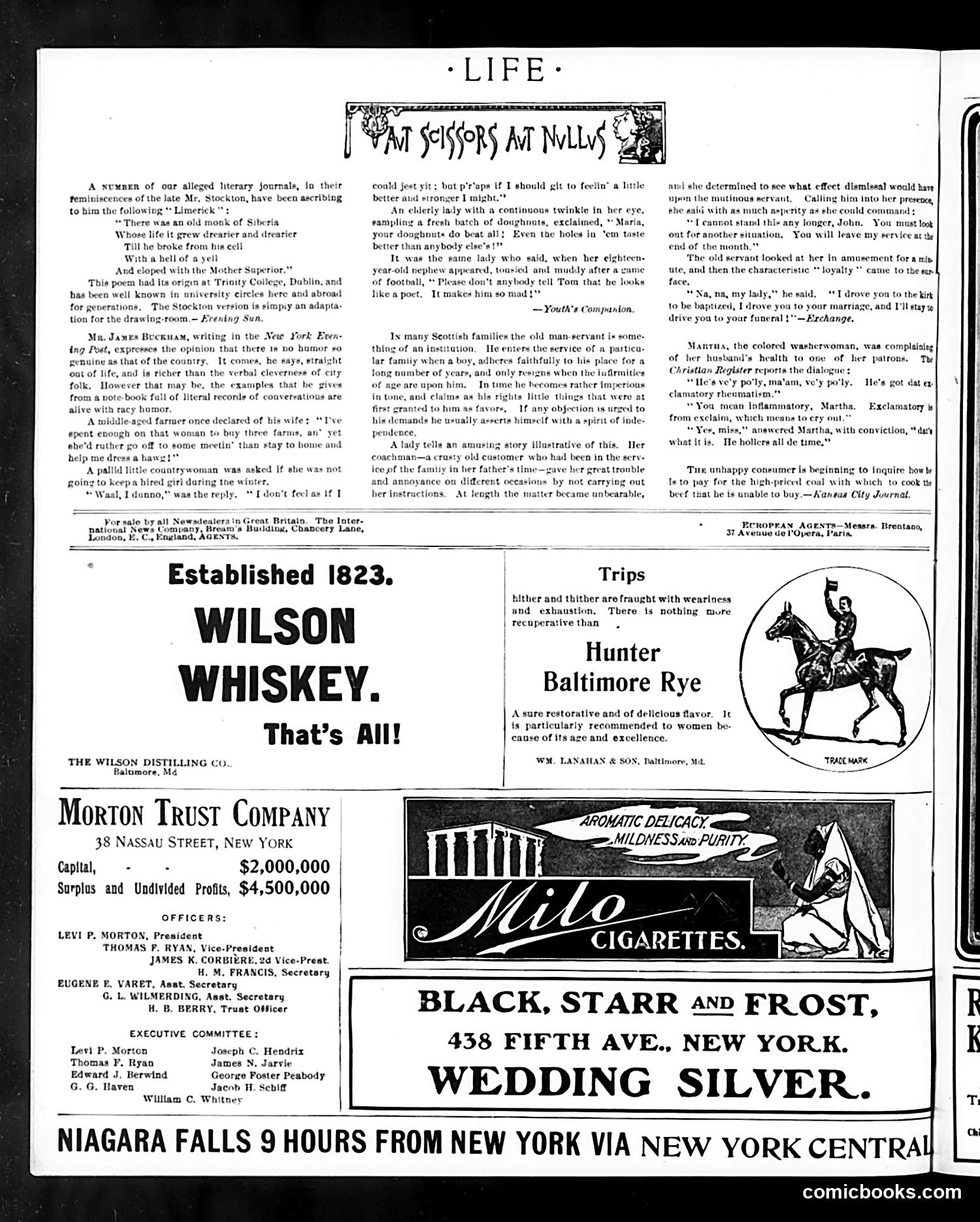
This page is primarily **advertising and filler content**, typical of early 20th-century *Life* magazine layout. The editorial content at the top consists of **humorous anecdotes** about country life and elderly servants in Scotland—stories emphasizing the vernacular wit and loyalty of rural/working-class characters. These pieces reflect period attitudes viewing such figures as endearingly quaint and amusing. The remainder is **advertisements**: Wilson Whiskey, Milo Cigarettes, Hunter Baltimore Rye whiskey, Black Starr and Frost jewelry, and financial institutions (Morton Trust Company). These ads target affluent readers of a satirical magazine aimed at educated, urban audiences. There are **no political cartoons** on this page—the humorous content is domestic/social rather than political satire. The cigarette ad includes a decorative illustration of a woman on horseback with trademark notation, but no caricature or specific reference requiring historical context beyond marketing conventions of the era.
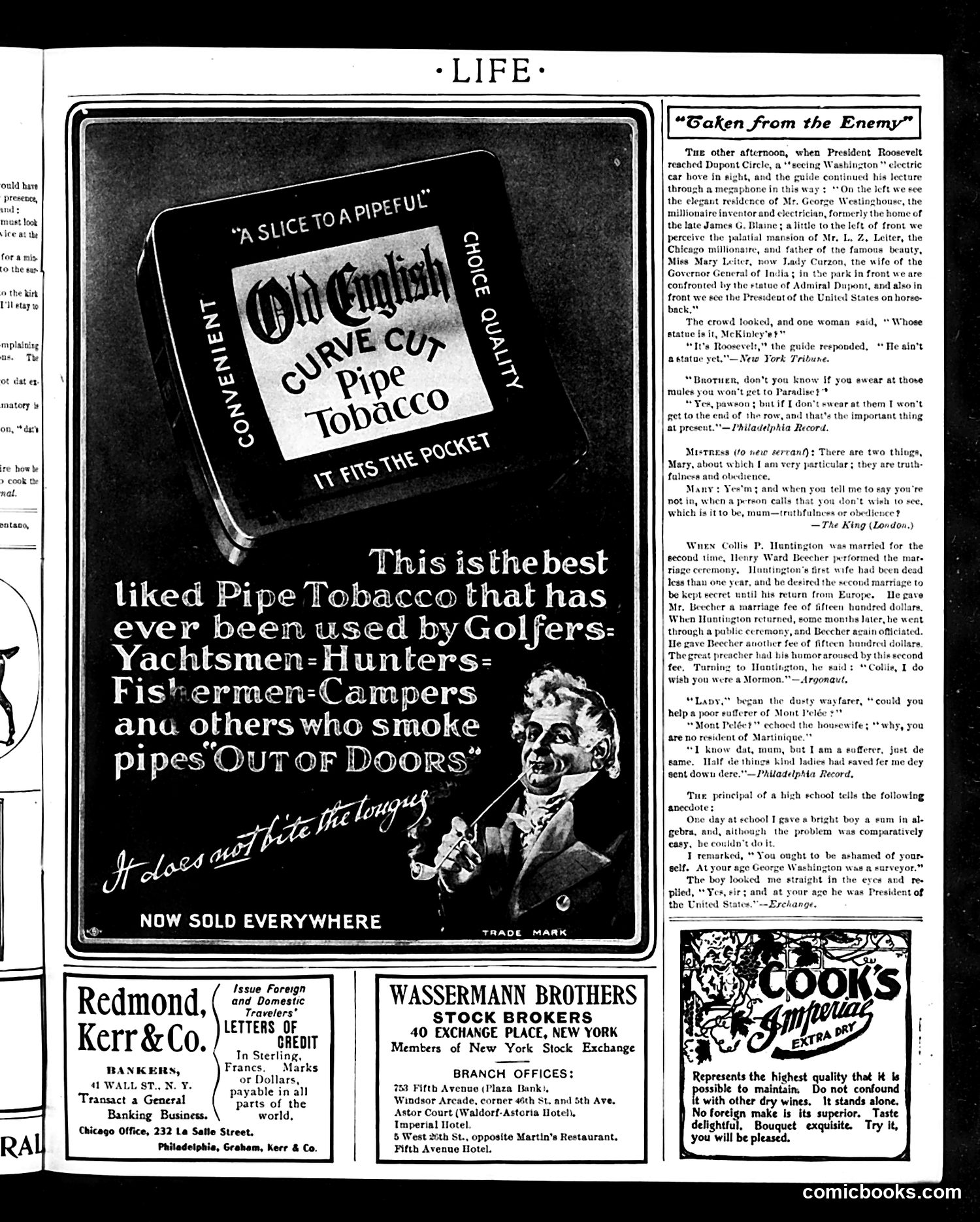
This page is primarily **advertising**, not editorial cartooning. The dominant content is a large advertisement for "Old English Curve Cut Pipe Tobacco," targeting outdoor enthusiasts (golfers, yachtsmen, hunters, fishermen, campers) with the appeal that it "closes out the longing." The right column contains brief **humorous anecdotes** rather than political satire—joke items about President Roosevelt visiting a mansion, a dusty waiter helping a poor settler, a principal testing a student's algebra skills, and a clergyman's remarriage ceremony. These are lightweight, sentimental humor typical of early 20th-century magazines. The bottom section features advertisements for financial services (banking, stock brokers) and Cook's Imperial wine. **There is no significant political cartoon or satire on this page.** The Roosevelt reference is merely incidental to a social anecdote, not commentary. This appears to be a standard commercial/humor page from Life's lighter editorial matter.
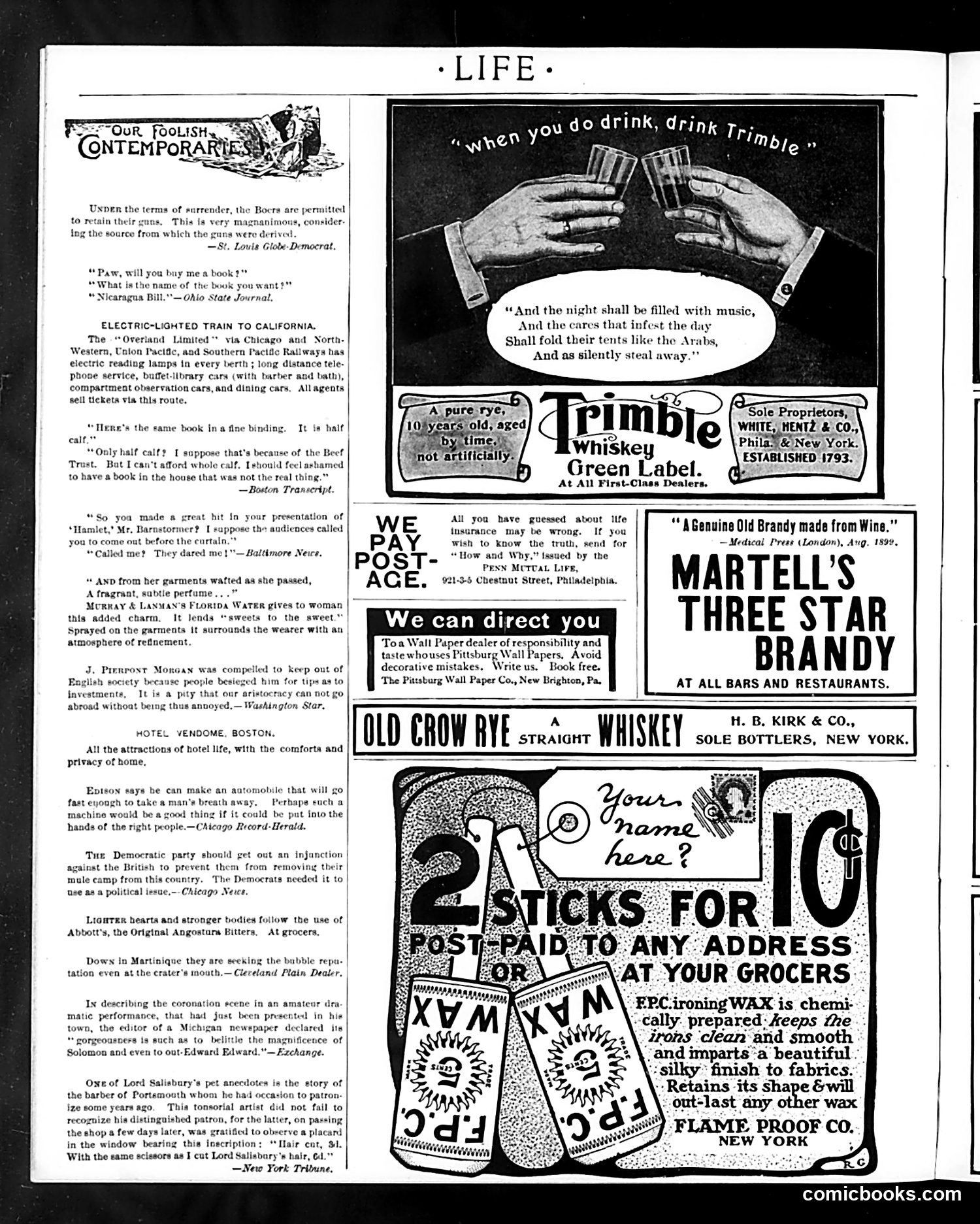
This page contains miscellaneous short satirical pieces typical of *Life* magazine, plus period advertisements. The cartoons mock everyday absurdities: a child wanting "Nicaragua Bill" as a book title (referencing political turmoil); complaints about the "Beef Trust" inflating prices; an actor forced to take curtains calls; Edison's dangerous fast automobiles. One joke involves Lord Salisbury's barber, who advertises he cut the distinguished statesman's hair—a satire on name-dropping and social pretension. The advertisements are era-specific: electric-lit trains (cutting-edge technology), whiskey brands, brandy, perfume water, and wall paper—products marketed to middle/upper-class readers. The "sticks for postcards" ad bottom-right hawks wax products, chemically prepared, supposedly superior to competitors. Overall, the page reflects Edwardian-era concerns: trust monopolies, technological novelty, social climbing, and consumer goods advertising dominating editorial space.
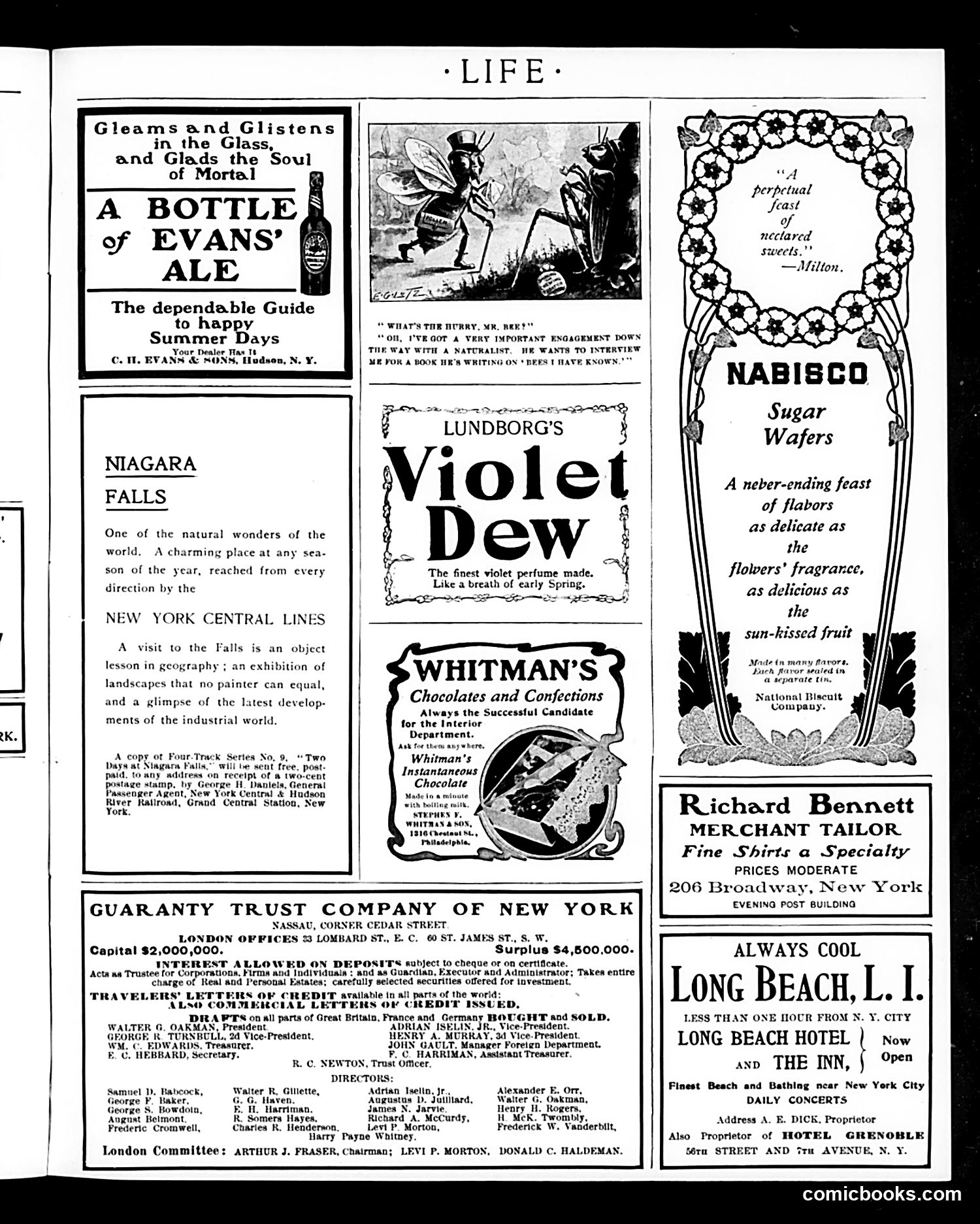
This page is primarily **advertisements** with one cartoon. The central cartoon depicts an insect (appears to be a bee or fly) rushing away, saying it has "a very important engagement down the way with a naturalist" who wants to interview it for a book on "bees I have known." **The joke**: This is a pun playing on the phrase "bees I have known"—the insect is fleeing because it fears being written about or studied, treating the naturalist's interest as a threatening "engagement." The page otherwise contains various early-20th-century consumer ads: Evans' Ale, Niagara Falls tourism, Lundborg's perfume, Whitman's chocolates (with a joke about being "the successful candidate for the Interior Department"), Nabisco wafers, a merchant tailor, and the Long Beach Hotel. The Guaranty Trust Company listing occupies substantial space, showing this was likely a wealthy readership's publication. The overall tone is light, consumer-focused humor typical of Life magazine's satirical approach to modern commerce and leisure.
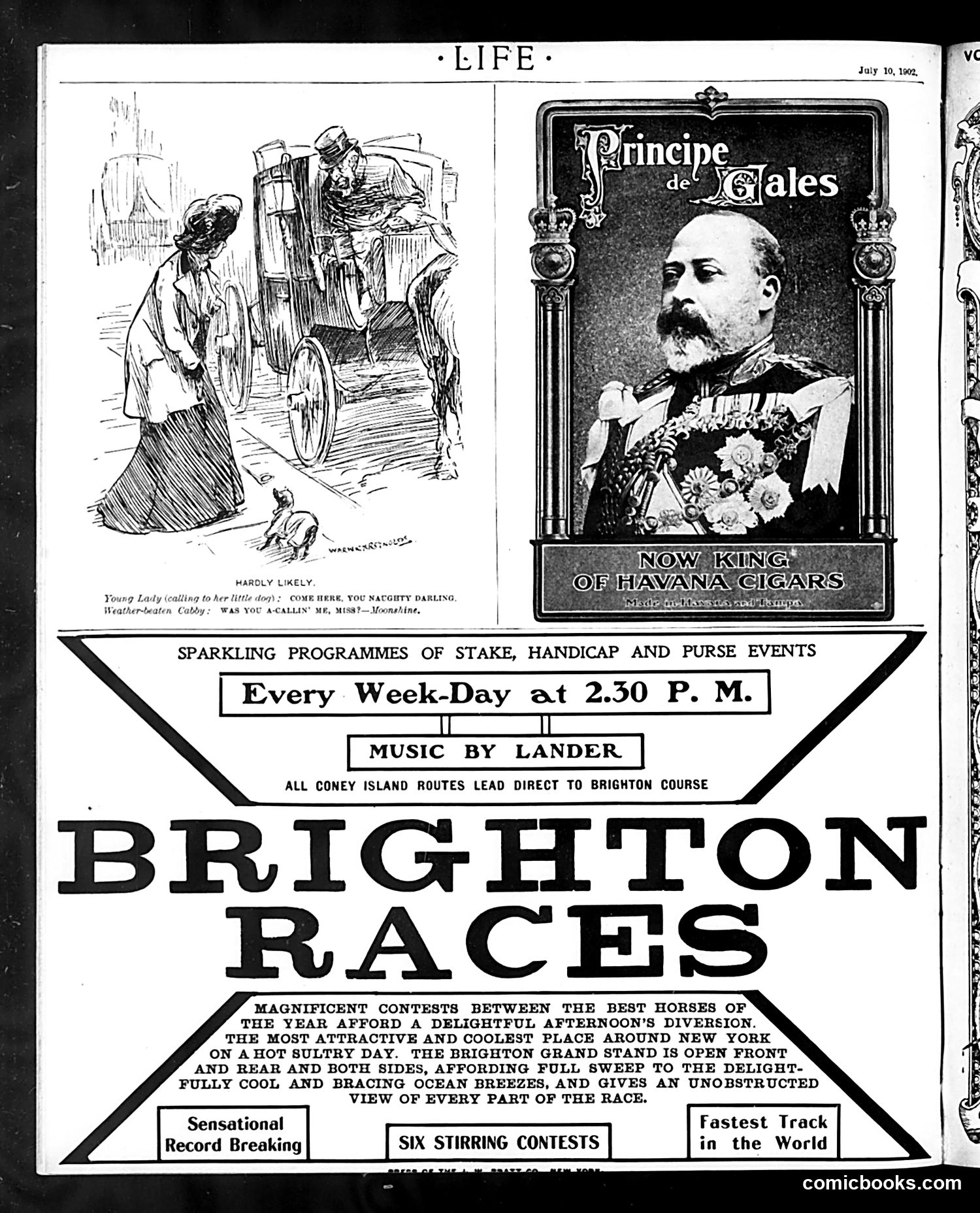
This page mixes satirical cartoon with advertising. **The Cartoon ("Hardly Likely"):** A young woman calls to her small dog while a weathered cab driver mishears her, thinking she's addressing him as "Miss." The joke plays on class and miscommunication—the rough cabby assumes an upper-class lady wouldn't address him familiarly, so he misinterprets her words. It's gentle satire of social distance and assumptions about propriety. **The Portrait:** The "Principe de Gales" (Prince of Wales) appears in formal military dress with medals, likely commentary on European royalty or diplomatic relations, though the specific reference is unclear. **The Advertisement:** The bulk of the page promotes Brighton Beach Races (horse racing), emphasizing its accessibility via Coney Island routes, cool ocean breezes, and "six stirring contests." This reflects early 1900s leisure culture and organized spectacle as popular entertainment.