
Life, 1902-07-10 · page 6 of 18
Life — July 10, 1902 — page 6: what you’re looking at
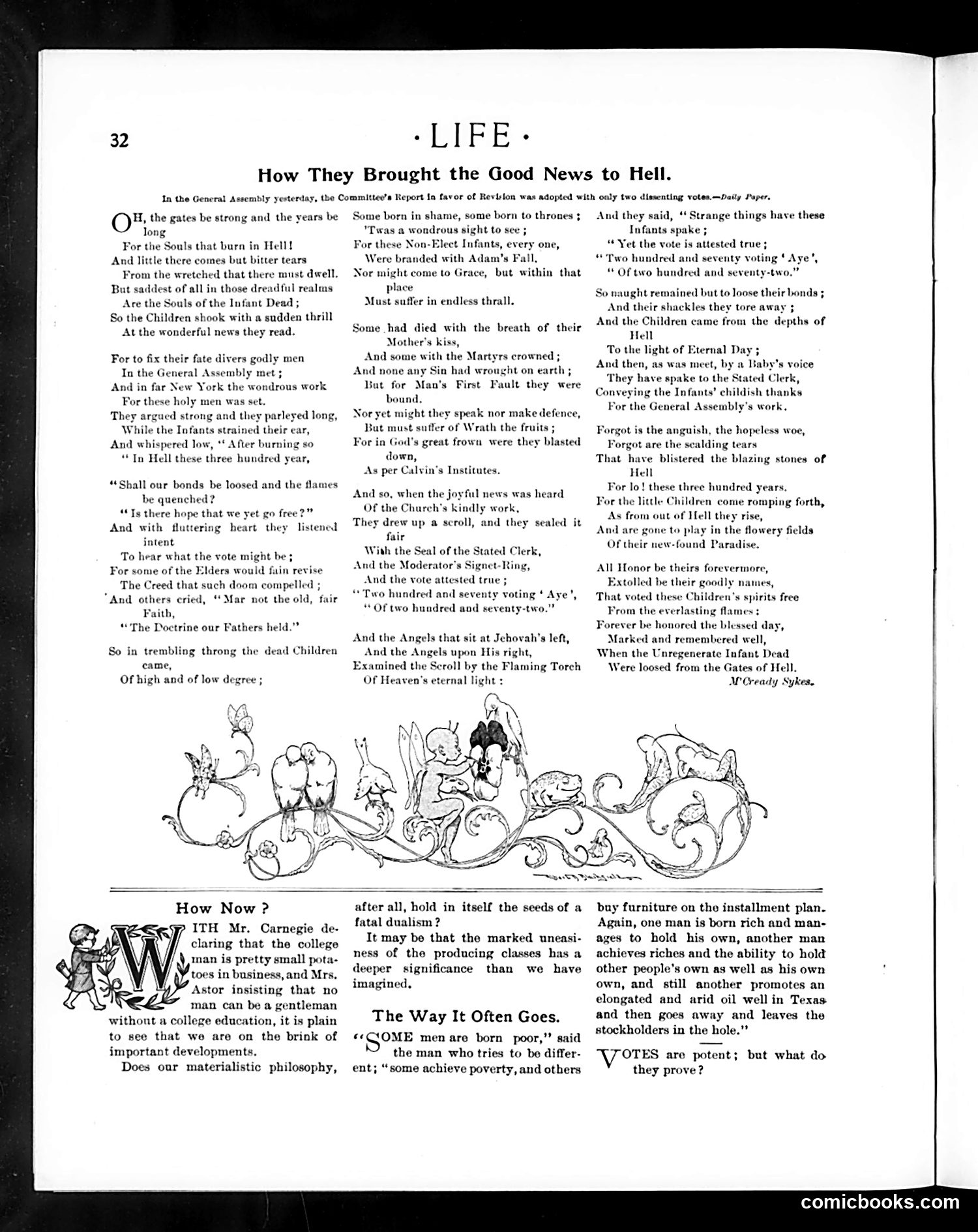
What you’re looking at
This page contains two satirical pieces addressing social inequality and class mobility in late 19th/early 20th-century America. **"How They Brought the Good News to Hell"** is a poem (by M. Oswald Sykes) satirizing a General Assembly debate on wealth redistribution. It mockingly depicts Hell's inhabitants celebrating news that 300 infants have been converted to Christianity, suggesting ironic commentary on whether moral conversion actually improves material conditions for the poor. **"How Now?" and "The Way It Often Goes"** critique Andrew Carnegie's claim that gentlemen need college education, then present contradictory scenarios showing that regardless of birth circumstances, wealthy men maintain advantages while poor men cannot escape poverty—even through individual achievement. The satire argues that systemic inequality persists despite meritocratic rhetoric. The decorative illustration depicts cherub-like figures, reinforcing the theological/moral dimensions of the wealth debate.
📄 Transcribed text from this page (OCR, searchable)
Machine-transcribed from the original scan — historical spelling and the odd misread are preserved.
“LDPE + How They Brought the Good News to Hell. In the General Assembly yesterday, the Committee's Report in favor of Revision was adopted with oaly two dissenting votes. Daily Paper, H, the gates be strong and the years be long For the Souls that burn in Hell! And little there comes but bitter tears From the wretched that there must dwell. But saddest of all in those dreadful realms Are the Souls of the Infant Dead ; So the Children shook with a sudden thrill At the wonderful news they read. For to fix their fate divers godly men In the G And in far New York the wondrous work For these ho eral Assembly met ; They argued strong and they parleyed long, While the Infants strained their ear, And whispered low, “After burning so “In Hell these three hundred year, “Shall our bonds be loosed and the flames be quenched? “Is there hope that we yet go fi And with fluttering heart they intent To hear what the vote might be ; For some of the Elders would fi The Creed that such doom compelled ; “And others cried, “Mar not the old, fair Faith, “The Doctrine our Fathers held.” in revise So in trembling throng the dead Children came, Of high and of low degree ; Some born in shame, some born to thrones 3 ‘Twas a wondrous sight to see ; For these Non-Elect Infants, every one, branded with Ac Nor might come to Grace, but within that place Must suffer in endless thrall. Some had died with the breath of their Mother's kiss, And some with the Martyrs crowned ; And none any Sin had wrought on Lat for Man's First Fi bound. Nor yet might they speak nor make defence, arth ; alt they were But must suffer of Wrath the fruits ; For in God’s great frown were they blasted down, AAs per Calvin's Institutes. And so, when the joyful news was heard Of the Church's kindly work, They drew up a scroll, and they sealed it fair the Seal of the And the Moderator’s Signet And the vote attested true “ Two hundred and seventy voting ‘ Aye’, * Of two hundred and seventy-tw: And the Angels that sit at Jehovah's left, And the Angels upon His right, Examined the Scroll by the Flaming Torch Of Heaven's eternal light : 6 ITH Mr. Carnegie de- , claring that the college / man is pretty small po ¥ toes in business, and Mrs, Vv i . Astor insisting that no oe can be a gentleman withont a college education, it is plain to see that we are on the brink of important developments. Does our materialistic philosophy, after all, hold in itself the seeds of a fatal dualism ? It may be that the marked uneasi- ness of the producing classes has a deeper significance than we have imagined, The Way It Often Goes. OME men are born poor,” said the man who tries to be differ- ent; “some achieve poverty, and others And they said, “ Stran Infants spake “Yet the vote is attested true; “Two hundred and seventy voting ¢ Ay “ Of two hundred and seventy-two.” things have these So naught remained but to loose their bonds ; And their shackles they tore away And the Children came from the depths of Hell To the light of Eternal Day ; And then, as was meet, by a Baby's voice ‘They have spake to the Stated Clerk, Conveying the Infants’ childish thanks For the General Assembly's work. Forgot is the anguish, the hopeless woe, Forgot are the scalding tears That have blistered the bls Hell For lo! these three hundred years, For the little Children come romping forth, As from out of Hell they rise, And are gone to play in the flowery fields Of their new-found Paradise. ing stones of All Honor be theirs forevermore, Extolled be their goodly names, That voted these Children’s spirits free From the everlasting flames: Forever be honored the blessed day, Marked and remembered well, When the Unregenerate Infant Dead Were loosed from the Gates of Hell. MCready Sykes. buy furniture on the installment plan. Again, one man is born rich and man- ages to hold his own, another man achieves riches and the ability to hold other people's own as well as his own own, and still another promotes an elongated and arid oil well in Texas and then goes away and leaves the stockholders in the hole.”” “VOTES aro potent; but what do they prove? comicbooks.com