
Life, 1902-07-10 · page 11 of 18
Life — July 10, 1902 — page 11: what you’re looking at
What you’re looking at
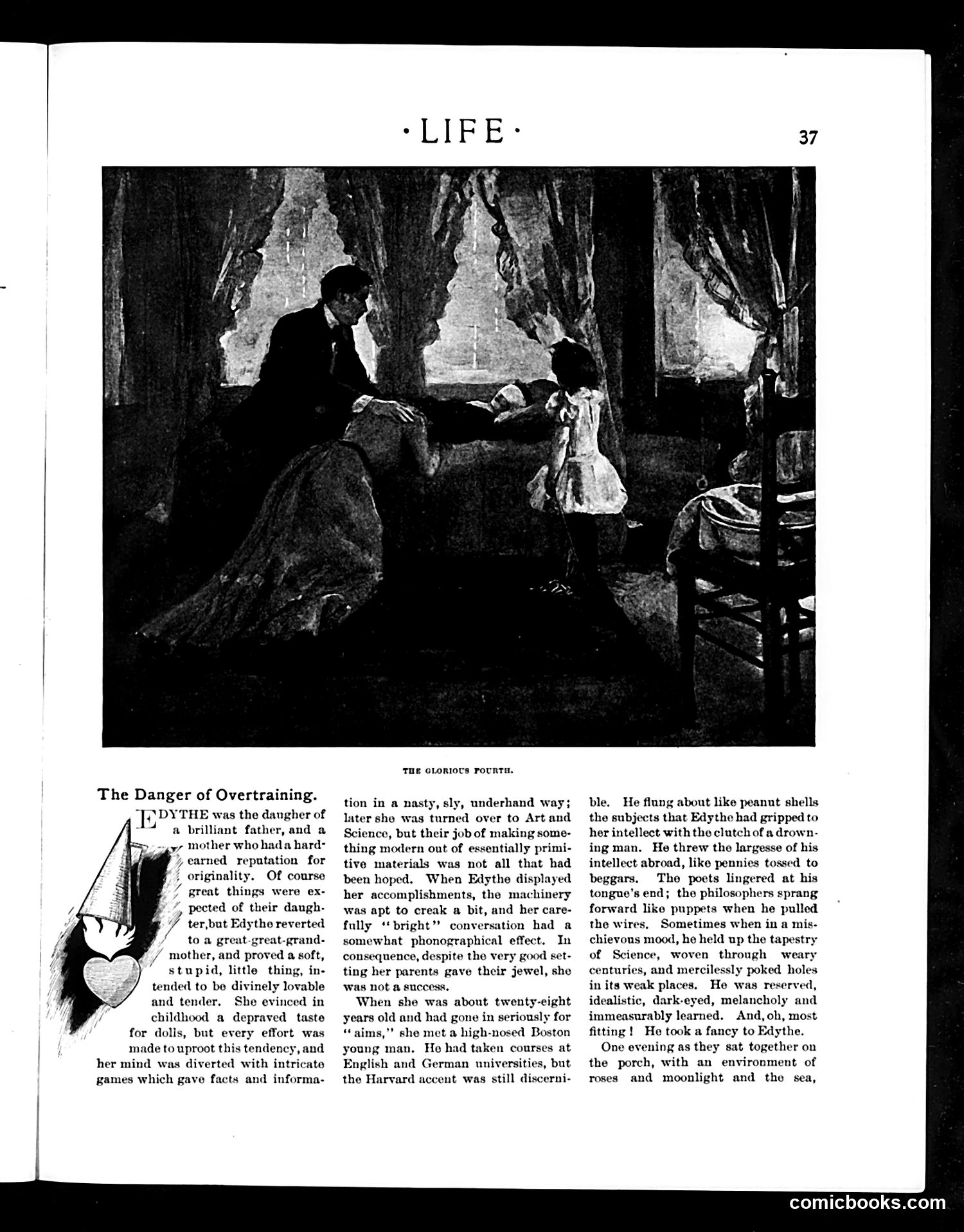
This story illustrates early 20th-century anxieties about over-education, particularly regarding women. The protagonist, Edythe, is the daughter of a brilliant family renowned for intellectual accomplishment. However, her parents' push for academic achievement—courses at English and German universities, Harvard—has backfired. Rather than producing a well-rounded woman, the intensive education has made her pedantic and socially awkward, causing her to fail at the social graces expected of her. The satire warns against prioritizing intellectual development over the cultivation of feminine charm and social skills. The story reflects contemporary concerns that excessive education could render women unmarriageable or unfit for their "proper" domestic roles, a common argument used against women's higher education in this era.
📄 Transcribed text from this page (OCR, searchable)
Machine-transcribed from the original scan — historical spelling and the odd misread are preserved.
The Danger of Overtraining. ‘T@ DYTHE was the daugher of 4 a brilliant father, and a _,.yr mother who hada hard- yearned reputation for ; originality. Of course / great things were ex- , 7 pected of their daugh- p / ter,but Edytho reverted to a great-great-grand- mother, and proved a soft, stupid, little thing, in- tended to be divinely lovable and tender. She evinced in childhood a depraved taste for dolls, but every effort was made to uproot this tendency, and her mind was diverted with intricate games which gave facts and informa- / Tue GLoRiovs rourtH. tion in a nasty, sly, underhand way; later she was turned over to Art and Science, but their job of making some- thing modern out of essentially primi- tive materials was not all that had been hoped. When Edythe displayed her accomplishments, the machinery was apt to creak a bit, and her care- fully “bright” conversation had a somewhat phonographical effect. In consequence, despite the very good set- ting her parents gave their jewel, she ‘was not a success, When she was about twenty-eight years old and had gone in seriously for “aims,” she met a high-nosed Boston young man. He had taken courses at English and German universities, but the Harvard accent was still discerni- ble. He flung about like peanut shells the subjects that Edythe had gripped to her intellect with the clutch of a drown- ing man. He threw tho largesse of his intellect abroad, like pennies tossed to beggars. The poets lingered at his tongue’s end; the philosophers sprang forward like puppets when he pulled the wires, Sometimes when in a mis- chievous mood, he held up the tapestry of Science, woven through weary centuries, and mercilessly poked holes in its weak places. He was reserved, idealistic, dark-eyed, melancholy and immeasurably learned. And, oh, most fitting! He took a fancy to Edythe. One evening as they sat together on the porch, with an environment of roses and moonlight and the sea, comicbooks.com