
Life, 1902-07-10 · page 13 of 18
Life — July 10, 1902 — page 13: what you’re looking at
What you’re looking at
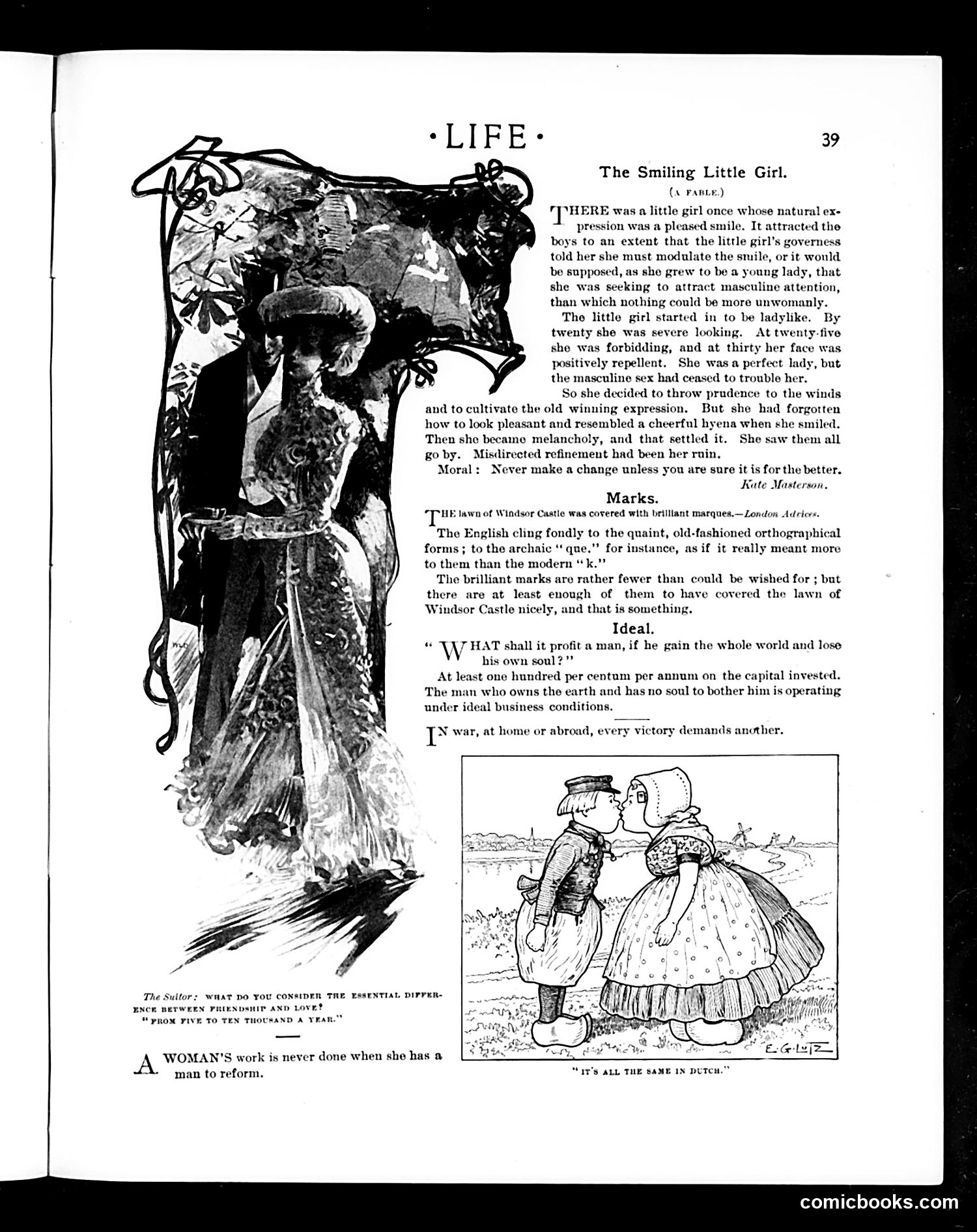
This page contains several satirical pieces targeting early-20th-century social conventions: **"The Smiling Little Girl"** critiques rigid Victorian femininity codes. A girl with a natural pleasant smile is told by her governess that smiling attracts male attention and is therefore "unwomanly." She suppresses her smile to appear proper, becoming severe and repellent. When she tries to smile again as an adult, she's forgotten how and looks grotesque. The moral: don't change your nature to meet impossible social standards—a critique of how women's behavior was policed. **"Marks"** is a brief British joke about Windsor Castle's lawn being decorated with ornate marquees, with a humorous aside about the English preference for archaic spelling ("que" vs. "k"). **"Ideal"** satirizes capitalist greed, twisting the biblical question "What profits a man who gains the world but loses his soul?" into a cynical answer: 100% annual return—implying the soulless businessman has achieved the ideal. The bottom cartoons are social commentary on courtship and gender relations, suggesting cynicism about romantic dynamics and marriage reform.
📄 Transcribed text from this page (OCR, searchable)
Machine-transcribed from the original scan — historical spelling and the odd misread are preserved.
The Smiling Little Girl. (\ rape.) "TRERE was a little girl once whose natural ex- pression was a pleased smile. It attracted the boys to an extent that the little girl’s governess told her she must modulate the smile, or it would be supposed, as she grew to be a young lady, that she was seeking to attract masculine attention, than which nothing could be more unwomanly. The little girl started in to be ladylike. By twenty she was severe looking. At twenty-five she was forbidding, and at thirty her face was positively repellent. She was a perfect lady, but the masculine sex had ceased to trouble her. So she decided to throw prudence to the winds and to cultivate the old winning expression. But she had forgotten how to look pleasant and resembled a cheerful hyena when she smiled. Then she becaine melancholy, and that settled it. She saw them all goby. Misdirected refinement had been her ruin. Moral: Never make a change unless you are sure it is for the better. Kate Masterson, Marks. HE lawn of Windsor Castle was covered with brilllant marques,—London Advices. The English cling fondly to the quaint, old-fashioned orthographical forms ; to the archaic ‘ que,"’ for instance, as if it really meant more to them than the modern “ k."” The brilliant marks are rather fewer than could be wished for ; but there are at least enough of them to have covered the lawn of Windsor Castle nicely, and that is something. Ideal. “ W HAT shall it profit a man, if he gain the whole world and lose his own soul?’’ At least one hundred per centum per annum on the capital invested. The man who owns the earth and has no soul to bother him is operating under ideal business conditions. 5 war, at home or abroad, every victory demands another. The Suitor: WHAT DO YOU CONSIDER THE ESSENTIAL DIFFRR- ENCE BETWEEN FRUENDSIIT AND LOY “ PROM FIVE TO TEN THOUSAND A WOMAN'S work is never done when she has a man to reform. “rr's ALL THE same IN DUTCH.” comicbooks.com