
Life, 1902-07-10 · page 4 of 18
Life — July 10, 1902 — page 4: what you’re looking at
What you’re looking at
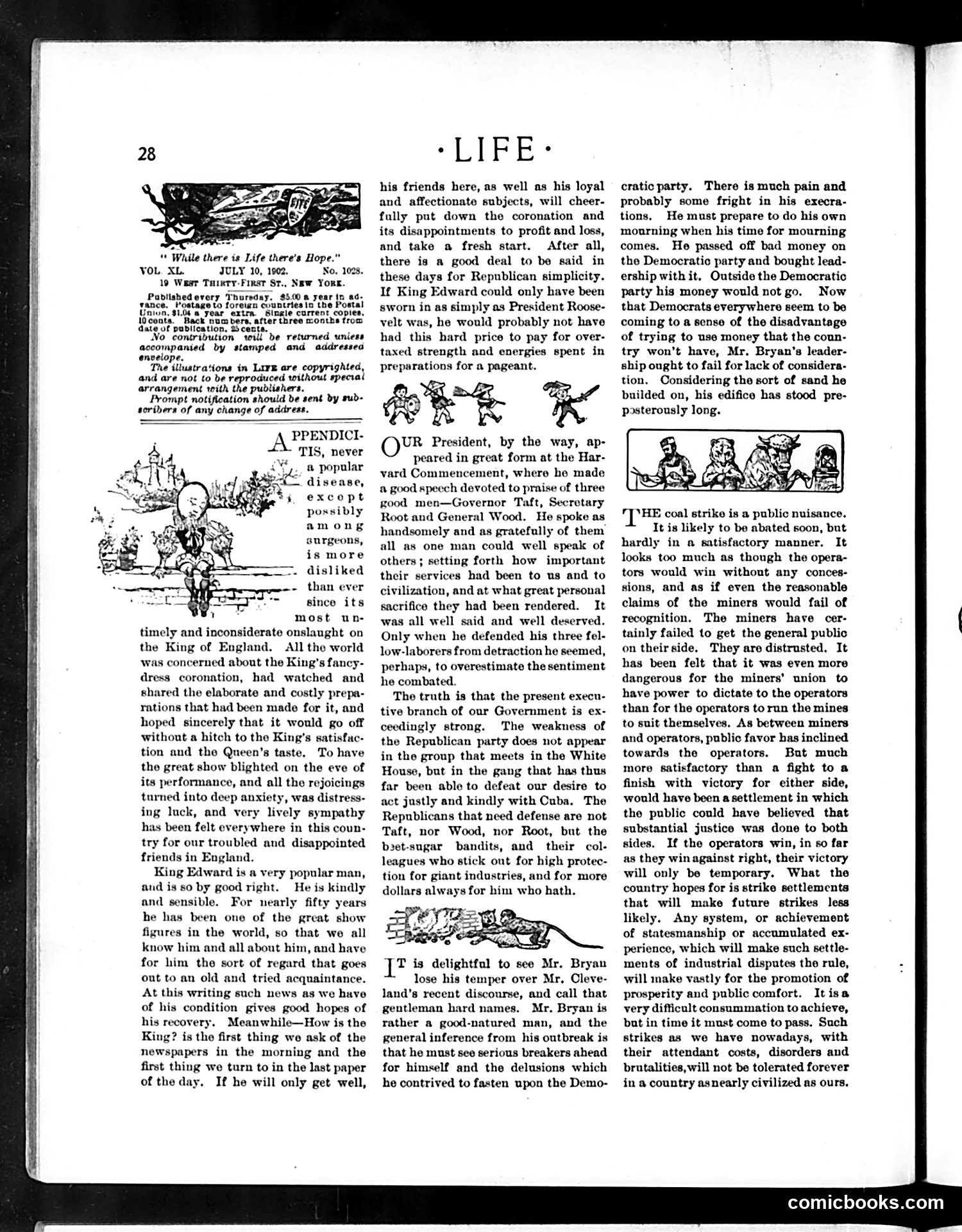
The page's main cartoon depicts **King Edward VII**, shown as a caricatured figure surrounded by symbolic imagery. The accompanying text discusses Edward's popularity and his "hard price to pay" regarding expensive coronation preparations. The satire critiques **Republican political strategy**: the piece argues Republicans underestimated Edward's personal appeal and failed to capitalize on coronation disappointments. It also addresses contemporary labor unrest—specifically a **coal strike**—suggesting public sympathy lies with miners rather than operators, and warning that unresolved industrial disputes pose dangers to the nation. The cartoon mocks Republican miscalculation while simultaneously cautioning that social instability from labor conflicts threatens national stability. The tone is cautiously nationalist.
📄 Transcribed text from this page (OCR, searchable)
Machine-transcribed from the original scan — historical spelling and the odd misread are preserved.
“« While there is Life there's Hope.” VOL. XL. JULY 10, 1902, No, 1028. 19 Waar Taixty-First St., New Yore. Published every 7 bureday. $5.00 a year in Vostage to foreign countries in the Pos rear extra. Single current copies. ipcoute Back num bers, after three months from date of publication, Scents. No contribution toil be returned uniess accompanied by stamped and addressea envelope. The illustrations in Lire are copyrighted, and are not to be reproduced without special arrangement with the publishers. Prompt notification should be sent by sub- soribers of any change of address. PPENDICI- TIS, never *,.. & popular — disease, excopt possibly among surgeons, is more disliked than ever since its most un- timely and inconsiderate onslaught on the King of England. All the world was concerned about the King’s fancy- dress coronation, had watched and shared the elaborate and costly prepa- rations that had been made for it, and hoped sincerely that it would go off without a hitch to the King’s satisfac- tion and the Queen’s taste. To have the great show blighted on the eve of its performance, and all the rejoicings turned into deep anxiety, was distress- ing luck, and very lively sympathy has been felt everywhere in this coun- try for our troubled and disappointed friends in England. King Edward is a very popular man, and is so by good right. He is kindly and sensible. For nearly fifty years he has been one of the great show figures in the world, so that we all know him and all about him, and have for him the sort of regard that goes out to an old and tried acquaintance. At this writing such news as we have of his condition gives good hopes of his recovery. Meanwhile—How is the King? is the first thing we ask of the newspapers in the morning and the first thing we turn to in the last paper of the day. If he will only get well, LIFE his friends here, as well as his loyal and affectionate subjects, will cheer- fully put down the coronation and its disappointments to profit and loss, and take a fresh start. After all, there is a good deal to be said in these days for Republican simplicity. If King Edward could only have been sworn in as simply as President Roose- velt was, he would probably not have had this hard price to pay for over- taxed strength and energies spent in preparations for a pageant. GRR K UR President, by the way, ap- peared in great form at the Har- vard Commencement, where he made a good speech devoted to praise of three good men—Governor Taft, Secretary Root and General Wood. He spoke as handsomely and as gratefully of them all as one man could well speak of others; setting forth how important their services had been to us and to civilization, and at what great personal sacrifice they had been rendered. It was all well said and well deserved. Only when he defended his three fel- low-laborers from detraction he seemed, perhaps, to overestimate the sentiment he combated. The truth is that the present execu- tive branch of our Government is ex- ceedingly strong. The weakness of the Republican party does not appear in the group that meets in the White House, but in the gang that has thus far been able to defeat our desire to act justly and kindly with Cuba. The Republicans that need defense are not Taft, nor Wood, nor Root, but the boet-sugar bandits, and their col- leagues who stick out for high protec- tion for giant industries, and for more dollars always for him who hath. T7T is delightfal to see Mr. Bryan lose his temper over Mr. Cleve- land’s recent discourse, and call that gentleman hard names. Mr. Bryan is rather a good-natured man, and the general inference from his outbreak is that he must see serious breakers ahead for himself and the delusions which he contrived to fasten upon the Demo- cratic party. There is much pain and probably some fright in his execra- tions, He must prepare to do his own mourning when his time for mourning comes. He passed off bad money on the Democratic party and bought lead- ership with it, Outside the Democratic party his money would not go. Now that Democrats everywhere seem to be coming to a sense of the disadvantage of trying to use money that the coun- try won't have, Mr. Bryan's leader- ship onght to fail for lack of considera- tion. Considering the sort of sand he builded on, his edifice has stood pre- posterously long. [T= coal strike is a public nuisance. It is likely to be abated soon, but hardly in a satisfactory manner. It looks too much as though the opera- tors would win without any conces- sions, and as if even the reasonable claims of the miners would fail of recognition. The miners have cer- tainly failed to get the general public on theirside. They are distrusted. It has been felt that it was even more dangerous for the miners’ union to have power to dictate to the operators than for the operators to run the mines to suit themselves. As between miners and operators, public favor has inclined towards the operators. Bat much more satisfactory than a fight to a finish with victory for either side, would have been a settlement in which the public could have believed that substantial justice was done to both sides. If the operators win, in so far as they win against right, their victory will only be temporary. What the country hopes for is strike settlements that will make future strikes less likely, Any system, or achievement of statesmanship or accumulated ex- perience, which will make such settle- ments of industrial disputes the rule, will make vastly for the promotion of prosperity and public comfort. It isa very difficult consummation to achieve, but in time it must come to pass. Such strikes as we have nowadays, with their attendant costs, disorders and brutalities, will not be tolerated forever in a country asnearly civilized as ours, comicbooks.com