
Life, 1902-07-10 · page 12 of 18
Life — July 10, 1902 — page 12: what you’re looking at
What you’re looking at
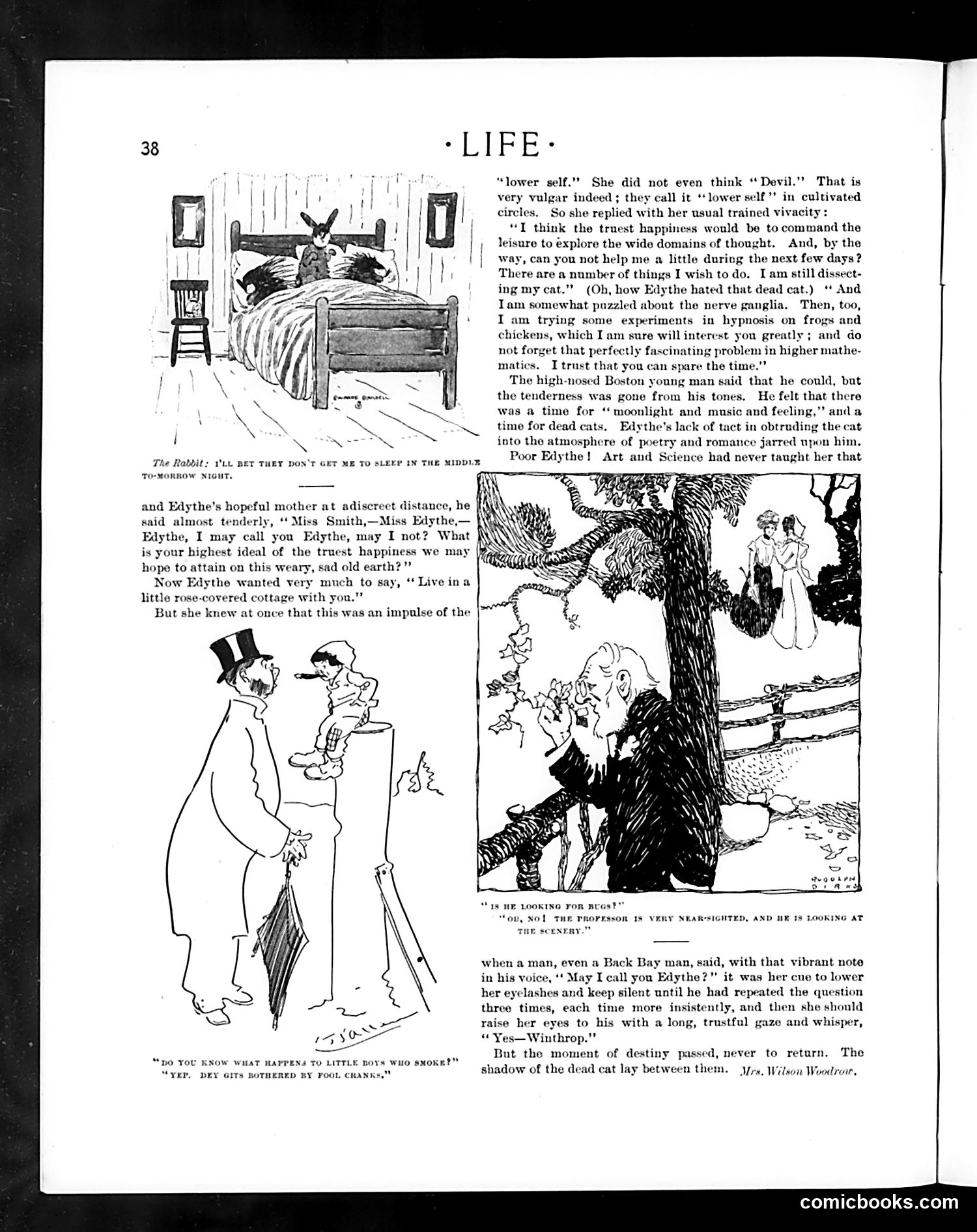
This page contains three separate satirical cartoons: 1. **"The Rabbit"** (top): Shows a rabbit in bed, satirizing someone's excuse-making about sleep disruption. 2. **"Do you know what happens to little boys who smoke?"** (bottom left): Depicts an adult warning a child about smoking, with the caption noting the child's feet are bothered by "fool cramps"—mocking both parental warnings and children's behavior. 3. **"Is he looking for bugs?"** (right): Shows an elderly man examining a tree while children watch. The caption notes "the professor is very near-sighted, and he is looking at the scenery"—a joke about mistaken observations and the gap between appearance and reality. These are gentle, domestic humor pieces typical of Life's satirical style, poking fun at everyday social situations rather than specific political targets.
📄 Transcribed text from this page (OCR, searchable)
Machine-transcribed from the original scan — historical spelling and the odd misread are preserved.
* LIFE = “lower self." She did not even think ‘ Devil.’’ That is very vulgar indeed ; they call it “lower self” in cultivated circles. So she replied with her usual trained vivacity: “I think the truest happiness would be to command the leisure to explore the wide domains of thought. And, by the way, can you not help me a little during the next few days? There are a number of things I wish to do. Iam still dissect- ing my cat.’ (Oh, how Edythe hated that dead cat.) ‘¢ And Tam somewhat puzzled about the nerve ganglia. Then, too, I am trying some experiments in hypnosis on frogs and chickens, which I am sure will interest you greatly ; and do not forget that perfectly fascinating problem in higher mathe- matics. I trust that you can spare the time.” The high-nosed Boston young man said that he could, but the tenderness was gone from his tones. He felt that there was a time for ‘moonlight and music and feeling,” and a time for dead cats. Edythe’s lack of tact in obtruding the cat into the atmosphere of poetry and romance jarred upon him. Poor Edythe! Art and Science had never taught her that TO-MORROW NIGUT. and Edythe’s hopeful mother at adiscrect distance, he said almost tenderly, “Miss Smith,—Miss Edythe,— Edythe, I may call you Edythe, may I not? What is your highest ideal of the truest happiness we may hope to attain on this weary, sad old earth?” Now Edythe wanted very much to say, ‘ Live ina little rose-covered cottage with you.” But she knew at once that this was an impulse of the “1s WE LOOKING “ou, NOL THE PROFESSOR 18 VERY NEARSIGUTED, AND ME 18 LOOKING AT m sceNeny.”* when a man, even a Back Bay man, said, with that vibrant note in his voice, ‘‘ May I call you Edythe?” it was her cue to lower her eyelashes and keep silent until he had repeated the question three times, each time more insistently, and then she should raise her eyes to his with a long, trustful gaze and whisper, “ Yes—Winthrop.”” But the moment of destiny passed, never to return. The “po You KNow w PPENS TC a4 # WHO ie tia sunnnia shadow of the dead cat lay between them. fr, Wilson Woodrow. “YEP, DEY GITs BOTHERED BY YooL cKAD comicbooks.com