
A complete issue · 24 pages · 1902
Life — July 3, 1902
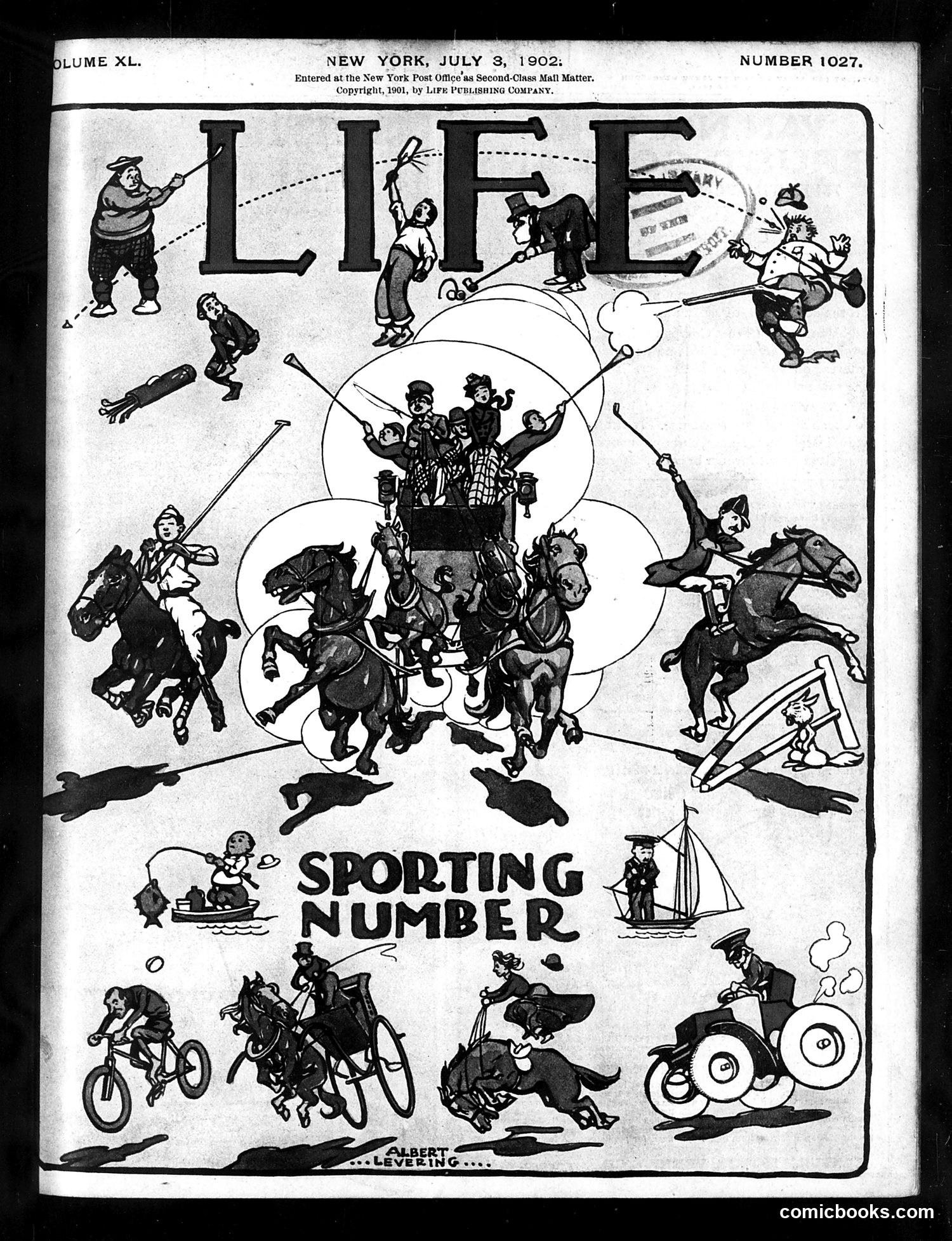
This is a cover for *Life*'s "Sporting Number" issue, celebrating various athletic and recreational pursuits. The central image shows a large hot-air balloon carrying multiple figures, surrounded by smaller vignettes depicting different sports and activities: horseback riding, cycling, polo, rowing, sailing, and automobiles. The balloon likely represents aspirational leisure and entertainment—the "life" of sport elevating society upward. The diverse sporting activities illustrated reflect turn-of-the-century pastimes enjoyed by the wealthy and middle class. This was the Edwardian era when sports were becoming increasingly popular spectacles and recreational pursuits for Americans. The cartoonish style and exaggerated figures are typical of *Life*'s satirical approach to contemporary culture, poking gentle fun at society's sporting obsessions.
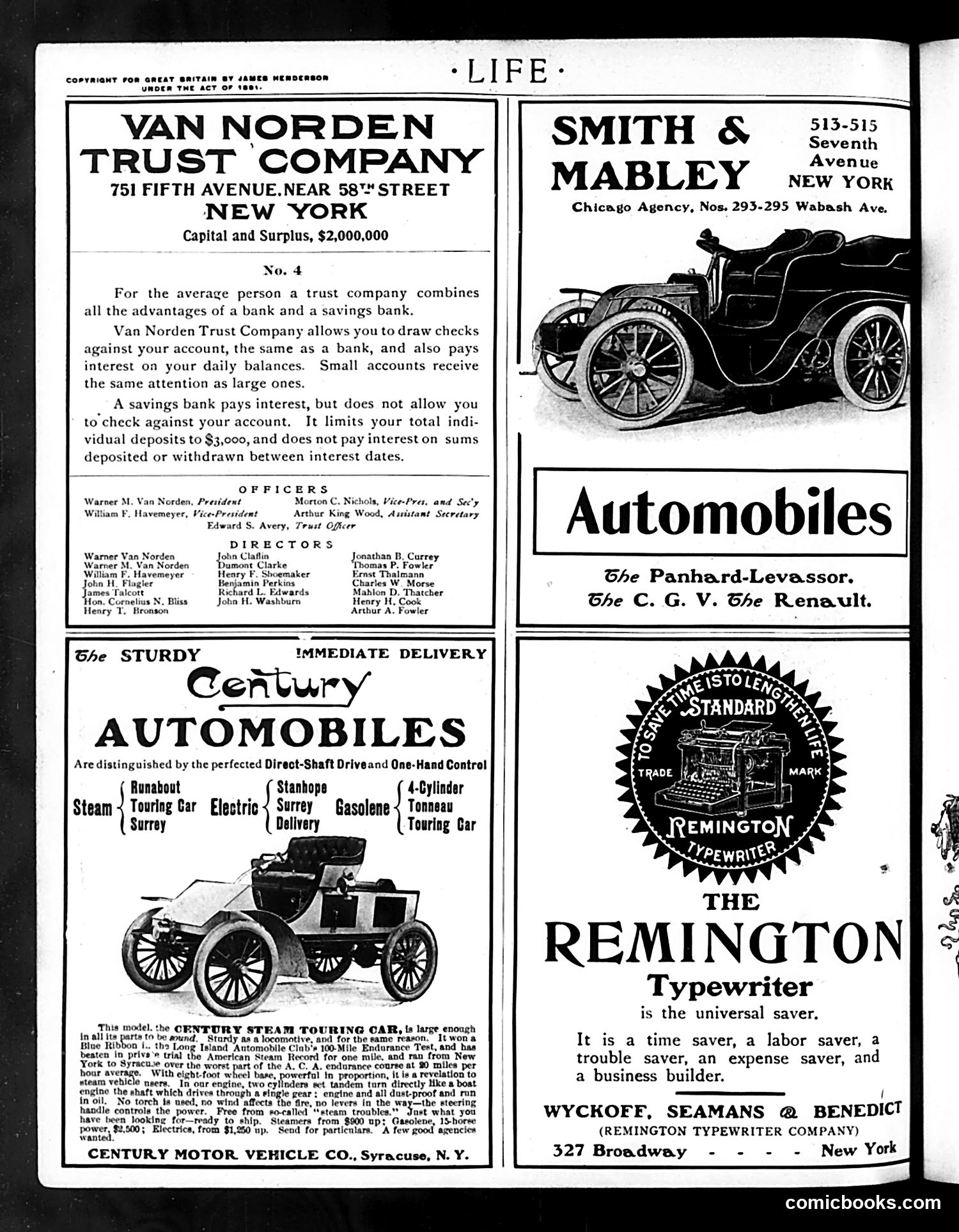
This page contains **no political cartoons or satirical content**. It consists entirely of **advertisements** from the early 1900s: - **Van Norden Trust Company** (banking services) - **Smith & Mabley** (automobiles: Panhard-Levassor, C.G.V., Renault) - **Century Automobiles** (steam, electric, and gasoline vehicles) - **Remington Typewriter** (marketed as a "universal saver") The ads reflect the era's emerging technologies: automobiles are prominently featured alongside traditional steam and electric vehicles, while typewriters represent office modernization. The design and product offerings are historically interesting but contain no satire or political commentary to interpret.
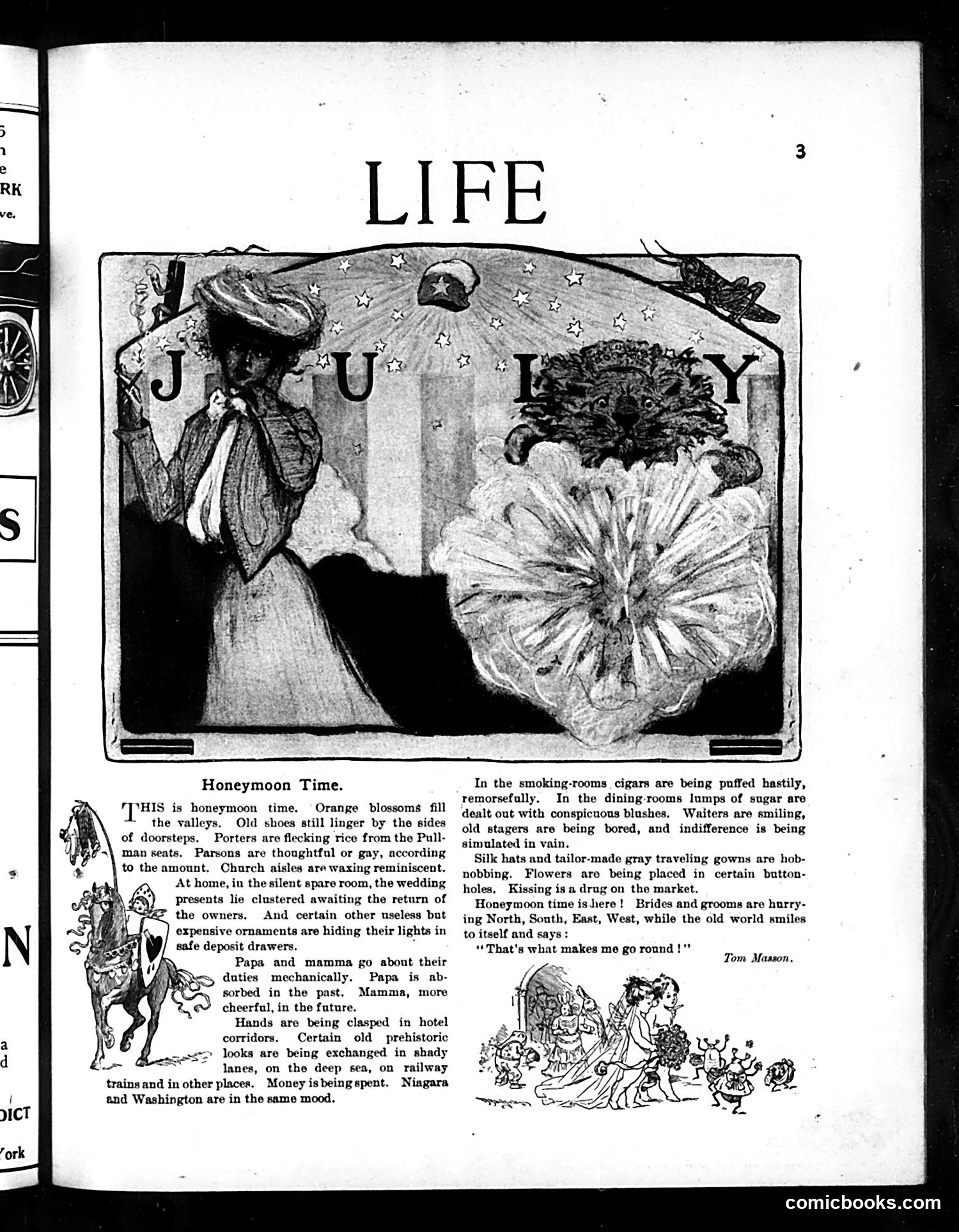
This satirical piece critiques honeymoon culture and post-wedding social dynamics during the early 1900s. The illustration depicts a bride and groom amid romantic imagery (flowers, stars, cherubs). The text mocks the honeymoon experience with sharp observations: newlyweds hurry through tourist destinations while the wider world continues indifferently. It satirizes the mechanical behavior of "Papa and Mamma," outdated social customs (old books being exchanged), and conspicuous consumption—silk hats, tailored gowns, expensive travel to Niagara Falls and Washington. The piece targets the artificiality of honeymoon performances: couples performing happiness for society while engaging in predictable, unoriginal rituals. The final quote ("That's what makes me go round!") suggests cynicism about marriage's true motivations beneath romantic pretense.
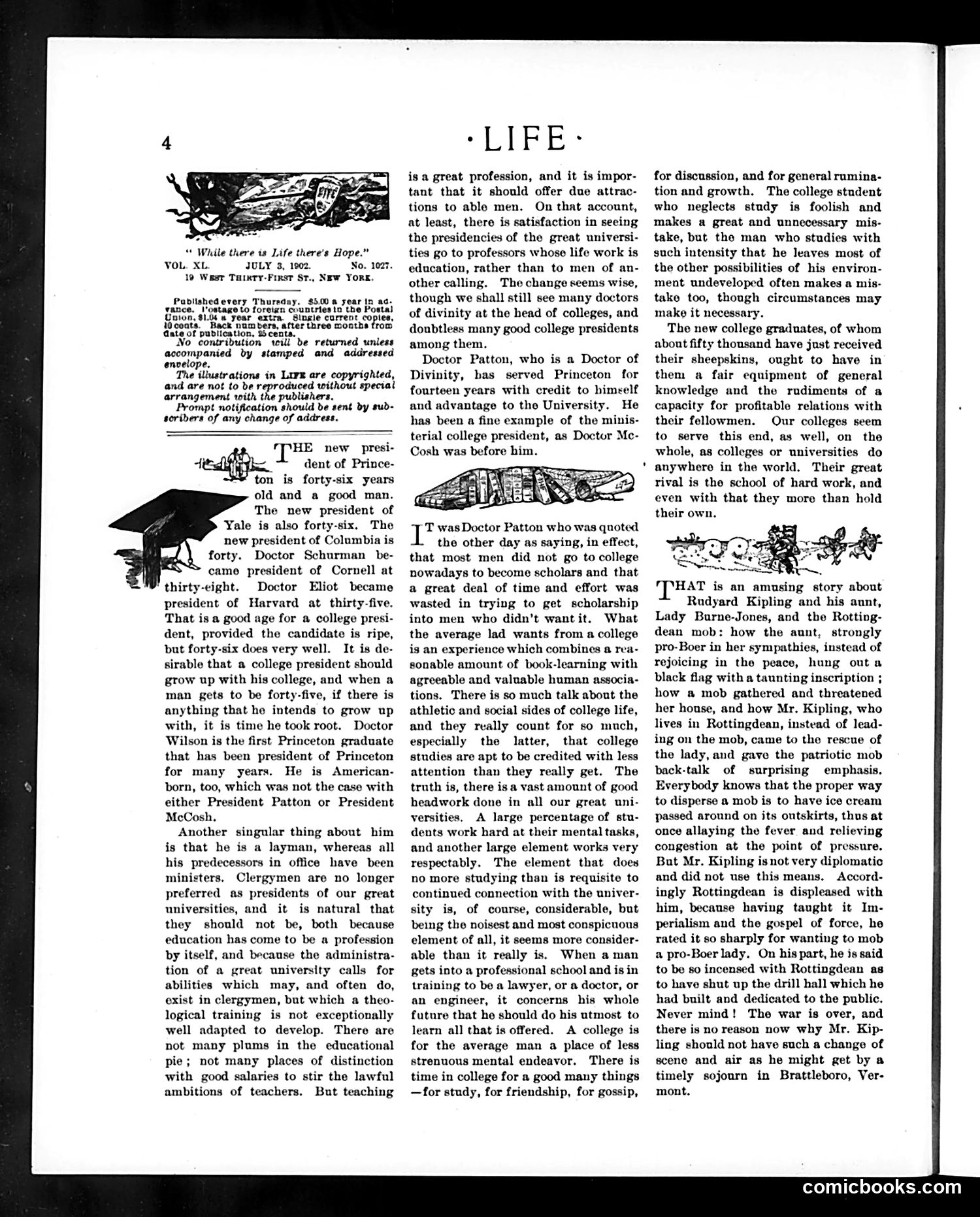
This page contains an editorial essay titled "While there is Life there's Hope" discussing American college leadership, illustrated with small decorative woodcuts rather than political cartoons. The text critiques the appointment of forty-six-year-old Doctor Patton as Princeton's new president, comparing him favorably to other university leaders like those at Yale and Columbia. The author argues that college presidencies should go to laymen rather than clergy, as previous presidents like McCosh were. The piece advocates that colleges should combine rigorous academics with practical human development, suggesting that too much emphasis on purely scholarly pursuits misses the broader educational mission. The brief anecdote about Rudyard Kipling and a "pro-Boer" incident illustrates tensions between institutional reputation and individual conscience during the Boer War era.
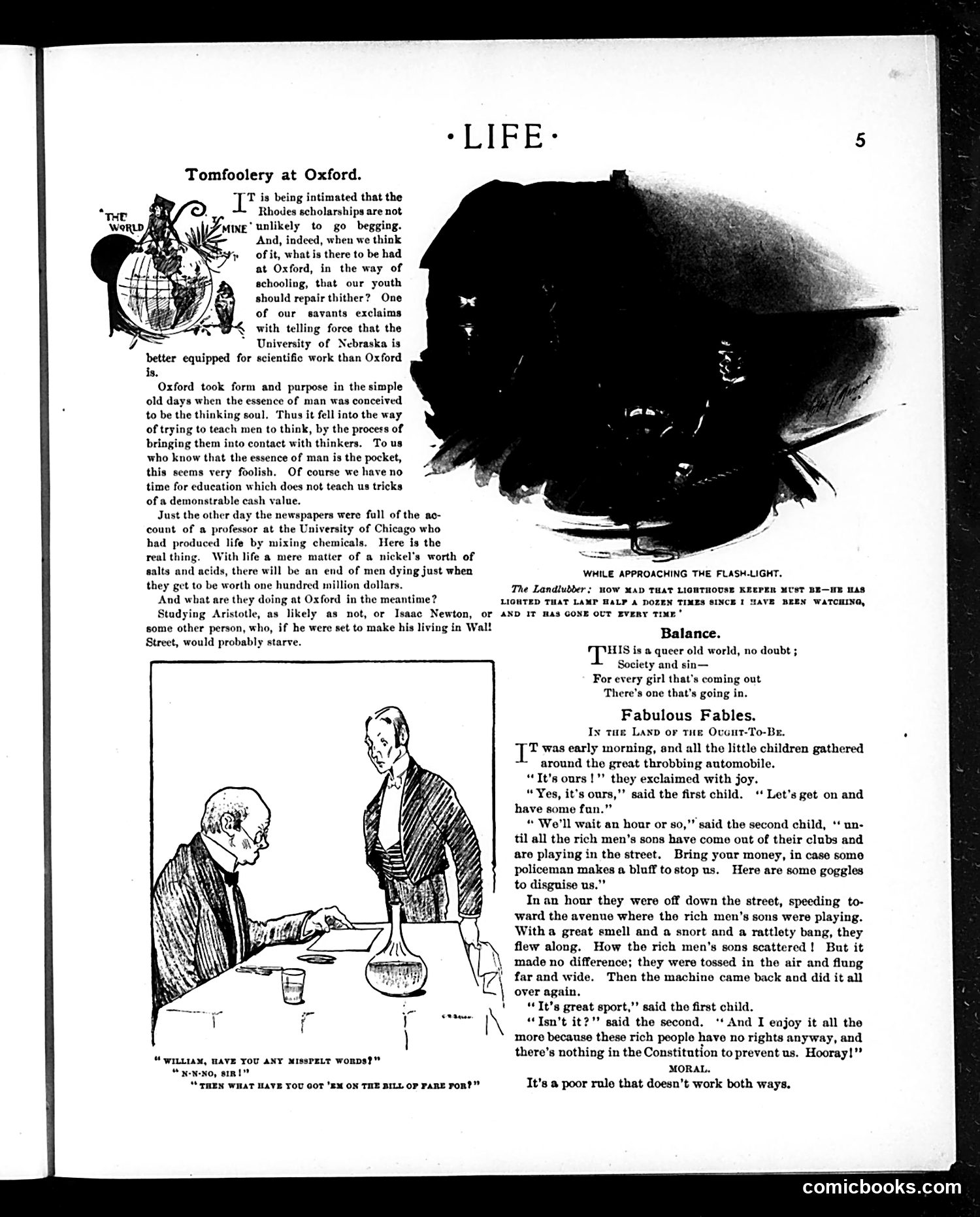
This page contains three distinct satirical pieces: 1. **"Tomfoolery at Oxford"**: Mocks Oxford University as outdated, contrasting it unfavorably with the University of Nebraska. The satire suggests Oxford emphasizes abstract thinking over practical knowledge—a dig at classical education as impractical for modern life. 2. **The cartoon below**: Shows two men in what appears to be a financial dispute. The dialogue references "miserly words" and "the bill of fare," suggesting satire about monetary disagreements or financial dishonesty. 3. **"Fabulous Fables"**: A brief story mocking wealthy people. Children find a rich man's automobile and repeatedly steal its contents while he's distracted. The moral criticizes wealth inequality: "It's a poor rule that doesn't work both ways." The overall theme critiques class privilege and impracticality in society.
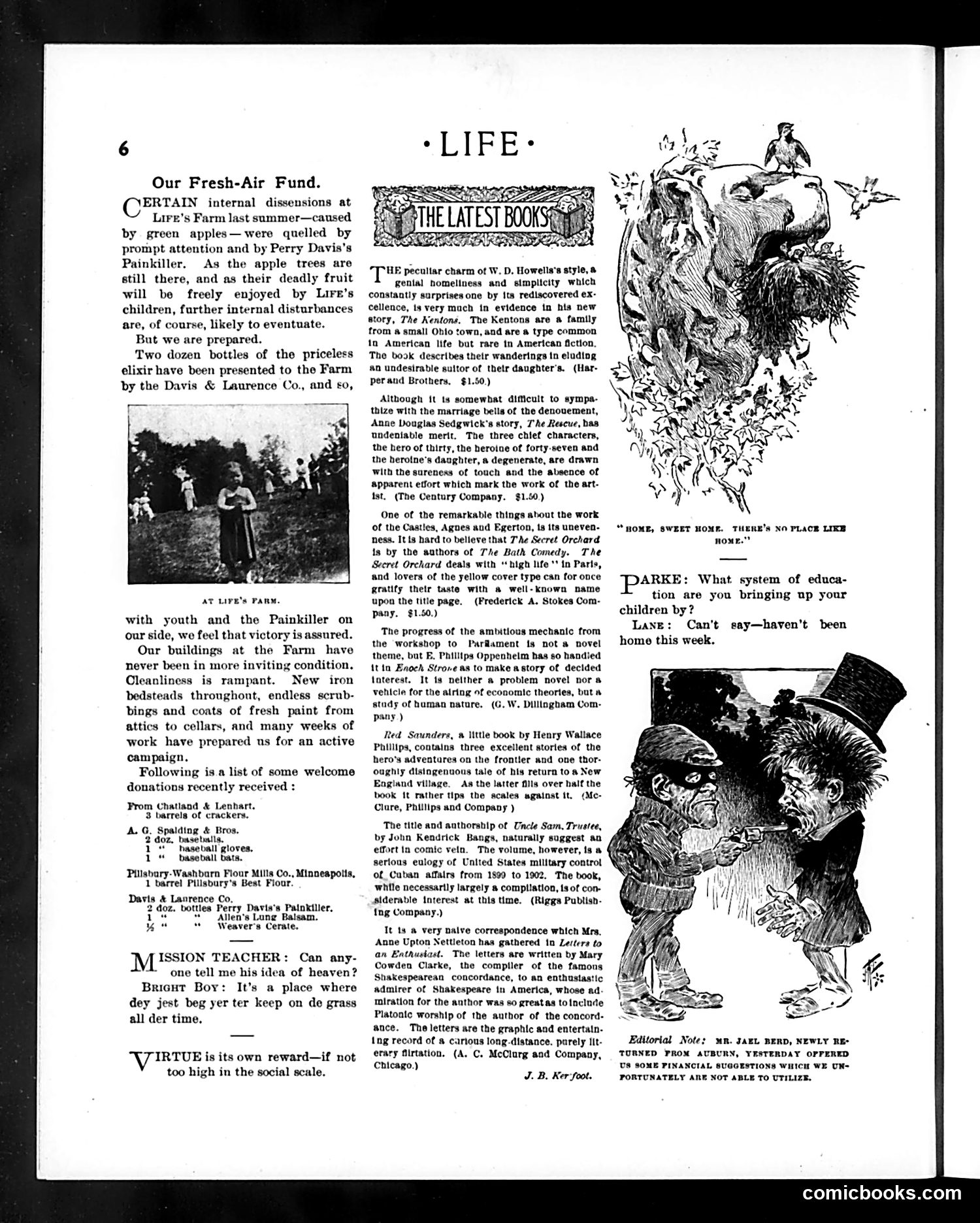
This page combines a farm feature with book reviews and a brief satirical dialogue. The main left image shows people at "Life's Farm," illustrating an article about the magazine's property and fresh-air initiative for children. The right side features a dialogue labeled "HOME, SWEET HOME" between characters "Darke" and "Lane," apparently satirizing domestic life—specifically a husband asking about children's education while the wife hasn't even been home that week. The joke hinges on marital discord and neglected domestic responsibilities. The page primarily serves as a book review section ("The Latest Books") rather than political commentary, discussing recent publications by W.D. Howells and other authors. The satirical content is mild social observation about marriage and parenting rather than political critique.
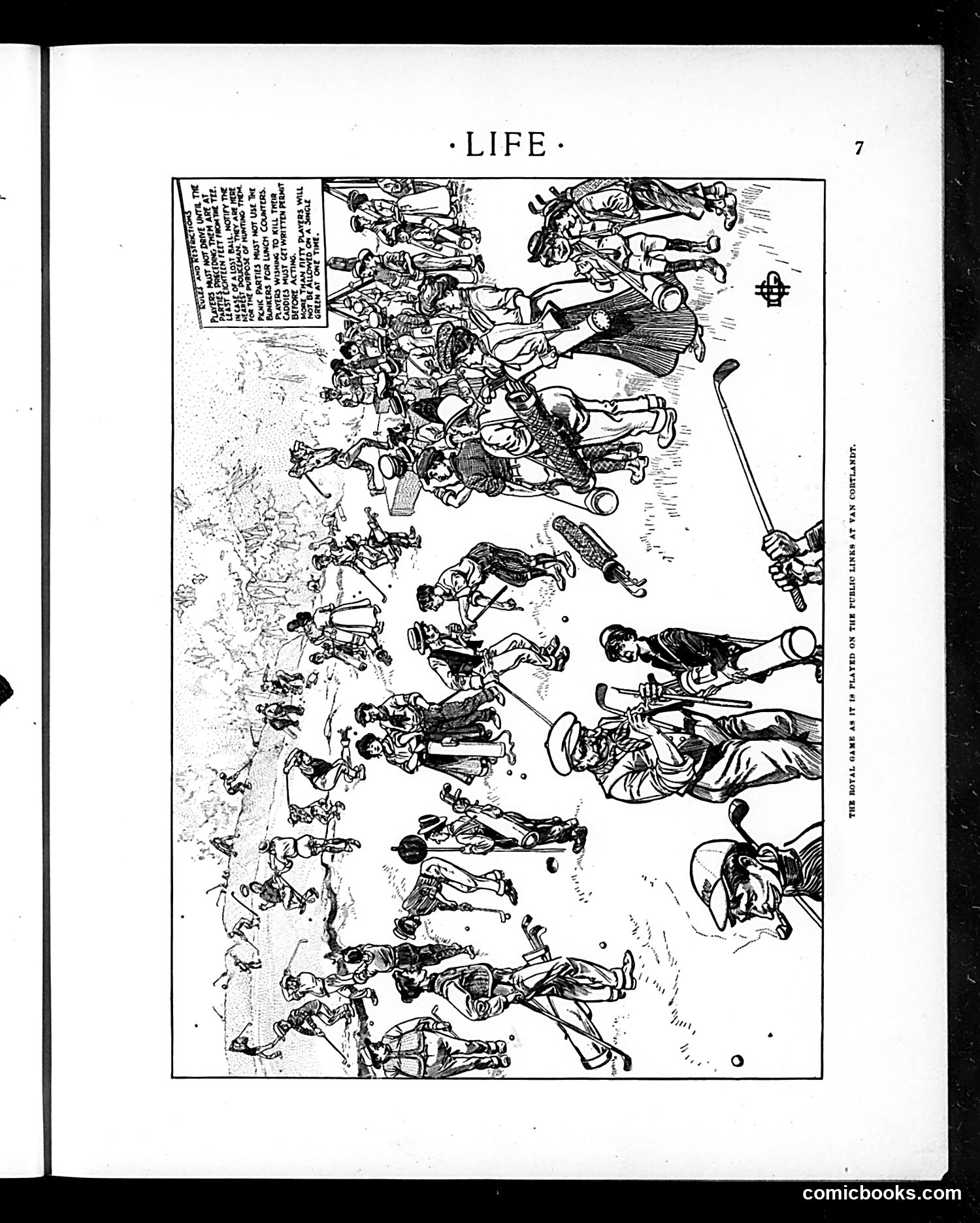
This page from *Life* magazine appears to be a satirical illustration showing a chaotic baseball or sporting scene viewed from above. The image depicts numerous figures in dynamic poses—some playing, some falling, some engaged in various physical activities—arranged across a field or ground space. The small text box in the upper left likely provides context or commentary, though it's not clearly legible in this reproduction. The composition suggests social satire about American leisure activities or sports culture, a common *Life* magazine subject. The cartoonist uses exaggerated poses and crowded composition to create comedic effect, possibly critiquing the chaos, competitiveness, or excess associated with popular American pastimes. The specific political or social target remains unclear without legible accompanying text.
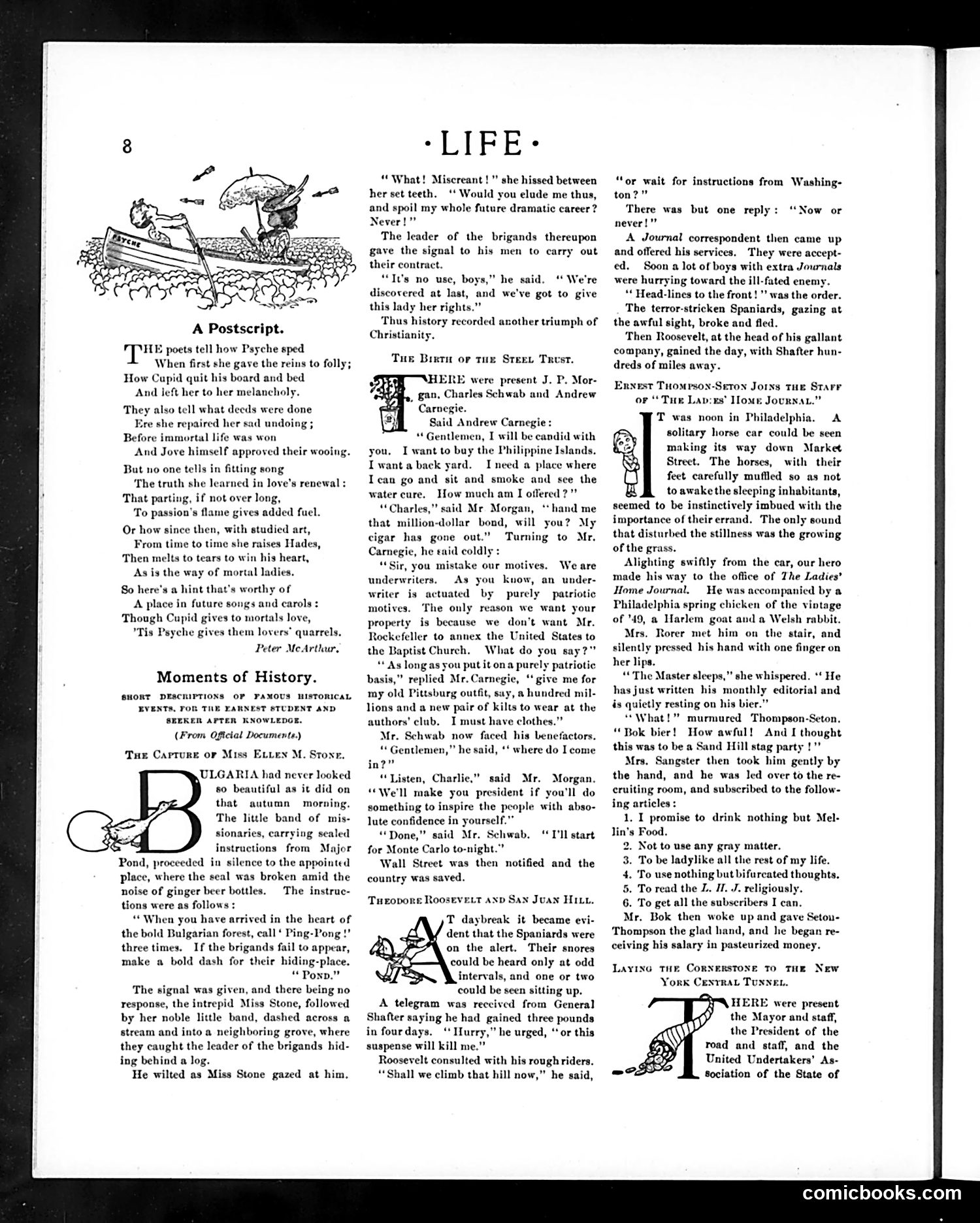
This page contains literary content rather than political satire. "A Postscript" is a poem about Psyche from classical mythology, describing her journey and the revelation that "passion's flame gives added fuel" to love. The "Moments of History" section presents anecdotes about historical events, including "The Capture of Miss Elles M. Stowe" and accounts involving Theodore Roosevelt and San Juan Hill. These appear to be humorous retellings rather than satirical commentary. The right column contains several brief items, including advertisements for subscriptions and pledges to avoid "bifurcated thoughts" and use gray matter responsibly. The page functions primarily as literary and historical content rather than satirical cartooning, featuring decorative illustrations but no clear political commentary.
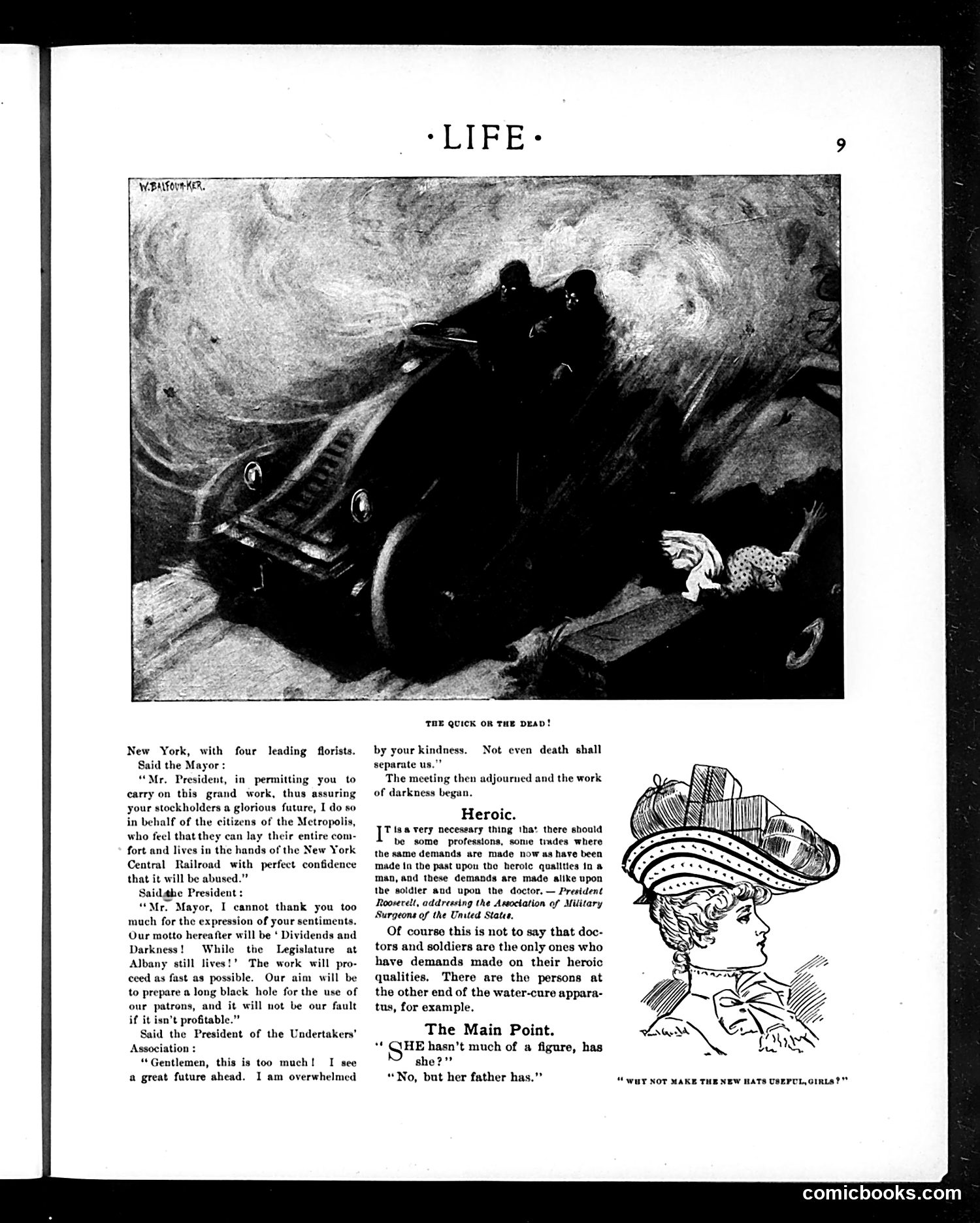
The main illustration shows two figures in a dark, cavernous space labeled "THE QUICK OR THE DEAD!" This appears to be a political cartoon addressing New York infrastructure, specifically a subway or tunnel project. The accompanying text quotes Mayor and President discussing a major public works initiative. The Mayor expresses confidence in the project's success and its economic benefits ("Dividends and Darkness!"). The President responds that the undertaking is overwhelming but necessary. The satirical point critiques the grandiose promises made around this infrastructure project—likely New York's early subway system—while the dark, shadowy illustration suggests the "darkness" and uncertainty surrounding both the literal tunnel work and the questionable financial outcomes being promised to citizens and stockholders. The right side contains unrelated content: a fashion illustration and a brief joke about hats.
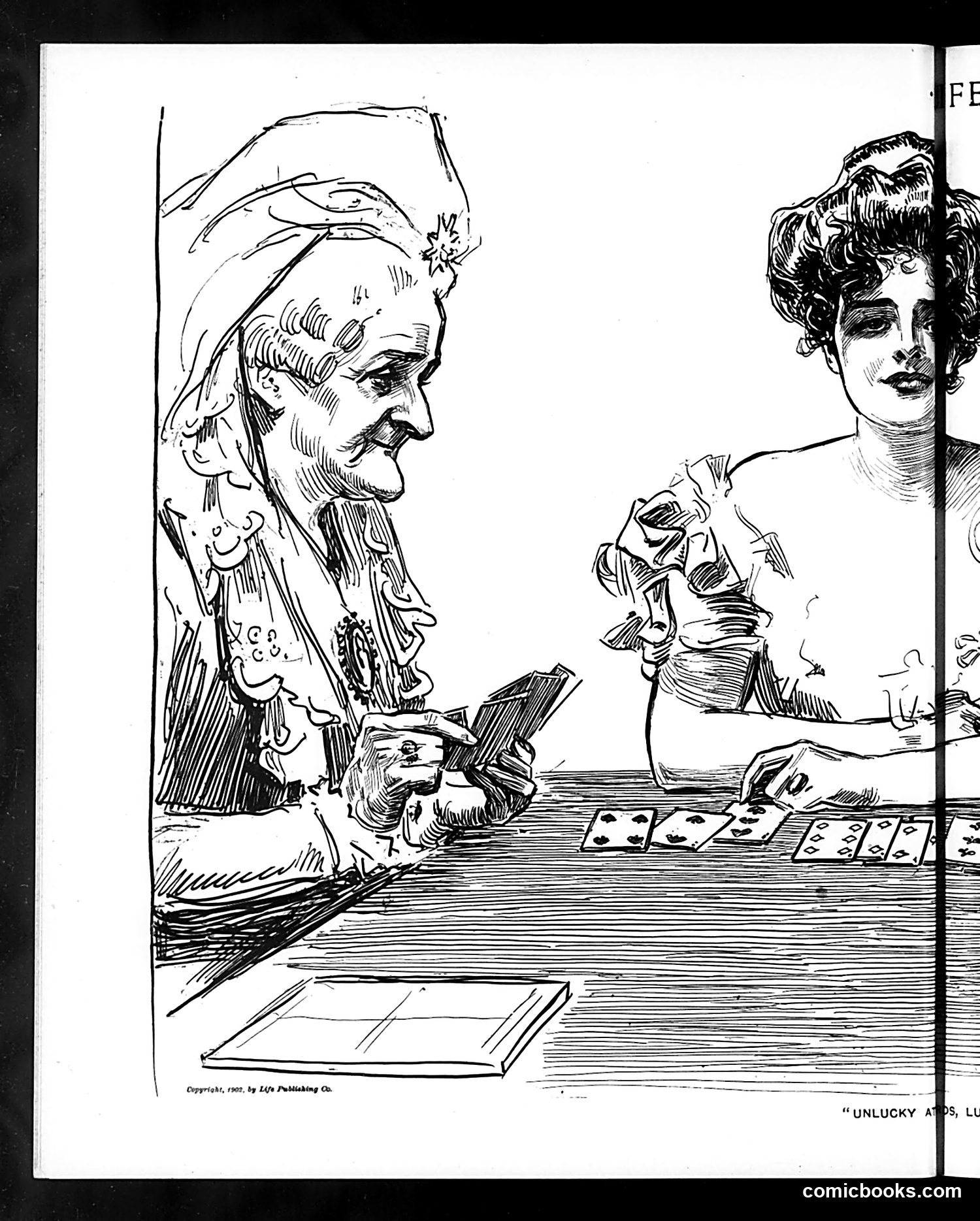
This appears to be a Life magazine cartoon titled "Unlucky at..., Lu[cky at...]" (the full title is cut off). The image shows two figures playing cards at a table. On the left is an elderly man wearing 18th-century clothing with a tricorn hat and period coat—likely a historical or allegorical figure representing something from the past. On the right is a modern woman in 1920s dress. Between them are playing cards spread on the table. The satirical point seems to contrast old and new, or past and present approaches to chance and fortune. Without the complete caption, the specific social or political commentary remains unclear, though it likely comments on changing attitudes or luck across generations during the early 20th century.
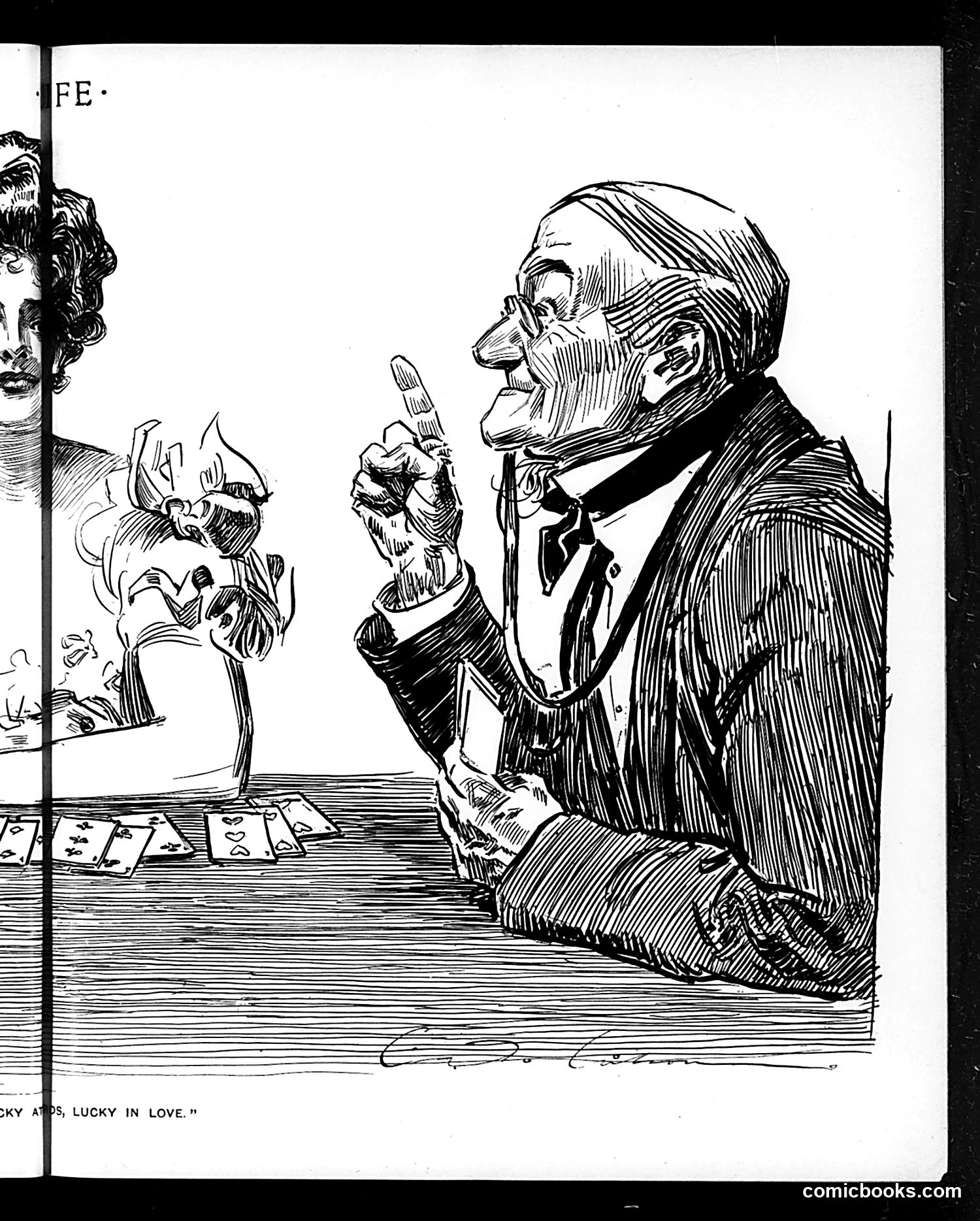
This appears to be a satirical cartoon about gambling and romance. A well-dressed man in formal attire sits at a card table, holding playing cards and what looks like a knife or card-cutting tool. He's gazing at a woman's portrait or image on the left side of the frame. The visible text fragment reads "...KY AT [?], LUCKY IN LOVE," suggesting a play on the old saying "lucky at cards, unlucky in love" (or vice versa). The cartoon inverts this traditional wisdom—the gambler appears to be both successful at cards AND romantically successful, as evidenced by his admiring gaze at the woman's image. The satire likely mocks the idea that a charming or successful man could excel in multiple pursuits simultaneously.
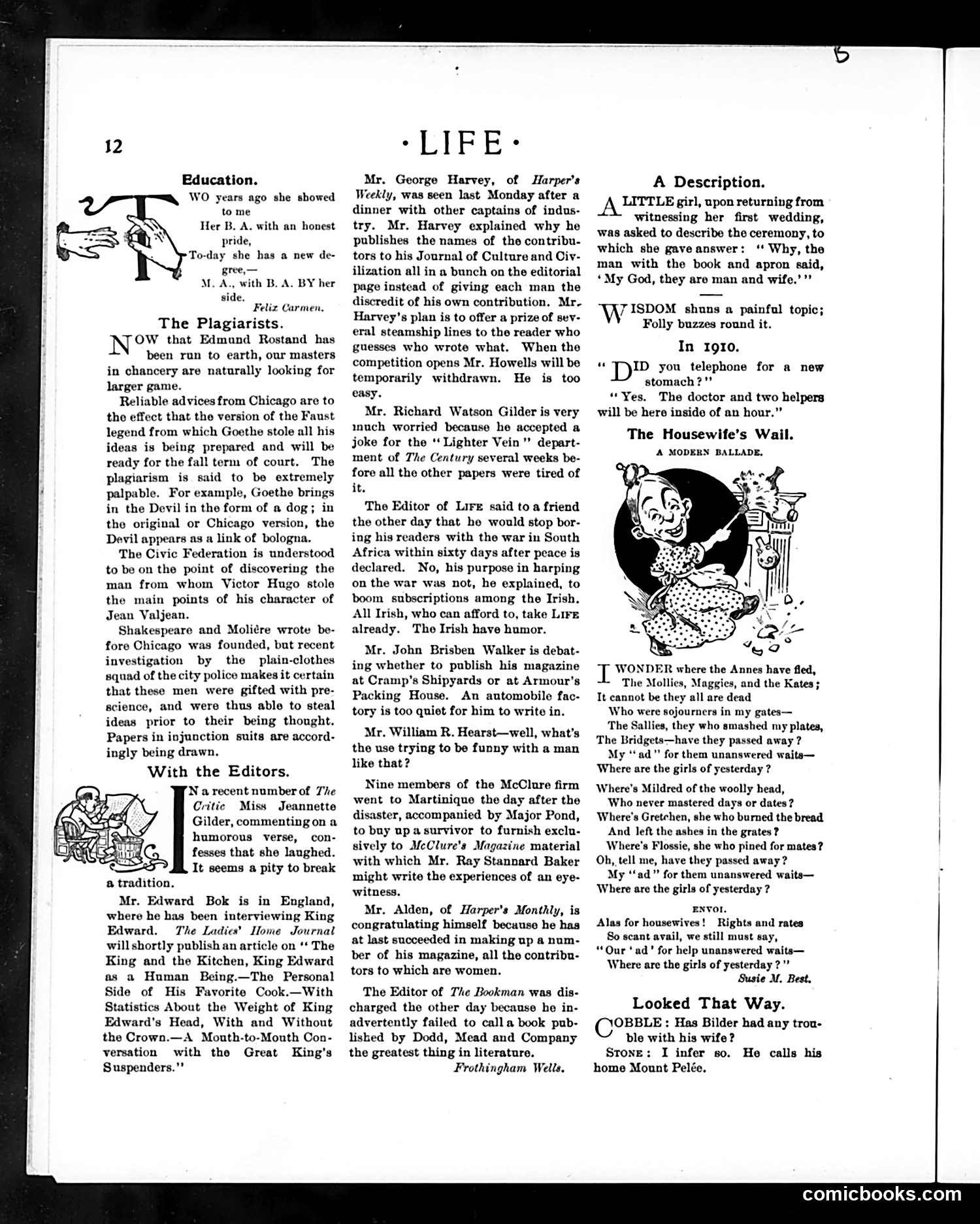
This page contains editorial commentary and light satirical pieces rather than political cartoons. The main sections include: **"The Plagiarists"** mocks various editors and writers for allegedly borrowing ideas—notably mentioning Goethe's concepts appearing in Chicago publications, and references to Victor Hugo and Jean Valjean. **"With the Editors"** features a small illustration showing editors discussing magazine content, including anecdotes about Harper's Weekly, The Century, and other publications' editorial decisions. **"The Housewife's Wail"** is a humorous modern ballad with accompanying illustration depicting a frustrated housewife, likely satirizing domestic labor and the emerging consumer culture of the era. **"Looked That Way"** is a brief joke about a character named Hobble and his wife. The overall tone is gossipy, focused on media industry personalities and domestic humor rather than hard political satire.
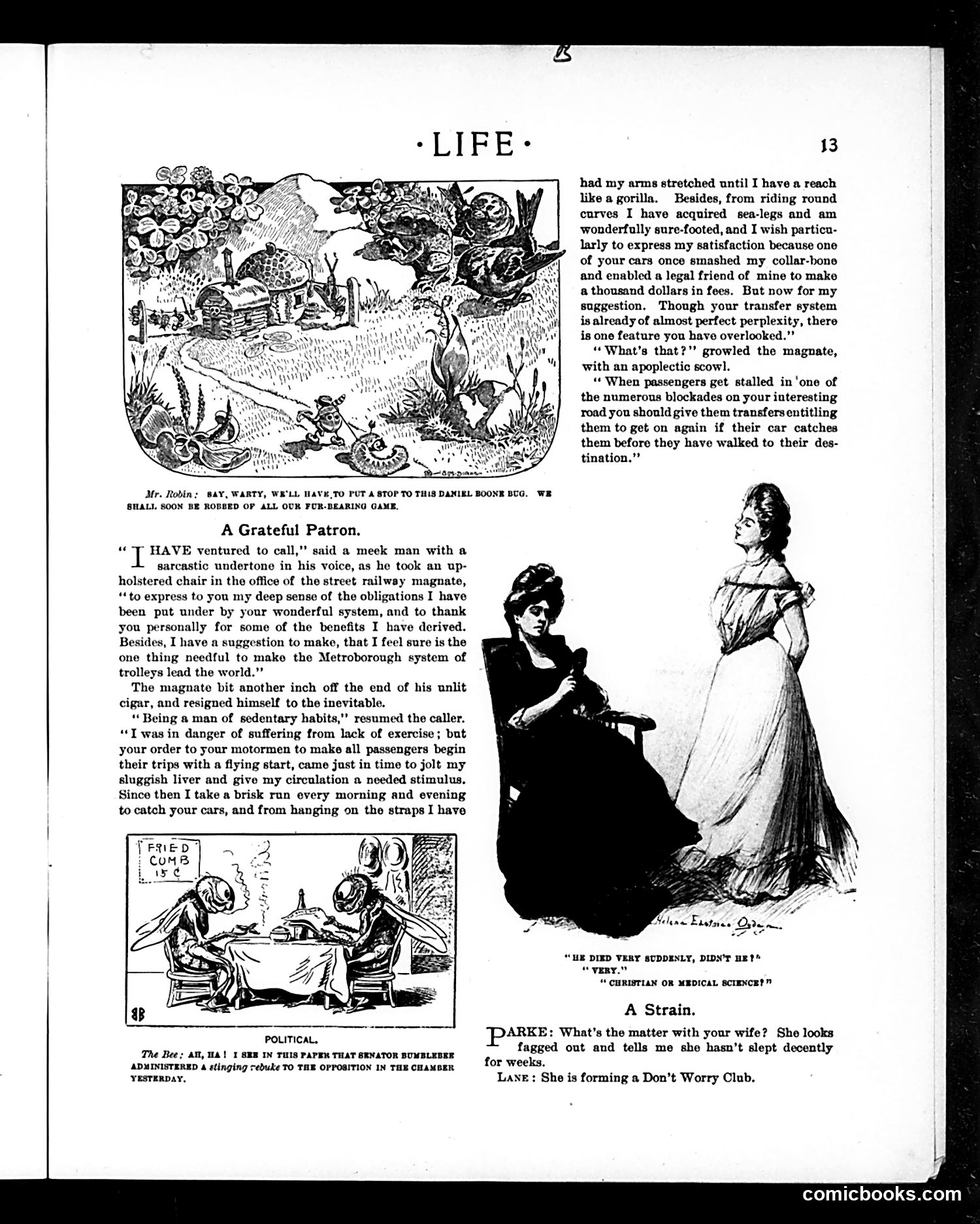
This page from *Life* magazine contains satirical commentary on early 20th-century urban transit systems, specifically streetcar/trolley services. **"A Grateful Patron"** mocks a transit company magnate through heavy irony. A passenger sarcastically "thanks" him for forcing commuters to physically exert themselves—running to catch cars and hanging onto straps—which the passenger frames as beneficial exercise. The joke critiques the company's poor service: deliberately fast starts that require passengers to sprint, inadequate transfer systems, and frequent breakdowns ("blockades"). The passenger's "suggestion" about transfers is delivered with mock deference to an obviously incompetent executive. **The Political cartoon** (bottom left) references Senator Bumblebee administering a "stinging rebuke," a pun on the bee's nature. **"A Strain"** is a brief joke about a wife who hasn't slept decently and is forming a "Don't Worry Club"—likely satirizing the contemporary self-help movement or women's social clubs. The overall tone criticizes public transportation mismanagement while mocking both the arrogant corporate executives running it and the resigned public forced to endure it.
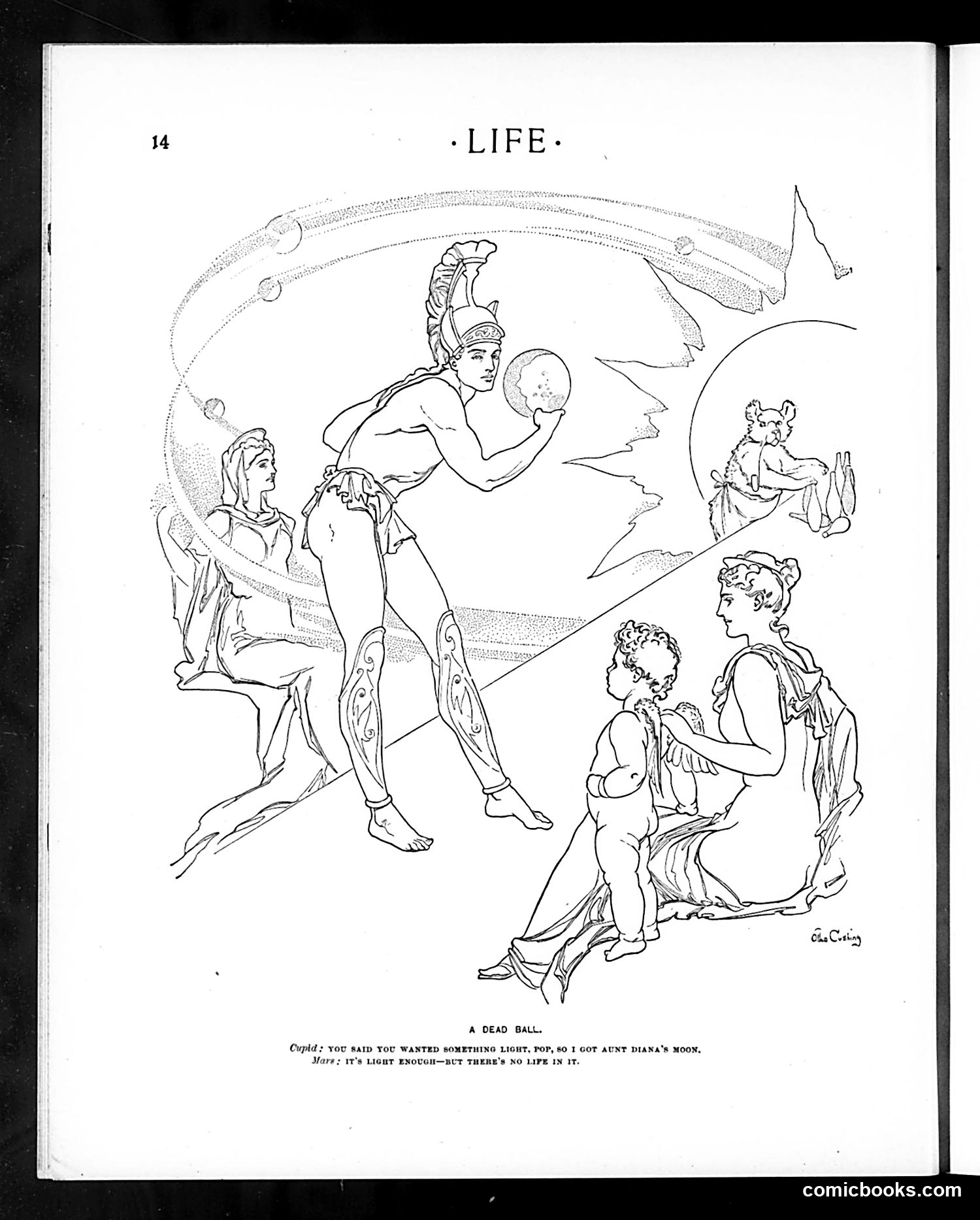
This satirical cartoon depicts classical mythological figures examining what appears to be a lifeless celestial sphere. The title "A Dead Ball" plays on a pun involving astronomy and vitality. The dialogue references "Aunt Diana's moon" and light, suggesting the cartoon critiques something lacking in substance or "life." The figures—appearing to be classical deities or allegorical characters—represent the artistic/intellectual establishment examining something they expected to be vital but found inert. Without the specific publication date visible, the precise target remains unclear, but this appears to mock either a scientific discovery, a cultural product, or perhaps a failed artistic/literary work that disappointed expectations. The classical artistic style and mythological framing was typical of *Life*'s sophisticated satirical approach to contemporary intellectual and cultural topics.
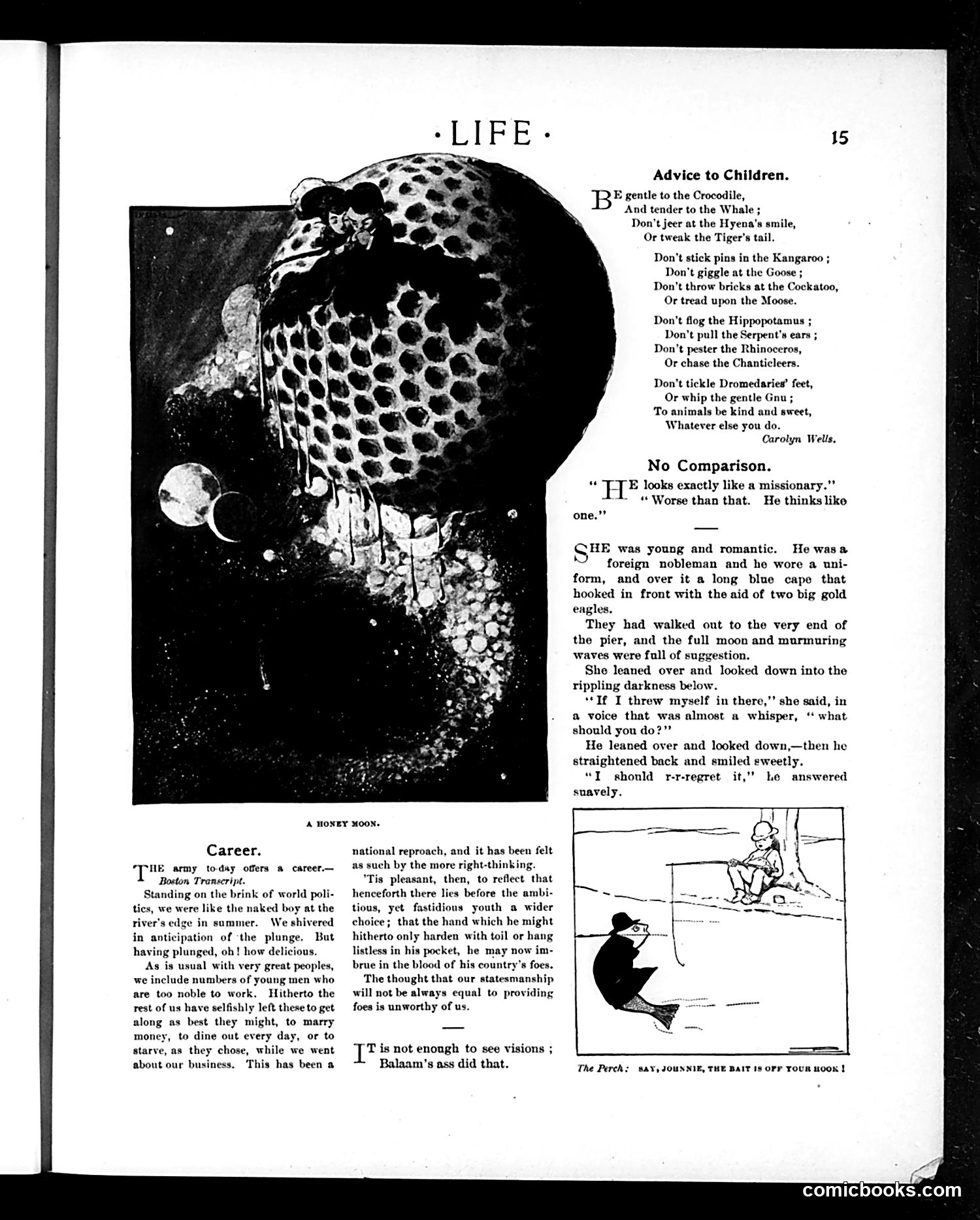
This page contains three distinct satirical pieces: **"Career"** mocks America's entry into World War I. It sarcastically celebrates that idle young aristocrats now have a patriotic outlet—military service where they can "imbrue [their hands] in the blood of his country's foes." The final line undercuts this by expressing hope that American statesmen can always find enemies to fight, suggesting ironic doubt about perpetual war justification. **"Advice to Children"** is a lighthearted poem (by Carolyn Wells) offering mock-serious warnings against mistreating animals, contrasting the brutal realism of the "Career" piece above it. **"No Comparison"** presents a romantic scenario where a foreign officer, when asked what he'd do if his companion jumped into the ocean, coolly responds he'd "regret it"—a punch line mocking his cold indifference disguised as continental suavity. The large illustration titled "A Honey Moon" depicts this final anecdote visually.
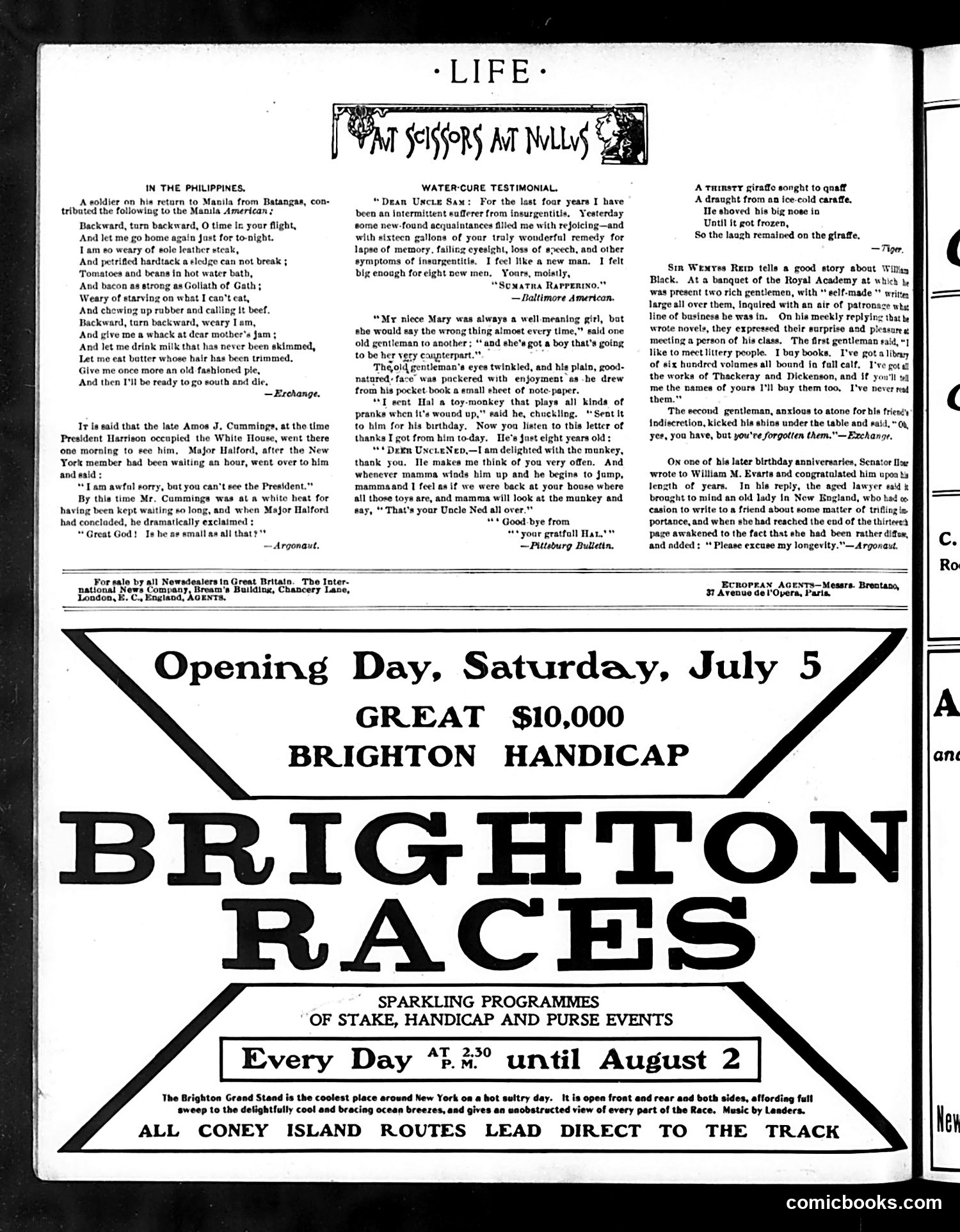
This page contains several brief humorous pieces typical of *Life* magazine's satirical style: **"At Scissors at Nullys"** (top): A cartoon/poem about a soldier in the Philippines complaining about terrible military rations—toughened meat, hard biscuits, overcooked vegetables—longing for home cooking. This reflects American soldiers' experiences during the Philippine-American War (early 1900s). **Anecdote about President Harrison**: A joke where congressman Amos Cummings, kept waiting an hour to see President Benjamin Harrison, sarcastically exclaims "Great God! Is he as small as all that?"—mocking Harrison's reputation as a weak or ineffectual president. **The toy monkey letter**: A humorous anecdote where an uncle sends his nephew a wind-up toy; the boy's thank-you note charmingly says the monkey makes him think of his uncle because it behaves chaotically—a gentle jab at the uncle's personality. **The giraffe poem**: A light nonsense verse about a giraffe freezing its nose in a cold drink. **Sir Webbe Reid anecdote**: A story about wealthy "self-made" men patronizing a novelist at a fancy dinner, offering to buy his books without reading them. The page is mostly advertisements for Brighton Races.
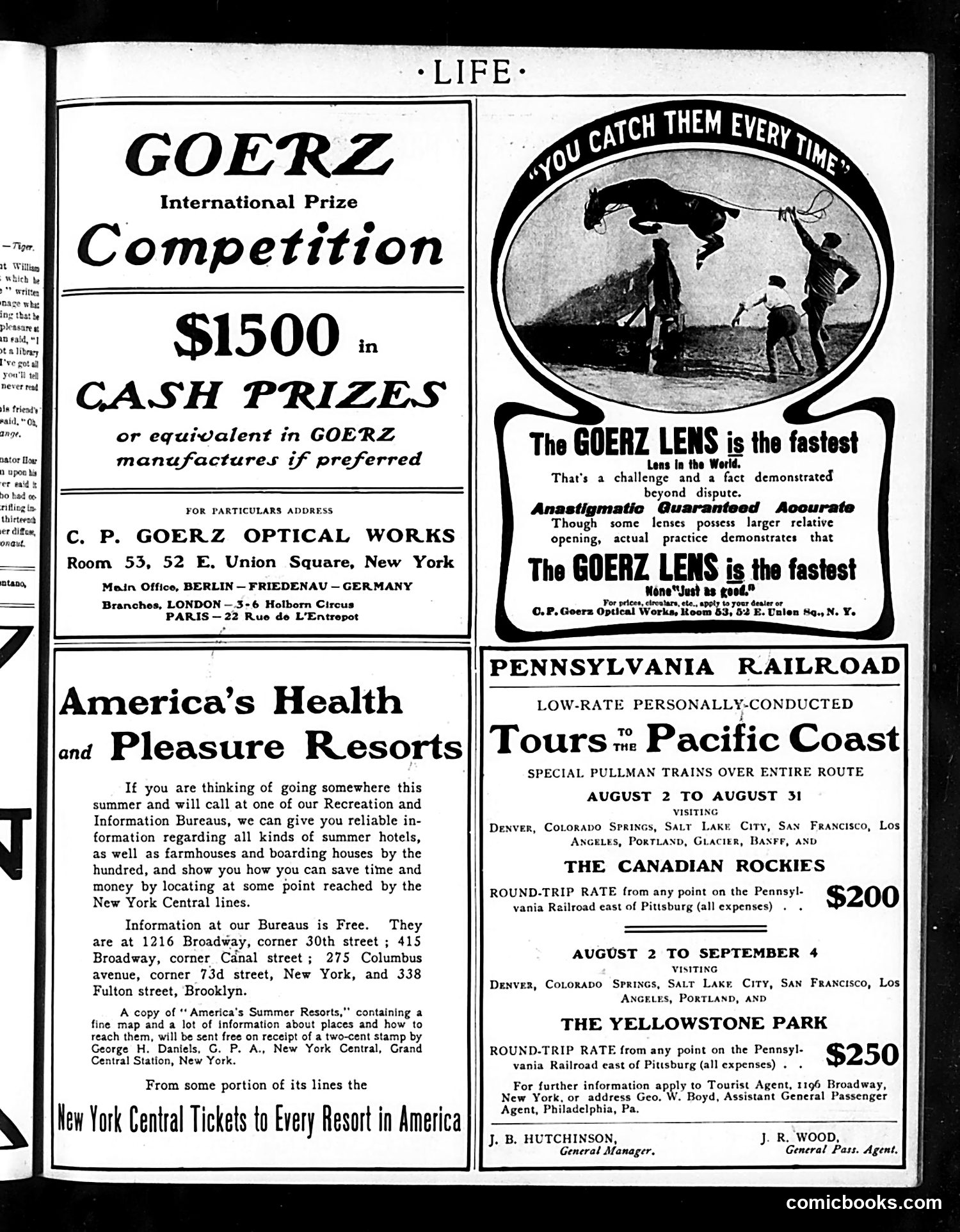
This is primarily a **page of advertisements** from *Life* magazine, not satire or political commentary. The content includes: - **Goerz Optical Works**: An international camera lens competition offering $1500 in cash prizes, with headquarters in Berlin and branches in London and Paris - **A cartoon advertisement for Goerz Lens** showing children with a bicycle, claiming it's "the fastest lens in the world" - **New York Central Railroad**: Promoting summer resort travel through their ticket network - **Pennsylvania Railroad**: Advertising guided tours to the Pacific Coast, Canadian Rockies, and Yellowstone Park (August-September dates, $200-$250 round-trip) - **America's Health and Pleasure Resorts**: Information about summer vacation destinations The page reflects turn-of-the-century American consumer culture, emphasizing leisure travel and emerging photography technology. There is no apparent satire—these are straightforward commercial advertisements aimed at affluent readers who could afford summer tourism.
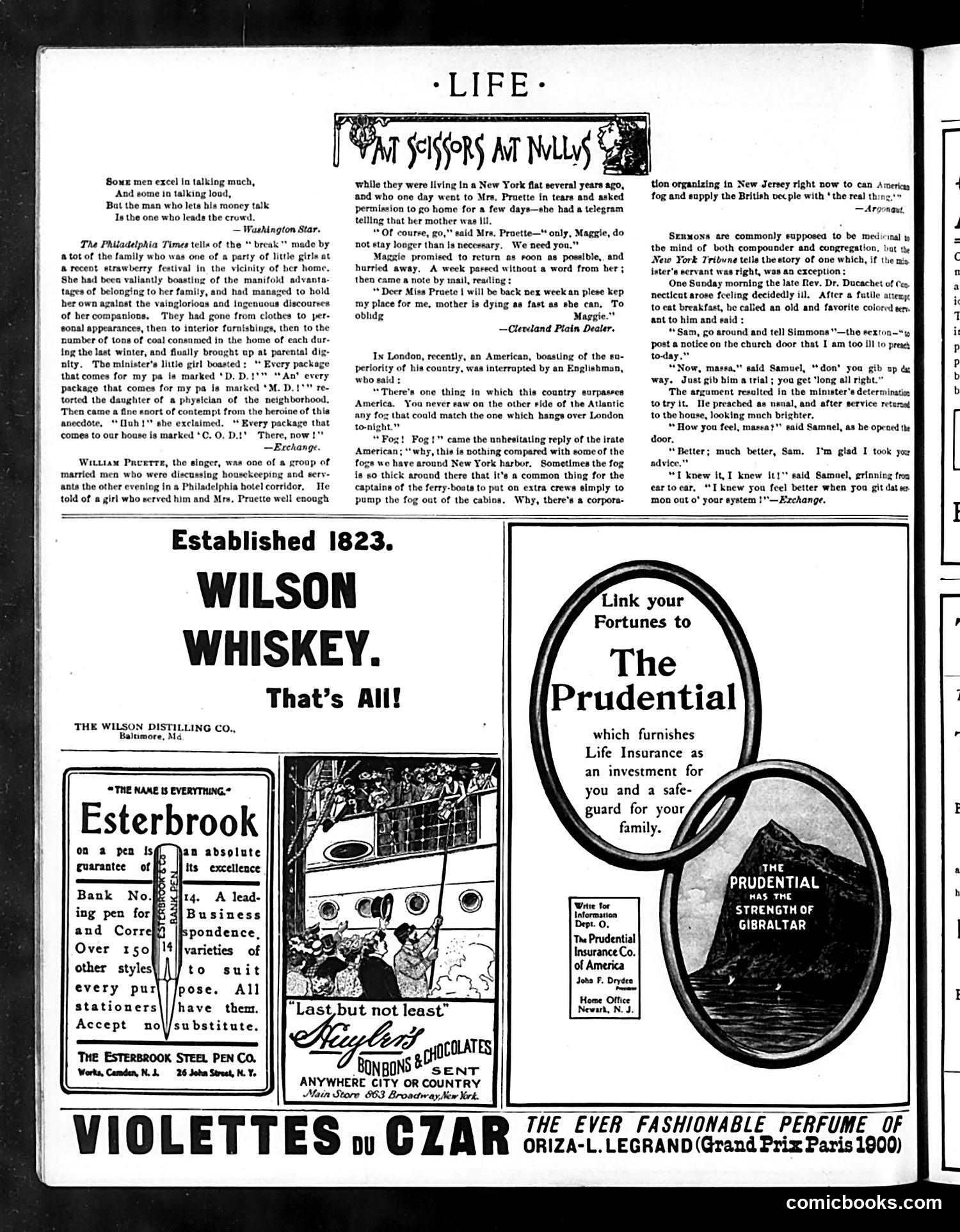
This page contains three anecdotal humor pieces typical of Life's satirical content, plus period advertisements. **The Anecdotes' Satire:** 1. **"C.O.D." Story**: Children boasting about their parents' status (minister, doctor, wealthy person). The joke: the C.O.D. (Cash on Delivery) child "wins" by implying wealth through constant purchases—satirizing how Americans measure social worth through spending and material goods. 2. **"Maggie" Story**: A servant's misspelled note about her dying mother reveals class attitudes—the employer's concern is only that service continue. The satire targets middle-class employers' indifference to servants' humanity. 3. **London Fog Story**: American boasting about superiority backfires humorously—American fog is so thick they need crews to pump it from ferry cabins. Satire of American braggart nationalism. 4. **Sermon Story**: Servant Samuel argues preaching helps the sick minister recover; the reverend agrees. Satire on faith healing and religious "medicine." The advertisements (Wilson Whiskey, Esterbrook pens, Prudential insurance, perfume) are standard period marketing unrelated to satirical content.
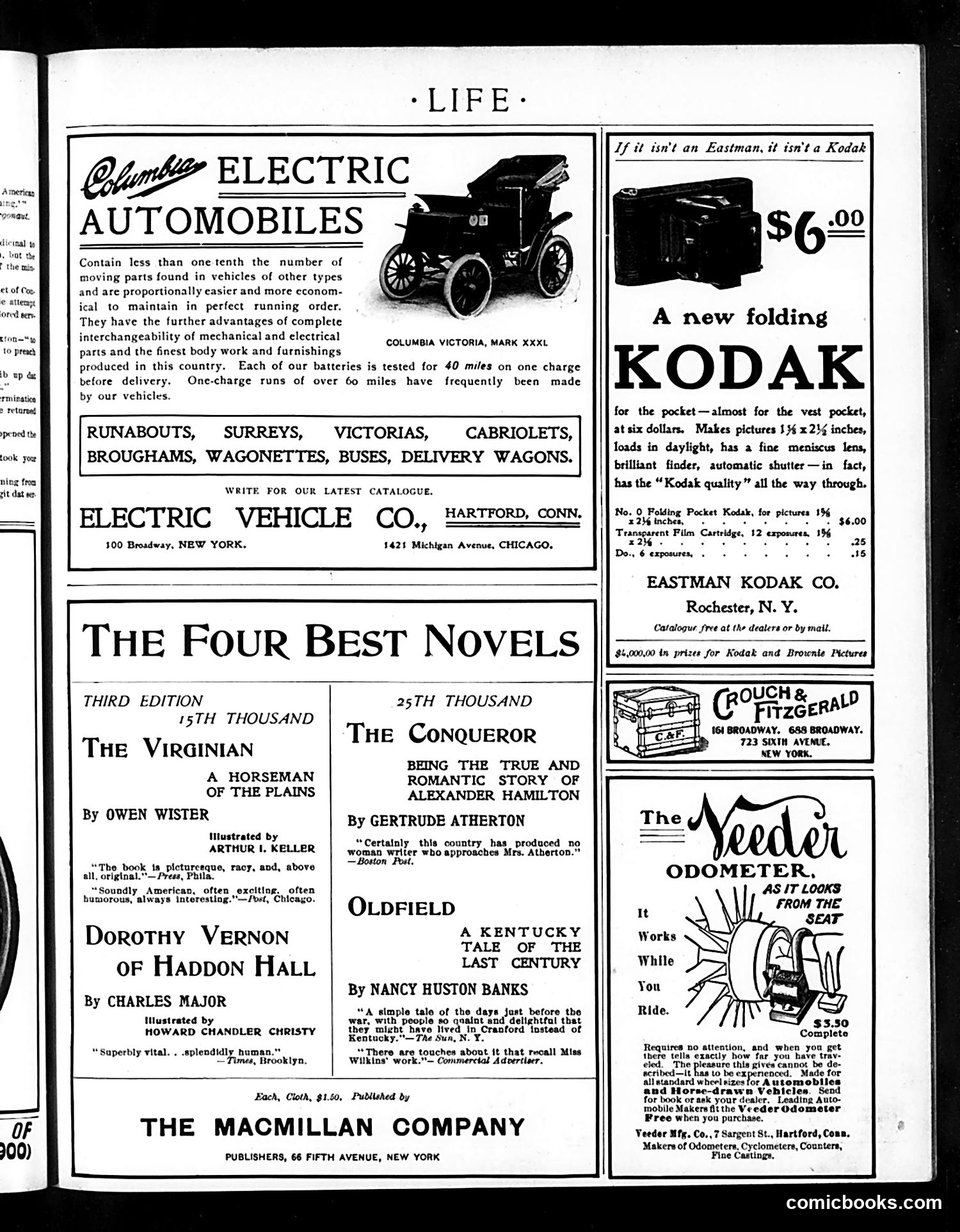
This is primarily an **advertising page** with minimal editorial content. There are no political cartoons or satire. The page showcases four major product advertisements reflecting early 1900s technology: 1. **Columbia Electric Automobiles** — promoting electric vehicles as practical alternatives to gasoline cars, emphasizing reliability and ease of maintenance 2. **Kodak folding camera** — advertising a portable $6 camera for amateur photographers 3. **The Four Best Novels** — promoting four contemporary books by Macmillan Company, including Owen Wister's *The Virginian* 4. **Veeder Odometer** — marketing a mechanical device measuring distance traveled in automobiles and carriages The layout and products reflect a transitional historical moment: electric cars competing with gasoline engines, photography becoming accessible to ordinary consumers, and automobiles becoming common enough to need specialized accessories. The advertising assumes a relatively affluent readership interested in new consumer technologies.
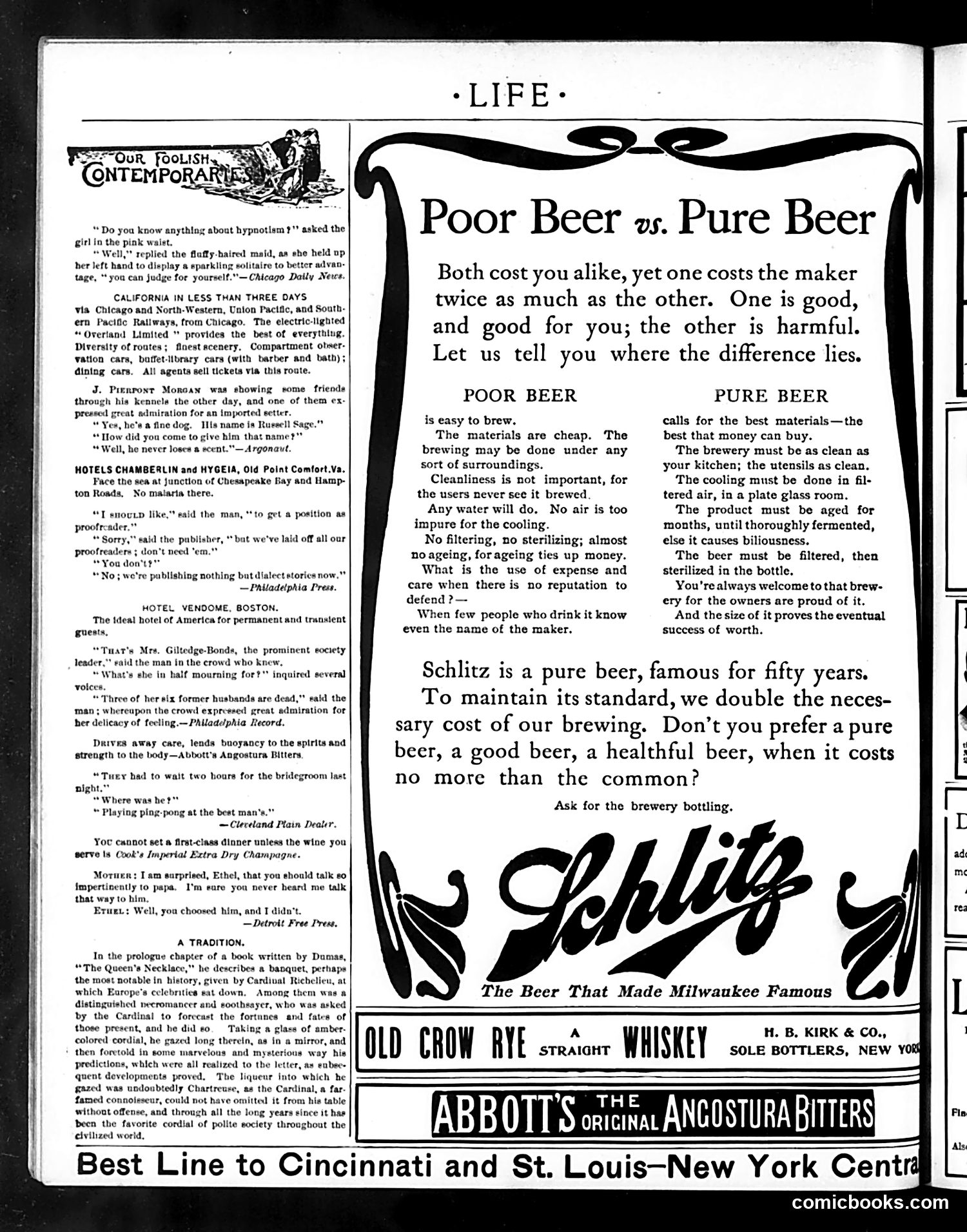
This page is primarily **advertising**, dominated by a large Schlitz beer advertisement. The ad uses a comparison format contrasting "Poor Beer vs. Pure Beer" to justify why Schlitz costs twice as much—claiming superior materials, cleanliness standards, proper aging, and filtration make it healthier and worth the premium price. The surrounding content consists of brief satirical anecdotes typical of Life magazine's humor section: - A girl displays an engagement ring, claiming hypnotism's power - J.P. Morgan names his dog "Russell Sage" (a wealthy contemporary) because "he never loses a cent" - A publisher rejects a proofreader because they only publish dialect stories now - A woman's marriages are discussed as evidence of her "delicacy" These jokes mock **wealth, materialism, and social pretension**—common Life magazine targets. The Schlitz ad, while positioned as consumer information, similarly appeals to class consciousness by suggesting superior breeding requires superior beer.
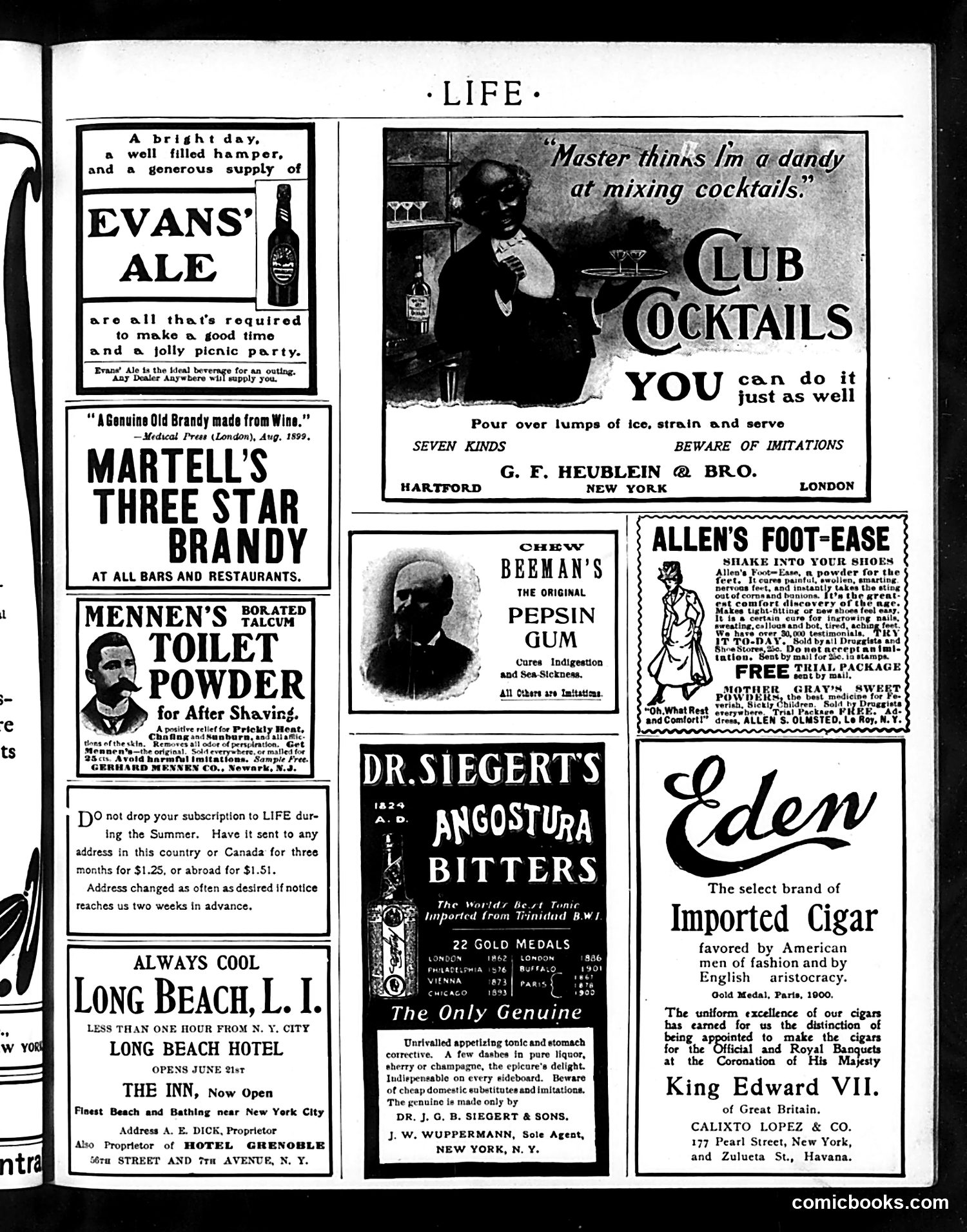
This is primarily an **advertisement page**, not a cartoon or satirical content page. It contains roughly a dozen product ads typical of early 1900s American magazines. The ads promote: - **Alcoholic beverages** (Evans' Ale, Martell's Brandy, Club Cocktails, Angostura Bitters) - **Patent medicines/toiletries** (Mennen's Talcum Powder, Beeman's Pepsin Gum for indigestion, Allen's Foot-Ease) - **Leisure services** (Long Beach Hotel, Life magazine subscriptions) - **Luxury goods** (Eden imported cigars) **Notable context for modern readers:** The ads reveal early 1900s attitudes—casual alcohol promotion, unregulated "medicinal" products (pepsin gum claimed to cure sea-sickness), and gendered marketing (foot powder for ladies). The repeated "beware of imitations" warnings suggest rampant counterfeiting of popular brands. References to "Gold Medals" and royal endorsements reflect period marketing strategies emphasizing prestige and medical legitimacy that would face modern regulatory scrutiny.
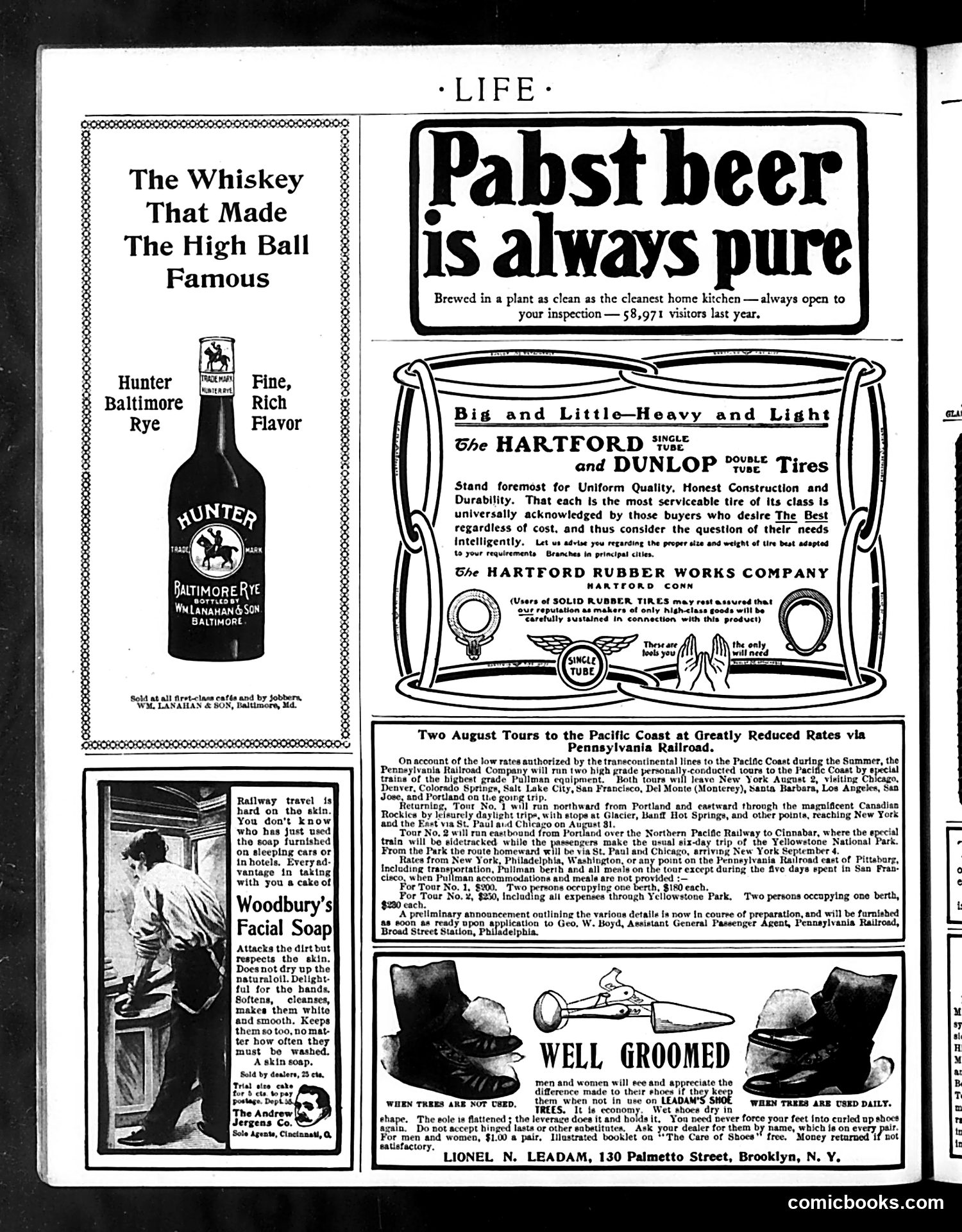
This page is primarily **advertising, not political satire**. It contains no identifiable political cartoons or satirical commentary. The advertisements showcase products typical of early 20th-century American life: Hunter Baltimore Rye whiskey ("The Whiskey That Made The High Ball Famous"), Pabst beer emphasizing purity and cleanliness, Hartford rubber automobile tires, Woodbury's Facial Soap, and Leadam shoe trees. The only substantial editorial content is a **Pennsylvania Railroad advertisement** promoting two "personally-conducted tours" to the Pacific Coast in August, featuring luxury Pullman train cars visiting Chicago, Denver, Colorado Springs, Salt Lake City, San Francisco, and (on Tour No. 2) Yellowstone National Park. Prices ranged from $180-$250 per person. The visual elements reinforce consumer messaging: a whiskey bottle, a soap advertisement showing careful hand care, and shoe-care imagery—all standard commercial appeals to prosperity and self-improvement for affluent readers.
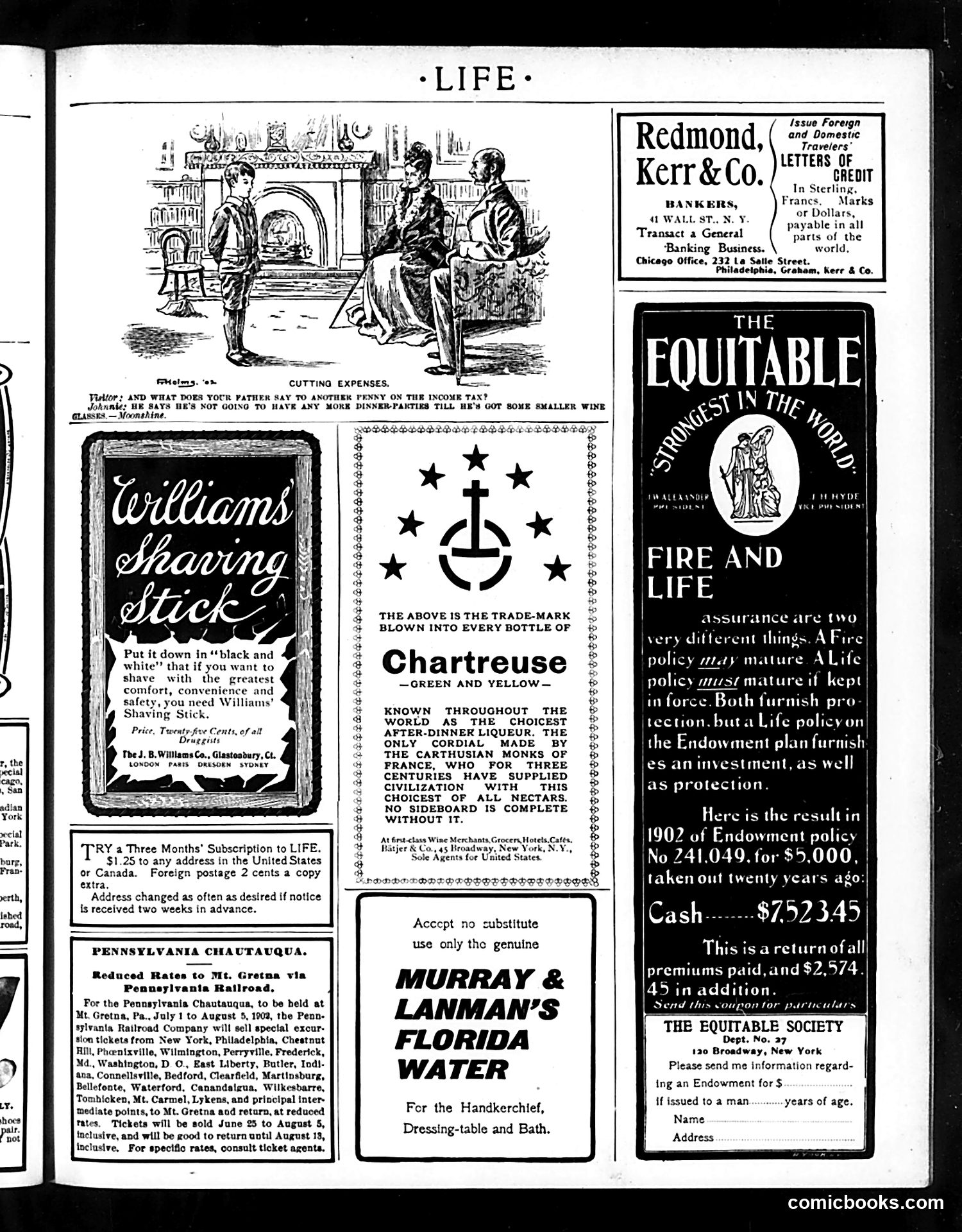
This satirical cartoon comments on early 1900s income tax debates. A visitor asks a father about his opinion on a proposed additional penny added to the income tax. The son, "Johnnie," reports that his father says he won't host any more dinner parties until he can afford smaller wine glasses. The joke targets wealthy households' responses to increased taxation: rather than reduce actual spending meaningfully, the father plans merely cosmetic economies (smaller glassware) while maintaining his social entertaining. This mocks the wealthy's resistance to progressive taxation and their claim that taxes force genuine hardship—when in reality they can still afford luxuries, just slightly diminished versions. The cartoon appears in *Life*, a satirical publication, during a period of growing debate over income tax and class economics in America.
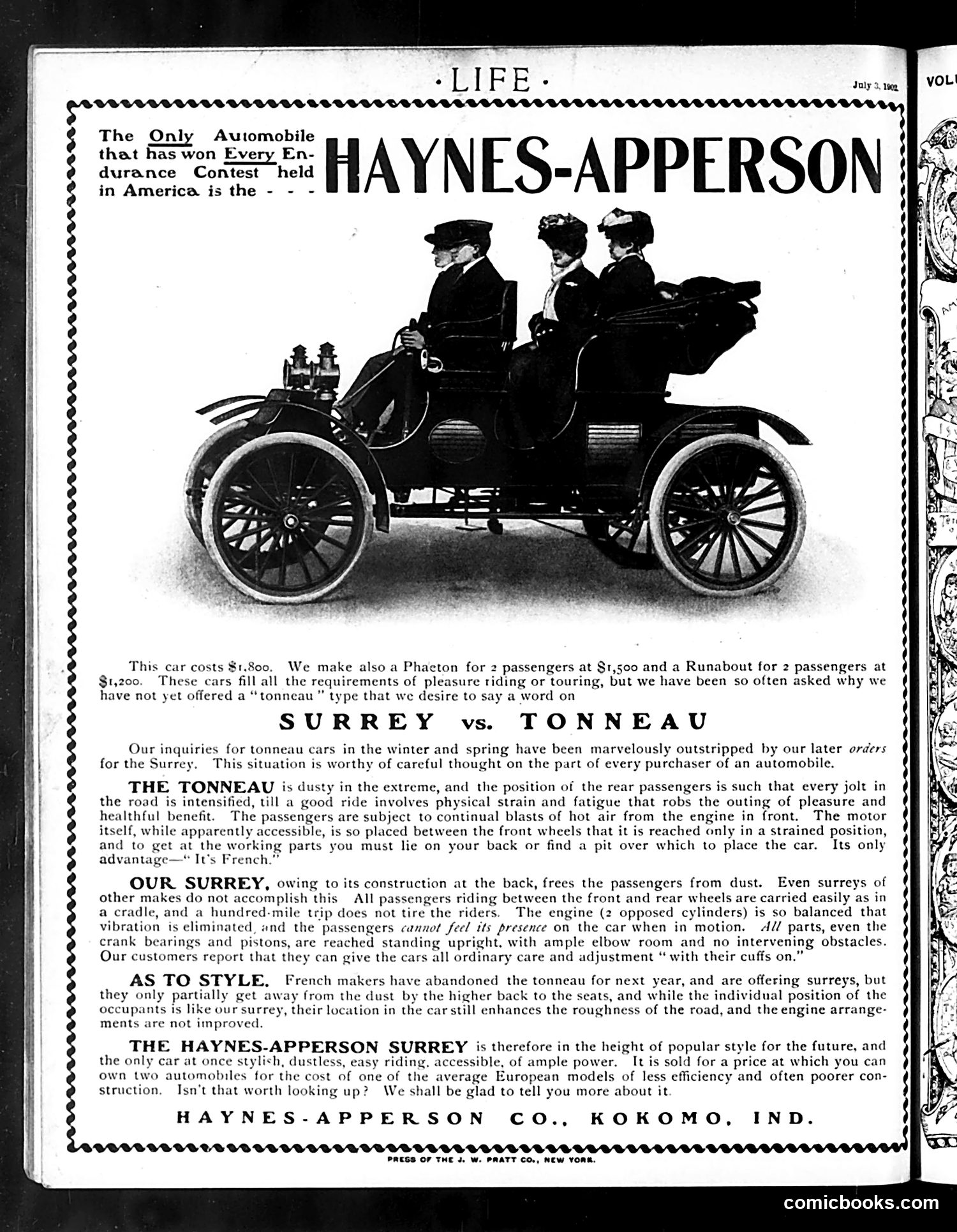
This is not a satirical cartoon but rather a **automobile advertisement** from Life magazine (July 3, 1908). The image shows three well-dressed passengers in a Haynes-Apperson motorcar—specifically their "Surrey" model. The advertisement's argument is comparative marketing, not satire: it contrasts the American-made Haynes-Apperson Surrey favorably against the French "Tonneau" design. The text claims the Surrey offers superior comfort, dust protection, and ease of engine access compared to the tonneau's acknowledged drawbacks (dust exposure, uncomfortable rear seating, difficult maintenance requiring one to "lie on your back"). The humor is mild and promotional: the ad mocks the tonneau's only advantage as being "*It's French*"—a jab at European styling pretension. The real sales pitch emphasizes that this American car costs less than European models while delivering better functionality and comfort. For modern readers: this reflects early automotive marketing when American manufacturers were competing with European imports, and "dustless" comfortable riding was a significant selling point before paved roads became standard.