
Life, 1902-07-03 · page 4 of 24
Life — July 3, 1902 — page 4: what you’re looking at
What you’re looking at
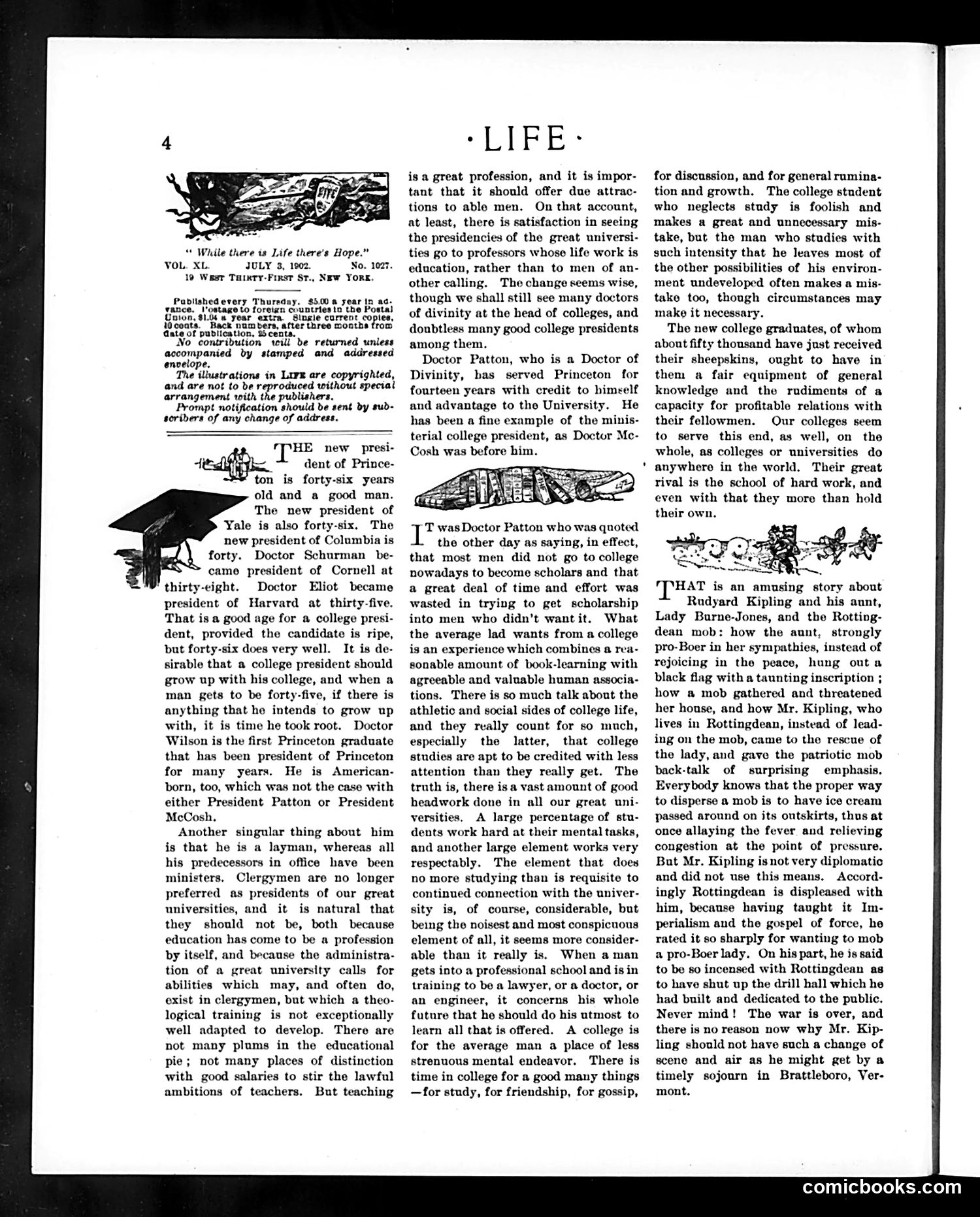
This page contains an editorial essay titled "While there is Life there's Hope" discussing American college leadership, illustrated with small decorative woodcuts rather than political cartoons. The text critiques the appointment of forty-six-year-old Doctor Patton as Princeton's new president, comparing him favorably to other university leaders like those at Yale and Columbia. The author argues that college presidencies should go to laymen rather than clergy, as previous presidents like McCosh were. The piece advocates that colleges should combine rigorous academics with practical human development, suggesting that too much emphasis on purely scholarly pursuits misses the broader educational mission. The brief anecdote about Rudyard Kipling and a "pro-Boer" incident illustrates tensions between institutional reputation and individual conscience during the Boer War era.
📄 Transcribed text from this page (OCR, searchable)
Machine-transcribed from the original scan — historical spelling and the odd misread are preserved.
“ While there ts Life there's eons XL. JULY 3, 1902. 19 Wasr Taixry-Finst St., NEW Tone. VOL Published every Thursday. $500 a sear in ag vance. lostage to foreign countries to the Postal Coon, $1.06 w year extra. Single current copies. AOcoats. “Back numbers, after three months from Gate of publication, % cents. No contribution veil be returned unless accompanied by stamped and addressed envelope. ‘The illustrations in Lure are copyrighted, and are not to be reproduced without special arrangement with the publishers. Prompt notification should be sent by sub- soribers of any change of address. HE new presi- esi dent of Prince- ton is forty-six years old and a good man. The new president of Yale is also forty-six. The new president of Columbia is forty. Doctor Schurman be- came president of Cornell at thirty-eight. Doctor Eliot became president of Harvard at thirty-five. That is a good age for a college presi- dent, provided the candidate is ripe, but forty-six does very well. It is de- sirable that a college president should grow up with his college, and when a man gets to be forty-five, if there is anything that he intends to grow up with, it is time he took root. Doctor Wilson is the first Princeton graduate that has been president of Princeton for many years. He is American- born, too, which was not the case with either President Patton or President McCosh. Another singular thing about him is that he is a layman, whereas all his predecessors in office have been ministers. Clergymen are no longer preferred as presidents of our great universities, and it is natural that they should not be, both because education has come to be a profession by itself, and because the administra- tion of a great university calls for abilities which may, and often do, exist in clergymen, but which a theo- logical training is not exceptionally well adapted to develop. There are not many plums in the educational pie; not many places of distinction with good salaries to stir the lawful ambitions of teachers, But teaching LIFE is a great profession, and it is impor- tant that it should offer due attrac- tions to able men. On that account, at least, there is satisfaction in seeing the presidencies of the great universi- ties go to professors whose life work is education, rather than to men of an- other calling. The change seems wise, though we shall still see many doctors of divinity at the head of colleges, and doubtless many good college presidents among them, Doctor Patton, who is a Doctor of Divinity, bas served Princeton for fourteen years with credit to himeelf and advantage to the University. He has been a fine example of the minis- terial college president, as Doctor Mc- Cosh was before him. T was Doctor Patton who was quoted the other day as saying, in effect, that most men did not go to college nowadays to become scholars and that a@ great deal of time and effort was wasted in trying to get scholarship into men who didn’t wantit. What the average lad wants from a college is an experience which combines a rea- sonable amount of book-learning with agreeable and valuable human associa- tions. There is so much talk about the athletic and social sides of college life, and they really count for so much, especially the latter, that college studies are apt to be credited with less attention than they really get. The truth is, there is a vast amount of good headwork done in all our great uni- versities. A large percentage of stu- dents work hard at their mental tasks, and another large element works very respectably. The element that does no more studying than is requisite to continued connection with the univer- sity is, of course, considerable, but being the noisest and most conspicuous element of all, it seems more consider- able than it really is. When aman gets into a professional school and is in training to be a lawyer, or a doctor, or an engineer, it concerns his whole future that he should do his utmost to learn all that is offered. A college is for the average man a place of less strenuous mental endeavor. There is time in college for a good many things —for study, for friendship, for gossip, for discussion, and for general rumina- tion and growth. The college student who neglects study is foolish and makes a great and unnecessary mis- take, but the man who studies with such intensity that he leaves most of the other possibilities of his environ- ment undeveloped often makes a mis- take too, though circumstances may make it necessary. The new college graduates, of whom abont fifty thousand have just received their sheepskins, ought to have in them a fair equipment of general knowledge and the rudiments of a capacity for profitable relations with their fellowmen. Our colleges seem to serve this end, as well, on the whole, as colleges or universities do anywhere in the world. Their great rival is the school of hard work, and even with that they more than hold their own. c THAT is an amusing story about Rudyard Kipling and his aunt, Lady Burne-Jones, and the Rotting- dean mob: how the aunt, strongly pro-Boer in her sympathies, instead of rejoicing in the peace, hung out a black flag with a taunting inscription ; how a mob gathered and threatened her house, and how Mr. Kipling, who lives in Rottingdean, instead of lead- ing on the mob, came to the rescue of the lady, and gave the patriotic mob back-talk of surprising emphasis. Everybody knows that the proper way to disperse a mob is to have ice cream passed around on its outskirts, thus at once allaying the fever and relieving congestion at the point of pressure. But Mr. Kipling is not very diplomatic and did not use this means. Accord- ingly Rottingdean is displeased with him, because having taught it Im- perialism and the gospel of force, he rated it so sharply for wanting to mob a pro-Boer lady. On his part, he is said to be so incensed with Rottingdean as to have shut up the drill hall which he had built and dedicated to the public. Never mind! The war is over, and there is no reason now why Mr. Kip- ling should not have such a change of scene and air as he might get by a timely sojourn in Brattleboro, Ver- mont. comicbooks.com