
Life, 1902-07-03 · page 6 of 24
Life — July 3, 1902 — page 6: what you’re looking at
What you’re looking at
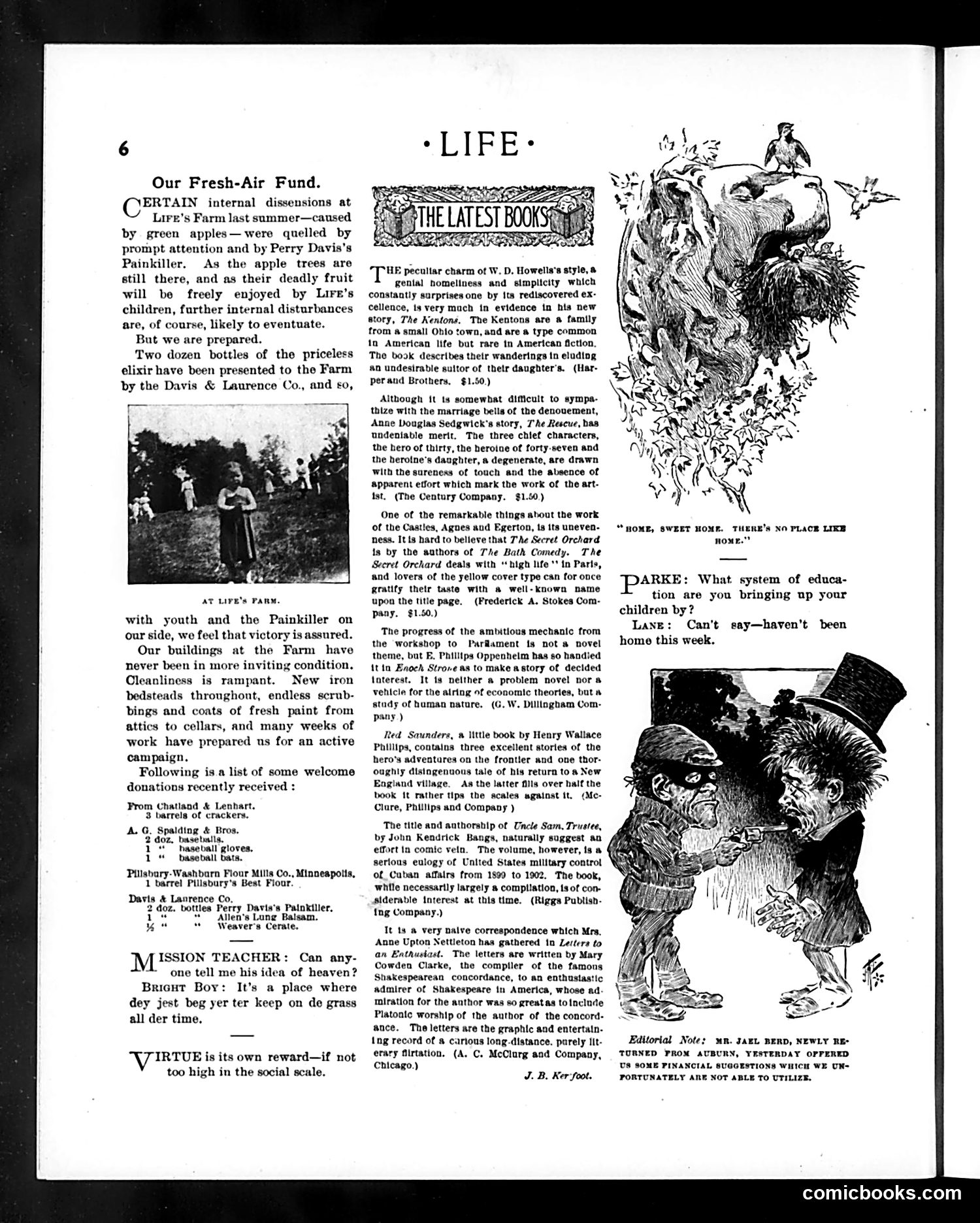
This page combines a farm feature with book reviews and a brief satirical dialogue. The main left image shows people at "Life's Farm," illustrating an article about the magazine's property and fresh-air initiative for children. The right side features a dialogue labeled "HOME, SWEET HOME" between characters "Darke" and "Lane," apparently satirizing domestic life—specifically a husband asking about children's education while the wife hasn't even been home that week. The joke hinges on marital discord and neglected domestic responsibilities. The page primarily serves as a book review section ("The Latest Books") rather than political commentary, discussing recent publications by W.D. Howells and other authors. The satirical content is mild social observation about marriage and parenting rather than political critique.
📄 Transcribed text from this page (OCR, searchable)
Machine-transcribed from the original scan — historical spelling and the odd misread are preserved.
Our Fresh-Air Fund. ERTAIN internal dissensions at Lire’s Farm last sammer—caused by green apples—were quelled by prompt attention and by Perry Davis's Painkil As the apple trees are still there, and as their deadly fruit will be freely enjoyed by LiFe’s children, further internal disturbances are, of course, likely to eventuate. But we are prepared. Two dozen bottles of the priceless elixir have been presented to the Farm by the Davis & Laurence Co., and £0, AT LIPE'S Pano. with youth and the Painkiller on our side, we feel that victory is assured. Our buildings at the Farm have never been in more inviting condition, Cleanliness is rampant. New iron bedsteads throughout, endless scrub- bings and coats of fresh paint from attics to cellars, and many weeks of work have prepared us for an active campaign. Following is.a list of some welcome donations recently received : From Chatland & Lenhart, 3 barrels of crackers. A. G. Spalding & Bros. 2 doz, basetulls. 1” haseball gloves, 1 * baseball bats. Pillsbary-Washbarn Flour Mills Co., Minneapotts, 1 barrel Pillsbury's Best Flour. Davis & Lanrence Co, 2 doz. bottles Perry Davis's Painkiller, “ “Allen's Lung Balsam. yu © Weaver's Cerate. M ISSION TEACHER: Can any- ~ one tell me his idea of heaven? Bricut Boy: It’s a place where dey jest beg yer ter keep on de grass all der time. IRTUE is its own reward—if not too high in the social scale. Rebs 'HE pecultar charm ot W. D. Howells’ Rental homeliness and simplicity which constantly surprises one by Its rediscovered ex- cellence, is very mach in evidence in his new story, The Nentons. The Kentons are ® family from a small Ohio town, and are a type common tn American life but rare in American fiction, The book describes their wanderings tn eluding &n undesirable sultor of thetr daughter's. (Har- perand Brothers, $1.50.) Although {t ts somewhat dificult to sympa- thize with the marriage bells of the denouement, Anne Douglas Sedgwick's story, The Rescue, bas undeniable merit. Tne three chief characters, the hero of thirty, the heroine of forty-seven and the heroine's daughter, a degenerate, are drawn with the sureness of touch and the absence of Apparent effort which mark the work of the art- ist, (The Century Company. $1.0.) One of the remarkable things about the work of the Castles, Agnes and Egerton, ts its uneven- ness. It ts hard to believe that The Secret Orchard is by the authors of The Bath Comedy. The Secret Orchard deals with “high life" in Parts, ‘and lovers of the yellow cover type can for once gratify their taste with a well-known name upon the title page. (Frederick A. Stokes Com- Pany. $1.50.) The progress of the ambitious mechanic from the workshop to Parllament 1s not a novel theme, but E, Philitps Oppenhelm has so handied {tin Enoch Strone as to make astory of decided Interest. It ts nelther a problem novel nor # vehicle for the airing of economic theortes, but a study of human nature. (G.W. Dillingham Com- pany ) Red Saunders, a Mttle book by Henry Wallace Phillips, contains three excellent stortes of the hero's adventares on the frontier and one thor- oughly disingenuous tale of hig return toa New Engiand village. As the latter fills over half the book It rather tips the scales against it, (Mc- Clure, Phillips and Company ) The title and anthorablp of Uncle Sam, Trustee, by Jobn Kendrick Bangs, naturally suggest an effort in comic veln. The volume, however, sertous eulogy of United States military controt of Cuban affairs from 1899 to 1902. The book, while necessarily largely 8 compliation, ts of con- siderable interest at this time. (Riggs Publish- {ng Company.) It ts a very naive correspondence which Mrs, Anne Upton Nettleton has gathered in Lesters to an Enthusiast. The letters are written by Mary Cowden Clarke, the compiler of the famous Shakespearean concordance, to an enthustastic admirer of Shakespeare in America, whose ad. miration for the anthor was so greatas totaclude Platonte worshtp of the author of the concord- ance. The letters are the graphic and entertain. Ing record of 8 carious long.distance, parely Iit- erary Mirtaton. (A. C. McClurg and Company, Chicago.) J.B. Ker'foot. “HOME, SWEET HOMR. THEnE's NO PLACE LIKE nomr.”* ‘PARKE: What system of educa- tion are you bringing up your children by? Lane: Can't eay—haven't been home this week. Editorial Note: mn. JauL BERD, NEWLY RE- TURNED PROM AUBURN, YESTERDAY OFFERED US SOME FINANCIAL SUGGESTIONS WHICH WE UN- PORTUNATELY ARE NOT ABLE TO UTILIZE. comicbooks.com