
Life, 1902-07-03 · page 5 of 24
Life — July 3, 1902 — page 5: what you’re looking at
What you’re looking at
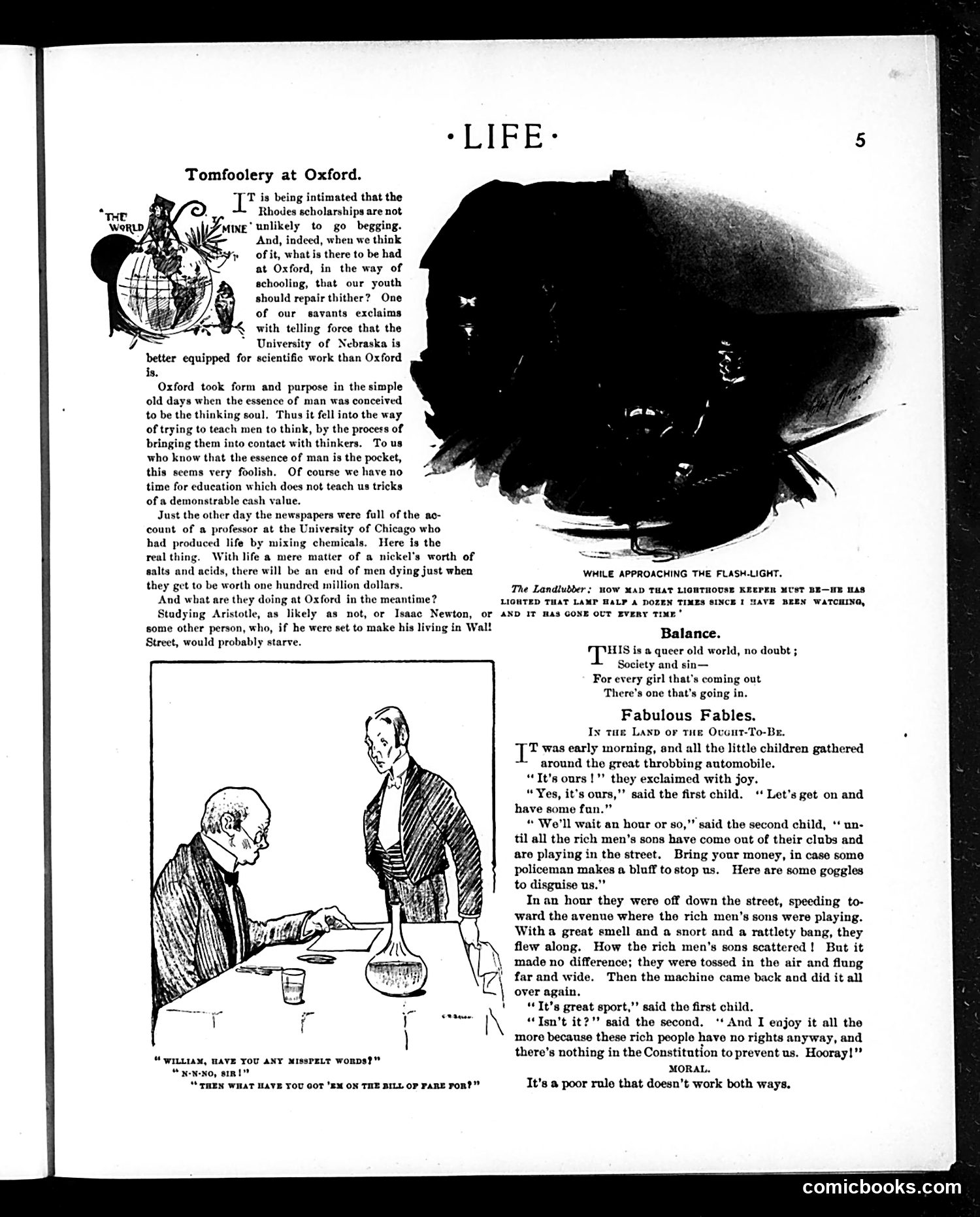
This page contains three distinct satirical pieces: 1. **"Tomfoolery at Oxford"**: Mocks Oxford University as outdated, contrasting it unfavorably with the University of Nebraska. The satire suggests Oxford emphasizes abstract thinking over practical knowledge—a dig at classical education as impractical for modern life. 2. **The cartoon below**: Shows two men in what appears to be a financial dispute. The dialogue references "miserly words" and "the bill of fare," suggesting satire about monetary disagreements or financial dishonesty. 3. **"Fabulous Fables"**: A brief story mocking wealthy people. Children find a rich man's automobile and repeatedly steal its contents while he's distracted. The moral criticizes wealth inequality: "It's a poor rule that doesn't work both ways." The overall theme critiques class privilege and impracticality in society.
📄 Transcribed text from this page (OCR, searchable)
Machine-transcribed from the original scan — historical spelling and the odd misread are preserved.
Tomfoolery at Oxford. qT is being intimated that the Rhodes scholarships are not ‘MINE’ Unlikely to go begging. And, indeed, when we think of it, what is there to be had at Oxford, in the way of schooling, that our youth should repair thither? One of our savants exclaims with telling force that the University of Nebraska is better equipped for scientific work than Oxford Oxford took form and purpose in the simple old days when the essence of man was conceived to be the thinking soul. Thus it fell into the way of trying to teach men to think, by the process of bringing them into contact with thinkers. To us who know that the essence of man is the pocket, this seems very foolish. Of course we have no time for education which does not teach us tricks of a demonstrable cash value. Just the other day the newspapers were full of the ac- count of a professor at the University of Chicago who had produced life by mixing chemicals. Here is the real thing. With life a mere matter of a nickel’s worth of salts and acids, there will be an end of men dying just when WHILE APPROACHING THE FLASH-LIGHT. they get to be worth one hundred million dollars. The Landlubder > HOW MAD THAT LIORTROUSE KEEPER MUST BE—HE 148 And what are they doing at Oxford in the meantime? LIGHTED THAT LAMP HALP A DOZEN TIMES SINCE I 1 BEEN WATCHING, Studying Aristotle, as likely as not, or Isaac Newton, or aXb IT mas GONE OUT EVERY TIMr.’ some other person, who, if he were set to make his living in Wal! Balance Btrect,. would probably starve. TT HIS in a queer old world, no doubt ; Society and sin— For every girl that’s coming out ‘There's one that’s going in. Fabulous Fables. Ix tuk Laxp or tHe Ovcut-To-Be. Tt was early morning, and all the little children gathered around the great throbbing automobile. “It's ours !"’ they exclaimed with joy. “ Yes, it’s ours,’’ said the first child. ‘ Let’s get on and have some fun.” “ We'll wait an honr or so,”’ said the second child, ‘‘ un- til all the rich men’s sons have come out of their clubs and aro playing in the street. Bring your money, in case somo policeman makes a bluff tostop us. Here are some goggles to disguise us.”” In an hour they were off down the street, speeding to- ward the avenue where the rich men’s sons were playing. With a great smell and a snort and a rattlety bang, they flew along. How the rich men’s sons scattered! But it made no difference; they were tossed in the air and flung far and wide. Then the machine came back and did it all over again. “It’s great sport,’’ said the first child. “Isn't it?’ said the second. ‘And I enjoy it all the more because these rich people have no rights anyway, and “ there’s nothing in the Constitution to prevent us. Hooray!" WILLIAM, HAVE YOU ANY MISSPELT WonDs?” * rew-No, SIR 1” MORAL. “THEN WHAT HAVE TOU OOT 'EM ON THE BILL OP FARE FoR?” It's a poor rule that doesn’t work both ways. comicbooks.com