
A complete issue · 22 pages · 1902
Life — June 5, 1902
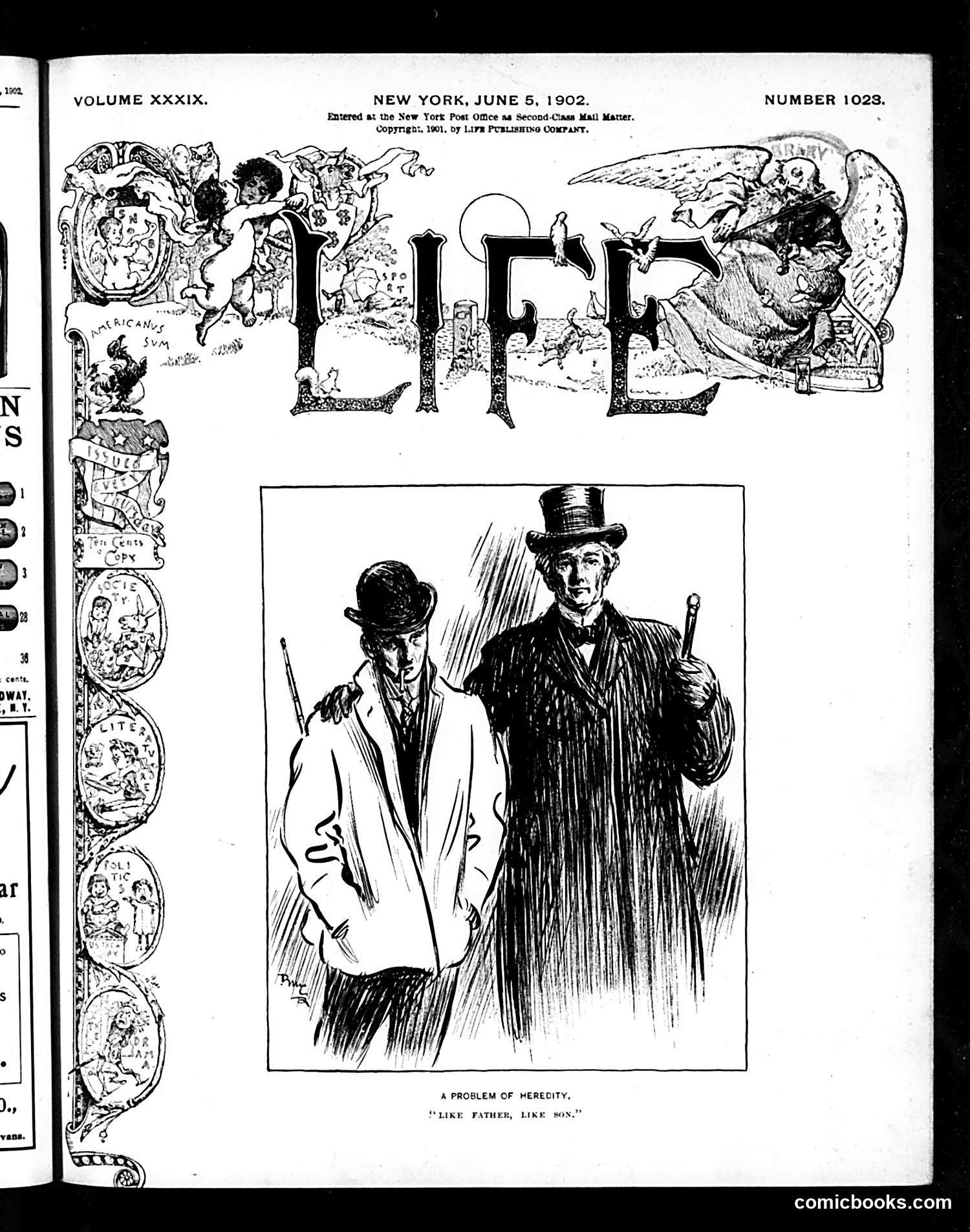
This *Life* magazine cover from June 5, 1902, presents a social satire about heredity and family resemblance. The illustration shows two men—likely a father and son based on the caption—dressed in formal attire with bowler hats and coats. Both figures display similar facial features and postures, reinforcing the proverb "like father, like son." The cartoon likely comments on inherited traits, whether physical characteristics or behavioral patterns passing between generations. Without additional context identifying these specific individuals, the satire appears to be making a general social observation about family resemblance or the inevitability of children inheriting their parents' qualities—possibly with ironic or critical intent regarding particular public figures of that era.
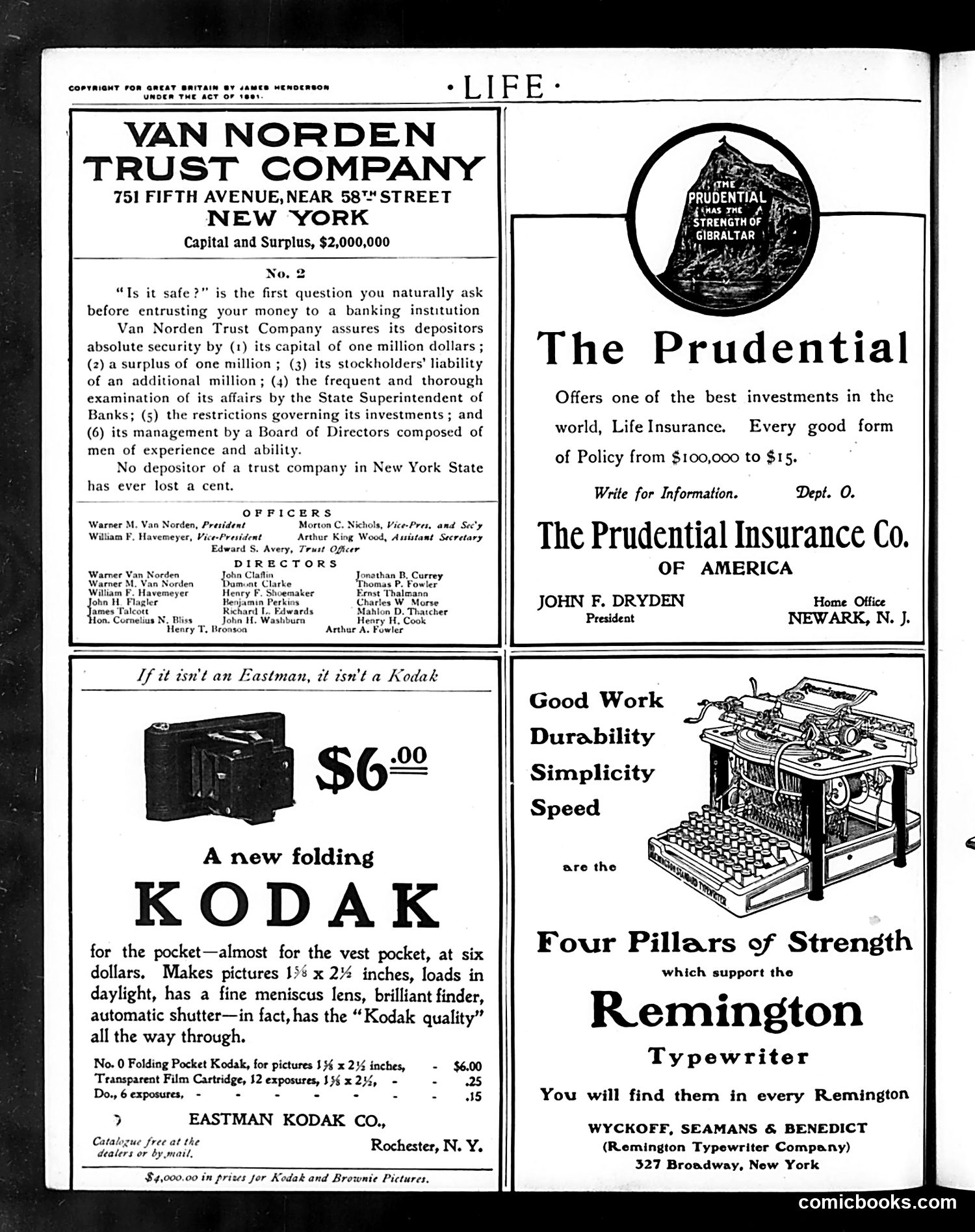
This page consists entirely of **advertisements**, not cartoons or political satire. There are four ads: 1. **Van Norden Trust Company** (banking institution) emphasizing depositor security through capital, surplus, and state oversight. 2. **The Prudential Insurance Company**, promoting life insurance policies as sound investments, featuring their iconic Rock of Gibraltar logo. 3. **Eastman Kodak Company**, advertising a new folding pocket camera ("Kodak") at $6.00, emphasizing portability and quality. 4. **Remington Typewriter**, highlighting durability and speed as key selling points. The page reflects early 20th-century consumer advertising focused on financial institutions, photography, and office equipment—products marketed to middle-class readers of *Life* magazine.
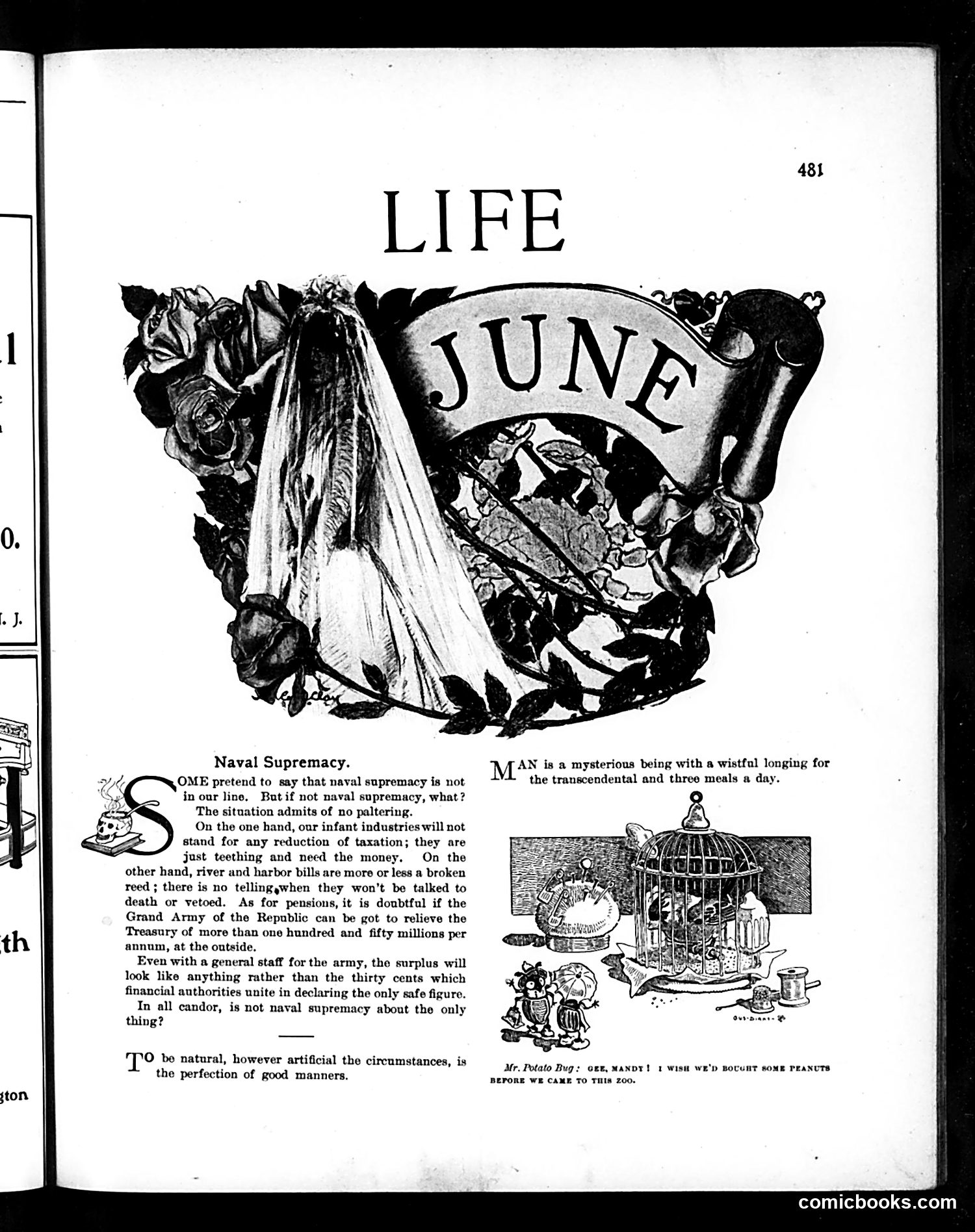
This page critiques American military spending priorities. The main article argues that naval supremacy isn't the only thing that matters—the nation also needs strong industries and financial stability. The author questions whether the military budget can sustainably relieve the Treasury of "more than one hundred and fifty millions per annum." The accompanying illustration shows a birdcage labeled "Mr. Potato Bug," depicting cramped conditions. The caption reads: "Gee, Mandy! I wish we'd bought some peanuts before we came to this zoo." This appears to be visual commentary on overcrowding or resource scarcity—possibly satirizing inadequate living conditions or supplies for military personnel, contrasting with expensive naval investments. The overall message criticizes prioritizing military hardware over soldiers' welfare and broader economic needs.
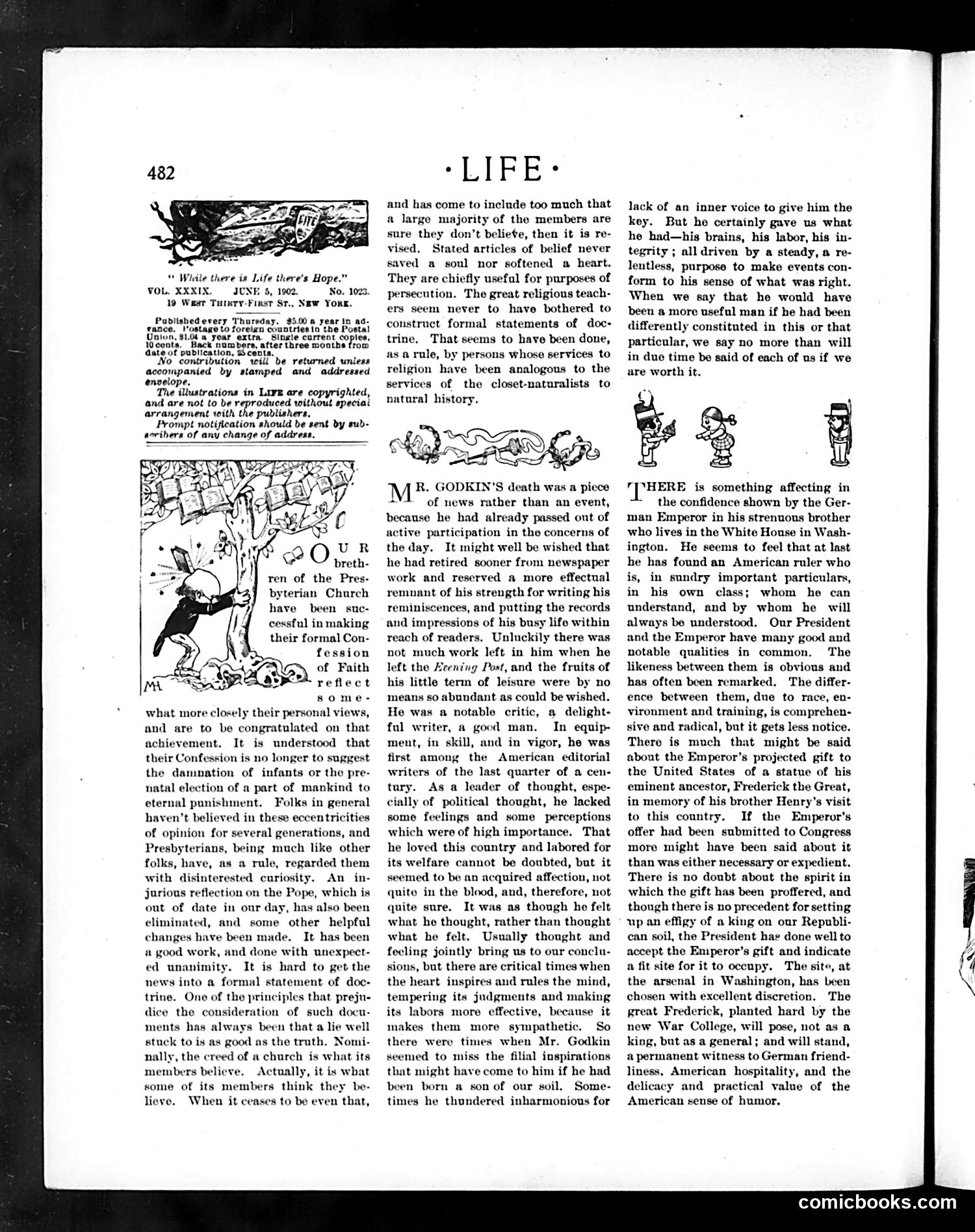
This page from *Life* magazine (June 5, 1902) contains a political cartoon and editorial text about Mr. Godkin's death and the German Emperor's gift to America. The cartoon appears to show a figure (likely representing a Presbyterian minister or religious leader) in the left margin, though the specific satirical point is unclear from the image quality. The main text discusses Godkin's passing and his career as a newspaper editor and influential American intellectual. The right column focuses on the German Emperor's gift of Frederick the Great's statue to the United States, praising it as a gesture of goodwill between nations. The author argues this demonstrates the Emperor understands American values and character. The satire seems to concern debates about accepting foreign gifts and what they signify about American autonomy and international relations during the early 20th century.
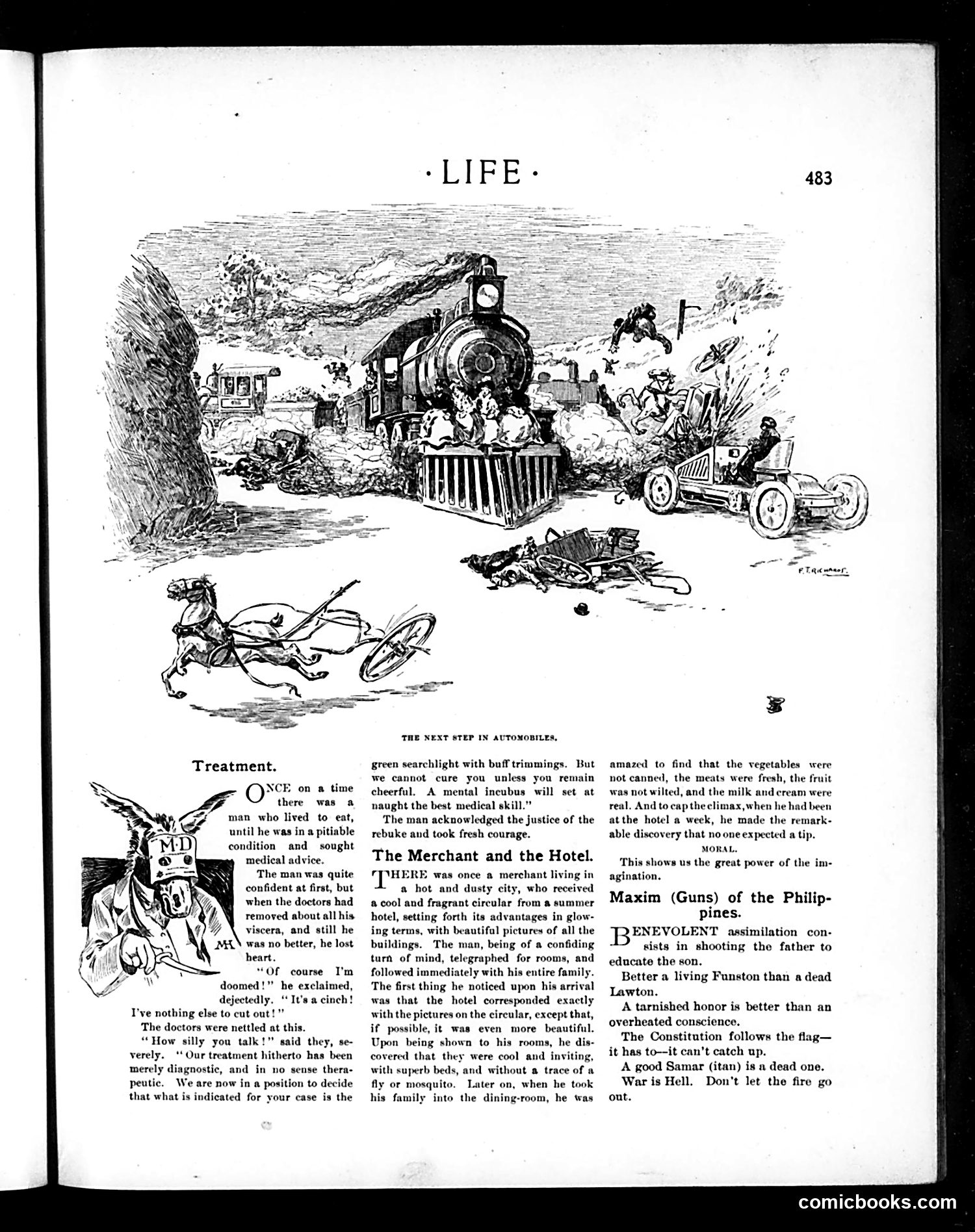
This cartoon satirizes the collision of modern transportation with traditional travel methods. The central image depicts a steam locomotive encountering various vehicles—a horse-drawn carriage, an early automobile, and a motorcycle—all apparently in chaos or conflict. The joke appears to mock the rapid technological change of the early automobile era, suggesting that adding more vehicles and speed creates danger rather than progress. The wreckage and scattered debris in the foreground emphasize this critique. The accompanying stories—"Treatment," "The Merchant and the Hotel," and "Maxim (Guns) of the Philippines"—are unrelated, typical of Life's format mixing humor pieces and commentary. This page reflects contemporary anxiety about how new transportation technology was disrupting traditional society and creating hazardous conditions.
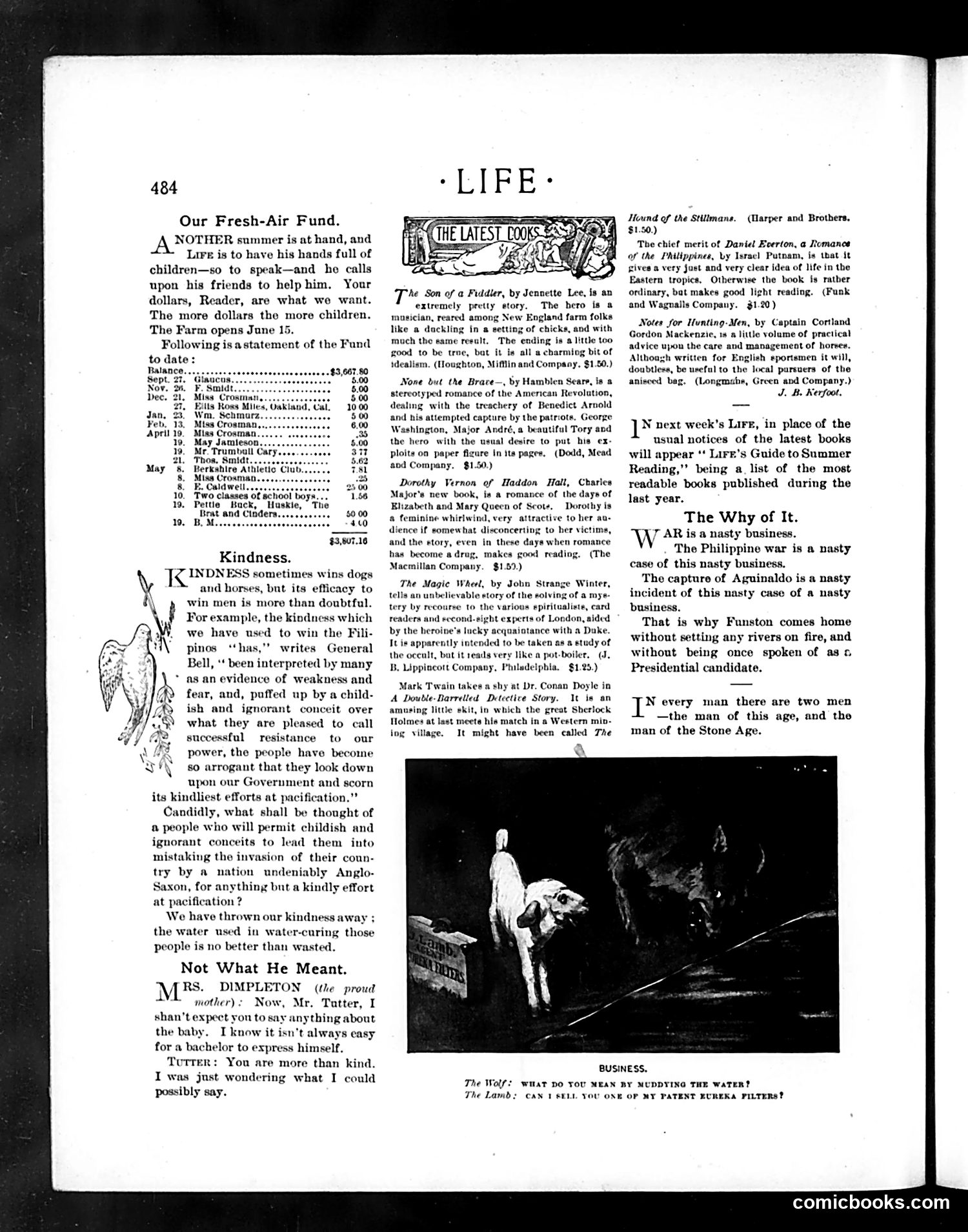
This cartoon depicts a dog and lamb in conversation by water. The caption reads: "The Wolf: 'What do you mean by muddying the water?' / The Lamb: 'Can I sell you one of my patent Eureka filters?'" This is a classic Aesop's fable reference—the story of the wolf and lamb at a stream, where the wolf falsely accuses the lamb of muddying water as a pretext to attack it. Life's satirical twist: the lamb, rather than being helpless prey, has become a salesman hawking "patent Eureka filters." The joke critiques American commercial culture—even in situations of obvious predatory intent, the enterprising American tries to sell something. It satirizes both aggressive capitalism and naive optimism about commercial solutions to genuine threats.
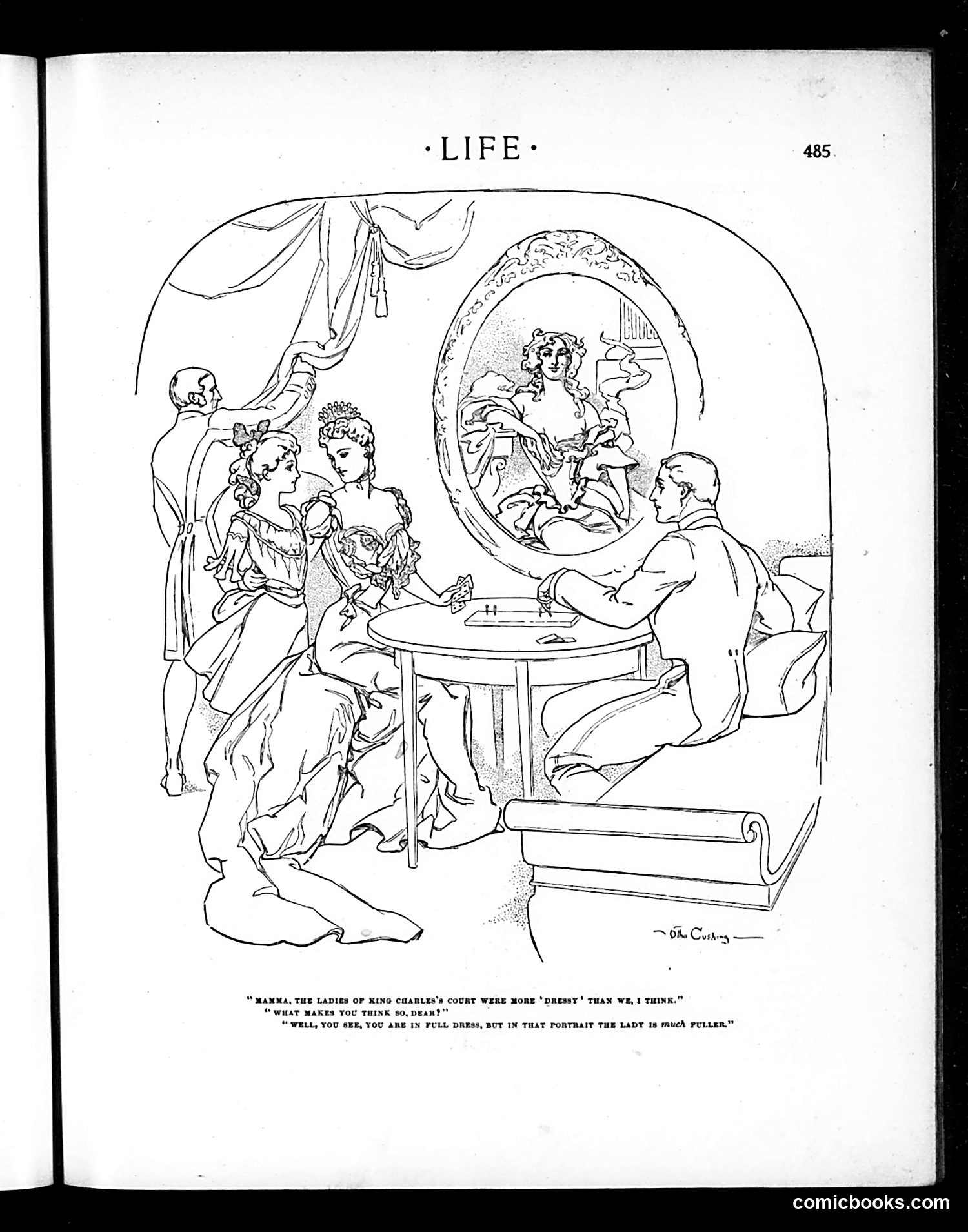
This cartoon satirizes fashion and social pretension at King Charles's court. A man viewing a portrait compliments two women on their elegant dress, but they protest that the portrait lady appears even more fashionably dressed. The man responds that despite the portrait subject's full formal gown, the women in front of him are "much fuller"—a cutting joke about their actual body size versus their clothing. The satire targets both vanity and the gap between fashionable appearance and reality. The reference to "King Charles's court" suggests this mocks aristocratic or royal society's obsession with appearance. The artist's signature appears to read "O.K. Cushing" or similar. The humor relies on a period audience recognizing courtly pretension as a worthy target.
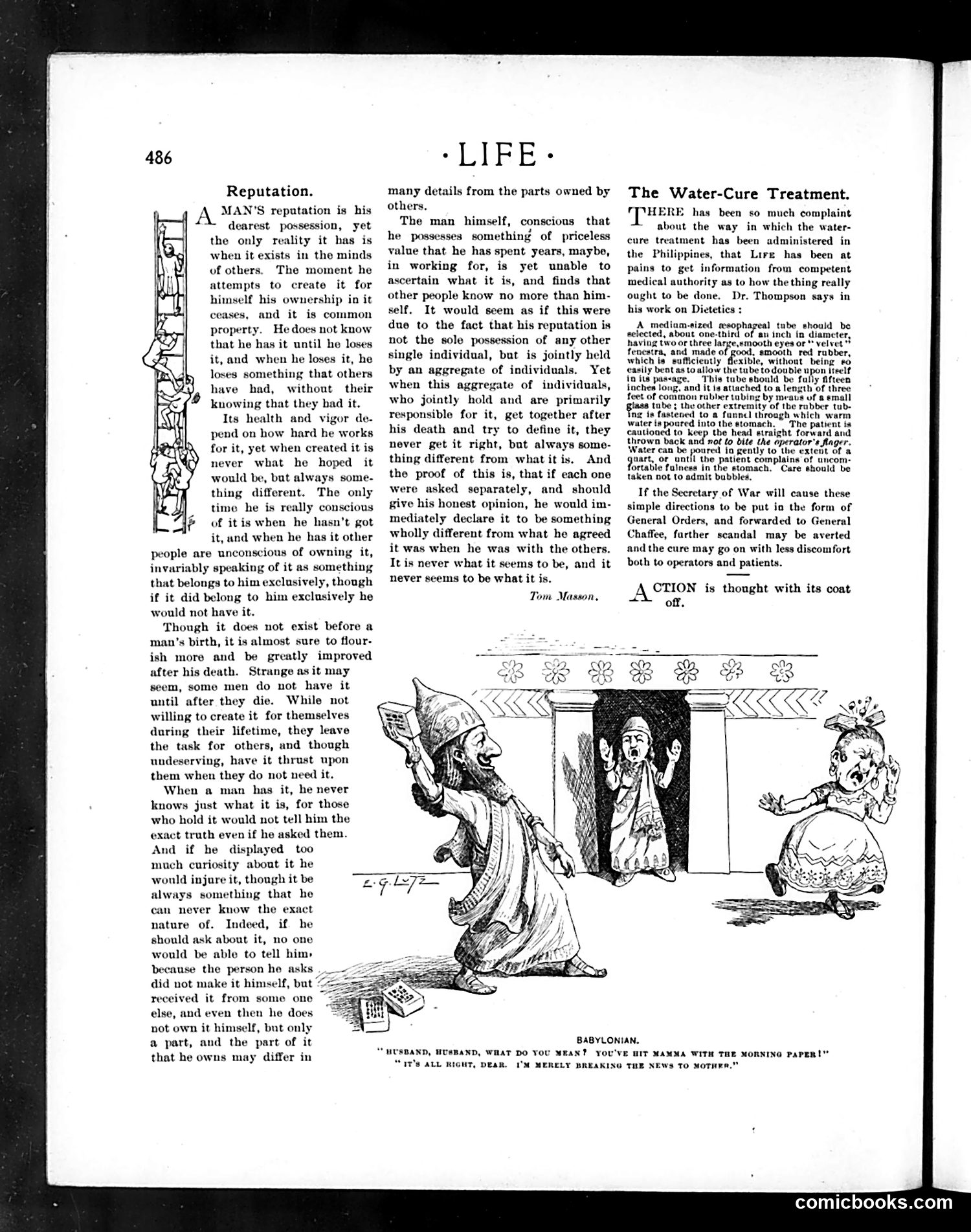
This page contains two distinct sections: **Left column ("Reputation"):** An essay about how a man's reputation is his most valued possession, yet paradoxically he cannot fully control or know it, since it exists primarily in others' minds. The piece explores this disconnect philosophically. **Right side:** A cartoon titled "Babylonian" showing what appears to be a man in ancient dress speaking to a woman, with the caption: "Husband, husband, what do you mean? You've hit mamma with the morning paper!" / "It's all right, dear. I'm merely breaking the news to mother." This is a domestic humor cartoon playing on the phrase "breaking the news"—literalizing it as physically striking someone with a newspaper. The "Babylonian" setting appears to be comedic anachronism, suggesting this marital dynamic is timeless.
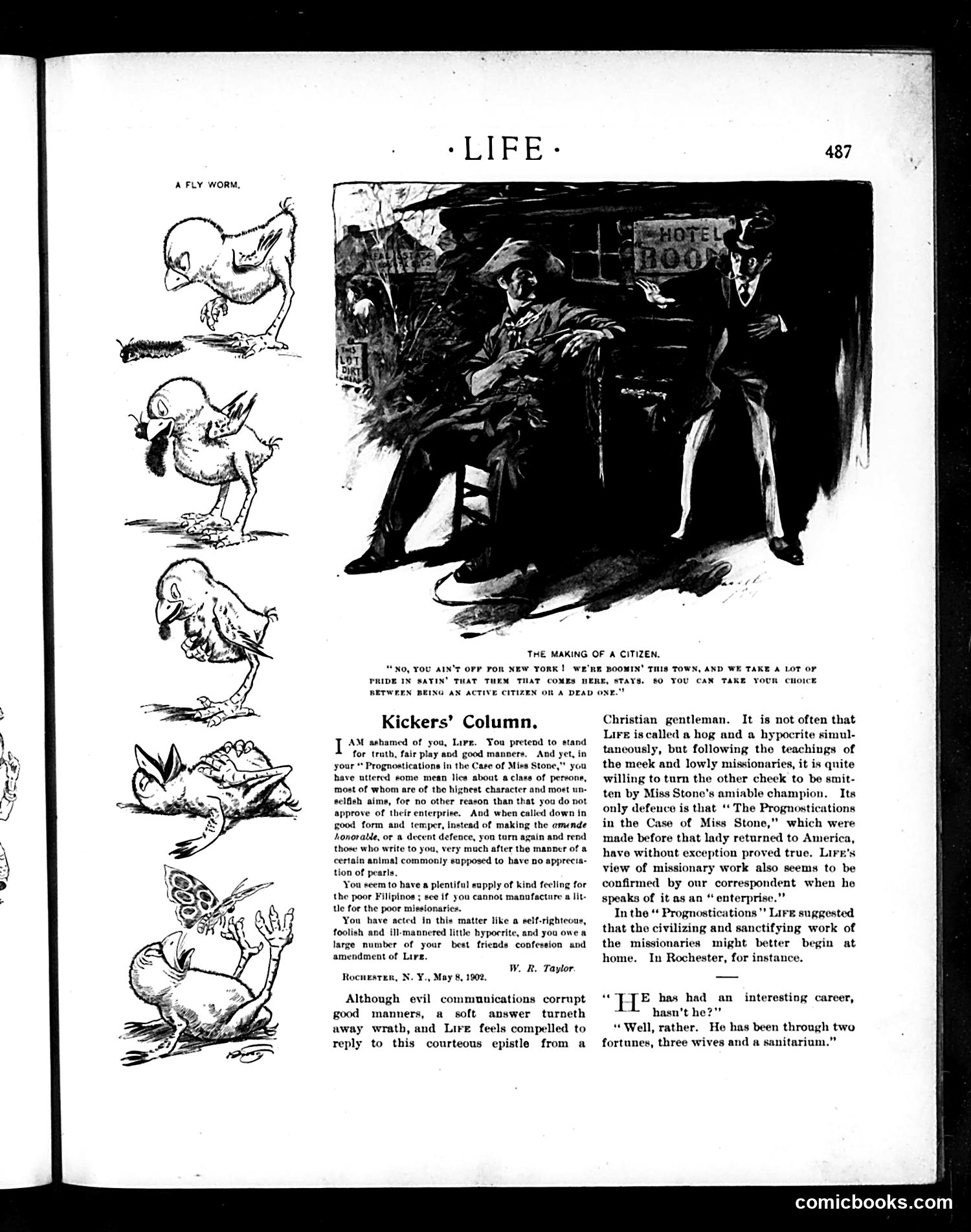
This page contains two distinct elements: **Left side:** A sequence of humorous illustrations labeled "A FLY WORM" showing a bird's awkward attempts to catch or consume a worm—satirizing clumsy or ineffective effort. **Right side:** "The Making of a Citizen"—a dark cartoon depicting men in a hotel room, apparently illustrating political corruption or bribery. The caption suggests cynicism about citizenship and civic participation being bought or manufactured rather than earned through genuine character. **Below:** "Kickers' Column," a letters section responding to previous articles about "Progressions in the Case of Miss Stone" and missionary work. The column criticizes hypocrisy among those claiming moral superiority while engaging in questionable practices. **Bottom joke:** A brief humorous exchange about someone's eventful personal history. The overall theme critiques institutional corruption and moral inconsistency in Gilded Age America.
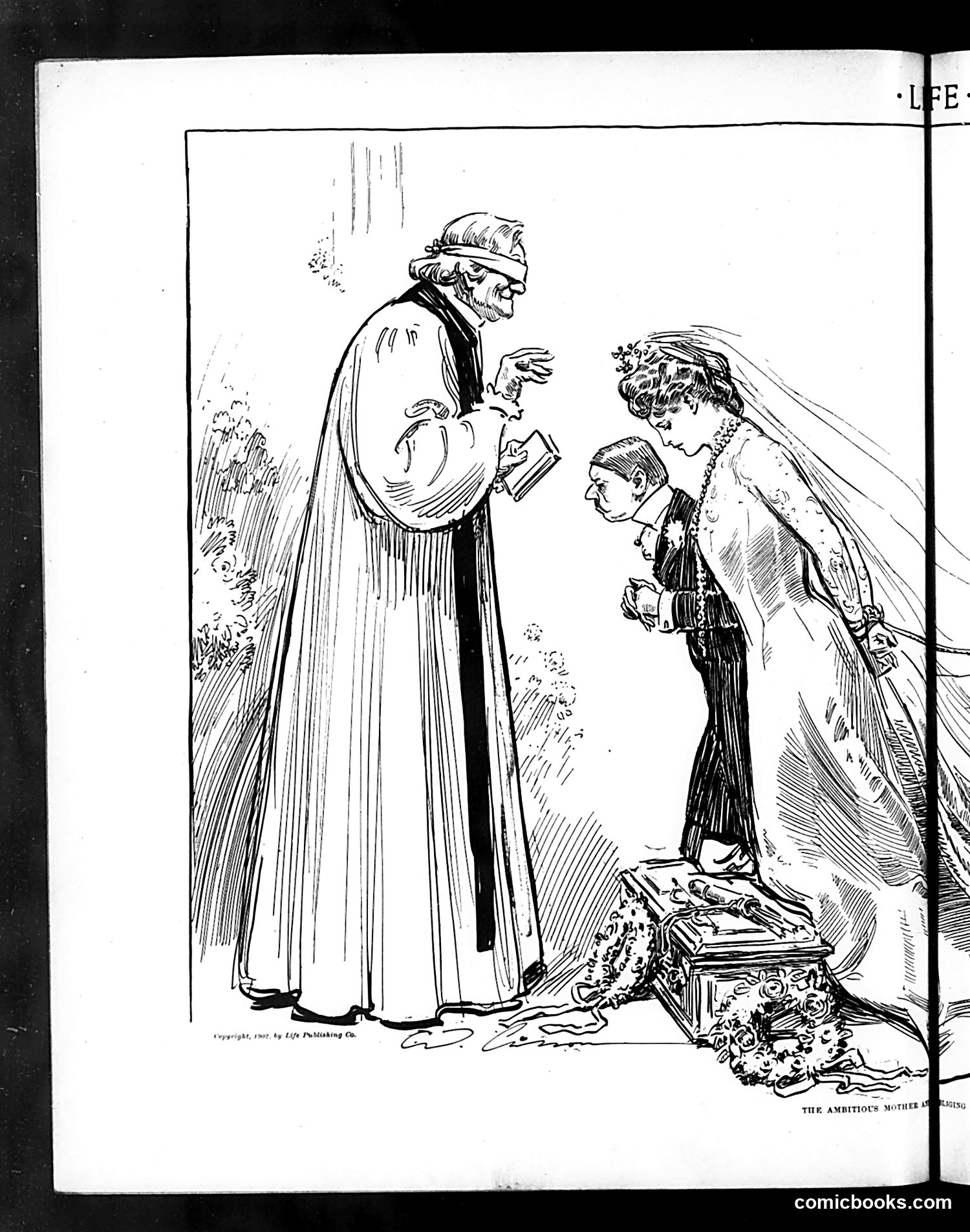
This cartoon satirizes an ambitious mother pushing her son forward socially. The tall, elderly woman in the cape appears to be a caricatured matriarch directing a young boy toward a bride in elaborate wedding dress. The caption "THE AMBITIOUS MOTHER MARRYING" suggests the joke: the mother is essentially orchestrating her son's marriage, treating it as her own social achievement rather than his romantic choice. The exaggerated features—the mother's sharp profile, the boy's reluctant expression—emphasize the humor. This reflects turn-of-the-century anxieties about overbearing mothers controlling their sons' lives and marriages for social advancement. The wealthy setting (ornate furniture, formal dress) suggests this critiques upper-class matchmaking practices where maternal ambition trumps genuine affection.
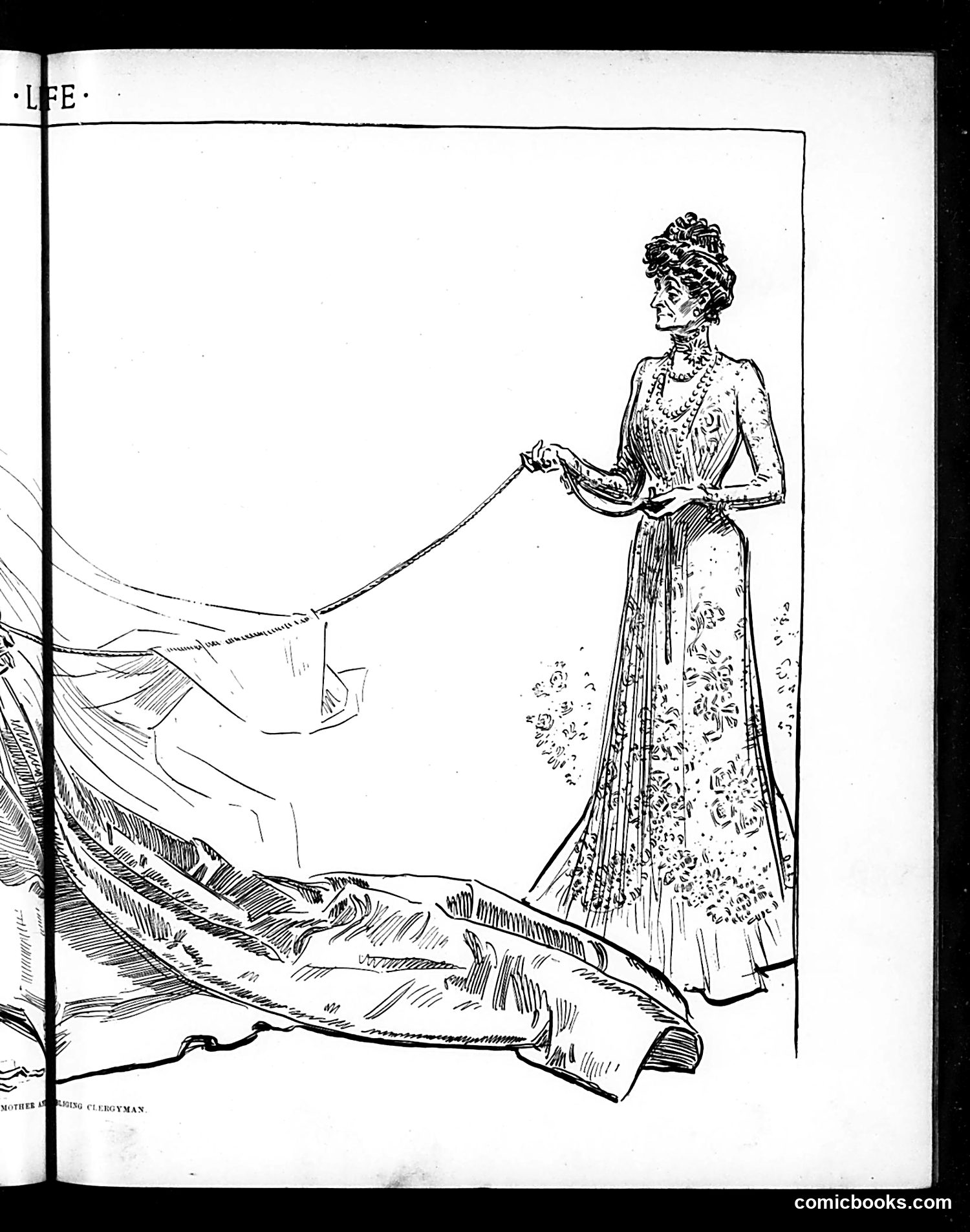
This is a single illustration from *Life* magazine showing a woman in an elegant Edwardian-era dress with elaborate upswept hair, pearl necklace, and ornate gown holding an extremely long train of fabric. The train extends dramatically across the page. The caption visible at bottom appears to reference "MOTHER RAISING CLERGYMAN" (though partially obscured). Without clearer text, the specific satirical point is difficult to determine with certainty. The exaggerated train length likely mocks either: 1) excessive fashion excess of the era, 2) a specific woman's notoriously long train, or 3) the impracticality of high society dress. The caption reference to "mother" and "clergyman" suggests possible social commentary about class pretension or family dynamics, but the exact target remains unclear from the visible information.
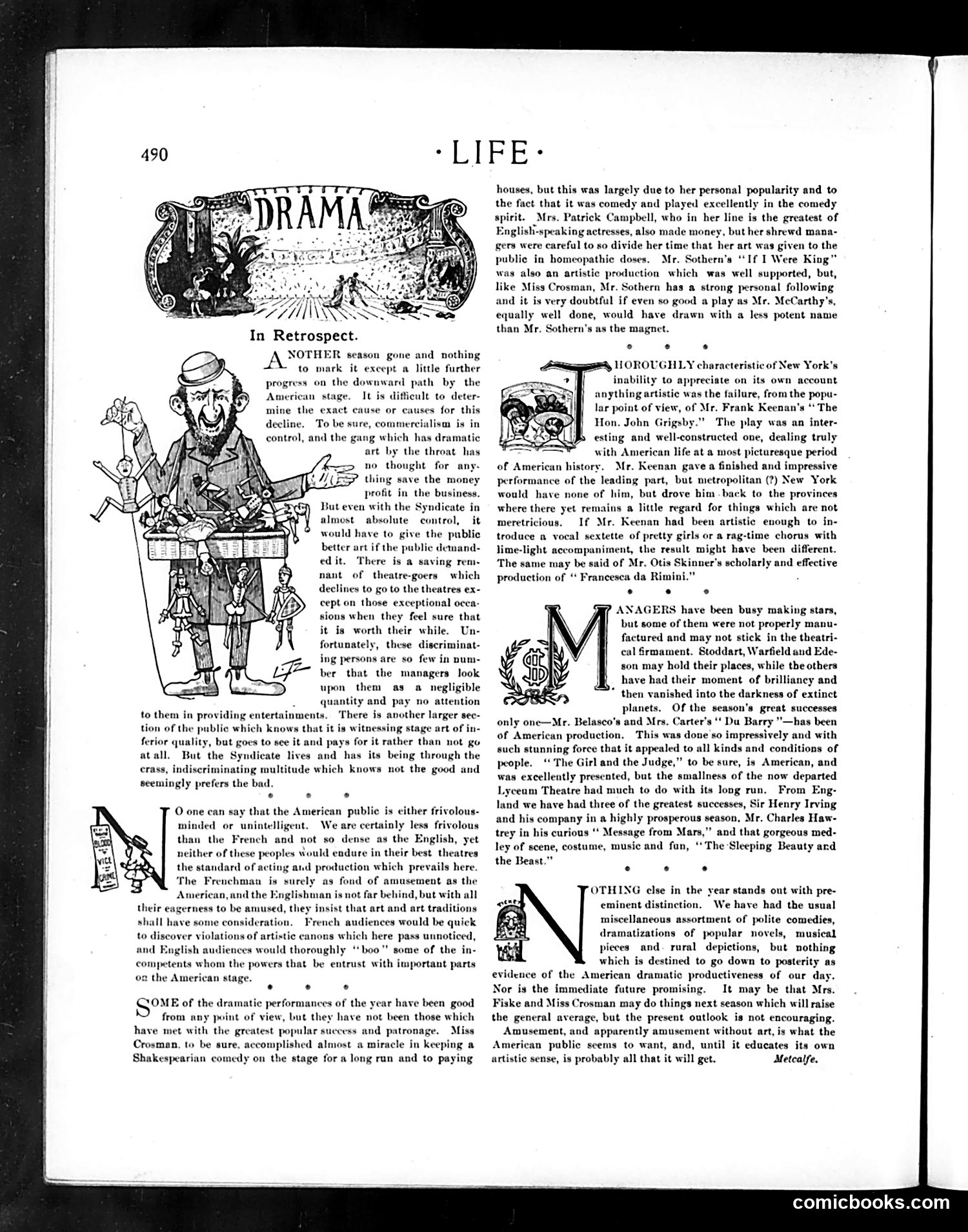
This page discusses the American theatrical season in review. The prominent cartoon shows a theatrical manager as a skeletal, desperate figure, literally propping up his failing business with actors/performers acting as supports beneath him—a visual metaphor for how heavily producers relied on star performers to keep productions financially afloat. The text criticizes commercialism dominating American theater and argues that the Syndicate (a major theatrical monopoly controlling distribution) forced managers to prioritize profit over artistic merit. It praises actress Miss Crosman's success maintaining Shakespearean comedy while lamenting that genuine artistic productions struggled financially compared to formulaic entertainments. The piece suggests American audiences preferred commercial spectacle to serious drama.
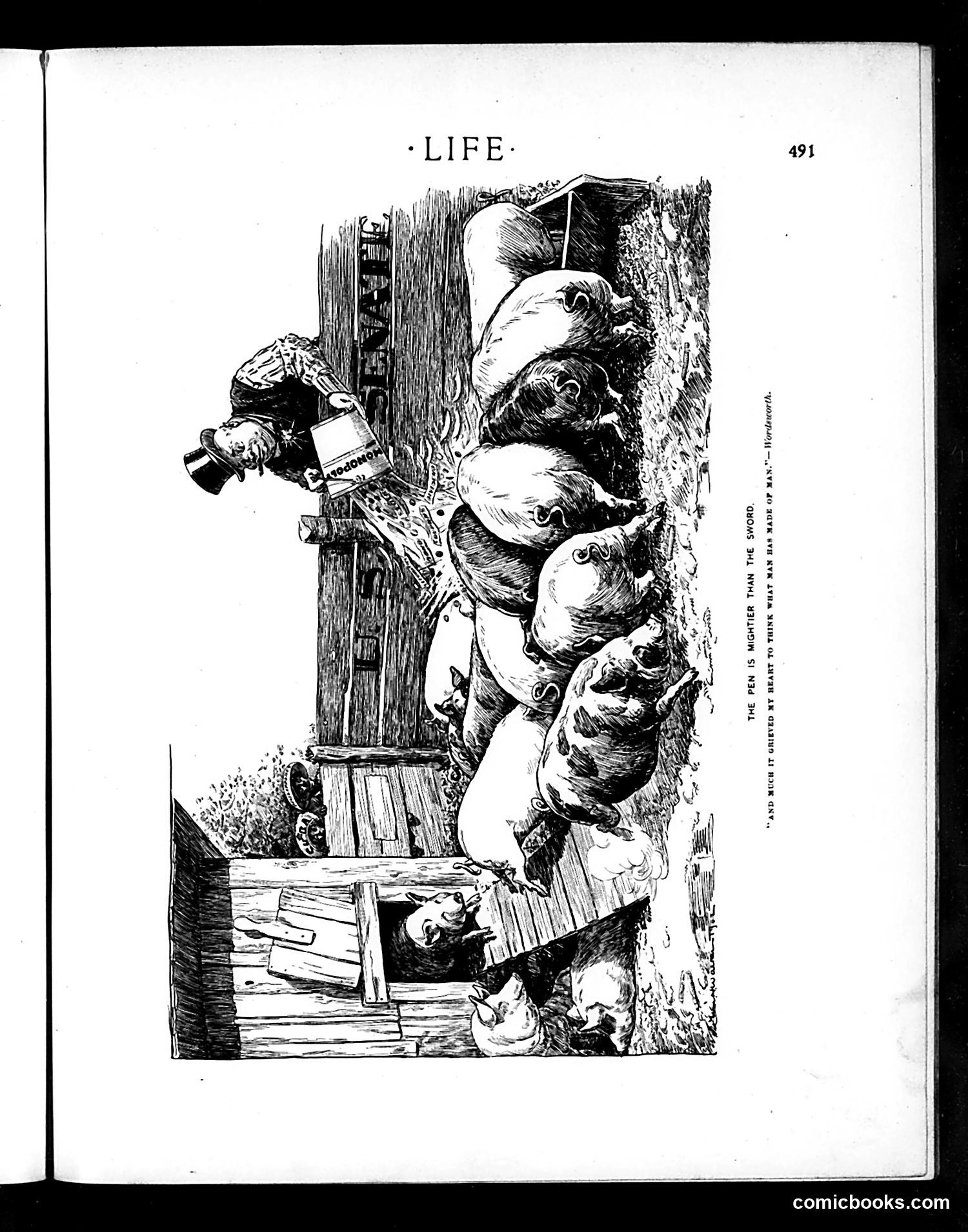
I can see this is page 491 from *Life* magazine featuring a detailed pen-and-ink illustration. The image appears to show multiple figures in what looks like a domestic or social scene, rendered in the satirical style characteristic of *Life*'s editorial cartoons. However, the OCR text is severely corrupted and unreadable, making it impossible to identify the specific political or social reference, the named figures being caricatured, or the intended satirical message. Without legible text or clear identifying labels in the image itself, I cannot reliably explain what contemporary event, politician, or social issue this cartoon addresses. To properly analyze this cartoon's meaning, I would need either clearer source text or additional context about the publication date.
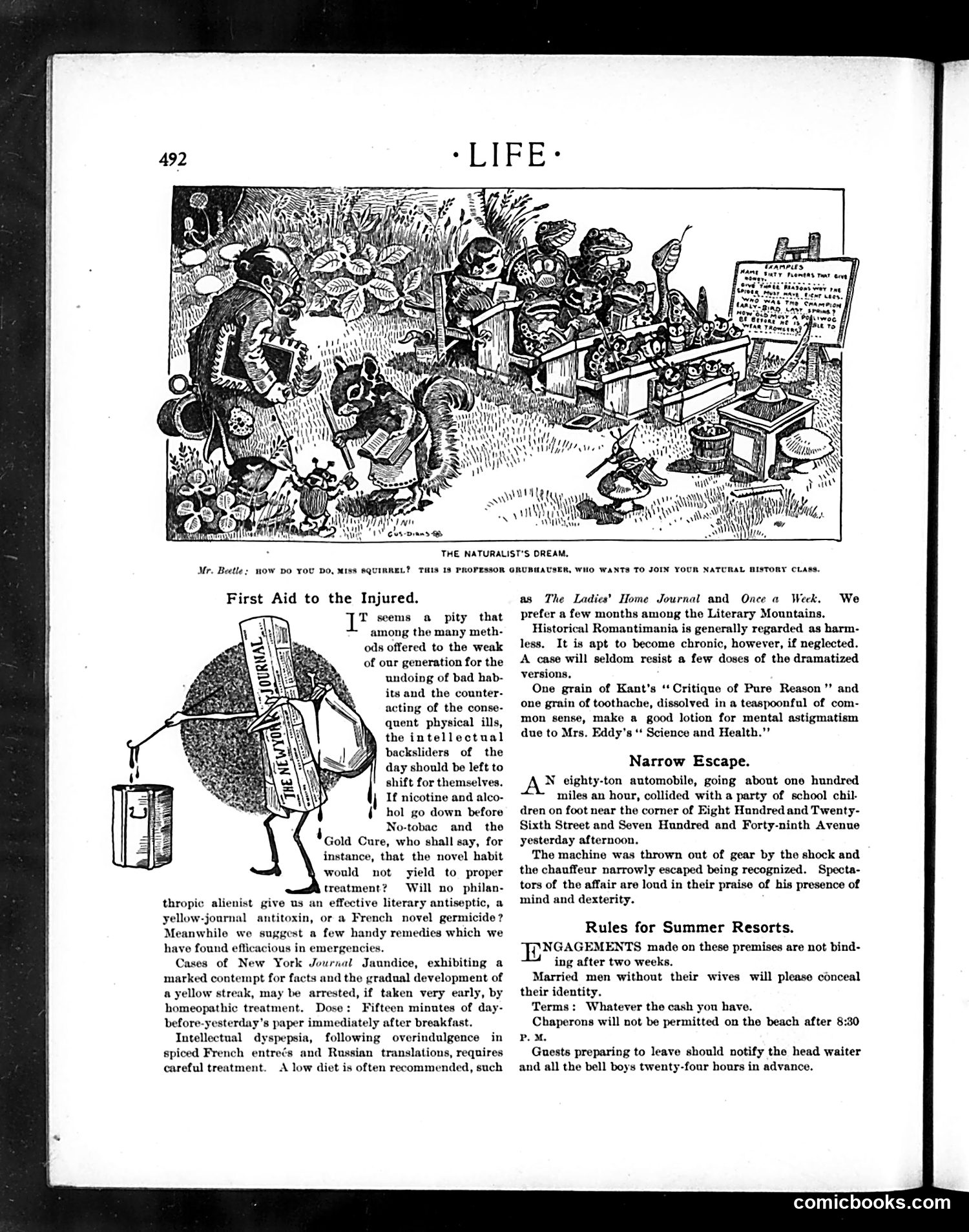
**"The Naturalist's Dream"** (top cartoon): A absurdist joke where Professor Gruenbauer attempts to join a natural history class alongside animals (Mr. Beetle, Miss Squirrel). The humor lies in treating the pompous professor as equivalent to fauna—mocking pretentious academics. **"First Aid to the Injured"** section satirizes popular self-help remedies of the era. It mocks: - The *New York Journal's* yellow journalism ("Jaundice") - Excessive French literature and Russian translations ("dyspepsia") - Historical romance obsession - Pseudointellectual fads (Kant, Christian Science/"Mrs. Eddy") The satirist suggests these cultural "diseases" need curing like nicotine addiction or alcoholism. **"Narrow Escape"**: Darkly satirizes wealthy automobile owners' recklessness—a child collision is treated as fortunate because the driver avoided "recognition" (legal accountability), praised for his composure. **"Rules for Summer Resorts"**: Mock etiquette mocking infidelity and class pretense among the wealthy leisure class. The page attacks intellectual charlatanry, yellow journalism, and upper-class hypocrisy.
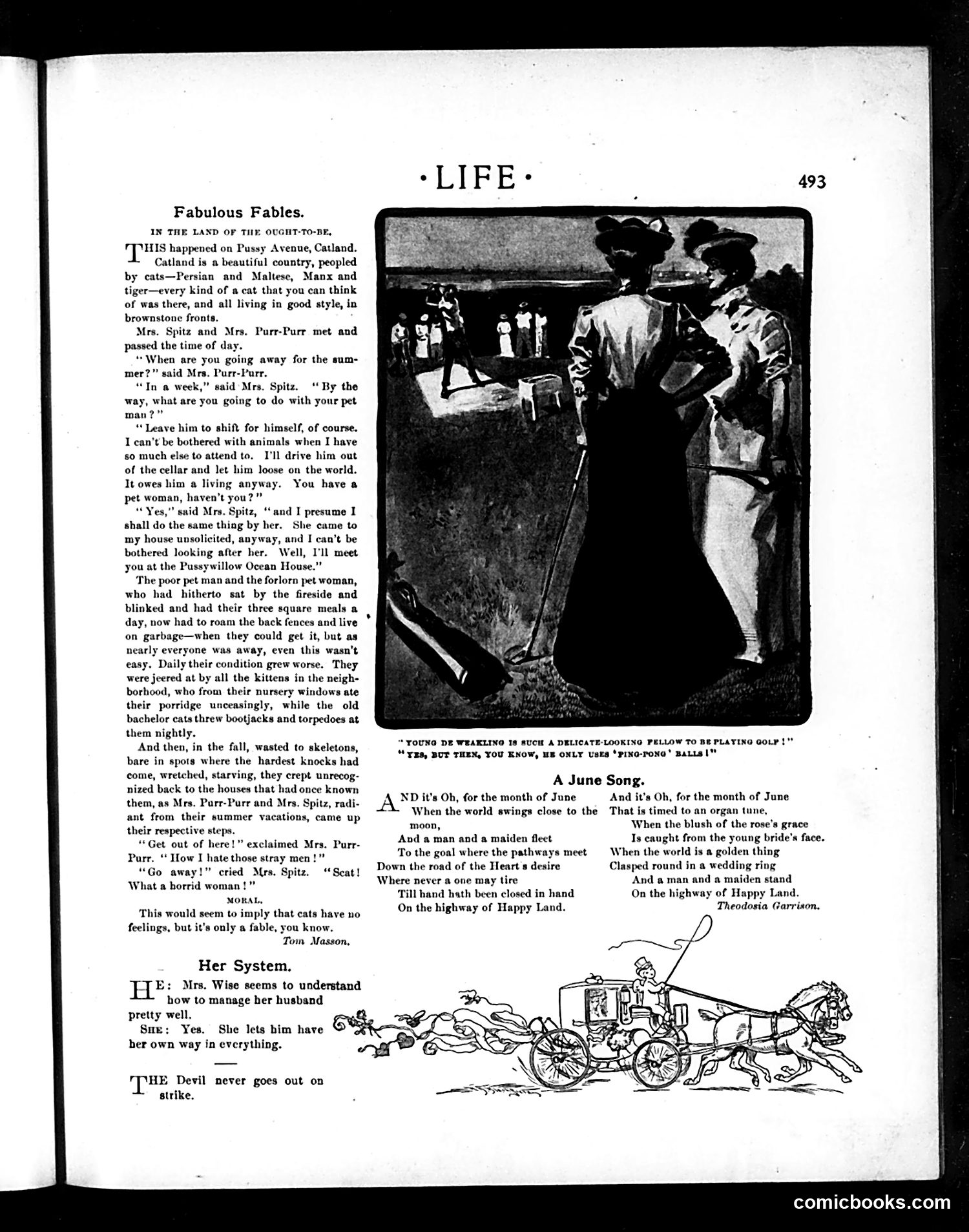
This fable inverts typical power dynamics: wealthy female cats ("Mrs. Spitz" and "Mrs. Purr-Purr") callously abandon their human servants—a man and woman—during summer vacation, driving them into destitution. The servants starve, are mocked by neighborhood children, and return skeletal and unrecognized. When the cats return refreshed, they angrily reject the desperate humans as "stray." The satire critiques upper-class women's indifference toward household servants and dependents. By casting women as the callous employers and humans as disposable staff, the story reverses typical hierarchies to highlight the cruelty of casual abandonment. The moral notes this describes cats having "no feelings"—suggesting the fable exposes moral failures in certain privileged women who treat their servants as interchangeable property rather than living beings deserving care.
This page contains three humorous anecdotes rather than a single political cartoon: 1. **"A Patriot"** - A poem satirizing hypocritical nationalism: a man loudly denounces his country's enemies, sings patriotic songs, displays the flag prominently, yet apparently avoids taxes or public service despite his wealth. The satire targets performative patriotism disconnected from actual civic contribution. 2. **The Episcopal Clergyman anecdote** - Humor from social embarrassment: a clergyman borrows his wife's petticoat as a makeshift cassock (clerical vestment), then is mortified when the Irish maid loudly demands its return in front of fashionable ladies. 3. **Lincoln and Navy anecdote** - Lincoln jokes that being President is easier than real life because one can always claim "it's only acting" if things go wrong. The page is primarily **humorous satirical content**, not political commentary on specific contemporary events. The Wilson Whiskey and other advertisements occupy substantial space, typical for Life's format.
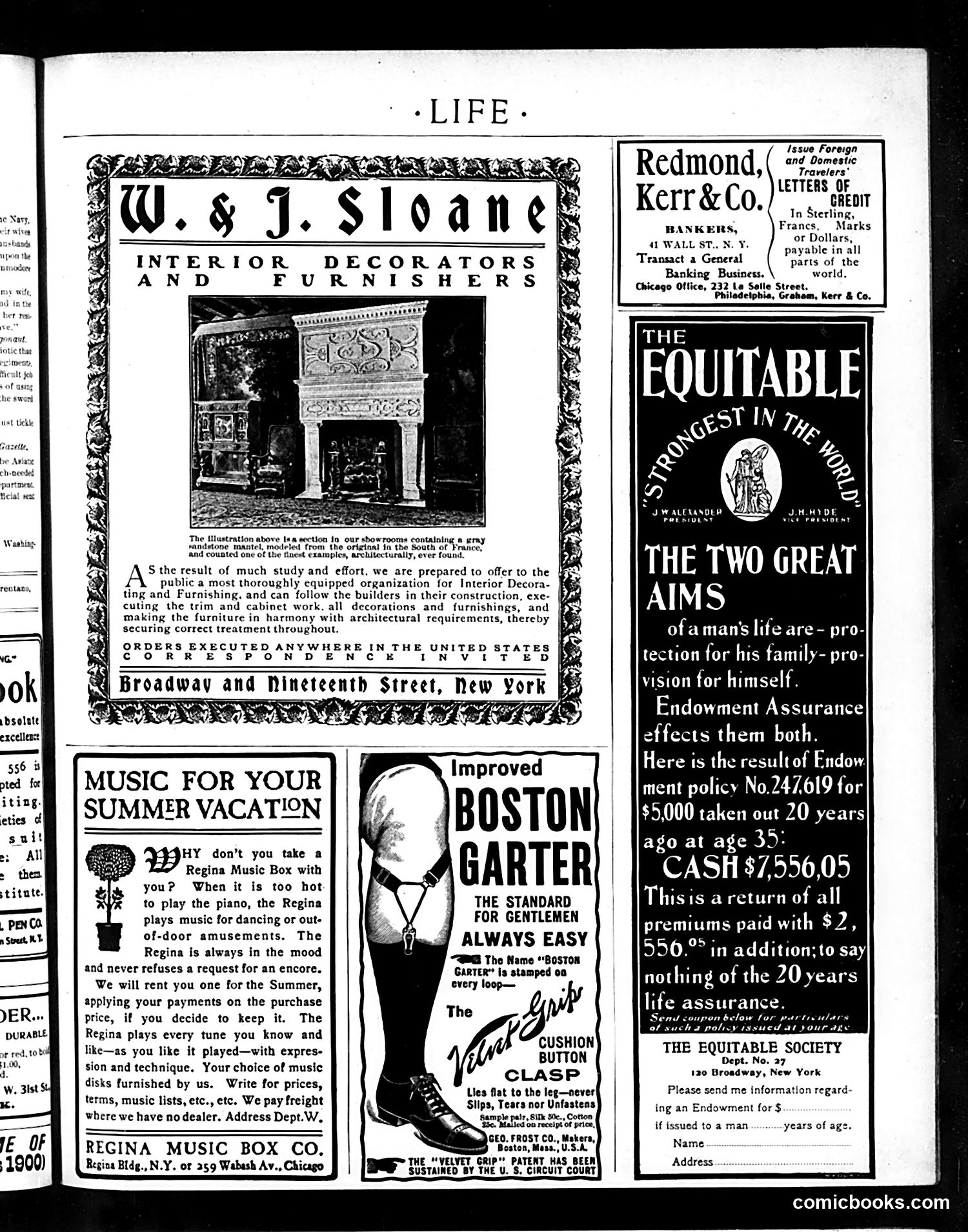
This is primarily an **advertising page** with no political cartoons or satirical content. The page showcases commercial advertisements typical of early 1900s America: **Key Advertisements:** 1. **W. & J. Sloane** (top): Interior decorators advertising high-end home furnishings and architectural trim work, emphasizing craftsmanship and nationwide service. 2. **Regina Music Box**: A rental service for mechanical music players—an entertainment technology for the wealthy before phonographs became standard. The pitch emphasizes convenience for summer vacations. 3. **Boston Garter**: Menswear accessory with a patented cushion-button clasp design, claiming superiority validated by U.S. court decision. 4. **The Equitable Society**: Life insurance/endowment assurance, demonstrating returns on a 20-year policy as evidence of financial security. 5. **Banking services** (Redmond, Kerr & Co.) The page reflects **Gilded Age consumer culture**: leisure activities, home luxury, life insurance as status symbol, and patent-protected innovations marketed to affluent Americans. No satire is evident.
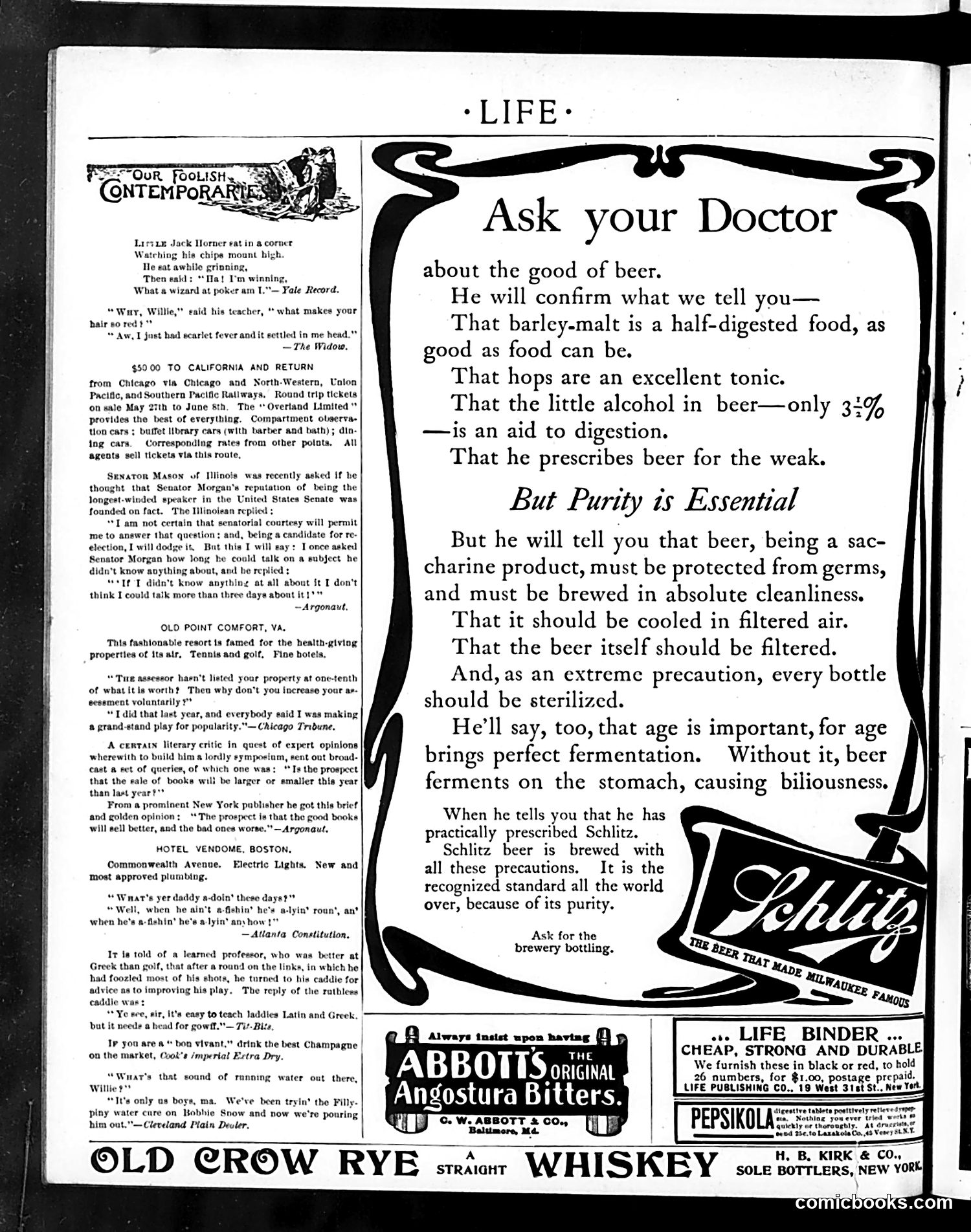
This page from *Life* magazine combines satirical commentary with period advertisements. The left column presents "Our Foolish Contemporaries"—humorous anecdotes mocking contemporary figures and ideas, including jabs at politicians (Senator Morgan's legendary verbosity) and social pretension. The dominant right-side advertisement for Schlitz beer uses pseudo-scientific rhetoric to market the product. It ironically frames beer as healthful, claiming doctors prescribe it and that its alcohol content (3½%) aids digestion. This reflects early-20th-century advertising that leveraged medical authority to legitimize alcohol consumption—a common practice before modern regulation. The Schlitz ad's emphasis on "purity" and sterilization reflects Progressive Era concerns about food safety and manufacturing standards. Other ads for whiskey and patent medicines appear below, typical of the era's unregulated advertising landscape. Together, the page satirizes contemporary foolishness while showcasing how businesses exploited scientific-sounding claims to sell products that would later face strict regulation.
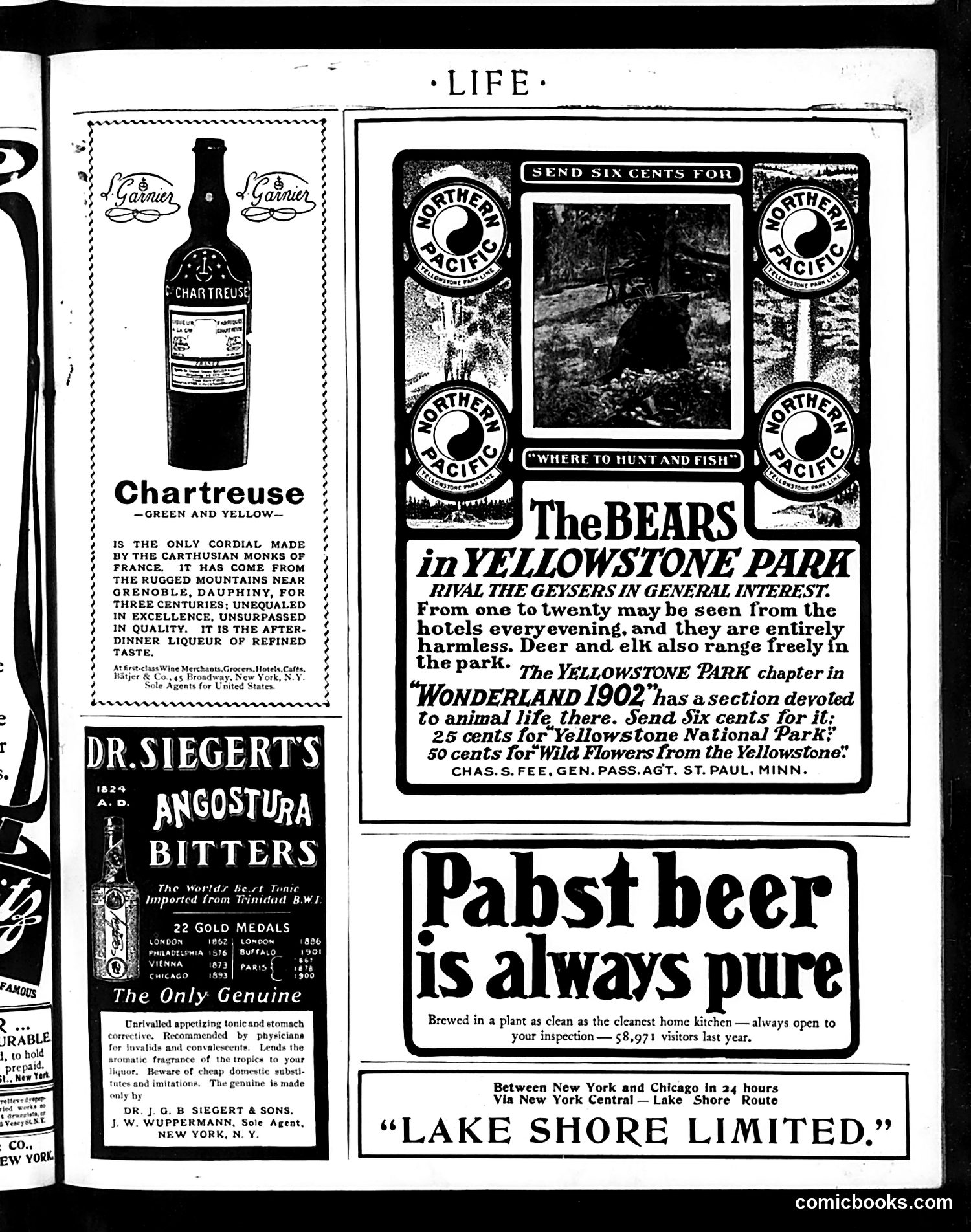
This page is **primarily advertising**, not satirical content. It contains four product advertisements: 1. **Chartreuse liqueur** — marketed as an exclusive French cordial made by Carthusian monks, emphasizing its centuries-old heritage and refined taste. 2. **Dr. Siegert's Angostura Bitters** — positioned as a medicinal tonic imported from Trinidad, claiming 22 gold medals and recommending it for invalids and convalescents. 3. **"The Bears in Yellowstone Park"** — promoting a tourism guide book from *Wonderland 1902*, advertising bears, geysers, and wildlife viewing as tourist attractions. 4. **Pabst Beer** — emphasizing purity and cleanliness, claiming 58,971 annual visitors to their brewery for inspection. 5. **Lake Shore Limited railway** — advertising fast travel between New York and Chicago. The page reflects early 1900s consumer culture, targeting affluent readers with luxury imports, health tonics, and tourism opportunities. There is no discernible political satire or cartoon commentary present.
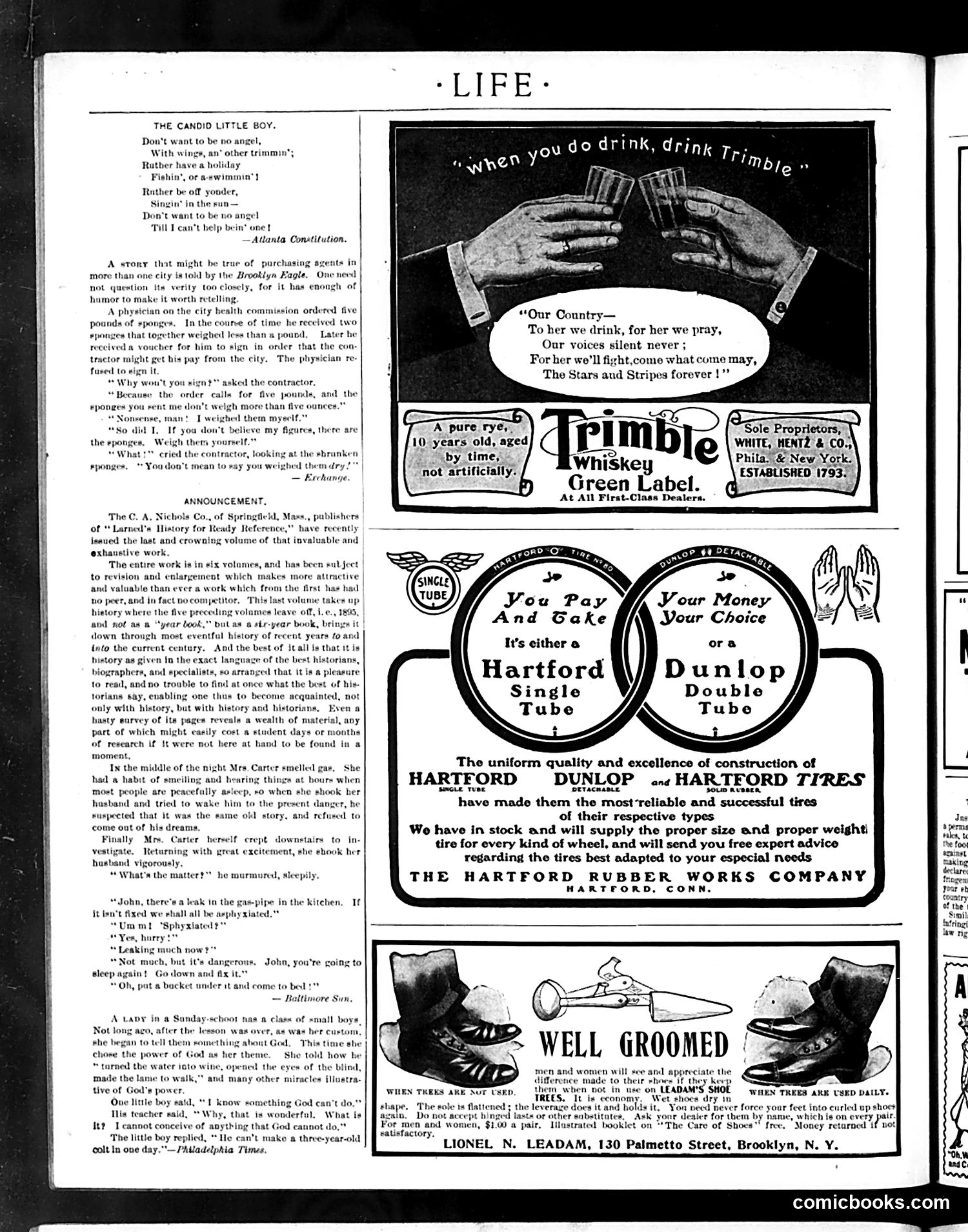
This page from *Life* magazine contains three satirical anecdotes and period advertisements. **"The Candid Little Boy"** opens with a humorous poem about childhood honesty, followed by a story mocking municipal corruption: a city health official orders five pounds of sponges but receives only one pound's worth. When asked to sign off on payment anyway, he refuses—exposing graft in city contracting. The satire highlights how government waste occurs through collusion between officials and contractors. **The second anecdote** humorously depicts marital dynamics: Mrs. Carter suspects a gas leak at night; her husband dismisses her concerns until she threatens to investigate herself, prompting his grudging action. This reflects period gender dynamics and domestic comedy. **The third story** features a Sunday school lesson where a child, asked what God cannot do, replies: "make a three-year-old colt in one day"—a joke about biological impossibility presented as theological challenge. The page is otherwise dominated by period advertisements for Trimble Whiskey, Hartford and Dunlop tires, and "Well Groomed" shoes—typical commercial content filling magazine space.
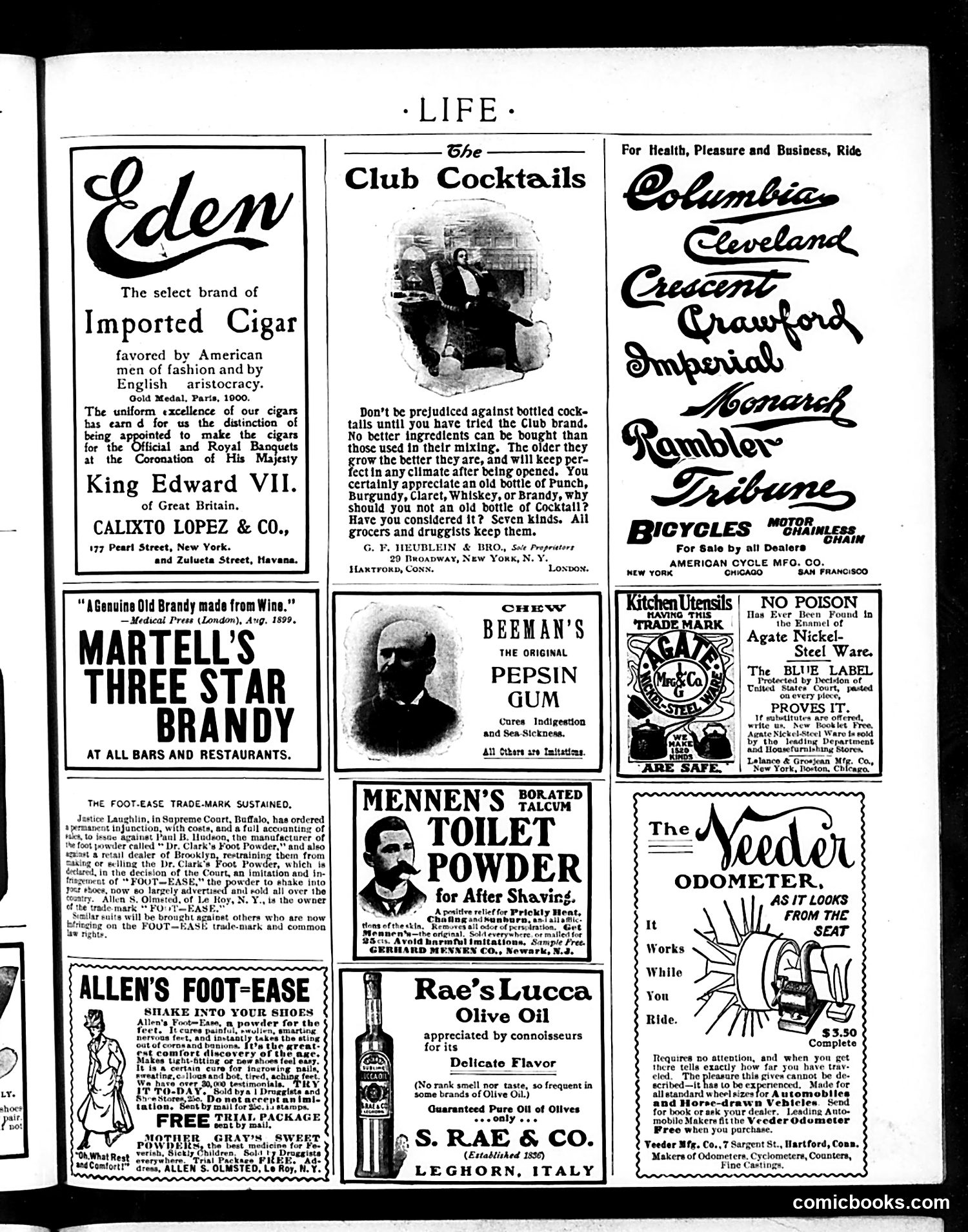
This is primarily an **advertisement page** from an early 1900s issue of *Life* magazine, not a political cartoon. It contains no satire or social commentary—just product promotions typical of the era. The ads reflect **Edwardian-era consumer culture**: imported cigars appointed for King Edward VII's coronation banquets (emphasizing British prestige), brandy, cocktails, bicycles, and various patent medicines and personal-care products (pepsin gum for digestion, foot powder, talc powder, olive oil). Notable to modern readers: the casual marketing of products later recognized as problematic—foot powders and talc without acknowledging health risks, and patent medicines making dubious medicinal claims. The page also reflects the era's class consciousness, with emphasis on aristocratic approval and "fashion." The **Veeder Odometer** ad is the most interesting substantively—an early automotive device measuring distance traveled, marketed as a novelty for the emerging automobile industry. This is essentially a historical artifact of consumer advertising and product claims from approximately 1900-1910.
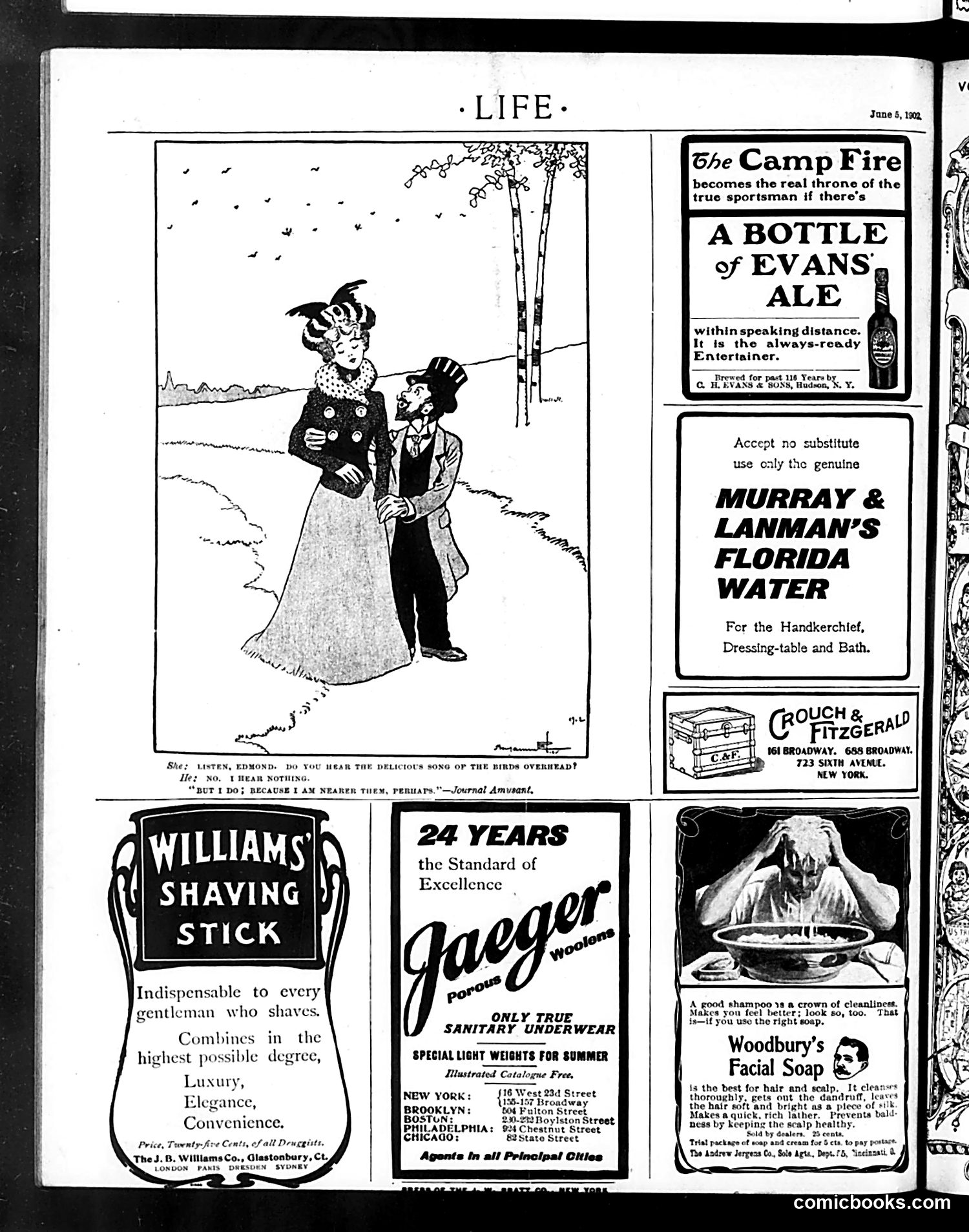
The main cartoon depicts a romantic outdoor scene: a fashionably dressed woman and man standing in a countryside setting with birds flying overhead. The woman says she hears birds singing; the man claims he hears nothing but says "I am nearer them, perhaps"—a flirtatious double entendre suggesting proximity grants special perception. The joke credits the *Journal Amusant*, a French publication, indicating Life was reprinting Continental humor. The page is otherwise dominated by period advertisements for gentlemen's grooming and luxury goods: Evans Ale (positioned as essential to camping), Williams Shaving Stick, Jaeger sanitary underwear, Murray & Lanman's Florida Water, Crouch & Fitzgerald luggage, and Woodbury's Facial Soap. These ads reflect early-1900s male consumer culture and the marketing of personal hygiene products—then relatively novel commercial categories.