
Life, 1902-06-05 · page 12 of 22
Life — June 5, 1902 — page 12: what you’re looking at
What you’re looking at
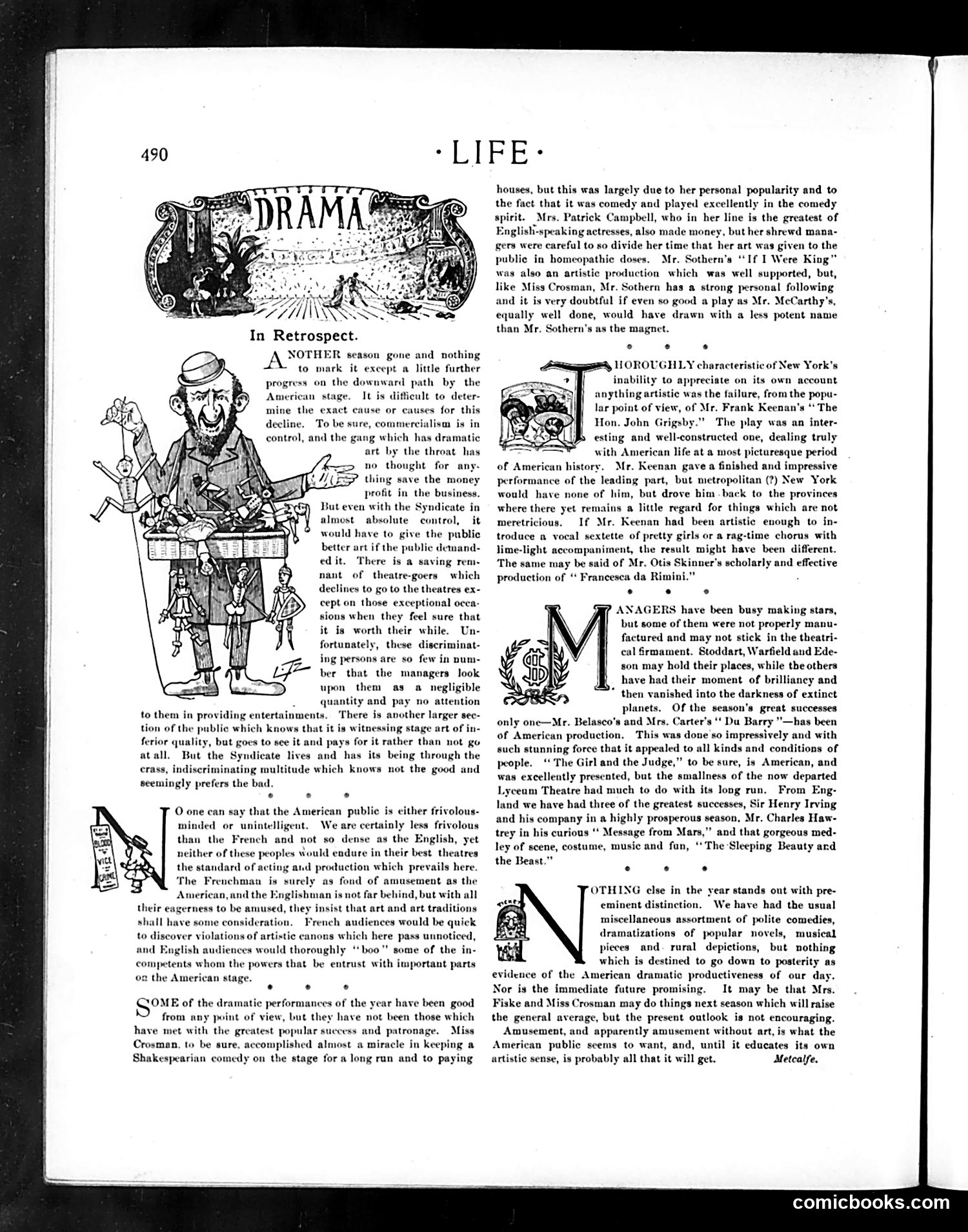
This page discusses the American theatrical season in review. The prominent cartoon shows a theatrical manager as a skeletal, desperate figure, literally propping up his failing business with actors/performers acting as supports beneath him—a visual metaphor for how heavily producers relied on star performers to keep productions financially afloat. The text criticizes commercialism dominating American theater and argues that the Syndicate (a major theatrical monopoly controlling distribution) forced managers to prioritize profit over artistic merit. It praises actress Miss Crosman's success maintaining Shakespearean comedy while lamenting that genuine artistic productions struggled financially compared to formulaic entertainments. The piece suggests American audiences preferred commercial spectacle to serious drama.
📄 Transcribed text from this page (OCR, searchable)
Machine-transcribed from the original scan — historical spelling and the odd misread are preserved.
* LIFE In Retrospect. NOTHER season gone and nothing J to mark it exce pt a little further progress on the downward path by the It is difficult to deter- es for this American stage. the exact cause or ¢: . commercialism is in control, and the gang which has dramatic art by the throat has => no thought for any. thing save the money profit in the business. But even with the Syndicate in almost absolute control, it would have to give the publ better art if the public demand- edit. There is a saving rem- nant of theatre-goers which declines to go to the theatres ex- cept on those exceptional ocea- sions when they feel sure that it is worth their while. Un- fortunately, these discriminat- ing persons are so few in num- ber that the managers look them as a negligible _ quantity and pay no attention to them in providing entertainments, There is another larger sec- tion of the public which knows that it is witnessing stage art of in- ferior qual but goes to see it and pays for it rather than not go atall. But the Syndicate lives and has its being through the crass, indiscriminating multitude which knows not the good and seemingly prefers the bad. . e * O one can say that the American public is either frivolous- minded or unintelligent. We are certainly less frivolous than the French and not so dense as the English, yet neither of these peoples Would endure in their best theatres the standard of acting and production which prevails here. ‘hman is surely as fond of amusement as the American, and the Englishman is not far behind, but with all their eagerness to be amused, they insist that art and art traditions ¢ consideration. French audiences would be quick ations of artistic canons which here pass unnoticed, and English audiences would thoroughly “boo” some of the competents whom the powers that be entrust with important parts on the American stage. 7 COME of the dramatic performances of the year have been good from any point of view, but they have not been those which have met with the greatest popular success and patronage. Miss Crosman, to be sure, accomplished almost a miracle in ke ig a Shakespearian comedy on the stage for a long run and to paying houses, but this was largely due to her personal popularity and to the fact that it was comedy and played excellently in the comedy spirit. Mrs. Patrick Campbell, who in her line is the greatest of English-speaking actresses, also made money, but her shrewd mana- gers were careful to so divide her time that her art was given to the public in homeopathic doses. Mr. Sothern’s ‘If I Were King” was also an artistic production which was well supported, but, like Miss Crosman, Mr. Sothern has a strong personal following and very doubtful if even so good a play as Mr. McCarthy's, equally well done, would have drawn with a less potent name than Mr. Sothern’s as the magnet. 4, HOROUGHLY charact inability to appreciate on its own account anything artistic was the failure, from the popu- lar point of view, of Mr. Frank Keenan's “ The Hon. John Grigsby.” ‘The play was an inter- esting and well-constructed one, dealing truly with American life at a most picturesque period of American history. Mr. Keenan gave a finished and impressive performance of the leading part, but metropolitan (?) New York would have none of him, but drove him back to the provinces where there yet remains a little regard for things which are not meretricious. If Mr. Keenan had been artistic enough to in- troduce a vocal sextette of pretty girls or a rag-time chorus with lime-light accompaniment, the result might have been different. The same may be said of Mr. Otis Skinner's scholarly and effective production of “ Francesca da Rimini. . . ° ANAGERS have been busy making stars, but some of them were not properly manu- factured and may not stick in the theatri- cal firmament. Stoddart, Warfield and Ede- son may hold their places, while the others have had their moment of brilliancy and then vanished into the darkness of extinct planets. Of the season's great successes only one—Mr. Belasco’s and Mrs. Carter's ‘ Du Barry "—has been of American production. This was done so impressively and with such stunning force that it appealed to all kinds and conditions of people. “The Girl and the Judge,” to be sure, is American, and was excellently presented, but the smallness of the now departed Lyceum Theatre had much to do with its long run. From Eng- land we have had three of the greatest successes, Sir Henry Irving and his company in a highly prosperous season, Mr. Charles Haw- trey in his curious “* Message from Mars,” and that gorgeous med- ley of scene, costume, music and fan, “The Sleeping Beauty and the Beast.” ic of New York's e . . OTHING clse in the year stands out with pre- eminent distinction. We have had the usual miscellaneous assortment of polite comedies, dramatizations of popular novels, musical pieces and. rural depictions, but nothing which is destined to go down to posterity as veil evidence of the American dramatic productiveness of our day. Nor is the immediate future promising. It may be that Mrs. and Miss Crosman may do things next season which will raise the general average, but the present outlook is not encouraging. Amusement, and apparently amusement without art, is what the American public seems to want, and, until it educates its own artistic sense, is probably all that it will get. Metcalfe. comicbooks.com