
Life, 1902-06-05 · page 4 of 22
Life — June 5, 1902 — page 4: what you’re looking at
What you’re looking at
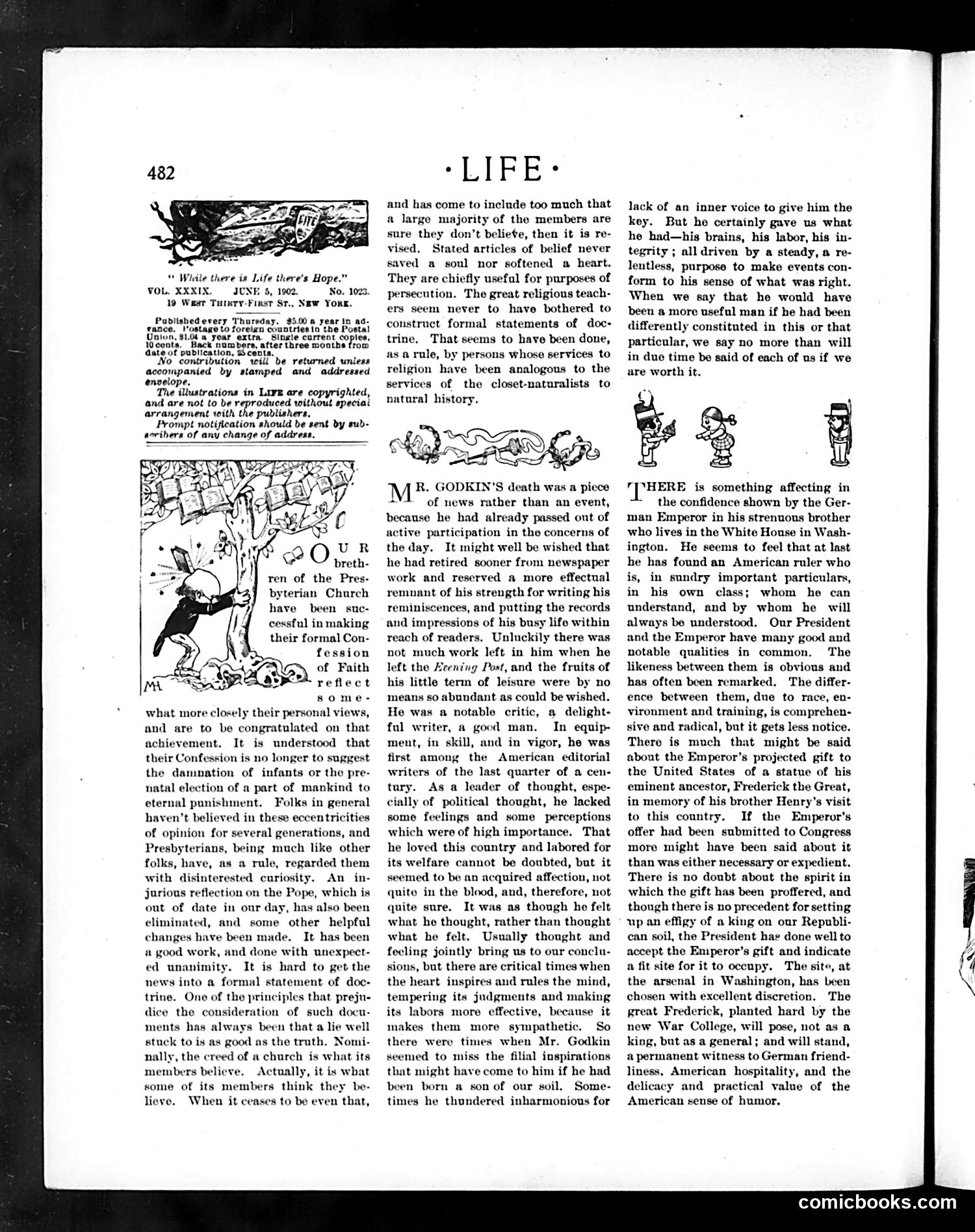
This page from *Life* magazine (June 5, 1902) contains a political cartoon and editorial text about Mr. Godkin's death and the German Emperor's gift to America. The cartoon appears to show a figure (likely representing a Presbyterian minister or religious leader) in the left margin, though the specific satirical point is unclear from the image quality. The main text discusses Godkin's passing and his career as a newspaper editor and influential American intellectual. The right column focuses on the German Emperor's gift of Frederick the Great's statue to the United States, praising it as a gesture of goodwill between nations. The author argues this demonstrates the Emperor understands American values and character. The satire seems to concern debates about accepting foreign gifts and what they signify about American autonomy and international relations during the early 20th century.
📄 Transcribed text from this page (OCR, searchable)
Machine-transcribed from the original scan — historical spelling and the odd misread are preserved.
“* Wheile there is Life there's Hope.” VOL. XXXIX. JUNE 5, 1902. No. 1023. 19 Wasr Turxry-First St., NEw YORE. Pablishedevery Thursday. $5.00 a year in ad. vance, Hostage to foreign count to the Postal Union, $1.06 a year extra. Single current copies. Weer Back numbers, after three months from Gate of publication, sscents. ‘No contribution twill be returned unless accompanied by stamped and addressed envelope. The illustrations in Lure are copyrighted, and are not to be reproduced without special arrangement with the publishers. Prompt notification should be sent by sub- sorihers of any change of address. UR oe) O breth- ren of the Pres- byterian Church have been suc- cessful in making their formal Con- fession teh ea Gy of Faith Mm eG SRA reflect some- what more closely their personal views, and are to be congratulated on that achievement. It is understood that their Confession is no longer to suggest the damnation of infants or the pre- natal election of a part of mankind to eternal punishment. Folks in general haven't believed in these eccentricities of opinion for several generations, and Presbyterians, being much like other folks, have, as a rule, regarded them with disinterested curiosity. An in- jurions reflection on the Pope, which is out of date in our day, has also been eliminated, and some other helpful changes have been made, It has been a good work, and done with unexpect- ed unanimity. It is hard to get the news into a formal statement of doc- trine. One of the principles that preju- dice the consideration of such docu- ments has always been that a lie well stuck to is as good as the truth, Nomi- nally, the creed of a church is what its members believe. Actually, it is what some of its members think they be- lieve. When it ceases to be even that, ‘LIFE « and has come to include too much that a large majority of the members are sure they don't beliete, then it is re- vised. Stated articles of belief never saved a soul nor softened a heart. They are chiefly usefal for purposes of persecution. The great religious teach- ers seem never to have bothered to construct formal statements of doc- trine. That seems to have been done, as arule, by persons whose services to religion have been analogous to the services of the closet-naturalists to natural history. N R, GODKIN'’S death was a piece - of news rather than an event, because he had already passed out of active participation in the concerns of the day. It might well be wished that he had retired sooner from newspaper work and reserved a more effectual remnant of his strength for writing his reminiscences, and putting the records and impressions of his busy life within reach of readers, Unluckily there was not much work left in him when he left the Ecening Post, and the fruits of his little term of leisure were by no means so abundant as could be wished. He was a notable critic, 9 delight- ful writer, a good man. In equip- ment, in skill, and in vigor, he was first among the American editorial writers of the last quarter of a cen- tury. As a leader of thought, espe- cially of political thought, he lacked some feelings and some perceptions which were of high importance. That he loved this country and labored for its welfare cannot be doubted, but it seemed to be an acquired affection, not quite in the blood, and, therefore, not quite sure. It was as though he felt what he thought, rather than thought what he felt. Usually thought and fecling jointly bring us to our conclu- sions, but there are critical times when the heart inspires and rules the mind, tempering its judgments and making its labors more effective, because it makes them more sympathetic. So there were times when Mr. Godkin seemed to miss the filial inspirations that might have come to him if he had been born a son of our soil, Some- times he thundered inharmonious for lack of an inner voice to give him the key. But he certainly gave us what he had—his brains, his labor, his in- tegrity ; alldriven by a steady, a re- lentless, purpose to make events con- form to his sense of what was right. When we say that he would have been a more useful man if he had been differently constituted in this or that particular, we say no more than will in due time be said of each of us if we are worth it. "THERE is something affecting in the confidence shown by the Ger- man Emperor in his strenuous brother who lives in the White House in Wash- ington. He seems to feel that at last he has found an American ruler who is, in sundry important particulars, in his own class; whom he can understand, and by whom he will always be understood. Our President and the Emperor have many good and notable qualities in common, The likeness between them is obvious and has often been remarked. The differ- ence between them, due to race, en- vironment and training, is comprehen- sive and radical, but it gets less notice. There is much that might be said about the Emperor’s projected gift to the United States of a statue of his eminent ancestor, Frederick the Great, in memory of his brother Henry’s visit to this country. If the Emperor's offer had been submitted to Congress more might have been said about it than was either necessary or expedient, There is no doubt about the spirit in which the gift has been proffered, and thongh there is no precedent for setting ‘up an effigy of a king on our Republi- can soil, the President hae done well to accept the Emperor's gift and indicate a fit site for it to occupy. The site, at the arsenal in Washington, has been chosen with excellent discretion. The great Frederick, planted hard by the new War College, will pose, not as a king, but as a general; and will stand, a permanent witness to German friend- liness, American hospitality, and the delicacy and practical value of the American sense of humor, comicbooks.com