
Life, 1902-06-05 · page 8 of 22
Life — June 5, 1902 — page 8: what you’re looking at
What you’re looking at
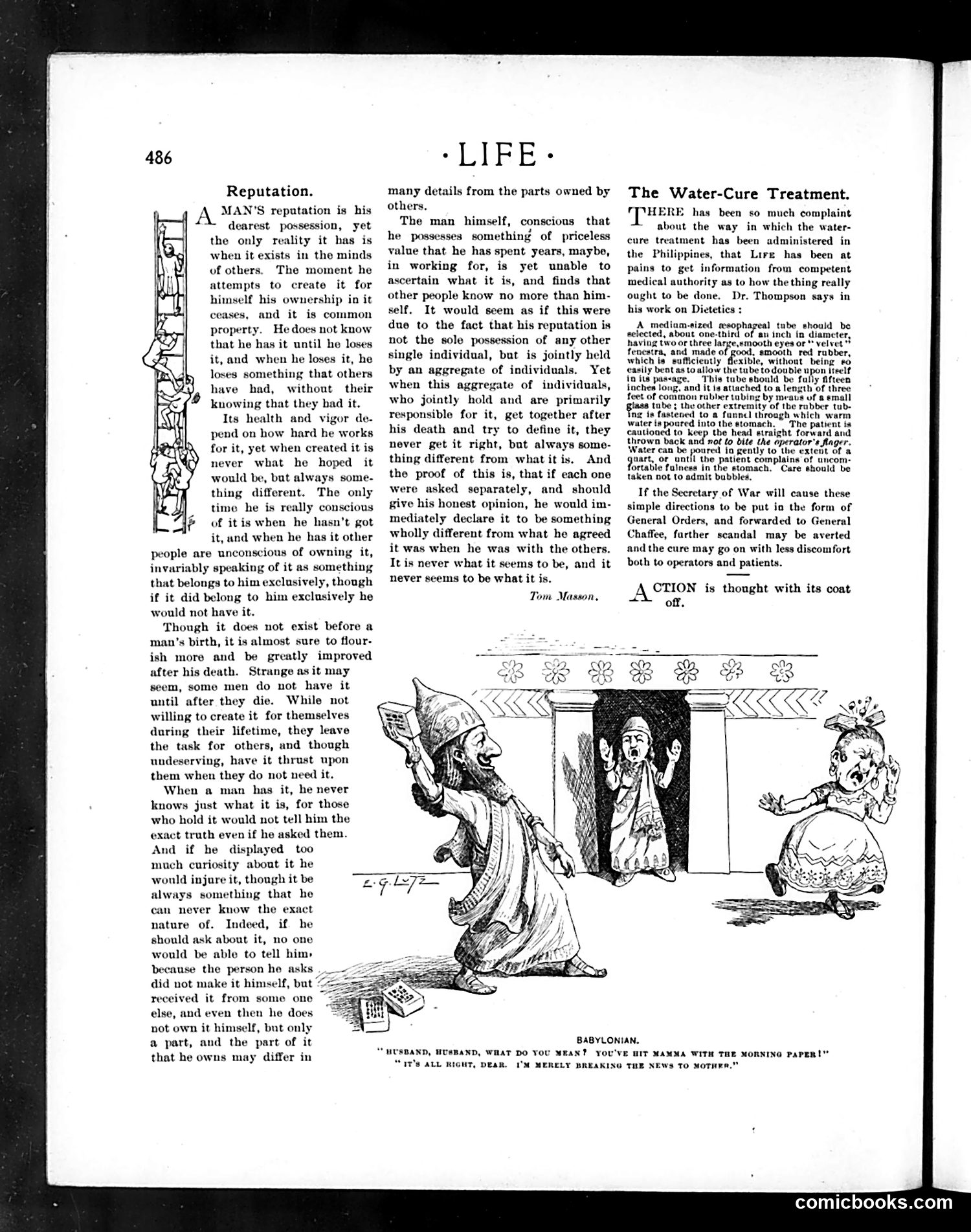
This page contains two distinct sections: **Left column ("Reputation"):** An essay about how a man's reputation is his most valued possession, yet paradoxically he cannot fully control or know it, since it exists primarily in others' minds. The piece explores this disconnect philosophically. **Right side:** A cartoon titled "Babylonian" showing what appears to be a man in ancient dress speaking to a woman, with the caption: "Husband, husband, what do you mean? You've hit mamma with the morning paper!" / "It's all right, dear. I'm merely breaking the news to mother." This is a domestic humor cartoon playing on the phrase "breaking the news"—literalizing it as physically striking someone with a newspaper. The "Babylonian" setting appears to be comedic anachronism, suggesting this marital dynamic is timeless.
📄 Transcribed text from this page (OCR, searchable)
Machine-transcribed from the original scan — historical spelling and the odd misread are preserved.
Reputation. MAN'S reputation is his dearest possession, yet the only reality it has is when it exists in the minds of others. The moment he attempts to create it for elf his ownership in it » and it is common property. He does not know that he has it until he loses it, and when he loses it, he loses something that others have had, without their knowing that they had it. Its health and vigor de- pend on how hard he works for it, yet when created it is never what he hoped it would be, but always some- thing different. The only time he is really conscious of itis when he hasn't got it, and when he has it other people are unconscious of owning it, invariably speaking of it as something that belongs to him exclusively, though if it did belong to him exclusively he would not have it. Though it does not exist before a man’s birth, it is almost sure to flour- ish more and be greatly improved after his death. Strange as it may seem, some men do not have it until after they die. While not willing to create it for themselves during their lifetime, they leave the task for others, and though undeserving, have it thrust upon them when they do not need it. When a man has it, he never knows just what it is, for those who hold it would not tell him the e truth even if he asked them. And if he displayed too much curiosity about it he would injure it, though it be always something that he can never know the exact nature of. Indeed, if he should ask about it, no one would be able to tell him» because the person he asks did not make it himself, but “ received it from some one else, and even then he does not own it himself, but only a part, aud the part of it that he owns may differ in ‘LIEBE « many details from the parts owned by others. The man himself, conscious that he possesses something of priceless value that he has spent years, maybe, in working for, is yet unable to ascertain what it is, and finds that other people know no more than him- self. It would seem as if this were due to the fact that his reputation is not the sole possession of any other single individual, but is jointly held by an aggregate of individuals. Yet when this aggregate of individuals, who jointly hold and are primarily responsible for it, get together after his death and try to define it, they never get it right, but always some- thing different from what itis. And the proof of this is, that if each one were asked separately, and should give his honest opinion, he would im- mediately declare it to be something wholly different from what he agreed it was when he was with the others. It is never what it seems to be, and it never seems to be what it is. Tom Masson, The Water-Cure Treatment. "THERE has been so much complaint about the way in which the water- cure treatment has been administered in the Philippines, that Lire has been at pains to get information from competent medical authority as to how the thing really ought to be done. Dr. Thompson says in his work on Dietetics : A_mediameized msophageal tube should be selected, about one-third of an inch in diameter, having two or three large,smooth eyes or * velvet fenestra, and made of smooth red rabber, which is sufficiently fexibie, without being. #6 easily bent as toallow the tube to double upon iteelf to its p This tube should be fally fifteen inches long, and itis attached to a length of three feet of common rubber tabing by meaus of a emall lass tube; the other extremity of the rubber tub- ing is fastened to a funnel throagh which warm water is poured into the stomach. — The patient is cautioned to keep the head straight forward and thrown back and not fo bite the operator's flager. ‘Water can be poured in gently to the extent of a guatt, of antlt the patient complains of uncom: fortable fulness in the stomach. Care ahould be taken not to admit bubbles. If the Secretary of War will cause these simple directions to be put in the form of General Orders, and forwarded to General Chaffee, farther scandal may be averted and the cure may go on with less discomfort both to operators and patients. A CTION is thought with its coat a off. BABYLONIAN. “UUSBAND, HUSBAND, WHAT DO YOU MEAN? YoU'VE WIT MAMMA WITH THE MORNING PAPER!” “it's ALL RIGHT, DEAR. VM MERELY BREAKING THE NEWS To MOTHER, comicbooks.com