
A complete issue · 22 pages · 1902
Life — May 22, 1902
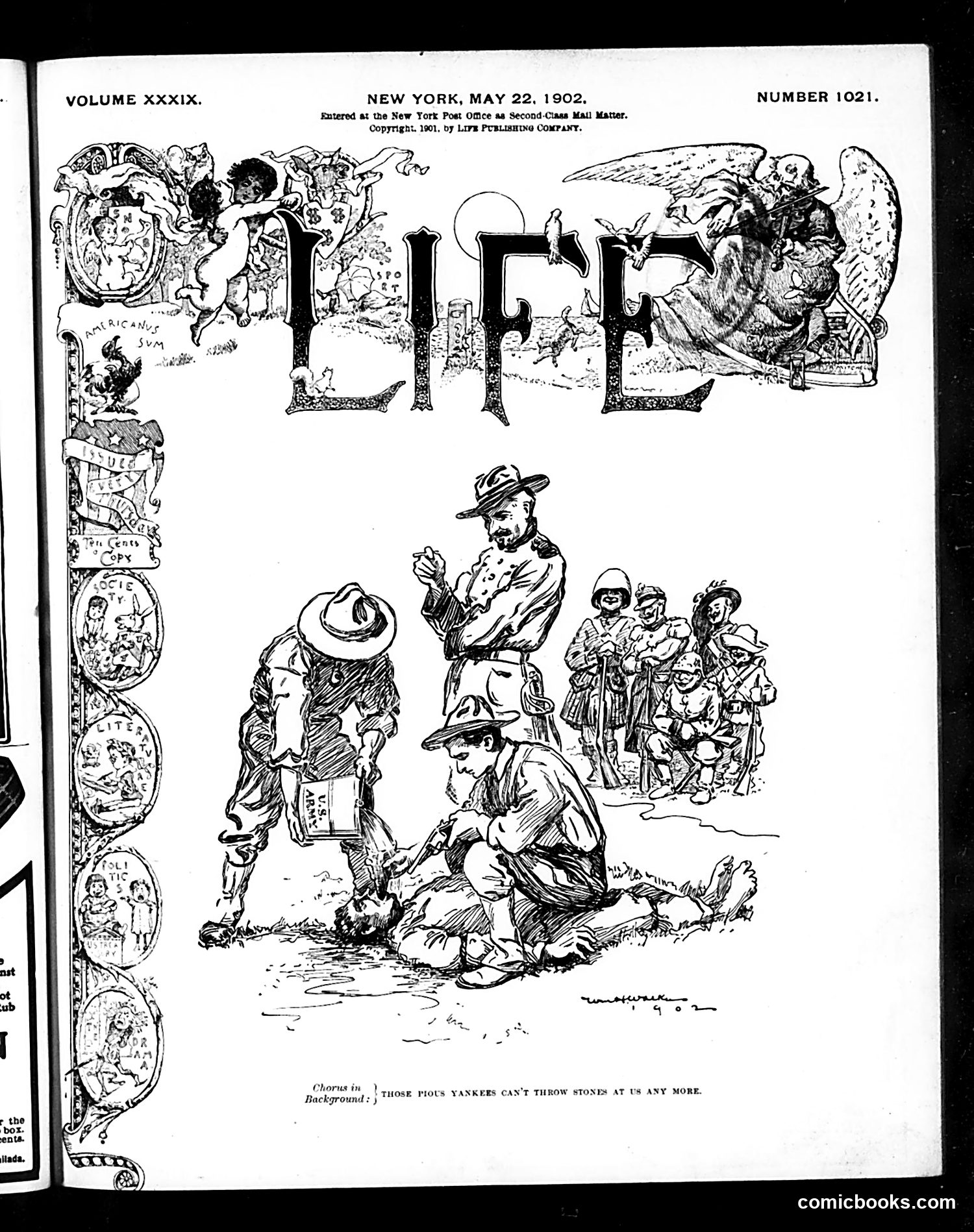
This page features a satirical cartoon about American prospectors or miners. The caption reads: "Those pious Yankees can't throw stones at us any more." The cartoon depicts men in Western attire (cowboy hats, work clothes) in what appears to be a mining or frontier setting. One figure crouches examining the ground while others stand nearby observing. The satire likely addresses American hypocrisy regarding moral judgment—possibly referencing American intervention or criticism of other nations' practices while engaging in questionable conduct themselves (mining exploitation, imperialism, or labor practices were contemporary controversies). The "Yankees" reference suggests criticism of American foreign policy or domestic practices from this era. The specific event or controversy is unclear from the image alone.
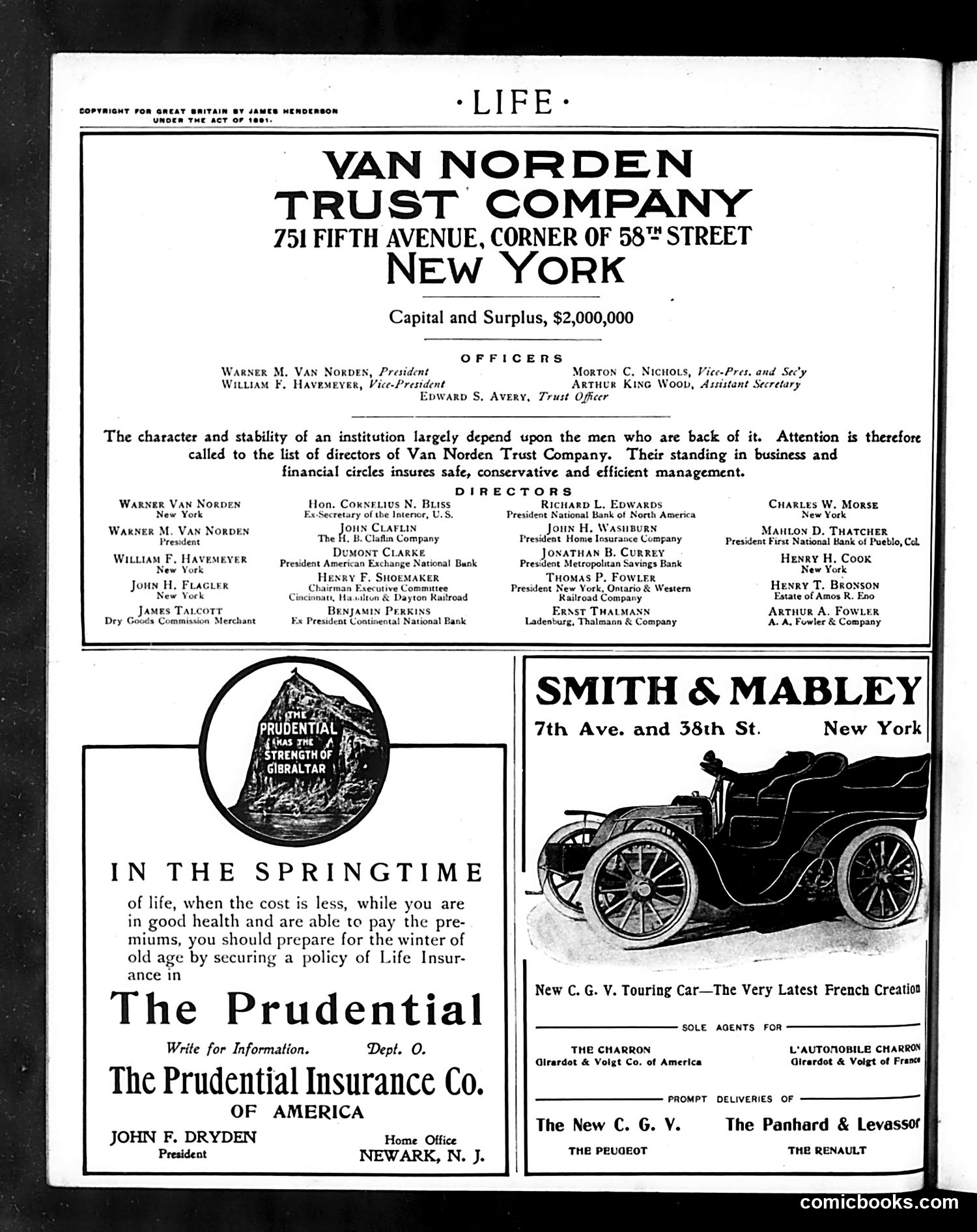
This page contains **no political cartoons or satire**. It is primarily **advertising and corporate announcements** from the early 20th century. The top half features a substantial advertisement for the Van Norden Trust Company in New York, listing its officers and board of directors—a standard corporate promotion emphasizing stability through prominent business leaders. Below that are two advertisements: one for The Prudential Insurance Company of America, using the metaphor of "springtime of life" to encourage young, healthy people to purchase life insurance; and another for Smith & Mabley, an automobile dealership advertising French touring cars. The page reflects the commercial nature of *Life* magazine during this era, when it functioned substantially as an advertising vehicle alongside satirical content.
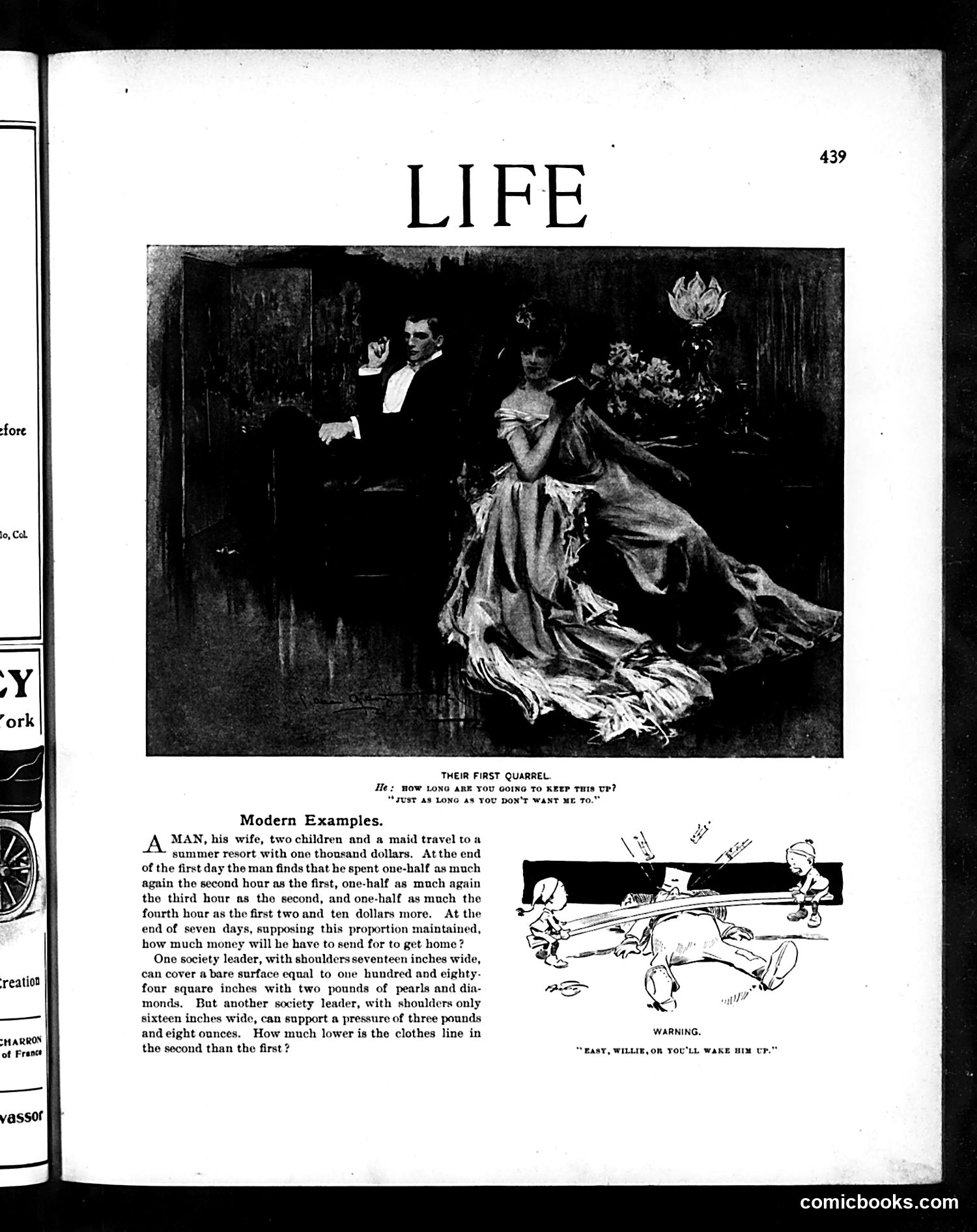
This page contains two unrelated satirical pieces: **"Their First Quarrel"** (top illustration) depicts a domestic dispute between a couple, with the caption suggesting conflict over household finances—the husband questioning how long the wife will "keep this up" while she responds she'll continue "just as long as you don't want me to." This satirizes marital tension over spending and control of money. **"Modern Examples"** (text section) presents mathematical puzzles involving distribution of resources among families and comparative physical measurements of society leaders' shoulders and pearls/diamonds. The bottom cartoon "Warning" humorously depicts children playing roughly, cautioning "Baby, Willie, or you'll wake him up." These appear to be typical Life magazine fare: domestic humor and mathematical riddles aimed at educated readers.
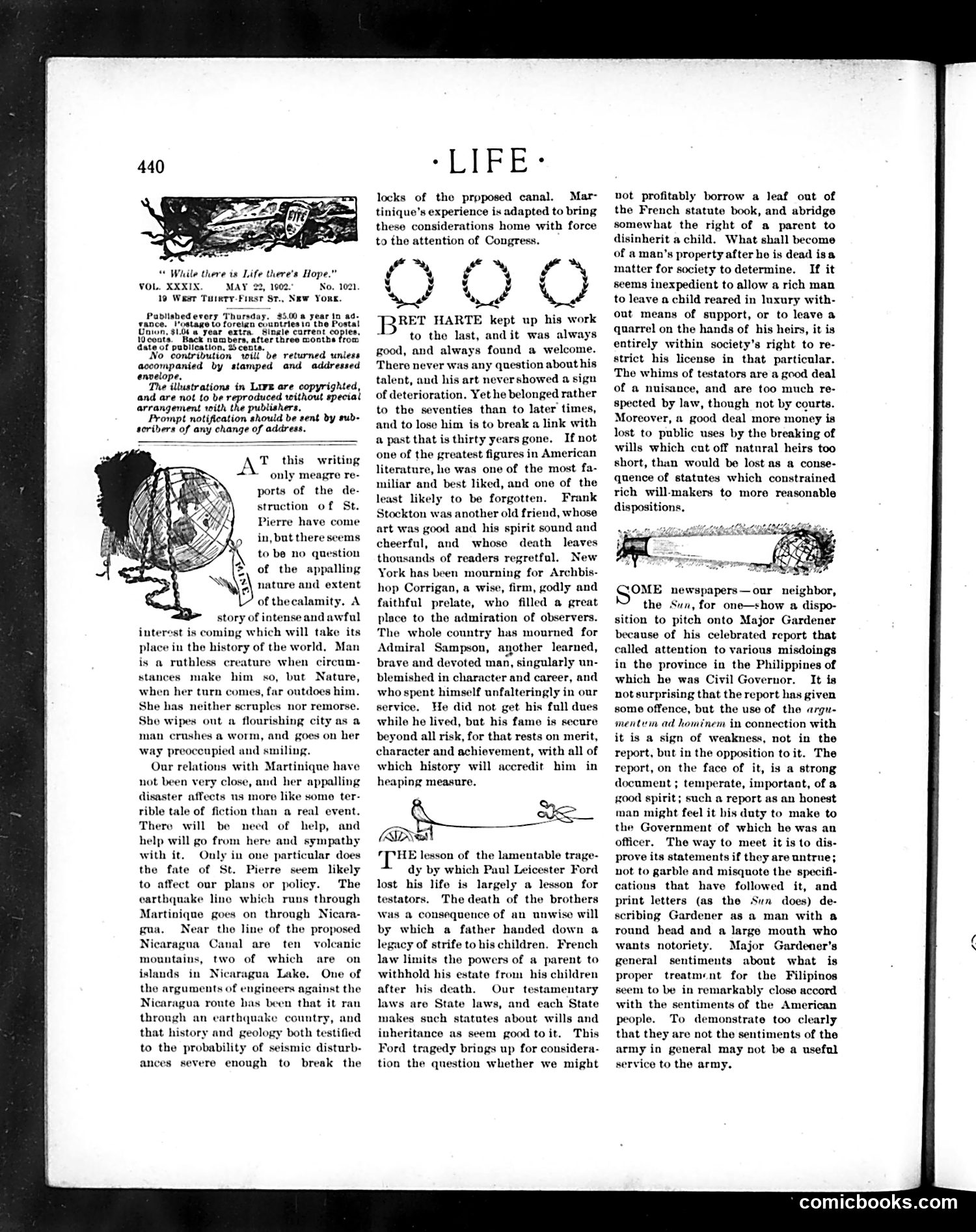
This page contains two editorial illustrations satirizing American political and social issues circa 1902. The left cartoon depicts a globe being crushed or manipulated, likely commenting on American imperialism and the construction of the Nicaragua Canal—a major political controversy of that era involving debates over American expansion and engineering ambitions. The right illustration (unlabeled in visible text) appears to reference the Philippine-American War or colonial administration, based on the editorial's discussion of "Major Gardener" and misgovernance in the Philippines. The text criticizes newspaper reports about colonial officers and questions whether military administration serves national interests. Both pieces reflect Progressive-era concerns about American foreign policy, imperial overreach, and governmental accountability during the Theodore Roosevelt presidency.
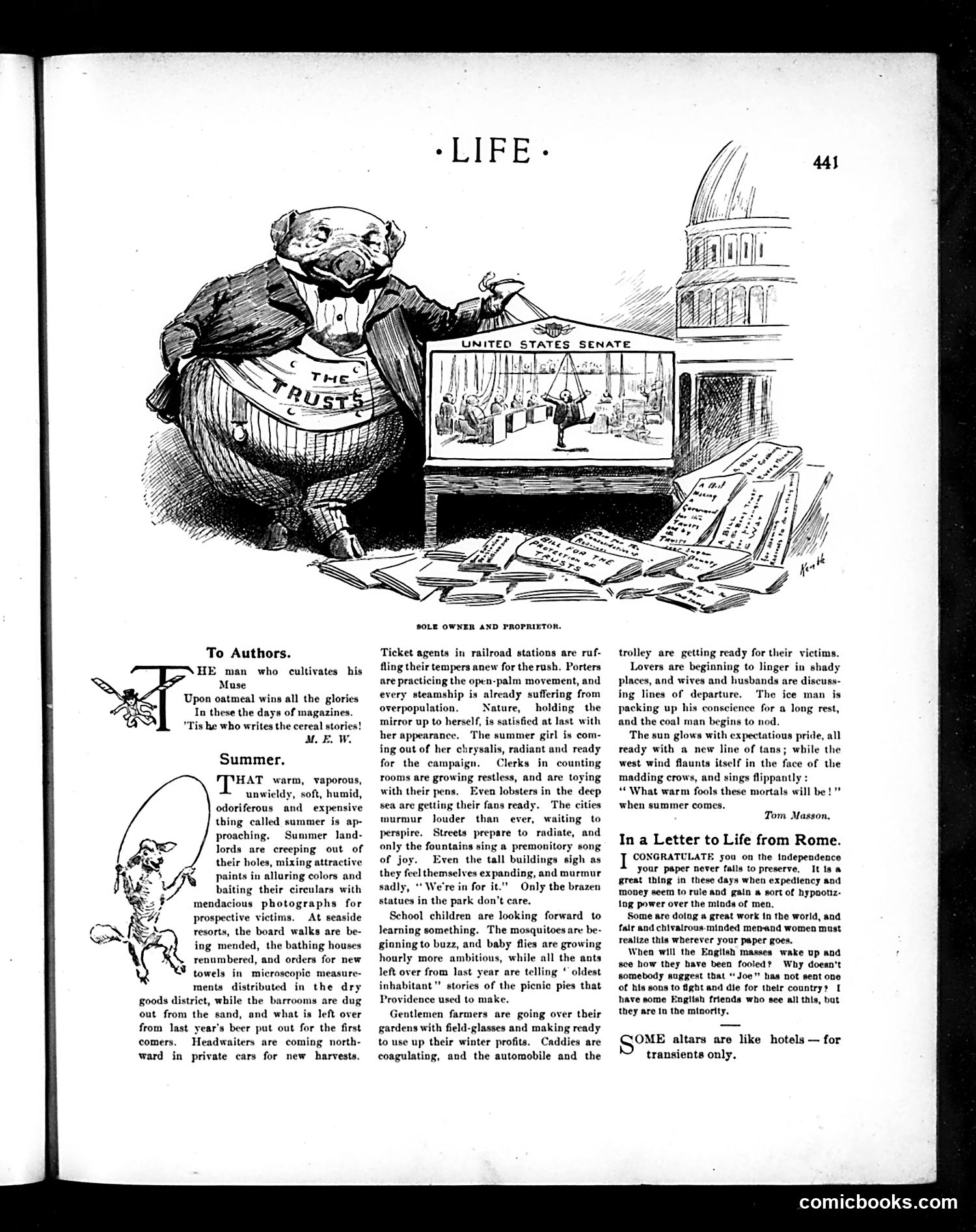
The main cartoon depicts a rotund figure labeled "THE TRUSTS" dressed in formal attire, positioned as a "Sole Owner and Proprietor" overlooking the United States Senate. He holds a theatrical stage showing senators in session, suggesting the trusts literally control or puppet the Senate's proceedings. This is **anti-trust satire** criticizing corporate monopolies' political influence during the Progressive Era (likely early 1900s). The cartoonist argues that major business trusts have corrupted or captured Senate operations, making elected officials mere performers following corporate scripts rather than representing the public interest. The accompanying text columns offer miscellaneous social commentary on summer activities and observations, unrelated to the political cartoon above.
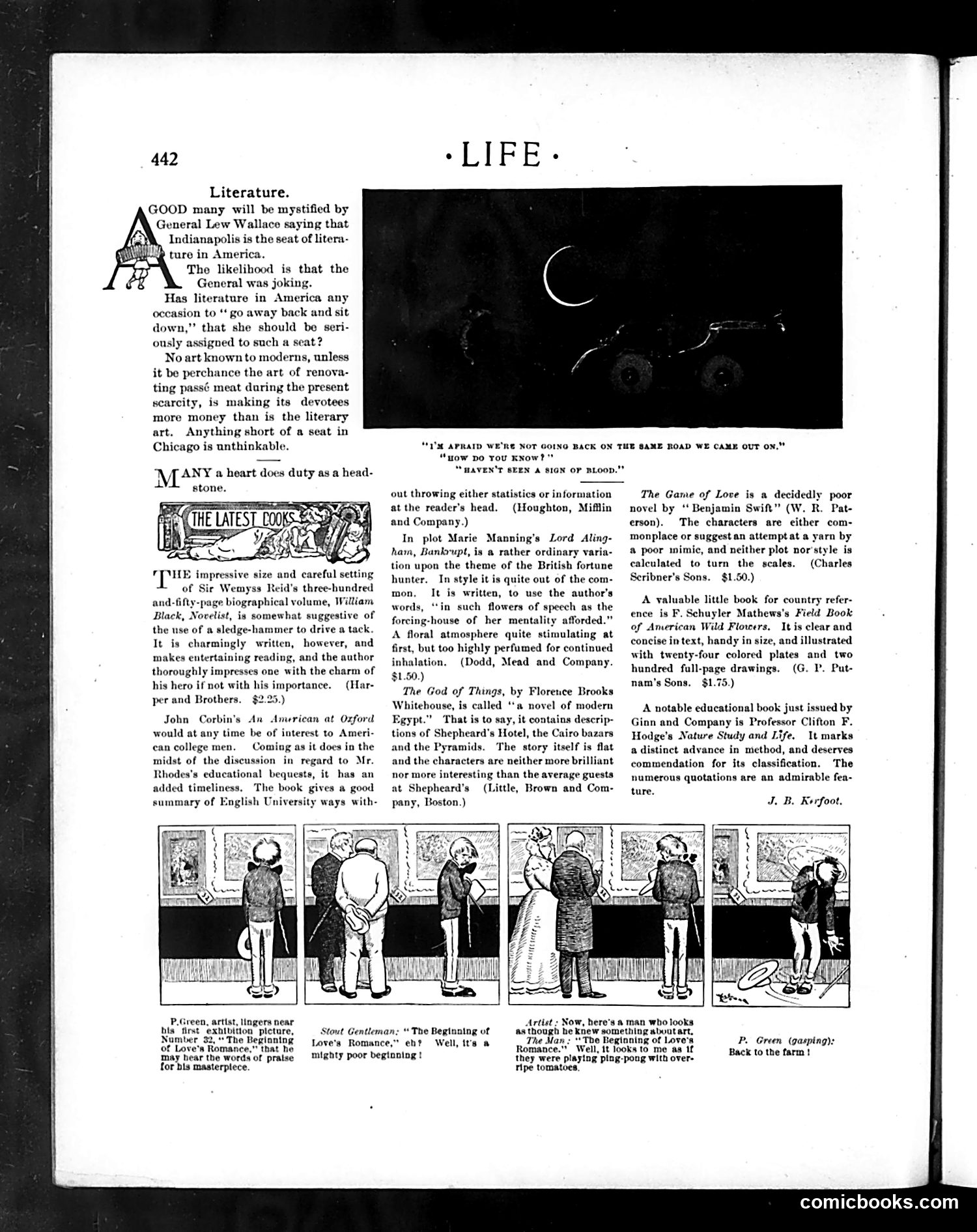
This page contains a **literature review section** rather than political cartoons. The top half discusses books and authors, including critiques of novels like "The Game of Love" and "The God of Things." The bottom contains a **comic strip** showing men viewing artwork in what appears to be an art gallery or exhibition. The caption references "The Beginning of Love's Romance" and includes dialogue where one figure expresses skepticism about the artwork, comparing it unfavorably to "ripe tomatoes." The humor appears to be satirizing **art criticism and pretension**—specifically the gap between avant-garde or modern art and common-sense public reaction. The "Stool Gentleman" questions whether this is truly art, reflecting contemporary debates about modernism that were common in early 20th-century satirical magazines like *Life*.
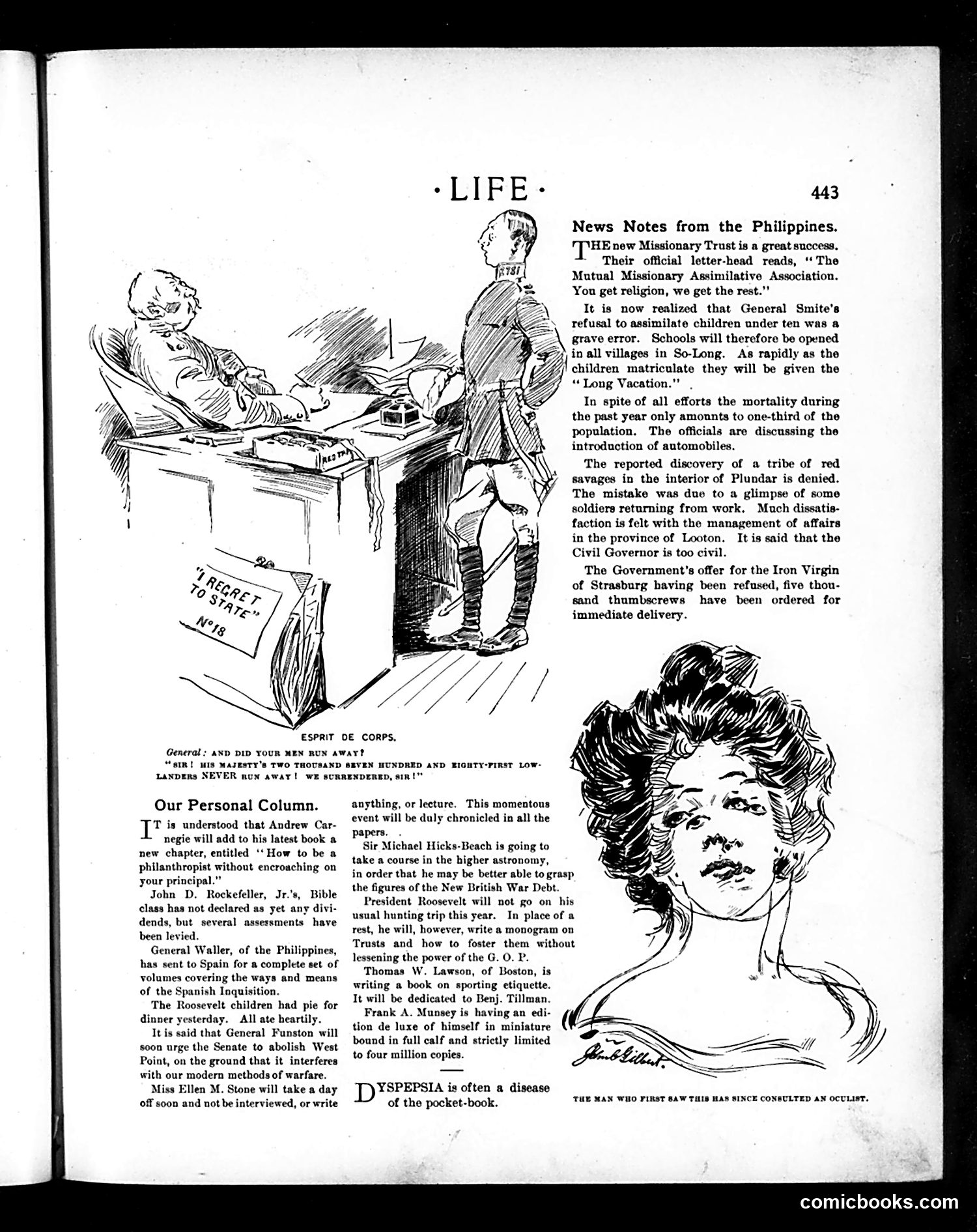
This cartoon satirizes military bureaucracy and secrecy. Two military officers are shown at a desk marked "SECRET FILE No. 18." The caption quotes a general claiming his majesty's forces have suffered enormous casualties but "NEVER RUN AWAY" — suggesting the officers are creating or maintaining false official narratives about military performance. The joke targets the gap between actual wartime conditions (implied by the high casualties) and official propaganda. "Esprit de corps" (military morale/pride) is invoked ironically — the officers protect the army's reputation through deliberate concealment rather than honest reporting. The accompanying "News Notes from the Philippines" section references real colonial-era governance issues, adding documentary context to the satire about how institutions spin uncomfortable truths.
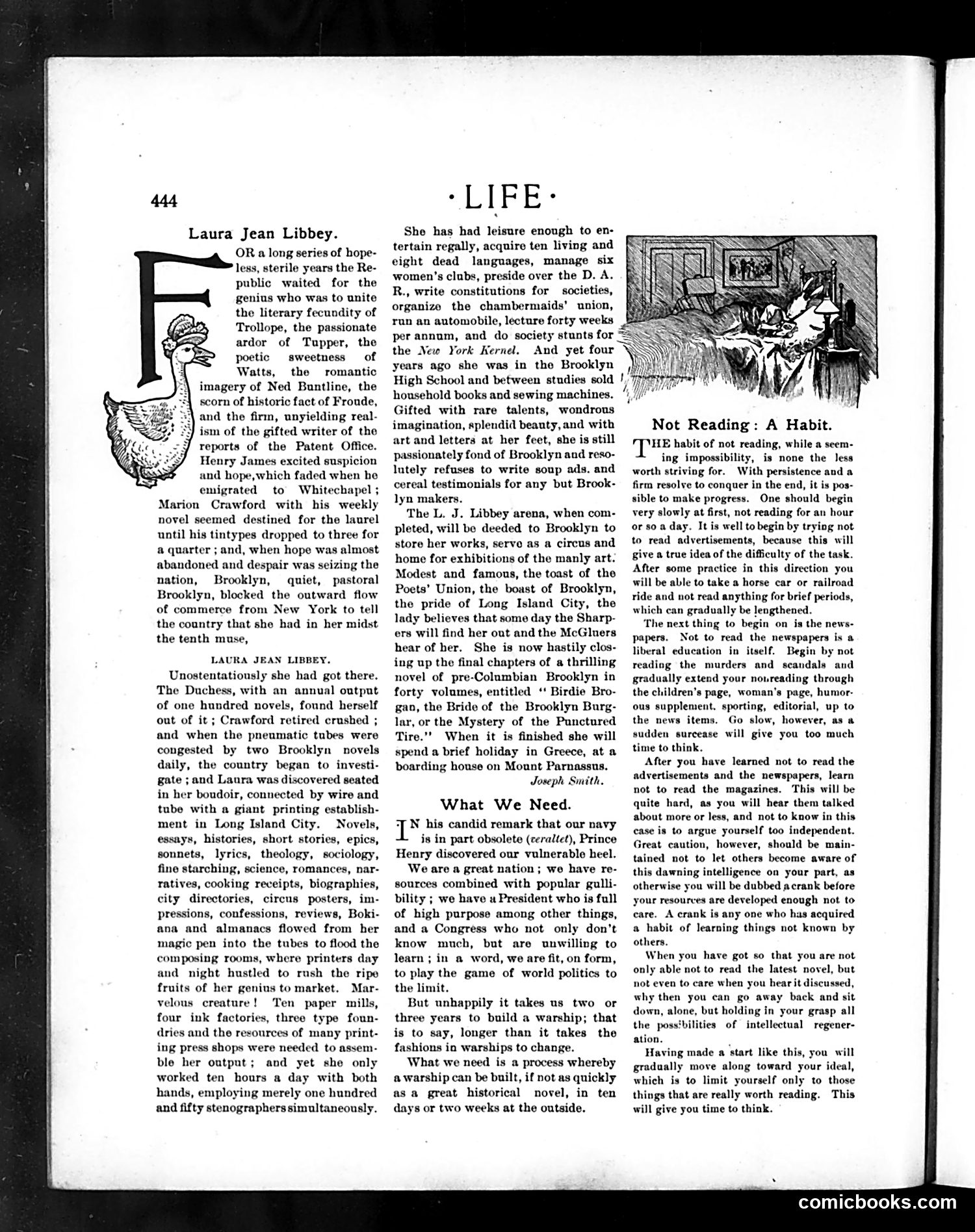
This page contains three distinct sections: a profile of writer **Laura Jean Libbey**, a satirical piece titled **"What We Need,"** and an illustration labeled **"Not Reading: A Habit."** The Libbey profile celebrates a prolific Brooklyn-based novelist known for serialized dime novels and romantic fiction. The satire mocks her extraordinary productivity—she reportedly employed 150 stenographers simultaneously and operated multiple ink factories to meet publishing demands. "What We Need" critiques American naval obsolescence and political incompetence, arguing the nation needs a rapid warship-building program rather than another historical novel (likely referencing Libbey's output). The right illustration satirizes reading avoidance as a social habit, advocating gradual newspaper and intellectual engagement over complete ignorance of current events.
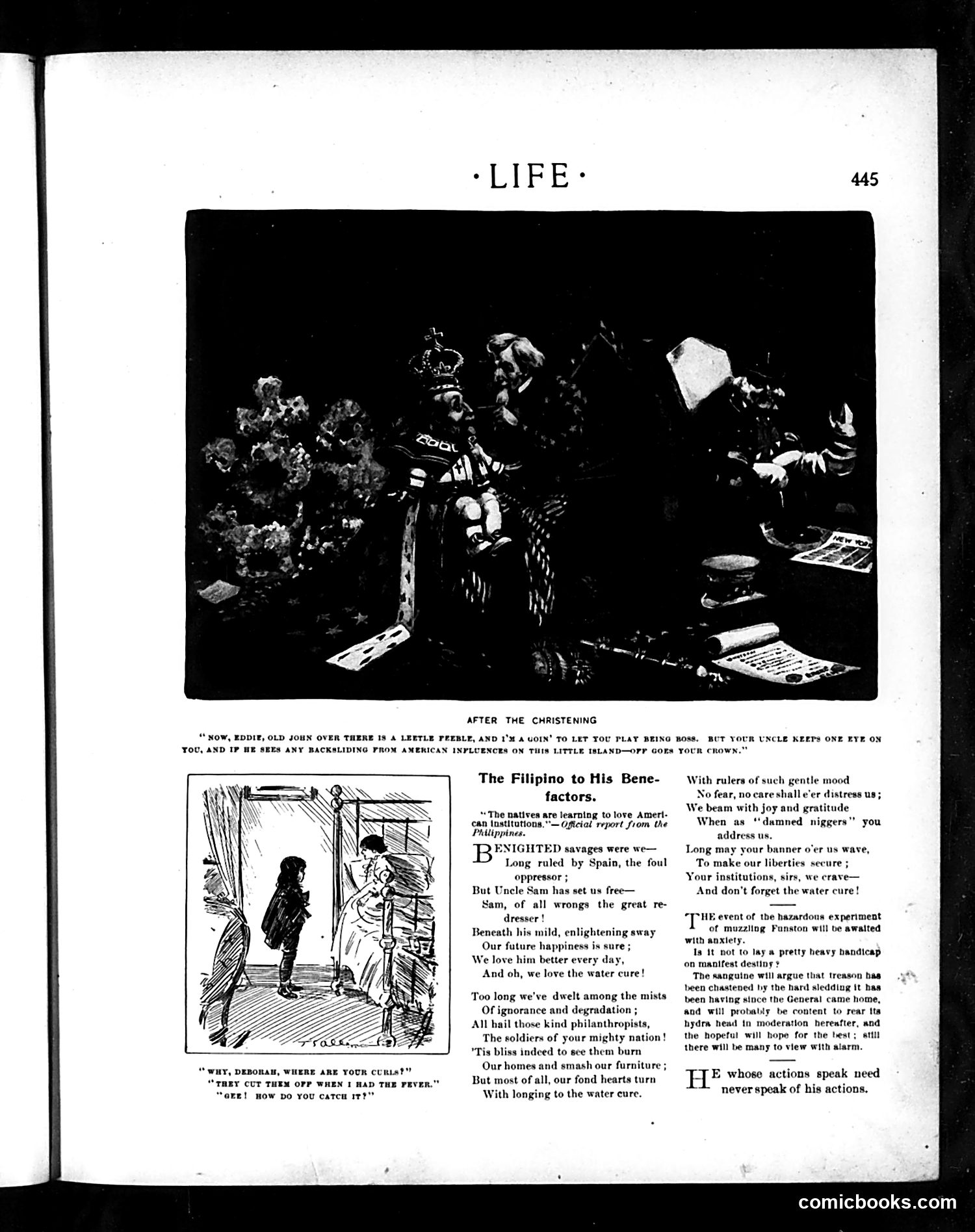
This page contains two distinct satirical pieces about American involvement in the Philippines during the early 1900s. **Top image ("After the Christening"):** Depicts a christening ceremony with military and colonial figures. The caption warns "Old John" (likely Uncle Sam) to watch for American influence "backsliding from American influences on this little island—off goes your trade towns." **Bottom cartoon and poem ("The Filipino to His Benefactors"):** A sketch shows a Filipino figure at a window, with accompanying verse. The poem is ironic—it thanks America for "enlightening away / Our future happiness" and mentions Spain's rule, but sarcastically addresses American soldiers as "philanthropists." The text criticizes American imperial policies in the Philippines, particularly muzzling of Funston (likely General Frederick Funston) and suggesting the occupation wasn't genuinely benevolent. Both pieces critique American colonialism as hypocritical "civilization" efforts.
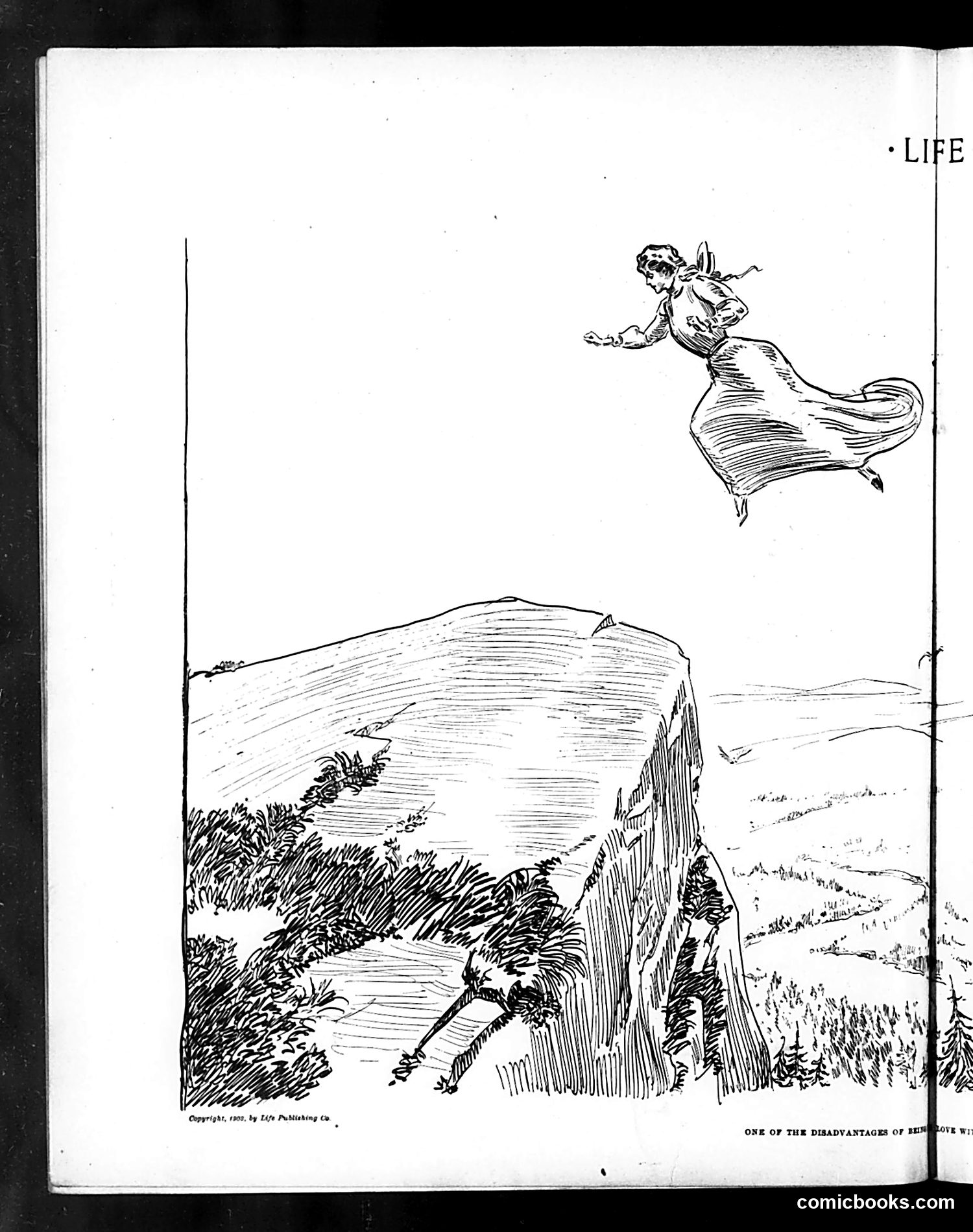
This is a satirical illustration from *Life* magazine depicting "One of the Disadvantages of Remote Work" (as indicated by the partial caption at bottom). The cartoon shows a woman in early 20th-century dress flying or floating through the air above a rural, mountainous landscape with sparse vegetation and a small cabin below. The satire appears to target the isolation and impracticality of working in remote locations—literally suggesting that even flying away becomes desirable when stuck in such desolate surroundings. The woman's joyful, airborne escape contrasts sharply with the barren, uninviting terrain, suggesting that remote work locations lack basic amenities and social opportunities that make life tolerable.
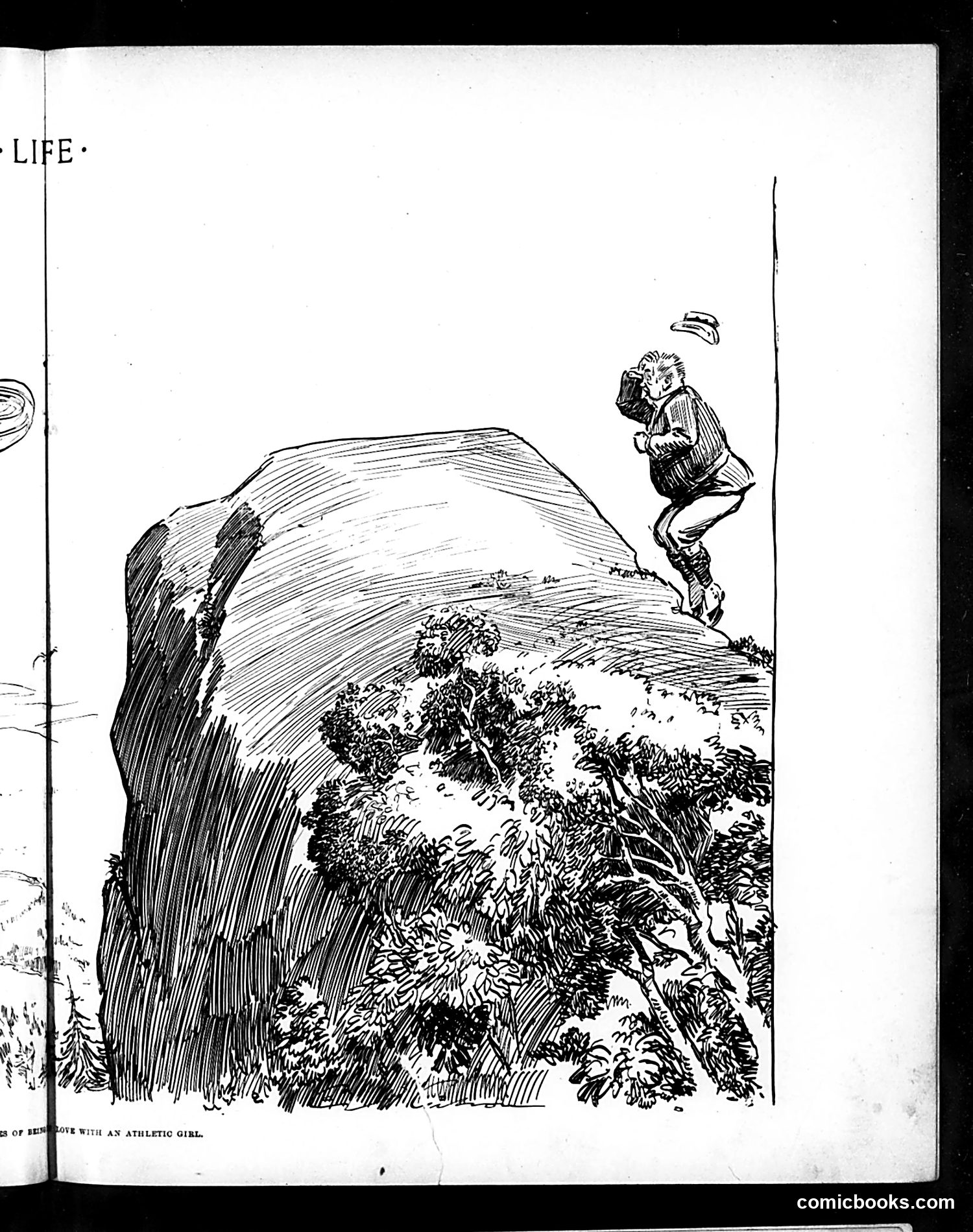
This appears to be a humorous illustration titled "Love with an Athletic Girl" (partially visible at bottom). The cartoon depicts a young man in formal attire losing his hat while being thrown or knocked backward by a muscular woman on a hillside. The woman appears strong and athletic, having physically overpowered the man. The satire likely mocks early 20th-century anxieties about the "New Woman"—particularly athletic women gaining strength and independence. The joke plays on conventional gender roles: the traditionally passive woman has literally inverted power dynamics, leaving the suitor literally off-balance. This reflects contemporary anxieties about changing women's roles in society, as physical fitness and sports participation became more socially acceptable for women.
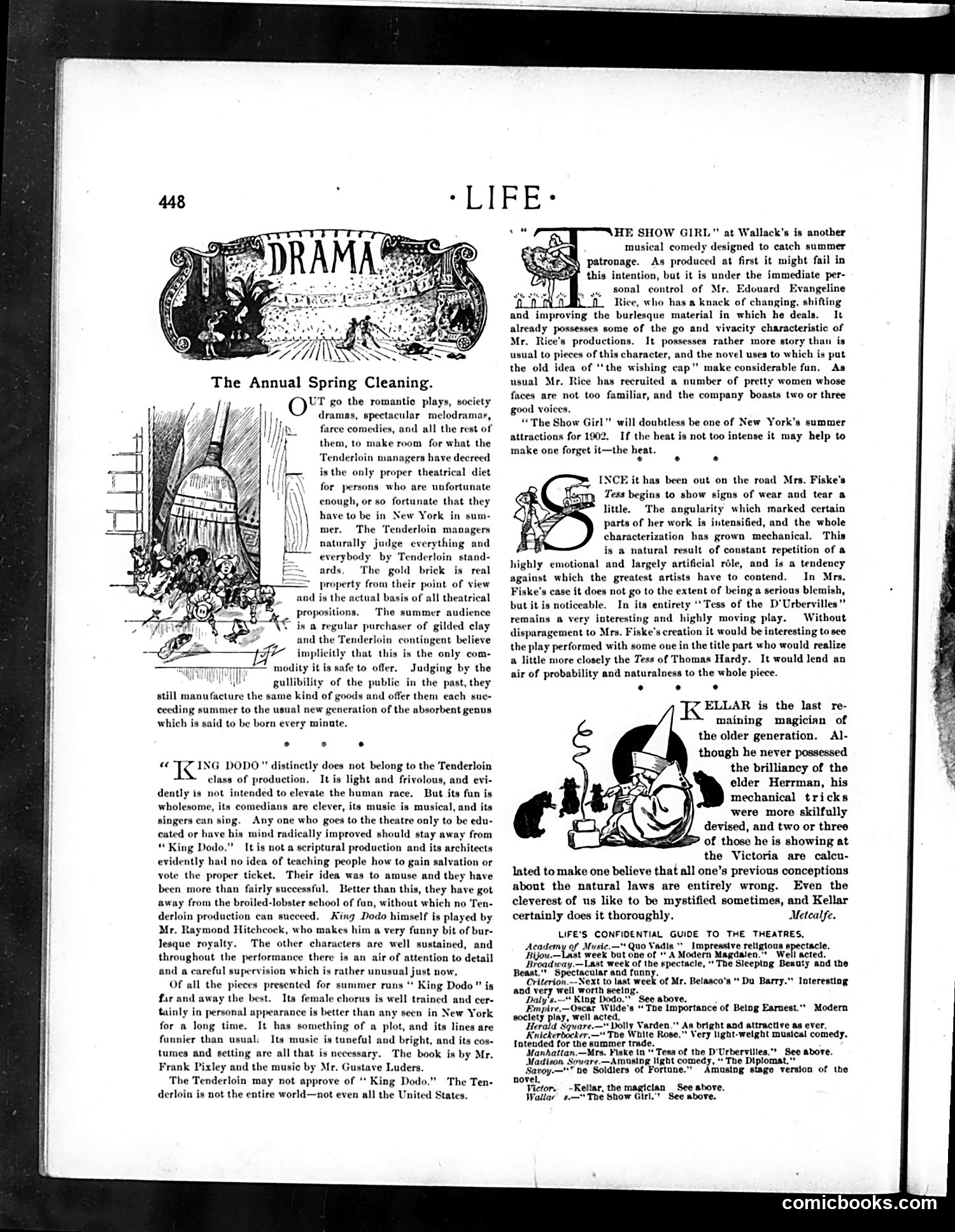
This page discusses theatrical productions for summer 1902. The main cartoon illustrates "The Annual Spring Cleaning"—a satirical commentary on theater management decisions. The text explains that theater managers, facing summer slumps, resort to lighter fare: romantic plays, society dramas, and farces rather than serious works. The cartoon shows a broom and dustpan, visually representing the "cleaning out" of serious theatrical repertoire in favor of commercially safer, crowd-pleasing entertainment. The accompanying articles critique specific productions like "King Dodo" and "The Show Girl," evaluating whether lighter summer comedies represent artistic compromise or appropriate audience service. The satire targets the theater industry's prioritization of profitable entertainment over artistic merit during slow seasons.
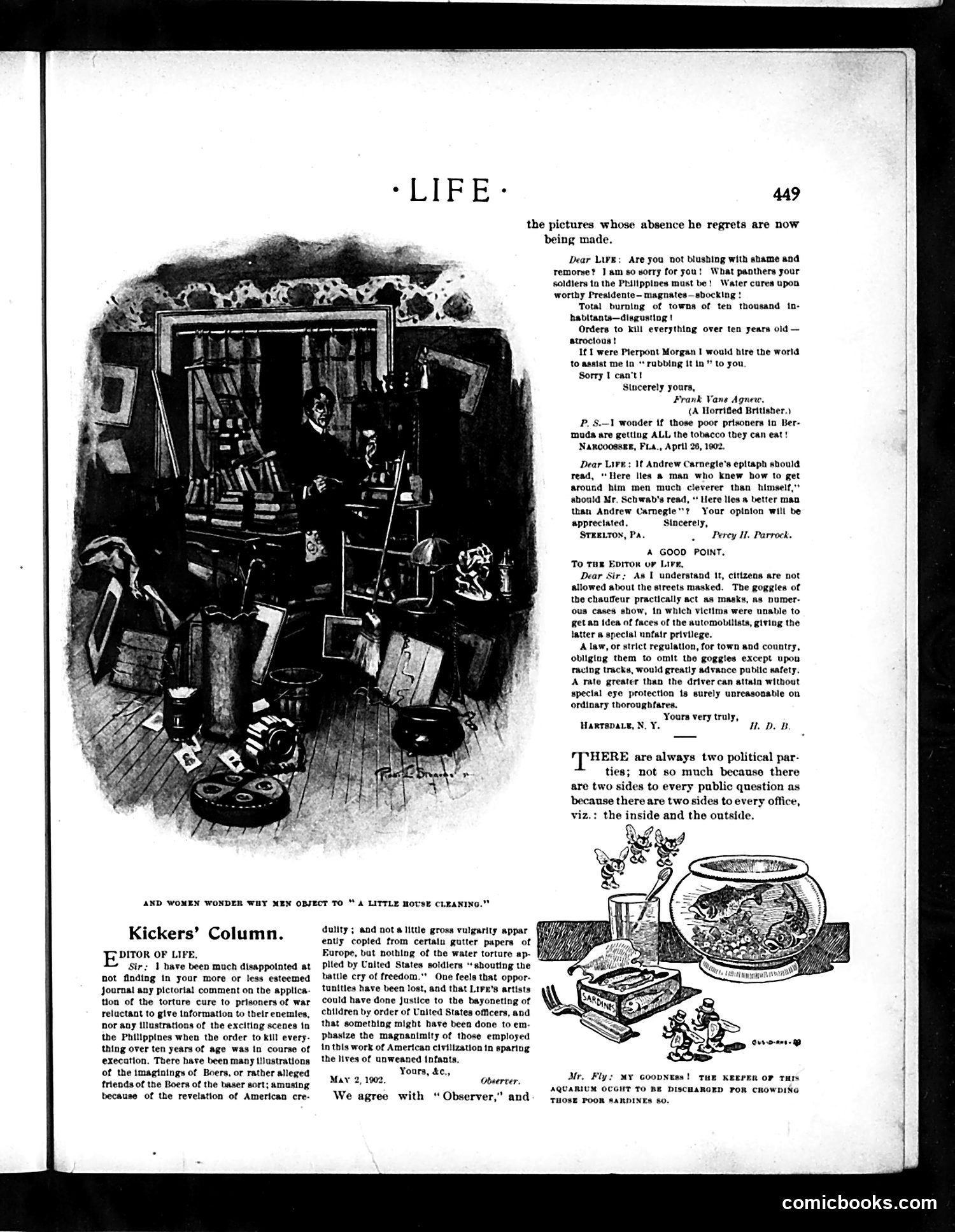
**Main Cartoon:** The large illustration shows a cluttered, chaotic interior—likely a library or study—with the caption "And Women Wonder Why Men Object to 'A Little House Cleaning.'" This is a domestic humor joke suggesting men fear the disruption caused by housecleaning activities. **Kickers' Column (Letters Section):** The page features reader responses to Life's editorial coverage. A letter signed "Observer" sarcastically criticizes Life for *not* publishing illustrations of American atrocities in the Philippine-American War—specifically water torture, executions of civilians, and killings of children. The editor's response, "We agree with 'Observer,'" indicates agreement that these are shameful acts worthy of exposure. This represents contemporary anti-imperialist criticism of U.S. military conduct. **Other items** include brief humorous letters about Andrew Carnegie, automobile safety goggles, and political commentary. A small cartoon shows sardines crowded in an aquarium. The page reflects early 1900s satirical journalism addressing imperialism and social issues.
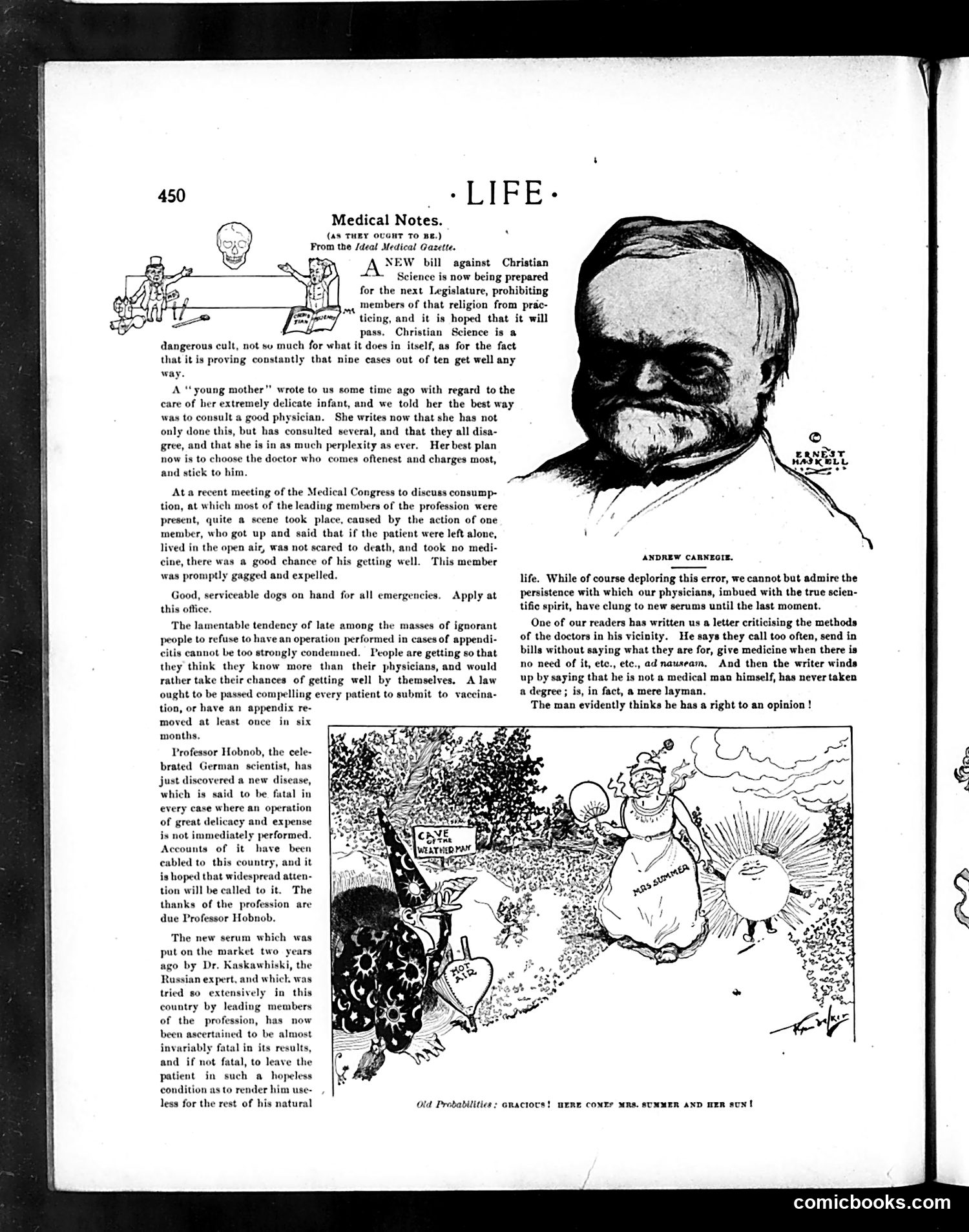
This page satirizes medical establishment arrogance and profit-driven practice. The main portrait appears to be **Andrew Carnegie**, identified in the text—likely chosen because he represents wealthy philanthropy being solicited by doctors. The satirical "Medical Notes" mock physicians for: 1. **Opposing Christian Science** not on principle but because it proves patients recover without doctors' intervention 2. **Recommending expensive, unnecessary procedures** (appendix removal, vaccination mandates) 3. **Gagging dissenting voices** at medical conferences who suggest rest and fresh air work 4. **Dismissing patient skepticism**, claiming lay people have no right to question medical authority 5. **Promoting unproven serums** (like the fictional "Kaskawhis" serum) that prove "invariably fatal" The cartoons mock medical pretension: one shows doctors as puppeteers controlling patients; another depicts "Old Probabilities" (likely a weather almanac figure) as legitimate competition to doctors. **The core joke**: Life attacks physicians as self-interested fraudsters hiding incompetence behind scientific jargon—a scathing critique of medical authority's abuses during an era of unregulated practice.
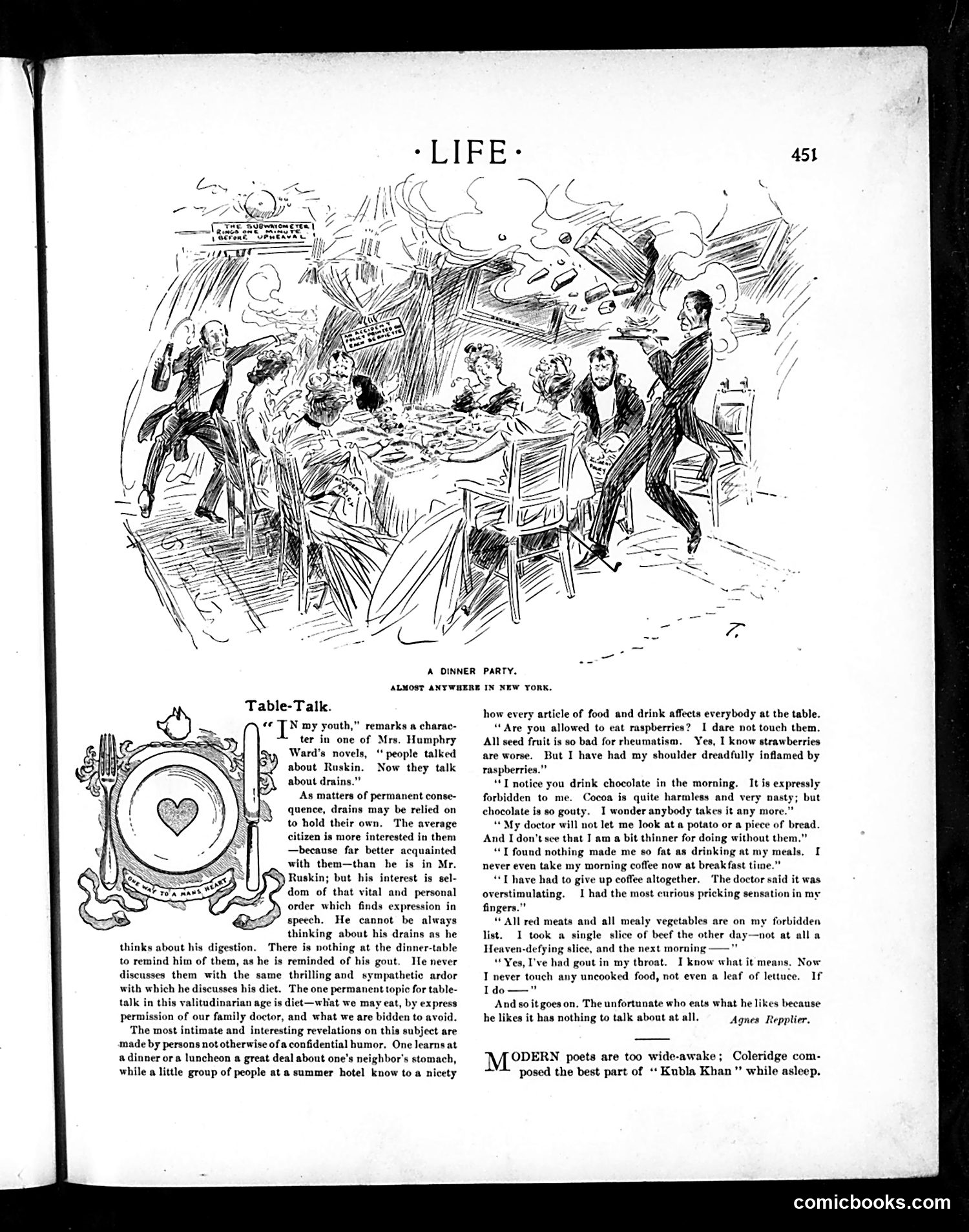
This 1890s Life magazine page satirizes the obsessive dinner-table conversation of wealthy New Yorkers, who have replaced substantive discussion with tedious recitations of dietary restrictions and medical complaints. The cartoon depicts a chaotic dinner party where guests appear animated and engaged—but the accompanying essay by Agnes Repplier reveals they're actually boring everyone with health talk. The satire targets the "valitudinarian age" (era of hypochondriacs): guests compulsively discuss which foods their doctors forbid, comparing ailments like gout, rheumatism, and indigestion. The joke is that people with genuine health restrictions dominate conversation, while those who simply eat what they enjoy have nothing interesting to contribute. Repplier mocks this as shallow pretension disguised as medical necessity—people seeking attention through cataloging their bodily malfunctions. The brief final note about Coleridge appears unrelated, possibly filler. The overall message: modern society has become consumed with self-focused health anxiety at the expense of meaningful discourse.
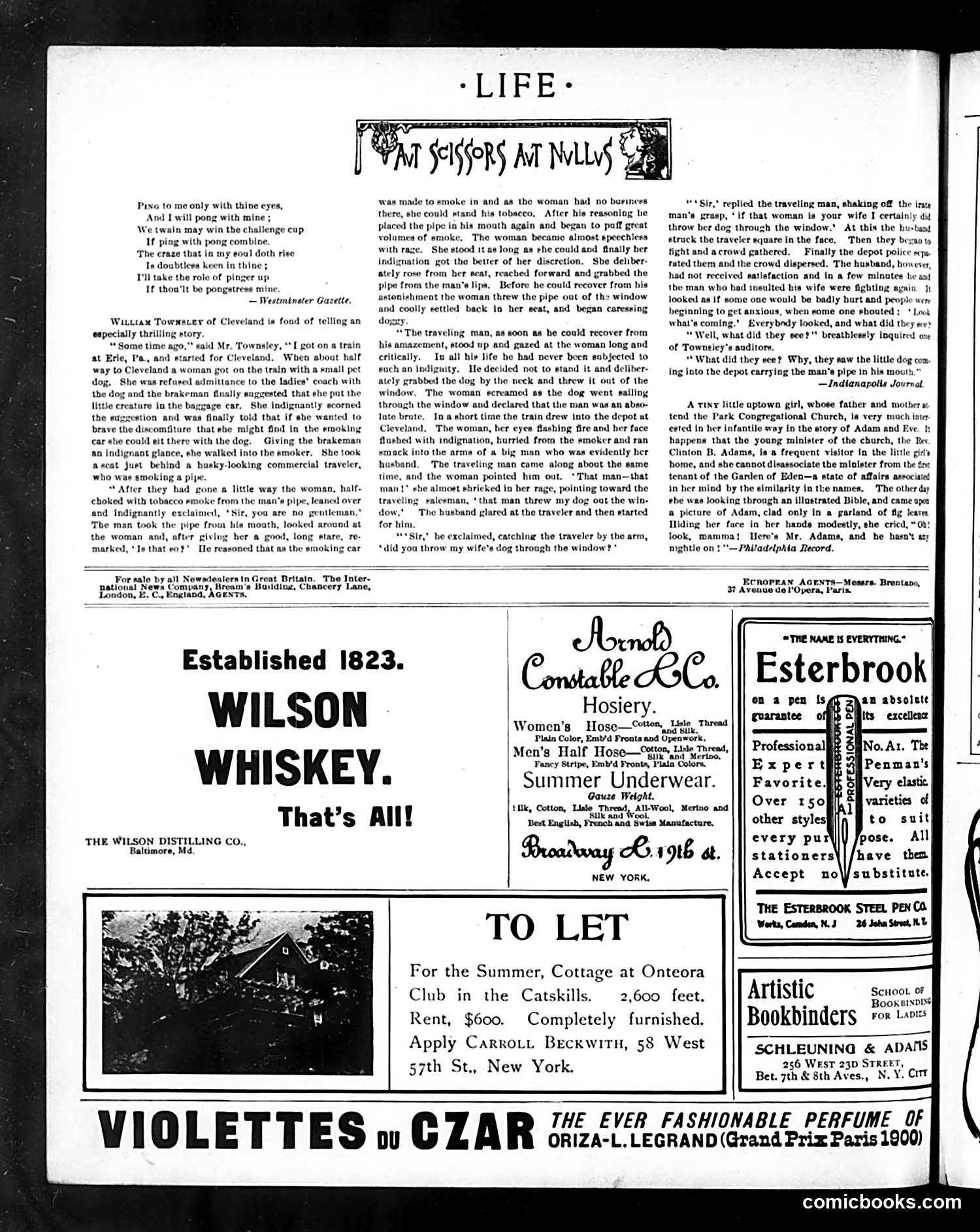
This page features a humorous story titled "Scissors at Mills" (the header reference is unclear) that satirizes the early 1900s craze for ping-pong. The accompanying verse from the Westminster Gazette mockingly adapts romantic poetry to ping-pong terminology ("pinger," "pongetress"). The main story concerns a traveling salesman's confrontation with a woman in a train's smoking car. When she complains about his pipe smoke, he defiantly continues smoking. She throws his pipe out the window; he retaliates by throwing her small dog out. Her husband then intervenes, leading to a brawl. **The satire's point**: The story mocks both the era's rigid social conventions (separate coaches for ladies, smoking car etiquette) and male arrogance. The salesman's smug logic—that since it's a smoking car, the woman shouldn't complain—and his petty revenge reveal how absurdly men prioritized their prerogatives over basic decency. The escalating absurdity (dog-throwing!) underscores the ridiculousness of the entire confrontation.
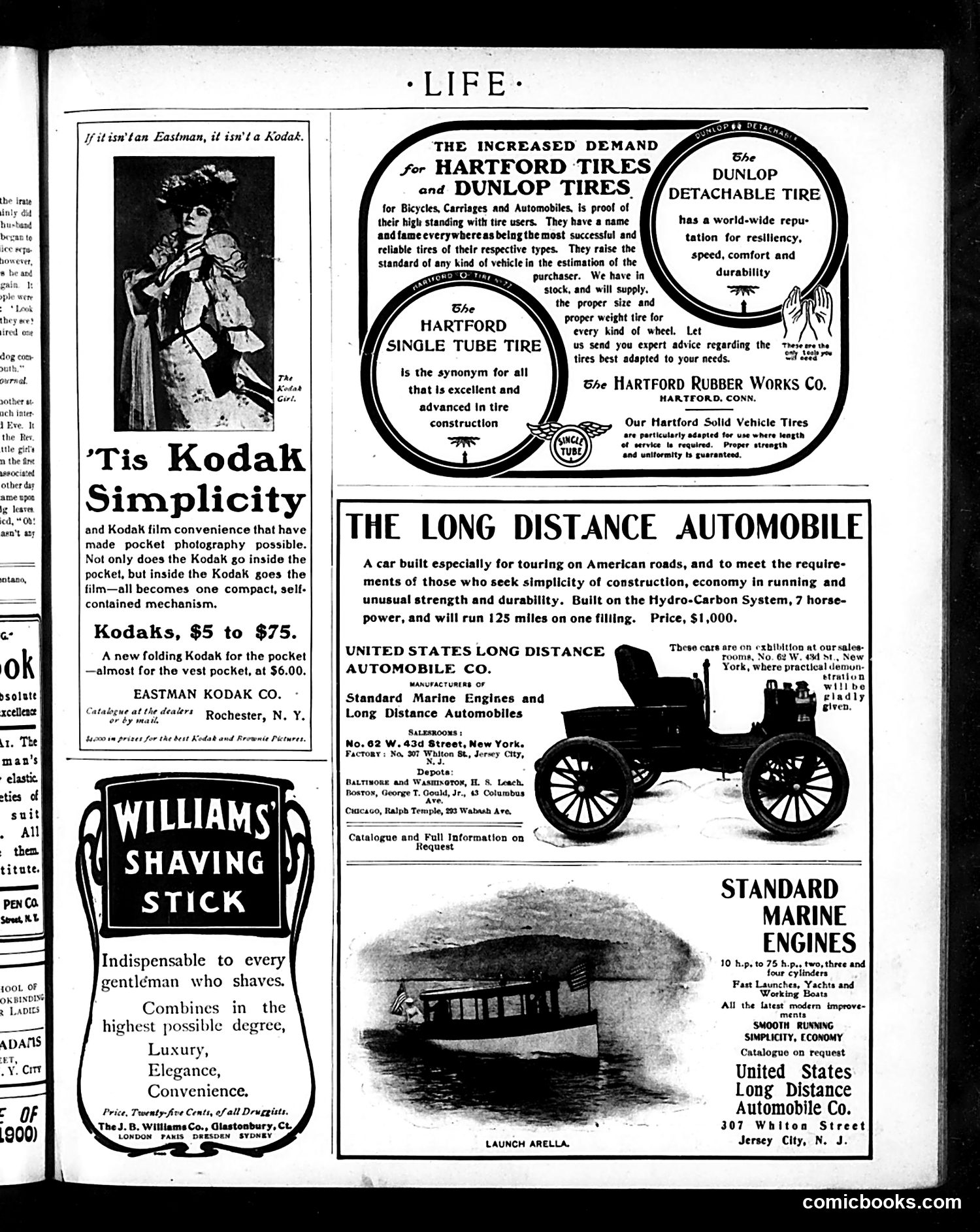
This page is primarily **advertisements**, not satire or political cartoons. It showcases early 1900s consumer products targeting middle and upper-class men. The ads highlight technological innovations of the era: - **Kodak cameras** ($5-$75) marketed for "pocket photography" — emphasizing convenience and portability as novel luxuries - **Williams Shaving Stick** — positioning grooming products as markers of gentlemanly status ("Luxury, Elegance, Convenience") - **Hartford and Dunlop tires** for bicycles, carriages, and automobiles — reflecting the racing competition between tire manufacturers - **Long Distance Automobile** ($1,000) — a touring car designed for American roads, emphasizing durability and fuel efficiency (125 miles per fill-up) - **Standard Marine Engines** for launches and yachts The "Tis Kodak Simplicity" header echoes contemporary advertising language celebrating modern convenience. These ads reveal early automotive culture, recreational travel aspirations, and how consumer goods were marketed as signs of sophistication during the Progressive Era.
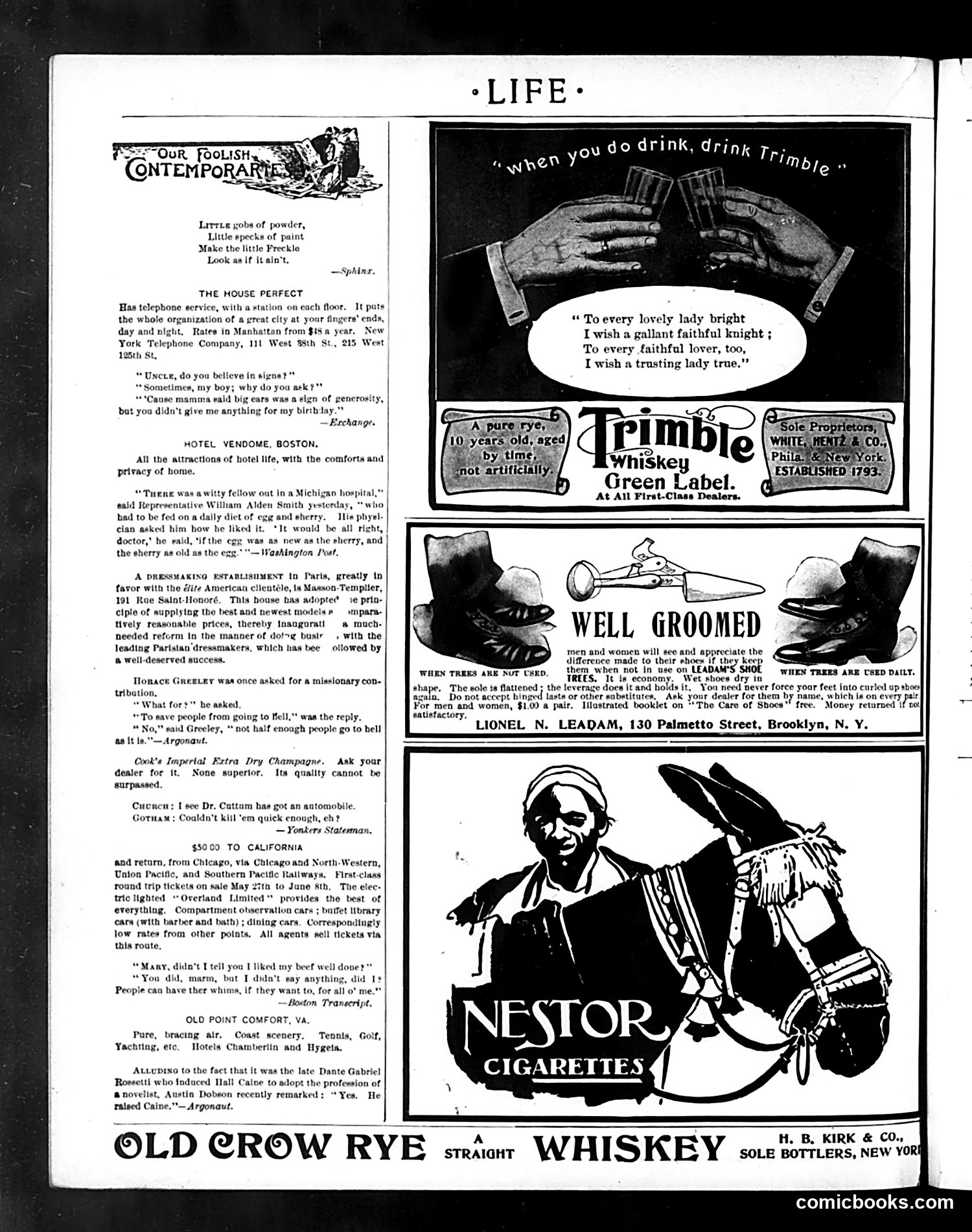
This page is primarily **advertising with minimal editorial content**. The small satirical items ("Our Foolish Contemporaries") are brief jokes rather than political cartoons: - One jokes about a child's observation that big ears supposedly signify generosity—but his mother didn't give him anything, undercutting the premise - Another features Horace Greeley's quip about missionary work - A third mocks a doctor's logic about eggs and sherry The bulk of the page consists of **product advertisements**: Trimble Whiskey, Nestor Cigarettes, shoe lasts, various hotels and travel services, and champagne. The only visual satire is implicit in the advertising itself—the Trimble Whiskey ad displays romantic language about faithfulness while promoting alcohol consumption, reflecting early 1900s attitudes toward drinking as sophisticated rather than problematic. This appears to be a **typical Life magazine format** from approximately 1900-1910, mixing light humor with commercial content.
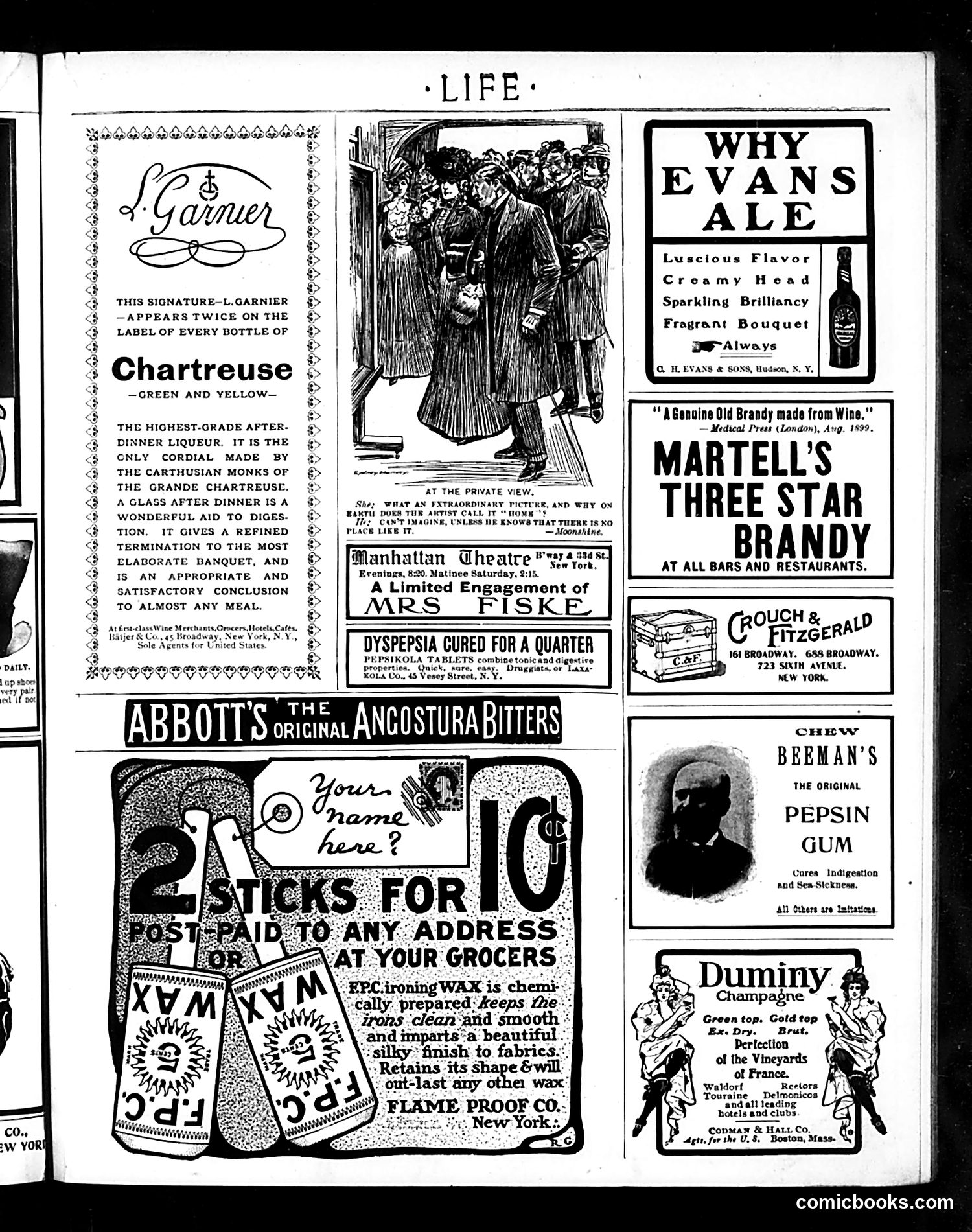
This page is primarily **advertising**, not political satire. It contains multiple product advertisements from the early 1900s, arranged around a small cartoon. The **single cartoon** (center) shows a couple viewing artwork at a private gallery. The woman asks why the artist titled a painting "Home," and the man replies he cannot imagine—"unless he knows that there is no place like it" (a reference to the saying "there's no place like home"). This is gentle domestic humor: the joke suggests homes are idealized in imagination but imperfect in reality. The surrounding ads promote luxury goods typical of the era: Chartreuse liqueur, brandy, champagne, theater tickets, and patent medicines (pepsin gum for indigestion, "dyspepsia cure"). These reflect early 1900s consumer culture and the medical claims common before modern FDA regulation. The page demonstrates how Life magazine monetized its satirical reputation by selling premium advertising space to upscale brands.
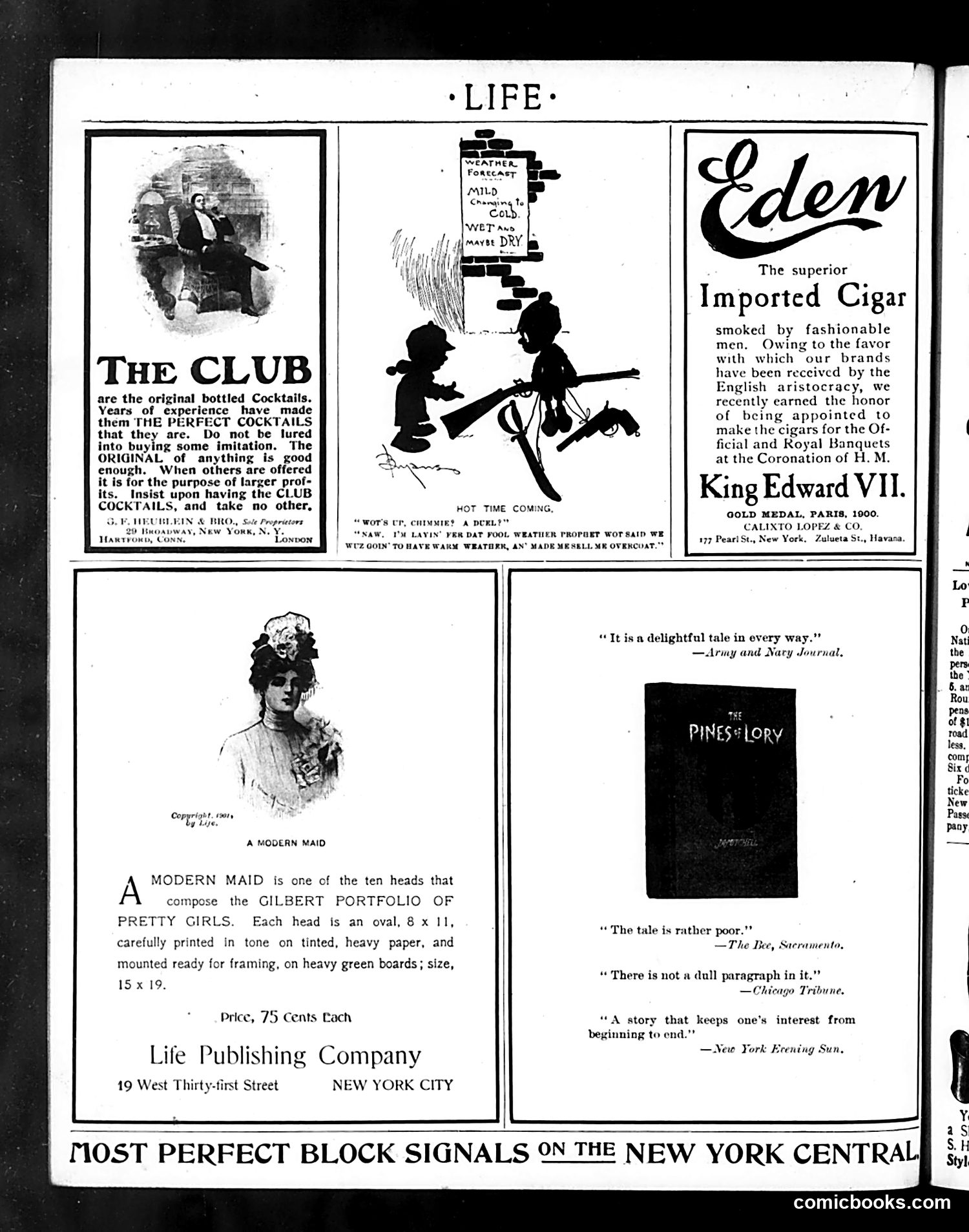
This page is primarily **advertisements and product promotions**, not political satire. The main content includes: **Advertisements:** - Club Cocktails (bottled cocktails claiming superiority over imitations) - Eden cigars (positioning themselves as smoked by English aristocracy, appointed for King Edward VII's coronation banquets) - Gilbert Portfolio of Pretty Girls (art prints of women's portraits) - "The Pines of Lory" (a book with conflicting reviews) **The Cartoon:** The only satirical image shows two figures discussing weather forecasts. One complains the weather prophet predicted warm weather but it remained cold, forcing him to keep wearing his overcoat. This is **everyday social satire** about unreliable weather predictions—a timeless complaint—not political commentary. The page reflects early 1900s consumer culture and advertising practices, with luxury goods marketed to fashionable, upper-class audiences.
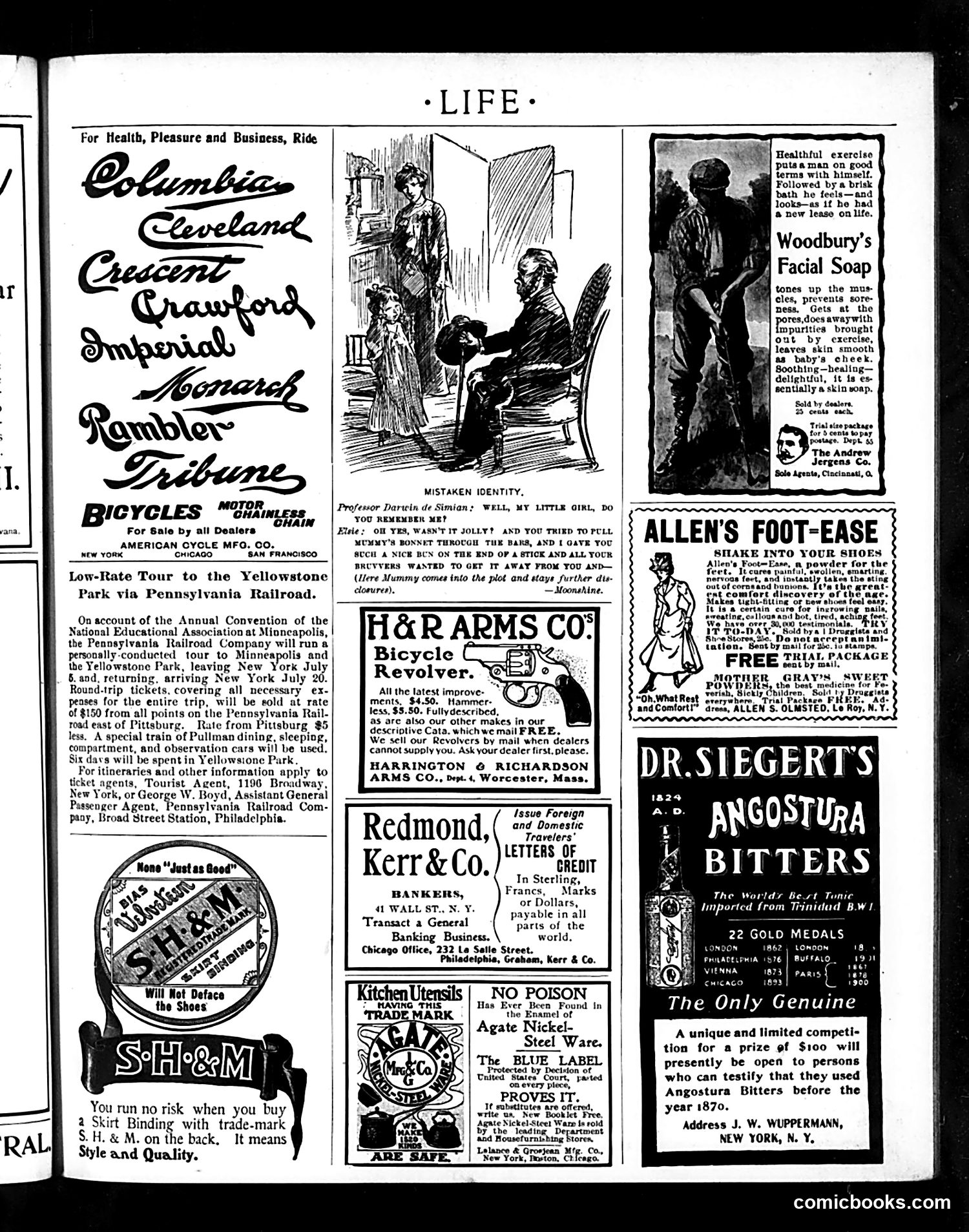
This page is primarily **advertising**, with one cartoon and extensive product ads typical of early 1900s publications. ## The Cartoon: "Mistaken Identity" The single cartoon depicts a confusion between a man and a monkey. **Professor Darwin de Simian** (a pun on Charles Darwin) addresses a young girl, believing her to be someone he knew from a zoo or animal setting. The girl's mother then appears, revealing the absurd mix-up. **The satire:** This is a lighthearted jab at Darwinian evolution theory—specifically, the common public misconception (and anti-evolution argument) that Darwin's theory claimed humans descended directly from apes. The joke plays on this anxiety by literally confusing a child with a monkey's offspring, mocking both the theory's popular misunderstanding and those who rejected it as absurd. ## Advertisements The page features numerous period products: bicycles, railroad tours, soap, firearms, banking services, bitters, and shoe products—representing typical early-1900s consumer goods marketed through satirical magazines.
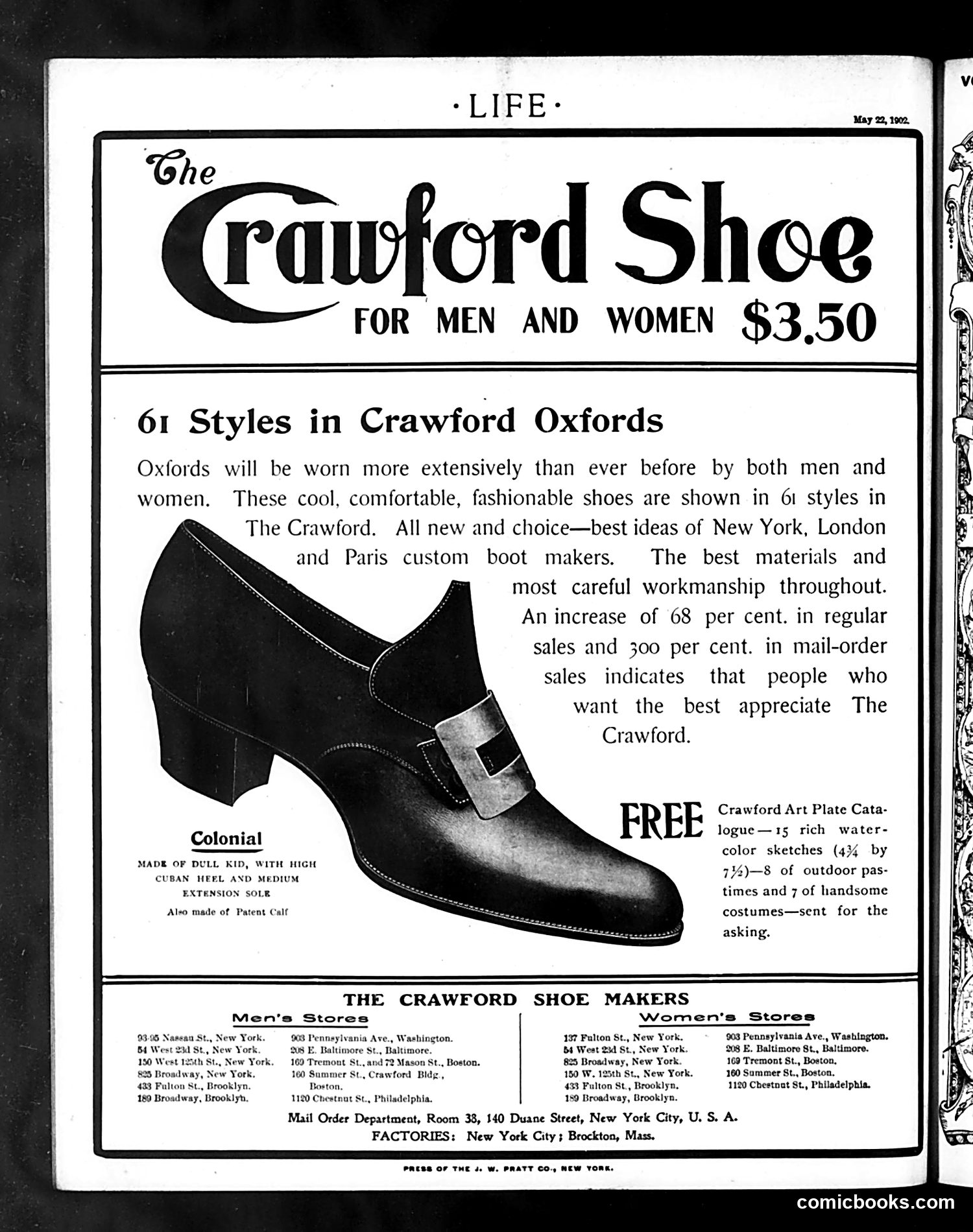
This page is **primarily advertising**, not a political cartoon. It's a full-page advertisement for Crawford Shoes from the May 22, 1902 issue of *Life* magazine. The ad promotes Oxford-style shoes priced at $3.50, available in 61 styles for both men and women. The key selling point is that Oxfords were becoming fashionable for both genders—a notable social shift at the time, as women's footwear was traditionally distinct from men's. The ad emphasizes the shoes' quality, drawing on design inspiration from "New York, London and Paris custom boot makers." The statistics cited (68% increase in regular sales, 300% in mail-order) suggest the product's growing popularity. A free art catalogue with color sketches is offered as an incentive. The only illustrated element is a single shoe example labeled "Colonial," shown with decorative stitching and a buckle detail. This is product photography/illustration, not satire or editorial content.