
Life, 1902-05-22 · page 4 of 22
Life — May 22, 1902 — page 4: what you’re looking at
What you’re looking at
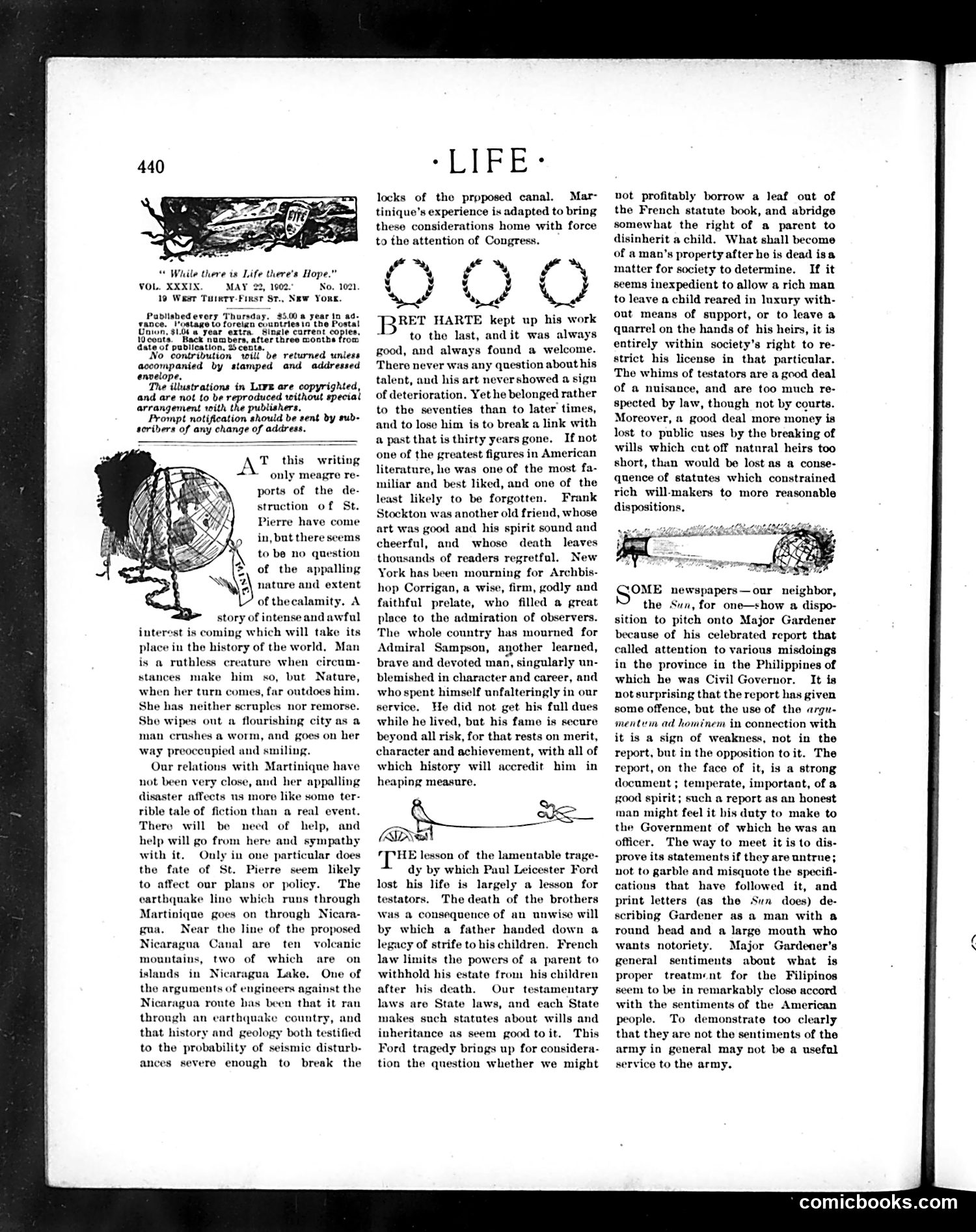
This page contains two editorial illustrations satirizing American political and social issues circa 1902. The left cartoon depicts a globe being crushed or manipulated, likely commenting on American imperialism and the construction of the Nicaragua Canal—a major political controversy of that era involving debates over American expansion and engineering ambitions. The right illustration (unlabeled in visible text) appears to reference the Philippine-American War or colonial administration, based on the editorial's discussion of "Major Gardener" and misgovernance in the Philippines. The text criticizes newspaper reports about colonial officers and questions whether military administration serves national interests. Both pieces reflect Progressive-era concerns about American foreign policy, imperial overreach, and governmental accountability during the Theodore Roosevelt presidency.
📄 Transcribed text from this page (OCR, searchable)
Machine-transcribed from the original scan — historical spelling and the odd misread are preserved.
“* While there is Life there's Hope.” XXXIX. MAY 22, 1902. No, 1021. 19 Wear Tuiety-Finst St.. New Yor. devery Thursday. $5.00 a year tn ad. "stage vo foreign countries ta the Postal Gta year exten, Single current copies, Wocouta. Back numbers, after three wontbe from Gate of publication, 35 cents. ; ‘No contribution will be returned untess accompanied by stamped and addressed envelope, The illustrations in Lure are copyrighted, and are not to be reproduced twithout special arrangement with the publishers, Prompt notification should be vent by sub- scribers of any change of address. AT this writing +X only meagre re- ports of the de- struction of St. Pierre have come in, but there seems to be no question of the appalling nature and extent of thecalamity, A story of intense and awful interest is coming which will take its place in the history of the world. Man is a ruthless creature when circum- stances make him so, but Nature, when her turn comes, far outdoes him. She has neither scruples nor remorse. She wipes out a flourishing city as a man crushes a worm, and goes on her way preoccupied and smiling. Our relations with Martinique have not been very close, and her appalling disaster affects us more like somo ter- rible tale of fiction than a real event. There will be need of help, and help will go from here and sympathy with it. Only in one particular does the fate of St. Pierre seem likely to affect our plans or policy. The earthquake linc which runs through Martinique goes on through Nicara- gua Near the line of the proposed Nicaragua Canal are ten volcanic mountains, two of which are on islands in Nicaragua Lake. One of the arguments of engineers against the Nicaragua route has been that it ran through an earthquake country, and that history and geology both testified to the probability of seismic disturb- ances severe enough to break the “LIFE locks of the prpposed canal, Mar- tinique’s experience is adapted to bring these considerations home with force to the attention of Congress. fx errs H » § Y §£ ww MY A. od RET HARTE kept up his work to the last, and it was always good, and always found a welcome. There never was any question about his talent, and his art never showed a sign of deterioration. Yet he belonged rather to the seventies than to later times, and to lose him is to break a link with a past that is thirty years gone. If not one of the greatest figures in American literature, he was one of the most fa- miliar and best liked, and one of the least likely to be forgotten. Frank Stockton was another old friend, whose art was good and his spirit sound and cheerful, and whose death leaves thousands of readers regretfol. New York has been mourning for Archbis- hop Corrigan, a wise, firm, godly and faithful prelate, who filled a great place to the admiration of observers. The whole country has mourned for Admiral Sampson, another learned, brave and devoted man, singularly un- blemished in character and career, and who spent himself unfalteringly in our service. He did not get his full dues while he lived, but his fame is secure beyond all risk, for that rests on merit, character and achievement, with all of which history will accredit him in heaping measure. ADs ‘THE lesson of the lamentable trage- dy by which Paul Leicester Ford lost his life is largely a lesson for testators. The death of the brothers was a consequence of an unwise will by which a father handed down a legacy of strife to his children. French law limits the powers of a parent to withhold his estate from his children after his death. Our testamentary laws are State laws, and each State makes such statutes about wills and inheritance as seem good toit, This Ford tragedy brings up for considera- tion the question whether we might not profitably borrow a leaf out of the French statute book, and abridge somewhat the right of a parent to disinherit a child. What shall become of a man’s property after he is dead isa matter for society to determine. If it seems inexpedient to allow a rich man to leave a child reared in luxury with- out means of support, or to leave a quarrel on the hands of his heirs, it is entirely within society's right to re- strict his license in that particular. The whims of testators are a good deal of a nuisance, and are too much re- spected by law, though not by courts. Moreover, a good deal more money is lost to public uses by the breaking of wills which cut off natural heirs too short, than would be lost as a conse- quence of statutes which constrained rich will-makers to more reasonable dispositions. GOME newspapers—our neighbor, the Sun, for one—show a dispo- sition to pitch onto Major Gardener because of his celebrated report that called attention to various misdoings in the province in the Philippines of which he was Civil Governor. It is not surprising that the report has given some offence, but the use of the argu- mentuin ad hominem in connection with it is a sign of weakness, not in the report, but in the opposition to it. The report, on the face of it, is a strong document ; temperate, important, of a good spirit; such a report as an honest man might feel it his duty to make to the Government of which he was an officer, The way to meet it is to dis- prove its statements if they are untrue; not to garble and misquote the specifi- cations that have followed it, and print letters (as the Sun does) de- scribing Gardener as a man with a round head and a large mouth who wants notoriety. Major Gardener’s general sentiments about what is proper treatment for the Filipinos seem to be in remarkably close accord with the sentiments of the American people. To demonstrate too clearly that they are not the sentiments of the army in general may not be a usefal service to the army. comicbooks.com poe