
Life, 1902-05-22 · page 15 of 22
Life — May 22, 1902 — page 15: what you’re looking at
What you’re looking at
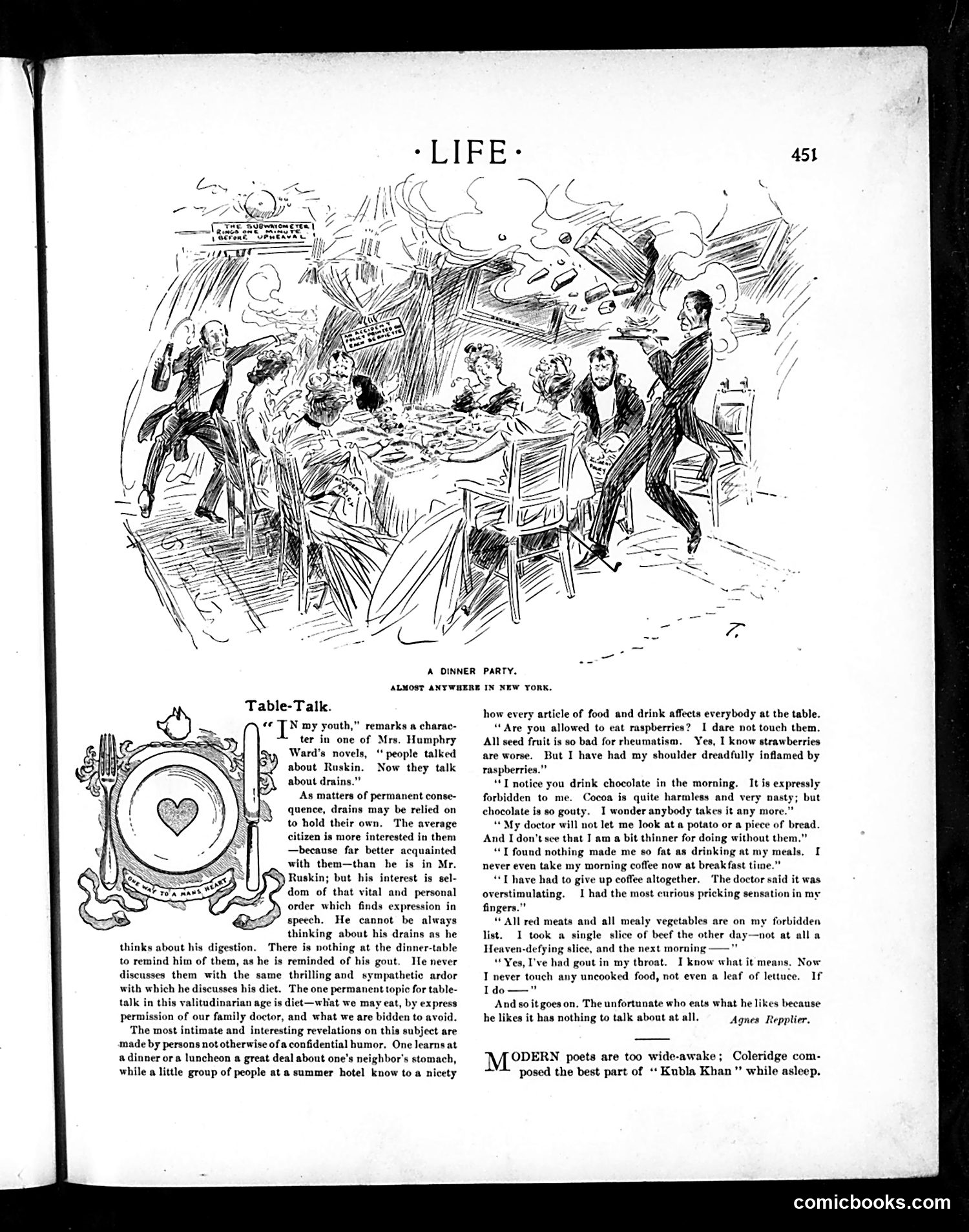
This 1890s Life magazine page satirizes the obsessive dinner-table conversation of wealthy New Yorkers, who have replaced substantive discussion with tedious recitations of dietary restrictions and medical complaints. The cartoon depicts a chaotic dinner party where guests appear animated and engaged—but the accompanying essay by Agnes Repplier reveals they're actually boring everyone with health talk. The satire targets the "valitudinarian age" (era of hypochondriacs): guests compulsively discuss which foods their doctors forbid, comparing ailments like gout, rheumatism, and indigestion. The joke is that people with genuine health restrictions dominate conversation, while those who simply eat what they enjoy have nothing interesting to contribute. Repplier mocks this as shallow pretension disguised as medical necessity—people seeking attention through cataloging their bodily malfunctions. The brief final note about Coleridge appears unrelated, possibly filler. The overall message: modern society has become consumed with self-focused health anxiety at the expense of meaningful discourse.
📄 Transcribed text from this page (OCR, searchable)
Machine-transcribed from the original scan — historical spelling and the odd misread are preserved.
A DINNER PARTY, ALMOST ANYWHERE IN NEW YORK. Table-Talk. ee my youth,” remarks a charac- ter in one of Mrs. Humphry Ward's novels, ‘people talked about Ruskin. Now they talk about drains.” As matters of permanent conse- quence, drains may be relied on to hold their own. The average citizen is more interested in them —because far better acquainted with them—than he is in Mr. Ruskin; but his interest is sel- dom of that vital and personal order which finds expression in speech. He cannot be always thinking about his drains as he thinks about his digestion. There is nothing at the dinner-table to remind him of them, as he is reminded of his gout. Ile never discusses them with the same thrilling and sympathetic ardor with which he discusses his diet. The one permanent topic for table- talk in this valitudinarian age is diet—whiat we may eat, by express permission of our family doctor, and what we are bidden to avoid. The most intimate and interesting revelations on this subject are made by persons not otherwise of a confidential humor. One learns at adinner ora luncheon a great deal about one's neighbor's stomach, while a little group of people at a summer hotel know to a nicety how every article of food and drink affects everybody at the table. “Are you allowed to eat raspberries? I dare not touch them. All seed fruit is so bad for rheumatism. Yes, I know strawberries are worse. But I have had my shoulder dreadfully inflamed by raspberries.” “T notice you drink chocolate in the morning. It is expressly forbidden to me. Cocoa is quite harmless and very nasty; but chocolate is 0 gouty. I wonder anybody takes it any more.” “My doctor will not let me look at a potato or a piece of bread. And I don't sce that I am a bit thinner for doing without them.” “IT found nothing made me so fat as drinking at my meals, [ never even take my morning coffee now at breakfast time.” “T have had to give up coffee altogether. The doctor said it was overstimulating. 1 had the most curious pricking sensation in my fingers.” “All red meats and all mealy vegetables are on my forbidden list. I took a single slice of beef the other day—not at all a Heaven-defying slice, and the next morning —" “Yes, I've had gout in my throat. I know what it means, Now T never touch any uncooked food, not even a leaf of lettuce. If Ido—”" And 80 it goes on. The unfortunate who eats what he likes because he likes it has nothing to talk about at all. Agnes _Repplier. MODERN poets are too wide-awake; Coleridge com- ANA posed the best part of “Kubla Khan" while asleep. comicbooks.com