
Life, 1902-05-22 · page 12 of 22
Life — May 22, 1902 — page 12: what you’re looking at
What you’re looking at
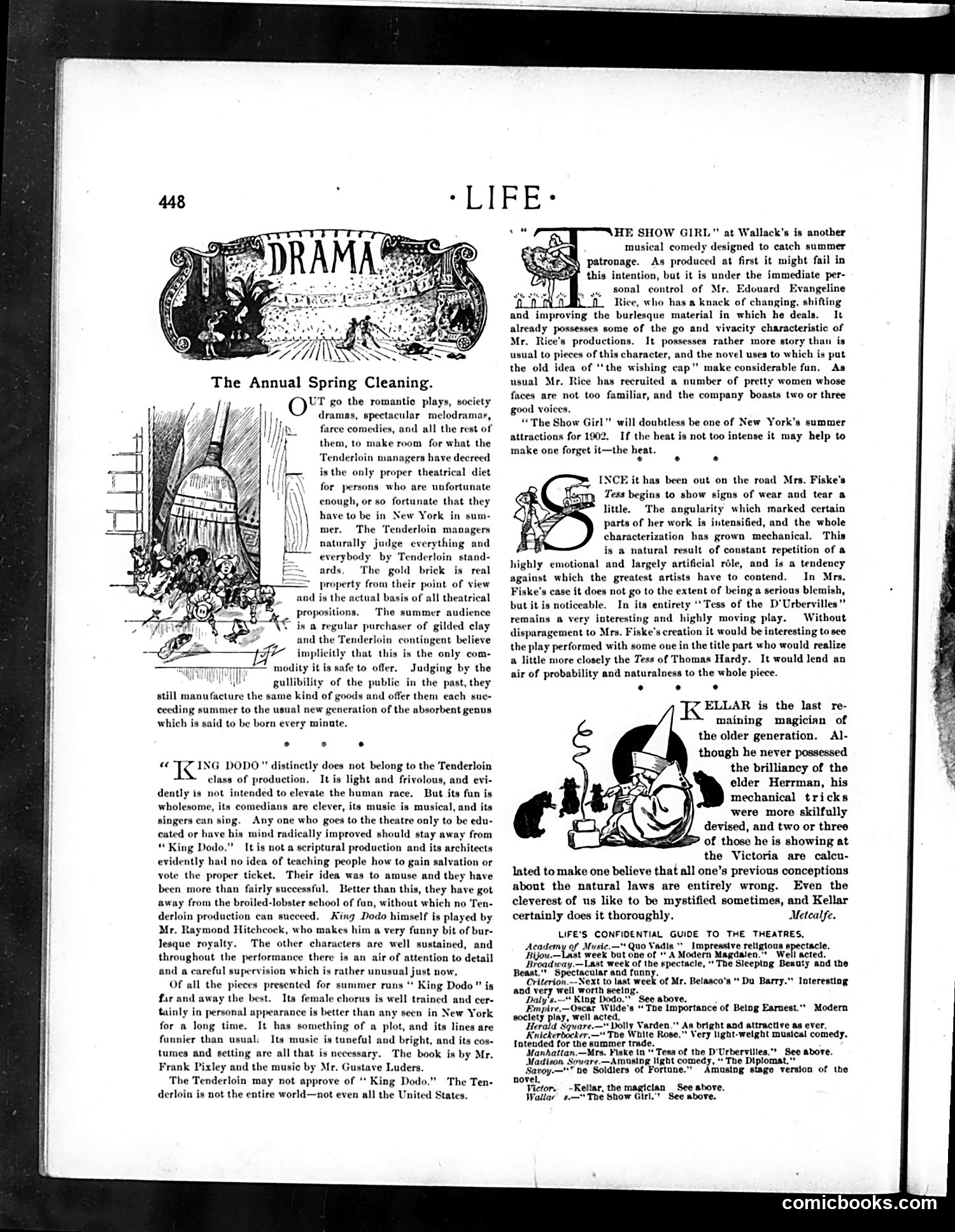
This page discusses theatrical productions for summer 1902. The main cartoon illustrates "The Annual Spring Cleaning"—a satirical commentary on theater management decisions. The text explains that theater managers, facing summer slumps, resort to lighter fare: romantic plays, society dramas, and farces rather than serious works. The cartoon shows a broom and dustpan, visually representing the "cleaning out" of serious theatrical repertoire in favor of commercially safer, crowd-pleasing entertainment. The accompanying articles critique specific productions like "King Dodo" and "The Show Girl," evaluating whether lighter summer comedies represent artistic compromise or appropriate audience service. The satire targets the theater industry's prioritization of profitable entertainment over artistic merit during slow seasons.
📄 Transcribed text from this page (OCR, searchable)
Machine-transcribed from the original scan — historical spelling and the odd misread are preserved.
The Annual Spring Cleaning. O T go the romantic plays, society dramas, spectacular melodramas, farce comedies, and all the rest of them, to make room for what the Tenderloin managers have decreed isthe only proper theatrical diet for persons who are unfortunate enough, or so fortunate that they have to be in New York in sum- mer. The Tenderloin managers naturally judge everything and everybody by Tenderloin stand- ards. The gold brick is real property from their point of view and is the actual basis of all theatrical propositions. The summer audience is a regular purchaser of gilded clay and the Tenderloin contingent believe a, i implicitly that this is the only com- 7 modity it is safe to offer. Judging by the gullibility of the public in the past, they still manufacture the same kind of goods and offer them each sue ceeding summer to the usual new generation of the absorbent genus which is said to be born every minute. ° ° . ING DODO" distinctly does not belong to the Tenderloin class of production. It is light and frivolous, and evi- t intended to elevate the human race, But its fun is comedians are clever, its music is musical, and its singers can sing. Any one who goes to the theatre only to be edu- cated or have his mind radically improved should stay away from “ King Dodo.” It is not a scriptural production and its architects evidently had no idea of teaching people how to gain salvation or vote the proper ticket. Their idea was to amuse and they have been more than fairly successful. Better than this, they have got away from the broiled-lobster school of fun, without which no Ten- derloin production can succeed. King Dodo himself is played by Mr. Raymond Hitchcock, who makes him a very fanny bit of bur- lesque royalty. The other characters are well sustained, and throughout the performance there is an air of attention to detail and a careful supervision which is rather unusual just now, Of all the pieces presented for summer runs “ King Dodo” is far and away the best. Its female chorus is well trained and cer- tainly in personal appearance is better than any seen in New York for a long time. It has something of a plot, and its lines are funnier than usual: Its music is tuneful and bright, and its cos- tumes and setting are all that is necessary. The book is by Mr. Frank Pixley and the music by Mr. Gustave Luders. The Tenderloin may not approve of “King Dodo.” The Ten- derloin is not the entire world—not even all the United States. “T HE SHOW GIRL” at Wallack’s is another musical comedy designed to catch summer SS) patronage. As produced at first it might fail in this intention, but it is under the immediate per- |. 4, Sonal control of Mr. Edouard Evangeline hit’ Rice, who has a knack of changing, shitting and improving the burlesque material in which he deals. It already possesses some of the go and vivacity characteristic of Mr. Rice's productions. It possesses rather more story than is usual to pieces of this character, and the novel uses to which is put the old idea of “the wishing cap" make considerable fan. As usual Mr. Rice has recruited a number of pretty women whose faces are not too familiar, and the company boasts two or three good voices. “ The Show Girl” will doubtless be one of New York's summer attractions for 1902. If the heat is not too intense it may help to make one forget it—the heat. ° . . INCE it has been out on the road Mrs. Fiske’s Garry Tess begins to show signs of wear and tear a * little. The angularity which marked certain parts of her work is intensified, and the whole characterization has grown mechanical. This is a natural result of constant repetition of a highly emotional and largely artificial réle, and is a tendency against which the greatest artists have to contend. In Mrs. Fiske’s case it does not go to the extent of being a serious blemish, but it is noticeable. In its entirety ‘‘Tess of the D*Urbervilles”” remains a very interesting and highly moving play. Without disparagement to Mrs. Fiske's creation it would be interesting to see the play performed with some oue in the title part who would realize a little more closely the Tess of Thomas Hardy. It would lend an air of probability and naturalness to the whole piece. . . . [CELLAR is the last re- ™~ maining magician of ag the older generation. Al- though he never possessed the brilliancy of the elder Herrman, his mechanical tricks were more skilfully devised, and two or three of those he is showing at the Victoria are calcu- lated to make one believe that all one’s previous conceptions about the natural laws are entirely wrong. Even the cleverest of us like to be mystified sometimes, and Kellar certainly does it thoroughly. Metcalfe. LIFE’S CONFIDENTIAL GUIDE TO THE THEATRES. Academy of Music.—* Quo Vadis * Impressive religious spectacle. Bou Laat week but one of * A Modern Magdalen.” Well acted. Broadway —Last week of the spectacle, “The Sleeping Beauty and the it." Spectacular and funny, Criterion.—Next to last week of Mr. Belasco’s “ Du Barry.” Interesting and very well worth seeing. Daly's.— King Dodo." See above. Empire—Oscar Wilde's “The Importance of Being Earnest." Modern soclety play, well acted, Herald Square.—" Dolly Varden. 8 bright and attractive as ever, De White Rose. Knick Very light-weight musical comedy. Intended for the summer trade. Manhattan.—Mrs. Fiske in “Tess of the D'Urbervilles."* See above. Madison Soware.— Amusing light comedy, “ The Diplomat." S ne Soldiers of Fortune.” Amusing stage version of the -Kellar, the magician _ See above. “The Show Girl.” See above. comicbooks.com